435 books match the query 'Asian American & Pacific Islander Studies' and 29 start with s
cover of Sacred Men: Law, Torture, and Retribution in Guam

Sacred Men

Law, Torture, and Retribution in Guam

Keith L. Camacho

Duke University Press, 2019
Between 1944 and 1949 the United States Navy held a war crimes tribunal that tried Japanese nationals and members of Guam's indigenous Chamorro population who had worked for Japan's military government. In Sacred Men Keith L. Camacho traces the tribunal's legacy and its role in shaping contemporary domestic and international laws regarding combatants, jurisdiction, and property. Drawing on Giorgio Agamben's notions of bare life and Chamorro concepts of retribution, Camacho demonstrates how the U.S. tribunal used and justified the imprisonment, torture, murder, and exiling of accused Japanese and Chamorro war criminals in order to institute a new American political order. This U.S. disciplinary logic in Guam, Camacho argues, continues to directly inform the ideology used to justify the Guantánamo Bay detention center, the torture and enhanced interrogation of enemy combatants, and the American carceral state.
[more]
cover of Samurai among Panthers: Richard Aoki on Race, Resistance, and a Paradoxical Life

Samurai among Panthers

Richard Aoki on Race, Resistance, and a Paradoxical Life

Diane C. Fujino

University of Minnesota Press, 2012

An iconic figure of the Asian American movement, Richard Aoki (1938–2009) was also, as the most prominent non-Black member of the Black Panther Party, a key architect of Afro-Asian solidarity in the 1960s and ’70s. His life story exposes the personal side of political activism as it illuminates the history of ethnic nationalism and radical internationalism in America.

A reflection of this interconnection, Samurai among Panthers weaves together two narratives: Aoki’s dramatic first-person chronicle and an interpretive history by a leading scholar of the Asian American movement, Diane C. Fujino. Aoki’s candid account of himself takes us from his early years in Japanese American internment camps to his political education on the streets of Oakland, to his emergence in the Black Panther Party. As his story unfolds, we see how his parents’ separation inside the camps and his father’s illegal activities shaped the development of Aoki’s politics. Fujino situates his life within the context of twentieth-century history—World War II, the Cold War, and the protests of the 1960s. She demonstrates how activism is both an accidental and an intentional endeavor and how a militant activist practice can also promote participatory democracy and social service.

The result of these parallel voices and analysis in Samurai among Panthers is a complex—and sometimes contradictory—portrait of a singularly extraordinary activist and an expansion and deepening of our understanding of the history he lived.

[more]
cover of San Francisco's International Hotel: Mobilizing the Filipino American Community in the Anti-Eviction Movement

San Francisco's International Hotel

Mobilizing the Filipino American Community in the Anti-Eviction Movement

Estella Habal

Temple University Press, 2008
The struggle to save the International Hotel and prevent the eviction of its elderly residents became a focal point in the creation of the contemporary Asian American movement, especially among Filipinos.  Like other minorities who were looking for positive models in their past to build an identity movement, Filipino youth found their "roots" in the stories and lives of the "manongs" (respected elders), and the anti-eviction movement became a key site for the formation of a distinct Filipino American consciousness. Estella Habal, a student activist during the anti-eviction protests, relates this history  within the context of the broader left politics of the era, the urban housing movement, and San Francisco city politics.  Ultimately, the hotel was razed, but a new one now occupies the site and commemorates the residents and activists who fought for low-income housing for the elderly and their right to remain in their own community.
[more]
cover of Saving Face: The Emotional Costs of the Asian Immigrant Family Myth

Saving Face

The Emotional Costs of the Asian Immigrant Family Myth

Angie Y. Chung

Rutgers University Press, 2016
Tiger Mom. Asian patriarchy. Model minority children. Generation gap. The many images used to describe the prototypical Asian family have given rise to two versions of the Asian immigrant family myth. The first celebrates Asian families for upholding the traditional heteronormative ideal of the “normal (white) American family” based on a hard-working male breadwinner and a devoted wife and mother who raises obedient children. The other demonizes Asian families around these very same cultural values by highlighting the dangers of excessive parenting, oppressive hierarchies, and emotionless pragmatism in Asian cultures.
 
Saving Face cuts through these myths, offering a more nuanced portrait of Asian immigrant families in a changing world as recalled by the people who lived them first-hand: the grown children of Chinese and Korean immigrants. Drawing on extensive interviews, sociologist Angie Y. Chung examines how these second-generation children negotiate the complex and conflicted feelings they have toward their family responsibilities and upbringing. Although they know little about their parents’ lives, she reveals how Korean and Chinese Americans assemble fragments of their childhood memories, kinship narratives, and racial myths to make sense of their family experiences. However, Chung also finds that these adaptive strategies come at a considerable social and psychological cost and do less to reconcile the social stresses that minority immigrant families endure today.
 
Saving Face not only gives readers a new appreciation for the often painful generation gap between immigrants and their children, it also reveals the love, empathy, and communication strategies families use to help bridge those rifts. 
 
[more]
cover of Screening Asian Americans

Screening Asian Americans

Feng, Peter X

Rutgers University Press, 2002

This innovative essay collection explores Asian American cinematic representations historically and socially, on and off screen, as they contribute to the definition of American character. The history of Asian Americans on movie screens, as outlined in Peter X Feng’s introduction, provides a context for the individual readings that follow. Asian American cinema is charted in its diversity, ranging across activist, documentary, experimental, and fictional modes, and encompassing a wide range of ethnicities (Filipino, Vietnamese, Indian, Japanese, Korean, Chinese, and Taiwanese). Covered in the discussion are filmmakers—Theresa Hak Kyung Cha, Ang Lee, Trinh T. Minh-ha, and Wayne Wang—and films such as The Wedding Banquet, Surname Viet Given Name Nam, and Chan is Missing.

Throughout the volume, as Feng explains, the term screening has a twofold meaning—referring to the projection of Asian Americans as cinematic bodies and the screening out of elements connected with these images. In this doubling, film representation can function to define what is American and what is foreign. Asian American filmmaking is one of the fastest growing areas of independent and studio production. This volume is key to understanding the vitality of this new cinema.

[more]
cover of Sensational Futures: On Asian Racialization and Speculative Aesthetics

Sensational Futures

On Asian Racialization and Speculative Aesthetics

Frances Tran

Duke University Press, 2027
The racialization of Asian peoples, as both “model minorities” and “the yellow peril,” has been instrumental to envisioning futures that reproduce racial capitalism as well as social and material inequities. In Sensational Futures, Frances Tran takes up this problem of Asian futurity to explore other possible modes of conceptualizing the future. Engaging an eclectic archive of transnational Asian and multiethnic literature, film, and public art, she demonstrates how the speculative multisensory worlds these texts animate recreate futures that have been discarded and delegitimized because they do not conform to liberal humanist and racial capitalist scripts of progress. She reaches beyond the spectacular visualization of Asian futurity captured in contemporary discourses of rising Asia and the Asian Century for practices that can sense futures otherwise. By bringing this temporal and sensory awareness to bear on debates over the future as problems of research, education, sustainability, and mourning, Tran attends to how a sensory, embodied aesthetics can attune us to alternative ways of conceiving and orienting ourselves toward the future.
[more]
cover of Serving Our Country: Japanese American Women in the Military during World War II

Serving Our Country

Japanese American Women in the Military during World War II

Moore, Brenda L

Rutgers University Press, 2003

Following the 1941 attack on Pearl Harbor and America's declaration of war on Japan, the U.S. War Department allowed up to five hundred second-generation, or "Nisei," Japanese American women to enlist in the Women's Army Corps and, in smaller numbers, in the Army Medical Corps.

Through in-depth interviews with surviving Nisei women who served, Brenda L. Moore provides fascinating firsthand accounts of their experiences. Interested primarily in shedding light on the experiences of Nisei women during the war, the author argues for the relevance of these experiences to larger questions of American race relations and views on gender and their intersections, particularly in the country's highly charged wartime atmosphere. Uncovering a page in American history that has been obscured, Moore adds nuance to our understanding of the situation of Japanese Americans during the war.
[more]
cover of Setsuko's Secret: Heart Mountain and the Legacy of the Japanese American Incarceration

Setsuko's Secret

Heart Mountain and the Legacy of the Japanese American Incarceration

Shirley Ann Higuchi

University of Wisconsin Press, 2020

As children, Shirley Ann Higuchi and her brothers knew Heart Mountain only as the place their parents met, imagining it as a great Stardust Ballroom in rural Wyoming. As they grew older, they would come to recognize the name as a source of great sadness and shame for their older family members, part of the generation of Japanese Americans forced into the hastily built concentration camp in the aftermath of Executive Order 9066.
Only after a serious cancer diagnosis did Shirley's mother, Setsuko, share her vision for a museum at the site of the former camp, where she had been donating funds and volunteering in secret for many years. After Setsuko's death, Shirley skeptically accepted an invitation to visit the site, a journey that would forever change her life and introduce her to a part of her mother she never knew.
Navigating the complicated terrain of the Japanese American experience, Shirley patched together Setsuko's story and came to understand the forces and generational trauma that shaped her own life. Moving seamlessly between family and communal history, Setsuko's Secret offers a clear window into the "camp life" that was rarely revealed to the children of the incarcerated. This volume powerfully insists that we reckon with the pain in our collective American past.
[more]
cover of Settler Garrison: Debt Imperialism, Militarism, and Transpacific Imaginaries

Settler Garrison

Debt Imperialism, Militarism, and Transpacific Imaginaries

Jodi Kim

Duke University Press, 2022

In Settler Garrison Jodi Kim theorizes how the United States extends its sovereignty across Asia and the Pacific in the post-World War II era through a militarist settler imperialism that is leveraged on debt as a manifold economic and cultural relation undergirded by asymmetries of power. Kim demonstrates that despite being the largest debtor nation in the world, the United States positions itself as an imperial creditor that imposes financial and affective indebtedness alongside a disciplinary payback temporality even as it evades repayment of its own debts. This debt imperialism is violently reproduced in juridically ambiguous spaces Kim calls the “settler garrison”: a colonial archipelago of distinct yet linked military camptowns, bases, POW camps, and unincorporated territories situated across the Pacific from South Korea to Okinawa to Guam. Kim reveals this process through an analysis of how a wide array of transpacific cultural productions creates antimilitarist and decolonial imaginaries that diagnose US militarist settler imperialism while envisioning alternatives to it.
[more]
cover of Settler Militarism: World War II in Hawai'i and the Making of US Empire

Settler Militarism

World War II in Hawai'i and the Making of US Empire

Juliet Nebolon

Duke University Press, 2024
Under martial law during World War II, Hawaiʻi was located at the intersection of home front and war front. In Settler Militarism, Juliet Nebolon shows how settler colonialism and militarization simultaneously perpetuated, legitimated, and concealed one another in wartime Hawaiʻi for the purposes of empire building in Asia and the Pacific Islands. She demonstrates how settler militarism operated through a regime of racial liberal biopolitics that purported to protect all people in Hawaiʻi, even as it intensified the racial and colonial differentiation of Kanaka Maoli, Asian settlers, and white settlers. Nebolon identifies settler militarism’s inherent contradiction: It depends on life, labor, and land to reproduce itself, yet it avariciously consumes, via violent and extractive projects, those same lives and natural resources that it needs to subsist. From vaccination and blood bank programs to the administration of internment and prisoner-of-war camps, Nebolon reveals how settler militarism and racial liberal biopolitics operated together in the service of capitalism. Collectively, the social reproduction of these regimes created the conditions for the late-twentieth-century expansion of US military empire.
[more]
cover of Seven Contemporary Plays from the Korean Diaspora in the Americas

Seven Contemporary Plays from the Korean Diaspora in the Americas

Esther Kim Lee, ed.

Duke University Press, 2012
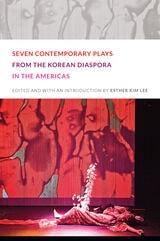
Showcasing the dynamism of contemporary Korean diasporic theater, this anthology features seven plays by second-generation Korean diasporic writers from the United States, Canada, and Chile. By bringing the plays together in this collection, Esther Kim Lee highlights the themes and styles that have enlivened Korean diasporic theater in the Americas since the 1990s. Some of the plays are set in urban Koreatowns. One takes place in the middle of Texas, while another unfolds entirely in a character's mind. Ethnic identity is not as central as it was in the work of previous generations of Asian diasporic playwrights. In these plays, experiences of diaspora and displacement are likely to be part of broader stories, such as the difficulties faced by a young mother trying to balance family and career. Running through these stories are themes of assimilation, authenticity, family, memory, trauma, and gender-related expectations of success. Lee's introduction includes a brief history of the Korean Peninsula in the twentieth century and of South Korean immigration to the Americas, along with an overview of Asian American theater and the place of Korean American theater within it. Each play is preceded by a brief biography of the playwright and a summary of the play's production history.
[more]
cover of Seventeen Syllables and Other Stories

Seventeen Syllables and Other Stories

Yamamoto, Hisaye

Rutgers University Press, 2001

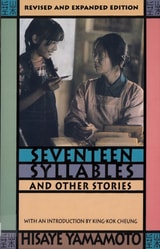
Seventeen Syllables and Other Stories brings together nineteen stories that span Hisaye Yamamoto's forty-year career. It was her first book to be published in the United States. Yamamoto's themes include the cultural conflicts between the first generation, the Issei, and their children, the Nisei; coping with prejudice; and the World War II internment of Japanese Americans.

In addition to the contents of the original volume, this edition brings back into print the following works:
- Death Rides the Rails to Poston
- Eucalyptus
- A Fire in Fontana
- Florentine Gardens
[more]
cover of Shadow Traces: Seeing Japanese/American and Ainu Women in Photographic Archives

Shadow Traces

Seeing Japanese/American and Ainu Women in Photographic Archives

Elena Tajima Creef

University of Illinois Press, 2022

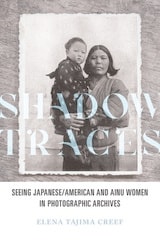
Images of Japanese and Japanese American women can teach us what it meant to be visible at specific moments in history. Elena Tajima Creef employs an Asian American feminist vantage point to examine ways of looking at indigenous Japanese Ainu women taking part in the 1904 Louisiana Purchase Exposition; Japanese immigrant picture brides of the early twentieth century; interned Nisei women in World War II camps; and Japanese war brides who immigrated to the United States in the 1950s. Creef illustrates how an against-the-grain viewing of these images and other archival materials offers textual traces that invite us to reconsider the visual history of these women and other distinct historical groups. As she shows, using an archival collection’s range as a lens and frame helps us discover new intersections between race, class, gender, history, and photography.

Innovative and engaging, Shadow Traces illuminates how photographs shape the history of marginalized people and outlines a method for using such materials in interdisciplinary research.
[more]
cover of Smuggled Chinese

Smuggled Chinese

Ko-Lin Chin

Temple University Press, 1999

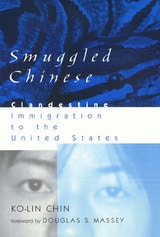
No one knows how many Chinese are being smuggled into the United States, but credible estimates put the number at 50,000 arrivals each year. Astonishing as this figure is, it represents only a portion of the Chinese illegally residing in the United States. Smuggled Chinese presents a detailed account of how this traffic is conducted and what happens to the people who risk their lives to reach Gold Mountain.

When the Golden Venture ran aground off New York's coast in 1993 and ten of the 260 Chinese on board drowned, the public outcry about human smuggling became front-page news. Probing into the causes and consequences of this clandestine traffic, Ko-lin Chin has interviewed more than 300 people -- smugglers, immigrants, government officials, and  business owners -- in the United States, China, and Taiwan. Their poignant and chilling testimony describes a flourishing industry in which smugglers -- big and little snakeheads -- command fees as high as $30,000 to move desperate but hopeful men and women around the world. For many who survive the hunger, filthy and  crowded conditions, physical and sexual abuse, and other perils of the arduous journey, life in the United States, specifically in New York's Chinatown, is a disappointment if not a curse. Few will return to China, though, because their families depend on the money and status gained by having a relative in the States.

In Smuggled Chinese, Ko-lin Chin puts a human face on this intractable international problem, showing how flaws in national policies and lax law enforcement perpetuate the cycle of desperation and suffering. He strongly believes, however, that the problem of human smuggling will continue as long as China's citizens are deprived of fundamental human rights and economic security.

Smuggled Chinese will engage readers interested in human rights, Asian and Asian American studies, urban studies, and sociology.
[more]
cover of Songs of the Caged, Songs of the Free: Music and the Vietnamese Refugee Experience

Songs of the Caged, Songs of the Free

Music and the Vietnamese Refugee Experience

Adelaida Reyes

Temple University Press, 1999

Sad songs and love songs. For Vietnamese refugees who fled Vietnam after the 1975 takeover by the Viet Cong, the predominant music of choice falls into these two general categories rather than any particular musical genre. In fact, Adelaida Reyes discovers, music that exiles call "Vietnamese music" -- that is, music sung in Vietnamese and almost exclusively written before 1975 -- includes such varied influences as Western rock, French-derived valse, Latin chacha, tango, bolero, an d paso doble.

The Vietnamese refugee experience calls attention to issues commonly raised by migration: the redefinition of group relations, the reformulation of identity, and the reconstruction of social and musical life in resettlement. Fifteen years ago, Adelaida Reyes began doing fieldwork on the musical activities of Vietnamese refugees. She entered the emotion-driven world of forced migrants through expressive culture; learned to see the lives of refugee-resettlers through the music they made and enjoyed; and, in turn, gained a deeper understanding of their music through knowledge of their lives.

In Songs of the Caged, Songs of the Free, Reyes brings history, politics, and decades of research to her study of four resettlement communities, including refugee centers in Palawan and Bataan; the early refugee community in New Jersey; and the largest of all Vietnamese communities -- Little Saigon, in southern California's Orange County.

Looking closely at diasporic Vietnamese in each location, Reyes demonstrates that expressive culture provides a valuable window into the refugee experience. Showing that Vietnamese immigrants deal with more than simply a new country and culture in these communities, Reyes considers such issues as ethnicity, socio-economic class, and differing generations. She considers in her study music of all kinds -- performed and recorded, public and private -- and looks at music as listened to and performed by all age groups, including church music, club music, and music used in cultural festivals. Moving from traditional folk music to elite and modern music and from the recording industry to pirated tapes. Reyes looks at how Vietnamese in exile struggled, in different ways, to hold onto a part of their home culture and to assimilate into their  new, most frequently American, culture.

Songs of the Caged, Songs of the Free will attract the attention of readers in Asian American studies, Asian studies, music, and ethnomusicology.
[more]
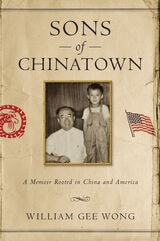
cover of Sons of Chinatown: A Memoir Rooted in China and America

Sons of Chinatown

A Memoir Rooted in China and America

William Gee Wong

Temple University Press, 2024

William Gee Wong was born in Oakland, California’s Chinatown in 1941, the only son of his father, known as Pop. Pop was born in Guangdong Province, China and emigrated to Oakland as a teenager during the Chinese Exclusion era in 1912. He entered the U.S. legally as the “son of a native,” despite having partially false papers. Sons of Chinatown is Wong’s evocative dual memoir of his and his father’s parallel experiences in America.

As Pop grappled with the systemic racism towards Asians during the exclusion era, Wong wistfully depicts Pop’s efforts to establish a family business and build a life for his family in segregated Oakland. As the exclusion law ended in 1943, young William was assimilating into American life and developing his path as a journalist. Writing for the Wall Street Journal, Oakland Tribune, and Asian American periodicals, Wong chronicled Asian American experiences while honoring Chinese American history and identity, but he too faced discrimination.

Sons of Chinatown poignantly weaves these father and son stories together with admiration and righteous anger. Through the mirrored lens of his father, Wong reflects on the hardships Asian Americans endured—and continue to face—with American exceptionalism. Wong’s inspiring memoir provides a personal history that also raises the question of whether America welcomes or repels immigrants.
[more]
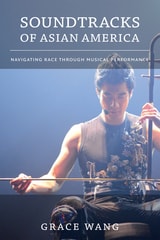
cover of Soundtracks of Asian America: Navigating Race through Musical Performance

Soundtracks of Asian America

Navigating Race through Musical Performance

Grace Wang

Duke University Press, 2015

In Soundtracks of Asian America, Grace Wang explores how Asian Americans use music to construct narratives of self, race, class, and belonging in national and transnational spaces. She highlights how they navigate racialization in different genres by considering the experiences of Asians and Asian Americans in Western classical music, U.S. popular music, and Mandopop (Mandarin-language popular music). Her study encompasses the perceptions and motivations of middle-class Chinese and Korean immigrant parents intensely involved in their children's classical music training, and of Asian and Asian American classical musicians whose prominence in their chosen profession is celebrated by some and undermined by others. Wang interviews young Asian American singer-songwriters who use YouTube to contest the limitations of a racialized U.S. media landscape, and she investigates the transnational modes of belonging forged by Asian American pop stars pursuing recording contracts and fame in East Asia. Foregrounding musical spaces where Asian Americans are particularly visible, Wang examines how race matters and operates in the practices and institutions of music making.
[more]
cover of Southeast Asian/American Studies, Volume 20

Southeast Asian/American Studies, Volume 20

Mimi Thi Nguyen

Duke University Press, 0

This special issue claims Southeast Asian/American studies as a unique site for scholarly engagements with US empire and its professions of liberal humanism as well as its practices of neoliberal violence. Dissolving the disciplinary distinctions between Southeast Asia area studies and Asian American studies, the authors construct transnational analytic methods to examine new assemblages of nations and states, refugees and residents, migrations and returns.

The contributors represent a new generation of scholars, some of whom are themselves migrants and refugees, who seek to reinvent the study of displaced populations and their diasporas. One essay considers the historical production of the refugee soldier during the “secret wars” of Laos. An ethnography of Southeast Asian American youth protests post-9/11 reveals how neoliberal rationalization of “personal responsibility” created a context for both deportation and the youth movement against it. Several contributions explore concepts of exile, belonging, and the nation-state via media representations of masculinity and the erotic, including the Hmong actors who appear in Clint Eastwood’s film Gran Torino, campy pan-Asian boy bands, and Vietnam Idol, a reality show that, like its British and American counterparts, illustrates specific cultural imagination and national ambitions.

Fiona I. B. Ngô and Mimi Thi Nguyen are both assistant professors of gender and women’s studies and Asian American studies at the University of Illinois, Urbana-Champaign. Nguyen is the author of The Gift of Freedom: War, Debt, and Other Refugee Passages and a co-editor of Alien Encounters: Popular Culture in Asian America, both also published by Duke University Press.

Contributors: Diem-My T. Bui, Long Bui, Thang Dao, Ly Chong Thong Jalao, Soo Ah Kwon, Mariam B. Lam, Viet Le, Fiona I.B. Ngô, Mimi Thi Nguyen, Viet Thanh Nguyen,
Louisa Schein, Cathy J. Schlund-Vials, Va-Megn Thoj, Khatharya Um, Julie Thi Underhill, Bee Vang, Ma Vang
[more]
cover of Southwest Asia: The Transpacific Geographies of Chicana/o Literature

Southwest Asia

The Transpacific Geographies of Chicana/o Literature

Jayson Gonzales Sae-Saue

Rutgers University Press, 2016
Chicana/o literature is justly acclaimed for the ways it voices opposition to the dominant Anglo culture, speaking for communities ignored by mainstream American media. Yet the world depicted in these texts is not solely inhabited by Anglos and Chicanos; as this groundbreaking new book shows, Asian characters are cast in peripheral but nonetheless pivotal roles.  
 
Southwest Asia investigates why key Chicana/o writers, including Américo Paredes, Rolando Hinojosa, Oscar Acosta, Miguel Méndez, and Virginia Grise, from the 1950s to the present day, have persistently referenced Asian people and places in the course of articulating their political ideas. Jayson Gonzales Sae-Saue takes our conception of Chicana/o literature as a transnational movement in a new direction, showing that it is not only interested in North-South migrations within the Americas, but is also deeply engaged with East-West interactions across the Pacific.  He also raises serious concerns about how these texts invariably marginalize their Asian characters, suggesting that darker legacies of imperialism and exclusion might lurk beneath their utopian visions of a Chicana/o nation. 
 
Southwest Asia provides a fresh take on the Chicana/o literary canon, analyzing how these writers have depicted everything from interracial romances to the wars Americans fought in Japan, Korea, and Vietnam.  As it examines novels, plays, poems, and short stories, the book makes a compelling case that Chicana/o writers have long been at the forefront of theorizing U.S.–Asian relations. 
 
[more]
cover of Spoiled: Asian American Hostility and the Damage of Repair

Spoiled

Asian American Hostility and the Damage of Repair

Summer Kim Lee

Duke University Press, 2025
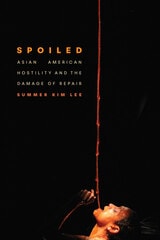
In Spoiled, Summer Kim Lee examines how contemporary Asian American artists challenge expectations that their work should repair the wounds of racial trauma. Kim Lee turns to the “spoiled”—the racialized, gendered body and all that it consumes, wrecks, and inflicts in its desire and excess—in visual culture, performance, music, and literature. Reading works by Cato Ouyang, Patty Chang, Wu Tsang, TJ Shin, Jes Fan, and others, Kim Lee highlights moments of hostility and deformation that spoil idealizations of Asian Americanness and incite modes of feeling and relating that relinquish fantasies of wholeness, power, and control. She observes the latent aggressive behaviors and negative affects in Asian American aesthetic practice: the embarrassment of asociality, the imposition of speaking as someone else, and the indulgence of ravenous appetites. In so doing, Kim Lee questions the political desires for repair expressed in “feeling Asian” and stays with the damage that spoilage creates as integral to the kinds of repair that Asian Americans seek.
[more]
cover of States Of Exception: Everyday Life and Postcolonial Identity

States Of Exception

Everyday Life and Postcolonial Identity

Keya Ganguly

University of Minnesota Press, 2001

Explores the conflict between capitalism and tradition in an immigrant community.

A philosophical anthropology of everyday experience, this book is also a deeply informed and thought-provoking reflection on the work of cultural critique. States of Exception looks into a community of immigrants from India living in southern New Jersey—a group to whom the author, as a daughter of two of its members, enjoyed unprecedented access.

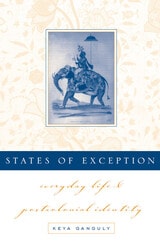
Her position allows Keya Ganguly to approach the culture of a middle-class group (albeit one that is marginalized by racial prejudice), while the group’s relatively comfortable and protected style of life offers unusual insight into the concept of the everyday and the sense in which a seemingly commonplace existence can be understood as in crisis: a state of exception. Thus, Ganguly draws on the work of the Frankfurt School, particularly Walter Benjamin and Theodor Adorno, to explore the possibilities of a dialectical critique of the everyday—a state of exception informing ordinary yet crisis-ridden narratives of the self under late capitalism.
[more]
cover of Straight A's: Asian American College Students in Their Own Words

Straight A's

Asian American College Students in Their Own Words

Christine R. Yano and Neal K. Adolph Akatsuka, editors

Duke University Press, 2018
The American Dream of success for many Asian Americans includes the highest levels of education. But what does it mean to live that success? In Straight A’s Asian American students at Harvard reflect on their common experiences with discrimination, immigrant communities, their relationships to their Asian heritage, and their place in the university. They also explore the difficulties of living up to family expectations and the real-world effects of the "model minority" stereotype. While many of the issues they face are familiar to a wide swath of college students, their examinations of race, ethnicity, gender and sexuality, and culture directly speak to the Asian American experience in U.S. higher education. Unique and revealing, intimate and unreserved, Straight A’s furthers the conversation about immigrant histories, racial and ethnic stereotypes, and multiculturalism in contemporary American society.
[more]
cover of Street Nihonga: The Art of Jimmy Tsutomu Mirikitani

Street Nihonga

The Art of Jimmy Tsutomu Mirikitani

Maki Kaneko

Amsterdam University Press, 2026

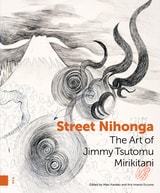
Street Nihonga: The Art of Jimmy Tsutomu Mirikitani is the most comprehensive publication to date of Jimmy Tsutomu Mirikitani (1920–2012), a Japanese American artist raised in Hiroshima, Japan. From Nihonga (“Japanese-style”) paintings to intricate collage works crafted on the streets of New York, Mirikitani’s art narrates a life shaped by war, displacement, survival, and collaboration. Drawing from the formal traditions of Japanese painting and the raw immediacy of urban materials, his poignant oeuvre offers a critical narrative of twentieth-century transpacific history and unexpected modes of transnational artistic exchange.
This volume features 163 color illustrations alongside scholarly essays and reflections that frame Mirikitani’s practice as both artistic achievement and political intervention. Maki Kaneko’s introduction situates the exhibition within the artist’s distinctive “street Nihonga” aesthetic—a collaged form of artmaking, storytelling, and community collaboration. Contributors Noriko Murai, Scott Tsuchitani, Yukinori Okamura, and Kris Ercums offer wide-ranging perspectives, including the transnational legacy of Nihonga, the memory politics of Japanese American incarceration, the evolving lineage of “A-bomb art,” and the curatorial process behind the exhibition. Linda Hattendorf and Masa Yoshikawa, Mirikitani’s close friends and documentarians, provide intimate insights into his life and art.
At once scholarly and inviting, Street Nihonga encourages readers to encounter Mirikitani not as an artist of the margins but as a radical reinterpreter of convention and a witness to histories often left untold. This catalogue remains open-ended—a living collage and a call to engage with Mirikitani’s extraordinary life and work.
[more]
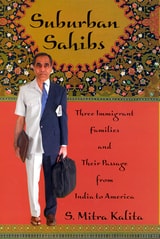
cover of Suburban Sahibs

Suburban Sahibs

Kalita, S. Mitra

Rutgers University Press, 2003

From movie theaters showing the songs and gyrations of “Bollywood” to valedictorians named Patel and Shah, signs are everywhere that Middlesex County, New Jersey is home to one of the largest Indian populations in the world outside India. By tracing the migration of three families, this book delves into how immigration has altered the American suburb, and how the suburb, in turn, has altered the immigrant.               

In this updated edition, journalist S. Mitra Kalita shows that although the reception from long-time residents has not been entirely welcoming, Indians have come to achieve economic success and their desire for political and social parity continues to grow stronger. She traces the evolution of the suburb from a destination for new arrivals to a launching pad for them.               

In the late nineteenth century, tourists descended upon Edison to gawk at its Christmas lights displays. Today, thousands of Indians from all over the United States arrive in the same bedroom community to celebrate their own festivals of lights and colors. Suburban Sahibs attempts to answer the question of how and why they arrived, and offers a window into what America has become: a nation of suburbs as well as a nation of immigrants.
[more]
cover of Success Won't Save Us: How Asian Americans Can Fight White Supremacy

Success Won't Save Us

How Asian Americans Can Fight White Supremacy

Pawan Dhingra

Duke University Press, 2027
Success Won’t Save Us considers the dual reality that Asian Americans must contend with in the United States: They are both celebrated for their achievements and subjected to racialized violence. They face obstacles as minorities but also have held prominent positions within a federal administration accused of spreading white nationalism. For Pawan Dhingra, these two narratives are intimately and necessarily linked. The conditions that produce xenophobic attacks against Asian Americans also facilitate their upward mobility and social prestige. Dhingra argues that the Asian American experience must be understood within a system of white supremacy and racial capitalism. Instead of simply fighting anti-Asian racism, he advocates for rethinking and reconstructing the institutions that educate about race, such as schools and museums. Dhingra also offers practical methods and approaches for transforming education, politics, and the economy to fight against racism.
[more]
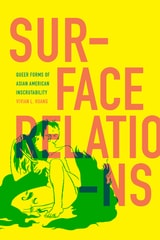
cover of Surface Relations: Queer Forms of Asian American Inscrutability

Surface Relations

Queer Forms of Asian American Inscrutability

Vivian L. Huang

Duke University Press, 2022
In Surface Relations Vivian L. Huang traces how Asian and Asian American artists have strategically reworked the pernicious stereotype of inscrutability as a dynamic antiracist, feminist, and queer form of resistance. Following inscrutability in literature, visual culture, and performance art since 1965, Huang articulates how Asian American artists take up the aesthetics of Asian inscrutability—such as invisibility, silence, unreliability, flatness, and withholding—to express Asian American life. Through analyses of diverse works by performance artists (Tehching Hsieh, Baseera Khan, Emma Sulkowicz, Tseng Kwong Chi), writers (Kim Fu, Kai Cheng Thom, Monique Truong), and video, multimedia, and conceptual artists (Laurel Nakadate, Yoko Ono, Mika Tajima), Huang challenges neoliberal narratives of assimilation that erase Asianness. By using sound, touch, and affect, these artists and writers create new frameworks for affirming Asianness as a source of political and social critique and innovative forms of life and creativity.
[more]
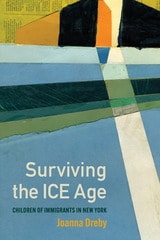
cover of Surviving the ICE Age: Children of Immigrants in New York

Surviving the ICE Age

Children of Immigrants in New York

Joanna Dreby

Russell Sage Foundation, 2025

For the past three decades, U.S. immigration policy has become increasingly restrictive, focused on enforcement both at the southern border and across the country. A shift in emphasis from status regularization to criminalization has had rippling effects for families and communities. While we know much about how immigration enforcement impacts the undocumented, we know less about longstanding effects on U.S. citizens. In Surviving the ICE Age, sociologist Joanna Dreby draws on interviews with young adults with foreign-born parents to better understand what it was like to grow up during a time of heightened U.S. migratory control. 
 
Dreby shows that a restrictive approach to immigration creates problems over time and across generations. These issues occur regardless of one’s citizenship status and go beyond deportations. Despite having pride in their heritage, her interviewees did not talk much about immigration. She refers to this unwillingness—and at times, inability—to speak about immigration as silencing. Silencing in a community or family is often intended to protect children, but this can leave them with little information about their backgrounds and status, leading to fear and anxiety instead. Self-silencing often resulted from traumatic experiences tied to enforcement episodes, which sometimes took the form of memory loss or emotional withholding. Dreby finds that experiences with the immigration system that disrupted relationships in a child’s household arising from family separations, moves, or changing roles in the family had especially long-term effects, causing, at times, ongoing mental health issues. Even the risk of immigration involvement left some young adults feeling vulnerable and undermined their sense of safety and security as U.S. citizens.
 
Dreby also highlights stories that offer hope. Young adults developed strategies to persevere, and children who grew up in communities and families that openly talked about migration felt empowered and fared much better, especially when they had access to resources, such as adequate food and shelter, mental health services, and community support. Dreby calls for policies and practices to mitigate the harms of restrictive migratory control on children’s wellbeing, such avoiding the arrest of parents in front of children and ensuring that U.S. citizen children’s interests are considered in immigration court without their direct involvement.
 
Surviving the ICE Age details the generational harms caused by U.S. immigration policy and offers suggestions for a better way forward.
 
[more]
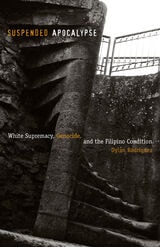
cover of Suspended Apocalypse: White Supremacy, Genocide, and the Filipino Condition

Suspended Apocalypse

White Supremacy, Genocide, and the Filipino Condition

Dylan Rodríguez

University of Minnesota Press, 2009

Suspended Apocalypse is a rich and provocative meditation on the emergence of the Filipino American as a subject of history. Culling from historical, popular, and ethnographic archives, Dylan Rodríguez provides a sophisticated analysis of the Filipino presence in the American imaginary. Radically critiquing current conceptions of Filipino American identity, community, and history, he puts forth a genealogy of Filipino genocide, rooted in the early twentieth-century military, political, and cultural subjugation of the Philippines by the United States.

Suspended Apocalypse critically addresses what Rodríguez calls "Filipino American communion," interrogating redemptive and romantic notions of Filipino migration and settlement in the United States in relation to larger histories of race, colonial conquest, and white supremacy. Contemporary popular and scholarly discussions of the Filipino American are, he asserts, inseparable from their origins in the violent racist regimes of the United States and its historical successor, liberal multiculturalism.

Rodríguez deftly contrasts the colonization of the Philippines with present-day disasters such as Hurricane Katrina and Mount Pinatubo to show how the global subjection of Philippine, black, and indigenous peoples create a linked history of genocide. But in these juxtapositions, Rodríguez finds moments and spaces of radical opportunity. Engaging the violence and disruption of the Filipino condition sets the stage, he argues, for the possibility of a transformation of the political lens through which contemporary empire might be analyzed, understood, and perhaps even overcome.
[more]
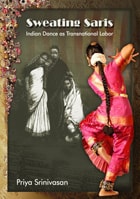
cover of Sweating Saris: Indian Dance as Transnational Labor

Sweating Saris

Indian Dance as Transnational Labor

Priya Srinivasan

Temple University Press, 2011

A groundbreaking book that seeks to understand dance as labor, Sweating Saris examines dancers not just as aesthetic bodies but as transnational migrant workers and wage earners who negotiate citizenship and gender issues. 
           
Srinivasan merges ethnography, history, critical race theory, performance and post-colonial studies among other disciplines to investigate the embodied experience of Indian dance. The dancers’ sweat stained and soaked saris, the aching limbs are emblematic of global circulations of labor, bodies, capital, and industrial goods.  Thus the sweating sari of the dancer stands in for her unrecognized labor.
         
Srinivasan shifts away from the usual emphasis on Indian women dancers as culture bearers of the Indian nation. She asks us to reframe the movements of late nineteenth century transnational Nautch Indian dancers to the foremother of modern dance Ruth St. Denis in the early twentieth century to contemporary teenage dancers in Southern California, proposing a transformative theory of dance, gendered-labor, and citizenship that is far-reaching.


[more]