Results by title
81 books match the query 'Belonging' and 4 start with s

Signing and Belonging in Nepal
Erika Hoffmann-Dilloway
Gallaudet University Press, 2016
While many deaf organizations around the world have adopted an ethno-linguistic framing of deafness, the meanings and consequences of this perspective vary across cultural contexts, and relatively little scholarship exists that explores this framework from an anthropological perspective.
In this book, Erika Hoffmann-Dilloway presents an accessible examination of deafness in Nepal. As a linguistic anthropologist, she describes the emergence of Nepali Sign Language and deaf sociality in the social and historical context of Nepal during the last decades before the Hindu Kingdom became a secular republic. She then shows how the adoption of an ethno-linguistic model interacted with the ritual pollution model, or the prior notion that deafness results from bad karma. Her focus is on the impact of these competing and co-existing understandings of deafness on three groups: signers who adopted deafness as an ethnic identity, homesigners whose ability to adopt that identity is hindered by their difficulties in acquiring Nepali Sign Language, and hearing Nepalis who interact with Deaf signers. Comparing these contexts demonstrates that both the ethno-linguistic model and the ritual pollution model, its seeming foil, draw on the same basic premise: that both persons and larger social formations are mutually constituted through interaction. Signing and Belonging in Nepal is an ethnography that studies a rich and unique Deaf culture while also contributing to larger discussions about social reproduction and social change.
In this book, Erika Hoffmann-Dilloway presents an accessible examination of deafness in Nepal. As a linguistic anthropologist, she describes the emergence of Nepali Sign Language and deaf sociality in the social and historical context of Nepal during the last decades before the Hindu Kingdom became a secular republic. She then shows how the adoption of an ethno-linguistic model interacted with the ritual pollution model, or the prior notion that deafness results from bad karma. Her focus is on the impact of these competing and co-existing understandings of deafness on three groups: signers who adopted deafness as an ethnic identity, homesigners whose ability to adopt that identity is hindered by their difficulties in acquiring Nepali Sign Language, and hearing Nepalis who interact with Deaf signers. Comparing these contexts demonstrates that both the ethno-linguistic model and the ritual pollution model, its seeming foil, draw on the same basic premise: that both persons and larger social formations are mutually constituted through interaction. Signing and Belonging in Nepal is an ethnography that studies a rich and unique Deaf culture while also contributing to larger discussions about social reproduction and social change.
[more]
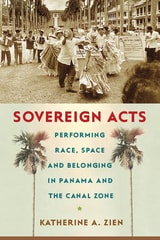
Sovereign Acts
Performing Race, Space, and Belonging in Panama and the Canal ZoneZien, Katherine A.
Rutgers University Press, 2017
Winner of the 2018 Gordon K. and Sybil Farrell Lewis Book Prize from the Caribbean Studies Association
Winner of the 2017 Annual Book Prize from the Canadian Association of Latin American and Caribbean Studies (CALACS)
Sovereign Acts explores how artists, activists, and audiences performed and interpreted sovereignty struggles in the Panama Canal Zone, from the Canal Zone’s inception in 1903 to its dissolution in 1999. In popular entertainments and patriotic pageants, opera concerts and national theatre, white U.S. citizens, West Indian laborers, and Panamanian artists and activists used performance as a way to assert their right to the Canal Zone and challenge the Zone’s sovereignty, laying claim to the Zone’s physical space and imagined terrain.
By demonstrating the place of performance in the U.S. Empire’s legal landscape, Katherine A. Zien transforms our understanding of U.S. imperialism and its aftermath in the Panama Canal Zone and the larger U.S.-Caribbean world.
[more]
Sown in Earth
Essays of Memory and BelongingFred Arroyo
University of Arizona Press, 2020
Sown in Earth is a collection of personal memories that speak to the larger experiences of hardworking migratory men. Often forgotten or silenced, these men are honored and remembered in Sown in Earth through the lens of Arroyo’s memories of his father. Arroyo recollects his father’s anger and alcohol abuse as a reflection of his place in society, in which his dreams and disappointments are patterned by work and poverty, loss and displacement, memory and belonging.
In Sown in Earth, Arroyo often roots his thoughts and feelings in place, expressing a deep connection to the small homes he inhabited in his childhood, his warm and hazy memories of his grandmother’s kitchen in Puerto Rico, the rivers and creeks he fished, and the small cafés in Madrid that inspired writing and reflection in his adult years. Swirling in romantic moments and a refined love for literature, Arroyo creates a sense of belonging and appreciation for his life despite setbacks and complex anxieties along the way.
By crafting a written journey through childhood traumas, poverty, and the impact of alcoholism on families, Fred Arroyo clearly outlines how his lived experiences led him to become a writer. Sown in Earth is a shocking yet warm collage of memories that serves as more than a memoir or an autobiography. Rather, Arroyo recounts his youth through lyrical prose to humanize and immortalize the hushed lives of men like his father, honoring their struggle and claiming their impact on the writers and artists they raised.
[more]
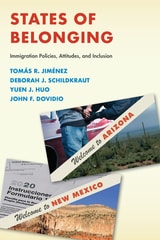
States of Belonging
Immigration Policies, Attitudes, and InclusionTomas R. Jimenez
Russell Sage Foundation, 2021
Political turmoil surrounding immigration at the federal level and the inability of Congress to pass comprehensive immigration reform have provided an opening for state and local governments to become more active in setting their own immigration-related policies. States largely dictate the resources, institutions, and opportunities immigrants can access: who can get a driver’s license or attend a state university, what languages are spoken in schools and public offices, how law enforcement interacts with the public, and even what schools teach students about history. In States of Belonging, an interdisciplinary team of immigration experts – Tomás R. Jiménez, Deborah J. Schildkraut, Yuen J. Huo, and John F. Dovidio – explore the interconnections among immigration policies, attitudes about immigrants and immigration, and sense of belonging in two neighboring states – Arizona and New Mexico – with divergent approaches to welcoming newcomers.
Arizona and New Mexico are historically and demographically similar, but they differ in their immigration policies. Arizona has enacted unwelcoming policies towards immigrants, restricting the access of immigrants to state resources, social services, and public institutions. New Mexico is more welcoming, actively seeking to protect the rights of immigrants and extending access to state resources and institutions. The authors draw on an original survey and in-depth interviews of a cross-section of each state’s population to illustrate how these differing approaches affect the sense of belonging not only among immigrants, but among the U.S.-born as well.
Respondents in Arizona, regardless of whether they were foreign- or native-born or their ethno-racial background, agreed that the state is unwelcoming to immigrants, and they pointed to Arizona’s restrictive policies as the primary factor. The sense of rejection perceived by Latinos in Arizona, including the foreign-born and the U.S.-born, was profound. They felt the effects of administrative and symbolic exclusions of the state’s unwelcoming policies as they went about their daily lives.
New Mexico’s more welcoming approach had positive effects on the Latino immigrant population, and these policies contributed to an increased sense of belonging among U.S.-born Latinos and U.S.-born whites as well. The authors show that exposure to information about welcoming policies is associated with an improved sense of belonging across most population groups. They also find that the primary dividing line when it came to reactions to welcoming policies was political, not ethno-racial. Only self-identified Republicans, Latino as well as white, showed reduced feelings of belonging.
States of Belonging demonstrates that welcoming policies cultivate a greater sense of belonging for immigrants and other state citizens, suggesting that policies aimed at helping immigrants gain a social, economic, and political foothold in this country can pay a broad societal dividend.
[more]