Results by title
211 books match the query 'Blacks' and 13 start with s
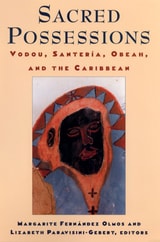
Sacred Possessions
Vodou, Santería, Obeah, and the CaribbeanOlmos, Margarite Fernândez
Rutgers University Press, 1997
Sacred Possessions is an unprecedented collection of thirteen comparative and interdisciplinary essays exploring the cross-cultural dynamics of African-based religious systems in the Caribbean. The contributors analyze the nature and liturgies of Vodou, Santeria, Obeah, Quimbois, and Gaga as they form one central cultural matrix in the region. They ask how these belief systems were affected by differing colonial histories and landscapes, and how they affected other cultural expressions (from the oral tradition to popular art and literature), and how they have been perceived and (mis)represented by the West.
The book is a unique contribution to the study of the Caribbean as a site of multiculturalism, demonstrating the linkages between anthropology, religion, literature, and popular culture. Also included are a stunning photoessay on Cuban Santeria, a glossary of terms, and an insightful introduction by the editors.
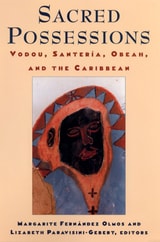
Sacred Possessions
Vodou, Santería, Obeah, and the CaribbeanOlmos, Margarite Fernândez
Rutgers University Press, 1997
Sacred Possessions is an unprecedented collection of thirteen comparative and interdisciplinary essays exploring the cross-cultural dynamics of African-based religious systems in the Caribbean. The contributors analyze the nature and liturgies of Vodou, Santeria, Obeah, Quimbois, and Gaga as they form one central cultural matrix in the region. They ask how these belief systems were affected by differing colonial histories and landscapes, and how they affected other cultural expressions (from the oral tradition to popular art and literature), and how they have been perceived and (mis)represented by the West.
The book is a unique contribution to the study of the Caribbean as a site of multiculturalism, demonstrating the linkages between anthropology, religion, literature, and popular culture. Also included are a stunning photoessay on Cuban Santeria, a glossary of terms, and an insightful introduction by the editors.

Scammer's Yard
The Crime of Black Repair in JamaicaJovan Scott Lewis
University of Minnesota Press, 2020
Tells the story of Jamaican “scammers” who use crime to gain autonomy, opportunity, and repair
There is romance in stealing from the rich to give to the poor, but how does that change when those perceived rich are elderly white North Americans and the poor are young Black Jamaicans? In this innovative ethnography, Jovan Scott Lewis tells the story of Omar, Junior, and Dwayne. Young and poor, they strive to make a living in Montego Bay, where call centers and tourism are the two main industries in the struggling economy. Their experience of grinding poverty and drastically limited opportunity leads them to conclude that scamming is the best means of gaining wealth and advancement. Otherwise, they are doomed to live in “sufferation”—an inescapable poverty that breeds misery, frustration, and vexation.
In the Jamaican lottery scam run by these men, targets are told they have qualified for a large loan or award if they pay taxes or transfer fees. When the fees are paid, the award never arrives, netting the scammers tens of thousands of U.S. dollars. Through interviews, historical sources, song lyrics, and court testimonies, Lewis examines how these scammers justify their deceit, discovering an ethical narrative that reformulates ideas of crime and transgression and their relationship to race, justice, and debt.
Scammer’s Yard describes how these young men, seeking to overcome inequality and achieve autonomy, come to view crime as a form of liberation. Their logic raises unsettling questions about a world economy that relegates postcolonial populations to deprivation even while expecting them to follow the rules of capitalism that exacerbate their dispossession. In this groundbreaking account, Lewis asks whether true reparation for the legacy of colonialism is to be found only through radical—even criminal—means.
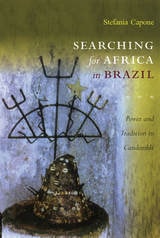
Searching for Africa in Brazil
Power and Tradition in CandombléStefania Capone
Duke University Press, 2010
Challenging the usual interpretations of Afro-Brazilian religions as fixed entities, completely independent of one another, Capone reveals these practices as parts of a unique religious continuum. She does so through an analysis of ritual variations as well as discursive practices. To illuminate the continuum of Afro-Brazilian religious practice and the tensions between exegetic discourses and ritual practices, Capone focuses on the figure of Exu, the sacred African trickster who allows communication between gods and men. Following Exu and his avatars, she discloses the centrality of notions of prestige and power—mystical and religious—in Afro-Brazilian religions. To explain how religious identity is constantly negotiated among social actors, Capone emphasizes the agency of practitioners and their political agendas in the “return to roots,” or re-Africanization, movement, an attempt to recover the original purity of a mythical and legitimizing Africa.
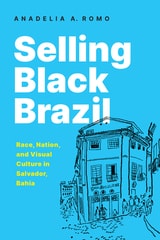
Selling Black Brazil
Race, Nation, and Visual Culture in Salvador, BahiaAnadelia Romo
University of Texas Press, 2022
2023 Honorable Mention, Brazil Section Humanities Book Prize, Latin American Studies Association (LASA)
This book explores visual portrayals of blackness in Brazil to reveal the integral role of visual culture in crafting race and nation across Latin America.
In the early twentieth century, Brazil shifted from a nation intent on whitening its population to one billing itself as a racial democracy. Anadelia Romo shows that this shift centered in Salvador, Bahia, where throughout the 1950s, modernist artists and intellectuals forged critical alliances with Afro-Brazilian religious communities of Candomblé to promote their culture and their city. These efforts combined with a growing promotion of tourism to transform what had been one of the busiest slaving depots in the Americas into a popular tourist enclave celebrated for its rich Afro-Brazilian culture. Vibrant illustrations and texts by the likes of Jorge Amado, Pierre Verger, and others contributed to a distinctive iconography of the city, with Afro-Bahians at its center. But these optimistic visions of inclusion, Romo reveals, concealed deep racial inequalities. Illustrating how these visual archetypes laid the foundation for Salvador’s modern racial landscape, this book unveils the ways ethnic and racial populations have been both included and excluded not only in Brazil but in Latin America as a whole.
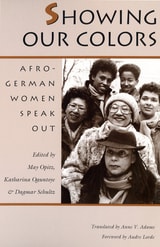
Showing Our Colors
Afro-German Women Speak OutMay Optiz
University of Massachusetts Press, 1992
Showing Our Colors: Afro-German Women Speak Out is an English translation of the German book Farbe bekennen, edited by author May Ayim, Katharina Oguntoye, and Dagmar Schultz. It is the first published book by Afro-Germans. It is the first written use of the term Afro-German.
Sociology and the Race Problem
THE FAILURE OF A PERSPECTIVEJames B. McKee
University of Illinois Press, 1993
"Masterful. . . . McKee transports the reader back to the intellectual world in which the early sociologists worked and does not simply treat them as evil racists. His approach is informed by the sociology of knowledge." -- Lewis M. Killian, author of The Impossible Revolution, Phase 2: Black Power and the American Dream
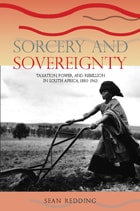
Sorcery and Sovereignty
Taxation, Power, and Rebellion in South Africa, 1880–1963Sean Redding
Ohio University Press, 2006
Rebellions broke out in many areas of South Africa shortly after the institution of white rule in the late nineteenth century and continued into the next century. However, distrust of the colonial regime reached a new peak in the mid-twentieth century, when revolts erupted across a wide area of rural South Africa. All these uprisings were rooted in grievances over taxes. Rebels frequently invoked supernatural powers for assistance and accused government officials of using witchcraft to enrich themselves and to harm ordinary people.
As Sean Redding observes in Sorcery and Sovereignty, beliefs in witchcraft and supernatural powers were part of the political rhetoric; the system of taxation—with all its prescribed interactions between ruler and ruled—was intimately connected to these supernatural beliefs.
In this fascinating study, Redding examines how black South Africans’ beliefs in supernatural powers, along with both economic and social change in the rural areas, resulted in specific rebellions and how gender relations in black South African rural families changed. Sorcery and Sovereignty explores the intersection of taxation, political attitudes, and supernatural beliefs among black South Africans, shedding light on some of the most significant issues in the history of colonized Africa.
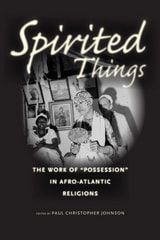
Spirited Things
The Work of "Possession" in Afro-Atlantic ReligionsEdited by Paul Christopher Johnson
University of Chicago Press, 2014
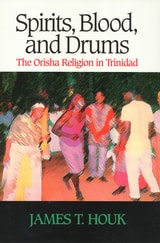
Spirits, Blood and Drums
The Orisha Religion in TrinidadJames T. Houk
Temple University Press, 1995
James Houk's field work in Trinidad and subsequent involvement in the Orisha religion allows him a uniquely intimate perspective on a complex and eclectic religion. Originating in Nigeria, Orisha combines elements of African religions (notably Yoruba), Catholicism, Hinduism, Protestantism Spiritual Baptist, and Kabbalah. A religion of spirits and spirit possession, ceremonies and feasts, churches and shrines, sacrifices and sacred objects, Orisha is constantly shifting and unstable, its practice widely varied. As a belief system, it is a powerful presence in the social structure, culture, and, more recently, the political realm of Trinidad.
Houk carefully examines the historical forces that have transformed Orisha from a relatively simple religion in colonial Trinidad to an abstruse mix of belief, ritual, and symbolism. The voices of worshippers and Orisha leaders spring to life the intensity and power of the religion. Houk's own recounting of participation in many of the mystical ceremonies, including taking on the important role of drummer in several feasts, his initiation into Orisha, and his exceptional field research provide fascinating details essential in understanding the development of this Caribbean religion.
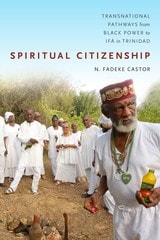
Spiritual Citizenship
Transnational Pathways from Black Power to Ifá in TrinidadN. Fadeke Castor
Duke University Press, 2017
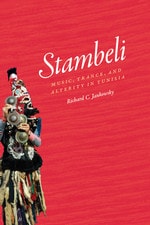
Stambeli
Music, Trance, and Alterity in TunisiaRichard C. Jankowsky
University of Chicago Press, 2010
Part ethnography, part history of the complex relationship between Tunisia’s Arab and sub-Saharan populations, Stambeli will be welcomed by scholars and students of ethnomusicology, anthropology, African studies, and religion.

Stolen Life
Fred Moten
Duke University Press, 2018
In Stolen Life—the second volume in his landmark trilogy consent not to be a single being—Fred Moten undertakes an expansive exploration of blackness as it relates to black life and the collective refusal of social death. The essays resist categorization, moving from Moten's opening meditation on Kant, Olaudah Equiano, and the conditions of black thought through discussions of academic freedom, writing and pedagogy, non-neurotypicality, and uncritical notions of freedom. Moten also models black study as a form of social life through an engagement with Fanon, Hartman, and Spillers and plumbs the distinction between blackness and black people in readings of Du Bois and Nahum Chandler. The force and creativity of Moten's criticism resonate throughout, reminding us not only of his importance as a thinker, but of the continued necessity of interrogating blackness as a form of sociality.