77 books match the query 'Congress' and 3 start with s
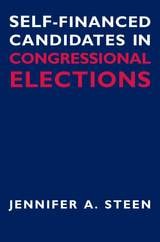
cover of Self-Financed Candidates in Congressional Elections

Self-Financed Candidates in Congressional Elections

Jennifer A. Steen

University of Michigan Press, 2006

Are our elections for sale? Americans have long asked this question in the face of skyrocketing campaign spending by candidates and parties. Then, in the 1990s, came a wave of wealthy individuals whose deep pockets seemed to be buying political offices across the country. Our worst suspicions were confirmed. Or were they? What effect do self-financers really have on electoral outcomes? Jennifer Steen's authoritative empirical study of self-financed candidates is a landmark in American politics. Steen thoroughly dispels the notion that self-funded candidates can buy legislative seats, proving that the vast majority of self-financers do not win their elections. Her book gives us a truer understanding of self-financers' actual influence on campaign competition and rhetoric.

Jennifer A. Steen is Assistant Professor of Political Science at Boston College and a former political consultant. She is one of the nation's leading authorities on self-financed candidates.
[more]
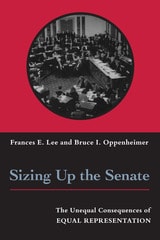
cover of Sizing Up the Senate: The Unequal Consequences of Equal Representation

Sizing Up the Senate

The Unequal Consequences of Equal Representation

Frances E. Lee and Bruce I. Oppenheimer

University of Chicago Press, 1999

We take it for granted that every state has two representatives in the United States Senate. Apply the "one person, one vote" standard, however, and the Senate is the most malapportioned legislature in the democratic world.

But does it matter that California's 32 million people have the same number of Senate votes as Wyoming's 480,000? Frances Lee and Bruce Oppenheimer systematically show that the Senate's unique apportionment scheme profoundly shapes legislation and representation. The size of a state's population affects the senator-constituent relationship, fund-raising and elections, strategic behavior within the Senate, and, ultimately, policy decisions. They also show that less populous states consistently receive more federal funding than states with more people. In sum, Lee and Oppenheimer reveal that Senate apportionment leaves no aspect of the institution untouched.

This groundbreaking book raises new questions about one of the key institutions of American government and will interest anyone concerned with issues of representation.
[more]
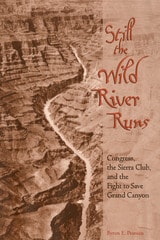
cover of Still the Wild River Runs: Congress, the Sierra Club, and the Fight to Save Grand Canyon

Still the Wild River Runs

Congress, the Sierra Club, and the Fight to Save Grand Canyon

Byron E. Pearson

University of Arizona Press, 2002

Between 1963 and 1968, environmentalists were outraged when western water interests sought to construct two dams in Grand Canyon as part of the Central Arizona Project. The Sierra Club led a national campaign opposed to the project, which most environmental historians credit with defeating the dams. In the wake of its victory, the Sierra Club has been lauded as the savior of Grand Canyon. Byron Pearson now takes a closer look at history to show that the Sierra Club's ability to mobilize public opinion did not appreciably influence Congress, where the issue was actually decided. When Arizona congressman Stewart Udall became Interior Secretary in 1960, he promoted a plan to import water from the Pacific Northwest to California in order to placate that state's opposition to the CAP with its proposed dams. When this support dissolved in the face of resistance from Washington senator Henry Jackson, who chaired the Senate Interior Committee, the pragmatic Udall sought passage of a bare-bones CAP bill without the dams before he and Arizona senator Carl Hayden retired. Despite this congressional deal-making, the Sierra Club received credit for blocking the dams and was propelled to the undisputed leadership of the environmental movement. Using the myth that it had saved the Canyon, the club transformed its image of power into real political influence after Congress passed the National Environmental Policy Act in 1970, giving environmental advocates access to the policy-making process for the first time. In revealing how the Sierra Club played a much lesser role in blocking the dams than they would have had the public believe, Pearson contrasts the ways in which the controversy unfolded in the court of public opinion versus the actual political process. He takes readers into congressional chambers and conference rooms, reconstructing the legislative process to convey the full flavor of this political give-and-take. Based on research in archives from all over the country, Still the Wild River Runs will itself be a subject of controversy as it challenges long-standing notions about the power of environmental lobbies. By putting this chain of historical events in clearer perspective, it can give citizens concerned with future causes a better understanding of the political process and what really moves it.
[more]