162 books match the query 'Economics & Trade' and 10 start with s
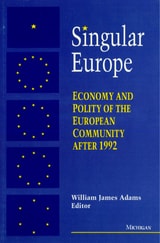
cover of Singular Europe: Economy and Polity of the European Community after 1992

Singular Europe

Economy and Polity of the European Community after 1992

William James Adams, Editor

University of Michigan Press, 1994
Singular Europe: Economy and Polity of the European Community after 1992 offers a thorough, multidisciplinary analysis of the sweeping changes and enduring challenges that faced the European Community in the wake of its ambitious 1992 integration project. Sponsored by the Chicago Council on Foreign Relations and drawing on the insights of leading economists, political scientists, and policymakers, this volume examines the economic, legal, and political forces that would shape Europe’s future at the end of the twentieth century.Taking its cue from the landmark “Project 1992”—the drive to create a single market for goods, services, capital, and people—the book begins by exploring the transformative view of a Europe no longer defined by its declining “Old Continent” image, but as a dynamic, populous, and increasingly prosperous global actor. Through three thematic parts, contributors address critical questions about the meaning and limits of integration: What steps remain for true political and economic union? How has European integration redefined competition, corporate strategy, social policy, and regulation? What are the external implications, and will the so-called “Fortress Europe” change global economic relations?With essays covering legitimacy and democracy after Maastricht, German reunification, the challenges of monetary union, competition policy, the social welfare state, telecommunications, banking, and international trade, Singular Europe blends scholarly rigor and policy relevance. The volume is a vital resource for anyone seeking to understand the ambitions and anxieties of a pivotal moment in Europe’s integration—and the ongoing debate over the balance between unity and diversity within the continent.
[more]
cover of Small and Medium-Sized Enterprises in the Global Economy

Small and Medium-Sized Enterprises in the Global Economy

Zoltan J. Acs and Bernard Yeung, Editors

University of Michigan Press, 1999
Entrepreneurship and globalization are two much-examined forces as we enter the new millennium--yet very little has been published on the intersection of small and medium-sized enterprises (SMEs) and the global economy. To close the gap, this volume delves into the intricate roles and consequences of such businesses on both global and domestic economies.
The first part of the volume provides an overview of the phenomenon of globalization, arguing that entrepreneurial discovery and technological change lead to globalization, which in turn leads to further opportunity for entrepreneurial discovery--no less for SMEs than for multinational corporations. In part two, the essays examine the role of SMEs in the global economy and why they are thriving. Part three reviews the roles of SMEs and innovators and examines their roles in direct foreign investment. Part four explores the role of technological diversity and knowledge spillovers as a way to explain the superior innovative performance of SMEs. Part five looks at the role of SMEs in technology transfer. Finally, part six examines the theoretical and policy implications of the international activities of SMEs, suggesting that policies should aim to reduce the costs in international expansion for SMEs.
This volume will provide the foundation for further study in SMEs and globalization. It will appeal to scholars and students in both international business and economics.
Zoltan J. Acs is Professor of Economics and Finance, University of Baltimore. Bernard Yin Yeung is Professor of International Business, University of Michigan.
[more]
cover of Social Security Programs and Retirement around the World: Fiscal Implications of Reform

Social Security Programs and Retirement around the World

Fiscal Implications of Reform

Edited by Jonathan Gruber and David A. Wise

University of Chicago Press, 2007

The future of Social Security is troubled, both in the United States and in most other developed countries with aging populations. As improvements in health care and changes in life styles enable retirees to live longer than ever before, the stress on national budgets will increase substantially. In Social Security Programs and Retirement around the World, Jonathan Gruber, David A. Wise, and experts in many countries examine the consequences of reforming retirement benefits in a dozen nations.

Drawing on the work of an international group of noted economists, the editors argue that social security programs provide strong incentives for workers to leave the labor force by retiring and taking the benefits to which they are entitled. By penalizing work, social security systems magnify the increased financial burden caused by aging populations, thus contributing to the insolvency of the system.  This book is a model of comparative analysis that evaluates the effects of illustrative policies for countries facing the impending rapid growth of social security benefits. Its insights will help inform one of the most pressing debates.

[more]
cover of Social Security Programs and Retirement around the World: Reforms and Retirement Incentives

Social Security Programs and Retirement around the World

Reforms and Retirement Incentives

Edited by Axel Börsch-Supan and Courtney C. Coile

University of Chicago Press, 2021

This ninth phase of the International Social Security project, which studies the experiences of twelve developed countries, examines the effects of public pension reform on employment at older ages. In the past two decades, men’s labor force participation at older ages has increased, reversing a long-term pattern of decline; participation rates for older women have increased dramatically as well. While better health, more education, and changes in labor-supply behavior of married couples may have affected this trend, these factors alone cannot explain the magnitude of the employment increase or its large variation across countries.

The studies in this volume explore how financial incentives to work at older ages have evolved as a result of public pension reforms since 1980 and how these changes have affected retirement behavior. Utilizing a common template to analyze the developments across countries, the findings suggest that social security reforms have strengthened the financial returns to working at older ages and that these enhanced financial incentives have contributed to the rise in late-life employment.
[more]
cover of Social Security Programs and Retirement around the World: The Relationship to Youth Employment

Social Security Programs and Retirement around the World

The Relationship to Youth Employment

Edited by Jonathan Gruber and David A. Wise

University of Chicago Press, 2010
Many countries have social security systems that are currently financially unsustainable. Economists and policy makers have long studied this problem and identified two key causes. First, as declining birth rates raise the share of older persons in the population, the ratio of retirees to benefits-paying employees increases. Second, as falling mortality rates increase lifespans, retirees receive benefits for longer than in the past. Further exacerbating the situation, the provisions of social security programs often provide strong incentives to leave the labor force.
Social Security Programs and Retirement around the World offers comparative analysis from twelve countries and examines the issue of age in the labor force. A notable group of contributors analyzes the relationship between incentives to retire and the proportion of older persons in the workforce, the effects that reforming social security would have on the employment rates of older workers, and how extending labor force participation will affect program costs. Dispelling the myth that employing older workers takes jobs away from the young, this timely volume challenges a raft of existing assumptions about the relationship between old and young people in the workforce.
[more]
cover of Social Security Programs and Retirement around the World: Working Longer

Social Security Programs and Retirement around the World

Working Longer

Edited by Courtney C. Coile, Kevin Milligan, and David A. Wise

University of Chicago Press, 2019

In developed countries, men’s labor force participation at older ages has increased in recent years, reversing a decades-long pattern of decline. Participation rates for older women have also been rising. What explains these patterns, and the differences in them across countries? The answers to these questions are pivotal as countries face fiscal and retirement security challenges posed by longer life-spans.
 
This eighth phase of the International Social Security project, which compares the social security and retirement experiences of twelve developed countries, documents trends in participation and employment and explores reasons for the rising participation rates of older workers. The chapters use a common template for analysis, which facilitates comparison of results across countries. Using within-country natural experiments and cross-country comparisons, the researchers study the impact of improving health and education, changes in the occupation mix, the retirement incentives of social security programs, and the emergence of women in the workplace, on labor markets. The findings suggest that social security reforms and other factors such as the movement of women into the labor force have played an important role in labor force participation trends.
[more]
cover of State Institutions, Private Incentives, Global Capital

State Institutions, Private Incentives, Global Capital

Andrew C. Sobel

University of Michigan Press, 2002
The growth of global finance since 1960 constitutes one of the most important transformations in social relations during the twentieth century. Using historical, statistical, and graphical techniques, State Institutions, Private Incentives, and Global Capital examines three important aspects of this phenomenal shift in the international political economy. First, Andrew Sobel explores the reawakening of the international financial markets, mapping their extraordinary transformation since the early 1960s and discussing the role of politics in that metamorphosis. The author then offers a fresh understanding of the systematic differences in access for borrowers in this rapidly transforming and expanding global capital pool. He then demonstrates the influence of political factors in producing differential access to the global capital pool. Showing how the character and stability of a country's political system affects investors's decisions to invest in that country, Sobel breaks new ground in understanding the basis for the frequent admonitions by the World Bank and others that a stable political and legal system are essential for states to attract significant foreign investment.
With the growing debate about the effect of financial interdependence on the ability of states to conduct economic policy and indeed to preserve their independence in the face of unprecedented economic linkages, this book will be of interest to political scientists and economists as well as policy makers concerned with the impact of financial globalization and the causes of differentials in access to capital.
Andrew C. Sobel is Assistant Professor of Political Science and Resident Fellow, Center in Political Economy, Washington University, St. Louis. He is the author of Domestic Choices, International Markets: Dismantling National Barriers and Liberalizing Securities Markets.
[more]
cover of State Trading in the Twenty-First Century: The World Trade Forum, Volume 1

State Trading in the Twenty-First Century

The World Trade Forum, Volume 1

Thomas Cottier and Petros C. Mavroidis, Editors

University of Michigan Press, 1998
The University of Michigan Press is pleased to announce the first volume in an annual series, The World Trade Forum. The Forum's members include scholars, lawyers, and government and business practitioners working in the area of international trade, law, and policy. They meet annually and discuss integration issues in international economic relations, focusing on a new theme each year.
The central topic of the first World Trade Forum is state trading. To what extent has trade liberalization, as we have experienced it over the last fifty years, affected property ownership? Contributors to the 1998 World Trade Forum explore this question, examining both state practice and the regulatory framework. Their discussions are divided into three parts: Part 1 looks at the World Trade Organization's legal framework for state trading enterprises, taking on such issues as monopolies and state enterprises, the WTO Antidumping Agreement and the economies in transition, and relationship of state trading and the Government Purchasing Act. Part 2 deals with regional experiences in state trading (for the EC, United States, Canada, Japan, China, and Russia). Part 3 examines conceptual issues such as auctions as a trade policy instrument and rule-making alternatives for entities with exclusive rights. The conclusion synthesizes the foregoing chapters in discussing the reach of modern international trade law.
Contributors are Frederick Abbott, Ichiro Araki, Christian Bach, Jacques H. J. Bourgeois, Thomas Cottier, William J. Davey, Vladimir Dbrentsov, Toni Haniotis, Bernard M. Hoekman, Gary Horlick, Henrik Horn, Robert Howse, Patrick Low, Will Martin, Mitsuo Matsushita, Petros Mavroidis, Aaditya Mattoo, Patrick Messerlin, Constantine Michalopoulos, Kristin Heim Mowry, Stilpon Nestor, Damien Neven, N. David Palmeter, Ernst-Ulrich Petersmann, André Sapir, Diane P. Wood, and Werner Zdouc.
Petros Mavroidis is Professor of Law, University of Neuchatel. Thomas Cottier is Professor of Law, Institute of European and International Economic Law, University of Bern Law School.
[more]
cover of Strained Relations: US Foreign-Exchange Operations and Monetary Policy in the Twentieth Century

Strained Relations

US Foreign-Exchange Operations and Monetary Policy in the Twentieth Century

Michael D. Bordo, Owen F. Humpage, and Anna J. Schwartz

University of Chicago Press, 2015

During the twentieth century, foreign-exchange intervention was sometimes used in an attempt to solve the fundamental trilemma of international finance, which holds that countries cannot simultaneously pursue independent monetary policies, stabilize their exchange rates, and benefit from free cross-border financial flows. Drawing on a trove of previously confidential data, Strained Relations reveals the evolution of US policy regarding currency market intervention, and its interaction with monetary policy. The authors consider how foreign-exchange intervention was affected by changing economic and institutional circumstances—most notably the abandonment of the international gold standard—and how political and bureaucratic factors affected this aspect of public policy.
[more]
cover of Structural Impediments to Growth in Japan

Structural Impediments to Growth in Japan

Edited by Magnus Blomström, Jennifer Corbett, Fumio Hayashi, and Anil Kashyap

University of Chicago Press, 2003

As Japan's decade-long economic stagnation continues, there has been much analysis of the immediate macroeconomic problems that confront the Japanese economy. This book looks past the short-run challenges to the future of Japan and highlights the intermediate and longer-term issues that country faces.

In this, the first book-length academic treatment of this important issue, a team of notable contributors present nine papers, offering a comprehensive assessment of those economic difficulties and addressing a range of specific issues, from financial restructuring and the impact of the aging Japanese population to corporate behavior, public lending, employment practices, and innovative capacity. In each paper, contributors clearly identify and outline problems and concerns, carefully pose provocative questions, and in many instances present concrete suggestions for improvement.

The resulting volume is a timely and important examination of critical issues for Japan's stalling economy, packed with both telling data and expert analysis and offering valuable perspectives on Japan's current obstacles.
[more]