Results by title
78 books match the query 'Emergence' and 4 start with s
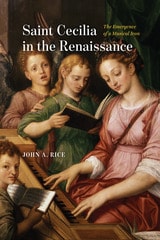
Saint Cecilia in the Renaissance
The Emergence of a Musical IconJohn A. Rice
University of Chicago Press, 2022
Until the fifteenth century, Saint Cecilia was not connected with music. She was perceived as one of many virgin martyrs, with no obvious musical skills or interests. During the next two centuries, however, she inspired many musical works written in her honor and a vast number of paintings that depicted her singing or playing an instrument.
In this book, John A. Rice argues that Cecilia’s association with music came about in several stages, involving Christian liturgy, visual arts, and music. It was fostered by interactions between artists, musicians, and their patrons and the transfer of visual and musical traditions from northern Europe to Italy. Saint Cecilia in the Renaissance explores the cult of the saint in Medieval times and through the sixteenth century when musicians’ guilds in the Low Countries and France first chose Cecilia as their patron. The book then turns to music and the explosion of polyphonic vocal works written in Cecilia’s honor by some of the most celebrated composers in Europe. Finally, the book examines the wealth of visual representations of Cecilia especially during the Italian Renaissance, among which Raphael’s 1515 painting, The Ecstasy of Saint Cecilia, is but the most famous example. Thoroughly researched and beautifully illustrated in color, Saint Cecilia in the Renaissance is the definitive portrait of Saint Cecilia as a figure of musical and artistic inspiration.
Saul, Benjamin, and the Emergence of Monarchy in Israel
Biblical and Archaeological PerspectivesJoachim J. Krause
SBL Press, 2020
Ponder questions of the united monarchy under Saul and David in light of current historical and archaeological evidence
Reconstructing the emergence of the Israelite monarchy involves interpreting historical research, approaching questions of ancient state formation, synthesizing archaeological research from sites in the southern Levant, and reexamining the biblical traditions of the early monarchy embedded in the books of Samuel and Kings. Integrating these approaches allows for a nuanced and differentiated picture of one of the most crucial periods in the history of ancient Israel. Rather than attempting to harmonize archaeological data and biblical texts or to supplement the respective approach by integrating only a portion of data stemming from the other, both perspectives come into their own in this volume presenting the results of an interdisciplinary Tübingen–Tel Aviv Research Colloquium.
Features:
- Essays on Israel's monarchy by experts in biblical archaeology and biblical studies
- Methods for integrating archaeology and biblical traditions in reconstructing ancient Israel's history
- New research on the sociopolitical process of state formation in Israel and Judah
Seeing by Electricity
The Emergence of Television, 1878-1939Doron Galili
Duke University Press, 2020
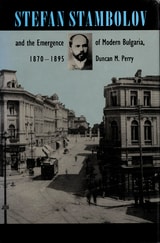
Stefan Stambolov and the Emergence of Modern Bulgaria, 1870-1895
Duncan M. Perry
Duke University Press, 1993
Perry begins with Bulgaria in the tumultuous years immediately following its founding in 1878. After the ousting of the country's first prince, Stambolov enters the stage as the fiery young lawyer who restored him to the throne. Although the prince promptly abdicated, Stambolov stepped into the breach and led the nation during the interregnum. Perry traces this patriotic politician's transformation into an authoritarian prime minister. He shows how Stambolov stabilized the Bulgarian economy and brought relative security to the land—but not without cost to himself and his regime. Perry depicts a man whose promotion of Bulgaria's independence exacted its price in individual rights, a ruler whose assassination in 1895 was the cause of both rejoicing and sorrow.
Stambolov thus emerges from these pages as a complex historical figure, an authoritarian ruler who protected his country's liberty at the cost of the people's freedom and whose dictatorial policies set Bulgaria upon a course of stability and modernization. An afterword compares the Bulgarian liberation era of Stambolov with the communist-era dictator, Todor Zhikov, analyzing similarities and differences.