Results by title
114 books match the query 'Enslaved persons' and 18 start with s
Sex, Power, and Slavery
Gwyn Campbell
Ohio University Press, 2014
Sexual exploitation was and is a critical feature of enslavement. Across many different societies, slaves were considered to own neither their bodies nor their children, even if many struggled to resist. At the same time, paradoxes abound: for example, in some societies to bear the children of a master was a potential route to manumission for some women. Sex, Power, and Slavery is the first history of slavery and bondage to take sexuality seriously.
Twenty-six authors from diverse scholarly backgrounds look at the vexed, traumatic intersections of the histories of slavery and of sexuality. They argue that such intersections mattered profoundly and, indeed, that slavery cannot be understood without adequate attention to sexuality. Sex, Power, and Slavery brings into conversation historians of the slave trade, art historians, and scholars of childhood and contemporary sex trafficking. The book merges work on the Atlantic world and the Indian Ocean world and enables rich comparisons and parallels between these diverse areas.
Contributors: David Brion Davis, Martin Klein, Richard Hellie, Abdul Sheriff, Griet Vankeerberghen, E. Ann McDougall, Matthew S. Hopper, Marie Rodet, George La Rue, Ulrike Schmieder, Tara Iniss, Mariana Candido, James Francis Warren, Johanna Ransmeier, Roseline Uyanga with Marie-Luise Ermisch, Francesca Ann Louise Mitchell, Shigeru Sato, Gabeba Baderoon, Charmaine Nelson, Ana Lucia Araujo, Brian Lewis, Ronaldo Vainfas, Salah Trabelsi, Joost Coté, Sandra Evers, and Subho Basu
Shade-Grown Slavery
The Lives of Slaves on Coffee Plantations in CubaWilliam C. Van Norman
Vanderbilt University Press, 2013
In this broad, interdisciplinary study, William Van Norman describes how each type of plantation and the amount of manual labor it required directly influenced the nature of slave life in that community. Slaves on coffee plantations lived in a unique context in comparison to that of their fellow slaves on sugar plantations, one that gave them greater flexibility in cultural and artistic creativity. To gain a deeper understanding of plantation slavery in Cuba, Van Norman explores what life and labor was like for coffee slaves and how it was different from what sugar slaves experienced. Shade-Grown Slavery reconstructs their world and in turn deconstructs the picture we now have of Cuba in the late eighteenth and early nineteenth centuries.
Ultimately, Shade-Grown Slavery reveals the lives of enslaved Africans on Cuban coffee plantations and shows how they were able to maintain and transform their cultural traditions in spite of slavery.
Sketches of Slave Life and From and From Slave Cabin to the Pulpit
Peter Randolph
West Virginia University Press, 2016
This book is the first anthology of the autobiographical writings of Peter Randolph, a prominent nineteenth-century former slave who became a black abolitionist, pastor, and community leader.
Randolph’s story is unique because he was freed and relocated from Virginia to Boston, along with his entire plantation cohort. A lawsuit launched by Randolph against his former master’s estate left legal documents that corroborate his autobiographies.
Randolph's writings give us a window into a different experience of slavery and freedom than other narratives currently available and will be of interest to students and scholars of African American literature, history, and religious studies, as well as those with an interest in Virginia history and mid-Atlantic slavery.
Slavery and Reform in West Africa
Toward Emancipation in Nineteenth-Century Senegal and the Gold CoastTrevor R. Getz
Ohio University Press, 2004
A series of transformations, reforms, and attempted abolitions of slavery form a core narrative of nineteenth-century coastal West Africa. As the region’s role in Atlantic commercial networks underwent a gradual transition from principally that of slave exporter to producer of “legitimate goods” and dependent markets, institutions of slavery became battlegrounds in which European abolitionism, pragmatic colonialism, and indigenous agency clashed.
In Slavery and Reform in West Africa, Trevor Getz demonstrates that it was largely on the anvil of this issue that French and British policy in West Africa was forged. With distant metropoles unable to intervene in daily affairs, local European administrators, striving to balance abolitionist pressures against the resistance of politically and economically powerful local slave owners, sought ways to satisfy the latter while placating or duping the former.
The result was an alliance between colonial officials, company agents, and slave-owning elites that effectively slowed, sidetracked, or undermined serious attempts to reform slave holding. Although slavery was outlawed in both regions, in only a few isolated instances did large-scale emancipations occur. Under the surface, however, slaves used the threat of self-liberation to reach accommodations that transformed the master-slave relationship.
By comparing the strategies of colonial administrators, slave-owners, and slaves across these two regions and throughout the nineteenth century, Slavery and Reform in West Africa reveals not only the causes of the astounding success of slave owners, but also the factors that could, and in some cases did, lead to slave liberations. These findings have serious implications for the wider study of slavery and emancipation and for the history of Africa generally.
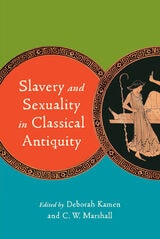
Slavery and Sexuality in Classical Antiquity
Edited by Deborah Kamen and C. W. Marshall
University of Wisconsin Press, 2021
Slavery and Sexuality in Classical Antiquity reveals the often hidden and contradictory attitudes concerning the sexual identities and expression of enslaved people. These individuals were typically objectified by both social convention and legal description but were also recognized as human subjects, with subjectivity and sexual desires of their own. The contributors provoke valuable and fascinating questions that not only recognize the trauma and struggles of enslaved people but also point to the apparent inconsistencies in the mindsets of the enslavers. The resulting volume expands our understanding of both sexuality and slavery in ancient Greece and Rome, as separate subjects and as they impacted each other.
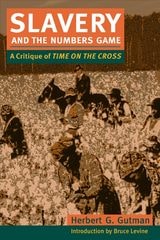
Slavery and the Numbers Game
A CRITIQUE OF TIME ON THE CROSSHerbert G. Gutman
University of Illinois Press, 1975
This detailed analysis of slavery in the antebellum South was written in 1975 in response to the prior year's publication of Robert Fogel and Stanley Engerman's controversial Time on the Cross, which argued that slavery was an efficient and dynamic engine for the southern economy and that its success was due largely to the willing cooperation of the slaves themselves.
Noted labor historian Herbert G. Gutman was unconvinced, even outraged, by Fogel and Engerman's arguments. In this book he offers a systematic dissection of Time on the Cross, drawing on a wealth of data to contest that book's most fundamental assertions. A benchmark work of historical inquiry, Gutman's critique sheds light on a range of crucial aspects of slavery and its economic effectiveness.
Gutman emphasizes the slaves' responses to their treatment at the hands of slaveowners. He shows that slaves labored, not because they shared values and goals with their masters, but because of the omnipresent threat of 'negative incentives,' primarily physical violence.
In his introduction to this new edition, Bruce Levine provides a historical analysis of the debate over Time on the Cross. Levine reminds us of the continuing influence of the latter book, demonstrated by Robert W. Fogel's 1993 Nobel Prize in Economic Sciences, and hence the importance and timeliness of Gutman's critique.
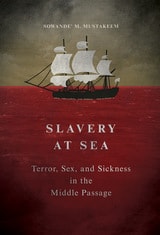
Slavery at Sea
Terror, Sex, and Sickness in the Middle PassageSowande M Mustakeem
University of Illinois Press, 2016
Sowande' Mustakeem's groundbreaking study goes inside the Atlantic slave trade to explore the social conditions and human costs embedded in the world of maritime slavery. Mining ship logs, records and personal documents, Mustakeem teases out the social histories produced between those on traveling ships: slaves, captains, sailors, and surgeons. As she shows, crewmen manufactured captives through enforced dependency, relentless cycles of physical, psychological terror, and pain that led to the the making--and unmaking--of enslaved Africans held and transported onboard slave ships. Mustakeem relates how this process, and related power struggles, played out not just for adult men, but also for women, children, teens, infants, nursing mothers, the elderly, diseased, ailing, and dying. Mustakeem offers provocative new insights into how gender, health, age, illness, and medical treatment intersected with trauma and violence transformed human beings into the world's most commercially sought commodity for over four centuries.
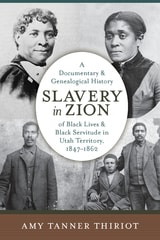
Slavery in Zion
A Documentary and Genealogical History of Black Lives and Black Servitude in Utah Territory, 1847-1862Amy Tanner Thiriot
University of Utah Press, 2022
Slavery in Zion has two major parts. The first section provides an introductory history, chapters on southern and western experiences, and information on life after emancipation. The second section is a biographical encyclopedia of names, relationships, and events. Although Slavery in Zion contains material applicable to legal history and the history of race and Mormonism, its most important contribution is as an archive of the experiences of Utah’s enslaved Black people, at last making their stories an integral part of the record of Utah and the American West—no longer forgotten or written out of history.
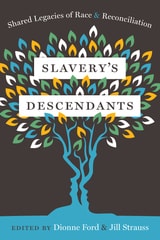
Slavery's Descendants
Shared Legacies of Race and ReconciliationJill Strauss
Rutgers University Press, 2019
Slavery’s Descendants brings together contributors from a variety of racial backgrounds, all members or associates of a national racial reconciliation organization called Coming to the Table, to tell their stories of dealing with America’s racial past through their experiences and their family histories. Some are descendants of slaveholders, some are descendants of the enslaved, and many are descendants of both slaveholders and slaves. What they all have in common is a commitment toward collective introspection, and a willingness to think critically about how the nation’s histories of oppression continue to ripple into the present, affecting us all.
The stories in Slavery’s Descendants deal with harrowing topics—rape, lynching, cruelty, shame—but they also describe acts of generosity, gratitude, and love. Together, they help us confront the legacy of slavery to reclaim a more complete picture of U.S. history, one cousin at a time.
Funding for the production of this book was provided by Furthermore, a program of the J. M. Kaplan Fund (https://www.furthermore.org).

Slavery's End In Tennessee
John Cimprich
University of Alabama Press, 1985
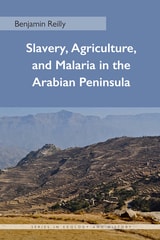
Slavery, Agriculture, and Malaria in the Arabian Peninsula
Benjamin Reilly
Ohio University Press, 2015
In Slavery, Agriculture, and Malaria in the Arabian Peninsula, Benjamin Reilly illuminates a previously unstudied phenomenon: the large-scale employment of people of African ancestry as slaves in agricultural oases within the Arabian Peninsula. The key to understanding this unusual system, Reilly argues, is the prevalence of malaria within Arabian Peninsula oases and drainage basins, which rendered agricultural lands in Arabia extremely unhealthy for people without genetic or acquired resistance to malarial fevers. In this way, Arabian slave agriculture had unexpected similarities to slavery as practiced in the Caribbean and Brazil.
This book synthesizes for the first time a body of historical and ethnographic data about slave-based agriculture in the Arabian Peninsula. Reilly uses an innovative methodology to analyze the limited historical record and a multidisciplinary approach to complicate our understandings of the nature of work in an area that is popularly thought of solely as desert. This work makes significant contributions both to the global literature on slavery and to the environmental history of the Middle East—an area that has thus far received little attention from scholars.
Slavery, Emancipation and Colonial Rule in South Africa
Wayne Dooling
Ohio University Press, 2008
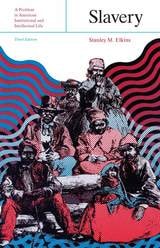
Slavery
A Problem in American Institutional and Intellectual LifeStanley M. Elkins
University of Chicago Press, 1987
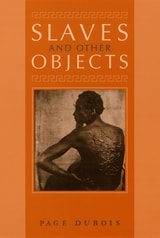
Slaves and Other Objects
Page duBois
University of Chicago Press, 2003
DuBois begins her study by exploring the material culture of slavery, including how most museum exhibits erase the presence of slaves in the classical world. Shifting her focus to literature, she considers the place of slaves in Plato's Meno, Aristotle's Politics, Aesop's Fables, Aristophanes' Wasps, and Euripides' Orestes. She contends throughout that portraying the difference between slave and free as natural was pivotal to Greek concepts of selfhood and political freedom, and that scholars who idealize such concepts too often fail to recognize the role that slavery played in their articulation.
Opening new lines of inquiry into ancient culture, Slaves and Other Objects will enlighten classicists and historians alike.
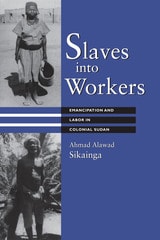
Slaves into Workers
Emancipation and Labor in Colonial SudanBy Ahmad Alawad Sikainga
University of Texas Press, 1996
Unlike African slavery in Europe and the Americas, slavery in the Sudan and other parts of Africa persisted well into the twentieth century. Sudanese slaves served Sudanese masters until the region was conquered by the Turks, who practiced slavery on a larger, institutional scale. When the British took over the Sudan in 1898, they officially emancipated the slaves, yet found it impossible to replace their labor in the country’s economy.
This pathfinding study explores the process of emancipation and the development of wage labor in the Sudan under British colonial rule. Ahmad Sikainga focuses on the fate of ex-slaves in Khartoum and on the efforts of the colonial government to transform them into wage laborers. He probes into what colonial rule and city life meant for slaves and ex-slaves and what the city and its people meant for colonial officials.
This investigation sheds new light on the legacy of slavery and the status of former slaves and their descendants. It also reveals how the legacy of slavery underlies the current ethnic and regional conflicts in the Sudan. It will be vital reading for students of race relations and slavery, colonialism and postcolonialism, urbanization, and labor history in Africa and the Middle East.
Speculators And Slaves
Masters, Traders, And Slaves In The Old SouthMichael Tadman
University of Wisconsin Press, 1996
Staging the Amistad
Three Sierra Leonean PlaysCharlie Haffner
Ohio University Press, 2019
Subfloor Pits and the Archaeology of Slavery in Colonial Virginia
Patricia Samford
University of Alabama Press, 2007
Enslaved Africans and their descendants comprised a significant portion of colonial Virginia populations, with most living on rural slave quarters adjacent to the agricultural fields in which they labored. Archaeological excavations into these home sites have provided unique windows into the daily lifeways and culture of these early inhabitants.