Results by title
53 books match the query 'Film adaptations' and 9 start with s
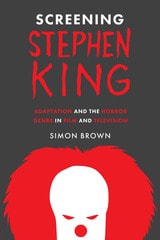
Screening Stephen King
Adaptation and the Horror Genre in Film and TelevisionBy Simon Brown
University of Texas Press, 2018
Since the 1970s, the name Stephen King has been synonymous with horror. His vast number of books has spawned a similar number of feature films and TV shows, and together they offer a rich opportunity to consider how one writer’s work has been adapted over a long period within a single genre and across a variety of media—and what that can tell us about King, about adaptation, and about film and TV horror. Starting from the premise that King has transcended ideas of authorship to become his own literary, cinematic, and televisual brand, Screening Stephen King explores the impact and legacy of over forty years of King film and television adaptations.
Simon Brown first examines the reasons for King’s literary success and then, starting with Brian De Palma’s Carrie, explores how King’s themes and style have been adapted for the big and small screens. He looks at mainstream multiplex horror adaptations from Cujo to Cell, low-budget DVD horror films such as The Mangler and Children of the Corn franchises, non-horror films, including Stand by Me and The Shawshank Redemption, and TV works from Salem’s Lot to Under the Dome. Through this discussion, Brown identifies what a Stephen King film or series is or has been, how these works have influenced film and TV horror, and what these influences reveal about the shifting preoccupations and industrial contexts of the post-1960s horror genre in film and TV.
Screening the Beats
Media Culture and the Beat SensibilityDavid Sterritt
Southern Illinois University Press, 2004
Film critic David Sterritt’s Screening the Beats: Media Culture and the Beat Sensibility showcases the social and aesthetic viewpoints of lynchpin Beat writers Jack Kerouac, William S. Burroughs, and Allen Ginsberg, juxtaposing their artistry with 1950s culture and achieving what Kerouac might have called a “bookmovie” riff. In clear prose, Sterritt captures the raw energy of the Beats and joins in their celebration of aesthetic freakishness. Tapping into the diversified spirit of the Beat Generation and its nuanced relationship with postwar American culture, Sterritt considers how the Beats variously foreground, challenge, and illuminate major issues in Hollywood and avant-garde film, critical and cultural theory, and music in the mass-media age.
Sterritt engages the creative and spiritual facets of the Beats, emulating their desire to evoke ephemeral aspects of human existence. Dealing with both high and low cultures as well as various subcultures, he highlights the complementary contributions to cultural creativity made by these authors. Screening the Beats grapples with paradoxes in Beat writing, in particular the conflict between spiritual purity and secular connectedness, which often materialized in the beatific bebop spontaneity, Zen-like transcendentalism, and plain hipster smarts that characterized the writings of Kerouac, Burroughs, and Ginsberg.
This interdisciplinary study tackles such topics as Ginsberg’s and Kerouac’s uses of racial and ethnic stereotypes prevalent in the popular movies of the 1950s era; the uses and limitations of improvisation as a creative tool in literature, jazz, and film; Kerouac’s use of cinematic metaphor to evoke Buddhist concepts; and intersections of the grotesque and carnivalesque in works as seemingly diverse as autobiographical novels by Kerouac, a radio play by Antonin Artaud, cultural theories of Gilles Deleuze and Félix Guattari, and the boisterous lunacy of Three Stooges farce. Deftly threading literary, musical, and cinematic works with a colorful array of critical theories, Screening the Beats illuminates the relationship between American culture and the imaginative forces of the Beat Generation.
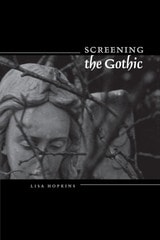
Screening the Gothic
By Lisa Hopkins
University of Texas Press, 2005
Filmmakers have long been drawn to the Gothic with its eerie settings and promise of horror lurking beneath the surface. Moreover, the Gothic allows filmmakers to hold a mirror up to their own age and reveal society's deepest fears. Franco Zeffirelli's Jane Eyre, Francis Ford Coppola's Bram Stoker's Dracula, and Kenneth Branagh's Hamlet are just a few examples of film adaptations of literary Gothic texts. In this ground-breaking study, Lisa Hopkins explores how the Gothic has been deployed in these and other contemporary films and comes to some surprising conclusions. For instance, in a brilliant chapter on films geared to children, Hopkins finds that horror resides not in the trolls, wizards, and goblins that abound in Harry Potter, but in the heart of the family.
Screening the Gothic offers a radical new way of understanding the relationship between film and the Gothic as it surveys a wide range of films, many of which have received scant critical attention. Its central claim is that, paradoxically, those texts whose affiliations with the Gothic were the clearest became the least Gothic when filmed. Thus, Hopkins surprises readers by revealing Gothic elements in films such as Sense and Sensibility and Mansfield Park, as well as exploring more obviously Gothic films like The Mummy and The Fellowship of the Ring. Written in an accessible and engaging manner, Screening the Gothic will be of interest to film lovers as well as students and scholars.
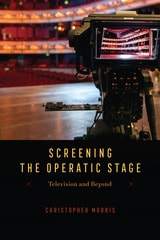
Screening the Operatic Stage
Television and BeyondChristopher Morris
University of Chicago Press, 2024
From the early days of television broadcasts to today’s live streams, opera houses have embraced technology as a way to reach new audiences. But how do these new forms of remediated opera extend, amplify, or undermine production values, and what does the audience gain or lose in the process? In Screening the Operatic Stage, Christopher Morris critically examines the cultural implications of opera’s engagement with screen media.
Foregrounding the potential for a playful exchange and self-awareness between stage and screen, Morris uses the conceptual tools of media theory to understand the historical and contemporary screen cultures that have transmitted the opera house into living rooms, onto desktops and portable devices, and across networks of movie theaters. If these screen cultures reveal how inherently “technological” opera is as a medium, they also highlight a deep suspicion among opera producers and audiences toward the intervention of media technology. Ultimately, Screening the Operatic Stage shows how the conventions of televisual representation employed in opera have masked the mediating effects of technology in the name of fidelity to live performance.
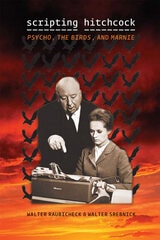
Scripting Hitchcock
Psycho, The Birds, and MarnieWalter Raubicheck and Walter Srebnick
University of Illinois Press, 2011
Hitchcock allowed his writers a great deal of creative freedom, which resulted in dynamic screenplays that expanded traditional narrative and defied earlier conventions. Critically examining the question of authorship in film, Raubicheck and Srebnick argue that Hitchcock did establish visual and narrative priorities for his writers, but his role in the writing process was that of an editor. While the writers and their contributions have generally been underappreciated, this study reveals that all the dialogue and much of the narrative structure of the films were the work of screenwriters Jay Presson Allen, Joseph Stefano, and Evan Hunter. The writers also shaped American cultural themes into material specifically for actors such as Janet Leigh, Tippi Hedren, and Tony Perkins. This volume gives due credit to those writers who gave narrative form to Hitchcock's filmic vision.
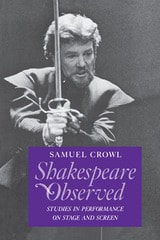
Shakespeare Observed
Studies in Performance on Stage and ScreenSamuel Crowl
Ohio University Press, 1993
Crowl’s study demonstrates the surprising resonances between Roman Polanski's 1971 film of Macbeth and Adrian Noble's heralded recent production of the play for The Royal Shakespeare Company; argues that Orson Welles's films of Othello and Cabins at Midnight are not only brilliant remaining of Shakespeare in another art form but make a powerful contribution to our contemporary understanding of performance as interpretation; and chronicles the impact of Peter Hall's creation of the Royal Shakespeare Company in 1960 on performance approaches to Shakespeare in the past thirty years.
Shakespeare Observed provides full interpretative readings of key recent Shakespeare productions in England and includes an intimate behind-the-scenes glimpse into the rehearsal process which produced Ron Daniels's emotionally charged version of Romeo and Juliet for the RSC in 1980. The final chapter uses Kenneth Branagh's highly successful film of Henry V as a summary example of the trends and influences Crowl's study traces, seeing the film as gathering its interpretative energies from both Olivier's famous film version of the play and Adrian Noble's stage production featuring Branagh as the king.
Written in a style which places a premium on capturing the vivid and often dazzling moments of stage and film performances of Shakespeare, Crowl's study will be of interest to the avid film and theatergoer as well as to the scholar and student. Shakespeare Observed joins a growing list of recent critical works which have significantly expanded and redefined the boundaries of Shakespeare studies in our time.

Shakespeare at the Cineplex
The Kenneth Branagh EraSamuel Crowl
Ohio University Press, 2005
Samuel Crowl’s Shakespeare at the Cineplex: The Kenneth Branagh Era is the first thorough exploration of the fifteen major Shakespeare films released since the surprising success of Kenneth Branagh’s Henry V (1989). Crowl presents the rich variety of these films in the “long decade: between the fall of the Berlin Wall and the terrorist attacks on September 11, 2001.” The productions range from Hollywood-saturated films such as Franco Zeffirelli’s Hamlet and Michael Hoffman’s A Midsummer Night’s Dream to more modest, experimental offerings, such as Christine Edzard’s As You Like It. Now available in paperback, Shakespeare at the Cineplex will be welcome reading for fans, students, and scholars of Shakespeare in performance.
Shakespeare the Illusionist
Magic, Dreams, and the Supernatural on FilmNeil Forsyth
Ohio University Press, 2019
In Shakespeare the Illusionist, Neil Forsyth reviews the history of Shakespeare’s plays on film, using the basic distinction in film tradition between what is owed to Méliès and what to the Lumière brothers. He then tightens his focus on those plays that include some explicit magical or supernatural elements—Puck and the fairies, ghosts and witches, or Prospero’s island, for example—and sets out methodically, but with an easy touch, to review all the films that have adapted those comedies and dramas, into the present day.
Forsyth’s aim is not to offer yet another answer as to whether Shakespeare would have written for the screen if he were alive today, but rather to assess what various filmmakers and TV directors have in fact made of the spells, haunts, and apparitions in his plays. From analyzing early camera tricks to assessing contemporary handling of the supernatural, Forsyth reads Shakespeare films for how they use the techniques of moviemaking to address questions of illusion and dramatic influence. In doing so, he presents a bold step forward in Shakespeare and film studies, and his fresh take is presented in lively, accessible language that makes the book ideal for classroom use.
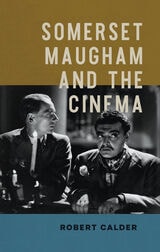
Somerset Maugham and the Cinema
Robert Calder
University of Wisconsin Press, 2024
This study of the famous author explores the relationship between literature and film, what is involved in adaptation, and how best to judge films based on celebrated books. Robert Calder, the world’s leading scholar of Maugham’s work, offers fascinating production histories, insight into both fortunate and misguided casting decisions, shrewd analyses of performances and film techniques, and summaries of public and critical responses. Maugham’s characters were often conflicted, iconoclastic, and morally out of step with their times, which may have accounted for the popularity of his fiction. Most of Maugham’s works could be adapted to satisfy the tastes of moviegoers and the demands of the Hays Office censors, if not the expectations of their author.