Results by title
668 books match the query 'History & Surveys' and 51 start with s
Sartre and Marxist Existentialism
The Test Case of Collective ResponsibilityThomas R. Flynn
University of Chicago Press, 1986
The study begins with an examination of the uses of "responsibility" in Being and Nothingness and in several postwar essays. Flynn then concentrates on the Critique of Dialectical Reason, offering a thorough analysis of the remarkable social theory Sartre constructs there. A masterful contribution to Sartre scholarship, Sartre and Marxist Existentialism will be of great interest to social and political philosophers involved in the debate over collective responsibility.
Sartre, Foucault, and Historical Reason, Volume One
Toward an Existentialist Theory of HistoryThomas R. Flynn
University of Chicago Press, 1997
A history, thought Foucault, should be a kind of map, a comparative charting of structural transformations and displacements. But for Sartre, authentic historical understanding demanded a much more personal and committed narrative, a kind of interpretive diary of moral choices and risks compelled by critical necessity and an exacting reality. Sartre's history, a rational history of individual lives and their intrinsic social worlds, was in essence immersed in biography.
In Volume One of this authoritative two-volume work, Thomas R. Flynn conducts a pivotal and comprehensive reconstruction of Sartrean historical theory, and provocatively anticipates the Foucauldian counterpoint to come in Volume Two.
Scholastic Meditations
Nicholas Rescher
Catholic University of America Press, 2005
Scholasticism
Personalities & Problems Medieval PhilosophyJosef Pieper
St. Augustine's Press, 2001
The account is broken by the gradual replacement of the synthesis of faith and reason that had been achieved in the early Middle Ages by a new one that made use of Aristotle. Pieper gives a thorough and lively account of the struggle between Aristotelians and anti-Aristotelians, and the famous condemnations that put the effort of Saint Thomas Aquinas at risk. But the Summa theologiae is regarded by Pieper as the unique achievement of the period.
If the early centuries, the medieval period, can be seen as moving toward the thirteenth and Thomas's unique achievement, subsequent centuries saw the decline of scholasticism and theappearance of harbingers of modern philosophy.
The book closes with Pieper's thoughts on the permanent philosophical and theological significance of scholasticism and the Middle Ages. Once again, wearing his learning lightly, writing with a clarity that delights, Josef Pieper has taken the field from stuffier and more extended accounts.
Science and an African Logic
Helen Verran
University of Chicago Press, 2001
In this captivating book, Helen Verran addresses precisely that question by looking at how science, mathematics, and logic come to life in Yoruba primary schools. Drawing on her experience as a teacher in Nigeria, Verran describes how she went from the radical conclusion that logic and math are culturally relative, to determining what Westerners find so disconcerting about Yoruba logic, to a new understanding of all generalizing logic. She reveals that in contrast to the one-to-many model found in Western number systems, Yoruba thinking operates by figuring things as wholes and their parts. Quantity is not absolute but always relational. Certainty is derived not from abstract logic, but from cultural practices and associations.
A powerful story of how one woman's investigation in this everday situation led to extraordinary conclusions about the nature of numbers, generalization, and certainty, this book will be a signal contribution to philosophy, anthropology of science, and education.

Science, Community, and the Transformation of American Philosophy, 1860-1930
Daniel J. Wilson
University of Chicago Press, 1990
The author situates the emergence of professional philosophy in the context of the professionalization of American higher education and articulates, in the case of philosophy, the structures and values of a professional discipline. One of the most important consequences of this transformation was a new emphasis on communal theories of truth. Peirce, Dewey, and Royce all developed sophisticated and important theories of community as they were engaged in reshaping and redefining the limits of philosophy. This book will be of great importance for those interested in the history of philosophy, the rise of professions, and American intellectual and educational history, and to all those seeking to understand the contemporary revival of pragmatic thought and theories of community.
Sciences from Below
Feminisms, Postcolonialities, and ModernitiesSandra Harding
Duke University Press, 2008
Describing the work of the post-Kuhnian science studies scholars Bruno Latour, Ulrich Beck, and the team of Michael Gibbons, Helga Nowtony, and Peter Scott, Harding reveals how, from different perspectives, they provide useful resources for rethinking the modernity versus tradition binary and its effects on the production of scientific knowledge. Yet, for the most part, they do not take feminist or postcolonial critiques into account. As Harding demonstrates, feminist science studies and postcolonial science studies have vital contributions to make; they bring to light not only the male supremacist investments in the Western conception of modernity and the historical and epistemological bases of Western science but also the empirical knowledge traditions of the global South. Sciences from Below is a clear and compelling argument that modernity studies and post-Kuhnian, feminist, and postcolonial sciences studies each have something important, and necessary, to offer to those formulating socially progressive scientific research and policy.
Seeming and Being in Plato’s Rhetorical Theory
Robin Reames
University of Chicago Press, 2018
Robin Reames’s Seeming & Being in Plato’s Rhetorical Theory marks a shift in Plato scholarship. Reames argues that an appropriate understanding of rhetorical theory in Plato’s dialogues illuminates how he developed the technical vocabulary needed to construct the very distinctions between seeming and being that separate true from false speech. By engaging with three key movements of twentieth- and twenty-first-century Plato scholarship—the rise and subsequent marginalization of “orality and literacy theory,” Heidegger’s controversial critique of Platonist metaphysics, and the influence of literary or dramatic readings of the dialogues—Reames demonstrates how the development of Plato’s rhetorical theory across several of his dialogues (Gorgias, Phaedrus, Protagoras, Theaetetus, Cratylus, Republic, and Sophist) has been both neglected and misunderstood.
Selected Philosophical Essays
Max Scheler
Northwestern University Press, 1973
Selected Writings of Richard McKeon
Volume One: Philosophy, Science, and CultureRichard McKeon
University of Chicago Press, 1998
Philosophy, Science, and Culture covers topics that range from philosophic semantics to the processes of the sciences to the forms of human rights. This collection makes McKeon's mission as a philosopher unmistakable. He characterized himself as a philosophic pluralist; he was an American philosopher in the tradition of the pragmatists, one whose philosophy subtly resonates with C. S. Peirce and John Dewey. McKeon also explored the themes of deconstructionism and other late-twentieth-century philosophies decades before their popular emergence—but, in generating a matrix of possibilities for productive debate, he avoided both relativism and the entrapments of dogmatism.
An important collection of his writings, this series will establish Richard McKeon as one of the foremost philosophers of the twentieth century.
Richard McKeon (1900-1985) taught philosophy at the University of Chicago from 1935 to 1973, and at the time of his death had published eleven books and 158 articles on an extraordinary array of topics and cultures. Among his many national and international distinctions, he was awarded the highest honor of the American Philosophical Association when he was invited to give the Paul Carus Lectures in New York in 1965.
Self-Deception and Paradoxes of Rationality
Edited by Jean-Pierre Dupuy
CSLI, 1998
Self
Ancient and Modern Insights about Individuality, Life, and DeathRichard Sorabji
University of Chicago Press, 2006
Seneca
Fifty Letters of a Roman StoicLucius Annaeus Seneca
University of Chicago Press, 2021
“There is only one course of action that can make you happy. . . . rejoice in what is yours. What is it that is yours? Yourself; the best part of you.”
In the year 62, citing health issues, the Roman philosopher Seneca withdrew from public service and devoted his time to writing. His letters from this period offer a window onto his experience as a landowner, a traveler, and a man coping with the onset of old age. They share his ideas on everything from the treatment of enslaved people to the perils of seafaring, and they provide lucid explanations for many key points of Stoic philosophy.
This selection of fifty letters brings out the essentials of Seneca’s thought, with much that speaks directly to the modern reader. Above all, they explore the inner life of the individual who proceeds through philosophical inquiry from a state of emotional turmoil to true friendship, self-determination, and personal excellence.

Sensus Communis
Vico, Rhetoric, and the Limits of RelativismJohn D. Schaeffer
Duke University Press, 1990
In extended commentaries on Gadamer, the Gadamer/Habermas debate, and Derrida, Schaeffer shows that Vico offers the possibility of analyzing social phenomena and constellations of power from within the humanist rhetorical tradition. Vico’s achievements have powerful implications for relating ethics and hermeneutics to the world of concrete social practice, particularly in an age in which the electronic media have replaced print as the primary means of communication and in which a “secondary orality” (a cast of mind similar to that of nonliterate peoples) is appearing within our literate civilization.
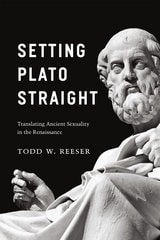
Setting Plato Straight
Translating Ancient Sexuality in the RenaissanceTodd W. Reeser
University of Chicago Press, 2015
In Setting Plato Straight, Todd W. Reeser undertakes the first sustained and comprehensive study of Renaissance textual responses to Platonic same-sex sexuality. Reeser mines an expansive collection of translations, commentaries, and literary sources to study how Renaissance translators transformed ancient eros into non-erotic, non-homosexual relations. He analyzes the interpretive lenses translators employed and the ways in which they read and reread Plato’s texts. In spite of this cleansing, Reeser finds surviving traces of Platonic same-sex sexuality that imply a complicated, recurring process of course-correction—of setting Plato straight.
Signature Derrida
Jacques Derrida
University of Chicago Press, 2013
Skeptical Essays
Benson Mates
University of Chicago Press, 1981
The problems Mates discusses are: the Liar paradox and Russell's Antinomy of the class of all nonself-membered classes; the problem of determinism and moral responsibility; and the existence of the external world. Clearly written and effectively organized, the book will be an excellent text for advanced students.
Socrates Founding Political Philosophy in Xenophon's "Economist", "Symposium", and "Apology"
Thomas L. Pangle
University of Chicago Press, 2020
Unlike the Socrates of Plato, Xenophon’s Socrates is more complicated and human, an individual working out the problem of what it means to live well and virtuously. While the Memorabilia defends Socrates by stressing his likeness to conventionally respectable gentlemen, Xenophon’s remaining Socratic texts offer a more nuanced characterization by highlighting how Socrates also diverges from conventions of gentlemanliness in his virtues, behaviors, and peculiar views of quotidian life and governmental rule. One question threads through the three writings: Which way of life best promotes human existence, politics, and economics—that of the Socratic political philosopher with his philosophic virtues or that of the gentleman with his familial, civic, and moral virtues? In uncovering the nuances of Xenophon’s approach to the issue in the Economist, Symposium, and Apology, Pangle’s book cements the significance of these writings for the field and their value for shaping a fuller conception of just who Socrates was and what he taught.
Socrates Meets Hume
The Father of Philosophy Meets the Father of Modern SkepticismPeter Kreeft
St. Augustine's Press, 2010
Kreeft invites the reader to take part in the process of refuting Hume’s skeptical arguments, with the great insights of Socrates. Based on an imagination dialogue between Socrates and Hume that takes place in the afterlife, this profound and witty book makes an entertaining and informative exploration of modern philosophy.
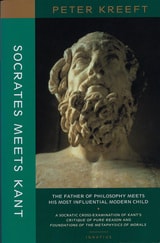
Socrates Meets Kant
The Father of Philosophy Meets His Most Influential Modern ChildPeter Kreeft
St. Augustine's Press, 2009
Kreeft’s Socrates reflects what the historical philosopher would likely have made of Kant’s ideas, while also recognizing the greatness, genius, and insightfulness of Kant. The result is a helpful, highly readable, even amusing book. Kant’s philosopher of knowing truly is a “Copernican revolution in philosophy,” as he himself dubbed it. His ethics intended to set out the rational grounds for morality. Did he achieve his goals? What would Socrates say about the matter?
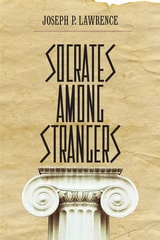
Socrates among Strangers
Joseph P. Lawrence
Northwestern University Press, 2015
In Socrates among Strangers, Joseph P. Lawrence reclaims the enigmatic sage from those who have seen him either as a prophet of science, seeking the security of knowledge, or as a wily actor who shed light on the dangerous world of politics while maintaining a prudent distance from it. The Socrates Lawrence seeks is the imprudent one, the man who knew how to die.
The institutionalization of philosophy in the modern world has come at the cost of its most vital concern: the achievement of life wisdom. Those who have ceased to grow (those who think they know) close their ears to the wisdom of strangers—and Socrates, who stood face to face with death, is the archetypal stranger. His avowal of ignorance, Lawrence suggests, is more needed than ever in an age defined by technical mastery and expert knowledge.
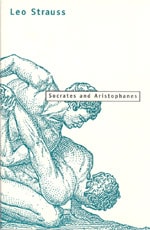
Socrates and Aristophanes
Leo Strauss
University of Chicago Press, 1996
"Strauss gives us an impressive addition to his life's work—the recovery of the Great Tradition in political philosophy. The problem the book proposes centers formally upon Socrates. As is typical of Strauss, he raises profound issues with great courage. . . . [He addresses] a problem that has been inherent in Western life ever since [Socrates'] execution: the tension between reason and religion. . . . Thus, we come to Aristophanes, the great comic poet, and his attack on Socrates in the play The Clouds. . . [Strauss] translates it into the basic problem of the relation between poetry and philosophy, and resolves this by an analysis of the function of comedy in the life of the city." —Stanley Parry, National Review
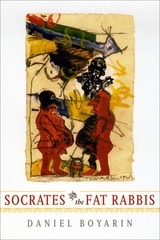
Socrates and the Fat Rabbis
Daniel Boyarin
University of Chicago Press, 2009
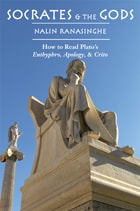
Socrates and the Gods
How to Read Plato's Euthyphro, Apology, and CritoNalin Ranasinghe
St. Augustine's Press, 2012
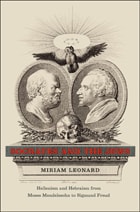
Socrates and the Jews
Hellenism and Hebraism from Moses Mendelssohn to Sigmund FreudMiriam Leonard
University of Chicago Press, 2012
"What has Athens to do with Jerusalem?” Asked by the early Christian Tertullian, the question was vigorously debated in the nineteenth century. While classics dominated the intellectual life of Europe, Christianity still prevailed and conflicts raged between the religious and the secular. Taking on the question of how the glories of the classical world could be reconciled with the Bible, Socrates and the Jews explains how Judaism played a vital role in defining modern philhellenism.
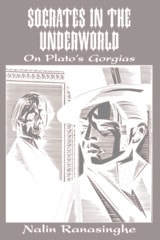
Socrates in the Underworld
On Plato's GorgiasNalin Ranasinghe
St. Augustine's Press, 2009
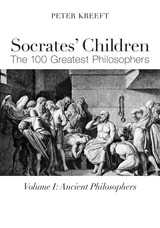
Socrates' Children
Ancient: The 100 Greatest PhilosophersPeter Kreeft
St. Augustine's Press, 2019
This is the first of a four-volume history of philosophy . . . on ancient, medieval, modern, and contemporary philosophy. After the fourth volume is produced in paper, a one-volume clothbound edition, containing all four paperbound editions, will be published.
Kreeft focuses on the “big ideas” that have influenced present people and present times, and includes relevant biographical data, proportionate to its importance for each thinker. Moreover, the aim of the work is to stimulate philosophizing, controversy, and argument. It uses ordinary language and logic, not jargon and symbolic logic, and it is commonsensical (like Aristotle) and existential in the sense that it sees philosophy as something to be lived and experienced in life. Philosophy, after all, is not about philosophy but reality . . . about wisdom, life and death, good and evil, and God.
Kreeft seeks to be simple and direct and clear. But it is not dumbed down and patronizing. It will stretch the reader, but it is meant for beginners, not just scholars. It can be used for college classes or do-it-yourselfers. It emphasizes surprises; remember, “philosophy begins in wonder.” And it includes visual aids: charts, cartoons, line drawings, and drawings of each philosopher.
Socrates' Children
Contemporary: The 100 Greatest PhilosophersPeter Kreeft
St. Augustine's Press, 2014
This is the fourth and final part of Kreeft’s four-volume history of philosophy . . . on ancient, medieval, modern, and contemporary philosophy.
Kreeft focuses on the “big ideas” that have influenced present people and present times, and includes relevant biographical data, proportionate to its importance for each thinker. Moreover, the aim of the work is to stimulate philosophizing, controversy, and argument. It uses ordinary language and logic, not jargon and symbolic logic, and it is commonsensical (like Aristotle) and existential in the sense that it sees philosophy as something to be lived and experienced in life. Philosophy, after all, is not about philosophy but reality . . . about wisdom, life and death, good and evil, and God.
Kreeft seeks to be simple and direct and clear. But it is not dumbed down and patronizing. It will stretch the reader, but it is meant for beginnings, not just scholars. It can be used for college classes or do-it-yourselfers. It emphasizes surprises; remember, “philosophy begins in wonder.” And it includes visual aids: charts, cartoons, line drawings, and drawings of philosophers.
Peter Kreeft teaches philosophy at Boston College and is a very prolific author of philosophy and theology texts, including, from St. Augustine’s Press, Socratic Logic, An Ocean Full of Angels, The Philosophy of Jesus, Jesus-Shock, The Sea Within, I Surf Therefore I Am, If Einstein Had Been a Surfer, the first nine titles in his Socrates Meets series, including Philosophy 101 by Socrates and the titles on Machiavelli, Descartes, Hume, Kant, Marx, and Sartre, and the first three volumes of this series, Socrates’ Children: Ancient, Socrates’ Children: Medieval, and Socrates’ Children: Modern.
Socrates' Children
Medieval: The 100 Greatest PhilosophersPeter Kreeft
St. Augustine's Press, 2019
This is the second of a four-volume history of philosophy . . . on ancient, medieval, modern, and contemporary philosophy. After the fourth volume is produced in paper, a one-volume clothbound edition, containing all four paperbound editions, will be published.
Kreeft focuses on the “big ideas” that have influenced present people and present times, and includes relevant biographical data, proportionate to its importance for each thinker. Moreover, the aim of the work is to stimulate philosophizing, controversy, and argument. It uses ordinary language and logic, not jargon and symbolic logic, and it is commonsensical (like Aristotle) and existential in the sense that it sees philosophy as something to be lived and experienced in life. Philosophy, after all, is not about philosophy but reality . . . about wisdom, life and death, good and evil, and God.
Kreeft seeks to be simple and direct and clear. But it is not dumbed down and patronizing. It will stretch the reader, but it is meant for beginnings, not just scholars. It can be used for college classes or do-it-yourselfers. It emphasizes surprises; remember, “philosophy begins in wonder.” And it includes visual aids: charts, cartoons, line drawings, and drawings of each philosopher.
Socrates' Children
Modern: The 100 Greatest PhilosophersPeter Kreeft
St. Augustine's Press, 2016
This is the third of a four-volume history of philosophy . . . on ancient, medieval, modern, and contemporary philosophy. After the fourth volume is produced in paper, a one-volume clothbound edition, containing all four paperbound editions, will be published.
Kreeft focuses on the “big ideas” that have influenced present people and present times, and includes relevant biographical data, proportionate to its importance for each thinker. Moreover, the aim of the work is to stimulate philosophizing, controversy, and argument. It uses ordinary language and logic, not jargon and symbolic logic, and it is commonsensical (like Aristotle) and existential in the sense that it sees philosophy as something to be lived and experienced in life. Philosophy, after all, is not about philosophy but reality . . . about wisdom, life and death, good
and evil, and God.
Kreeft seeks to be simple and direct and clear. But it is not dumbed down and patronizing. It will stretch the reader, but it is meant for beginnings, not just scholars. It can be used for college classes or do-it-yourselfers. It emphasizes surprises; remember, “philosophy begins in wonder.” And it includes visual aids: charts, cartoons, line drawings, and drawings of each philosopher.
Socrates' Second Sailing
On Plato's RepublicSeth Benardete
University of Chicago Press, 1989
When the winds fall, the sailor picks up his oars, no longer relying on help outside his own power. This “second sailing,” according to the distinguished classicist Seth Benardete, is the essence of Socratic philosophizing
In this section-by-section commentary on Plato's most important dialogue, Benardete argues that the Republic is such a self-powered, holistic analysis of the beautiful, the good, and the just. This book provides a fresh interpretation of the Republic and a new understanding of philosophy as practiced by Plato and Socrates.
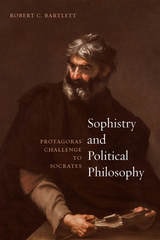
Sophistry and Political Philosophy
Protagoras' Challenge to SocratesRobert C. Bartlett
University of Chicago Press, 2016
With Sophistry and Political Philosophy, Robert C. Bartlett provides the first close reading of Plato’s two-part presentation of Protagoras. In the “Protagoras,” Plato sets out the sophist’s moral and political teachings, while the “Theaetetus,” offers a distillation of his theoretical and epistemological arguments. Taken together, the two dialogues demonstrate that Protagoras is attracted to one aspect of conventional morality—the nobility of courage, which in turn is connected to piety. This insight leads Bartlett to a consideration of the similarities and differences in the relationship of political philosophy and sophistry to pious faith. Bartlett’s superb exegesis offers a significant tool for understanding the history of philosophy, but, in tracing Socrates’s response to Protagoras’ teachings, Bartlett also builds toward a richer understanding of both ancient sophistry and what Socrates meant by “political philosophy.”
Speaking into the Air
A History of the Idea of CommunicationJohn Durham Peters
University of Chicago Press, 1999
"This is a most interesting and thought-provoking book. . . . Peters maintains that communication is ultimately unthinkable apart from the task of establishing a kingdom in which people can live together peacefully. Given our condition as mortals, communication remains not primarily a problem of technology, but of power, ethics and art." —Antony Anderson, New Scientist
"Guaranteed to alter your thinking about communication. . . . Original, erudite, and beautifully written, this book is a gem." —Kirkus Reviews
"Peters writes to reclaim the notion of authenticity in a media-saturated world. It's this ultimate concern that renders his book a brave, colorful exploration of the hydra-headed problems presented by a rapid-fire popular culture." —Publishers Weekly
What we have here is a failure-to-communicate book. Funny thing is, it communicates beautifully. . . . Speaking Into the Air delivers what superb serious books always do-hours of intellectual challenge as one absorbs the gradually unfolding vision of an erudite, creative author." —Carlin Romano, Philadelphia Inquirer
Speaking the Truth about Oneself
Lectures at Victoria University, Toronto, 1982Michel Foucault
University of Chicago Press, 2021
Just before the summer of 1982, French philosopher Michel Foucault gave a series of lectures at Victoria University in Toronto. In these lectures, which were part of his project of writing a genealogy of the modern subject, he is concerned with the care and cultivation of the self, a theme that becomes central to the second, third, and fourth volumes of his History of Sexuality. Foucault had always been interested in the question of how constellations of knowledge and power produce and shape subjects, and in the last phase of his life, he became especially interested not only in how subjects are formed by these forces but in how they ethically constitute themselves.
In this lecture series and accompanying seminar, Foucault focuses on antiquity, starting with classical Greece, the early Roman empire, and concluding with Christian monasticism in the fourth and fifth centuries AD. Foucault traces the development of a new kind of verbal practice—“speaking the truth about oneself”—in which the subject increasingly comes to be defined by its inner thoughts and desires. He deemed this new form of “hermeneutical” subjectivity important not just for historical reasons, but also due to its enduring significance in modern society.
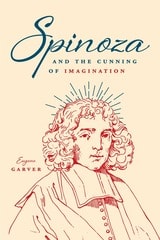
Spinoza and the Cunning of Imagination
Eugene Garver
University of Chicago Press, 2018
Spinoza initially presents imagination as an inadequate and confused way of thinking, always inferior to ideas that adequately represent things as they are. It would seem to follow that one ought to purge the mind of imaginative ideas and replace them with rational ideas as soon as possible, but as Garver shows, the Ethics don’t allow for this ultimate ethical act until one has cultivated a powerful imagination. This is, for Garver, “the cunning of imagination.” The simple plot of progress becomes, because of the imagination, a complex journey full of reversals and discoveries. For Garver, the “cunning” of the imagination resides in our ability to use imagination to rise above it.
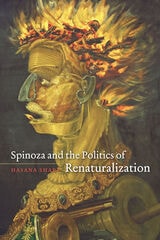
Spinoza and the Politics of Renaturalization
Hasana Sharp
University of Chicago Press, 2011
Spirit's Gift
The Metaphysical Insight of Claude BruaireAntonio López, F.S.C.B.
Catholic University of America Press, 2006

Spurs
Nietzsche's Styles/Eperons: Les Styles de NietzscheJacques Derrida
University of Chicago Press, 1981
Spurs, then, is aptly titled, for Derrida's "deconstructions" of Nietzsche's meanings will surely act as spurs to further thought and controversy. This dual-language edition offers the English-speaking reader who has some knowledge of French an opportunity to examine the stylistic virtuosity of Derrida's writing—of particular significance for his analysis of "the question of style."
Spurs
Nietzsche's Styles/Eperons: Les Styles de NietzscheJacques Derrida
University of Chicago Press, 1981
Spurs, then, is aptly titled, for Derrida's "deconstructions" of Nietzsche's meanings will surely act as spurs to further thought and controversy. This dual-language edition offers the English-speaking reader who has some knowledge of French an opportunity to examine the stylistic virtuosity of Derrida's writing—of particular significance for his analysis of "the question of style."
State Repression and the Labors of Memory
Elizabeth Jelin
University of Minnesota Press, 2003
A timely exploration of the nature of memory and its political uses
Hearing the news from South America at the turn of the millennium can be like traveling in time: here are the trials of Pinochet, the searches for “the disappeared” in Argentina, the investigation of the death of former president Goulart in Brazil, the Peace Commission in Uruguay, the Archive of Terror in Paraguay, a Truth Commission in Peru. As societies struggle to come to terms with the past and with the vexing questions posed by ineradicable memories, this wise book offers guidance.
Combining a concrete sense of present urgency and a theoretical understanding of social, political, and historical realities, State Repression and the Labors of Memory fashions tools for thinking about and analyzing the presences, silences, and meanings of the past. With unflappable good judgment and fairness, Elizabeth Jelin clarifies the often muddled debates about the nature of memory, the politics of struggles over memories of historical injustice, the relation of historiography to memory, the issue of truth in testimony and traumatic remembrance, the role of women in Latin American attempts to cope with the legacies of military dictatorships, and problems of second-generation memory and its transmission and appropriation. Jelin’s work engages European and North American theory in its exploration of the various ways in which conflicts over memory shape individual and collective identities, as well as social and political cleavages. In doing so, her book exposes the enduring consequences of repression for social processes in Latin America, and at the same time enriches our general understanding of the fundamentally conflicted and contingent nature of memory.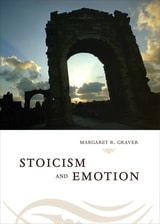
Stoicism and Emotion
Margaret Graver
University of Chicago Press, 2007
In this elegant and clearly written work, Margaret Graver gives a compelling new interpretation of the Stoic position. Drawing on a vast range of ancient sources, she argues that the chief demand of Stoic ethics is not that we should suppress or deny our feelings, but that we should perfect the rational mind at the core of every human being. Like all our judgments, the Stoics believed, our affective responses can be either true or false and right or wrong, and we must assume responsibility for them. Without glossing over the difficulties, Graver also shows how the Stoics dealt with those questions that seem to present problems for their theory: the physiological basis of affective responses, the phenomenon of being carried away by one’s emotions, the occurrence of involuntary feelings and the disordered behaviors of mental illness. Ultimately revealing the deeper motivations of Stoic philosophy, Stoicism and Emotion uncovers the sources of its broad appeal in the ancient world and illuminates its surprising relevance to our own.
Studies in Aristotle
Dominic J. O'Meara
Catholic University of America Press, 2018
Studies in Medieval Philosophy
John F. Wippel
Catholic University of America Press, 2018
Studies in Philosophy and the History of Philosophy
John K. Ryan
Catholic University of America Press, 2018
Studies in Philosophy and the History of Philosophy Vol. 2
John K. Ryan
Catholic University of America Press, 2018
Studies in Philosophy and the History of Philosophy Vol. 4
John K. Ryan
Catholic University of America Press, 2018
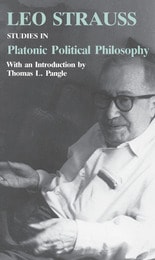
Studies in Platonic Political Philosophy
Leo Strauss
University of Chicago Press, 1983
As his choice of title indicates, the heart of Strauss's work is Platonism—a Platonism that is altogether unorthodox and highly controversial. These essays consider, among others, Heidegger, Husserl, Nietzsche, Marx, Moses Maimonides, Machiavelli, and of course Plato himself to test the Platonic understanding of the conflict between philosophy and political society. Strauss argues that an awesome spritual impoverishment has engulfed modernity because of our dimming awareness of that conflict.
Thomas Pangle's Introduction places the work within the context of the entire Straussian corpus and focuses especially on Strauss's late Socratic writings as a key to his mature thought. For those already familiar with Strauss, Pangle's essay will provoke thought and debate; for beginning readers of Strauss, it provides a fine introduction. A complete bibliography of Strauss's writings if included.
Subject Of Philosophy
Phillipe Lacoue-Labarthe
University of Minnesota Press, 1993
Swimming Against the Current in Contemporary Philosophy
Harry B. Veatch
Catholic University of America Press, 2018
Symposium Of Plato
Shelley TranslationPercy Bysshe Shelley
St. Augustine's Press, 2002