Results by title
94 books match the query 'Middle Ages, 600-1500' and 7 start with s
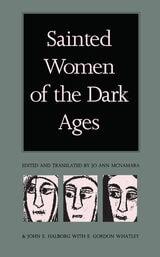
Sainted Women of the Dark Ages
Jo Ann McNamara, John E. Halborg, and Gordon Whatley, eds.
Duke University Press, 1992
Sainted Women of the Dark Ages makes available the lives of eighteen Frankish women of the sixth and seventh centuries, all of whom became saints. Written in Latin by contemporaries or near contemporaries, and most translated here for the first time, these biographies cover the period from the fall of the Roman Empire and the conversion of the invading Franks to the rise of Charlemagne's family.
Three of these holy women were queens who turned to religion only after a period of intense worldly activity. Others were members of the Carolingian family, deeply implicated in the political ambitions of their male relatives. Some were partners in the great Irish missions to the pagan countryside and others worked for the physical salvation of the poor. From the peril and suffering of their lives they shaped themselves as paragons of power and achievement. Beloved by their sisters and communities for their spiritual gifts, they ultimately brought forth a new model of sanctity.
These biographies are unusually authentic. At least two were written by women who knew their subjects, while others reflect the direct testimony of sisters within the cloister walls. Each biography is accompanied by an introduction and notes that clarify its historical context. This volume will be an excellent source for students and scholars of women's studies and early medieval social, religious, and political history.
[more]
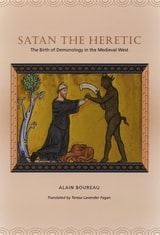
Satan the Heretic
The Birth of Demonology in the Medieval WestAlain Boureau
University of Chicago Press, 2006
Before the end of the thirteenth century, theologians had little interest in demons, but with Thomas Aquinas and his formidable “Treatise on Evil” in 1272, everything changed. In Satan the Heretic, Alain Boureau trains his skeptical eye not on Satan or Satanism, but on the birth of demonology and the sudden belief in the power of demons who inhabited Satan’s Court, setting out to understand not why people believed in demons, but why theologians—especially Pope John XXII—became so interested in the subject.
Depicting this new demonology, Satan the Heretic considers the period between the mid-thirteenth and mid-fourteenth centuries when demons, in the eyes of Church authorities, suddenly burst forth, more real and more terrifying than ever before in the history of Christianity. Boureau argues that the rise in this obsession with demons occurs at the crossroads of the rise of sovereignties and of the individual, a rise that, tellingly, also coincides with the emergence of the modern legal system in the European West.
Teeming with original insights and lively anecdotes, Satan the Heretic is a significant contribution to the history of Christian demonology from one of the most original minds in the field of medieval studies today.
[more]
Sin
A Thomistic PsychologySteven J. Jensen
Catholic University of America Press, 2018
If the human soul is made for good, then how do we choose evil? On the other hand, perhaps the human soul is not made for good. Perhaps the magnitude of human depravity reveals that the human soul may directly choose evil. Notably, Thomas Aquinas rejects this explanation for the prevalence of human sin. He insists that in all our desires we seek what is good. How, then, do we choose evil? Only by mistaking evil for good. This solution to the difficulty, however, leads Aquinas into another conundrum. How can we be held responsible for sins committed under a misunderstanding of the good? The sinner, it seems, has simply made an intellectual blunder. Sin has become an intellectual defect rather than a depravity of will and desire. Sin: A Thomistic Psychology grapples with these difficulties. A solution to the problem must address a host of issues. Does the ultimate good after which we all strive have unity, or is it simply a collection of basic goods? What is venial sin? What momentous choice must a child make in his first moral act? In what way do passion, a habitually evil will, and ignorance cause human beings to sin? What is the first cause of moral evil? Do human beings have free will to determine themselves to particular actions? The discussion of these topics focuses upon the interplay of reason, will, and the emotions, examining the inner workings of our moral deliberations. Ultimately, the book reveals how the failure to maintain balance in our deliberations subverts our fidelity to the one true good.
[more]
Sisters and Workers in the Middle Ages
Edited by Judith M. Bennett, Elizabeth A. Clark, Jean F. O'Barr, B. Anne Vilen,
University of Chicago Press, 1989
Focusing on medieval women with a wide range of occupations and life-styles, the interdisciplinary essays in this collection examine women's activities within the patriarchal structures of the time. Individual essays explore women's challenges to a sexual ideology that confined them strictly to the roles of wives, mothers, and servants. Also included are sections on women and work, cultural production and literacy, and religious life.
These essays provide a greater understanding of the ways in which gender has played a part in determining relations of power in Western cultures. This volume makes a vital contribution to the current scholarship about women in the Middle Ages.
These essays provide a greater understanding of the ways in which gender has played a part in determining relations of power in Western cultures. This volume makes a vital contribution to the current scholarship about women in the Middle Ages.
[more]
Speaking the Incomprehensible God
Thomas Aquinas on the Interplay of Positive and Negative TheologyGregory P. Rocca O.P.
Catholic University of America Press, 2004
Gregory Rocca's nuanced discussion prevents Aquinas's thought from being capsulized in familiar slogans and is an antidote to unilateralist or monochrome views about God-talk.
[more]
Spiraling Into God
Bonaventure on Grace, Hierarchy , and HolinessKatherine Wrisley Shelby
Catholic University of America Press, 2023
Spiraling into God: Bonaventure on Grace, Hierarchy, and Holiness offers a systematic account of the Seraphic Doctor’s doctrine of grace across his speculative-academic, mystical, hagiographical, and pastoral texts. It does so by arguing that an account of this kind can only be provided by also attending to his theology of hierarchy, a methodology derived from Bonaventure’s claim in the Major Legend of St. Francis that Francis of Assisi was a “vir hierarchicus,” or hierarchical man. As the book explores in great depth, this appellation relies upon Bonaventure’s reading of a Victorine Dionysian interpreter by the name of Thomas Gallus, whose “angelic anthropology”—or notion of the hierarchical soul—becomes a crucial component within the Seraphic Doctor’s teaching on grace as he interprets the sanctity of St. Francis. Throughout the course of his career, Bonvaenture will define sanctifying grace as a created “inflowing” (influentia) that “hierarchizes” human beings by purifying, illuminating, and perfecting them from within, thus causing them to become a similitude of the Trinity. This book explains what this means and why it matters.
Most existing scholarship on this subject in Bonaventure’s thought interprets it as a subtopic with respect to other themes—for example, with respect to his Christology or his Trinitarian theology—rather than taking the time to understand his doctrine of grace in its own right. Alternatively, scholarly treatments of his doctrine of grace will treat it at length, but will only examine the topic as it appears in his more speculative-academic texts—most especially his Commentary on the Sentences or his famous Itinerarium Mentis in Deum—without bringing these into conversation with his pastoral works, sermon literature, or hagiographical texts. This book provides the first unified treatment of Bonaventure’s doctrine of grace across all these different genres of his known corpus, and in so doing, fills a massive lacuna in both Bonaventurean scholarship and in the field of medieval historical theology.
[more]
Syriac Christian Culture
Beginnings to RenaissanceAaron Michael Butts
Catholic University of America Press, 2021
Syriac Christianity developed in the first centuries CE in the Middle East, where it continued to flourish throughout Late Antiquity and the Medieval period, while also spreading widely, as far as India and China. Today, Syriac Christians are found in the Middle East, in India, as well in diasporas scattered across the globe. Over this extended time period and across this vast geographic expanse, Syriac Christians have built impressive churches and monasteries, crafted fine pieces of art, and written and transmitted a sizable body of literature. Though often overlooked, neglected, and even persecuted, Syriac Christianity has been – and continues to be – an important part of the humanistic heritage of the last two millennia.
The present volume brings together fourteen studies that offer fresh perspectives on Syriac Christianity, especially its literary texts and authors. The timeframes of the individual studies span from the second-century Syriac translation of the Hebrew Bible up to the thirteenth century with the end of the Syriac Renaissance. Several studies analyze key authors from Late Antiquity, such as Aphrahat, Ephrem, Narsai, and Jacob of Serugh. Others investigate translations into Syriac, both from Hebrew and from Greek, while still others examine hagiography, especially its formation and transmission. Reflecting a growing trend in the field, the volume also devotes significant attention to the Medieval period, during which Syriac Christians lived under Islamic rule. The studies in the volume are united in their quest to explore the richness, diversity, and vibrance of Syriac Christianity.
[more]