Results by title
159 books match the query 'Minnesota' and 18 start with s

Salt Lantern
Traces of an American FamilyWilliam Towner Morgan
University of Iowa Press, 1997
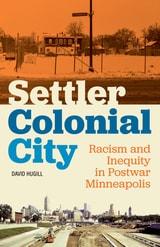
Settler Colonial City
Racism and Inequity in Postwar MinneapolisDavid Hugill
University of Minnesota Press, 2021
Revealing the enduring link between settler colonization and the making of modern Minneapolis
Colonial relations are often excluded from discussions of urban politics and are viewed instead as part of a regrettable past. In Settler Colonial City, David Hugill confronts this culture of organized forgetting by arguing that Minnesota’s largest city is enduringly bound up with the power dynamics of settler-colonial politics. Examining several distinct Minneapolis sites, Settler Colonial City tracks how settler-colonial relations were articulated alongside substantial growth in the Twin Cities Indigenous community during the second half of the twentieth century—creating new geographies of racialized advantage.
Studying the Phillips neighborhood of Minneapolis in the decades that followed the Second World War, Settler Colonial City demonstrates how colonial practices and mentalities shaped processes of urban reorganization, animated non-Indigenous “advocacy research,” informed a culture of racialized policing, and intertwined with a broader culture of American imperialism. It reveals how the actions, assumptions, and practices of non-Indigenous people in Minneapolis produced and enforced a racialized economy of power that directly contradicts the city’s “progressive” reputation.
Ultimately, Settler Colonial City argues that the hierarchical and racist political dynamics that characterized the city’s prosperous beginnings are not exclusive to a bygone era but rather are central to a recalibrated settler-colonial politics that continues to shape contemporary cities across the United States.
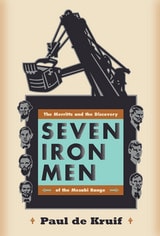
Seven Iron Men
The Merritts and the Discovery of the Mesabi RangePaul de Kruif
University of Minnesota Press, 2007
In the tradition of great American rags to riches stories, Seven Iron Men weaves together the history of how the seven Merritt brothers discovered iron ore on the Mesabi Range. In 1890 they were poised to become one of the wealthiest families in America but lost it all to industrialist John D. Rockefeller.
“The tale of their long and furious quest makes for one of the most melodramatic stories in American history. . . . The Merritts leap from the chronicle in all the colors of life—especially Lon, the king of them all, with his maudlin poetizing, his childlike faith in mankind, and his incredible tropical hat. It is a tale full of thrills, shot with sardonic humors.” —H. L. Mencken, The Nation
“Certainly it is no small contribution to the history of the American people to unfold the tale of the discovery and development of those huge iron deposits of the Mesabi Range flanking much of Lake Superior. To these perhaps quite as much as to any other one factor the country owes its industrial supremacy in the ago of steel.” —New York Herald Tribune
Paul de Kruif (1890–1971) was a microbiologist, served as a contributing editor to Reader’s Digest, and was the best-selling author of Microbe Hunters.

Sherlock Holmes and the Ice Palace Murders
Larry Millett
University of Minnesota Press, 2010

Sherlock Holmes and the Red Demon
Larry Millett
University of Minnesota Press, 2010
The manuscript contains the story of how Sherlock Holmes and Watson traveled to Minnesota to track a murderous arsonist—known only as the Red Demon—who is threatening both Hill and his Great Northern Railway. Set against the backdrop of the real, devastating Hinckley forest fire of 1894, Sherlock Holmes and the Red Demon is the tense and atmospheric first novel in Larry Millett’s classic series of adventures that brought Sherlock Holmes and Dr. Watson to Minnesota.

Sherlock Holmes and the Secret Alliance
Larry Millett
University of Minnesota Press, 2012
As the city of Minneapolis prepares for a visit from President William McKinley, someone else prepares for murder. On the day before the visit, a union activist is found hanged, naked, outside a ruined mansion. A placard around his neck reads “THE SECRET ALLIANCE HAS SPOKEN.” Who is the alliance? What does it want? How was the victim involved with the city’s corrupt mayor? And why did he possess a photograph of a prominent citizen in a compromising position? Shadwell Rafferty searches for answers, encountering bribery, corruption, union organizers, anarchists, and conspiracy, putting himself in danger. But as luck would have it, his old friends Sherlock Holmes and Dr. John H. Watson are on their way.
In this fourth installment of Larry Millett’s Minnesota Mystery series, Shadwell Rafferty commands center stage in a brand-new city. Packed with Millett’s signature historical and architectural detail, this book is deviously delightful.

Ship Captain's Daughter
Growing Up on the Great LakesAnn Michler Lewis
Wisconsin Historical Society Press, 2015
Ann Lewis's childhood was marked by an unusual rhythm. Each year the thawing and freezing of the Great Lakes signaled the beginning and end of the shipping season, months of waiting that were punctuated by brief trips to various ports to meet her father, the captain.
With lively storytelling and vivid details, Lewis captures the unusual life of shipping families whose days and weeks revolved around the shipping industry on the Great Lakes. She paints an intriguing and affectionate portrait of her father, a talented pianist whose summer job aboard an ore freighter led him to a life on the water. Working his way up from deckhand to ship captain, Willis Michler became the master of thirteen ships over a span of twenty-eight years. From the age of twelve, Ann accompanied the captain to the ports of Milwaukee, Chicago, Toledo, and Cleveland on the lower Great Lakes. She describes sailing through stormy weather and starry nights, visiting the engine room, dining at the captain's table, and wheeling the block-long ship with her father in the pilot house. Through her mother's stories and remarks, Lewis also reveals insights into the trials and rewards of being a ship captain's wife. The book is enhanced by the author's vintage snapshots, depicting this bygone lifestyle.

Sister City Diplomacy
Community Engagement in U.S.–Russian Relations from the Cold War to TodayDouglas C. Nord
University of Wisconsin Press, 2025
Sister City Diplomacy offers a historical account of citizen diplomacy set in a unique political and social environment. But in its theoretical grounding and informed arguments, this study speaks to much broader and contemporary concerns, both in terms of United States–Russian relations today and with regard to the challenges and opportunities of community-based diplomacy in general. Lessons learned along the shores of Lakes Superior and Onega in the last days of the Cold War hold great value given the heightened tensions of current geopolitics.

Sky Blue Water
Great Stories for Young ReadersJay D. Peterson
University of Minnesota Press, 2016
A one-of-a-kind collection of short stories for adolescent readers that celebrates Minnesota’s vibrant storytelling tradition—now in paperback
From the Dakota people who first inhabited the state to its generations of immigrants and today’s residents, Minnesota has long had a vibrant and unique storytelling tradition. A rich and often under appreciated part of this tradition is youth storytelling—a movement of which Minnesota is a national forerunner. Here, for the first time, two of the state’s beloved independent booksellers collect a wide array of short stories for young readers that pay homage to Minnesota's diverse cultures and stunning landscapes.
Sky Blue Water celebrates young adult and intermediate fiction from some of Minnesota’s most beloved and award-winning authors to emerging talents and many more. With each turn of the page, every young reader will find a poignant and relatable story: tales of discovering hidden truths about one’s family, dealing with a difficult bully, and falling for the new kid who dresses like a cowboy, as well as settings from Rainy Lake to Lake Calhoun and time periods from Prohibition to the present day. Featuring primarily never-published stories, this anthology beautifully captures the essence of a Minnesota adolescence in twenty short stories and poems. Sky Blue Water features a Q&A between Minnesota classrooms and the contributing authors as well as curriculum materials for families, teachers, and students.
This collection embodies passion for fostering literacy in young readers. A portion of the proceeds from Sky Blue Water will go to the Mid-Continent Oceanographic Institute, a Twin Cities organization offering free tutoring and writing assistance for students ages six to eighteen.
Contributors: William Alexander; Swati Avasthi; Kelly Barnhill; Mary Casanova; John Coy; Kirstin Cronn-Mills; Anika Fajardo; Shannon Gibney; Pete Hautman; Lynne Jonell; Kevin Kling; Margi Preus; Marcie Rendon; Kurtis Scaletta; Julie Schumacher; Joyce Sidman; Phuoc Thi Minh Tran; Anne Ursu; Sarah Warren; Stephanie Watson; Kao Kalia Yang.
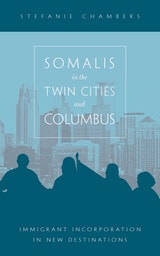
Somalis in the Twin Cities and Columbus
Immigrant Incorporation in New DestinationsStephanie Chambers
Temple University Press, 2017
In the early 1990s, Somali refugees arrived in Minneapolis and St. Paul, Minnesota. Later in the decade, an additional influx of immigrants arrived in a second destination of Columbus, Ohio. These refugees found low-skill jobs in warehouses and food processing plants and struggled as social “outsiders,” often facing discrimination based on their religious traditions, dress, and misconceptions that they are terrorists. The immigrant youth also lacked access to quality educational opportunities.
In Somalis in the Twin Cities and Columbus, Stefanie Chambers provides a cogent analysis of these refugees in Midwestern cities where new immigrant communities are growing. Her comparative study uses qualitative and quantitative data to assess the political, economic, and social variations between these urban areas. Chambers examines how culture and history influenced the incorporation of Somali immigrants in the U.S., and recommends policy changes that can advance rather than impede incorporation.
Her robust investigation provides a better understanding of the reasons these refugees establish roots in these areas, as well as how these resettled immigrants struggle to thrive.
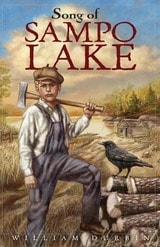
Song of Sampo Lake
William Durbin
University of Minnesota Press, 2011

Streams and Rivers of Minnesota
Thomas Waters
University of Minnesota Press, 1980

Strike!
Twenty Days in 1970 When Minneapolis Teachers Broke the LawWilliam D. Green
University of Minnesota Press, 2022
When viewed from our turbulent times, the Minneapolis of fifty years ago might seem serene, but Minneapolis schoolteachers of the day remember it quite differently. It was, author William D. Green said of their recollections, as if they’d been through war. This book recreates twenty days in April 1970 when a then-illegal strike by Minneapolis’s public school teachers marked a singular moment of cultural upheaval—and forever changed the city’s politics, labor law, educational climate, and the right to collective bargaining.
Since the inception of public education in Minnesota, teachers were expected to pursue their vocation out of civic spirit, with low wages, no benefits, and no job security. Strike! describes the history and circumstances leading to the teachers’ extraordinary action, which pitted the progressive and conservative teachers’ unions against each other—and both against the all-powerful school district, a hostile governor and state legislature, and a draconian Minnesota law. Capturing the intense emotions and heated rivalries of the strike, Green profiles the many actors involved, the personal and professional stakes, and the issues of politics, law, and the business of education.
Informed by interviews, firsthand accounts, news reports, and written records, Strike! brings to life a pivotal moment not just for Minneapolis’s teachers but for the city itself, whose government, school system, and culture would, in a complex but inexorable way, change course for good.

Student Self-Support at the University of Minnesota
James Umstattd
University of Minnesota Press, 1932
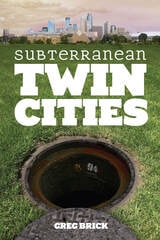
Subterranean Twin Cities
Greg Brick
University of Minnesota Press, 2009
We tend to send things underground that we are not interested in ever seeing again. Sewage. Garbage. In the past, we have used the underground to age such provisions as cheese and beer. In Subterranean Twin Cities, geologist, historian, and urban speleologist Greg Brick takes us on an adventurous, educational, and—thankfully—sanitary tour beneath the streets and into the myriad tunnels, caves, and industrial spaces that make up the Twin Cities’ fascinating and surprisingly vast underground landscape.
In this groundbreaking tour, the first of its kind of the Twin Cities, Brick mines the stories that lie below the city surface. Beginning with an accessible history on the geology of the area—including the giant cone-shaped mollusk Endoceras, whose thirteen-foot-long fossils are found in the Mississippi gorge—Brick guides us into a series of astounding firsthand expeditions. We follow him into St. Paul’s historic Carver’s Cave, with its stories of sunken treasure; through the many caves constructed for brewing, cheese ripening, and mushroom farming; and into the world of nineteenth-century show caves for tourists. We even find ourselves in the “Shangri-la” of urban caves: the extensive Schiek’s Cave seventy-five feet beneath the busy streets of downtown Minneapolis.
From spending the onset of Y2K in Carver’s Cave (just in case) to long hours wading in underground rivers, Brick proves himself a knowledgeable, wry, and daring guide. Subterranean Twin Cities shines a headlamp (with extra batteries, of course) into the captivating labyrinths beneath the Twin Cities and reminds us that what we see aboveground is really only half of the story.

Sugar Bush Babies
Stories of My Ojibwe GrandmotherJanis A. Fairbanks
University of Minnesota Press, 2025
A memoir of lessons learned from an Ojibwe grandmother during the time of Relocation
Why, her mother asked, did Janis keep running away from kindergarten? She wanted to go home. But not to the house they had just moved to in Duluth, with its gravel yard and traffic noise. She was a country girl, and home was the log cabin among the wildflowers on the Leech Lake Indian Reservation in Bena, Minnesota. Knowing they were now going to stay in the city, Janis’s parents offered her a compromise: during the summer, Janis could leave the bustle of Duluth and live with her grandmother on the Fond du Lac Reservation, listening to stories, learning Ojibwe, and finding her place in the world. In Sugar Bush Babies, Janis A. Fairbanks returns to that time of Relocation, dislocation, and discovery, taking us home with her through stories of childhood and lessons learned at her grandmother’s knee, enveloped in love and tradition.
Through the eyes of a child and the teachings of an elder, Fairbanks revisits her life during Indian Relocation from reservations to urban areas, from Ojibwe villages to white communities whose ideas about Indians came from Hollywood Westerns. Recalling her early childhood at Leech Lake, her school days in Duluth, and her summers in Fond du Lac, Janis brings the gifts of living history full circle, continuing the traditions of carrying family lore, women’s wisdom, and Indigenous culture from generation to generation.
There are tales told at nighttime or during thunderstorms; lessons in Native medicine; stories of Grandma’s recollections of boarding school, Daddy’s days as a lumberjack, and Mother’s special powers; memories of wash days and dancing, of powwows and Girl Scout camp, of snaring rabbits, selling lilacs, and attending the circus. A lyrical memoir, Sugar Bush Babies conveys the eloquence of women speaking and sharing through generations and the lasting power of tradition.

Superior North Shore
A Natural History of Lake Superior’s Northern Lands and WatersThomas F. Waters
University of Minnesota Press, 1999
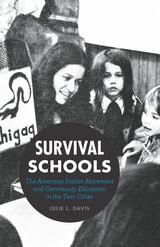
Survival Schools
The American Indian Movement and Community Education in the Twin CitiesJulie L. Davis
University of Minnesota Press, 2013
In the late 1960s, Indian families in Minneapolis and St. Paul were under siege. Clyde Bellecourt remembers, “We were losing our children during this time; juvenile courts were sweeping our children up, and they were fostering them out, and sometimes whole families were being broken up.” In 1972, motivated by prejudice in the child welfare system and hostility in the public schools, American Indian Movement (AIM) organizers and local Native parents came together to start their own community school. For Pat Bellanger, it was about cultural survival. Though established in a moment of crisis, the school fulfilled a goal that she had worked toward for years: to create an educational system that would enable Native children “never to forget who they were.”
While AIM is best known for its national protests and political demands, the survival schools foreground the movement’s local and regional engagement with issues of language, culture, spirituality, and identity. In telling of the evolution and impact of the Heart of the Earth school in Minneapolis and the Red School House in St. Paul, Julie L. Davis explains how the survival schools emerged out of AIM’s local activism in education, child welfare, and juvenile justice and its efforts to achieve self-determination over urban Indian institutions. The schools provided informal, supportive, culturally relevant learning environments for students who had struggled in the public schools. Survival school classes, for example, were often conducted with students and instructors seated together in a circle, which signified the concept of mutual human respect. Davis reveals how the survival schools contributed to the global movement for Indigenous decolonization as they helped Indian youth and their families to reclaim their cultural identities and build a distinctive Native community.
The story of these schools, unfolding here through the voices of activists, teachers, parents, and students, is also an in-depth history of AIM’s founding and early community organizing in the Twin Cities—and evidence of its long-term effect on Indian people’s lives.