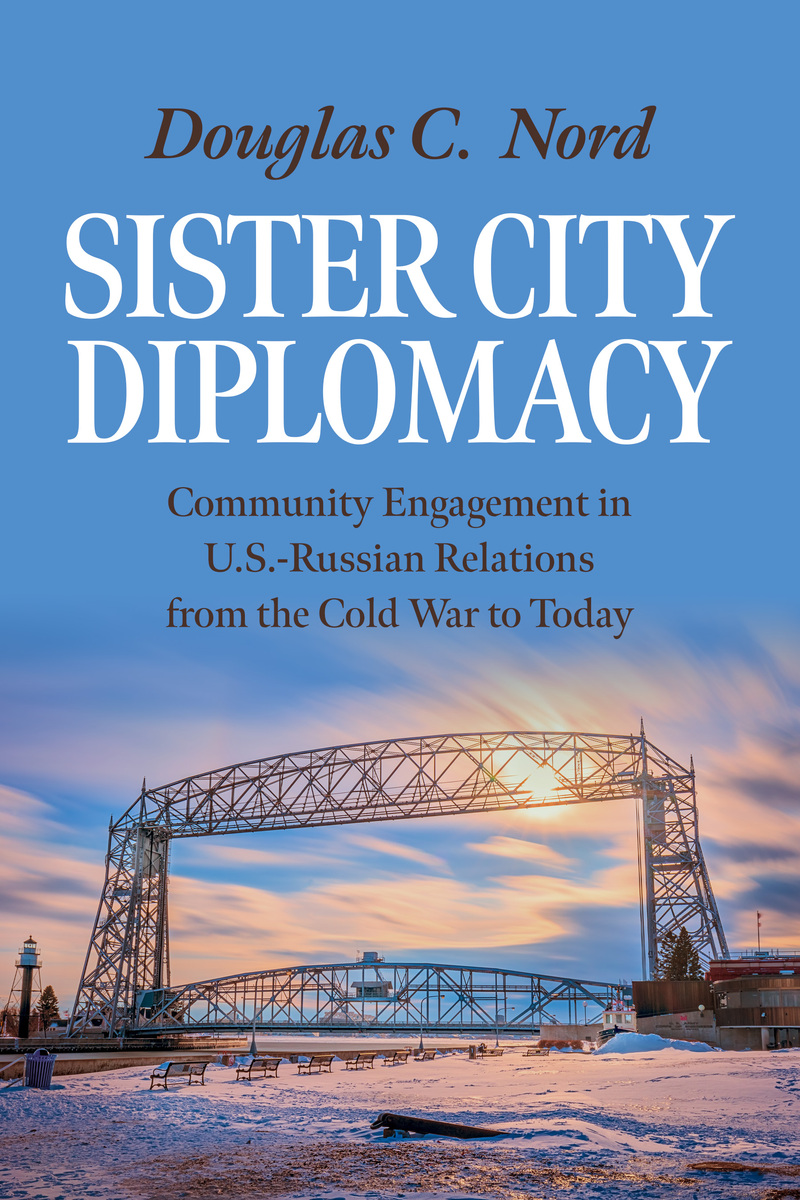
Sister City Diplomacy: Community Engagement in U.S.–Russian Relations from the Cold War to Today
University of Wisconsin Press, 2025
Cloth: 978-0-299-35290-5 | eISBN: 978-0-299-35298-1 (ePub) | eISBN: 978-0-299-35293-6 (PDF)
Library of Congress Classification E183.8.R9N665 2025
Dewey Decimal Classification 303.482776771047
Cloth: 978-0-299-35290-5 | eISBN: 978-0-299-35298-1 (ePub) | eISBN: 978-0-299-35293-6 (PDF)
Library of Congress Classification E183.8.R9N665 2025
Dewey Decimal Classification 303.482776771047
ABOUT THIS BOOK | AUTHOR BIOGRAPHY | REVIEWS | TOC | REQUEST ACCESSIBLE FILE
ABOUT THIS BOOK
In 1987, Duluth, Minnesota, and Petrozavodsk, in what is now Russia, officially joined hands as sister cities. Douglas C. Nord tells the stories of their collaboration in the context of the late Cold War, covering in substantial detail the lived experiences of city officials, community leaders, academics, and average citizens who worked to bridge the divide between the United States and the Soviet Union. What circumstances supported or undermined efforts to conduct people-to-people diplomacy? What internal difficulties emerged, and how were they overcome? And what were the short-term effects and long-term consequences of the relationships forged in these postindustrial cities, across an ideological divide as deep and wide as the ocean that separated them?
Sister City Diplomacy offers a historical account of citizen diplomacy set in a unique political and social environment. But in its theoretical grounding and informed arguments, this study speaks to much broader and contemporary concerns, both in terms of United States–Russian relations today and with regard to the challenges and opportunities of community-based diplomacy in general. Lessons learned along the shores of Lakes Superior and Onega in the last days of the Cold War hold great value given the heightened tensions of current geopolitics.
Sister City Diplomacy offers a historical account of citizen diplomacy set in a unique political and social environment. But in its theoretical grounding and informed arguments, this study speaks to much broader and contemporary concerns, both in terms of United States–Russian relations today and with regard to the challenges and opportunities of community-based diplomacy in general. Lessons learned along the shores of Lakes Superior and Onega in the last days of the Cold War hold great value given the heightened tensions of current geopolitics.
See other books on: Community Engagement | Diplomacy | Minnesota | Russia (Federation) | Today
See other titles from University of Wisconsin Press