193 books match the query 'Modernism (Literature)' and 9 start with s
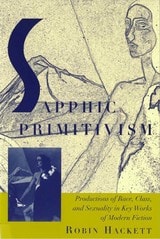
cover of Sapphic Primitivism: Productions of Race, Class, and Sexuality in Key Works of Modern Fiction

Sapphic Primitivism

Productions of Race, Class, and Sexuality in Key Works of Modern Fiction

Hackett, Robin

Rutgers University Press, 2003

In this book, Robin Hackett examines portrayals of race, class, and sexuality in modernist texts by white women to argue for the existence of a literary device that she calls “Sapphic primitivism.” The works vary widely in their form and content and include Olive Schreiner’s proto-modernist exploration of New Womanhood, The Story of an African Farm; Virginia Woolf’s high modernist “play-poem,” The Waves; Sylvia Townsend Warner’s historical novel, Summer Will Show; and Willa Cather’s Southern pastoral, Sapphira and the Slave Girl. In each, blackness and working-class culture are figured to represent sexual autonomy, including lesbianism, for white women. Sapphic primitivism exposes the ways several classes of identification were intertwined with the development of homosexual identities at the turn of the century. Sapphic primitivism is not, however, a means of disguising lesbian content. Rather, it is an aesthetic displacement device that simultaneously exposes lesbianism and exploits modern, primitivist modes of self-representation. Hackett’s revelations of the mutual interests of those who study early twentieth-century constructions of race and sexuality and twenty-first-century feminists doing anti-racist and queer work are a major contribution to literary studies and identity theory.
[more]
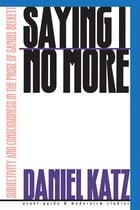
cover of Saying I No More: Subjectivity and Consciousness in the Prose of Samuel Beckett

Saying I No More

Subjectivity and Consciousness in the Prose of Samuel Beckett

Daniel Katz

Northwestern University Press, 1999
In recent criticism, Samuel Beckett's prose has been increasingly described as a labor of refusal: not only of what traditionally has made possible narrative and the novel but also of the major conventional suppositions concerning the primacy of consciousness, subjectivity, and expression for the artistic act. Beginning from the premise that Beckett never betrays his belief in "the impossibility to express," Saying I No More explores the Beckettian refusal. Katz posits that the expression of voicelessness in Beckett is not silence, that the negativity and negation so evident in the great writer's work are not simply affirmed, but that the valorization of abnegation, emptiness, impotence, or the "no" can all too easily become itself an affirmation of power or an inverted imposition of force.
[more]
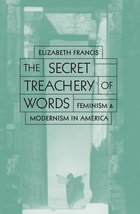
cover of Secret Treachery Of Words: Feminism And Modernism In America

Secret Treachery Of Words

Feminism And Modernism In America

Elizabeth Francis

University of Minnesota Press, 2002
Untangles the intertwined relationship between feminism and modernism through a look at four major figures of the era. In the early decades of the twentieth century, women's pursuit of freedom and independence earned both the adulation and the scorn of American modernists. Elizabeth Francis traces this unexpected, complex strain in cultural history through the stories of four legendary American figures--Isadora Duncan, Margaret Anderson, Floyd Dell, and Josephine Herbst. The Secret Treachery of Words begins in the early 1910s, when feminism was an essential part of "the shock of the new" that modernist art and thought introduced to American culture. Francis follows an arc of treacherous repression into the 1920s and 1930s, as feminists broke out of the mold of Victorian culture only to find themselves bound by the historical representation so central to modernism. Francis's four portraits vividly reveal the dynamic tensions in feminist modernism: in Duncan's performances of the female body, Anderson's manifestos of self-expression and cultural outlawry, Dell's advocacy of the revolutionary potential of sex, and Herbst's insights into cultural and political marginality. Part of a new appreciation of the diversity of American modernism, The Secret Treachery of Words discloses both the centrality and the critical impasses of feminist and modernist engagements with modern culture. Elizabeth Francis teaches American history at the University of Rhode Island.
[more]
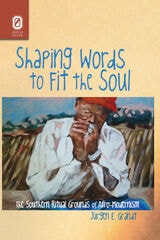
cover of Shaping Words to Fit the Soul: The Southern Ritual Grounds of Afro-Modernism

Shaping Words to Fit the Soul

The Southern Ritual Grounds of Afro-Modernism

Jürgen E. Grandt

The Ohio State University Press, 2009
Taking up where he left off with Kinds of Blue (The Ohio State University Press, 2004), Jürgen E. Grandt seeks to explore in depth some of the implications of the modernist jazz aesthetic resonating in the African American literary tradition. Grandt’s new book, Shaping Words to Fit the Soul:The Southern Ritual Grounds of Afro-Modernism, probes the ways in which modernism’s key themes of fragmentation, alienation, and epistemology complicate the mapping of the American South as an “authenticating” locus of African American narrative. Rather than being a site of authentication, the South constitutes a symbolic territory that actually resists the very narrative strategies deployed to capture it.
 
The figurative ritual grounds traversed in texts by Frederick Douglass, Jean Toomer, Richard Wright, and Tayari Jones reveal Afro-modernism as modernism with a historical conscience. Since literary Afro-modernism recurrently points to music as a symbolic territory of liberatory potential, this study also visits a variety of soundscapes, from the sorrow songs of the slaves to the hip-hop of the Dirty South, and from the blues of W. C. Handy to the southern rock of the Allman Brothers Band.
 
Afro-modernism as modernism with a historical conscience thus suggests a reconfiguration of southern ritual grounds as situated in time and mind rather than time and place, and the ramifications of this process extend far above and beyond the Mason-Dixon Line.
 
 
[more]
cover of Singing the Chaos: Madness and Wisdom in Modern Poetry

Singing the Chaos

Madness and Wisdom in Modern Poetry

William Pratt

University of Missouri Press, 1996

Singing the Chaos: Madness and Wisdom in Modern Poetry combines both a historical and a critical approach toward the works of major British, American, French, German, and Russian poets. Comprehensive in scope and arranged chronologically to survey a century of high poetic achievement, the study is unified by Pratt's overriding argument that "modern poets have endowed a disintegrating civilization with humane wisdom by 'singing the chaos' that surrounds them, making ours a great age in spite of itself."

In developing this central theme, Pratt brings alive the energy, the freshness, and the originality of technique that made Baudelaire, Pound, Yeats, Rilke, Eliot, and others the initiators of the revolution in poetry. He brings a more complete, clearer perspective to other major themes: modernism as an age of irony; poets as both madmen and geniuses; the modern poet as tragic hero; the dominance of religious or visionary truths over social or political issues; and the combination of radical experiments in poetic form with an apocalyptic view of Western civilization. His detailed treatment of the Fugitive poets and his recognition of their prominent role in twentieth-century literature constitute an important historical revision.

Brilliantly informed, insightful, and, above all, accurately sympathetic to the points of view of the poets Pratt presents, Singing the Chaos is that rare book that belongs on all shelves devoted to modernist poetry.

[more]
cover of Six Modernist Moments in Poetry

Six Modernist Moments in Poetry

David Young

University of Iowa Press, 2006
This study of six modernist poems by six different poets demonstrates the multiple facets of modernism. By showing not only what the poets and poems have in common but also by exploring their remarkable diversity, David Young reveals that the modernist narrative is really many narratives at once. Young believes that modernist poetic practice can best be demonstrated through close attention to particular poems. In this composite portrait of high modernist poetry, each of the book's six chapters reads one key modernist poem in the light of emergent modernism. The six poets discussed here--four writing in English, one in German, and one in Italian--emerge as distinctive practitioners of a common aesthetic, one that challenged received ideas and patterns of thinking from a variety of perspectives. “Making it new” was very much what modernism was all about, and these six examples demonstrate that fully.Along with the four poems written in English, the two non-English poems are presented and discussed in Young's own translations. He describes the provenance of each of the six poems, puts it in the context of its time and the poet's career, and surrounds it with references to other poems that are quoted generously. In this way, each poem is not only fully explicated but also presented as a kind of preeminent example representing other poems of its type.Combining close reading with contextual discussion, this book is a significant contribution to the fields of poetry and modernism. The impeccable scholarship is presented in an accessible, engaging manner. Written for general readers as well as for scholars, it will shed a new and timely light on some of the 20th century's finest poems.
[more]
cover of Slapstick Modernism: Chaplin to Kerouac to Iggy Pop

Slapstick Modernism

Chaplin to Kerouac to Iggy Pop

William Solomon

University of Illinois Press, 2018

Slapstick comedy landed like a pie in the face of twentieth-century culture. Pratfalls percolated alongside literary modernism throughout the 1920s and 1930s before slapstick found explosive expression in postwar literature, experimental film, and popular music.

William Solomon charts the origins and evolution of what he calls slapstick modernism--a merging of artistic experimentation with the socially disruptive lunacy made by the likes of Charlie Chaplin. Romping through texts, films, and theory, Solomon embarks on an intellectual odyssey from the high modernism of Dos Passos and Williams to the late modernism of the Beats and Burroughs before a head-on crash into the raw power of punk rock. Throughout, he shows the links between the experimental writers and silent screen performers of the early century, and explores the potent cultural undertaking that drew inspiration from anarchical comedy after World War II.
[more]
cover of Split-Gut Song: Jean Toomer and the Poetics of Modernity

Split-Gut Song

Jean Toomer and the Poetics of Modernity

Karen Jackson Ford

University of Alabama Press, 2005

Reclaiming Jean Toomer as a radical innovator of African American modernist poetics.

In Split-Gut Song, Karen Jackson Ford looks at what it means to be African American, free, and creative by analyzing Jean Toomer's main body of work, specifically, his groundbreaking creation Cane. When first published in 1923, this pivotal work of modernism was widely hailed as inaugurating a truly artistic African American literary tradition. Yet Toomer's experiments in literary form are consistently read in terms of political radicalism—protest and uplift—rather than literary radicalism.

Ford contextualizes Toomer's poetry, letters, and essays in the literary culture of his period and, through close readings of the poems, shows how they negotiate formal experimentation (imagism, fragmentation, dialect) and traditional African American forms (slave songs, field hollers, call-and-response sermons, lyric poetry). At the heart of Toomer's work is the paradox that poetry is both the saving grace of African American culture and that poetry cannot survive modernity. This contradiction, Ford argues, structures Cane, wherein traditional lyric poetry first flourishes, then falters, then falls silent.

The Toomer that Ford discovers in Split-Gut Song is a complicated, contradictory poet who brings his vexed experience and ideas of racial identity to both conventional lyric and experimental forms. Although Toomer has been labelled a political radical, Ford argues that politics is peripheral in his experimental, stream-of-consciousness work. Rather Toomer exhibits a literary radicalism as he struggles to articulate his perplexed understanding of race and art in 20th-century America.
 

[more]
cover of Style and the Single Girl: How Modern Women Re-Dressed the Novel, 1922–1977

Style and the Single Girl

How Modern Women Re-Dressed the Novel, 1922–1977

Hope Howell Hodgkins

The Ohio State University Press, 2016

Style and the Single Girl by Hope Howell Hodgkins reveals how four very different single-girl novelists employed modern modes to re-dress the traditional English marriage plot. In the first monograph to use fashion theory and history to trace the literary progress of British women in later modernity, Hodgkins argues that correspondences between a gendered sartorial style and a gendered literary style persisted throughout the modern era. She demonstrates how those correspondences did not fade but became fraught as women matured in the sharply gendered crucible of war.
 
Hodgkins delineates how in the 1920s and 1930s, popular novels by Dorothy Sayers and high-art fiction by Jean Rhys used dress to comment wittily and bitterly on gender relations. During World War II, changes in British Vogue and compromises made by the literary journal Horizon signaled the death of modernist styles, as Elizabeth Bowen’s gender-bent wartime stories show. Then demure and reserved postwar styles—Dior’s curvy New Look, the Movement’s understated literary irony—were intertwined in the fictions of Barbara Pym and Muriel Spark, who re-dressed the novel with a vengeance. Whether fashioning detective fiction, literary impressionism, or postwar comedy, these novelists used style in every sense to redefine that famous question, “What do women want?”
[more]