Results by title
968 books match the query 'Movements' and 55 start with s

SARS Stories
Affect and Archive of the 2003 PandemicBelinda Kong
Duke University Press, 2024

Sade My Neighbor
Pierre Klossowski
Northwestern University Press, 1991
Klossowski was one of the first philosophers in postwar Europe to ask whether Sade's reason, although aberrant and perverted to evil passions, could be taken seriously. Klossowski's seminal work inspired virtually all subsequent study of Sadean thought, including that of de Beauvoir, Deleuze, Derrida, Bataille, Blanchot, Paulhan, and Lacan.

Saint Cecilia in the Renaissance
The Emergence of a Musical IconJohn A. Rice
University of Chicago Press, 2022
Until the fifteenth century, Saint Cecilia was not connected with music. She was perceived as one of many virgin martyrs, with no obvious musical skills or interests. During the next two centuries, however, she inspired many musical works written in her honor and a vast number of paintings that depicted her singing or playing an instrument.
In this book, John A. Rice argues that Cecilia’s association with music came about in several stages, involving Christian liturgy, visual arts, and music. It was fostered by interactions between artists, musicians, and their patrons and the transfer of visual and musical traditions from northern Europe to Italy. Saint Cecilia in the Renaissance explores the cult of the saint in Medieval times and through the sixteenth century when musicians’ guilds in the Low Countries and France first chose Cecilia as their patron. The book then turns to music and the explosion of polyphonic vocal works written in Cecilia’s honor by some of the most celebrated composers in Europe. Finally, the book examines the wealth of visual representations of Cecilia especially during the Italian Renaissance, among which Raphael’s 1515 painting, The Ecstasy of Saint Cecilia, is but the most famous example. Thoroughly researched and beautifully illustrated in color, Saint Cecilia in the Renaissance is the definitive portrait of Saint Cecilia as a figure of musical and artistic inspiration.
Sartre, Foucault, and Historical Reason, Volume One
Toward an Existentialist Theory of HistoryThomas R. Flynn
University of Chicago Press, 1997
A history, thought Foucault, should be a kind of map, a comparative charting of structural transformations and displacements. But for Sartre, authentic historical understanding demanded a much more personal and committed narrative, a kind of interpretive diary of moral choices and risks compelled by critical necessity and an exacting reality. Sartre's history, a rational history of individual lives and their intrinsic social worlds, was in essence immersed in biography.
In Volume One of this authoritative two-volume work, Thomas R. Flynn conducts a pivotal and comprehensive reconstruction of Sartrean historical theory, and provocatively anticipates the Foucauldian counterpoint to come in Volume Two.

Saying What We Mean
Implicit Precision and the Responsive OrderSelected Works by Eugene T. Gendlin, Edited by Edward S. Casey and Donata M. Schoeller; Foreword by Edward S. Casey
Northwestern University Press, 2018
The first collection of Eugene T. Gendlin’s groundbreaking essays in philosophical psychology, Saying What We Mean casts familiar areas of human experience, such as language and feeling, in a radically different light. Instead of the familiar scientific emphasis on what is conceptually explicit, Gendlin shows that the implicit also comprises a structure that can be made available for recognition and analysis.
Developing the traditions of phenomenology, existentialism, and pragmatism, Gendlin forges a new path that synthesizes contemporary evolutionary theory, cognitive psychology, and philosophical linguistics.
Science Unfettered
A Philosophical Study in Sociohistorical OntologyJames E. McGuire
Ohio University Press, 2000
Working on a large canvas, Science Unfettered contributes to the ongoing debates in the philosophy of science. The ambitious aim of its authors is to reconceptualize the orientation of the subject, and to provide a new framework for understanding science as a human activity. Mobilizing the literature of the philosophy of science, the history of science, the sociology of science, and philosophy in general, Professors McGuire and Tuchanska build on these fields with the view of transforming their insights into a new epistemological and ontological basis for studying the enterprise of science.
In this approach, McGuire and Tuchanska have combined work from both Anglo-American and Continental traditions of philosophy. As a result, the works of Popper, Kuhn, Quine, and Lakatos, as well as Heidegger, Gadamer, Nietzsche, Foucault, and Feyerabend, are called into play. In addition, Science Unfettered deals extensively with history and historicity, offering a theory of historicity of science as it emerges in sociocultural contexts.
Unorthodox in its approach, Science Unfettered articulates an alternative that views science ontologically as a “practice,” a perspective from which traditional issues concerning the relationship of experiment to theory, the cognitive to the social, the relation between historical change and epistemic validity, the meaning of “objectivity” and the like can be addressed in a more fruitful way than is possible by starting with the traditional, ontological framework of subject and object.
Science and the Humanities
Moody E. Prior
Northwestern University Press, 1962

Science in Translation
Movements of Knowledge through Cultures and TimeScott L. Montgomery
University of Chicago Press, 2000
"[A] book of great richness, as much for its examples as for its ideas, which keenly illustrate the development of knowledge across languages and epochs. It is a book to read and reread. Its subject is important; it is ours, it is our history." -André Clas, Meta: Journal des Traducteurs
"[T]his book . . . seems to stand alone on the shelf. A good thing, therefore, that it is so full of good things, both in the content and the prose." —William R. Everdell, MAA Online
"[A]n impressive work. . . . By reminding us of the role of diverse cultures in the elevation of science within a particular nation or civilization, the book makes a substantial contribution to the postmodern worldview that emphasizes multiculturalism." —Choice

Sciences from Below
Feminisms, Postcolonialities, and ModernitiesSandra Harding
Duke University Press, 2008
Describing the work of the post-Kuhnian science studies scholars Bruno Latour, Ulrich Beck, and the team of Michael Gibbons, Helga Nowtony, and Peter Scott, Harding reveals how, from different perspectives, they provide useful resources for rethinking the modernity versus tradition binary and its effects on the production of scientific knowledge. Yet, for the most part, they do not take feminist or postcolonial critiques into account. As Harding demonstrates, feminist science studies and postcolonial science studies have vital contributions to make; they bring to light not only the male supremacist investments in the Western conception of modernity and the historical and epistemological bases of Western science but also the empirical knowledge traditions of the global South. Sciences from Below is a clear and compelling argument that modernity studies and post-Kuhnian, feminist, and postcolonial sciences studies each have something important, and necessary, to offer to those formulating socially progressive scientific research and policy.

Secrets of Responsibility
Jacques Derrida
University of Chicago Press, 2027
Jacques Derrida on the problem of secrecy, the first in a ten-seminar series on questions of responsibility.
Delivered at the École des hautes études en sciences sociales in Paris during the 1991–92 academic year, Secrets of Responsibility is the first of ten seminars given by Jacques Derrida under the umbrella “Questions of Responsibility,” a cycle that includes Hospitality, Perjury and Pardon, Death Penalty, and The Beast and the Sovereign—each also published by the University of Chicago Press.
In this seminar, Derrida asks a basic question—what is a secret?—which he then explores across scientific, technical, social, political, and religious domains. Over twelve sessions, we are treated to analyses of industrial, state, military, professional, and religious secrets as well as secret societies and secret police. Derrida also tackles secrecy in literary fiction (especially in Melville, James, Poe, and Baudelaire) and philosophical texts (including Freud, Kant, Heidegger, Kierkegaard, Patočka, Nietzsche, Levinas, and others). The result is a set of profound and surprising insights delivered as only Derrida can.
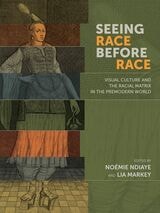
Seeing Race Before Race
Visual Culture and the Racial Matrix in the Premodern WorldEdited by Noémie Ndiaye and Lia Markey
Arizona Center for Medieval and Renaissance Studies, 2023
The capacious visual archive studied in this volume includes a trove of materials such as annotated or illuminated manuscripts, Renaissance costume books and travel books, maps and cartographic volumes produced by Europeans as well as Indigenous peoples, mass-printed pamphlets, jewelry, decorative arts, religious iconography, paintings from around the world, ceremonial objects, festival books, and play texts intended for live performance.
Contributors explore the deployment of what coeditor Noémie Ndiaye calls “the racial matrix” and its interconnected paradigms across the medieval and early modern chronological divide and across vast transnational and multilingual geographies. This volume uses items from the Fall 2023 exhibition “Seeing Race Before Race”—a collaboration between RaceB4Race and the Newberry Library—as a starting point for an ambitious theoretical conversation between premodern race studies, art history, performance studies, book history, and critical race theory.
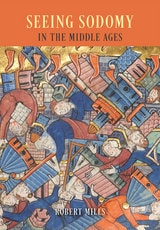
Seeing Sodomy in the Middle Ages
Robert Mills
University of Chicago Press, 2015
In Seeing Sodomy in the Middle Ages, Robert Mills explores the relationship between sodomy and motifs of vision and visibility in medieval culture, on the one hand, and those categories we today call gender and sexuality, on the other. Challenging the view that ideas about sexual and gender dissidence were too confused to congeal into a coherent form in the Middle Ages, Mills demonstrates that sodomy had a rich, multimedia presence in the period—and that a flexible approach to questions of terminology sheds new light on the many forms this presence took. Among the topics that Mills covers are depictions of the practices of sodomites in illuminated Bibles; motifs of gender transformation and sex change as envisioned by medieval artists and commentators on Ovid; sexual relations in religious houses and other enclosed spaces; and the applicability of modern categories such as “transgender,” “butch” and “femme,” or “sexual orientation” to medieval culture.
Taking in a multitude of images, texts, and methodologies, this book will be of interest to all scholars, regardless of discipline, who engage with gender and sexuality in their work.
Selected Philosophical Essays
Max Scheler
Northwestern University Press, 1973
Selected Writings on Visual Arts and Culture
Detour to the ImaginaryStuart Hall. Edited by Gilane Tawadros
Duke University Press, 2024
Self-Awareness and Alterity
A Phenomenological InvestigationDan Zahavi
Northwestern University Press, 1999
In the rigorous and highly original Self-Awareness and Alterity, Dan Zahavi provides a sustained argument that phenomenology, especially in its Husserlian version, can contribute something decisive to the analysis of self-awareness. Taking on recent discussions within both analytical philosophy (Shoemaker, Castaneda, Nagel) and contemporary German philosophy (Henrich, Frank, Tugendhat), Zahavi argues that the phenomenological tradition has much more to offer when it comes to the problem of self-awareness than is normally assumed. As a contribution to the current philosophical debate concerning self-awareness, the book presents a comprehensive reconstruction of Husserl's theory of pre-reflective self-awareness, thereby criticizing a number of prevalent interpretations and a systematic discussion of a number of phenomenological insights related to this issue, including analyses of the temporal, intentional, reflexive, bodily, and social nature of the self.

Self-Awareness and Alterity
A Phenomenological InvestigationDan Zahavi
Northwestern University Press, 2020
As a contribution to the current philosophical debate concerning self-awareness, the book presents a comprehensive reconstruction of Husserl’s theory of pre-reflective self-awareness, thereby criticizing a number of prevalent interpretations. In addition, Zahavi also offers a systematic discussion of a number of phenomenological insights related to the issue of self-awareness, including analyses of the temporal, intentional, reflexive, bodily, and social nature of the self.
The new edition of this prize-winning book has been updated and revised, and all quotations have been translated into English. It also contains a new preface in which Zahavi traces the developments of the debates around self-awareness over the last twenty years and situates this book in the context of his subsequent work.
Self-Deception and Paradoxes of Rationality
Edited by Jean-Pierre Dupuy
CSLI, 1998
Self-Relation
A Phenomenology of AmbiguityEllie Anderson
Northwestern University Press, 2027
A perceptive new look at the perennial subject of selfhood
In the wake of the so-called death of the subject, some philosophers within or adjacent to phenomenology have come to embrace the idea that the self does indeed exist but is multiplicitous in nature. Many today appeal to the idea that the self is therefore relational: that the self exists only in and through its relations to others. Though this is true, there is also more to the relationality of the self than the fact that we are always relating to what is beyond ourselves. In this book, Ellie Anderson argues that the defining feature of the self is that it is self-relating. That is, the self has identity by virtue of its own self-relationality.
Anderson develops a relational account of the self, drawing on the French philosophical tradition of existential phenomenology—in particular, Jean-Paul Sartre, Maurice Merleau-Ponty, and Simone de Beauvoir. Anderson contends that a throughline in their work is an emergent account of self-relation, which both provides a phenomenologically grounded alternative to some of the more popular views of the self today and highlights the ethical character of the self. Through novel approaches to the topics of self-objectification, bad faith, self-affection, and responsibility, Self-Relation develops an account of the self as having a peculiar kind of identity—ipseity—that is grounded in the structure of consciousness, and a selfhood that not only accommodates but also requires difference.
Sense and Non-Sense
Maurice Merleau-Ponty
Northwestern University Press, 1992
The first part of Sense and Non-Sense, "Arts," is concerned with Merleau-Ponty's concepts of perception, which were advanced in his major philosophical treatise, Phenomenology of Perception. Here the analysis is focused and enriched in descriptions of the perceptual world of Cezanne, the encounter with the Other as expressed in the novels of Simone de Beauvoir and Sartre, and the gestalt quality of experience brought out in the film art form. In the second part, "Ideas," Merleau-Ponty shows how the categories of the phenomenology of perception can be understood as an outgrowth of the behavioral sciences and how a model of existence based on perception sensitizes us to the insights and limitations of previous philosophies and suggests constructive criticisms of contemporary philosophy. The third part, "Politics," clarifies the political dilemmas facing intellectuals in postwar France.
Sense and Uncertainty
A Phenomenology of Rational Actions in an Uncertain WorldEsteban Marín-Ávila
Ohio University Press, 2025
- We are often forced through violence to do things that do not make sense for us except to avoid retaliations, punishments, or the various evils that others might inflict on us.
- We inhabit a world that escapes our control. This involves living in uncertainty concerning the things that we might suffer and do, that is, the things that might happen to us and the results of our actions.
- We are dependent on others and collaborate with them in ways that make it impossible to fully understand the sense of our own actions and practical intentions.

Sex, Drugs and Rock 'n' Roll in the Dutch Golden Age
Benjamin B. Roberts
Amsterdam University Press, 2018
With his engaging storytelling style and humorous anecdotes, Roberts convincingly reveals that deviant male youth behavior is common to all times, especially periods when youngsters have too much money and too much free time on their hands.
Sex, or the Unbearable
Lauren Berlant and Lee Edelman
Duke University Press, 2014
Through virtuoso interpretations of works of cinema, photography, critical theory, and literature, including Lydia Davis's story "Break It Down" (reprinted in full here), Berlant and Edelman explore what it means to live with negativity, with those divisions that may be irreparable. Together, they consider how such negativity affects politics, theory, and intimately felt encounters. But where their critical approaches differ, neither hesitates to voice disagreement. Their very discussion—punctuated with moments of frustration, misconstruction, anxiety, aggression, recognition, exhilaration, and inspiration—enacts both the difficulty and the potential of encounter, the subject of this unusual exchange between two eminent critics and close friends.

Shadow Modernism
Photography, Writing, and Space in Shanghai, 1925-1937William Schaefer
Duke University Press, 2017

Shapely Bodies
The Image of Porcelain in Eighteenth-Century FranceChristine A. Jones
University of Delaware Press, 2013
Shapely Bodies: The Image of Porcelain in Eighteenth-Century France constructs the first cultural history of porcelain making in France. It takes its title from two types of “bodies” treated in this study: the craft of porcelain making shaped clods of earth into a clay body to produce high-end commodities and the French elite shaped human bodies into social subjects with the help of makeup, stylish patterns, and accessories. These practices crossed paths in the work of artisans, whose luxury objects reflected and also influenced the curves of fashion in the eighteenth century.
French artisans began trials to reproduce fine Chinese porcelain in the 1660s. The challenge proved impossible until they found an essential ingredient, kaolin, in French soil in the 1760s. Shapely Bodies differs from other studies of French porcelain in that it does not begin in the 1760s at the Sèvres manufactory when it became technically possible to produce fine porcelain in France, but instead ends there. Without the secret of Chinese porcelain, artisans in France turned to radical forms of experimentation. Over the first half of the eighteenth century, they invented artificial alternatives to Chinese porcelain, decorated them with French style, and, with equal determination, shaped an identity for their new trade that distanced it from traditional guild-crafts and aligned it with scientific invention. The back story of porcelain making before kaolin provides a fascinating glimpse into the world of artisanal innovation and cultural mythmaking.
To write artificial porcelain into a history of “real” porcelain dominated by China, Japan, and Meissen in Saxony, French porcelainiers learned to describe their new commodity in language that tapped into national pride and the mythic power of French savoir faire. Artificial porcelain cut such a fashionable image that by the mid-eighteenth century, Louis XV appropriated it for the glory of the crown. When the monarchy ended, revolutionaries reclaimed French porcelain, the fruit of a century of artisanal labor, for the Republic. Tracking how the porcelain arts were depicted in documents and visual arts during one hundred years of experimentation, Shapely Bodies reveals the politics behind the making of French porcelain’s image.
Published by University of Delaware Press. Distributed worldwide by Rutgers University Press.
Shelter for the Night
On Afghanistan, Language, and DetoursFatima Mojaddedi
Duke University Press, 2026

Signature Derrida
Jacques Derrida
University of Chicago Press, 2013
Signs
Maurice Merleau-Ponty
Northwestern University Press, 1964
Thus does Maurice Merleau-Ponty describe speech in this collection of his important writings on the philosophy of expression, composed during the last decade of his life. For him, expression is a category of human behavior and existence much broader than language alone. He maintains that man is essentially expressive, even prior to speaking: in his silence, gestures, and lived behavior.

Simone de Beauvoir’s Political Thinking
Edited by Lori Jo Marso and Patricia Moynagh
University of Illinois Press, 2006
By exploring the life and work of the influential feminist thinker Simone de Beauvoir, this book shows how each of us lives within political and social structures that we can--and must--play a part in transforming. It argues that Beauvoir’s careful examination of her own existence can also be understood as a dynamic method for political thinking.
As the contributors illustrate, Beauvoir's political thinking proceeds from the bottom up, using examples from individual lives as the basis for understanding and transforming our collective existence. For example, she embraced her responsibility as a French citizen as making her complicit in the French war against Algeria. Here, she sees her role as an oppressor. In other contexts, she looks to the lives of individual women, including herself, to understand the dimensions of gender inequality.
This volume’s six tightly connected essays home in on the individual’s relationship to community, and how one’s freedom interacts with the freedom of other people. Here, Beauvoir is read as neither a liberal nor a communitarian. The authors focus on her call for individuals to realize their freedom while remaining consistent with ethical obligations to the community. Beauvoir's account of her own life and the lives of others is interpreted as a method to understand individuals in relations to others, and as within structures of personal, material, and political oppression. Beauvoir's political thinking makes it clear that we cannot avoid political action. To do nothing in the face of oppression denies freedom to everyone, including oneself.
Situatedness, or, Why We Keep Saying Where We're Coming From
David Simpson
Duke University Press, 2002
Simpson traces the rhetorical syndrome through its truly interdisciplinary genealogy. Discussing its roles within the fields of legal theory, social science, fiction, philosophy, and ethics, he argues that the discourse of situatedness consists of a volatile fusion of modesty and aggressiveness. It oscillates, in other words, between accepting complete causal predetermination and advocating personal agency and responsibility. Simpson’s study neither fully rejects nor endorses the present-day language of self-specification. Rather it calls attention to the limitations and opportunities of situatedness—a notion whose ideological slippage it ultimately sees as allowing late-capitalist liberal democracies to function.
Given its wide scope and lively rendering, Situatedness will attract a range of scholars in the humanities and legal studies. It will also interest all those for whom the politics of subjectivity pose real problems of authority, identity, and belief.
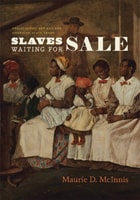
Slaves Waiting for Sale
Abolitionist Art and the American Slave TradeMaurie D. McInnis
University of Chicago Press, 2011
In 1853, Eyre Crowe, a young British artist, visited a slave auction in Richmond, Virginia. Harrowed by what he witnessed, he captured the scene in sketches that he would later develop into a series of illustrations and paintings, including the culminating painting, Slaves Waiting for Sale, Richmond, Virginia.
Social Justice
Theories, Issues, and MovementsCapeheart, Loretta
Rutgers University Press, 2007
In Social Justice: Theories, Issues, and Movements, Loretta Capeheart and Dragan Milovanovic respond to the need for a comprehensive introduction to this topic. The authors argue that common conceptions of criminal justice--which accept, for the most part, a politically established definition of crime--are too limited. Instead, they show the relevancy of history, political economy, culture, critique, and cross-cultural engagement to the advancement of justice.
Drawing on contemporary issues ranging from globalization to the environment, this essential textbook--ideal for course use--encourages practitioners, reformists, activists, and scholars to question the limits of the law in its present state in order to develop a fairer system at the local, national, and global levels.
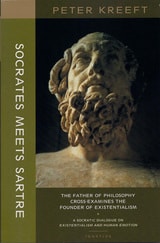
Socrates Meets Sartre
The Father of Philosophy Cross-examines the Founder of ExistentialismPeter Kreeft
St. Augustine's Press, 2005
Kreeft takes the reader through the world of existentialist philosophy, posing questions that challenge the concepts that Sartre proposed. Based on an imagination dialogue between Socrates and Sartre that takes place in the afterlife, this profound and witty book makes an entertaining and informative exploration of modern philosophy
“Peter Kreeft’s work is (1) unfailingly brilliant, (2) intellectually agile, (3) astonishingly perspicacious, (4) gloriously orthodox, (5) Chestertonian aphoristic.” – Thomas Howard, author of On Being Catholic
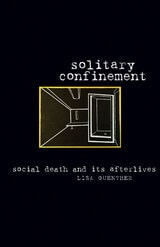
Solitary Confinement
Social Death and Its AfterlivesLisa Guenther
University of Minnesota Press, 2013
Prolonged solitary confinement has become a widespread and standard practice in U.S. prisons—even though it consistently drives healthy prisoners insane, makes the mentally ill sicker, and, according to the testimony of prisoners, threatens to reduce life to a living death. In this profoundly important and original book, Lisa Guenther examines the death-in-life experience of solitary confinement in America from the early nineteenth century to today’s supermax prisons. Documenting how solitary confinement undermines prisoners’ sense of identity and their ability to understand the world, Guenther demonstrates the real effects of forcibly isolating a person for weeks, months, or years.
Drawing on the testimony of prisoners and the work of philosophers and social activists from Edmund Husserl and Maurice Merleau-Ponty to Frantz Fanon and Angela Davis, the author defines solitary confinement as a kind of social death. It argues that isolation exposes the relational structure of being by showing what happens when that structure is abused—when prisoners are deprived of the concrete relations with others on which our existence as sense-making creatures depends. Solitary confinement is beyond a form of racial or political violence; it is an assault on being.
A searing and unforgettable indictment, Solitary Confinement reveals what the devastation wrought by the torture of solitary confinement tells us about what it means to be human—and why humanity is so often destroyed when we separate prisoners from all other people.

Somatics in Dance, Ecology, and Ethics
The Flowing Live PresentSondra Fraleigh
Intellect Books, 2024
Somatics in Dance, Ecology, and Ethics explores the relationships between self, world, and earth to understand the experience of being alive and corporeal. In doing so, Sondra Fraleigh develops a philosophy of an ethical world gaze that promises to enliven the senses. Chapters borrow from wide-ranging intellectual influences—phenomenology, Buddhism, butoh, dialogics, aesthetics, poetry, feminism, ecology, and more—Fraleigh describes the ways somatics can help people to feel well, practice empathetic communication, and recognize the psychic, unpredictable edges of experience as they move. An interview with Amanda Williamson complements the chapters. “The body is the fascinating home for all our dispositions,” Fraleigh tells hers. “Spiritual qualities are embodied. We dance and sing them into being.”

Sophie Taeuber-Arp and the Avant-Garde
A BiographyRoswitha Mair
University of Chicago Press, 2018
Now Roswitha Mair has brought us the first biography of this unique polymath, illuminating not just Tauber-Arp’s own life and work, but also the various milieux and movements in which she traveled. No fan of the Dadaists and their legacy will want to miss this first English-language translation.

Space, Site, Intervention
Situating Installation ArtErika Suderburg
University of Minnesota Press, 2000
In Space, Site, Intervention, some of today's most prominent art critics, curators, and artists view installation art as a diverse, multifaceted, and international art form that challenges institutional assumptions and narrow conceptual frameworks. Together, the essays in Space, Site, Intervention investigate how installation resonates within modern culture and society, as well as its ongoing influence on contemporary visual culture.
Contributors: C. Ondine Chavoya, John Coleman, Sean Cubitt, Colin Gardner, Chrissie Iles, Miwon Kwon, Ernest Larsen, Tiffany Ana López, Catherine Lord, Kevin McMahon, James Meyer, Alessandra Moctezuma, Leda Ramos, Laurence A. Rickels, Barbara Maria Stafford, Susan Stewart, Marita Sturken, and John C. Welchman.
Speaking
(La Parole)Georges Gusdorf
Northwestern University Press, 1965
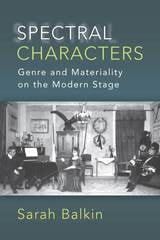
Spectral Characters
Genre and Materiality on the Modern StageSarah Balkin
University of Michigan Press, 2019
Theater’s materiality and reliance on human actors has traditionally put it at odds with modernist principles of aesthetic autonomy and depersonalization. Spectral Characters argues that modern dramatists in fact emphasized the extent to which humans are fictional, made and changed by costumes, settings, props, and spoken dialogue. Examining work by Ibsen, Wilde, Strindberg, Genet, Kopit, and Beckett, the book takes up the apparent deadness of characters whose selves are made of other people, whose thoughts become exteriorized communication technologies, and whose bodies merge with walls and furniture. The ghostly, vampiric, and telepathic qualities of these characters, Sarah Balkin argues, mark a new relationship between the material and the imaginary in modern theater. By considering characters whose bodies respond to language, whose attempts to realize their individuality collapse into inanimacy, and who sometimes don’t appear at all, the book posits a new genealogy of modernist drama that emphasizes its continuities with nineteenth-century melodrama and realism.
Speculation
Politics, Ideology, EventGlyn Daly
Northwestern University Press, 2019
Speculation: Politics, Ideology, Event develops Hegel’s radical perspective of speculative thought as a way of reclaiming and revitalizing the sense of the future and its possibilities. Engaging with such figures as Alain Badiou, Quentin Meillassoux, Ernesto Laclau, Slavoj Žižek, and Fredric Jameson, Glyn Daly articulates the distinctness of speculative philosophy and draws its implications for new debates in areas of science, politics, capitalism, ideology, ethics, and the event.
In a confrontation with today’s fatalistic milieu, principal emphasis is given to Hegel’s idea of infinity as the intrinsic dimension of negativity within all finitude. Against the modern era’s paradigmatic tendency to externalize social problems in the form of antagonism and Otherness, Daly argues for a renewal of utopian thought based on Hegelian reconciliation and the affirmation of excess as the essence of all being. On these grounds, he advances a new kind of political imagination that in speculative terms centers on uncompromising notions of truth and reason.

Speech and Phenomena
And Other Essays on Husserl's Theory of SignsJacques Derrida
Northwestern University Press, 1973
Spiritual Moderns
Twentieth-Century American Artists and ReligionErika Doss
University of Chicago Press, 2022
Andy Warhol is one of the best-known American artists of the twentieth century. He was also an observant Catholic who carried a rosary, went to mass regularly, kept a Bible by his bedside, and depicted religious subjects throughout his career. Warhol was a spiritual modern: a modern artist who appropriated religious images, beliefs, and practices to create a distinctive style of American art.
Spiritual Moderns centers on four American artists who were both modern and religious. Joseph Cornell, who showed with the Surrealists, was a member of the Church of Christ, Scientist. Mark Tobey created pioneering works of Abstract Expressionism and was a follower of the Bahá’í Faith. Agnes Pelton was a Symbolist painter who embraced metaphysical movements including New Thought, Theosophy, and Agni Yoga. And Warhol, a leading figure in Pop art, was a lifelong Catholic. Working with biographical materials, social history, affect theory, and the tools of art history, Doss traces the linked subjects of art and religion and proposes a revised interpretation of American modernism.

Spurs
Nietzsche's Styles/Eperons: Les Styles de NietzscheJacques Derrida
University of Chicago Press, 1981
Spurs, then, is aptly titled, for Derrida's "deconstructions" of Nietzsche's meanings will surely act as spurs to further thought and controversy. This dual-language edition offers the English-speaking reader who has some knowledge of French an opportunity to examine the stylistic virtuosity of Derrida's writing—of particular significance for his analysis of "the question of style."

Spurs
Nietzsche's Styles/Eperons: Les Styles de NietzscheJacques Derrida
University of Chicago Press, 1981
Spurs, then, is aptly titled, for Derrida's "deconstructions" of Nietzsche's meanings will surely act as spurs to further thought and controversy. This dual-language edition offers the English-speaking reader who has some knowledge of French an opportunity to examine the stylistic virtuosity of Derrida's writing—of particular significance for his analysis of "the question of style."
Storytelling in Sixteenth-Century France
Negotiating Shifting FormsEmily E. Thompson
University of Delaware Press, 2022
Published by the University of Delaware Press. Distributed worldwide by Rutgers University Press.

Strange Tastes
Aesthetics and the Public in Latin American and Latinx FeminismsMonique Roelofs
Duke University Press, 2026

Studies in Phenomenology and Psychology
Aron Gurwitsch
Northwestern University Press, 1966
Studies on the Illuminated Chronicle
János M. Bak
Central European University Press, 2018
The present volume of studies—a joint publication with the National Széchényi Library, Budapest—is the first Subsidium of the Central European Medieval Text series, accompanying CEMT vol. IX on the Illuminated Chronicle, composed in the fourteenth century at the royal court of Louis I of Hungary. The large size of the volume, with the text and its annotations, did not permit the inclusion of a detailed scholarly introduction, unlike other CEMT items, so it is here printed separately.
The first essays analyze the text and the illuminations of the Illuminated Chronicle (formerly called the Vienna Chronicle) from literary-historical, art historical and heraldic perspectives. They also summarize the literature on the chronicle for the past two hundred years. Additional studies address the narrative. Since the chronicle starts with the history of the Huns, the imaginary ancestors of the Hungarians, one essay addresses the Attila tradition in Hungarian historiography. Others devote attention to the dynastic struggles of the eleventh century, placing them in the context of amicitia and deditio, and to the image of St. Ladislas I as the “ideal king”. The final essays examine the fate of the fourteenth-century chronicle texts over the subsequent centuries, their appearance in legal texts, and their reception abroad.
Studious Drift
Movements and Protocols for a Postdigital EducationPeter Hyland
University of Minnesota Press, 2022
What kind of university is possible when digital tools are not taken for granted, but hacked for a more experimental future?
The global pandemic has underscored contemporary reliance on digital environments. This is particularly true among schools and universities, which, in response, shifted much of their instruction online. Because the rise of e-learning logics, ed-tech industries, and enterprise learning-management systems all threaten to further commodify and instrumentalize higher education, these technologies and platforms have to be creatively and critically struggled over.
Studious Drift intervenes in this struggle by reviving the relationship between studying and the generative space of the studio in service of advancing educational experimentation for a world where digital tools have become a permanent part of education. Drawing on Alfred Jarry’s pataphysics, the “science of imaginary solutions,” this book reveals how the studio is a space-time machine capable of traveling beyond the limits of conventional online learning to redefine education as interdisciplinary, experimental, public study.

Style and Seduction
Jewish Patrons, Architecture, and Design in Fin de Siècle ViennaElana Shapira
Brandeis University Press, 2016
Subject Lessons
Hegel, Lacan, and the Future of MaterialismEdited by Russell Sbriglia and Slavoj Zizek
Northwestern University Press, 2020
Responding to the ongoing “objectal turn” in contemporary humanities and social sciences, the essays in Subject Lessons present a sustained case for the continued importance— indeed, the indispensability—of the category of the subject for the future of materialist thought.
Approaching matters through the frame of Hegel and Lacan, the contributors to this volume, including the editors, as well as Andrew Cole, Mladen Dolar, Nathan Gorelick, Adrian Johnston, Todd McGowan, Borna Radnik, Molly Anne Rothenberg, Kathryn Van Wert, and Alenka Zupančič—many of whom stand at the forefront of contemporary Hegel and Lacan scholarship—agree with neovitalist thinkers that material reality is ontologically incomplete, in a state of perpetual becoming, yet they maintain that this is the case not in spite of but, rather, because of the subject.
Incorporating elements of philosophy, psychoanalysis, and literary and cultural studies, Subject Lessons contests the movement to dismiss the subject, arguing that there can be no truly robust materialism without accounting for the little piece of the Real that is the subject.