Results by title
413 books match the query 'New York' and 42 start with s
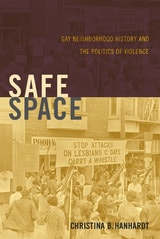
Safe Space
Gay Neighborhood History and the Politics of ViolenceChristina B. Hanhardt
Duke University Press, 2013
Since the 1970s, a key goal of lesbian and gay activists has been protection against street violence, especially in gay neighborhoods. During the same time, policymakers and private developers declared the containment of urban violence to be a top priority. In this important book, Christina B. Hanhardt examines how LGBT calls for "safe space" have been shaped by broader public safety initiatives that have sought solutions in policing and privatization and have had devastating effects along race and class lines.
Drawing on extensive archival and ethnographic research in New York City and San Francisco, Hanhardt traces the entwined histories of LGBT activism, urban development, and U.S. policy in relation to poverty and crime over the past fifty years. She highlights the formation of a mainstream LGBT movement, as well as the very different trajectories followed by radical LGBT and queer grassroots organizations. Placing LGBT activism in the context of shifting liberal and neoliberal policies, Safe Space is a groundbreaking exploration of the contradictory legacies of the LGBT struggle for safety in the city.
Salome of the Tenements
Anzia Yezierska
University of Illinois Press, 1951
Originally published in 1923.
Salvaging the Past
Georges Hoentschel and French Decorative Arts from The Metropolitan Museum of Art, 1907-2013Daniëlle O. Kisluk-Grosheide
Bard Graduate Center, 2013
Samuel Steward and the Pursuit of the Erotic Sexuality, Literature, Archives
Sexuality, Literature, ArchivesEdited by Debra A. Moddelmog and Martin Joseph Ponce
The Ohio State University Press, 2017
With work by prominent scholars in queer, transgender, and sexuality studies, and with topics such as the queer archive, hoarding, masochism, the queer mystery, race and desire, sexology, and gay pornography, Samuel Steward and the Pursuit of the Erotic will appeal to a wide range of readers across a variety of disciplines invested in queer experience. Closing on a personal recollection from one of Steward’s last close friends, the volume will also appeal to readers interested in the personal aspects of this fascinating, idiosyncratic figure’s multifaceted life.
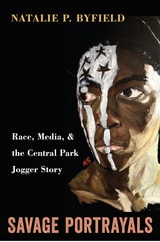
Savage Portrayals
Race, Media and the Central Park Jogger StoryNatalie Byfield
Temple University Press, 2014
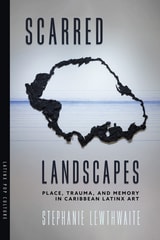
Scarred Landscapes
Place, Trauma, and Memory in Caribbean Latinx ArtStephanie Lewthwaite
University of Arizona Press, 2025
The book combines formal analysis with artist testimony, exhibition histories, and theoretical frameworks from trauma, memory, and archipelagic studies, to offer a multifaceted examination of Caribbean Latinx art. Lewthwaite explores how these artists practice “archipelagic memory,” a generative, decolonial, and coalitional form of memory work that envisions alternative modes of belonging in difference and solidarity with others. By connecting different people, pasts, and places, Caribbean Latinx artists expose the reverberations of trauma while imagining other worlds beyond it.
This work puts Caribbean Latinx artists at the center of debates about the exclusions of dominant memory narratives and contemporary art worlds, highlighting their contributions to a wider decolonial project of remembrance. By revealing the interconnectedness of traumatic histories and the potential for art to foster empathy and justice, Lewthwaite’s work underscores the importance of relational and decolonial thought for imagining a better society.
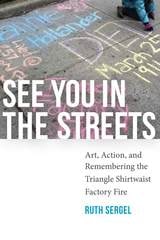
See You in the Streets
Art, Action, and Remembering the Triangle Shirtwaist Factory FireRuth Sergel
University of Iowa Press, 2016
In 1911, a fire at the Triangle Shirtwaist Factory in New York City took the lives of 146 workers, most of them young immigrant women and girls. Their deaths galvanized a movement for social and economic justice then, but today’s laborers continue to battle dire working conditions. How can we bring the lessons of the Triangle fire back into practice today? For artist Ruth Sergel, the answer was to fuse art, activism, and collective memory to create a large-scale public commemoration that invites broad participation and incites civic engagement. See You in the Streets showcases her work.
It all began modestly in 2004 with Chalk, an invitation to all New Yorkers to remember the 146 victims of the fire by inscribing their names and ages in chalk in front of their former homes. This project inspired Sergel to found the Remember the Triangle Fire Coalition, a broad alliance of artists and activists, universities and unions—more than 250 partners nationwide—to mark the 2011 centennial of the infamous blaze. Putting the coalition together and figuring what to do and how to do it were not easy. This book provides a lively account of the unexpected partnerships, false steps, joyous collective actions, and sustainability of such large public works. Much more than an object lesson from the past, See You in the Streets offers an exuberant perspective on building a social art practice and doing public history through argument and agitation, creativity and celebration with an engaged public.
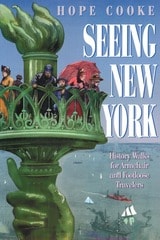
Seeing New York
History Walks for Armchair and Footloose TravelersHope Cooke
Temple University Press, 1995
Since the 1700s, various ethnic and immigrant groups have been shifting and negotiating their place in New York City. Hope Cooke also struggled to find a "correlation of space" and "sense of belonging" when she returned to the city after spending her adult life living in a place in the Himalayas, the Queen of Sikkim (a tiny kingdom near Nepal). Abroad for so long, she returned with an urgent need to rediscover this city, to "find her way home."
It was not always a comfortable journey for Cooke: "On the days I felt secure, Manhattan's maelstrom was pure energy. On shaky days, the boundlessness made me yearn for limits, or, failing that, at least a vantage point." The book that has emerged is an entertaining and integrated account of New York City's social history, architecture, physical space, and culture. Starting with the American Indian settlements and the early days when the southern-most tip of Manhattan held little more than a bleak outpost of Dutch fur traders, Cooke tracks the economic development and journeys north, from the Village's beginnings as a refuge from dreaded summer fevers to the present day Dominican enclave of Washington Heights.
Written for armchair enthusiasts and walkabout adventurers, this book travels fourteen of the city's distinct and significant neighborhoods. Cooke's guide will make a historical sleuth out of local residents and tourists alike. Her off-the-beaten-path insights and witty observations help decode the urban landscape and reveal how social changes have reworked the city's terrain. Enhancing the narrative are 140 illustrations, including old engravings, maps, and current photographs.
In the series Critical Perspectives on the Past, edited by Susan Porter Benson, Stephen Brier, and Roy Rosenzweig.
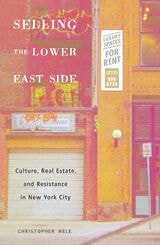
Selling The Lower East
Culture, Real Estate, and Resistance in New York CityChristopher Mele
University of Minnesota Press, 2000
Tracks the shifting views of the Lower East Side from ghetto to desirable urban niche.
The Lower East Side of Manhattan is rich in stories-of poor immigrants who flocked there in the late nineteenth and early twentieth centuries; of beatniks, hippies, and artists who peopled it mid-century; and of the real estate developers and politicians who have always shaped what is now termed the "East Village." Today, the musical Rent plays on Broadway to a mostly white and suburban audience, MTV exploits the neighborhood’s newly trendy squalor in a film promotion, and on the Internet a cyber soap opera and travel-related Web pages lure members of the middle class to enjoy a commodified and sanitized version of the neighborhood.
In this sweeping account, Christopher Mele analyzes the political and cultural forces that have influenced the development of this distinctive community. He describes late nineteenth-century notions of the Lower East Side as a place of entrenched poverty, ethnic plurality, political activism, and "low" culture that elicited feelings of revulsion and fear among the city’s elite and middle classes. The resulting-and ongoing-struggle between government and residents over affordable and decent housing has in turn affected real estate practices and urban development policies. Selling the Lower East Side recounts the resistance tactics used by community residents, as well as the impulse on the part of some to perpetuate the image of the neighborhood as dangerous, romantic, and bohemian, clinging to the marginality that has been central to the identity of the East Village and subverting attempts to portray it as "new and improved." Ironically, this very image of urban grittiness has been appropriated by a cultural marketplace hungry for new fodder. Mele explores the ways that developers, media executives, and others have coopted the area’s characteristics-analyzing the East Village as a "style provider" where what is being marketed is "difference." The result is a visionary look at how political and economic actions transform neighborhoods and at what happens when a neighborhood is what is being "consumed."A comprehensive web site for Selling the Lower East Side can be found at www.upress.umn.edu/sles.
Seriously Mad
Mental Distress and the Broadway MusicalAleksei Grinenko
University of Michigan Press, 2023
Theatermakers in the United States have long been drawn to madness as a source of dramatic spectacle. During the Broadway musical’s golden age in the mid-twentieth century, creative teams used the currently in-vogue psychoanalytic ideas about mental life to construct troubled characters at odds with themselves and their worlds. As the clinical and cultural profile of madness transformed over the twentieth century, musicals continued to delve into the experience of those living with mental pain, trauma, and unhappiness.
Seriously Mad offers a dynamic account of stage musicals’ engagement with historically significant theories about mental distress, illness, disability, and human variance in the United States. By exploring who is considered mad and what constitutes madness at different moments in U.S. history, Aleksei Grinenko shows how, in attempts to bring the musicals closer to highbrow sophistication, theater dramatized serious medical conditions and social problems. Among the many Broadway productions discussed are Next to Normal, A Strange Loop, Sweeney Todd, Man of La Mancha, Gypsy, Oklahoma!, and Lady in the Dark.
Seven Shots
An NYPD Raid on a Terrorist Cell and Its AftermathJennifer C. Hunt
University of Chicago Press, 2010
On July 31, 1997, a six-man Emergency Service team from the NYPD raided a terrorist cell in Brooklyn and narrowly prevented a suicide bombing of the New York subway that would have cost hundreds, possibly thousands of lives.
Seven Shots tells the dramatic story of that raid, the painstaking police work involved, and its paradoxical aftermath, which drew the officers into a conflict with other rank-and-file police and publicity-hungry top brass. Jennifer C. Hunt draws on her personal knowledge of the NYPD and a network of police contacts extending from cop to four-star chief, to trace the experience of three officers on the Emergency Service entry team and the two bomb squad detectives who dismantled the live device. She follows their lives for five years, from that near-fatal day in 1997, through their encounters inside the brutal world of departmental politics, and on to 9/11, when they once again put their lives at risk in the fight against terrorism, racing inside the burning towers and sorting through the ash, debris, and body parts. Throughout this fast paced narrative, Hunt maintains a strikingly fine-grained, street-level view, allowing us to understand the cops on their own terms—and often in their own words. The result is a compelling insider’s picture of the human beings who work in two elite units in the NYPD and the moral and physical danger and courage involved.
As gripping as an Ed McBain novel—and just as steeped in New York cop culture and personalities—Seven Shots takes readers on an unforgettable journey behind the shield and into the hearts of New York City police.
Sex Trafficking, Scandal, and the Transformation of Journalism, 1885-1917
Gretchen Soderlund
University of Chicago Press, 2013
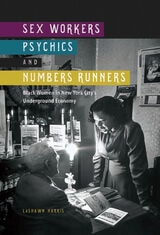
Sex Workers, Psychics, and Numbers Runners
Black Women in New York City's Underground EconomyLaShawn Harris
University of Illinois Press, 2016
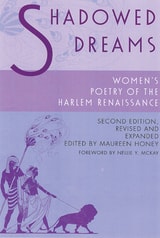
Shadowed Dreams
Women's Poetry of the Harlem RenaissanceMcKay, Nellie
Rutgers University Press, 2006
The first edition of Shadowed Dreams was a groundbreaking anthology that brought to light the contributions of women poets to the Harlem Renaissance. This revised and expanded version contains twice the number of poems found in the original, many of them never before reprinted, and adds eighteen new voices to the collection to once again strike new ground in African American literary history. Also new to this edition are nine period illustrations and updated biographical introductions for each poet.
Shadowed Dreams features new poems by Gwendolyn Bennett, Anita Scott Coleman, Mae Cowdery, Blanche Taylor Dickinson, Alice Dunbar-Nelson, Jessie Fauset, Angelina Weld Grimké, Gladys Casely Hayford (a k a Aquah Laluah), Virginia Houston, Georgia Douglas Johnson, Helene Johnson, Effie Lee Newsome, Esther Popel, and Anne Spencer, as well as writings from newly discovered poets Carrie Williams Clifford, Edythe Mae Gordon, Alvira Hazzard, Gertrude Parthenia McBrown, Beatrice Murphy, Lucia Mae Pitts, Grace Vera Postles, Ida Rowland, and Lucy Mae Turner, among others.
Covering the years 1918 through 1939 and ranging across the period’s major and minor journals, as well as its anthologies and collections, Shadowed Dreams provides a treasure trove of poetry from which to mine deeply buried jewels of black female visions in the early twentieth century.
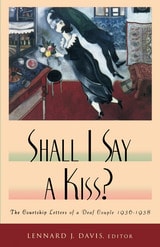
Shall I Say A Kiss?
The Courtship Letters of a Deaf Couple, 1936-1938Lennard J. Davis
Gallaudet University Press, 1999
Upon the death of his father Morris at age 82, Lennard Davis found among his effects a trove of letters, kept in careful chronological order, that dated from 1936. The letters ended in 1938, when Eva Weintrobe came to America to marry Morris, and they provide the core of Shall I Say A Kiss?, their courtship by correspondence. In his framing comments, Davis speculates that his parents met perhaps four or five times before they wed, a fact that heightens the importance of these letters to their fate. Davis illustrates vast contrasts between Morris and Eva, both to each other (Morris was 38; Eva was 26), and to themselves in later life as witnessed by their son. Where Davis saw his father brimming with confidence and a sense of superior intellect while his mother acted as the reserved, dutiful wife, he was startled to learn through their letters that she could be the shrewd questioning correspondent even as his father wrote as an unsure, imploring suitor.
Shall I Say A Kiss? opens a window into the lives of two working-class, Jewish, British, Deaf people in the 1930s. This striking book reveals a consistent, journal-like account of the “lived” experience of Deaf people during the tumultuous times just prior to World War II. Because the correspondence is mainly composed of Eva’s letters, the focus sharpens even further as a record of the life and opinions of a young, working-class, Deaf woman about to embark upon marriage and life in a new country. The challenges she faced, including de facto racial barriers for both deaf and Jewish immigrants, and the prospect of uniting with a man she knew mostly through his letters alone, make for a compelling and emotional trip through her life. Shall I Say A Kiss? serves as a singular social document and also as an engaging and often moving narrative that will win audiences among academics and romantics alike.
Shaping American Catholicism
Maryland and New York, 1805-1915Robert Emmett Curran
Catholic University of America Press, 2012
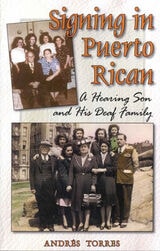
Signing in Puerto Rican
A Hearing Son and His Deaf FamilyAndrés Torres
Gallaudet University Press, 2009
The only child of deaf Puerto Rican immigrants, Andrés Torres grew up in New York City in a large, extended family that included several deaf aunts and uncles. In Signing in Puerto Rican: A Hearing Son and His Deaf Family, he opens a window into the little known culture of Deaf Latinos chasing the immigrant American dream. Like many children of deaf adults (codas), Torres loved his parents deeply but also longed to be free from being their interpreter to the hearing world. Torres’s story is unique in that his family communicated in three languages. The gatherings of his family reverberated with “deaf talk,” in sign, Spanish, and English. What might have struck outsiders as a strange chaos of gestures and mixed spoken languages was just normal for his family.
Torres describes his early life as one of conflicting influences in his search for identity. His parents’ deep involvement in the Puerto Rican Society for the Catholic Deaf led him to study for the priesthood. He later left the seminary as his own ambitions took hold. Torres became very active in the Puerto Rico independence party against the backdrop of the Civil Rights movement and protest against the Vietnam War. Throughout these defining events, Torres’s journey never took him too far from his Deaf Puerto Rican family roots and the passion of arms, hands, and fingers filling the air with simultaneous translation and understanding.
Singing in the Age of Anxiety
Lieder Performances in New York and London between the World WarsLaura Tunbridge
University of Chicago Press, 2018
Laura Tunbridge explores the renewed vitality of this refugee musical form between the world wars, offering a fresh perspective on a period that was pervaded by anxieties of displacement. Through richly varied case studies, Singing in the Age of Anxiety traces how lieder were circulated, presented, and consumed in metropolitan contexts, shedding new light on how music facilitated unlikely crossings of nationalist and internationalist ideologies during the interwar period.
Slumming in New York
From the Waterfront to Mythic HarlemRobert M. Dowling
University of Illinois Press, 2006
Using the methods of ethnicity theory, black studies, regional studies, literary studies, and popular culture, Robert M. Dowling reveals the way in which "outsider" authors helped alleviate New York's mounting social anxieties by popularizing "insider" voices from neighborhoods as distinctive as the East Side waterfront, the Bowery, the Tenderloin's "black Bohemia," the Jewish Lower East Side, and mythic Harlem.
Slumming
Sexual and Racial Encounters in American Nightlife, 1885-1940Chad Heap
University of Chicago Press, 2009
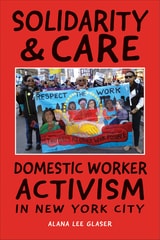
Solidarity & Care
Domestic Worker Activism in New York CityAlana Lee Glaser
Temple University Press, 2023
Solidarity & Care examines the political mobilization of diverse care workers who joined together and supported one another through education, protests, lobbying, and storytelling. Domestic work activists used narrative and emotional appeals to build a coalition of religious communities, employers of domestic workers, labor union members, and politicians to first pass and then to enforce the new law.
Through oral history interviews, as well as ethnographic observation during DWU meetings and protest actions, Glaser chronicles how these women fought (and continue to fight) to improve working conditions. She also illustrates how they endure racism, punitive immigration laws, on-the-job indignities, and unemployment that can result in eviction and food insecurity.
The lessons from Solidarity & Care along with the DWU’s precedent-setting legislative success have applications to workers across industries.
All royalties will go directly to the Domestic Workers United
Something Left To Lose
Personal Relations and Survival among New York's HomelessGwendolyn Dordick
Temple University Press, 1997
In Something Left to Lose, Gwendolyn A. Dordick gives us a dramatic portrait of the social and personal lives of the homeless. Through her extensive "hanging out" with homeless people, Dordick came to a profound understanding of the web of relationships that provides complex social structure in situations where, to the casual eye, there appears to be only chaos and paralysis.
The author shows us that improvising shelter means working hard to co-exist with others. Lacking conventional private dwellings, the homeless find or create shelter in unconventional places -- on street corners adjoining bus stations, on empty lots of land, or in shelters, public or private -- and negotiate the rules of these places with authorities, passersby, and fellow homeless.
The different environments lead to quite different social relations. The Armory, for example, is a frightening place, thanks to the authoritarian attitudes of the employees and cliques of homeless people in charge. In the Shanty, on the other hand, the difficult issues are those of a self-governing community concerned about safety -- controlling the drug use of some residents, deciding who is allowed to tap into the electricity, and worrying about intruders.
In all settings, daily life for people without homes, like daily life for people with homes, if full of the concerns of personal relationships. How will we share our goods and emotions, speak respectfully to each other, love and joke and work out our disputes, and act in a trustworthy fashion?
This book is also a miniature research odyssey, complete with moments of fear, frustration, blunders, distrust, and trust. In order to gather these interviews, Dordick had to not only win the the confidence of the homeless people she visited (the women at the Station thought she was interested in their boyfriends) but also negotiate with unsympathetic police and shelters employees or defy them.
Sondheim's Broadway Musicals
Stephen Banfield
University of Michigan Press, 1995
Sondheim's Broadway Musicals is the first book to take an in-depth look at Sondheim's work. Stephen Banfield examines each of Sondheim's musicals for Broadway, from West Side Story and Gypsy to the 1987 musical Into the Woods, and includes A Funny Thing Happened on the Way to the Forum, Company, Follies, Anyone Can Whistle, A Little Night Music, Pacific Overtures, Merrily We Roll Along, Sweeney Todd, and Sunday in the Park with George. Banfield also discusses Sondheim's other work, such as the 1991 show Assassins and his music for the 1990 film Dick Tracy--for which "Sooner or Later" won him an Academy Award for Best Song.
"Banfield seems almost to hear Sondheim's music with Sondheim's ears. This extremely valuable work discusses Sondheim's early training and subsequent career, his general compositional concerns, and his style. The meat of the book is a musical-dramatic analysis of his musicals . . . . For each musical, Banfield places the work and its components in a historical and typological text. He also treats in welcome detail the musical profile or universe of each show: Sondheim's use of generative intervals or interval complexes as source material, motifs that reappear in various guises in various songs, the sound world that defines the musical's emotional mind. The book will be as useful to those who are cool to Sondheim's work as to his fans." --Choice
Sounding Salsa
Performing Latin Music in New York CityChristopher Washburne
Temple University Press, 2008
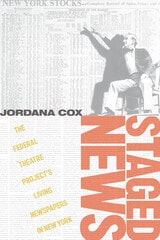
Staged News
The Federal Theatre Project’s Living Newspapers in New YorkJordana Cox
University of Massachusetts Press, 2023
Finalist for the 2023 Frank Luther Mott - Kappa Tau Alpha Journalism and Mass Communication Research Award
In 1935, a group of journalists and theater artists embarked on an unusual collaboration. With funds from the Federal Theatre Project (FTP), a Depression-era employment initiative established by President Roosevelt’s New Deal, they set out to produce news for the theatrical stage. Over the next four years, the New York–based team created six productions, known as the Living Newspapers. Covering a variety of public issues that included affordable housing, the plight of Dust Bowl farmers, the Tennessee Valley Authority, and labor law, Living Newspaper productions would reach hundreds of thousands of spectators and inspire adaptations across the country.
Staged News interprets the Living Newspaper’s process and repertoire amid journalists’ changing conceptions of their profession. Jordana Cox spotlights marginalized “newsmakers,” particularly Black artists, who challenged the parameters of public knowledge and assumptions surrounding newsworthiness. This timely analysis reveals how a vital theatrical form sprouted from a changing news landscape and reimagined what journalism could do for people seeking democratic change.
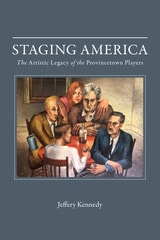
Staging America
The Artistic Legacy of the Provincetown PlayersJeffery Kennedy
University of Alabama Press, 2023
A comprehensive history of the Provincetown Players and their influence on modern American theatre
The Provincetown Players created a revolution in American theatre, making room for truly modern approaches to playwriting, stage production, and performance unlike anything that characterized the commercial theatre of the early twentieth century. In Staging America: The Artistic Legacy of the Provincetown Players, Jeffery Kennedy gives readers the unabridged story in a meticulously researched and comprehensive narrative that sheds new light on the history of the Provincetown Players. This study draws on many new sources that have only become available in the last three decades; this new material modifies, refutes, and enhances many aspects of previous studies.
At the center of the study is an extensive account of the career of George Cram Cook, the Players’ leader and artistic conscience, as well as one of the most significant facilitators of modernist writing in early twentieth-century American literature and theatre. It traces Cook’s mission of “cultural patriotism,” which drove him toward creating a uniquely American identity in theatre. Kennedy also focuses on the group of friends he calls the “Regulars,” perhaps the most radical collection of minds in America at the time; they encouraged Cook to launch the Players in Provincetown in the summer of 1915 and instigated the move to New York City in fall 1916.
Kennedy has paid particular attention to the many legends connected to the group (such as the “discovery” of Eugene O’Neill), and also adds to the biographical record of the Players’ forty-seven playwrights, including Susan Glaspell, Neith Boyce, Edna St. Vincent Millay, Floyd Dell, Rita Wellman, Mike Gold, Djuna Barnes, and John Reed. Kennedy also examines other fascinating artistic, literary, and historical personalities who crossed the Players’ paths, including Emma Goldman, Charles Demuth, Berenice Abbott, Sophie Treadwell, Theodore Dreiser, Claudette Colbert, and Charlie Chaplin. Kennedy highlights the revolutionary nature of those living in bohemian Greenwich Village who were at the heart of the Players and the America they were responding to in their plays.

Starting Over with John and Yoko
The PhotographsRoger Farrington
Rutgers University Press, 2026
“This is one to linger over.” —Publishers Weekly
On August 7, 1980, John Lennon and Yoko Ono made their triumphant return to the recording studio after a self-imposed five-year absence. Roger Farrington, an up-and-coming photographer from Boston, was hired to get “the shot” that would announce their comeback. It would be Lennon’s most intense press scrutiny since the heady days of the Beatles’ maiden voyage to America in 1964, and for Farrington, it would be the assignment of a lifetime. Just four months later, Lennon’s assassination would plunge the world into mourning.
Reproducing, for the first time, the entire run of Farrington’s iconic photographs from that day, Starting Over transports readers back to 1980 and into Manhattan’s Hit Factory, where Lennon and Ono recorded their acclaimed LP Double Fantasy. With supporting photos and other ephemera, Farrington and renowned Beatles historian Kenneth Womack capture a poignant moment in music history and provide an insider’s look at celebrity photography in the pre-digital age.
Steppin' Out
New York Nightlife and the Transformation of American CultureLewis A. Erenberg
University of Chicago Press, 1984
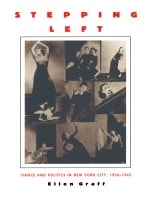
Stepping Left
Dance and Politics in New York City, 1928–1942Ellen Graff
Duke University Press, 1997
From Communist Party pageants to union hall performances to benefits for the Spanish Civil War, Graff documents the passionate involvement of American dancers in the political and social controversies that raged throughout the Depression era. Dancers formed collectives and experimented with collaborative methods of composition at the same time that they were marching in May Day parades, demonstrating for workers’ rights, and protesting the rise of fascism in Europe. Graff records the explosion of choreographic activity that accompanied this lively period—when modern dance was trying to establish legitimacy and its own audience. Stepping Left restores a missing legacy to the history of American dance, a vibrant moment that was supressed in the McCarthy era and almost lost to memory. Revisiting debates among writers and dancers about the place of political content and ethnicity in new dance forms, Stepping Left is a landmark work of dance history.
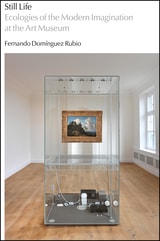
Still Life
Ecologies of the Modern Imagination at the Art MuseumFernando Domínguez Rubio
University of Chicago Press, 2020
Still Life offers a fascinating and detailed ethnographic account of what it takes to prevent these disasters from happening. Going behind the scenes at MoMA, Domínguez Rubio provides a rare view of the vast technological apparatus—from climatic infrastructures and storage facilities, to conservation labs and machine rooms—and teams of workers—from conservators and engineers to guards and couriers—who fight to hold artworks still.
As MoMA reopens after a massive expansion and rearranging of its space and collections, Still Life not only offers a much-needed account of the spaces, actors, and forms of labor traditionally left out of the main narratives of art, but it also offers a timely meditation on how far we, as a society, are willing to go to keep the things we value from disappearing into oblivion.
Street Scenes
Staging the Self in Immigrant New York, 1880–1924Esther Romeyn
University of Minnesota Press, 2008
Street Scenes focuses on the intersection of modern city life and stage performance. From street life and slumming to vaudeville and early cinema, to Yiddish theater and blackface comedy, Esther Romeyn discloses racial comedy, passing, and masquerade as gestures of cultural translation. In these performances she detects an obsession with the idea of the city as theater and the self as actor, which was fueled by the challenges that consumer capitalism presented to notions of an “authentic” self.
It was exactly this idea of “authentic” immigrant selfhood that was at stake in many performances on the popular stage, and Romeyn ultimately demonstrates how these diverse and potent immigrant works influenced the emergence of a modern metropolitan culture.
Streetwise
How Taxi Drivers Establish Customer's TrustworthinessDiego Gambetta
Russell Sage Foundation, 2005
Strength through Diversity
Harlem Prep and the Rise of MulticulturalismBarry M. Goldenberg
Rutgers University Press, 2025
strengththroughdiversity.com
Strong on Music
The New York Music Scene in the Days of George Templeton Strong, Volume 1: Resonances, 1836-1849Vera Brodsky Lawrence
University of Chicago Press, 1995
Formerly a concert pianist, Vera Brodsky Lawrence spent the last third of her life as a historian of American music (she died in 1996). She was editor of The Piano Works of Louis Moreau Gottschalk and The Complete Works of Scott Joplin.
On Volume 1: "A marvelous book. There is nothing like it in the literature of American music."—Harold C. Schonberg, New York Times Book Review
On Volume 2: "A monumental achievement."—Victor Fell Yellin, Opera Quarterly

Strong on Music
The New York Music Scene in the Days of George Templeton Strong, Volume 2: Reverberations, 1850-1856Vera Brodsky Lawrence
University of Chicago Press, 1995
Each chapter presents one year in the musical life of New York City, with Lawrence's extensive commentary enriched both by excerpts from Strong's diaries and a lavish selection of little-known music criticism and comment from the period. The reviews, written by an often truculent, sometimes venal tribe of music journalists, cover the entire world of music—from opera to barrel organ, salon to saloon.
In this New York, operas performed by renowned artists are parodied by blackface minstrels; performances of the Philharmonic Society are drowned by the raucous chatter of flirtatious adolescents, who turn concerts into a noisy singles' hangout; and irate critics trash the first performances of Verdi operas, calling the plots indecent and the scores noisy and unmelodic. In this volatile atmosphere, a native musical culture is born; its whose first faltering efforts are dubiously received, and the first American composers begin to emerge.
Strong on Music
The New York Music Scene in the Days of George Templeton Strong, Volume 3: Repercussions, 1857-1862Vera Brodsky Lawrence
University of Chicago Press, 1999
Among the many striking scenes vividly portrayed in Repercussions are the rapturous reception of Verdi's Ballo in maschera in 1861; the impact of the Civil War on New York's music scene, from theaters closing as their musicians enlisted to the performance of "The Star-Spangled Banner" at every possible occasion; and open-air concerts in the developing Central Park. Throughout, Lawrence mines a treasure trove of primary source materials including daily newspapers, memoirs, city directories, and architectural drawings.
Indispensable for scholars, Repercussions will also fascinate music fans with its witty writing and detailed descriptions of the cultural life of America's first metropolis.
Formerly a concert pianist, Vera Brodsky Lawrence spent the last third of her life as a historian of American music (she died in 1996). She was editor of The Piano Works of Louis Moreau Gottschalk and The Complete Works of Scott Joplin.
On Volume 1: "A marvelous book. There is nothing like it in the literature of American music."—Harold C. Schonberg, New York Times Book Review
On Volume 2: "A monumental achievement."—Victor Fell Yellin, Opera Quarterly
Struggle For Academic Democr
Abraham Edel
Temple University Press, 1990
Subversive Expectations
Performance Art and Paratheater in New York, 1976-85Sally Banes
University of Michigan Press, 1998
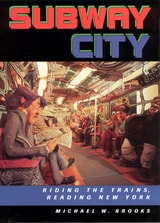
Subway City
Riding the Trains, Reading New YorkBrooks, Michael
Rutgers University Press, 1997
None of the world's great cities is as closely identified with its subway as New York. Its trains provide much more than just rapid transit. They give New Yorkers a powerful symbol of their metropolis, one that they use to express both their hopes and their fears for the urban future.
Subway City explores New York's transit system as both fact and metaphor. Brooks traces the development of the subway from its inception as the newest and most efficient public transportation system to its decline as an overcrowded and dangerous part of city life. The crowded cars gave Harold Lloyd material for comedy, fueled William Randolph Hearst's crusade against the Traction Trust, and convinced Lewis Mumford that the subway was a futile effort to solve the city's problems. Brooks explores films which have dramatized the dangers lurking below ground, and examines the infamous Bernhard Goetz shooting that made the subway a symbol of urban decay. More hopefully, he describes the Metropolitan Transportation Authority's station improvements and ambitious programs for Music Underground, Poetry in Transit, and Arts-in-Transit, as keys to the city's renewal.
Supremely Tiny Acts
A Memoir of a DaySonya Huber
The Ohio State University Press, 2021
“I think we have to get to the real, to catch the facts we have, to hold on to what we see. . . .in this time where lies are currency,” Sonya Huber writes in her book-length essay Supremely Tiny Acts: A Memoir of a Day. On the theory that naming the truths of quotidian experience can counter the dangerous power of lies, she carefully recounts two anxiety-fueled days one fall. On the first, she is arrested as part of a climate protest in Times Square. On the other, she must make it to her court appearance while also finding time to take her son to get his learner's permit. Paying equal attention to minor details, passing thoughts, and larger political concerns around activism and parenting in the Trump-era United States, Huber asks: How can one simultaneously be a good mother, a good worker, and a good citizen? As she reflects on the meaning of protest and on whiteness and other forms of privilege within political activism, Huber offers a wry, self-aware, and stirring testament to the everyday as a seedbed for meaningful change.
Surviving the Americas
Garifuna Persistence from Nicaragua to New York CitySerena Cosgrove, José Idiáquez, Leonard Joseph Bent, and Andrew Gorvetzian
University of Minnesota Press, 2020
In Surviving the Americas, Serena Cosgrove, José Idiáquez, Leonard Joseph Bent, and Andrew Gorvetzian shed light on what it means to be Garifuna today, particularly in Nicaragua. Their research includes over nine months of fieldwork in Garifuna communities in the Pearl Lagoon on the southern Caribbean coast of Nicaragua and in New York City. The resulting ethnography illustrates the unique social issues of the Nicaraguan Garifuna and how their culture, traditions, and reverence for their ancestors continues to persist.
Surviving the ICE Age
Children of Immigrants in New YorkJoanna Dreby
Russell Sage Foundation, 2025
Dreby shows that a restrictive approach to immigration creates problems over time and across generations. These issues occur regardless of one’s citizenship status and go beyond deportations. Despite having pride in their heritage, her interviewees did not talk much about immigration. She refers to this unwillingness—and at times, inability—to speak about immigration as silencing. Silencing in a community or family is often intended to protect children, but this can leave them with little information about their backgrounds and status, leading to fear and anxiety instead. Self-silencing often resulted from traumatic experiences tied to enforcement episodes, which sometimes took the form of memory loss or emotional withholding. Dreby finds that experiences with the immigration system that disrupted relationships in a child’s household arising from family separations, moves, or changing roles in the family had especially long-term effects, causing, at times, ongoing mental health issues. Even the risk of immigration involvement left some young adults feeling vulnerable and undermined their sense of safety and security as U.S. citizens.
Dreby also highlights stories that offer hope. Young adults developed strategies to persevere, and children who grew up in communities and families that openly talked about migration felt empowered and fared much better, especially when they had access to resources, such as adequate food and shelter, mental health services, and community support. Dreby calls for policies and practices to mitigate the harms of restrictive migratory control on children’s wellbeing, such avoiding the arrest of parents in front of children and ensuring that U.S. citizen children’s interests are considered in immigration court without their direct involvement.
Surviving the ICE Age details the generational harms caused by U.S. immigration policy and offers suggestions for a better way forward.