Results by title
87 books match the query 'Officials and employees' and 5 start with s

Shadows on the Klamath
A Woman in the WoodsLouise Wagenknecht
Oregon State University Press, 2021
With Shadows on the Klamath, Louise Wagenknecht completes her trilogy about life in remote northwestern California. In this new work, she recounts her years in the Forest Service, starting as a clerical worker on the Klamath National Forest before moving to a field position where she did everything from planting trees to fighting fires.
Her story is about a Forest Service in transition, as forest management practices began to shift. Not least among these changes was the presence of women in the ranks—a change that many in the Forest Service resisted. Wagenknecht blends the personal and professional to describe land management in the West and the people who do it—their friendships, rivalries, and rural communities.
Anyone with an interest in the Klamath-Siskiyou region, or the history of women in natural resource agencies, or the many issues associated with industrial forestry, should read this book for its valuable firsthand perspective. General readers interested in the rural West and personal memoir will also be richly rewarded.

Smoky, the Dog That Saved My Life
The Bill Wynne StoryNancy Roe Pimm
Ohio University Press, 2019
World War II soldier Bill Wynne met Smoky while serving in New Guinea, where the dog, who was smaller than Wynne’s army boot, was found trying to scratch her way out of a foxhole. After he adopted her, she served as the squadron mascot and is credited as being the first therapy dog for the emotional support she provided the soldiers. When they weren’t fighting, Bill taught Smoky hundreds of tricks to entertain the troops. Smoky became a war hero herself at an airstrip in Luzon, the Philippines, where she helped save forty airplanes and hundreds of soldiers from imminent attack.
After the war, Bill worked as a Hollywood animal trainer and then returned to his hometown of Cleveland, Ohio. He and Smoky continued to perform their act, even getting their own TV show, How to Train Your Dog with Bill Wynne and Smoky.
Nancy Roe Pimm presents Bill and Smoky’s story to middle-grade readers in delightful prose coupled with rich archival illustrations. Children will love learning about World War II from an unusual perspective, witnessing the power of the bond between a soldier and his dog, and seeing how that bond continued through the exciting years following the war.

Southwestern National Monuments
Frank Pinkley and the Rise of the National Park SystemWill Moore
University of Utah Press, 2025
This volume uncovers the little-known legacy of Frank Pinkley, the first superintendent of the Southwestern National Monuments (SWNM)—a unique National Park Service unit established in 1923. Pinkley’s leadership and innovative approach helped protect and develop thirty diverse monuments, ranging from Montezuma Castle to White Sands, linked by miles of rough roads and united by their historical, archaeological, and natural significance.
Drawing on archived SWNM Monthly Reports, Will Moore reconstructs the stories behind these monuments and their contributions to the nascent national park system. From the pioneering all-Navajo Mobile Unit of the Civilian Conservation Corps to visionary work in visitor education, Pinkley and his team helped to set a course for the protection of American landscapes. Southwestern National Monuments is essential reading for anyone passionate about America's natural heritage and national parks.
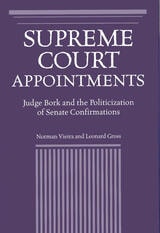
Supreme Court Appointments
Judge Bork and the Politicization of Senate ConfirmationsNorman Vieira and Leonard Gross
Southern Illinois University Press, 1998
Norman Vieira and Leonard Gross provide an in-depth analysis of the political and legal framework surrounding the confirmation process for Supreme Court nominees.
President Ronald Reagan’s nomination of Judge Robert Bork to the Supreme Court met with a fierce opposition that was apparent in his confirmation hearings, which were different in many ways from those of any previous nominee. Lasting longer than any other Supreme Court confirmation battle, the Senate hearings dragged on for eighty-seven hours over a twelve-day period. Bork personally testified for more than thirty hours, outlining his legal philosophy in greater detail than had ever before been required of a Supreme Court nominee. Nor had any previous Supreme Court nominee faced the number of witnesses who testified at the Bork hearings.
Deriving their material from hundreds of in-depth interviews with those who participated in the confirmation hearings, Vieira and Gross present a firsthand account of the behind-the-scenes pressure on senators to oppose Bork. Special-interest groups, they note, attempted to control the confirmation process, with both the media and public-opinion polls playing major roles in the defeat of the nomination. Both liberal and conservative groups used the Bork debate to raise money for political war chests.
This behind-the-scenes view of the politics and personalities involved in the Bork confirmation controversy provides a framework for future debates regarding the confirmation process. To help establish that framework, Vieira and Gross examine the similarities as well as the differences between the Bork confirmation battle and other confirmation proceedings for Supreme Court nominees. They also analyze the Supreme Court nominations made after the Bork hearings, including an extensive examination of the controversial Clarence Thomas nomination.

Supreme Court Confirmation Hearings in the U.S. Senate
Reconsidering the CharadeDion Farganis and Justin Wedeking
University of Michigan Press, 2014