Results by title
117 books match the query 'Opera' and 7 start with s
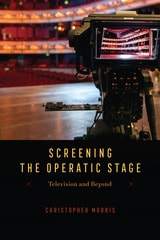
Screening the Operatic Stage
Television and BeyondChristopher Morris
University of Chicago Press, 2024
An ambitious study of the ways opera has sought to ensure its popularity by keeping pace with changes in media technology.
From the early days of television broadcasts to today’s live streams, opera houses have embraced technology as a way to reach new audiences. But how do these new forms of remediated opera extend, amplify, or undermine production values, and what does the audience gain or lose in the process? In Screening the Operatic Stage, Christopher Morris critically examines the cultural implications of opera’s engagement with screen media.
Foregrounding the potential for a playful exchange and self-awareness between stage and screen, Morris uses the conceptual tools of media theory to understand the historical and contemporary screen cultures that have transmitted the opera house into living rooms, onto desktops and portable devices, and across networks of movie theaters. If these screen cultures reveal how inherently “technological” opera is as a medium, they also highlight a deep suspicion among opera producers and audiences toward the intervention of media technology. Ultimately, Screening the Operatic Stage shows how the conventions of televisual representation employed in opera have masked the mediating effects of technology in the name of fidelity to live performance.
[more]
Semiramide
Melodramma tragico in Two Acts, Libretto by Gaetano RossiGioachino Rossini
University of Chicago Press, 2002
Semiramide brought Rossini's Italian career to a spectacular close in 1823. Its key scenes have great musical and dramatic impact, and in its expansive dimensions he attains masterful heights. Yet Semiramide remains true to neoclassical archetypes of style and form, with its preponderance of arias and duets. Proving gratifying to generations of fine singers, it was one of Rossini's last opere serie to disappear from the repertory and the first to be revived. Today it remains his most frequently performed Italian heroic opera. This critical edition is based on the autograph score, including the spartitino (for the wind and percussion instruments in large ensembles) recently discovered in the archives of Venice's La Fenice. More than a dozen contemporary manuscript copies and numerous early printed vocal scores were also consulted. An appendix includes Gossett's edition of Rossini's sketches for several numbers. Following the main score in three volumes, a fourth volume provides the original realization for the on-stage band.
[more]
Sensing Sound
Singing and Listening as Vibrational PracticeNina Sun Eidsheim
Duke University Press, 2016
In Sensing Sound Nina Sun Eidsheim offers a vibrational theory of music that radically re-envisions how we think about sound, music, and listening. Eidsheim shows how sound, music, and listening are dynamic and contextually dependent, rather than being fixed, knowable, and constant. She uses twenty-first-century operas by Juliana Snapper, Meredith Monk, Christopher Cerrone, and Alba Triana as case studies to challenge common assumptions about sound—such as air being the default medium through which it travels—and to demonstrate the importance a performance's location and reception play in its contingency. By theorizing the voice as an object of knowledge and rejecting the notion of an a priori definition of sound, Eidsheim releases the voice from a constraining set of fixed concepts and meanings. In Eidsheim's theory, music consists of aural, tactile, spatial, physical, material, and vibrational sensations. This expanded definition of music as manifested through material and personal relations suggests that we are all connected to each other in and through sound. Sensing Sound will appeal to readers interested in sound studies, new musicology, contemporary opera, and performance studies.
[more]
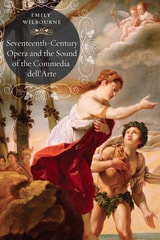
Seventeenth-Century Opera and the Sound of the Commedia dell’Arte
Emily Wilbourne
University of Chicago Press, 2016
In this book, Emily Wilbourne boldly traces the roots of early opera back to the sounds of the commedia dell’arte. Along the way, she forges a new history of Italian opera, from the court pieces of the early seventeenth century to the public stages of Venice more than fifty years later.
Wilbourne considers a series of case studies structured around the most important and widely explored operas of the period: Monteverdi’s lost L’Arianna, as well as his Il Ritorno d’Ulisse and L’incoronazione di Poppea; Mazzochi and Marazzoli’s L’Egisto, ovvero Chi soffre speri; and Cavalli’s L’Ormindo and L’Artemisia. As she demonstrates, the sound-in-performance aspect of commedia dell’arte theater—specifically, the use of dialect and verbal play—produced an audience that was accustomed to listening to sonic content rather than simply the literal meaning of spoken words. This, Wilbourne suggests, shaped the musical vocabularies of early opera and facilitated a musicalization of Italian theater.
Highlighting productive ties between the two worlds, from the audiences and venues to the actors and singers, this work brilliantly shows how the sound of commedia performance ultimately underwrote the success of opera as a genre.
[more]
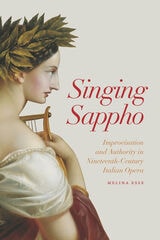
Singing Sappho
Improvisation and Authority in Nineteenth-Century Italian OperaMelina Esse
University of Chicago Press, 2021
From the theatrical stage to the literary salon, the figure of Sappho—the ancient poet and inspiring icon of feminine creativity—played a major role in the intertwining histories of improvisation, text, and performance throughout the nineteenth century. Exploring the connections between operatic and poetic improvisation in Italy and beyond, Singing Sappho combines earwitness accounts of famous female improviser-virtuosi with erudite analysis of musical and literary practices. Melina Esse demonstrates that performance played a much larger role in conceptions of musical authorship than previously recognized, arguing that discourses of spontaneity—specifically those surrounding the improvvisatrice, or female poetic improviser—were paradoxically used to carve out a new authority for opera composers just as improvisation itself was falling into decline. With this novel and nuanced book, Esse persuasively reclaims the agency of performers and their crucial role in constituting Italian opera as a genre in the nineteenth century.
[more]
Song and Self
A Singer's Reflections on Music and PerformanceIan Bostridge
University of Chicago Press, 2023
Award-winning singer Ian Bostridge examines iconic works of Western classical music to reflect on the relationship between performer and audience.
Like so many performers, renowned tenor Ian Bostridge spent much of 2020 and 2021 unable to take part in live music. The enforced silence of the pandemic led him to question an identity that was previously defined by communicating directly with audiences in opera houses and concert halls. It also allowed him to delve deeper into many of the classical works he has encountered over the course of his career, such as Claudio Monteverdi’s seventeenth-century masterpiece Il Combattimento di Tancredi e Clorinda and Robert Schumann’s popular song cycle Frauenliebe und Leben. In lucid and compelling prose, Bostridge explores the ways Monteverdi, Schumann, and Britten employed and disrupted gender roles in their music; questions colonial power and hierarchy in Ravel’s Songs of Madagascar; and surveys Britten’s reckoning with death in works from the War Requiem to his final opera, Death in Venice.
As a performer reconciling his own identity and that of the musical text he delivers on stage, Bostridge unravels the complex history of each piece of music, showing how today’s performers can embody that complexity for their audiences. As readers become privy to Bostridge’s unique lines of inquiry, they are also primed for the searching intensity of his interpretations, in which the uncanny melding of song and self brings about moments of epiphany for both the singer and his audience.
[more]
Stiffelio
Libretto (in three acts) by Francesco Maria PiaveGiuseppe Verdi
University of Chicago Press, 2003
The performance history of Stiffelio as Verdi envisioned it began only in 1993. Composed with Rigoletto, and sharing many of its characteristics, Stiffelio suffered from the censors' strictures. From its premiere in 1850, its text was diluted to appease the authorities, making a mockery of the action and Verdi's carefully calibrated music. The story of Stiffelio, a protestant minister who eventually divorces his adulterous wife but forgives her from the pulpit in the final scene, shocked conservative Italian religious and political powers. The libretto was rewritten for subsequent revivals, and even some music was dropped. In 1856 the composer angrily withdrew Stiffelio from circulation, reusing parts of the score for his Aroldo. The rest was later presumed lost.
Not until 1992 was it revealed that Verdi's heirs possessed not only most of the canceled score, but also sixty pages of sketches for Stiffelio. These were used for the preliminary score of the critical edition, premiered in 1993 at New York's Metropolitan Opera. It was the first time Stiffelio was performed as Verdi wrote it. It has been enthusiastically received around the world.
With the publication of the critical edition, the first in full orchestral score, Stiffelio should take its rightful place in the Verdi canon.
[more]