111 books match the query 'Personal narratives, American' and 6 start with s
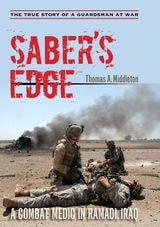
cover of Saber’s Edge: A Combat Medic in Ramadi, Iraq

Saber’s Edge

A Combat Medic in Ramadi, Iraq

Thomas A. Middleton

University Press of New England, 2010
The National Guardsman, the citizen soldier called upon to fight for this nation in a time of war, is one of the least understood — and perhaps one of the most compelling — figures of the Iraq War. Saber’s Edge is the story of a middle-aged Vermont firefighter called upon to be a soldier in the worst place on earth — Ramadi, Iraq. In a few short weeks Thomas A. Middleton went from being a suburban dad to a combat medic traveling between platoons, filling in for other medics and engaging in some of the fiercest and most crucial fighting of the war. This is the war as experienced from the ground level: days of tedium interspersed with the adrenalin of combat; moments of lighthearted laughter broken by the sorrow of loss. This is also the story of the unique wartime perspective of our guardsmen. Unlike the raw, unformed young recruit, the mature guardsman often comes with the burdens of family, experience, and a developed sense of self. Accordingly, Sgt. Middleton’s story chronicles the inner conflict created by his long-time professional role as a healer and his newfound life as a warrior in the urban battlefields of Iraq. Thrust into a culture and theater of war that he is little equipped or trained for, the author tries to make sense of his actions. Coarsened by combat and increasingly disdainful of the local population, he receives solace and insight from his life-long faith and ultimately emerges as a man who understands his role in the world. Saber’s Edge is also the story of the Green Mountain Boys of Task Force Saber: a story of comradeship and communion amid fierce street fighting in a crucial theater of the Iraq War (the eventual site of the “Al Anbar Awakening”). Based on the author’s first-hand experiences and interviews with other soldiers, Saber’s Edge presents a riveting account of modern urban warfare and the inspiring story of one man reconciling his actions in warfare.
[more]
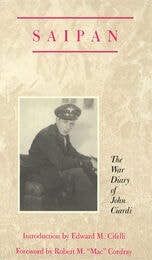
cover of Saipan: The War Diary of John Ciardi

Saipan

The War Diary of John Ciardi

John Ciardi

University of Arkansas Press, 1988
Ciardi records his days and nights as a gunner on a B-29 in the South Pacific during four of the last terrible months of World War II.
[more]
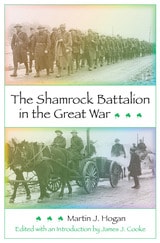
cover of Shamrock Battalion in the Great War

Shamrock Battalion in the Great War

Martin J. Hogan, Edited & Intro by James J. Cooke

University of Missouri Press, 2007

When Martin Hogan began training on a vacant lot to be a soldier, he had no idea that he was about to become part of one of the most famed fighting units of World War I. But soon he and other citizen soldiers from the Irish neighborhoods of New York City were locked in deadly combat with the German army.

            Hogan’s book records his recollections of the 165th Infantry in World War I, a regiment in the famed Rainbow Division. Company K of the Third or Shamrock Battalion had a part in every fight, and those who survived had more wound stripes than  did the soldiers of any other company in the American Expeditionary Forces. Few soldiers saw as much of the war in eighteen months as did young Martin Hogan, and in this stirring account he tells of his experiences with graphic power, humility, and humor.

Hogan depicts World War I at its most human level, with memories of combat in the trenches and on blood-soaked battlefields at St. Mihiel and in the Argonne Forest. His account tells us much about how unprepared for service the United States really was, with the National Guard woefully undersupplied and seriously undertrained. His experiences as a gassed, then wounded, soldier also show the reader a side of war that was far from glorious—in a time before penicillin, when the dangers of gangrene ran high—and his memoir conveys rare insight about conditions in American military hospitals where he found care.

            This insider view of the frontline experience during the Great War, complete with well-known figures such as Chaplain Father Francis Duffy and Colonel “Wild Bill” Donovan, attests that the Rainbow Division “epitomized the best of the best spirit in the world—the American spirit.”

            James Cooke’s new introduction to this edition places that renowned division in historical context. Now that other part-time American soldiers are facing new challenges abroad, Hogan’s account also attests that the National Guard, citizen soldiers who bore the brunt of much decisive fighting, measured up to the highest standards of professional fighting men.
[more]
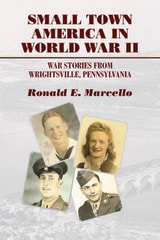
cover of Small Town America in World War II: War Stories from Wrightsville, Pennsylvania

Small Town America in World War II

War Stories from Wrightsville, Pennsylvania

Ronald E. Marcello

University of North Texas Press, 2014
[more]
cover of Soldier of the Press: Covering the Front in Europe and North Africa, 1936-1943

Soldier of the Press

Covering the Front in Europe and North Africa, 1936-1943

Henry T. Gorrell, Edited & Intro by Kenneth Gorrell, & Foreword by John C. McManus

University of Missouri Press, 2009
Threatened by each side in the Spanish Civil War with death as a suspected spy, decorated for saving an airman’s life in a bullet-ridden B-24 Liberator over Greece, war correspondent Henry “Hank” Gorrell often found himself in the thick of the fighting he had been sent to cover. And in reporting on some of the world’s most dangerous stories, he held newspaper readers spellbound with his eyewitness accounts from battlefields across Europe, Africa, and the Middle East.
An “exclusive” United Press correspondent, Gorrell saw more than his share of war, even more than most reporters, as his beat took him from the siege of Madrid to the sands of North Africa. His memoir, left in an attic trunk for sixty years, is presented here in its entirety for the first time. As he risks life and limb on the front lines, Gorrell gives us new perspectives on the overall conflict—including some of World War II’s lesser-known battles—as well as insights into behind-the-lines intrigue.
Gorrell’s account first captures early Axis intervention in Spain and their tests of new weaponry and blitzkrieg tactics at the cost of millions of Spanish lives. While covering the Spanish Civil War, he was captured by forces from each side and saw many brave men die disillusioned, and his writings offer a contrast to other views of that conflict from writers like Hemingway. But Spain was just Hank’s training ground: before America even entered World War II, he was embedded with Allied forces from seven nations.
When war broke out, Gorrell was sent to Hungary, where in Budapest he witnessed pro-Axis enthusiasts toast the victory of Fascist armies. Later in Romania he watched Stalin kick over the Axis apple cart with his invasion of Bessarabia—forcing the Germans to deal with the Russian menace before they had planned. Then he saw twenty Italian divisions mauled in the mountains of Albania, marking the beginning of the end for Mussolini.
Combining the historian’s accuracy with the journalist’s on-the-spot reportage, Gorrell provides eyewitness impressions of what war looked, sounded, and felt like to soldiers on the ground. Soldier of the Press weaves personal adventures into the larger fabric of world events, plunging modern readers into the heat of battle while revealing the dangers faced by war correspondents in that bygone era.
[more]
cover of Steel Helmet and Mortarboard: An Academic in Uncle Sam's Army

Steel Helmet and Mortarboard

An Academic in Uncle Sam's Army

Francis H. Heller

University of Missouri Press, 2009

As a young officer candidate in the Austrian army in 1938, Francis Heller put himself at risk by refusing to swear an oath of allegiance to Adolf Hitler. Had he stayed in Vienna, he would have been arrested by the Gestapo as a supporter of Austrian independence and an enemy of the Nazis. But he managed to escape into Czechoslovakia under cover of darkness. He subsequently made his way to America, where he finally pursued the academic career that military service had interrupted.
            Steel Helmet and Mortarboard is the story of this Austrian refugee who earned an American law degree in 1941 and set his sights on studying political science but a year later was drafted into the U.S. Army. In his second military career, Heller opted for service as an enlisted man in a combat unit. After basic training, he was assigned as a private in a regular army division. Then in a field artillery unit, he so distinguished himself in combat in the Pacific theater that he received a battlefield commission and went on to serve in the early months of the occupation of Japan—and on one assignment, escorting German nationals home from the Far East, found himself back in Europe and witnessing evidence of the horrors at Dachau that he himself had barely managed to escape.
Heller’s account of those years recalls how an upper-middle-class émigré adjusted to military life while serving in such combat zones as New Guinea and the Philippines, then how he later resumed his academic career, earned his Ph.D., and went on to teach at the University of Kansas. But Heller’s return to academic life was anything but final: recalled to active duty for the Korean War, he also served in later years with the U.S. Army Command and General Staff College at Fort Leavenworth.
After a lifetime of changing hats—mortarboard for helmet and back again—Heller, now in his nineties, has recorded his unique perceptions as an educated observer of the world. Steel Helmet and Mortarboard is an absorbing narrative of one individual’s experiences across a spectrum of personal and professional challenges, written with wry humor and insight that reflect a keen ability to master whatever circumstances life brings.
[more]