Results by title
4917 books match the query 'Philosophy' and 320 start with s

S. L. Frank
The Life And Work Of A Russian Philosopher, 1877-1950Philip Boobbyer
Ohio University Press, 1995
“There are many reasons for writing a biography of Semyon Frank. Quite apart from his philosophy, he lived a remarkable life. Born in Moscow in 1877, he was exiled from Soviet Russia in 1922 and died in London in 1950. The son of a Jewish doctor, he became a revolutionary Social Democrat in his teens and finished his life as a Neoplatonist Christian. One of the Russian revisionist Marxists, he was then involved in the Kadet Party during the 1905 revolution before breaking with active political activity and turning to philosophy. He lived in Petrograd through the First World War until September 1917, after which he went to Saratov, where he experienced the chaos of the Russian Civil War. Living in Germany after his exile, he witnessed the rise of Hitler in Berlin, left for France in a hurry in 1937, and spent part of the war hiding from the Gestapo in the Grenoble mountains. It was a life that encompassed a lot of history.
”Yet along with this, Frank was arguably Russia’s greatest twentieth-century philosopher. Indeed, V.V. Zen‘kovskii, the historian of Russian philosophy, considered Frank ’in strength of philosophic vision … the most outstanding among Russian philosophers generally — not merely among those who share his ideas.‘ For its lucidity, conciseness, systematic character, and unity, Zen’kovskii considered Frank’s system ‘ the highest achievement … of Russian philosophy.’ Doubtless, Zen‘kovskii’s assessment is disputable, but his remarks emphasize Frank’s stature in the Russian tradition. In the style of German idealism, Frank constructed a comprehensive philosophical system, which he believed offered a coherent alternative to materialism. He was deeply worried by the implications of epistemological relativism and constructed a system of metaphysics designed to link epistemology and ontology, to bridge the gulf between thought and being. In addition, he attempted to express the idea of a personal God in philosophical language. His system also embraced social philosophy, anthropology, and ethics.“
— from the Introduction by the author
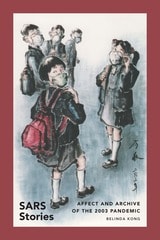
SARS Stories
Affect and Archive of the 2003 PandemicBelinda Kong
Duke University Press, 2024
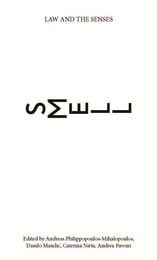
SMELL
Andrea Pavoni, Danilo Mandic, Caterina Nirta and Andreas Philippopoulos-Mihalopoulos
University of Westminster Press, 2023
Although somewhat marginal in relation to the other senses, smell is the most potent way of anchoring ourselves to the world. We subconsciously find our place in it by sniffing our body, the body of the one next to us, the room in which we are, the culture with which we are familiar. There is an incessant olfactory flow consisting of bodies, human and nonhuman, that are agents of generation, consumption, diffusion, reproduction and dissolution of odours. As they move or pause, as they cluster with others or try to move away, these bodies constantly partake in this olfactory flow, this dense planetary swirl that leaves nothing outside.
The law aims at presenting itself as rational and objective. Smell, on the other hand, is one of the least integrated senses in the legal edifice, in comparison to, say, seeing and hearing. This can be attributed mainly to the fact that sense-making of smell and law are different, even antithetical. Smell operates undercurrent, tickling the olfactory antennas of individual and collective bodies while habitually hiding behind other sensory volumes. Law, on the other hand, has an interest in appearing present, universal, constant. Olfactory sense-making relies on its elusiveness; legal sense-making invests in its obviousness. Yet, the two can interact in most unexpected ways, as this volume amply shows. If anything, smell airs the way in which law conceptualises and contextualises its own actuality. Smell brings law forth by allowing it to show its underbelly, its elusive sense-making that is invariably sacrificed in preference to the necessity of legal impressions of constancy. However, smell’s fragmentary, discontinuous and unstable nature, despite all the ordering that goes to it, poses a peculiar challenge to the law. This volume sets out to investigate this juncture.
Sabbatian Heresy
Writings on Mysticism, Messianism, and the Origins of Jewish ModernityEdited by Pawel Maciejko
Brandeis University Press, 2017
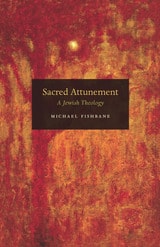
Sacred Attunement
A Jewish TheologyMichael Fishbane
University of Chicago Press, 2008
The first part of the book regrounds theology in this setting and opens up new pathways through nature, art, and the theological dimension as a whole. In the second section, Fishbane introduces his hermeneutical theology—one grounded in the interpretation of scripture as a distinctly Jewish practice. The third section focuses on modes of self-cultivation for awakening and sustaining a covenant theology. The final section takes up questions of scripture, authority, belief, despair, and obligation as theological topics in their own right.
The first full-scale Jewish theology in America since Abraham J. Heschel’s God in Search of Man and the first comprehensive Jewish philosophical theology since Franz Rosenzweig’s Star of Redemption, Sacred Attunement is a work of uncommon personal integrity and originality from one of the most distinguished scholars of Judaica in our time.

Sacred Stacks
The Higher Purpose of Libraries and LibrarianshipNancy Kalikow Maxwell
American Library Association, 2006
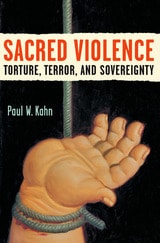
Sacred Violence
Torture, Terror, and SovereigntyPaul W. Kahn
University of Michigan Press, 2008
In Sacred Violence, the distinguished political and legal theorist Paul W. Kahn investigates the reasons for the resort to violence characteristic of premodern states. In a startling argument, he contends that law will never offer an adequate account of political violence. Instead, we must turn to political theology, which reveals that torture and terror are, essentially, forms of sacrifice. Kahn forces us to acknowledge what we don't want to see: that we remain deeply committed to a violent politics beyond law.
Paul W. Kahn is Robert W. Winner Professor of Law and the Humanities at Yale Law School and Director of the Orville H. Schell, Jr. Center for International Human Rights.
Cover Illustration: "Abu Ghraib 67, 2005" by Fernando Botero. Courtesy of the artist and the American University Museum.
Sacrifice
René Girard
Michigan State University Press, 2011
In Sacrifice, René Girard interrogates the Brahmanas of Vedic India, exploring coincidences with mimetic theory that are too numerous and striking to be accidental. Even that which appears to be dissimilar fails to contradict mimetic theory, but instead corresponds to the minimum of illusion without which sacrifice becomes impossible.
The Bible reveals collective violence, similar to that which generates sacrifice everywhere, but instead of making victims guilty, the Bible and the Gospels reveal the persecutors of a single victim. Instead of elaborating myths, they tell the truth absolutely contrary to the archaic sense. Once exposed, the single victim mechanism can no longer function as the model for would-be sacrificers.
Recognizing that the Vedic tradition also converges on a revelation that discredits sacrifice, mimetic theory locates within sacrifice itself a paradoxical power of quiet reflection that leads, in the long run, to the eclipse of this institution which is violent but nevertheless fundamental to the development of human culture. Far from unduly privileging the Western tradition and awarding it a monopoly on the knowledge and repudiation of blood sacrifice, mimetic analysis recognizes comparable, but never truly identical, traits in the Vedic tradition.
Sade My Neighbor
Pierre Klossowski
Northwestern University Press, 1991
Klossowski was one of the first philosophers in postwar Europe to ask whether Sade's reason, although aberrant and perverted to evil passions, could be taken seriously. Klossowski's seminal work inspired virtually all subsequent study of Sadean thought, including that of de Beauvoir, Deleuze, Derrida, Bataille, Blanchot, Paulhan, and Lacan.
Sade
The Invention Of The Libertine BodyMarcel Henaff
University of Minnesota Press, 1999
A new model for examining Sade and his creations.
A new model for examining Sade and his creations.
Decried as a misogynist and pornographer, imprisoned for debauchery and for his writings, there is scarcely a cultural figure as flamboyant and controversial as the Marquis de Sade, the father of the new libertine body. But this is not, Hénaff maintains, the only way to see Sade. In this long-awaited English translation, Hénaff says that Sade should be discussed less for the sensual heat of his writing and more for the larger poetic and economic model his work represents.With unabashed candor, Sade describes bodies in terms not of flesh but of production, use, exchange, and waste. In his writing, this libertine self is unleashed from its constraints, no longer bound by old conceptions of desire and traditions of courtship. Hénaff’s argument that Sade is a sign of his times-exposing the courtly facade of a society unable to preserve itself-reveals dark, disquieting secrets about the direction of civilization. The libertine body, he says, is a child of this new order.ISBN 0-8166-2536-0 Cloth £34.50 $49.95xxISBN 0-8166-2537-9 Paper £14.00 $19.95x296 Pages 5 7/8 x 9 OctoberTranslation inquiries: University of Minnesota Press
Saint Thomas Aquinas
The Person and His WorkJean-Pierre Torrell, OP
Catholic University of America Press, 2022
Saints and Postmodernism
Revisioning Moral PhilosophyEdith Wyschogrod
University of Chicago Press, 1990
"A 'must' for readers interested in the borderlands between philosophy, hagiography, and ethics."—Mark I. Wallace, Religious Studies Review
Saints
Faith without BordersEdited by Françoise Meltzer and Jas Elsner
University of Chicago Press, 2011
While the modern world has largely dismissed the figure of the saint as a throwback, we remain fascinated by excess, marginality, transgression, and porous subjectivity—categories that define the saint. In this collection, Françoise Meltzer and Jas Elsner bring together top scholars from across the humanities to reconsider our denial of saintliness and examine how modernity returns to the lure of saintly grace, energy, and charisma.
Sandino's Communism
Spiritual Politics for the Twenty-First CenturyBy Donald C. Hodges
University of Texas Press, 1992
Drawing on previously unknown or unassimilated sources, Donald C. Hodges here presents an entirely new interpretation of the politics and philosophy of Augusto C. Sandino, the intellectual progenitor of Nicaragua's Sandinista revolution.
The first part of the book investigates the political sources of Sandino's thought in the works of Babeuf, Buonarroti, Blanqui, Proudhon, Bakunin, Most, Malatesta, Kropotkin, Ricardo Flores Magón, and Lenin—a mixed legacy of pre-Marxist and non-Marxist authoritarian and libertarian communists.
The second half of the study scrutinizes the philosophy of nature and history that Sandino made his own. Hodges delves deeply into this philosophy as the supreme and final expression of Sandino's communism and traces its sources in the Gnostic and millenarian occult undergrounds. This results in a rich study of the ways in which Sandino's revolutionary communism and communist spirituality intersect—a spiritual politics that Hodges presents as more realistic than the communism of Karl Marx.
While accepting the current wisdom that Sandino was a Nicaraguan liberal and social reformer, Hodges also makes a persuasive case that Sandino was first and foremost a communist, although neither of the Marxist nor anarchist variety. He argues that Sandino's eclectic communist spirituality was more of an asset than a liability for understanding the human condition, and that his spiritual politics promises to be more relevant than Marxism-Leninism for the twenty-first century. Indeed, Hodges believes that Sandino's holistic communism embraces both deep ecology and feminist spirituality—a finding that is sure to generate lively and productive debate.
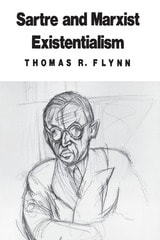
Sartre and Marxist Existentialism
The Test Case of Collective ResponsibilityThomas R. Flynn
University of Chicago Press, 1986
The study begins with an examination of the uses of "responsibility" in Being and Nothingness and in several postwar essays. Flynn then concentrates on the Critique of Dialectical Reason, offering a thorough analysis of the remarkable social theory Sartre constructs there. A masterful contribution to Sartre scholarship, Sartre and Marxist Existentialism will be of great interest to social and political philosophers involved in the debate over collective responsibility.
Sartre, Foucault, and Historical Reason, Volume One
Toward an Existentialist Theory of HistoryThomas R. Flynn
University of Chicago Press, 1997
A history, thought Foucault, should be a kind of map, a comparative charting of structural transformations and displacements. But for Sartre, authentic historical understanding demanded a much more personal and committed narrative, a kind of interpretive diary of moral choices and risks compelled by critical necessity and an exacting reality. Sartre's history, a rational history of individual lives and their intrinsic social worlds, was in essence immersed in biography.
In Volume One of this authoritative two-volume work, Thomas R. Flynn conducts a pivotal and comprehensive reconstruction of Sartrean historical theory, and provocatively anticipates the Foucauldian counterpoint to come in Volume Two.
Sartre, Foucault, and Historical Reason, Volume Two
A Poststructuralist Mapping of HistoryThomas R. Flynn
University of Chicago Press, 2005
A history, theorized Foucault, should be a kind of map, a comprehensive charting of structural transformations and displacements over time. Contrary to other Foucault scholars, Flynn proposes an "axial" rather than a developmental reading of Foucault's work. This allows aspects of Foucault's famous triad of knowledge, power, and the subject to emerge in each of his major works. Flynn maps existentialist categories across Foucault's "quadrilateral," the model that Foucault proposes as defining modernist conceptions of knowledge. At stake is the degree to which Sartre's thought is fully captured by this mapping, whether he was, as Foucault claimed, "a man of the nineteenth century trying to think in the twentieth."
Saturation
An Elemental PoliticsMelody Jue and Rafico Ruiz, editors
Duke University Press, 2021
Contributors. Marija Cetinić, Jeff Diamanti, Bishnupriya Ghosh, Lisa Yin Han, Stefan Helmreich, Mél Hogan, Melody Jue, Rahul Mukherjee, Max Ritts, Rafico Ruiz, Bhaskar Sarkar, John Shiga, Avery Slater, Janet Walker, Joanna Zylinska

Savage Anomaly
The Power of Spinoza’s Metaphysics and PoliticsAntonio Negri
University of Minnesota Press, 1999
A fresh take on this critical philosopher.
In this essential rereading of Spinoza’s (1632-1677) philosophical and political writings, Negri positions this thinker within the historical context of the development of the modern state and its attendant political economy. Through a close examination of Spinoza, Negri reveals him as unique among his contemporaries for his nondialectical approach to social organization in a bourgeois age.
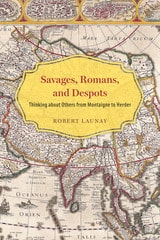
Savages, Romans, and Despots
Thinking about Others from Montaigne to HerderRobert Launay
University of Chicago Press, 2018
Beginning with Mandeville and Montaigne, and working through Montesquieu, Diderot, Gibbon, Herder, and others, Launay traces how Europeans both admired and disdained unfamiliar societies in their attempts to work through the inner conflicts of their own social worlds. Some of these writers drew caricatures of “savages,” “Oriental despots,” and “ancient” Greeks and Romans. Others earnestly attempted to understand them. But, throughout this history, comparative thinking opened a space for critical reflection. At its worst, such space could give rise to a sense of European superiority. At its best, however, it could prompt awareness of the value of other ways of being in the world. Launay’s masterful survey of some of the Western tradition’s finest minds offers a keen exploration of the genesis of the notion of “civilization,” as well as an engaging portrait of the promises and perils of cross-cultural comparison.
Saying What We Mean
Implicit Precision and the Responsive OrderSelected Works by Eugene T. Gendlin, Edited by Edward S. Casey and Donata M. Schoeller; Foreword by Edward S. Casey
Northwestern University Press, 2018
The first collection of Eugene T. Gendlin’s groundbreaking essays in philosophical psychology, Saying What We Mean casts familiar areas of human experience, such as language and feeling, in a radically different light. Instead of the familiar scientific emphasis on what is conceptually explicit, Gendlin shows that the implicit also comprises a structure that can be made available for recognition and analysis.
Developing the traditions of phenomenology, existentialism, and pragmatism, Gendlin forges a new path that synthesizes contemporary evolutionary theory, cognitive psychology, and philosophical linguistics.
Scale Theory
A Nondisciplinary InquiryJoshua DiCaglio
University of Minnesota Press, 2021
A pioneering call for a new understanding of scale across the humanities
How is it possible that you are—simultaneously—cells, atoms, a body, quarks, a component in an ecological network, a moment in the thermodynamic dispersal of the sun, and an element in the gravitational whirl of galaxies? In this way, we routinely transform reality into things already outside of direct human experience, things we hardly comprehend even as we speak of DNA, climate effects, toxic molecules, and viruses. How do we find ourselves with these disorienting layers of scale? Enter Scale Theory, which provides a foundational theory of scale that explains how scale works, the parameters of scalar thinking, and how scale refigures reality—that teaches us how to think in terms of scale, no matter where our interests may lie.
Joshua DiCaglio takes us on a fascinating journey through six thought experiments that provide clarifying yet provocative definitions for scale and new ways of thinking about classic concepts ranging from unity to identity. Because our worldviews and philosophies are largely built on nonscalar experience, he then takes us slowly through the ways scale challenges and reconfigures objects, subjects, and relations.
Scale Theory is, in a sense, nondisciplinary—weaving together a dizzying array of sciences (from nanoscience to ecology) with discussions from the humanities (from philosophy to rhetoric). In the process, a curious pattern emerges: attempts to face the significance of scale inevitably enter terrain closer to mysticism than science. Rather than dismiss this connection, DiCaglio examines the reasons for it, redefining mysticism in terms of scale and integrating contemplative philosophies into the discussion. The result is a powerful account of the implications and challenges of scale, attuned to the way scale transforms both reality and ourselves.

Scalia v. Scalia
Opportunistic Textualism in Constitutional InterpretationCatherine L. Langford
University of Alabama Press, 2018
Antonin Scalia is considered one of the most controversial justices to have been on the United States Supreme Court. A vocal advocate of textualist interpretation, Justice Scalia argued that the Constitution means only what it says and that interpretations of the document should be confined strictly to the directives supplied therein. This narrow form of constitutional interpretation, which limits constitutional meaning to the written text of the Constitution, is known as textualism.
Scalia v. Scalia:Opportunistic Textualism in Constitutional Interpretation examines Scalia’s discussions of textualism in his speeches, extrajudicial writings, and judicial opinions. Throughout his writings, Scalia argues textualism is the only acceptable form of constitutional interpretation. Yet Scalia does not clearly define his textualism, nor does he always rely upon textualism to the exclusion of other interpretive means.
Scalia is seen as the standard bearer for textualism. But when textualism fails to support his ideological aims (as in cases that pertain to states’ rights or separation of powers), Scalia reverts to other forms of argumentation. Langford analyzes Scalia’s opinions in a clear area of law, the cruel and unusual punishment clause; a contested area of law, the free exercise and establishment cases; and a silent area of law, abortion. Through her analysis, Langford shows that Scalia uses rhetorical strategies beyond those of a textualist approach, concluding that Scalia is an opportunistic textualist and that textualism is as rhetorical as any other form of judicial interpretation.

Scandalous Knowledge
Science, Truth, and the HumanBarbara Herrnstein Smith
Duke University Press, 2006
With keen wit, Smith demonstrates that the familiar charges involved in these scandals—including the recurrent invocation of “postmodern relativism”—protect intellectual orthodoxy by falsely associating important intellectual developments with logically absurd and morally or politically disabling positions. She goes on to offer bold, original, and insightful perspectives on the currently strained relations between the natural sciences and the humanities; on the grandiose but dubious claims of evolutionary psychology to explain human behavior, cognition, and culture; and on contemporary controversies over the psychology, biology, and ethics of animal-human relations. Scandalous Knowledge is a provocative and compelling intervention into controversies that continue to roil through journalism, pulpits, laboratories, and classrooms throughout the United States and Europe.

Scattering the Seed
A Guide through Balthasar's Early Writings on Philosophy and the ArtsAidan Nichols
Catholic University of America Press, 2006
Scheler’s Critique of Kant’s Ethics
Philip Blosser
Ohio University Press, 1995
“My interest in [Max] Scheler’s critique of Kant runs back nearly a decade…. The more I read of Scheler, the more I began to see the value of a project dealing with his critique of Kant in Der Formalismus in der Ethik und die Materiale Wetethik, which would possess the virtue of focusing in a single project three important strands of philosophical interest: phenomenology, Kantianism, and ethics….
“The study is divided into six chapters and two appendices. Each of the chapters constituting the body of the work contains a brief analysis of the Kantian position or discussion of the basic questions at issue in it, an exposition of Scheler’s critique of the Kantian position and its presuppositions, and a detailed appraisal of Scheler’s critique.”—from the introduction by the author
Schelling’s Treatise on the Essence of Human Freedom
On Essence Human FreedomMartin Heidegger
Ohio University Press, 1985
Heidegger’s lectures delivered at the University of Freiburg in 1936 on Schelling’s Treatise On Human Freedom came at a crucial turning point in Heidegger’s development. He had just begun his study to work out the term “Ereignis.” Heidegger’s interpretation of Schelling’s work reveals a dimension of his thinking which has never been previously published in English.
While Schelling’s philosophy is less known than that of the other major German Idealists, Fichte and Hegel, he is one of the thinker with whom Heidegger has the most affinity, making this study fruitful for an understanding of both philosophers. Heidegger’s interpretation of On Human Freedom is the most straightforward of the studies to have appeared in English on the Treatise, and is the only work that is devoted to Schelling in Heidegger’s corpus. The basic problems at stake in Schelling’s Treatise lie at the very heart of the idealist tradition: the question of the compatibility of the system and individual freedom, the questions of pantheism and the justification of evil. Schelling was the first thinker in the rationalist-idealist tradition to grapple seriously with the problem of evil.
These are the great questions of the philosophical tradition. They lead Schelling and, with him, Heidegger, to possibilities that come very close to the boundaries of the idealist tradition. For example, Schelling’s concept of the “groundless”—what reason can no longer ground and explain—points back to Jacob Boehme and indirectly forward to the direction of Heidegger’s own inquiry into “Being.” Heidegger’s reading of Schelling, especially of the topics of evil and freedom, clearly shows Schelling’s influence on Heidegger’s views.
Scholastic Meditations
Nicholas Rescher
Catholic University of America Press, 2005
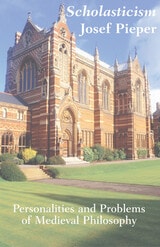
Scholasticism
Personalities & Problems Medieval PhilosophyJosef Pieper
St. Augustine's Press, 2001
The account is broken by the gradual replacement of the synthesis of faith and reason that had been achieved in the early Middle Ages by a new one that made use of Aristotle. Pieper gives a thorough and lively account of the struggle between Aristotelians and anti-Aristotelians, and the famous condemnations that put the effort of Saint Thomas Aquinas at risk. But the Summa theologiae is regarded by Pieper as the unique achievement of the period.
If the early centuries, the medieval period, can be seen as moving toward the thirteenth and Thomas's unique achievement, subsequent centuries saw the decline of scholasticism and theappearance of harbingers of modern philosophy.
The book closes with Pieper's thoughts on the permanent philosophical and theological significance of scholasticism and the Middle Ages. Once again, wearing his learning lightly, writing with a clarity that delights, Josef Pieper has taken the field from stuffier and more extended accounts.
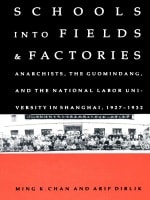
Schools into Fields and Factories
Anarchists, the Guomindang, and the National Labor University in Shanghai, 1927–1932Ming K. Chan and Arif Dirlik
Duke University Press, 1991
During its five years of existence, Labor University was the most impressive institutional embodiment in twentieth-century China of the labor-learning ideal, which was introduced by anarchists in the first decade of the century and came to be shared by a diverse group of revolutionaries in the 1920s. This detailed study places Labor University within the broad context of anarchist social ideals and educational experiments that inspired it directly, as well as comparable socialist experiments within labor education in Europe that Labor University’s founders used as models. The authors bring to bear the perspectives of institutional and intellectual history on their examination of the structure and operation of the University, presenting new material on its faculty, curriculum, physical plant, and history.

Schopenhauer and Nietzsche
Georg Simmel
University of Illinois Press, 1991
Georg Simmel pits the two German masters of philosophy of life against
each other in a play of opposition and supplementation. This first English
translation of Simmel's work includes an extensive introduction, providing
the reader with ready access to the text by mapping its discursive strategies.
Science Fiction and Extro-Science Fiction
Quentin Meillassoux
University of Minnesota Press, 2015
In Science Fiction and Extro-Science Fiction, Quentin Meillassoux addresses the problem of chaos and of the constancy of natural laws in the context of literature. With his usual argumentative rigor, he elucidates the distinction between science fiction, a genre in which science remains possible in spite of all the upheavals that may attend the world in which the tale takes place, and fiction outside-science, the literary concept he fashions in this book, a fiction in which science becomes impossible. With its investigations of the philosophies of Hume, Kant, and Popper, Science Fiction and Extro-Science Fiction broadens the inquiry that Meillassoux began in After Finitude, thinking through the concrete possibilities and consequences of a chaotic world in which human beings can no longer resort to science to ground their existence. It is a significant milestone in the work of an emerging philosopher, which will appeal to readers of both philosophy and literature. The text is followed by Isaac Asimov’s essay “The Billiard Ball.”
Science Incarnate
Historical Embodiments of Natural KnowledgeEdited by Christopher Lawrence and Steven Shapin
University of Chicago Press, 1998
Bringing body and knowledge into such intimate contact is occasionally seen as funny, sometimes as enraging, and more often just as pointless. Vividly written and well illustrated, Science Incarnate offers concrete historical answers to such skeptical questions about the relationships between body, mind, and knowledge.
Focusing on the seventeenth century to the present, Science Incarnate explores how intellectuals sought to establish the value and authority of their ideas through public displays of their private ways of life. Patterns of eating, sleeping, exercising, being ill, and having (or avoiding) sex, as well as the marks of gender and bodily form, were proof of the presence or absence of intellectual virtue, integrity, skill, and authority. Intellectuals examined in detail include René Descartes, Isaac Newton, Charles Darwin, and Ada Lovelace.
Science Incarnate is at once very funny and deeply serious, addressing issues of crucial importance to present-day discussions about the nature of knowledge and how it is produced. It incorporates much that will interest cultural and social historians, historians of science and medicine, philosophers, sociologists, and anthropologists.
Science Of Love
Wisdom Of Well BeingThomas Oord
Templeton Press, 2004
We all know the saying, "Love can change the world." When science looks at love, it considers cosmology, sociobiology, evolutionary psychology, neurology, sex and romance, and the role of emotions as each relates to love. It also explores religious, ethical, and philosophical issues, such as virtue, creation ex nihilo, progress, divine action, agape, values, religious practices, pacifism, sexuality, friendship, freedom, and marriage. All affect the ways in which people understand each other and interact with one another. In this book, Oord explores these varied dimensions of love, illuminating the love-science symbiosis for both scholars and general readers.
His definition of love is "to act intentionally, in sympathetic response to others (including God), to promote overall well-being. Love acts are influenced by previous actions and executed in the hope of attaining a high degree of good for all." He begins his study with an exploration of the role love plays in all major world religions: Hinduism, Buddhism, Confucianism, Judaism, Islam, and Christianity. He explains how divine love in action can be viewed as consonant with the big bang theory and the continual creation of the universe.
He looks at pacifism and concludes that nonviolence is not always the most loving thing (sometimes violence must be used to rescue victims or prevent holocausts). He explores the animal kingdom to see how creatures work together with the Creator to make the world a better place. And he analyzes the fundamentals of love, the basic characteristics of existence that must be present for love to be expressed. He concludes with the important argument that progress can best be made when religion and science work together to both understand and promote love.
Science Unfettered
A Philosophical Study in Sociohistorical OntologyJames E. McGuire
Ohio University Press, 2000
Working on a large canvas, Science Unfettered contributes to the ongoing debates in the philosophy of science. The ambitious aim of its authors is to reconceptualize the orientation of the subject, and to provide a new framework for understanding science as a human activity. Mobilizing the literature of the philosophy of science, the history of science, the sociology of science, and philosophy in general, Professors McGuire and Tuchanska build on these fields with the view of transforming their insights into a new epistemological and ontological basis for studying the enterprise of science.
In this approach, McGuire and Tuchanska have combined work from both Anglo-American and Continental traditions of philosophy. As a result, the works of Popper, Kuhn, Quine, and Lakatos, as well as Heidegger, Gadamer, Nietzsche, Foucault, and Feyerabend, are called into play. In addition, Science Unfettered deals extensively with history and historicity, offering a theory of historicity of science as it emerges in sociocultural contexts.
Unorthodox in its approach, Science Unfettered articulates an alternative that views science ontologically as a “practice,” a perspective from which traditional issues concerning the relationship of experiment to theory, the cognitive to the social, the relation between historical change and epistemic validity, the meaning of “objectivity” and the like can be addressed in a more fruitful way than is possible by starting with the traditional, ontological framework of subject and object.
Science Unlimited?
The Challenges of ScientismEdited by Maarten Boudry and Massimo Pigliucci
University of Chicago Press, 2017
In this wide-ranging collection, contributors ask whether the term scientism in fact (or in belief) captures an interesting and important intellectual stance, and whether it is something that should alarm us. Is scientism a well-developed position about the superiority of science over all other modes of human inquiry? Or is it more a form of excessive confidence, an uncritical attitude of glowing admiration? What, if any, are its dangers? Are fears that science will marginalize the humanities and eradicate the human subject—that it will explain away emotion, free will, consciousness, and the mystery of existence—justified? Does science need to be reined in before it drives out all other disciplines and ways of knowing? Both rigorous and balanced, Science Unlimited? interrogates our use of a term that is now all but ubiquitous in a wide variety of contexts and debates. Bringing together scientists and philosophers, both friends and foes of scientism, it is a conversation long overdue.
Science and Culture
Popular and Philosophical EssaysHermann von Helmholtz
University of Chicago Press, 1995
From the 1850s to the 1890s, Helmholtz delivered more than two dozen popular lectures, seeking to educate the public and to enlighten the leaders of European society and governments about the potential benefits of science and technology to a developing modern society. David Cahan has selected fifteen of these lectures, which reflect the wide range of topics of crucial importance to Helmholtz and his audiences. Among the subjects discussed are the origins of the planetary system, the relation of natural science to science in general, the aims and progress of the physical sciences, the problems of perception, and academic freedom in German universities. This collection also includes Helmholtz's fascinating lectures on the relation of optics to painting and the physiological causes of harmony in music, which provide insight into the relations between science and aesthetics.
Science and Culture makes available again Helmholtz's eloquent arguments on the usefulness, benefits, and, intellectual pleasures of understanding the natural world. With Cahan's Introduction to set these essays in their broader context, this collection makes an important contribution to the philosophical and intellectual history of Europe at a time when science played an increasingly significant role in social, economic, and cultural life.

Science and Relativism
Some Key Controversies in the Philosophy of ScienceLarry Laudan
University of Chicago Press, 1990
Science and Religion
A Critical SurveyHolmes Rolston
Templeton Press, 2006
opportunities been greater for fertile interaction between these fields, with mutual benefits to both,” states Rolston. The re-publication of this book provides current researchers and students in the field an invaluable, timeless methodological resource.The new introduction offers updated insights based on new scientific research.
Science and Social Inequality
Feminist and Postcolonial IssuesSandra Harding
University of Illinois Press, 2006
In Science and Social Inequality, Sandra Harding makes the provocative argument that the philosophy and practices of today's Western science, contrary to its Enlightenment mission, work to insure that more science will only worsen existing gaps between the best and worst off around the world. She defends this claim by exposing the ways that hierarchical social formations in modern Western sciences encode antidemocratic principles and practices, particularly in terms of their services to militarism, the impoverishment and alienation of labor, Western expansion, and environmental destruction. The essays in this collection--drawing on feminist, multicultural, and postcolonial studies--propose ways to reconceptualize the sciences in the global social order.
At issue here are not only social justice and environmental issues but also the accuracy and comprehensiveness of our understandings of natural and social worlds. The inadvertent complicity of the sciences with antidemocratic projects obscures natural and social realities and thus blocks the growth of scientific knowledge. Scientists, policy makers, social justice movements and the consumers of scientific products (that is, the rest of us) can work together and separately to improve this situation.
Science and an African Logic
Helen Verran
University of Chicago Press, 2001
In this captivating book, Helen Verran addresses precisely that question by looking at how science, mathematics, and logic come to life in Yoruba primary schools. Drawing on her experience as a teacher in Nigeria, Verran describes how she went from the radical conclusion that logic and math are culturally relative, to determining what Westerners find so disconcerting about Yoruba logic, to a new understanding of all generalizing logic. She reveals that in contrast to the one-to-many model found in Western number systems, Yoruba thinking operates by figuring things as wholes and their parts. Quantity is not absolute but always relational. Certainty is derived not from abstract logic, but from cultural practices and associations.
A powerful story of how one woman's investigation in this everday situation led to extraordinary conclusions about the nature of numbers, generalization, and certainty, this book will be a signal contribution to philosophy, anthropology of science, and education.
Science and the Humanities
Moody E. Prior
Northwestern University Press, 1962
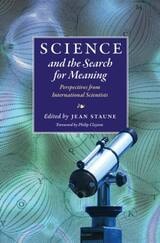
Science and the Search for Meaning
Perspectives from International ScientistsJean Staune
Templeton Press, 2006
As the organizer of some of the most important meetings in science and religion in Europe, Jean Staune is in a core position to report on the dialogue between science and religion, primarily from the views of scientists. In this book, the translation of a recent French edition, he presents "audacious and rigorous" articles by fifteen renowned leaders in the field, of whom four are Nobel Prize winners. They represent nine countries and seven religions.
Each of the authors in this volume responds in a different way, addressing naturalism, materialism, the nature of consciousness, reductionism, and the quest for meaning.Two paradigms emerge, with those who say that God (or direction) can exist in the universe because we can understand certain things, while others say that God exists because we cannot understand the universe altogether. Their reflections on the accessibility and the mystery of the world show the extraordinary abstract revolution that took place in science during the twentieth century and the way this establishes a bridge between science and religion.
Contributors are Nobel Prize winners Christian de Duve, Charles Townes, Ahmed Zewail, and William D. Phillips; as well as Paul Davies, Bernard d'Espagnat, Thomas Odhiambo, Ramanath Cowsik, Jean Kovalevsky, Thierry Magnin, Bruno Guiderdoni, Trinh Xuan Thuan, Khalil Chamcham, Michael Heller, and Philip Clayton.
Science as Power
Discourse and Ideology in Modern SocietyStanley Aronowitz
University of Minnesota Press, 1988
Science as Power was first published in 1988. Minnesota Archive Editions uses digital technology to make long-unavailable books once again accessible, and are published unaltered from the original University of Minnesota Press editions.
Science has established itself as not merely the dominant but the only legitimate form of human knowledge. By tying its truth claims to methodology, science has claimed independence from the influence of social and historical conditions. Here, Aronowitz asserts that the norms of science are by no means self-evident and that science is best seen as a socially constructed discourse that legitimates its power by presenting itself as truth.
Stanley Aronowitz is professor of sociology in the graduate school of City University of New York. His books include Working Class Hero: A New Strategy for Labor and, with Henry Giroux, Education Under Siege.
Science as Practice and Culture
Edited by Andrew Pickering
University of Chicago Press, 1992
Andrew Pickering has invited leading historians, philosophers, sociologists, and anthropologists of science to prepare original essays for this volume. The essays range over the physical and biological sciences and mathematics, and are divided into two parts. In part I, the contributors map out a coherent set of perspectives on scientific practice and culture, and relate their analyses to central topics in the philosophy of science such as realism, relativism, and incommensurability. The essays in part II seek to delineate the study of science as practice in arguments across its borders with the sociology of scientific knowledge, social epistemology, and reflexive ethnography.
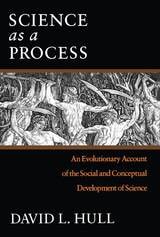
Science as a Process
An Evolutionary Account of the Social and Conceptual Development of ScienceDavid L. Hull
University of Chicago Press, 1990
"In Science as a Process, [David Hull] argues that the tension between cooperation and competition is exactly what makes science so successful. . . . Hull takes an unusual approach to his subject. He applies the rules of evolution in nature to the evolution of science, arguing that the same kinds of forces responsible for shaping the rise and demise of species also act on the development of scientific ideas."—Natalie Angier, New York Times Book Review
"By far the most professional and thorough case in favour of an evolutionary philosophy of science ever to have been made. It contains excellent short histories of evolutionary biology and of systematics (the science of classifying living things); an important and original account of modern systematic controversy; a counter-attack against the philosophical critics of evolutionary philosophy; social-psychological evidence, collected by Hull himself, to show that science does have the character demanded by his philosophy; and a philosophical analysis of evolution which is general enough to apply to both biological and historical change."—Mark Ridley, Times Literary Supplement
"Hull is primarily interested in how social interactions within the scientific community can help or hinder the process by which new theories and techniques get accepted. . . . The claim that science is a process for selecting out the best new ideas is not a new one, but Hull tells us exactly how scientists go about it, and he is prepared to accept that at least to some extent, the social activities of the scientists promoting a new idea can affect its chances of being accepted."—Peter J. Bowler, Archives of Natural History
"I have been doing philosophy of science now for twenty-five years, and whilst I would never have claimed that I knew everything, I felt that I had a really good handle on the nature of science, Again and again, Hull was able to show me just how incomplete my understanding was. . . . Moreover, [Science as a Process] is one of the most compulsively readable books that I have ever encountered."—Michael Ruse, Biology and Philosophy
Science in the Age of Computer Simulation
Eric Winsberg
University of Chicago Press, 2010
Computer simulation was first pioneered as a scientific tool in meteorology and nuclear physics in the period following World War II, but it has grown rapidly to become indispensible in a wide variety of scientific disciplines, including astrophysics, high-energy physics, climate science, engineering, ecology, and economics. Digital computer simulation helps study phenomena of great complexity, but how much do we know about the limits and possibilities of this new scientific practice? How do simulations compare to traditional experiments? And are they reliable? Eric Winsberg seeks to answer these questions in Science in the Age of Computer Simulation.
Scrutinizing these issue with a philosophical lens, Winsberg explores the impact of simulation on such issues as the nature of scientific evidence; the role of values in science; the nature and role of fictions in science; and the relationship between simulation and experiment, theories and data, and theories at different levels of description. Science in the Age of Computer Simulation will transform many of the core issues in philosophy of science, as well as our basic understanding of the role of the digital computer in the sciences.

Science in the Forest, Science in the Past
Edited by Geoffrey E. R. Lloyd and Aparecida Vilaça
HAU, 2020
Science in the Forest, Science in the Past is a pioneering interdisciplinary exploration that will challenge the way readers interested in sciences, mathematics, humanities, social research, computer sciences, and education think about deeply held notions of what constitutes reality, how it is apprehended, and how to investigate it.
Science without Laws
Ronald N. Giere
University of Chicago Press, 1999
Giere does not question the major findings of modern science: for example, that the universe is expanding or that inheritance is carried by DNA molecules with a double helical structure. But like many critics of modern science, he rejects the widespread notion of science—deriving ultimately from the Enlightenment—as a uniquely rational activity leading to the discovery of universal truths underlying all natural phenomena. In these highly readable essays, Giere argues that it is better to understand scientists as merely constructing more or less abstract models of limited aspects of the world. Such an understanding makes possible a resolution of the issues at stake in the science wars. The critics of science are seen to be correct in rejecting the Enlightenment idea of science, and its defenders are seen to be correct in insisting that science does produce genuine knowledge of the natural world.
Giere is utterly persuasive in arguing that to criticize the Enlightenment ideal is not to criticize science itself, and that to defend science one need not defend the Enlightenment ideal. Science without Laws thus stakes out a middle ground in these debates by showing us how science can be better conceived in other ways.
Science without Laws
Model Systems, Cases, Exemplary NarrativesAngela N. H. Creager, Elizabeth Lunbeck and M. Norton Wise, eds.
Duke University Press, 2007
Contributors examine the role of the fruit fly Drosophila and nematode worms in biology, troops of baboons in primatology, box and digital simulations of the movement of the earth’s crust in geology, and meteorological models in climatology. They analyze the intensive study of the prisoner’s dilemma in game theory, ritual in anthropology, the individual case in psychoanalytic research, and Athenian democracy in political theory. The contributors illuminate the processes through which particular organisms, cases, materials, or narratives become foundational to their fields, and they examine how these foundational exemplars—from the fruit fly to Freud’s Dora—shape the knowledge produced within their disciplines.
Contributors
Rachel A. Ankeny
Angela N. H. Creager
Amy Dahan Dalmedico
John Forrester
Clifford Geertz
Carlo Ginzburg
E. Jane Albert Hubbard
Elizabeth Lunbeck
Mary S. Morgan
Josiah Ober
Naomi Oreskes
Susan Sperling
Marcel Weber
M. Norton Wise