Results by title
230 books match the query 'Physics' and 25 start with s
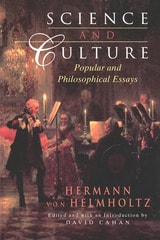
Science and Culture
Popular and Philosophical EssaysHermann von Helmholtz
University of Chicago Press, 1995
From the 1850s to the 1890s, Helmholtz delivered more than two dozen popular lectures, seeking to educate the public and to enlighten the leaders of European society and governments about the potential benefits of science and technology to a developing modern society. David Cahan has selected fifteen of these lectures, which reflect the wide range of topics of crucial importance to Helmholtz and his audiences. Among the subjects discussed are the origins of the planetary system, the relation of natural science to science in general, the aims and progress of the physical sciences, the problems of perception, and academic freedom in German universities. This collection also includes Helmholtz's fascinating lectures on the relation of optics to painting and the physiological causes of harmony in music, which provide insight into the relations between science and aesthetics.
Science and Culture makes available again Helmholtz's eloquent arguments on the usefulness, benefits, and, intellectual pleasures of understanding the natural world. With Cahan's Introduction to set these essays in their broader context, this collection makes an important contribution to the philosophical and intellectual history of Europe at a time when science played an increasingly significant role in social, economic, and cultural life.

Scientific Papers of Arthur Holly Compton
X-Ray and Other StudiesArthur Holly Compton
University of Chicago Press, 1974
During the years when Compton was an active leader in X-ray research, he made many notable contributions which are reflected in the papers presented here. He was the first to prove several important optical properties of X-rays, including scattering, complete polarization, and total reflection. He was also the first, with his student R. L. Doan, to use ruled gratings for the production of X-ray spectra.
Professor Compton's greatest discovery, for which he was awarded a Nobel Prize in 1927, was the Compton Effect. This was the outgrowth of experiments he had initiated during a year at Cambridge in 1919-20. He did the major portion of these experiments at Washington University in St. Louis during the period 1920-24. His work demonstrated that in the scattering of X-rays by electrons, the radiation behaves like corpuscles, and that the interaction between the X-ray corpuscles and the electrons in the scatter is completely described by the principles of the conservation of energy and momentum for the collisions of particles.
In his introduction, Professor Shankland gives a historical account of the papers, narrates Professor Compton's early scientific career, and shows how he arrived at a quantum explanation of the Compton scattering after eliminating all classical explanations.
Scientific Practice
Theories and Stories of Doing PhysicsEdited by Jed Z. Buchwald
University of Chicago Press, 1995
This book examines small-scale experiment in physics, in particular the relation between theory and practice. The contributors focus on interactions among the people, materials, and ideas involved in experiments—factors that have been relatively neglected in science studies.
The first half of the book is primarily philosophical, with contributions from Andrew Pickering, Peter Galison, Hans Radder, Brian Baigrie, and Yves Gingras. Among the issues they address are the resources deployed by theoreticians and experimenters, the boundaries that constrain theory and practice, the limits of objectivity, the reproducibility of results, and the intentions of researchers. The second half is devoted to historical case studies in the practice of physics from the early nineteenth to the early twentieth century. These chapters address failed as well as successful experimental work ranging from Victorian astronomy through Hertz's investigation of cathode rays to Trouton's attempt to harness the ether. Contributors to this section are Jed Z. Buchwald, Giora Hon, Margaret Morrison, Simon Schaffer, and Andrew Warwick.
With a lucid introduction by Ian Hacking, and original articles by noted scholars in the history and philosophy of science, this book is poised to become a significant source on the nature of small-scale experiment in physics.
Selected Papers, Volume 1
Stellar Structure and Stellar AtmospheresS. Chandrasekhar
University of Chicago Press, 1989
Chandrasekhar has selected papers that trace the development of his ideas and that present aspects of his work not fully covered in the books he has periodically published to summarize his research in each area.
Volume 1, Stellar Structure and Stellar Atmospheres, covers primarily the period 1930-40 and includes early papers on the theory of white dwarfs. In the Preface, Chandrasekhar explains the criteria for selection and provides historical background. Each subsequent volume will include a foreword by an authority on the topics covered.
Selected Papers, Volume 2
Radiative Transfer and Negative Ion of HydrogenS. Chandrasekhar
University of Chicago Press, 1989
Chandrasekhar has selected papers that trace the development of his ideas and that present aspects of his work not fully covered in the books he has periodically published to summarize his research in each area.
Volume 2 covers primarily the period 1940-50 and includes papers on the theory of radiative transfer and on the physics and astrophysics of the negative ion of hydrogen. Of particular note are Chandrasekhar's Gibbs Lecture to the American Mathematical Society in 1946 and his "Personal Account" presented at a conference at Erevan in the U.S.S.R. in 1981. A foreword by T. W. Mullikin, a distinguished scholar in the area of radiative transfer, and an author's note provide a historical context for the papers.
Selected Papers, Volume 3
Stochastic, Statistical, and Hydromagnetic Problems in Physics and AstronomyS. Chandrasekhar
University of Chicago Press, 1989
Chandrasekhar has selected papers that trace the development of his ideas and that present aspects of his work not fully covered in the books he has periodically published to summarize his research in each area.
This volume is divided into four sections. The first, on dynamical friction and Brownian motion, includes papers written after Chandrasekhar published his 1942 monograph Principles of Stellar Dynamics. Also in this section is "Stochastic Problems in Physics and Astronomy," one of the most cited papers in the physics literature, as well as papers written jointly with John von Neumann that have been given impetus to recent research. As Chandrasekhar notes, the papers in the second section, on statistical problems in astronomy, were influenced by Ambartsumian's analysis of brightness in the Milky Way. A third section on the statistical theory of turbulence addresses issues still unresolved in fluid dynamics, and the last section is devoted to hydromagnetic problems in astrophysics that are not discussed in Chandrasekhar's monographs.
Selected Papers, Volume 4
Plasma Physics, Hydrodynamic and Hydromagnetic Stability, and Applications of the Tensor-Virial TheoremS. Chandrasekhar
University of Chicago Press, 1989
Chandrasekhar has selected papers that trace the development of his ideas and that present aspects of his work not fully covered in the books he has periodically published to summarize his research in each area.
Volume 4 has three parts. The first, on plasma physics, includes joint work with A. N. Kaufman and K. M. Watson on the stability of the pinch, as well as a paper on Chandrasekhar's own approach to the topic of adiabatic invariants. Part 2 includes work with specific scientific applications of hydrodynamic and hydromagnetic stability not covered in his monograph on the subject. The final part contains Chandrasekhar's papers on the scientific applications of the tensor-virial theorem, in which he restores to its proper place Riemann's neglected work with ellipsoidal figures.
Selected Papers, Volume 5
Relativistic AstrophysicsS. Chandrasekhar
University of Chicago Press, 1990
Chandrasekhar has selected papers that trace the development of his ideas and that present aspects of his work not fully covered in the books he has periodically published to summarize his research in each area.
Volume 5 covers all of Chandrasekhar's contributions to the general theory of relativity and relativity's astrophysical applications (except his research on black holes and colliding gravitational waves, which is covered in Volume 6). The major topics include the influence of general relativity on the pulsations and stability of stars; the back reaction of gravitational waves on their sources; and post-Newtonian approximations to general relativity and their astrophysical applications. In addition to research papers, the volume includes two 1972 lectures in which Chandrasekhar assessed the past, present, and future of relativistic astrophysics. The foreword by astrophysicist Kip S. Thorne is an absorbing, brief history of the field since 1961, capturing the atmosphere of the early research and clarifying Chandrasekhar's dominant role in it.
Chandrasekhar has never written a monograph synthesizing his research in relativistic astrophysics, and therefore this volume of his papers serves as a summary of that work for students and more senior researchers.
Selected Papers, Volume 6
The Mathematical Theory of Black Holes and of Colliding Plane WavesS. Chandrasekhar
University of Chicago Press, 1991
Chandrasekhar has selected papers that trace the development of his ideas and that present aspects of his work not fully covered in the books he has periodically published to summarize his research in each area.
Selected Papers, Volume 7
The Non-Radial Oscillations of Stars in General Relativity and Other WritingsS. Chandrasekhar
University of Chicago Press, 1997
world through the eyes of one of the twentieth century's most brilliant
and sensitive scientists. Conceived by Chandrasekhar as a supplement to
his Selected Papers, this volume begins with eight papers he
wrote with Valeria Ferrari on the non-radial oscillations of stars. It
then explores some of the themes addressed in Truth and Beauty,
with meditations on the aesthetics of science and the world it examines.
Highlights include: "The Series Paintings of Claude Monet and the
Landscape of General Relativity," "The Perception of Beauty and the
Pursuit of Science," "On Reading Newton's Principia at Age Past
Eighty," and personal recollections of Indira Gandhi, Jawaharlal Nehru,
and others.
Selected Papers, Volume 7 paints a picture of Chandra's universe,
filled with stars and galaxies, but with space for poetics, paintings,
and politics.
The late S. Chandrasekhar was best known for his discovery of the upper
limit to the mass of a white dwarf star, for which he received the Nobel
Prize in Physics in 1983. He was the author of many books, including
The Mathematical Theory of Black Holes and, most recently,
Newton's Principia for the Common Reader.
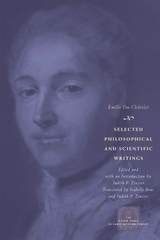
Selected Philosophical and Scientific Writings
Emilie Du Châtelet
University of Chicago Press, 2009
Though most historians remember her as the mistress of Voltaire, Emilie Du Châtelet (1706–49) was an accomplished writer in her own right, who published multiple editions of her scientific writings during her lifetime, as well as a translation of Newton’s Principia Mathematica that is still the standard edition of that work in French. Had she been a man, her reputation as a member of the eighteenth-century French intellectual elite would have been assured.
In the 1970s, feminist historians of science began the slow work of recovering Du Châtelet’s writings and her contributions to history and philosophy. For this edition, Judith P. Zinsser has selected key sections from Du Châtelet’s published and unpublished works, as well as related correspondence, part of her little-known critique of the Old and New Testaments, and a treatise on happiness that is a refreshingly uncensored piece of autobiography—making all of them available for the first time in English. The resulting volume will recover Châtelet’s place in the pantheon of French letters and culture.
Semiconductor Lasers and Diode-based Light Sources for Biophotonics
Peter E. Andersen
The Institution of Engineering and Technology, 2019
Serving the Reich
The Struggle for the Soul of Physics under HitlerPhilip Ball
University of Chicago Press, 2014
After World War II, most scientists in Germany maintained that they had been apolitical or actively resisted the Nazi regime, but the true story is much more complicated. In Serving the Reich, Philip Ball takes a fresh look at that controversial history, contrasting the career of Peter Debye, director of the Kaiser Wilhelm Institute for Physics in Berlin, with those of two other leading physicists in Germany during the Third Reich: Max Planck, the elder statesman of physics after whom Germany’s premier scientific society is now named, and Werner Heisenberg, who succeeded Debye as director of the institute when it became focused on the development of nuclear power and weapons.
Mixing history, science, and biography, Ball’s gripping exploration of the lives of scientists under Nazism offers a powerful portrait of moral choice and personal responsibility, as scientists navigated “the grey zone between complicity and resistance.” Ball’s account of the different choices these three men and their colleagues made shows how there can be no clear-cut answers or judgment of their conduct. Yet, despite these ambiguities, Ball makes it undeniable that the German scientific establishment as a whole mounted no serious resistance to the Nazis, and in many ways acted as a willing instrument of the state.
Serving the Reich considers what this problematic history can tell us about the relationship between science and politics today. Ultimately, Ball argues, a determination to present science as an abstract inquiry into nature that is “above politics” can leave science and scientists dangerously compromised and vulnerable to political manipulation.

Solved Problems in Dynamical Systems and Control
J. Tenreiro-Machado
The Institution of Engineering and Technology, 2017
Something Incredibly Wonderful Happens
Frank Oppenheimer and His Astonishing ExploratoriumK. C. Cole
University of Chicago Press, 2012
Space, Time, and Gravity
The Theory of the Big Bang and Black HolesRobert M. Wald
University of Chicago Press, 1992
Spacetime And Geometry
The Alfred Schild LecturesEdited by Richard A. Matzner and L. C. Shepley
University of Texas Press, 1982
These reports, at the forefront of relativity theory when they were written, in particular the geometrical aspects of spacetime theory, were the result of the Alfred Schild Memorial Lecture Series presented at the University of Texas at Austin beginning in 1977. Each article is a self-contained summary of an important area of contemporary gravitational physics, while the book as a whole provides an overview of a wide variety of the problems of general relativity and gravitation.
St. Austin Review, Faith & Physics
Fr. LeMaître and the Big Bang, November/December 2017, Vol. 17, No. 6Joseph Pearce
St. Augustine's Press, 2017
Star Day
A Story of 24 Hours and 24 Stellar LivesMarcia Bartusiak and Stephen Lowe
University of Chicago Press, 2027
An hourly guide that tracks twenty-four stars, stellar clusters, and constellations across the sky to reveal their luminous lives and lore.
Over the course of a day, the constellations slowly shift, rising in the east and setting in the west, due to Earth’s rotation. A full turn of the celestial sphere, that bowl above us where the stars seemingly appear fixed to the surface, is completed once every twenty-four hours. In fact, the stars inspired the twenty-four-hour day, and one star, our Sun, rules the circadian rhythms of all life on our planet. This short book sweeps through the celestial sphere hour by hour, introducing a remarkable cast of stellar characters with each chapter. Celebrated science writer Marcia Bartusiak and mathematician Stephen Lowe blend practical astronomy with fascinating history to share unique cosmological stories.
This husband and wife team explain that observers have long split the sky into twenty-four hours of right ascension—a celestial equivalent of longitude and a universal scheme for locating cosmological objects. Each chapter of Star Day presents a single right ascension hour, from the stellar death of S Andromedae (zeroth hour)—an explosion that helped reveal the size of the universe—to Scheat (twenty-third hour), an aging red giant. Twice the mass of the Sun and some 1,500 times as bright, Scheat sometimes guides amateur astronomers to distant galaxies. In between, we learn about humans’ pole star, Polaris (second hour), and meet the supermassive black hole at the center of our Milky Way galaxy (seventeenth hour). By the end of our star day, we will appreciate both our own stellar origins and the fragile and deep connections between human civilizations and the ever-changing heavens. Star Day reminds us that wonder and discovery are easily available, all for the simple price of looking up.
For each chapter, artist Matthew Green has depicted these stellar scenes with entrancing pen-and-ink drawings. Working together to narrate and illustrate these stars' stories, Bartusiak, Lowe, and Green have created an engaging read that is a perfect way to spend an hour or two—and a true gift to both seasoned skywatchers and curious beginners.
Stars as Laboratories for Fundamental Physics
The Astrophysics of Neutrinos, Axions, and Other Weakly Interacting ParticlesGeorg G. Raffelt
University of Chicago Press, 1996
Raffelt presents the many uses of stellar astrophysics for research in basic particle physics. He focuses primarily on the properties and nongravitational interactions of elementary particles. Numerous graphs and figures complement the text.
Stars as Laboratories for Fundamental Physics is a valuable reference for cosmologists, astrophysicists, and particle physicists.
Stepping Motors
A guide to theory and practicePaul Acarnley
The Institution of Engineering and Technology, 2002
Strung Together
The Cultural Currency of String Theory as a Scientific ImaginarySean Miller
University of Michigan Press, 2013
In Strung Together: The Cultural Currency of String Theory as a Scientific Imaginary, Sean Miller examines the cultural currency of string theory, both as part of scientific discourse and beyond it. He demonstrates that the imaginative component of string theory is both integral and indispensable to it as a scientific discourse. While mathematical arguments provide precise prompts for physical intervention in the world, the imaginary that supplements mathematical argument within string theory technical discourse allows theorists to imagine themselves interacting with the cosmos as an abstract space in such a way that strings and branes as phenomena become substantiated and legitimized. And it is precisely this sort of imaginary—which Miller calls a scientific imaginary—duly substantiated and acculturated, that survives the move from string theory technical discourse to popularizations and ultimately to popular and literary discourses. In effect, a string theory imaginary legitimizes the science itself and helps to facilitate a virtual domestication of a cosmos that was heretofore remote, alien, and incomprehensible.

Swarm Intelligence
Applications, Volume 3Ying Tan
The Institution of Engineering and Technology, 2018

Swarm Intelligence
Innovation, new algorithms and methods, Volume 2Ying Tan
The Institution of Engineering and Technology, 2018
Swarm Intelligence
Principles, current algorithms and methods, Volume 1Ying Tan
The Institution of Engineering and Technology, 2018