Results by title
267 books match the query 'Poetics' and 18 start with s
Salsa Consciente
Politics, Poetics, and Latinidad in the Meta-BarrioAndrés Espinoza Agurto
Michigan State University Press, 2021

Salted Earth
Poetics of Place and Migration through Four Journeys in Search of SaltKaty Beinart
Intellect Books, 2026
While histories of salt have long emphasized its central role in trade, power, and capitalism, is that the only way to understand this everyday substance? In Salted Earth, artist and researcher Katy Beinart offers a fresh perspective, exploring the poetics of salt. Through a series of journeys to South Africa, Lithuania and Russia, Portugal, and Haiti, Beinart and her collaborators investigate the everyday rituals and cultural meanings of salt in diverse contexts. In her work, salt becomes a medium through which large-scale histories of migration, trade, empire, slavery, and colonialism—as well as deeply personal relationships, emotional geographies, memory, and intercultural connections—are symbolized and reimagined.
Drawing on fiction, poetry, and visual art, alongside family history, travel writing, trade archives, and artistic process, Beinart builds a rich, interdisciplinary portrait of salt as both a material and a cultural symbol. These journeys and embodied artistic practices open a sensorial and situated way of understanding material entanglements, where knowledge emerges through movement, encounter, and acts of making. Salted Earth offers valuable insights for students and researchers in art, creative writing, cultural history and geography, memory studies, and across the wider fields of aesthetics and the humanities.
Set in Motion
Essays, Interviews, and DialoguesA. R. Ammons
University of Michigan Press, 1996
Shelf Life
Essays, Memoirs, and an InterviewThom Gunn
University of Michigan Press, 1993
Gunn’s criticism communicates his own enthusiasm for poetry. He tries to show his readers how to get a first foothold into the work of some of his favorite poets, whether Wyatt or Whitman, Mina Loy or Robert Creeley.
Sidney's Poetics
Imitating CreationMichael Mack
Catholic University of America Press, 2005
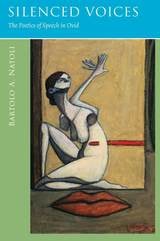
Silenced Voices
The Poetics of Speech in OvidBartolo A. Natoli
University of Wisconsin Press, 2021
Bartolo A. Natoli provides a unique cross-reading of these works. He examines how the motifs and ideas articulated in the Metamorphoses provide the template for the poet's representation of his own exile. Ovid depicts his transformation with an eye toward memory, reformulating how his exile would be perceived by his audience. His exilic poems are an attempt to recover the voice he lost and to reconnect with the community of Rome.
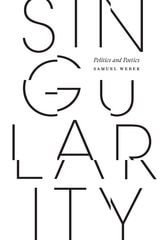
Singularity
Politics and PoeticsSamuel Weber
University of Minnesota Press, 2021
An influential thinker on the concept of singularity and its implications on politics, theology, economics, psychoanalysis, and literature
For readers versed in critical theory, German and comparative literature, or media studies, a new book by Samuel Weber is essential reading. Singularity is no exception. Bringing together two decades of his essays, it hones in on the surprising implications of the singular and its historical relation to the individual in politics, theology, economics, psychoanalysis, and literature. Although singularity has long been a keyword in literary studies and philosophy, never has it been explored as in this book, which distinguishes singularity as an “aporetic” notion from individuality, with which it remains historically closely tied.
To speak or write of the singular is problematic, Weber argues, since once it is spoken of it is no longer strictly singular. Walter Benjamin observed that singularity and repetition imply each other. This approach informs the essays in Singularity. Weber notes that what distinguishes the singular from the individual is that it cannot be perceived directly, but rather experienced through feelings that depend on but also exceed cognition. This interdependence of cognition and affect plays itself out in politics, economics, and theology as well as in poetics. Political practice as well as its theory have been dominated by the attempt to domesticate singularity by subordinating it to the notion of individuality. Weber suggests that this political tendency draws support from what he calls “the monotheological identity paradigm” deriving from the idea of a unique and exclusive Creator-God.
Despite the “secular” tendencies usually associated with Western modernity, this paradigm continues today to inform and influence political and economic practices, often displaying self-destructive tendencies. By contrast, Weber reads the literary writings of Hölderlin, Nietzsche, and Kafka as exemplary practices that put singularity into play, not as fiction but as friction, exposing the self-evidence of established conventions to be responses to challenges and problems that they often prefer to obscure or ignore.

Sir Philip Sidney and the Poetics of Protestantism
A Study of ContextsAndrew Weiner
University of Minnesota Press, 1978
So Ask
Essays, Conversations, and InterviewsPhilip Levine
University of Michigan Press, 2002
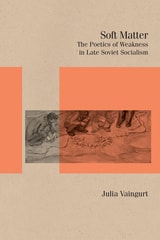
Soft Matter
The Poetics of Weakness in Late Soviet SocialismJulia Vaingurt
Northwestern University Press, 2025
Identifies and examines a poetics of weakness in Soviet underground literature
Artists of the late Soviet era sought new, nonconformist ways of approaching literary fiction, arriving at weakness as a crucial principle of narrative and character formation. Julia Vaingurt argues that this counter-discourse of strategic weakness constituted both an aesthetic strategy and an ethical code, affording like-minded authors a feeling of recognition and commonality and uniting an international community of artists in resistance to the divisiveness of their worlds. Soft Matter: The Poetics of Weakness in Late Soviet Socialism explores the cultivation of weak subjectivity through modes such as gender subversion, queer holy foolishness, intoxication, madness, and writing disorders like graphomania and writer’s block. Identifying the poetics of weakness as formative for Soviet underground literature of the 1960s and ’70s, Vaingurt also traces the inheritance of a far older tradition within Russian culture of salutary weakness. As democratic deliberation continues to be under threat around the world, alternatives to the ubiquitous politics of force are an aesthetic, ethical, and ideological imperative.
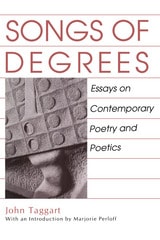
Songs of Degrees
Essays on Contemporary Poetry and PoeticsJohn Taggart
University of Alabama Press, 1994
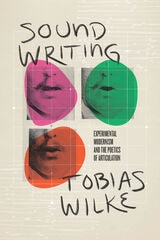
Sound Writing
Experimental Modernism and the Poetics of ArticulationTobias Wilke
University of Chicago Press, 2022
Avant-garde writers and artists of the twentieth century radically reconceived poetic language, appropriating scientific theories and techniques as they turned their attention to the physical process of spoken language. This modernist “sound writing” focused on the bodily production of speech, which it rendered in poetic, legible, graphic form.
Modernist sound writing aims to capture the acoustic phenomenon of vocal articulation by graphic means. Tobias Wilke considers sound writing from its inception in nineteenth-century disciplines like physiology and experimental phonetics, following its role in the aesthetic practices of the interwar avant-garde and through to its reemergence in the postwar period. These projects work with the possibility of crossing over from the audible to the visible, from speech to notation, from body to trace. Employing various techniques and concepts, this search for new possibilities played a central role in the transformation of poetry into a site of radical linguistic experimentation. Considering the works of writers and artists—including Raoul Hausmann, Kurt Schwitters, Viktor Shklovsky, Hugo Ball, Charles Olson, and Marshall McLuhan—Wilke offers a fresh look at the history of the twentieth-century avant-garde.
Sound and Form in Modern Poetry
Second EditionHarvey Gross and Robert McDowell
University of Michigan Press, 1996
Poet, critic, and editor Robert McDowell has updated this classic text in the light of the poetic and critical developments of the last three decades. Segments on Dickinson, Robinson, Frost, Jeffers, and Lowell, among other poets, have been greatly expanded, and Ashbery, Creeley, Ginsberg, Hall, Kees, Kumin, Levertov, Levine, O'Hara, Plath, Rich, Simpson, and Wilbur added, among others. The epilogue discusses a new generation of poets whose works will likely be read well into the next century-- among others, Thomas M. Disch, Rita Dove, Dana Gioia, Emily Grosholz, Mark Jarman, Molly Peacock, Gjertrud Schnackenberg, Timothy Steele, Mary Swander, and Marilyn Nelson Waniek.
Over the last ten years, the most inspiring topic of conversation and argument among poets and their readers has been the resurgence of narrative and traditional forms. The new Sound and Form in Modern Poetry is a seminal text in this discussion, examining not only this movement but all of the important developments (Dadaism, Surrealism, Imagism, Language Poetry, and the Confessional School) that have defined our poetry in the twentieth century and have set the stage for poetry's continued life in the twenty-first. The original Sound and Form in Modern Poetry enjoyed extensive classroom use as a text; the revised version promises to be even more accessible, and more essential, for years to come.
The late Harvey Gross was Professor of Comparative Literature, State University of New York at Stony Brook.
Robert McDowell is publisher and editor of Story Line Press, and is also poet, critic, translator, fiction writer, and essayist.
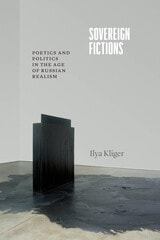
Sovereign Fictions
Poetics and Politics in the Age of Russian RealismIlya Kliger
University of Chicago Press, 2024
The nineteenth-century novel is generally assumed to owe its basic social imaginaries to the ideologies, institutions, and practices of modern civil society. In Sovereign Fictions, Ilya Kliger asks what happens to the novel when its fundamental sociohistorical orientation is, as in the case of Russian realism, toward the state. Kliger explores Russian realism’s distinctive construals of sociality through a broad range of texts from the 1830s to the 1870s, including major works by Tolstoy, Dostoevsky, Gogol, Pushkin, Lermontov, Goncharov, and Turgenev, and several lesser-known but influential books of the period, including Alexander Druzhinin’s Polinka Saks (1847), Aleksei Pisemsky’s One Thousand Souls (1858), and Vasily Sleptsov’s Hard Times (1865). Challenging much current scholarly consensus about the social dynamics of nineteenth-century realist fiction, Sovereign Fictions offers an important intervention in socially inflected theories of the novel and in current thinking on representations of power and historical poetics.
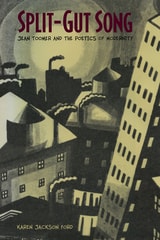
Split-Gut Song
Jean Toomer and the Poetics of ModernityKaren Jackson Ford
University of Alabama Press, 2005
Reclaiming Jean Toomer as a radical innovator of African American modernist poetics.
In Split-Gut Song, Karen Jackson Ford looks at what it means to be African American, free, and creative by analyzing Jean Toomer's main body of work, specifically, his groundbreaking creation Cane. When first published in 1923, this pivotal work of modernism was widely hailed as inaugurating a truly artistic African American literary tradition. Yet Toomer's experiments in literary form are consistently read in terms of political radicalism—protest and uplift—rather than literary radicalism.
Ford contextualizes Toomer's poetry, letters, and essays in the literary culture of his period and, through close readings of the poems, shows how they negotiate formal experimentation (imagism, fragmentation, dialect) and traditional African American forms (slave songs, field hollers, call-and-response sermons, lyric poetry). At the heart of Toomer's work is the paradox that poetry is both the saving grace of African American culture and that poetry cannot survive modernity. This contradiction, Ford argues, structures Cane, wherein traditional lyric poetry first flourishes, then falters, then falls silent.
The Toomer that Ford discovers in Split-Gut Song is a complicated, contradictory poet who brings his vexed experience and ideas of racial identity to both conventional lyric and experimental forms. Although Toomer has been labelled a political radical, Ford argues that politics is peripheral in his experimental, stream-of-consciousness work. Rather Toomer exhibits a literary radicalism as he struggles to articulate his perplexed understanding of race and art in 20th-century America.
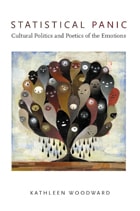
Statistical Panic
Cultural Politics and Poetics of the EmotionsKathleen Woodward
Duke University Press, 2009
Referring discreetly to her own experience, Woodward examines the interpenetration of social structures and subjectivity, considering how psychological emotions are social phenomena, with feminist anger, racial shame, old-age depression, and sympathy for non-human cyborgs (including robots) as key cases in point. She discusses how emerging institutional and discursive structures engender “new” affects that in turn can help us understand our changing world if we are attentive to them—the “statistical panic” produced by the risk society, with its numerical portents of disease and mortality; the rage prompted by impenetrable and bloated bureaucracies; the brutal shame experienced by those caught in the crossfire of the media; and the conservative compassion that is not an emotion at all, only an empty political slogan.
The orbit of Statistical Panic is wide, drawing in feminist theory, critical phenomenology, and recent theories of the emotions. But at its heart are stories. As an antidote to the vacuous dramas of media culture, with its mock emotions and scattershot sensations, Woodward turns to the autobiographical narrative. Stories of illness—by Joan Didion, Yvonne Rainer, Paul Monette, and Alice Wexler, among others—receive special attention, with the inexhaustible emotion of grief framing the book as a whole.
Stubborn Poetries
Poetic Facticity and the Avant-GardePeter Quartermain
University of Alabama Press, 2013
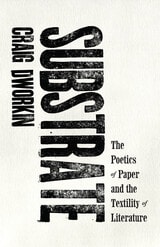
Substrate
The Poetics of Paper and the Textility of LiteratureCraig Dworkin
University of Chicago Press, 0
A study of the signifying potential of paper, the foundational material for literary texts in the modern era.
For ease of reading, the paper of a printed page must recede far enough into the background to make ink legible. Yet paper—the primary substrate for literary texts—has its own signifying potential, its own poetics. Craig Dworkin shows that looking at the page, rather than through its illusory withdrawal, can unlock interpretive insights that readers would otherwise miss. What often seems incidental can prove to be as semantically important as the words of the text themselves.
Substrate argues that the material affordances of paper in general—its pliability, fibrous weave, and capacity to fold, tear, crumple, and shuffle—variously inform the poetics of William Blake, Stéphane Mallarmé, Jen Bervin, and Susan Howe. For all four of these poets, the qualities of paper serve as models for structuring the language of their poems in innovative ways. Dworkin further shows how each poet in turn engages paper at another level by incorporating it within the thematic ambit of key poems. The full meaning of these poems is thus inextricable from their printing. Substrate is a brilliant inquiry in poetics and the logic of media more generally.