Results by title
2018 books match the query 'Political aspects' and 129 start with s
Sacrifice in the Modern World
On the Particularity and Generality of Nazi MythDavid Pan
Northwestern University Press, 2012
A landmark book, David Pan’s Sacrifice in the Modern World seeks to explain the continuing emphasis, in modern times, on sacrifice. Pan specifically turns to the culture of sacrifice—ritualized and sanctified death—in Nazi Germany, showing how that regime co-opted an existing discussion of sacrifice and infused it with its own mythology. Pan suggests that sacrifice is a key value in every society but that there is a preponderance of association of sacrifice with Nazi culture and therefore a largely pejorative treatment of sacrifice.
Surveying the arguments of philosopher Alfred Baeumler and other symptomatic Nazi texts, Pan shows how the Nazis’ reactionary intellectual culture unraveled much of the Enlightenment project. In so doing, he is able to offer a compelling new perspective on basic theoretical concepts in the work of Kant, Nietzsche, Adorno, Bataille, Girard, and others. He posits that it is only by clearing our way through the Nazis’ misuse of sacrifice that we can understand the durability of sacrificial structures that—following several of the theorists he discusses— establish the fundamental values by which we live our lives.
Rather than condemning the Nazi appeal to sacrifice itself, this book looks at the particular ways in which sacrifice was distributed and structured within that society. All cultures must grapple with the existential violence of the human condition, and they frequently do so through aesthetic treatments of sacrifice, rooted in myths and traditions. Pan argues that our task is not to eradicate these traditions but to engage them by carefully evaluating the commitments and values that they imply.

Saharan Winds
Energy Systems and Aeolian Imaginaries in Western SaharaAllan, Joanna
West Virginia University Press, 2024
Winner, ASLE-UKI Critical Book Prize, 2025
Finalist, Ecocritical Book Award, 2025, Association for the Study of Literature and Environment (ASLE)
Longlisted, Bread and Roses Award for Radical Publishing, 2025
Saharan Winds contributes to a fairer energy horizon by illuminating the role of imaginaries--how we understand energy sources such as wind and the meanings we attach to wind--in determining the wider politics, whether oppressive or just, associated with energy systems. This book turns to various cultures and communities across different time periods in one space, Western Sahara, to explore how wind imaginaries affect the development, management, and promotion of windfarms; the distribution of energy that windfarms produce; and, vitally, the type of politics mediated by all these elements combined. Highlighting the wind-fueled oppression of colonial energy systems, the book shows the potential offered by nomadic, Indigenous wind imaginaries for contributing to a fairer energy future.
Salsa Consciente
Politics, Poetics, and Latinidad in the Meta-BarrioAndrés Espinoza Agurto
Michigan State University Press, 2021

Same River Twice
The Politics of Dam Removal and River RestorationPeter Brewitt
Oregon State University Press, 2019
How did this happen? Same River Twice answers this question by telling the stories of three major Northwestern dam removals – the politics, people, hopes, and fears that shaped three rivers and their communities. Brewitt begins each story with the dam’s construction, shows how its critics gained power, details the conflicts and controversies of removal, and explores the aftermath as the river re-established itself.
Each dam removal offers a unique case study. On the Elwha and Rogue Rivers, dam removal was a multi-decade political brawl; on the Sandy River it was swift and amicable. A key controversy in every case was the loss of the recreational lake created by the dam. Local communities loved their lakes and felt that they were natural, public spaces rather than industrial creations. They fought dam removal with passion and ingenuity. To be successful, dam removal advocates had to learn to weld together mega-coalitions that embraced most interest groups and moved forward together.
While the dams profiled here are all in the Pacific Northwest, dam removal is a national and international phenomenon, and Brewitt’s findings apply everywhere. Written for both a scholarly and a general audience, Same River Twice presents invaluable case studies for scholars of environmental politics, wildlife and public land professionals, environmental activists, and anyone interested in the intersection of politics, public policy, and dam removal.
Sampling and Remixing Blackness in Hip-Hop Theater and Performance
Nicole Hodges Persley
University of Michigan Press, 2021
Sampling and Remixing Blackness is a timely and accessible book that examines the social ramifications of cultural borrowing and personal adaptation of Hip-hop culture by non-Black and non-African American Black artists in theater and performance. In a cultural moment where Hip-hop theater hits such as Hamilton offer glimpses of Black popular culture to non-Black people through musical soundtracks, GIFs, popular Hip-hop music, language, clothing, singing styles and embodied performance, people around the world are adopting a Blackness that is at once connected to African American culture--and assumed and shed by artists and consumers as they please. As Black people around the world live a racial identity that is not shed, in a cultural moment of social unrest against anti-blackness, this book asks how such engagements with Hip-hop in performance can be both dangerous and a space for finding cultural allies. Featuring the work of some of the visionaries of Hip-hop theater including Lin-Manuel Miranda, Sarah Jones and Danny Hoch, this book explores the work of groundbreaking Hip-hop theater and performance artists who have engaged Hip-hop's Blackness through popular performance. The book challenges how we understand the performance of race, Hip-hop and Blackness in the age of Instagram, TikTok and Facebook. In a cultural moment where racial identity is performed through Hip-hop culture's resistance to the status quo and complicity in maintaining it, Hodges Persley asks us to consider who has the right to claim Hip-hop's blackness when blackness itself is a complicated mixtape that offers both consent and resistance to transgressive and inspiring acts of performance.
Savages and Citizens
How Indigeneity Shapes the StateAndrew Canessa and Manuela Lavinas Picq; Foreword by Jeff Ganohalidoh Corntassel
University of Arizona Press, 2024
Delving into European political philosophy, comparative politics, and contemporary international law, the book shows how the concept of indigeneity has shaped the development of the modern state. The exclusion of Indigenous people was not a collateral byproduct; it was a political project in its own right. The book argues that indigeneity is a political identity relational to modern nation-states and that Indigenous politics, although marking the boundary of the state, are co-constitutive of colonial processes of state-making. In showing how indigeneity is central to how the international system of states operates, the book forefronts Indigenous peoples as political actors to reject essentializing views that reduce them to cultural “survivors” rooted in the past.
With insights drawn from diverse global contexts and empirical research from Bolivia and Ecuador, this work advocates for the relevance of Indigenous studies within political science and argues for an ethnography of sovereignty in anthropology. Savages and Citizens makes a compelling case for the centrality of Indigenous perspectives to understand the modern state from political theory to international studies.

Saving Grand Canyon
Dams, Deals, and a Noble MythByron E. Pearson
University of Nevada Press, 2019
2020 Spur Awards Finalist Contemporary Nonfiction, Western Writers of America
The Grand Canyon has been saved from dams three times in the last century. Unthinkable as it may seem today, many people promoted damming the Colorado River in the canyon during the early twentieth century as the most feasible solution to the water and power needs of the Pacific Southwest. These efforts reached their climax during the 1960s when the federal government tried to build two massive hydroelectric dams in the Grand Canyon. Although not located within the Grand Canyon National Park or Monument, they would have flooded lengthy, unprotected reaches of the canyon and along thirteen miles of the park boundary.
Saving Grand Canyon tells the remarkable true story of the attempts to build dams in one of America’s most spectacular natural wonders. Based on twenty-five years of research, this fascinating ride through history chronicles a hundred years of Colorado River water development, demonstrates how the National Environmental Policy Act came to be, and challenges the myth that the Sierra Club saved the Grand Canyon. It also shows how the Sierra Club parlayed public perception as the canyon’s savior into the leadership of the modern environmental movement after the National Environmental Policy Act became law.
The tale of the Sierra Club stopping the dams has become so entrenched—and so embellished—that many historians, popular writers, and filmmakers have ignored the documented historical record. This epic story puts the events from 1963–1968 into the broader context of Colorado River water development and debunks fifty years of Colorado River and Grand Canyon myths.
Say Her Name
Centering Black Feminism and Black Women in SportLetisha Engracia Cardoso Brown
Rutgers University Press, 2025
Say Her Name delves deeply into issues of gender, the politics of punishment, athlete activism, the politics of Black hair, fingernails and fashion, and the representation and commodification of Blackgirlwomen in sport and society. An entry point into the growing research in sport studies and beyond from a Black feminist lens, Say Her Name offers a clear window into the power and potential of nuanced examinations of sport. As a reflection of the larger social world, sport provides a framework for understanding larger social issues, including racism, sexism, and misogynoir. Blackgirlwomen have varied experiences in sport, and Say Her Name provides a window into those experiences. The book discusses Black women in sports including the South African runner Caster Semenya and the American runners Florence Griffith Joyner and Sha’Carri Richardson, as well as Venus and Serena Williams, Gabby Douglas, and Simone Biles. The women in this book have lived experiences that speak to the larger experiences of Black women and girls in sport and society, while also leaning into a larger discussion of the importance of the social movement #SayHerName.
School Choice and the Future of American Democracy
Scott Franklin Abernathy
University of Michigan Press, 2005
"Scott Abernathy takes up big questions and provides answers grounded in the complex reality of policy and politics. School Choice and the Future of American Democracy is a book written for those who understand that the world does not fit the simple explanations too often put forward."
--Clarence Stone, Professor Emeritus, University of Maryland, and Research Professor, George Washington University
"Will school choice revive or eviscerate democratic processes and institutions? Will it narrow or exacerbate the range of educational inequities? This book takes several differently angled slices into these questions and draws intriguing answers."
--Jeffrey R. Henig, Teachers College, Columbia University, and author of Rethinking School Choice: Limits of the Market Metaphor
"Through extensive research and refreshingly impartial analysis, Scott Abernathy probes how the use of market principles to reform public schools affects democratic citizenship. Treating citizens first and foremost as customers, he finds, threatens civic engagement and the well-being of schools, especially in the nation's neediest communities. This thoughtful and balanced appraisal is must-reading for those concerned about the future of American education and democracy."
--Suzanne Mettler, Alumni Associate Professor, Syracuse University, and author of Soldiers to Citizens: The G.I. Bill and the Making of the Greatest Generation
Scott Franklin Abernathy is Assistant Professor of Political Science, University of Minnesota

Schoolbook Nation
Conflicts over American History Textbooks from the Civil War to the PresentJoseph Moreau
University of Michigan Press, 2004
-Gary B. Nash, Director of the National Center for History in the Schools
Taking Frances FitzGerald's textbook study America Revised as a point of departure, Joseph Moreau in Schoolbook Nation challenges FitzGerald's premise that the 1960s were the beginning of the end of the glory days of American history education.
Moreau recounts how in the late twentieth century, cultural commentators such as historian Arthur Schlesinger Jr. and politician Newt Gingrich preached that a new identity crisis had shaken American history in the sixties, and that the grand unified view of our past had given way to various interest groups, who dismantled the old national narrative while demanding a more "inclusive" curriculum for their children.
Moreau discovered, however, that American history, while grand, has never been unified. Delving into more than 100 history books from the last 150 years, the author reveals that the efforts of pressure groups to influence the history curriculum are nearly as old as the mustiest textbook. "For those who would influence textbooks and teaching-Protestant elites in the 1870s, Irish-Americans in the 1920s, and conservative politicians today-the sky has always been falling," according to Moreau.
Schoolbook Nation offers a history lesson of its own: when the story of the past is written or rewritten, truth is often a victim. With its comprehensive treatment of the subjects of honesty and politics in the teaching of history, this is an essential book on the side of truth in a complex debate.
Schooling and the struggle for public life
critical pedagogy in the modern ageHenry A. Giroux
University of Minnesota Press, 1988
Science Be Dammed
How Ignoring Inconvenient Science Drained the Colorado RiverEric Kuhn and John Fleck
University of Arizona Press, 2019
Arguing that the science of the early twentieth century can shed new light on the mistakes at the heart of the over-allocation of the Colorado River, authors Eric Kuhn and John Fleck delve into rarely reported early studies, showing that scientists warned as early as the 1920s that there was not enough water for the farms and cities boosters wanted to build. Contrary to a common myth that the authors of the Colorado River Compact did the best they could with limited information, Kuhn and Fleck show that development boosters selectively chose the information needed to support their dreams, ignoring inconvenient science that suggested a more cautious approach.
Today water managers are struggling to come to terms with the mistakes of the past. Focused on both science and policy, Kuhn and Fleck unravel the tangled web that has constructed the current crisis. With key decisions being made now, including negotiations for rules governing how the Colorado River water will be used after 2026, Science Be Dammed offers a clear-eyed path forward by looking back.
Understanding how mistakes were made is crucial to understanding our contemporary problems. Science Be Dammed offers important lessons in the age of climate change about the necessity of seeking out the best science to support the decisions we make.
Science for the People
Documents from America's Movement of Radical ScientistsSigrid Schmalzer
University of Massachusetts Press, 2018
For the first time, this book compiles original documents from Science for the People, the most important radical science movement in U.S. history. Between 1969 and 1989, Science for the People mobilized American scientists, teachers, and students to practice a socially and economically just science, rather than one that served militarism and corporate profits. Through research, writing, protest, and organizing, members sought to demystify scientific knowledge and embolden “the people” to take science and technology into their own hands. The movement's numerous publications were crucial to the formation of science and technology studies, challenging mainstream understandings of science as “neutral” and instead showing it as inherently political. Its members, some at prominent universities, became models for politically engaged science and scholarship by using their knowledge to challenge, rather than uphold, the social, political, and economic status quo.
Highlighting Science for the People's activism and intellectual interventions in a range of areas—including militarism, race, gender, medicine, agriculture, energy, and global affairs—this volume offers vital contributions to today's debates on science, justice, democracy, sustainability, and political power.

Screening Cuba
Film Criticism as Political Performance during the Cold WarHector Amaya
University of Illinois Press, 2010

Screening Social Justice
Brave New Films and Documentary ActivismSherry B. Ortner
Duke University Press, 2023
Scripts of Blackness
Race, Cultural Nationalism, and U.S. Colonialism in Puerto RicoIsar P. Godreau
University of Illinois Press, 2015
Based on an ethnographic study of the barrio of San Antón in the city of Ponce, Scripts of Blackness examines institutional and local representations of blackness as developing from a power-laden process that is inherently selective and political, not neutral or natural. Godreau traces the presumed benevolence or triviality of slavery in Puerto Rico, the favoring of a Spanish colonial whiteness (under a hispanophile discourse), and the insistence on a harmonious race mixture as discourses that thrive on a presumed contrast with the United States that also characterize Puerto Rico as morally superior. In so doing, she outlines the debates, social hierarchies, and colonial discourses that inform the racialization of San Antón and its residents as black.
Mining ethnographic materials and anthropological and historical research, Scripts of Blackness provides powerful insights into the critical political, economic, and historical context behind the strategic deployment of blackness, whiteness, and racial mixture.
Sea Level Rise
A Slow Tsunami on America's ShoresOrrin H. Pilkey and Keith C. Pilkey
Duke University Press, 2019
Searching for Solidarity
Revolutionary Dreams and Radical Social MovementsNoor Ghazal Aswad
The Ohio State University Press, 2025

Secret Power
WikiLeaks and Its EnemiesStefania Maurizi
Pluto Press, 2022
*Winner of the European Award for Investigative And Judicial Journalism 2021*
*Winner of the Premio Alessandro Leogrande Award for Investigative Journalism 2022*
*Winner of the Premio Angelo Vassallo Award 2022*
'I want to live in a society where secret power is accountable to the law and to public opinion for its atrocities, where it is the war criminals who go to jail, not those who have the conscience and courage to expose them.'
It is 2008, and Stefania Maurizi, an investigative journalist with a growing interest in cryptography, starts looking into the little-known organisation WikiLeaks. Through hushed meetings, encrypted files and explosive documents, what she discovers sets her on a life-long journey that takes her deep into the realm of secret power.
Working closely with WikiLeaks' founder Julian Assange and his organisation for her newspaper, Maurizi has spent over a decade investigating state criminality protected by thick layers of secrecy, while also embarking on a solitary trench warfare to unearth the facts underpinning the cruel persecution of Assange and WikiLeaks.
With complex and disturbing insights, Maurizi’s tireless journalism exposes atrocities, the shameful treatment of Chelsea Manning and Edward Snowden, on up to the present persecution of WikiLeaks: a terrifying web of impunity and cover-ups.
At the heart of the book is the brutality of secret power and the unbearable price paid by Julian Assange, WikiLeaks and truthtellers.
Secularism as Misdirection
Critical Thought from the Global SouthNivedita Menon
Duke University Press, 2024

Seeds and Sovereignty
Debate Over the Use and Control of Plant Genetic ResourcesJack R. Jr. Kloppenburg, ed.
Duke University Press, 1988
Twenty experts from several nations, representing both the natural and social sciences, consider the historical background, the issue of patent rights as applied to plant germplasm, the nature of global genetic interdependence, the internationalization of the seed industry, the implications of biotechnology on genetic resources, the Third World attitude toward the debate, and the viewpoints of the International Agricultural Research Centers.

Seeing Like a Citizen
Decolonization, Development, and the Making of Kenya, 1945–1980Kara Moskowitz
Ohio University Press, 2019
In Seeing Like a Citizen, Kara Moskowitz approaches Kenya’s late colonial and early postcolonial eras as a single period of political, economic, and social transition. In focusing on rural Kenyans—the vast majority of the populace and the main targets of development interventions—as they actively sought access to aid, she offers new insights into the texture of political life in decolonizing Kenya and the early postcolonial world.
Using multisited archival sources and oral histories focused on the western Rift Valley, Seeing Like a Citizen makes three fundamental contributions to our understanding of African and Kenyan history. First, it challenges the widely accepted idea of the gatekeeper state, revealing that state control remained limited and that the postcolonial state was an internally varied and often dissonant institution. Second, it transforms our understanding of postcolonial citizenship, showing that its balance of rights and duties was neither claimed nor imposed, but negotiated and differentiated. Third, it reorients Kenyan historiography away from central Kenya and elite postcolonial politics. The result is a powerful investigation of experiences of independence, of the meaning and form of development, and of how global political practices were composed and recomposed on the ground in local settings.
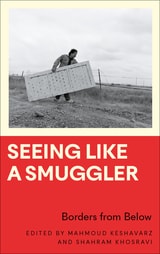
Seeing Like a Smuggler
Borders from BelowMahmoud Keshavarz and Shahram Khosravi
Pluto Press, 2022
Stories of smuggling as acts of resistance and decolonization.
'This conceptually vivid book refreshes our vision' - Ruth Wilson Gilmore
The word smuggler often unleashes a simplified, negative image painted by the media and the authorities. Such state-centric perspectives hide many social, political, and economic relations generated by smuggling. This book looks at the practice through the eyes of the smugglers, revealing how their work can be productive, subversive, and deeply sociopolitical.
By tracing the illegalized movement of people and goods across borders, Seeing Like a Smuggler shows smuggling as a contradiction within the nation-state system, and in a dialectical relation with the national order of things. It raises questions about how smuggling engages and unsettles the ethics, materialities, visualities, histories, and the colonial power relations that form borders and bordering.
Covering a wide spectrum of approaches from personal reflections and ethnographies to historical accounts, cultural analysis, and visual essays, the book spans the globe from Colombia to Ethiopia, Singapore to Guatemala, Afghanistan to Zimbabwe, and from Kurdistan to Bangladesh, to show how people deal with global inequalities and the restrictions of poverty and immobility.
Seeing Through Madness
Essays in Crazy TimesW. J. T. Mitchell
University of Chicago Press, 2027
An insightful reconsideration of our historical moment seen through the lens of madness.
In Seeing Through Madness, W. J. T. Mitchell pursues the idea of “putting madness to work” by transforming it from an individual affliction—an illness to be treated—into a critical framework for understanding the human condition. The human species is now a danger to itself and others—the very definition of mental disorder in most societies. Therefore, it is time, Mitchell argues, for a fundamental reconsideration of madness, not only as a subject in media and the arts but more fundamentally as a “critical optic” on our historical moment. It is time to see through madness in all its variations, to see by means of it as a template for understanding, and to see it through to some form of wisdom.
While drawing a sense of urgency from Mitchell’s conviction that the whole world is experiencing a widespread political madness, the book specifically focuses on American psychoses and collective disorders, not least the country’s delusional exceptionalism.
Incisive, eclectic, and occasionally enraged, Mitchell’s essays are the guide we need to see us through crazy times.

Seeking Mandela
Peacemaking Between Israelis And PalestiniansHeribert Adam and Kogila Moodley
Temple University Press, 2005
Seizing the Means of Reproduction
Entanglements of Feminism, Health, and TechnoscienceM. Murphy
Duke University Press, 2012
Murphy traces the transnational circulation of cheap, do-it-yourself health interventions, highlighting the uneasy links between economic logics, new forms of racialized governance, U.S. imperialism, family planning, and the rise of NGOs. In the twenty-first century, feminist health projects have followed complex and discomforting itineraries. The practices and ideologies of alternative health projects have found their way into World Bank guidelines, state policies, and commodified research. While the particular moment of U.S. feminism in the shadow of Cold War and postcolonialism has passed, its dynamics continue to inform the ways that health is governed and politicized today.
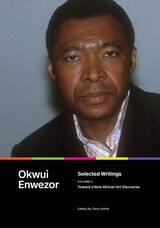
Selected Writings, Volume 1
Toward a New African Art DiscourseOkwui Enwezor. Edited by Terry Smith.
Duke University Press, 2025
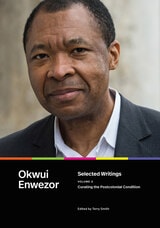
Selected Writings, Volume 2
Curating the Postcolonial Condition, Volume 2Okwui Enwezor. Edited by Terry Smith.
Duke University Press, 2025
Selective Remembrances
Archaeology in the Construction, Commemoration, and Consecration of National PastsEdited by Philip L. Kohl, Mara Kozelsky, and Nachman Ben-Yehuda
University of Chicago Press, 2008
Examining such relatively new or reconfigured nation-states as Iran, Iraq, Turkey, Israel, Russia, Ukraine, India, and Thailand, Selective Remembrances shows how states invoke the remote past to extol the glories of specific peoples or prove claims to ancestral homelands. Religion has long played a key role in such efforts, and the contributors take care to demonstrate the tendency of many people, including archaeologists themselves, to view the world through a religious lens—which can be exploited by new regimes to suppress objective study of the past and justify contemporary political actions.
The wide geographic and intellectual range of the essays in Selective Remembrances will make it a seminal text for archaeologists and historians.
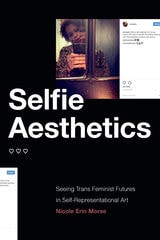
Selfie Aesthetics
Seeing Trans Feminist Futures in Self-Representational ArtNicole Erin Morse
Duke University Press, 2022

Settling Nature
The Conservation Regime in Palestine-IsraelIrus Braverman
University of Minnesota Press, 2023
A study of Palestine-Israel through the unexpected lens of nature conservation
Settling Nature documents the widespread ecological warfare practiced by the state of Israel. Recruited to the front lines are fallow deer, gazelles, wild asses, griffon vultures, pine trees, and cows—on the Israeli side—against goats, camels, olive trees, hybrid goldfinches, and akkoub—which are affiliated with the Palestinian side. These nonhuman soldiers are all the more effective because nature camouflages their tactical deployment as such.
Drawing on more than seventy interviews with Israel’s nature officials and on observations of their work, this book examines the careful orchestration of this animated warfare by Israel’s nature administration on both sides of the Green Line. Alongside its powerful protection of wildlife biodiversity, the territorial reach of Israel’s nature protection is remarkable: to date, nearly 25 percent of the country’s total land mass is assigned as a park or a reserve. Settling Nature argues that the administration of nature advances the Zionist project of Jewish settlement and the corresponding dispossession of non-Jews from this space.

Seven Stories of Threatening Speech
Women's Suffrage Meets Machine CodeRuth A. Miller
University of Michigan Press, 2012
This book thus represents a radical methodological initiative not just for scholars of history and language but for specialists in law, political theory, political science, gender studies, semiotics, and science and technology studies. It takes posthumanist scholarship to an exciting and essential, if sometimes troubling, conclusion.
“It is an erudite work by a scholar of enormous talent, who advances a thesis that is richly insightful and deeply provocative.”—Mary Hawkesworth, Rutgers University
Sexual Hegemony
Statecraft, Sodomy, and Capital in the Rise of the World SystemChristopher Chitty
Duke University Press, 2020
Sexual Strangers
Gays, Lesbians, and Dilemmas of CitizenshipShane Phelan
Temple University Press, 2001
In Sexual Strangers, Shane Phelan argues that, in the United States, queers are strangers -- not exactly the enemy, since they are not excluded from all rights of citizenship, but not quite members. Rather, they are ambiguous figures who trouble the border between "us" and "them," a border just as central to liberal regimes as to other states. Life on this border structures both the exclusion of sexual minorities and their ambivalence about becoming part of the "mainstream."
Sexual Strangers addresses questions of long-standing importance to minority group politics: the meaning and terms of inclusion, respect, and resistance. Phelan looks at citizenship as including not only equal protection and equal rights to such institutions as marriage and military service, but also political and cultural visibility, as inclusion in the national imaginary. She discusses the continuing stigmatization of bisexuals and transgendered people within lesbian and gay communities as a result of the attempt to flee from strangeness, a flight that inevitably produces new strangers. Her goal is to convince students of politics, both academic and activist, to embrace the rewards of strangeness as a means of achieving inclusive citizenship, rather than a citizenship that defines itself by what it will not accept.
Shades of Springsteen
Politics, Love, Sports, and MasculinityJohn Massaro
Rutgers University Press, 2021
In this unique blend of memoir and musical analysis, John Massaro reflects on his experiences as a lifelong fan of The Boss and one of the first professors to design a college course on Springsteen’s work. Focusing on five of the Jersey rocker’s main themes—love, masculinity, sports, politics, and the power of music—he shows how they are represented in Springsteen’s lyrics and shares stories from his own life that powerfully resonate with those lyrics. Meanwhile, paying tribute to Springsteen’s inclusive vision, he draws connections among figures as seemingly disparate as James Joyce, Ta-Nehisi Coates, Thomas Aquinas, Bobby Darin, and Lin-Manuel Miranda. Shades of Springsteen offers a deeply personal take on the musical and cultural legacies of an American icon.
Shadows on the Past
Studies in the Historical Fiction FilmLeger Grindon
Temple University Press, 1994
Studying popular Hollywood films from Gone With the Wind to Reds and such distinguished European films as La Marseillaise and The Rise to Power of Louis XIV, Leger Grindon examines how historical fiction films interpret the present through a representation of the past.
The historical fiction film is characterized by a set of motives and, Grindon argues, deserves to be considered a genre unto itself. Appropriation of historical events can insinuate a film's authority of its subject, veil an intention, provide an escape into nostalgia, or direct a search for knowledge and origins. Utilizing the past as a way of responding to social conflicts in the present, Grindon shows how the genre promotes a political agenda, superseding the influence of scholarship on the public's perception and interpretation of history.
In the series Culture and the Moving Image, edited by Robert Sklar.

Shaky Foundations
The Politics-Patronage-Social Science Nexus in Cold War AmericaSolovey, Mark
Rutgers University Press, 2015
Numerous popular and scholarly accounts have exposed the deep impact of patrons on the production of scientific knowledge and its applications. Shaky Foundations provides the first extensive examination of a new patronage system for the social sciences that emerged in the early Cold War years and took more definite shape during the 1950s and early 1960s, a period of enormous expansion in American social science.
By focusing on the military, the Ford Foundation, and the National Science Foundation, Mark Solovey shows how this patronage system presented social scientists and other interested parties, including natural scientists and politicians, with new opportunities to work out the scientific identity, social implications, and public policy uses of academic social research. Solovey also examines significant criticisms of the new patronage system, which contributed to widespread efforts to rethink and reshape the politics-patronage-social science nexus starting in the mid-1960s.
Based on extensive archival research, Shaky Foundations addresses fundamental questions about the intellectual foundations of the social sciences, their relationships with the natural sciences and the humanities, and the political and ideological import of academic social inquiry.
Shamanism, History, and the State
Nicholas Thomas and Caroline Humphrey, Editors
University of Michigan Press, 1994
The literature on shamanism and related topics is extensive, but has in general been biased toward curing and trance; the political and historical significance of shamanic activities has been largely neglected. The contributors to Shamanism, History, and the State—distinguished anthropologists and historians from England, Australia, and France—show that shamanism is not static and stable, but always changing as a result of political dynamics and historical processes. Contributors are Tamsyn Barton, Sysan Bayly, Mary Beard, Maurice Bloch, Peter Gow, Roberte N. Hamayon, Stephen Hugh-Jones, Caroline Humphrey, and Nicholas Thomas.
"The importance of this collection lies in the painstaking, many-sided ways in which it shows 'shamanism' to be a multifarious and continuously changing 'dialogue' or interaction with specific, local contexts. . . . Thus, rather than tackling the issue in principle, this collection tries to demonstrate through 'case studies' just how different 'shamanism' becomes if seen through a lens sensitive to history and the influence of institutions, such as the state, which seem far removed from it. I think the demonstrations add up to an impressive force." --Michael Taussig
"This new, ably edited volume provides . . . chapters that are rich in historic detail and that provide insights into general cultural processes and social interactions.
Shanghai Rising
State Power and Local Transformations in a Global MegacityXiangming Chen
University of Minnesota Press, 2009
Analyzing a Chinese city’s dazzling rise to global megacity status
Until around 1990, Shanghai was China’s premier but sluggish industrial center. Now at the beginning of the twenty-first century, the joint impact of global forces and state power has turned Shanghai into a dynamic megacity. Shanghai’s remarkable growth in economy, infrastructure, and global presence has prompted questions about the Shanghai “miracle.” This collection places the city’s unprecedented rise in a rare comparative examination of U.S. cities, as well as with Asian megacities Singapore and Hong Kong, providing a nuanced account of how Shanghai’s politics, economy, society, and space have been transformed by macro- and micro-level forces.
Contributors: Stephen W. K. Chiu, Chinese U of Hong Kong; K. C. Ho, National U of Singapore; John D. Kasarda, U of North Carolina; Hanlong Lu, Shanghai Academy of Social Sciences; Tai-lok Lui, Chinese U of Hong Kong; Ann R. Markusen, U of Minnesota; Anthony M. Orum, U of Illinois, Chicago; Yuan Ren, Fudan U Shanghai; Saskia Sassen, Columbia U; Jiaming Sun, Texas A&M U, Commerce; Fulong Wu, Cardiff U; Pingkang Yu, George Washington U; Tingwei Zhang, U of Illinois, Chicago; Zhenhua Zhou, Development Research Center, Shanghai Municipal Government.
Shaping Language Policy in the U.S.
The Role of Composition StudiesScott Wible
Southern Illinois University Press, 2013
In Shaping Language Policy in the U.S.: The Role of Composition Studies, author Scott Wible explores the significance and application of two of the Conference on College Composition and Communication’s key language policy statements: the 1974 Students’ Right to Their Own Language resolution and the 1988 National Language Policy. Wible draws from a wealth of previously unavailable archived material and professional literature to offer for the first time a comprehensive examination of these policies and their legacies that continue to shape the worlds of rhetoric, politics, and composition.
Wible demonstrates the continued relevance of the CCCC’s policies, particularly their role in influencing the recent, post-9/11 emergence of a national security language policy. He discusses in depth the role the CCCC’s language policy statements can play in shaping the U.S. government’s growing awareness of the importance of foreign language education, and he offers practical discussions of the policies’ pedagogical, professional, and political implications for rhetoric and composition scholars who engage contemporary debates about the politics of linguistic diversity and language arts education in the United States. Shaping Language Policy in the U.S. reveals the numerous ways in which the CCCC language policies have usefully informed educators’ professional practices and public service and investigates how these policies can continue to guide scholars and teachers in the future.

Shared Land/Conflicting Identity
Trajectories of Israeli & Palestinian Symbol UseRobert C. Rowland
Michigan State University Press, 2002
Shared Land/Conflicting Identity: Trajectories of Israeli and Palestinian Symbol Use argues that rhetoric, ideology, and myth have played key roles in influencing the development of the 100-year conflict between first the Zionist settlers and the current Israeli people and the Palestinian residents in what is now Israel. The Israeli-Palestinian conflict is usually treated as an issue of land and water. While these elements are the core of the conflict, they are heavily influenced by the symbols used by both peoples to describe, understand, and persuade each other. The authors argue that symbolic practices deeply influenced the Oslo Accords, and that the breakthrough in the peace process that led to Oslo could not have occurred without a breakthrough in communication styles.
Rowland and Frank develop four crucial ideas on social development: the roles of rhetoric, ideology, and myth; the influence of symbolic factors; specific symbolic factors that played a key role in peace negotiations; and the identification and value of criteria for evaluating symbolic practices in any society.

Shooting for Change
Korean Photography after the WarJung Joon Lee
Duke University Press, 2024
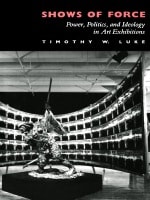
Shows of Force
Power, Politics, and Ideology in Art ExhibitionsTimothy W. Luke
Duke University Press, 1992
The first section, “Envisioning a Past, Imagining the West,” looks at art exhibitions devoted to artworks about or from the American West. Luke shows how these exhibitions—displaying nineteenth- and early-twentieth century works by artists such as George Caleb Bingham, Frederic Remington, Frederic Edwin Church, and Georgia O’Keefe—express contemporary political agendas in the way the portray “the past” and shape new visions of “the West.”
In “Developing the Present, Defining a World,” Luke considers artists from the post-1945 era, including Ilya Kabokov, Hans Haacke, Sue Coe, Roger Brown, and Robert Longo. Recent art exhibits, his analysis reveals, attempt to develop politically charged conceptions of the present, which in turn struggle to define the changing contemporary world and art’s various roles within it.
Luke brings to light the contradictions encoded in the exhibition of art and, in doing so, illuminates the political realities and cultural ideologies of the present. Shows of Force offers a timely and surely controversial contribution to current discussions of the politics of exhibiting art.
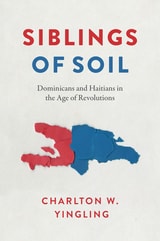
Siblings of Soil
Dominicans and Haitians in the Age of RevolutionsCharlton W. Yingling
University of Texas Press, 2022
2023 Honorable Mention, Isis Duarte Book Prize, Haiti/ Dominican Republic section (LASA)
After revolutionary cooperation between Dominican and Haitian majorities produced independence across Hispaniola, Dominican elites crafted negative myths about this era that contributed to anti-Haitianism.
Despite the island’s long-simmering tensions, Dominicans and Haitians once unified Hispaniola. Based on research from over two dozen archives in multiple countries, Siblings of Soil presents the overlooked history of their shared imperial endings and national beginnings from the 1780s to 1822. Haitian revolutionaries both inspired and aided Dominican antislavery and anti-imperial movements. Ultimately, Santo Domingo's independence from Spain came in 1822 through unification with Haiti, as Dominicans embraced citizenship and emancipation. Their collaboration resulted in one of the most unique and inclusive forms of independence in the Americas.
Elite reactions to this era formed anti-Haitian narratives. Racial ideas permeated the revolution, Vodou, Catholicism, secularism, and even Deism. Some Dominicans reinforced Hispanic and Catholic traditions and cast Haitians as violent heretics who had invaded Dominican society, undermining the innovative, multicultural state. Two centuries later, distortions of their shared past of kinship have enabled generations of anti-Haitian policies, assumptions of irreconcilable differences, and human rights abuses.

Sick Work
Exhaustion, Labor, and Invisible IllnessEmily Lim Rogers
Duke University Press, 2026
Silent Medievalisms
Reimagining the Middle Ages During Film’s Foundational EraEdited by Tison Pugh and Angela Jane Weisl
The Ohio State University Press, 2026
Contributors:
Kimberly Ball, Elizabeth Coggeshall, John Haines, Kevin J. Harty, Valerie B. Johnson, Tison Pugh, Sabina Rahman, Carol L. Robinson, Robert Squillace, Alexandra Sterling-Hellenbrand, Alfred Thomas, Laura E. Wangerin, Angela Jane Weisl

Sing and Sing On
Sentinel Musicians and the Making of the Ethiopian American DiasporaKay Kaufman Shelemay
University of Chicago Press, 2022
Sing and Sing On is the first study of the forced migration of musicians out of the Horn of Africa dating from the 1974 Ethiopian revolution, a political event that overthrew one of the world’s oldest monarchies and installed a brutal military regime. Musicians were among the first to depart the region, their lives shattered by revolutionary violence, curfews, and civil war. Reconstructing the memories of forced migration, Sing and Sing On traces the challenges musicians faced amidst revolutionary violence and the critical role they played in building communities abroad.
Drawing on the recollections of dozens of musicians, Sing and Sing On details personal, cultural, and economic hardships experienced by musicians who have resettled in new locales abroad. Kay Kaufman Shelemay highlights their many artistic and social initiatives and the ways they have offered inspiration and leadership within and beyond a rapidly growing Ethiopian American diaspora. While musicians held this role as sentinels in Ethiopian culture long before the revolution began, it has taken on new meanings and contours in the Ethiopian diaspora. The book details the ongoing creativity of these musicians while exploring the attraction of return to their Ethiopian homeland over the course of decades abroad. Ultimately, Shelemay shows that musicians are uniquely positioned to serve this sentinel role as both guardians and challengers of cultural heritage.

Sins Of The Parents
Politics Of National Apologies In The U.S.Brian A. Weiner
Temple University Press, 2005
Situating Composition
Composition Studies and the Politics of LocationLisa Ede
Southern Illinois University Press, 2004
Responding to a growing pedagogical paralysis in debates over the nature and status of composition studies as an academic discipline, Lisa Ede offers a provocative inquiry into the politics of composition’s place in the academy. The result is a timely and engaging reflection on the rhetoric, ideology, and ethics of scholarship and instruction in composition studies today.
Situating Composition: Composition Studies and the Politics of Location delves into some of the most vexing issues presently facing the field: its status in relation to English studies, the nature and consequences of the writing process movement, the uneven professionalization of composition teachers, and the widening chasm between theory and practice. Ede interrogates key moments and texts in composition’s evolution, from the writing process movement to Susan Miller’s Textual Carnivals, through the interpretive lenses of historical analysis, theoretical critique, feminist and cultural theory, and Ede’s own two decades of experiences as a teacher and writing program administrator.
Questioning the narratives of progress and paradigm shifts that inform the field’s highly regarded recent theoretical studies, Ede urges scholars to carefully reconsider these claims, to honor the roles of teachers and students as more than dupes of ideology, and to more fully acknowledge—and utilize—the differences between the practice of theory and the practice of teaching. As academic hierarchies of knowledge increasingly privilege scholarship over instruction, Ede warns researchers to be cognizant of the politics and power inherent in their own location in the academy, particularly when professing to speak for teachers and students. To that end, the volume’s conclusion advocates pragmatic avenues for change and proffers topics for future discussion and debate.