Results by title
397 books match the query 'Rome' and 23 start with s
Saeculum
Defining Historical Eras in Ancient Roman ThoughtPaul Hay
University of Texas Press, 2023
How the notion of unique eras influenced the Roman view of time and the narration of history from various perspectives.
The Victorian Era. The Age of Enlightenment. The post-9/11 years. We are accustomed to demarcating history, fencing off one period from the next. But societies have not always operated in this way. Paul Hay returns to Rome in the first century BCE to glimpse the beginnings of periodization as it is still commonly practiced, exploring how the ancient Romans developed a novel sense of time and used it to construct their views of the past and of the possibilities of the future.
It was the Roman general Sulla who first sought to portray himself as the inaugurator of a new age of prosperity, and through him Romans adopted the Etruscan term saeculum to refer to a unique era of history. Romans went on to deepen their investment in periodization by linking notions of time to moments of catastrophe, allowing them to conceptualize their own epoch and its conclusion, as in the literature of Vergil and Horace. Periodization further introduced the idea of specific agents of change into Roman thought—agents that were foundational to narratives of progress and decline. An eye-opening account, Saeculum describes nothing less than an intellectual and cognitive revolution, that fundamentally reorganized the meanings of history and time.
Satire and the Threat of Speech
Horace's Satires, Book 1Catherine M. Schlegel
University of Wisconsin Press, 2006
Satyr Square
A Year, a Life in RomeLeonard Barkan
Northwestern University Press, 2008
Part memoir, part literary criticism, part culinary and aesthetic travelogue, this loving reflection is a poignant, funny narrative about an American professor spending a year in Rome. A scarred veteran of academic culture wars retreating to a cradle of culture, Barkan is at first hungry, lonely, and uncertain of his intellectual mission. But soon he is appointed unofficial mascot of an eccentric community of gastronomes, becomes virtually bilingual, and falls in love. As the year progresses, he finds his voice as a writer, loses his lover, and definitively returns to America with heart, mind, and body. His memoir is the celebration of a life lived in the uncanny spaces where art and real people intersect.
Barkan’s reminiscence is not just about the Renaissance and ancient statuary, or Shakespeare and Mozart, Charles Bukowski and Paul de Man, eggplant antipasto and Brunello di Montalcino, foot fetishism and sulfur baths. At the heart of the narrative—beneath that beguiling surface of irony, humor, and misdirection—is a man of genuine ardor, struggling with what it means to be a homosexual and a Jew, trying to rediscover or reinvent his own intellectual passions. Hilarious, erudite, and lusciously rendered, Satyr Square gives us the whole of a life made up from fragments of Italy, art, food, and longing.
Secret History
Procopius
University of Michigan Press, 1961
. . . How the Great General Belisarius was hoodwinked by his wife, whose lover became a monk.
. . . How Theodora, most depraved of all empresses, won Justinian's love.
. . . How she saved five hundred harlots from a life of sin, made off with her own natural son, and other curious incidents of her passion.
Selected Epigrams
Martial, Translated with notes by Susan McLean, Introduction by Marc Kleijwegt
University of Wisconsin Press, 2014
Seneca
Fifty Letters of a Roman StoicLucius Annaeus Seneca
University of Chicago Press, 2021
“There is only one course of action that can make you happy. . . . rejoice in what is yours. What is it that is yours? Yourself; the best part of you.”
In the year 62, citing health issues, the Roman philosopher Seneca withdrew from public service and devoted his time to writing. His letters from this period offer a window onto his experience as a landowner, a traveler, and a man coping with the onset of old age. They share his ideas on everything from the treatment of enslaved people to the perils of seafaring, and they provide lucid explanations for many key points of Stoic philosophy.
This selection of fifty letters brings out the essentials of Seneca’s thought, with much that speaks directly to the modern reader. Above all, they explore the inner life of the individual who proceeds through philosophical inquiry from a state of emotional turmoil to true friendship, self-determination, and personal excellence.
Shakespeare's Roman Trilogy
The Twilight of the Ancient WorldPaul A. Cantor
University of Chicago Press, 2017
Cantor analyzes the way Shakespeare chronicles the rise and fall of the Roman Republic and the emergence of the Roman Empire. The transformation of the ancient city into a cosmopolitan empire marks the end of the era of civic virtue in antiquity, but it also opens up new spiritual possibilities that Shakespeare correlates with the rise of Christianity and thus the first stirrings of the medieval and the modern worlds.
More broadly, Cantor places Shakespeare’s plays in a long tradition of philosophical speculation about Rome, with special emphasis on Machiavelli and Nietzsche, two thinkers who provide important clues on how to read Shakespeare’s works. In a pathbreaking chapter, he undertakes the first systematic comparison of Shakespeare and Nietzsche on Rome, exploring their central point of contention: Did Christianity corrupt the Roman Empire or was the corruption of the Empire the precondition of the rise of Christianity? Bringing Shakespeare into dialogue with other major thinkers about Rome, Shakespeare’s Roman Trilogy reveals the true profundity of the Roman Plays.
Shakespeare's Rome
Republic and EmpirePaul A. Cantor
University of Chicago Press, 2017
In Shakespeare’s Rome, Cantor examines the political settings of Shakespeare’s Roman plays, Coriolanus and Antony and Cleopatra, with references as well to Julius Caesar. Cantor shows that Shakespeare presents a convincing portrait of Rome in different eras of its history, contrasting the austere republic of Coriolanus, with its narrow horizons and martial virtues, and the cosmopolitan empire of Antony and Cleopatra, with its “immortal longings” and sophistication bordering on decadence.
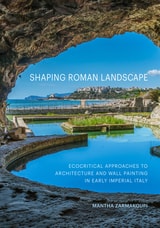
Shaping Roman Landscape
Ecocritical Approaches to Architecture and Wall Painting in Early Imperial ItalyMantha Zarmakoupi
J. Paul Getty Trust, The, 0
Landscape emerged as a significant theme in the Roman Late Republican and Early Imperial periods. Writers described landscape in texts and treatises, its qualities were praised and sought out in everyday life, and contemporary perceptions of the natural and built environment, as well as ideas about nature and art, were intertwined with architectural and decorative trends.
This illustrated volume examines how representations of real and depicted landscapes, and the merging of both in visual space, contributed to the creation of novel languages of art and architecture. Drawing on a diverse body of archaeological, art historical, and literary evidence, this study applies an ecocritical lens that moves beyond the limits of traditional iconography. Chapters consider, for example, how garden designs and paintings appropriated the cultures and ecosystems brought under Roman control and the ways miniature landscape paintings chronicled the transformation of the Italian shoreline with colonnaded villas, pointing to the changing relationship of humans with nature. Making a timely and original contribution to current discourses on ecology and art and architectural history, Shaping Roman Landscape reveals how Roman ideas of landscape, and the decorative strategies at imperial domus and villa complexes that gave these ideas shape, were richly embedded with meanings of nature, culture, and labor.
Silence in Catullus
Benjamin Eldon Stevens
University of Wisconsin Press, 2014
Silenced Voices
The Poetics of Speech in OvidBartolo A. Natoli
University of Wisconsin Press, 2021
Bartolo A. Natoli provides a unique cross-reading of these works. He examines how the motifs and ideas articulated in the Metamorphoses provide the template for the poet's representation of his own exile. Ovid depicts his transformation with an eye toward memory, reformulating how his exile would be perceived by his audience. His exilic poems are an attempt to recover the voice he lost and to reconnect with the community of Rome.
Slavery and Sexuality in Classical Antiquity
Edited by Deborah Kamen and C. W. Marshall
University of Wisconsin Press, 2021
Slavery and Sexuality in Classical Antiquity reveals the often hidden and contradictory attitudes concerning the sexual identities and expression of enslaved people. These individuals were typically objectified by both social convention and legal description but were also recognized as human subjects, with subjectivity and sexual desires of their own. The contributors provoke valuable and fascinating questions that not only recognize the trauma and struggles of enslaved people but also point to the apparent inconsistencies in the mindsets of the enslavers. The resulting volume expands our understanding of both sexuality and slavery in ancient Greece and Rome, as separate subjects and as they impacted each other.
Soldiers and Silver
Mobilizing Resources in the Age of Roman ConquestBy Michael J. Taylor
University of Texas Press, 2020
Soldiers, Cities, and Civilians in Roman Syria
Nigel Pollard
University of Michigan Press, 2000
Nigel Pollard is currently a Research Assistant at the Institute of Archaeology, University of Oxford.
Space, Geography, and Politics in the Early Roman Empire
Claude Nicolet
University of Michigan Press, 2015
Speculum Iuris
Roman Law as a Reflection of Social and Economic Life in AntiquityJean-Jacques Aubert and Boudewijn Sirks, Editors
University of Michigan Press, 2002
Speculum Iuris examines the complex relationship between law and social practice from the particular angle of Roman legislation and jurisprudence as conditioned by or reacting to a specific social, economic, and political context. Using various strategies, the editors and contributors mine a huge body of texts to study attitudes and behaviors of the Roman upper class, whose social concerns are reflected in the development of legal rules.
A close reading of juristic opinions and Republican or imperial legislation allows the contributors to find rationales behind rules and decisions in order to explain practices and mentalities of the elite within a larger social context. This book demonstrates clearly that Roman law was not divorced from the realities of daily life, even if some jurists may have been working with purely hypothetical cases.
Speculum Iuris provides a multidisciplinary approach to the question of the interplay of legal and social forces in the Roman world. As such, it will be a helpful study for general classicists and ancient historians, as well as for legal historians, social historians, economic historians, sociologists, and cultural anthropologists.
Jean-Jacques Aubert is Professor of Latin Language and Literature, University of Neuchâtel, Switzerland. Boudewijn Sirks is Professor of the History of Ancient Law, the History of European Private Law, and German Civil Law, Institute for the History of Law, Germany.
Staging Masculinity
The Rhetoric of Performance in the Roman WorldErik Gunderson
University of Michigan Press, 2000
Stealing from the Gods
Temple Robbery in the Roman ImaginationIsabel K. Köster
University of Michigan Press, 2026
Ancient authors including Cicero, Caesar, Livy, Appian, and Pausanias present isolated, grotesque individuals whose actions have no bearing on the conduct of Romans as a whole, rendering temple robbery not a matter of collective responsibility, but of individual moral failure. By revealing how narratives of temple robbery are constructed from a literary perspective and how they inform discourses about military conquest and imperial rule, Isabel K. Köster shines a new light on how the Romans coped with the more pernicious aspects of their empire.
Stock Characters Speaking
Eight Libanian Declamations Introduced and TranslatedRobert J. Penella
University of Michigan Press, 2023
Declamations were composed and orally delivered in the Roman Empire by sophists, or teachers of rhetoric, of whom the Greek-speaking Libanius was one of the most distinguished. Stock Characters Speaking may be thought of as emerging from three developments of recent decades: an explosive interest in late antiquity, a newly sympathetic interest in rhetoric (including ancient declamation), and a desire to bring Libanius’s massive corpus into English and other modern languages.
In this book, author Robert J. Penella translates eight of Libanius’s declamations: 29, 30, 34, 35, 37, 45, 46, 47, and, in an appendix, the thirteenth-century Gregory of Cyprus’s response to Declamation 34. Each translation is accompanied by an introduction, in which Penella examines the themes, structure, and the stasis, or key issue, of the declamations. Figures who appear in the translated declamations include a parasite who has lost his patron, a man envious of his rich neighbor, a miser’s son, a poor man willing to die for his city, a rich war-hero accused of aiming at tyranny, and a convict asking for exile. Three of these declamations have appeared in German; otherwise, these translations are the first into a modern language.
Stones, Bones, and the Sacred
Essays on Material Culture and Ancient Religion in Honor of Dennis E.Alan H. Cadwallader
SBL Press, 2016
A crucial text for any university course on the interaction of archaeology and the Bible
The world of early Christians was not a world lived in texts; it was a world saturated with material reality and concerns: what, where and when to eat or drink; how to present oneself in the space of bodily life and that of death; how to move from one place to another; what impacted status or the adjudication of legal charges. All these and more controlled so much of life in the ancient world. The Christians were not immune from the impact of these realities. Sometimes they absorbed their surrounds; sometimes they quite explicitly rejected the material practices bearing in on them; frequently they modified the practice and the rationale to create a significant Christian alternative. The collection of essays in this volume come from a range of international scholars who, for all their different interests and critical commitments, are yet united in treasuring research into the Greek and Roman worlds in which Christians sought to make their way. They offer these essays in honor of one who has made a lifetime's work in mining ancient material culture to extract nuggets of insight into early Christian dining practices: Dennis E. Smith.
Features
- Rich examples of method in the utilization of ancient material culture for biblical interpretation.
- Thirteen essays with a response from Dennis E. Smith
- Maps, diagrams, and plates

Stories and Histories of Islamic Art in Italy
Supplements to the Memoirs of the American Academy in RomeEdited by Silvia Armando
University of Michigan Press, 2027
In the past decades, scholarship on Islamic art has challenged the parameters of the discipline, but in the process, the Italian context has often been overlooked. Gathering the voices of prominent international specialists, the book fills an important gap by presenting new research on topics ranging from the medieval to modern periods. Contributors investigate how Islamic artifacts were collected, categorized, and studied; examine Orientalism(s) in Italy and beyond; reconstruct the genealogies of scholars who helped found and develop the academic discipline and museum practices; and offer new scholarship on ceramics, textiles, metalwork, rock crystals, numismatics, and archaeology. The volume reveals the interchange between romantic reveries and more “scientific” Islamic art studies. Following the model of counter-Orientalism proposed by Karla Mallette, it raises questions of identity, otherness, and self-representation within a cultural and geographical context where the Islamic “component” was—and is—perceived either as exotic or integral to Italian identity.
With over 100 illustrations, Stories and Histories of Islamic Art in Italy explores how amateurs, artists, and intellectuals perceived of, depicted, and wrote about the Islamic world, offering new ways to examine Italy’s Islamic past.
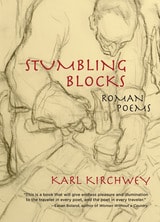
Stumbling Blocks
Roman PoemsKarl Kirchwey
Northwestern University Press, 2017
As in his 1998 New York Times Notable Book The Engrafted Word, the city of Rome becomes a lens through which to understand the contemporary human experience and the upheavals of human loss. Stumbling Blocks takes as its starting point the shattered ancient Roman ruins described in Renaissance poet Joachim du Bellay's celebrated sonnet—a landscape of death feeding upon itself and restored to life in the imagination of each successive generation to salvage its own narratives.
Kirchwey builds new arches and mythological intersections in exquisite poems that take long walks in the Eternal City, through landscapes far away and deep within. This gorgeous collection takes us back in time and brings us forward through our Old and New Worlds, revealing through the religion of art both beauty and atrocity.
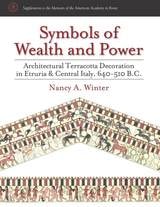
Symbols of Wealth and Power
Architectural Terracotta Decoration in Etruria and Central Italy, 640-510 B.C.Nancy A. Winter
University of Michigan Press, 2009
Although initially intended for the innovative, if prosaic, purpose of providing waterproof and fireproof cover for earlier thatch-roofed homes, fired clay tiles, in seventh- and sixth-century Etruria and Central Italy, combined with Etruscan love of adornment to create exceptional domestic and religious building decoration. Featuring statues and figured friezes of humans, animals, and mythological figures intended to convey the status of the owner or dedicator, the surviving terracotta roofs provide important insights into the architectural history of Etruria. With Symbols of Wealth and Power, Nancy A. Winter has provided a definitive overview of the evidence for these roofing elements that will enhance our knowledge of Etruscan---and more broadly, ancient---architecture.
Nancy A. Winter is an archaeologist and former librarian of the American School of Classical Studies, Athens. She is the author of Greek Architectural Terracottas: From the Prehistoric to the End of the Archaic Period (1993).
Role Models in the Roman World: Identity and Assimilation, edited by Sinclair Bell and Inge Lyse Hansen
The Maritime World of Ancient Rome, edited by Robert L. Hohlfelder
Cosa: The Black-Glaze Pottery 2, by Ann Reynolds Scott