Results by title
386 books match the query 'Russia' and 28 start with s

S. L. Frank
The Life And Work Of A Russian Philosopher, 1877-1950Philip Boobbyer
Ohio University Press, 1995
“There are many reasons for writing a biography of Semyon Frank. Quite apart from his philosophy, he lived a remarkable life. Born in Moscow in 1877, he was exiled from Soviet Russia in 1922 and died in London in 1950. The son of a Jewish doctor, he became a revolutionary Social Democrat in his teens and finished his life as a Neoplatonist Christian. One of the Russian revisionist Marxists, he was then involved in the Kadet Party during the 1905 revolution before breaking with active political activity and turning to philosophy. He lived in Petrograd through the First World War until September 1917, after which he went to Saratov, where he experienced the chaos of the Russian Civil War. Living in Germany after his exile, he witnessed the rise of Hitler in Berlin, left for France in a hurry in 1937, and spent part of the war hiding from the Gestapo in the Grenoble mountains. It was a life that encompassed a lot of history.
”Yet along with this, Frank was arguably Russia’s greatest twentieth-century philosopher. Indeed, V.V. Zen‘kovskii, the historian of Russian philosophy, considered Frank ’in strength of philosophic vision … the most outstanding among Russian philosophers generally — not merely among those who share his ideas.‘ For its lucidity, conciseness, systematic character, and unity, Zen’kovskii considered Frank’s system ‘ the highest achievement … of Russian philosophy.’ Doubtless, Zen‘kovskii’s assessment is disputable, but his remarks emphasize Frank’s stature in the Russian tradition. In the style of German idealism, Frank constructed a comprehensive philosophical system, which he believed offered a coherent alternative to materialism. He was deeply worried by the implications of epistemological relativism and constructed a system of metaphysics designed to link epistemology and ontology, to bridge the gulf between thought and being. In addition, he attempted to express the idea of a personal God in philosophical language. His system also embraced social philosophy, anthropology, and ethics.“
— from the Introduction by the author
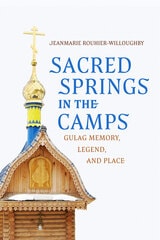
Sacred Springs in the Camps
Gulag Memory, Legend, and PlaceJeanmarie Rouhier-Willoughby
University of Wisconsin Press, 2026
Grounded by detailed ethnography, Sacred Springs in the Camps explores how legend creates, negotiates, and challenges collective memory; how lived religious practices intersect with the current revival of the Russian Orthodox Church; how politics intertwine with belief; and how the social construction of sacred places affects folk narratives, faith, and local identity. These unlikely holy waters thus reflect important facets of contemporary Russian religion, politics, and society, refracting and reframing memories of the socialist past even as they offer important lessons for the present moment.
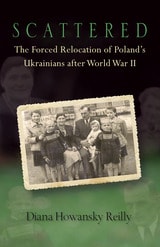
Scattered
The Forced Relocation of Poland’s Ukrainians after World War IIDiana Howansky Reilly
University of Wisconsin Press, 2013
Born in the Lemko region of southeastern Poland, Petro, Melania, and Hania Pyrtej survived World War II only to be separated by political decisions over which they had no control. Petro relocated with his wife to Soviet Ukraine during the population exchange of 1944–46, while his sisters Melania and Hania were resettled to western Poland through Operation Vistula in 1947. As the Ukrainian Insurgent Army fought resettlement, the Polish government meanwhile imprisoned suspected sympathizers within the Jaworzno concentration camp. Melania, Reilly's maternal grandmother, eventually found her way to the United States during Poland's period of liberalization in the 1960s.
Drawing on oral interviews and archival research, Reilly tells a fascinating, true story that provides a bottom-up perspective and illustrates the impact of extraordinary historical events on the lives of ordinary people. Tracing the story to the present, she describes survivors' efforts to receive compensation for the destruction of their homes and communities.
Silver Medal for World History, Independent Publisher Book Awards
Finalist, Housatonic Book Awards
Finalist in History, Foreword Books of the Year
Selected Essays
Viacheslav IvanovViacheslav Ivanov
Northwestern University Press, 2003
A poet, critic, and theoretician during the Silver Age of Russian poetry, at the turn of the twentieth century, Viacheslav Ivanov was dubbed "Viacheslav the Magnificent" by his contemporaries for his erudition, sumptuous and allusive poetry, and brilliant essays. He provided Russian Symbolism with theoretical underpinnings based on classical and biblical mythology, the aesthetics of music, philosophy ranging from Plato and Kant to Schopenhauer and Nietzsche, and a profound knowledge of classical and modern European poetry.
In choosing material for this volume of essays, Robert Bird and Michael Wachtel have covered a broad range of Ivanov's interests: the aesthetics of Symbolism, theater, culturological concerns, and on such influential figures of the period as Nietzsche, Solovyov, Tolstoy, and Scriabin. Also included are extensive notes on the essays in which classical, biblical, and poetic citations and allusions are identified, the aesthetic and theoretical contexts are clarified, and certain translation problems are briefly discussed. This volume provides valuable insight into the theory of Symbolism as it developed in Russia.
Selected Stories
A. F. Veltman
Northwestern University Press, 2026
In 1830s and ’40s Russia, A. F. Veltman’s eccentric writings were a fixture on the bookshelves of the reading public. In his era, his work influenced writers including Pushkin, Gogol, and Dostoevsky. The five stories collected here, united by themes of social satire, display Veltman’s characteristic pivots between the tragic, comic, and grotesque.
“Erotida” riffs on the genre of the society tale with linguistic puns and a bizarre plot resolution. In “Roland the Furious,” provincial officials mistake a traveler for a high-ranking government functionary. “Travel Impressions, and, among Other Things, a Pot of Geraniums” plays on the travelogue genre and includes what may be the first description in Russian literature of journey by railroad. “A Traveler from the Provinces; or, A Commotion in the Capital” parodies the Moscow literary salons of Veltman’s day. Finally, “It’s Not a House, but a Plaything!” toys with yet another storytelling convention of the time—the Russian folkloric tradition of “house spirits.”
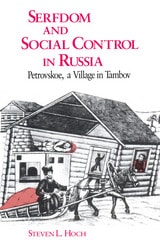
Serfdom and Social Control in Russia
Petrovskoe, a Village in TambovSteven L. Hoch
University of Chicago Press, 1986

Seward's Folly
A New Look at the Alaska PurchaseLee A. Farrow
University of Alaska Press, 2016
This book aims to correct that. Lee Farrow offers here a detailed account of just what the Alaska Purchase was, how it came about, its impact at the time, and more. Farrow shows why both America and Russia had plenty of good reasons to want the sale to occur, including Russia’s desire to let go of an unprofitable, hard-to-manage colony and the belief in the United States that securing Alaska could help the nation gain control of British Columbia and generate closer trade ties with Asia . Farrow also delves into the implications of the deal for foreign policy and international diplomacy far beyond Russia and the United States at a moment when the global balance of power was in question.
A thorough, readable retelling of a story we only think we know, Seward’s Folly will become the standard book on the Alaska Purchase.
Shamara and Other Stories
Svetlana Vasilenko
Northwestern University Press, 1999
Shock Therapy
Psychology, Precarity, and Well-Being in Postsocialist RussiaTomas Matza
Duke University Press, 2018
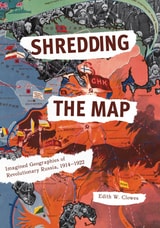
Shredding the Map
Imagined Geographies of Revolutionary Russia, 1914-1922Edith W. Clowes
Amherst College Press, 2024
An innovative, digitally-aided study of Russia’s “imagined geography” during the early decades of the twentieth century, Shredding the Map uncovers vying emotional patterns and responses to Russian ideas of place, some familiar and some quite new. The book includes new visualizations that connect otherwise invisible networks of shared place, feeling, and perception among dozens of writers in order to trace patterns of geospatial identity. A scholarly companion to the “Mapping Imagined Geographies of Revolutionary Russia” website and database, this book offers an innovative analysis of place and identity beyond the centers of power, enhancing our perceptions of Russia and encouraging debate about the possibilities for digital humanities and literary analysis.
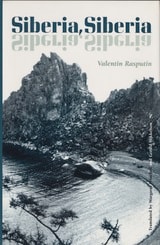
Siberia, Siberia
Valentin Rasputin
Northwestern University Press, 1997
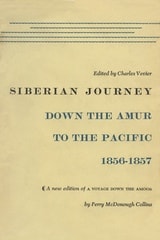
Siberian Journey
Down the Amur to the Pacific, 1856–1857Perry McDonough Collins
University of Wisconsin Press, 2011
Perry McDonough Collins was the first American to journey through Siberia and down the 2,690-mile Amur River to the Pacific Ocean. In 1860 he wrote A Voyage Down the Amoor, an account of his adventures, and his book proved so popular that it was reissued in 1864. Siberian Journey consists of Collins’s original text framed by an interpretive introduction and explanatory notes by Charles Vevier, providing an extensive, first-hand account of Russia’s land and its people in the mid–nineteenth century.
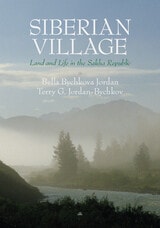
Siberian Village
Land and Life in the Sakha RepublicBella Bychkova Jordan
University of Minnesota Press, 2001
A fascinating portrait of the history and landscape of this remote settlement.
The village of Djarkhan is in the heart of Russia’s Sakha Republic, on the Central Yakut Plain. The world around Djarkhan, with its extreme subarctic climate and intractable permafrost, seems an unlikely place to look for a rich, historic, and exotic efflorescence of human life, and yet this is precisely what the authors found. Their book is a remarkable account of how the people of Djarkhan have created their own distinctive place through their unique relationship with a severe and demanding land.
This book traces the way of life of the village’s Turkic inhabitants, the Yakuts, from their arrival in the 1600s through czarist times and the Soviet era to the present day. As a native of the village, geographer Bella Bychkova Jordan enjoyed unparalleled access to its people and their stories, myths, humor, problems, and folklore. Viewed through the prism of cultural geography, this material forms the basis of a remarkable portrait of a people wresting a living from the land in one of the coldest and most isolated spots on Earth. Published in collaboration with the Center for American Places.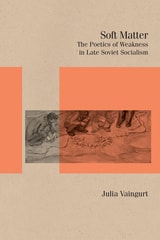
Soft Matter
The Poetics of Weakness in Late Soviet SocialismJulia Vaingurt
Northwestern University Press, 2025
Identifies and examines a poetics of weakness in Soviet underground literature
Artists of the late Soviet era sought new, nonconformist ways of approaching literary fiction, arriving at weakness as a crucial principle of narrative and character formation. Julia Vaingurt argues that this counter-discourse of strategic weakness constituted both an aesthetic strategy and an ethical code, affording like-minded authors a feeling of recognition and commonality and uniting an international community of artists in resistance to the divisiveness of their worlds. Soft Matter: The Poetics of Weakness in Late Soviet Socialism explores the cultivation of weak subjectivity through modes such as gender subversion, queer holy foolishness, intoxication, madness, and writing disorders like graphomania and writer’s block. Identifying the poetics of weakness as formative for Soviet underground literature of the 1960s and ’70s, Vaingurt also traces the inheritance of a far older tradition within Russian culture of salutary weakness. As democratic deliberation continues to be under threat around the world, alternatives to the ubiquitous politics of force are an aesthetic, ethical, and ideological imperative.
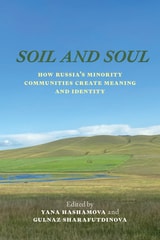
Soil and Soul
How Russia’s Minority Communities Create Meaning and IdentityEdited by Yana Hashamova and Gulnaz Sharafutdinova
University of Wisconsin Press, 2027
By landmass, Russia is the world’s largest country, due largely to centuries of military expansion, imperial rule, and colonization. As a result, it contains people of many ethnicities, nationalities, religions, and languages. Yet Russia’s non-Russian, Indigenous, and minority communities have often been marginalized by state policy and underrepresented in scholarship. Soil and Soul explores how these communities sustain distinct forms of identity and belonging not only through discourse or state institutions but also through embodied relations with land, nature, and animals. These local practices complicate and unsettle state-centered narratives of Russian cultural superiority by showing how meaning and identity are created through relationships with the nonhuman world. Drawing on decolonial, anthropological, environmental, sociological, linguistic, and geographic approaches, this volume reframes minority agency as ecosocial practice embedded in local ecologies, everyday life, and postimperial power asymmetries.
Contributors: Megan Dixon, Yana Hashamova, Kristina Kovalskaya, Jesko Schmoller, Gulnaz Sharafutdinova, Laura Siragusa, Zoia Tarasova, Baasanjav Terbish
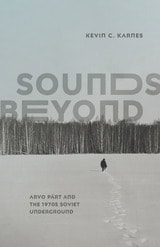
Sounds Beyond
Arvo Pärt and the 1970s Soviet UndergroundKevin C. Karnes
University of Chicago Press, 2021
In Sounds Beyond, Kevin C. Karnes studies the interconnected alternative music and art scenes in the USSR during the second half of the 1970s, revealing the audacious origins of some of Estonian composer Arvo Pärt’s most famous music. Karnes shows how Pärt’s work was created within a vital yet forgotten culture of collective experimentation, the Soviet underground.
Mining archives and oral history from across the former USSR, Sounds Beyond carefully situates modes of creative experimentation within their late socialist contexts. In documenting Pärt’s work, Karnes reveals the rich creative culture that thrived covertly in the USSR and the network of figures that made underground performances possible: students, audio engineers, sympathetic administrators, star performers, and aspiring DJs. Sounds Beyond advances a new understanding of Pärt’s music as an expression of the aesthetic and religious commitments shared, nurtured, and celebrated by many in Soviet underground circles. At the same time, this story attests to the lasting power of Pärt’s music. Dislodging the mythology of the solitary creative genius, Karnes shows that Pärt’s work would be impossible without community.
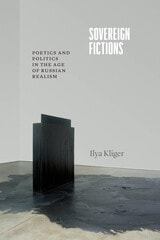
Sovereign Fictions
Poetics and Politics in the Age of Russian RealismIlya Kliger
University of Chicago Press, 2024
The nineteenth-century novel is generally assumed to owe its basic social imaginaries to the ideologies, institutions, and practices of modern civil society. In Sovereign Fictions, Ilya Kliger asks what happens to the novel when its fundamental sociohistorical orientation is, as in the case of Russian realism, toward the state. Kliger explores Russian realism’s distinctive construals of sociality through a broad range of texts from the 1830s to the 1870s, including major works by Tolstoy, Dostoevsky, Gogol, Pushkin, Lermontov, Goncharov, and Turgenev, and several lesser-known but influential books of the period, including Alexander Druzhinin’s Polinka Saks (1847), Aleksei Pisemsky’s One Thousand Souls (1858), and Vasily Sleptsov’s Hard Times (1865). Challenging much current scholarly consensus about the social dynamics of nineteenth-century realist fiction, Sovereign Fictions offers an important intervention in socially inflected theories of the novel and in current thinking on representations of power and historical poetics.
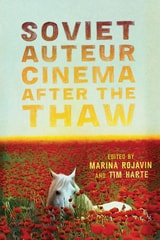
Soviet Auteur Cinema After the Thaw
Edited by Marina Rojavin and Tim Harte
University of Wisconsin Press, 2027
Following Stalin’s death, Soviet film—like Soviet culture—changed in meaningful ways. Emerging from a system that had stymied individual, creative voices, prominent directors now found their own respective styles, as they embraced their personal visions to produce works that diverged significantly from the mainstream. Grounded in auteur theory, this volume explores how these filmmakers expressed themselves through creative cinematic means rather than through a narrow emphasis on narrative or in accordance with popular—and governmental—whims.
Each chapter focuses on a specific filmmaker, from well-known auteurs Aleksei German Sr., Kira Muratova, Andrei Tarkovsky, Sergei Parajanov, and Larisa Shepit’ko, to others less familiar in the West: Sergei Solovyov, Roman Balayan, Otar Iosseliani, Tengiz Aduladze, and Ali Khamraev. Hailing from a range of Soviet republics, they all impacted the Soviet cinematic sphere despite harsh censorship and the repression of artists throughout the nation. By integrating cinematic and theoretical perspectives into a discussion of auteur Soviet films, this volume illuminates the significance of a cinematic trend that took place in both Soviet culture and international film history.
Contributors: Robert Efird, Tim Harte, Lilya Kaganovsky, David Gomiero Molina, Lida Oukaderova, Elizabeth A. Papazian, Marina Rojavin, Rita Safariants, Sydney Stotter, Sergey Toymentsev
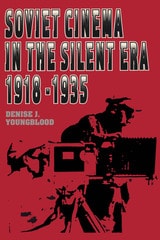
Soviet Cinema in the Silent Era, 1918–1935
By Denise J. Youngblood
University of Texas Press, 1991
The golden age of Soviet cinema, in the years following the Russian Revolution, was a time of both achievement and contradiction, as reflected in the films of Eisenstein, Pudovkin, and Kuleshov. Tensions ran high between creative freedom and institutional constraint, radical and reactionary impulses, popular and intellectual cinema, and film as social propaganda and as personal artistic expression. In less than a decade, the creative ferment ended, subjugated by the ideological forces that accompanied the rise of Joseph Stalin and the imposition of the doctrine of Socialist Realism on all the arts.
Soviet Cinema in the Silent Era, 1918–1935 records this lost golden age. Denise Youngblood considers the social, economic, and industrial factors that influenced the work of both lesser-known and celebrated directors. She reviews all major and many minor films of the period, as well as contemporary film criticism from Soviet film journals and trade magazines. Above all, she captures Soviet film in a role it never regained—that of dynamic artform of the proletarian masses.
Soviet Jewry in the 1980s
The Politics of Anti-Semitism and Emigration and the Dynamics of ResettlementRobert O. Freedman, ed.
Duke University Press, 1989
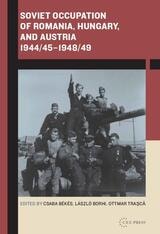
Soviet Occupation of Romania, Hungary, and Austria 1944/45–1948/49
László Borhi
Central European University Press, 2015
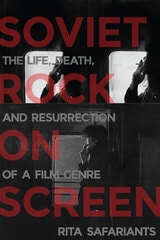
Soviet Rock on Screen
The Life, Death, and Resurrection of a Film GenreRita Safariants
University of Wisconsin Press, 2026
In Soviet Rock on Screen, Rita Safariants chronicles the birth, life, death, and resurrection of a genre that rapidly became one of the most readily recognized cultural signifiers of the perestroika era and which continues to reflect and codify Russian culture. During their initial heyday in the 1980s, rock films were influenced by and encouraged the cultural shifts of perestroika and the incipient political storm. Today, Safariants argues, the reemergence and reconfiguration of the genre indicates the extent to which Soviet-era cultural emblems inform Russian national identity and obliquely support the current political repression under Putin.
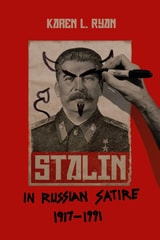
Stalin in Russian Satire, 1917–1991
Karen L. Ryan
University of Wisconsin Press, 2009
Examining works from the 1917 Revolution to the fall of the Soviet Union in 1991, Karen L. Ryan reveals how satirical treatments of Stalin often emphasize his otherness, distancing him from Russian culture. Some satirists portray Stalin as a madman. Others show him as feminized, animal-like, monstrous, or diabolical. Stalin has also appeared as the unquiet dead, a spirit that keeps returning to haunt the collective memory of the nation. While many writers seem anxious to exorcise Stalin from the body politic, for others he illuminates the self in disturbing ways. To what degree Stalin was and is “in us” is a central question of all these works. Although less visible than public trials, policy shifts, or statements of apology, Russian satire has subtly yet insistently participated in the protracted process of de-Stalinization.
Stalin
An Unknown PortraitMiklós Kun
Central European University Press, 2003
State-building
A Comparative Study of Ukraine, Lithuania, Belarus, and RussiaVerena Fritz
Central European University Press, 2007
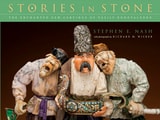
Stories in Stone
The Enchanted Gem Carvings of Vasily KonovalenkoStephen E. Nash
University Press of Colorado, 2016
Part art catalogue and part life history, Stories in Stone tells the tale of Konovalenko’s impressive works, explaining their conception, creation, and symbolism. Each handcrafted figure depicts a scene from life in the Soviet Union—a bowman hunting snow geese, a woman reposing in a hot spring surrounded by ice, peasants spinning wool, a pair of gulag prisoners sawing lumber—painstakingly rendered in precious stones and metals. The materials used to make the figurines are worth millions of dollars, but as cultural artifacts, the sculptures are priceless. Author Stephen Nash draws upon oral history and archival research to detail the life of their creator, revealing a rags-to-riches and life-imitates-art narrative full of Cold War intrigue, Communist persecution, and capitalist exploitation.
Augmented by Richard M. Wicker’s exquisite and revelatory photographs of sixty-five Konovalenko sculptures from museums, state agencies, and private collections around the world, Stories in Stone is a visually stunning glimpse into a unique corner of Russian art and cultural history, the craft and science of gem carving, and the life of a Russian artist and immigrant who loved people everywhere.
Co-published with the Denver Museum of Nature & Science, home to the most significant collection of Russian gem-carving sculptures by Vasily Konovalenko in the world.
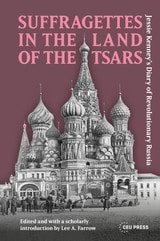
Suffragettes in the Land of the Tsars
Jessie Kenney’s Diary of Revolutionary RussiaLee Farrow
Central European University Press, 2026

Surge to Freedom
The End of Communist Rule in Eastern EuropeJ. F. Brown
Duke University Press, 1991
"Nobody has yet produced a more perceptive and inclusive work on the events of what is arguably the most important year of our lifetimes. This book is essential for anyone with an interest in Eastern Europe, radical social change, or post-bipolar global politics."—Joel M. Jenswold, Social Science Quarterly
"Brown has been a close observer of the region for decades, and the breadth of his knowledge and the acuity of his judgments are evident throughout."—Michael Bernhard, Political Science Quarterly
"There is no surer guide than Brown to an understanding of these events, and no one better qualified to describe the complex and daunting problems facing the new non-communist governments."—John C. Campbell, Foreign Affairs