Results by title
59 books match the query 'San Francisco' and 7 start with s

Safe Space
Gay Neighborhood History and the Politics of ViolenceChristina B. Hanhardt
Duke University Press, 2013
Since the 1970s, a key goal of lesbian and gay activists has been protection against street violence, especially in gay neighborhoods. During the same time, policymakers and private developers declared the containment of urban violence to be a top priority. In this important book, Christina B. Hanhardt examines how LGBT calls for "safe space" have been shaped by broader public safety initiatives that have sought solutions in policing and privatization and have had devastating effects along race and class lines.
Drawing on extensive archival and ethnographic research in New York City and San Francisco, Hanhardt traces the entwined histories of LGBT activism, urban development, and U.S. policy in relation to poverty and crime over the past fifty years. She highlights the formation of a mainstream LGBT movement, as well as the very different trajectories followed by radical LGBT and queer grassroots organizations. Placing LGBT activism in the context of shifting liberal and neoliberal policies, Safe Space is a groundbreaking exploration of the contradictory legacies of the LGBT struggle for safety in the city.
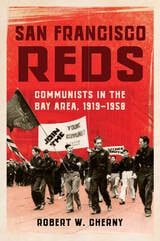
San Francisco Reds
Communists in the Bay Area, 1919-1958Robert W. Cherny
University of Illinois Press, 2024
Founded in 1919, the Communist Party (CP) in San Francisco survived an ineffectual early period to become a force in the trade union heyday of the 1930s. Robert Cherny uses the lives and careers of more than fifty members to tell the story of the city’s CP from its founding through 1958.
Cherny draws on FBI files, the records of the CP at the Russian State Archive for Social and Political History, interviews, and memoirs to follow male and female party and union leaders, rank-and-file members, and others. His history reveals why people joined the CP while charting the frequent changes in policy, constant member turnover, and disruptive factionalism that limited party aims and successes. Cherny also follows his subjects through their resignations, expulsions, or other reasons for departure and looks at the CP’s influence on their lives in subsequent years.
Vivid and exhaustively researched, San Francisco Reds is a long view account of the personal motivations and activism of an Old Left generation in a West Coast city.
San Francisco's International Hotel
Mobilizing the Filipino American Community in the Anti-Eviction MovementEstella Habal
Temple University Press, 2008

San Francisco, 1846-1856
From Hamlet to CityRoger W. Lotchin
University of Illinois Press, 1997
Now back in print with a new introduction by the author, this is the classic study of America's most admired instant city, from its days as a sleepy Mexican village, through the Gold Rush and into its establishment as a major international port. Roger Lotchin examines the urbanizing influences in San Francisco and compares these to other urban centers, doing so against a colorful backdrop of opium dens and other sinful institutions.
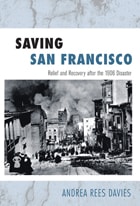
Saving San Francisco
Relief and Recovery after the 1906 DisasterAndrea Rees Davies
Temple University Press, 2011
Combining the experiences of ordinary people with urban politics and history, Saving San Francisco challenges the long-lived myth that the 1906 disaster erased social differences as it leveled the city. Highlighting new evidence from San Francisco’s relief camps, Andrea Rees Davies shows that as policy makers directed various forms of aid to groups and projects that enjoyed high social status before the disaster, the widespread need and dislocation created opportunities for some groups to challenge biased relief policy. Poor and working-class refugees organized successful protests, while Chinatown business leaders and middle-class white women mobilized resources for the less privileged. Ultimately, however, the political and financial elite shaped relief and reconstruction efforts and cemented social differences in San Francisco.
Silicon Valley Imperialism
Techno Fantasies and Frictions in Postsocialist TimesErin McElroy
Duke University Press, 2024
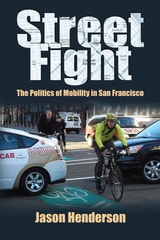
Street Fight
The Politics of Mobility in San FranciscoJason Henderson
University of Massachusetts Press, 2013
Faced with intolerable congestion and noxious pollution, cities around the world are rethinking their reliance on automobiles. In the United States a loosely organized livability movement seeks to reduce car use by reconfiguring urban space into denser, transit-oriented, walkable forms, a development pattern also associated with smart growth and new urbanism. Through a detailed case study of San Francisco, Jason Henderson examines how this is not just a struggle over what type of transportation is best for the city, but a series of ideologically charged political fights over issues of street space, public policy, and social justice.
Historically San Francisco has hosted many activist demonstrations over its streets, from the freeway revolts of the 1960s to the first Critical Mass bicycle rides decades later. Today the city's planning and advocacy establishment is changing zoning laws to limit the number of parking spaces, encouraging new car-free housing near transit stations, and applying “transit first” policies, such as restricted bus lanes. Yet Henderson warns that the city's accomplishments should not be romanticized. Despite significant gains by livability advocates, automobiles continue to dominate the streets, and the city's financially strained bus system is slow and often unreliable.
Both optimistic and cautionary, Henderson argues that ideology must be understood as part of the struggle for sustainable cities and that three competing points of view—progressive, neoliberal, and conservative—have come to dominate the contemporary discourse about urban mobility. Consistent with its iconic role as an incubator of environmental, labor, civil rights, and peace movements, San Francisco offers a compelling example of how the debate over sustainable urban transportation may unfold both in the United States and globally.