Results by title
169 books match the query 'Shakespeare, William' and 50 start with s
Sacred and Secular Transactions in the Age of Shakespeare
Edited by Katherine Steele Brokaw and Jay Zysk
Northwestern University Press, 2019
The term “secular” inspires thinking about disenchantment, periodization, modernity, and subjectivity. The essays in Sacred and Secular Transactions in the Age of Shakespeare argue that Shakespeare’s plays present “secularization” not only as a historical narrative of progress but also as a hermeneutic process that unleashes complex and often problematic transactions between sacred and secular. These transactions shape ideas about everything from pastoral government and performative language to wonder and the spatial imagination.
Thinking about Shakespeare and secularization also involves thinking about how to interpret history and temporality in the contexts of Shakespeare’s medieval past, the religious reformations of the sixteenth century, and the critical dispositions that define Shakespeare studies today. These essays reject a necessary opposition between “sacred” and “secular” and instead analyze how such categories intersect. In fresh analyses of plays ranging from Hamlet and The Tempest to All’s Well that Ends Well and All Is True, secularization emerges as an interpretive act that explores the cultural protocols of representation within both Shakespeare’s plays and the critical domains in which they are studied and taught.
The volume’s diverse disciplinary perspectives and theoretical approaches shift our focus from literal religion and doctrinal issues to such aspects of early modern culture as theatrical performance, geography, race, architecture, music, and the visual arts.
Shakespeare & Violence Prevention
A Practical Handbook for EducatorsAmanda Giguere
University of Wyoming Press, 2025
Framed by examples from Giguere’s work with the Shakespeare & Violence Prevention program, an interdisciplinary outreach project for K–12 schools developed at the University of Colorado Boulder, the text offers helpful entry points, digestible research, and practical exercises to align a violence-prevention curriculum with Shakespeare’s plays. It provides a condensed overview of key findings from violence prevention, clear synopses of the plays, and practicable strategies to implement the program. Guided by firsthand experience with a tried-and-true school program that reaches thousands of K–12 students annually, Giguere shares the Colorado Shakespeare Festival method, which focuses on “upstander” roleplays to practice violence-prevention strategies. Using a clear distillation of Shakespeare studies and violence-prevention research, she shows how the two fields naturally reinforce the concepts of teamwork, empathy, change, and hope.
Shakespeare and Violence Prevention is a new spin on these classic texts that empowers teachers and community leaders to use these tools to create research-guided university engagement programs, theatre company outreach programs, and K–12 student engagement with Shakespeare, even for those without expertise in violence prevention or Shakespeare.
Shakespeare Behind Bars
One Teacher's Story of the Power of Drama in a Women's PrisonJean Trounstine
University of Michigan Press, 2004
Originally published in cloth in 2001, the paperback includes a new foreword that will inspire all teachers who work with students others have deemed unteachable. A new afterword updates readers on the prison art's program -- and the author herself -- since 2001.
Shakespeare Dwelling
Designs for the Theater of LifeJulia Reinhard Lupton
University of Chicago Press, 2018
Focusing on five works (Romeo and Juliet, Macbeth, Pericles, Cymbeline, and The Winter’s Tale), Lupton remakes the concept of dwelling by drawing on a variety of sources, including modern design theory, Renaissance treatises on husbandry and housekeeping, and the philosophies of Hannah Arendt and Martin Heidegger. The resulting synthesis not only offers a new entry point into the contemporary study of environments; it also shows how Shakespeare’s works help us continue to make sense of our primal creaturely need for shelter.
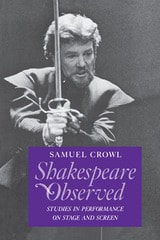
Shakespeare Observed
Studies in Performance on Stage and ScreenSamuel Crowl
Ohio University Press, 1993
Crowl’s study demonstrates the surprising resonances between Roman Polanski's 1971 film of Macbeth and Adrian Noble's heralded recent production of the play for The Royal Shakespeare Company; argues that Orson Welles's films of Othello and Cabins at Midnight are not only brilliant remaining of Shakespeare in another art form but make a powerful contribution to our contemporary understanding of performance as interpretation; and chronicles the impact of Peter Hall's creation of the Royal Shakespeare Company in 1960 on performance approaches to Shakespeare in the past thirty years.
Shakespeare Observed provides full interpretative readings of key recent Shakespeare productions in England and includes an intimate behind-the-scenes glimpse into the rehearsal process which produced Ron Daniels's emotionally charged version of Romeo and Juliet for the RSC in 1980. The final chapter uses Kenneth Branagh's highly successful film of Henry V as a summary example of the trends and influences Crowl's study traces, seeing the film as gathering its interpretative energies from both Olivier's famous film version of the play and Adrian Noble's stage production featuring Branagh as the king.
Written in a style which places a premium on capturing the vivid and often dazzling moments of stage and film performances of Shakespeare, Crowl's study will be of interest to the avid film and theatergoer as well as to the scholar and student. Shakespeare Observed joins a growing list of recent critical works which have significantly expanded and redefined the boundaries of Shakespeare studies in our time.
Shakespeare Only
Jeffrey Knapp
University of Chicago Press, 2009

Shakespeare Valued
Education Policy and Pedagogy 1989-2009Sarah Olive
Intellect Books, 2015
Shakespeare and Chekhov in Production and Reception
Theatrical Events and Their AudiencesTulloch, John
University of Iowa Press, 2005
With a focus on the canonical institutions of Shakespeare and Chekhov, John Tulloch brings together for the first time new concepts of “the theatrical event” with live audience analysis. Using mainstream theatre productions from across the globe that were highly successful according to both critics and audiences, this book of case studies—ethnographies of production and reception—offers a combined cultural and media studies approach to analyzing theatre history, production, and audience.
Tulloch positions these concepts and methodologies within a broader current theatrical debate between postmodernity and risk modernity. He also describes the continuing history of Shakespeare and Chekhov as a series of stories “currently and locally told” in the context of a blurring of academic genres that frames the two writers. Drawn from research conducted over nearly a decade in Australia, Britain, and the U.S., Shakespeare and Chekhov in Production and Reception will be of interest to students and scholars of theatre studies, media studies, and audience research.

Shakespeare and Trump
Jeffrey R. Wilson
Temple University Press, 2020
Should we draw an analogy between Shakespeare’s tyrants—Richard III, Julius Caesar, Macbeth, and King Lear—and Donald Trump? In Shakespeare and Trump, Jeffrey Wilson applies literary criticism to real life, examining plot, character, villainy, soliloquy, tragedy, myth, and metaphor to identify the formal features of the Trump phenomenon, and its hidden causes, structure, and meanings.
Wilsonapproaches his comparison prismatically. He first considers two high-concept (read: far-fetched) Shakespeare adaptations penned by Trump’s former chief political strategist Steve Bannon. He looks at University of Pennsylvania students protesting Trump by taking down a monument to Shakespeare. He reads Trump’s first 100 days in office against Netflix’s House of Cards. Wilson also addresses the summer 2017 Shakespeare in the Park production of Julius Caesar wherein an assassination of a Trump-ian leader caused corporations to withdraw sponsorship.
These stories reveal a surprising—and bizarre—relationship between the provincial English playwright and the billionaire President of the United States, ostensibly a medieval king living in a modern world. The comparison reveals a politics that blends villainy and comedy en route to tragedy.

Shakespeare and the Denial of Death
James Calderwood
University of Massachusetts Press, 1987
Shakespeare and the French Poet
Yves Bonnefoy
University of Chicago Press, 2004
Translated specifically for an American readership, Shakespeare and the French Poet also features a new interview with Bonnefoy. For Shakespeare scholars, Bonnefoy enthusiasts, and students of literary translation, Shakespeare and the French Poet is a celebration of the global language of poetry and the art of "making someone else's voice live again in one's own."
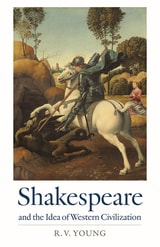
Shakespeare and the Idea of Western Civilization
R.V. Young
Catholic University of America Press, 2022
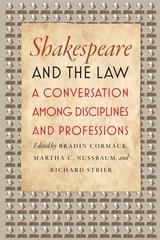
Shakespeare and the Law
A Conversation among Disciplines and ProfessionsEdited by Bradin Cormack, Martha C. Nussbaum, and Richard Strier
University of Chicago Press, 2013
The book’s opening essays offer perspectives on law and literature that emphasize both the continuities and contrasts between the two fields. The second section considers Shakespeare’s awareness of common law thinking and common law practice, while the third inquires into Shakespeare’s general attitudes toward legal systems. The fourth part of the book looks at how law enters into conversation with issues of politics and community, whether in the plays, in Shakespeare’s world, or in our own world. Finally, a colloquy among Supreme Court Justice Stephen Breyer, Judge Richard Posner, Martha C. Nussbaum, and Richard Strier covers everything from the ghost in Hamlet to the nature of judicial discretion.
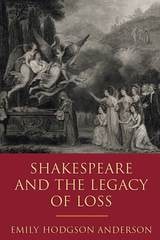
Shakespeare and the Legacy of Loss
Emily Hodgson Anderson
University of Michigan Press, 2018
How do we recapture, or hold on to, the live performances we most love, and the talented artists and performers we most revere? Shakespeare and the Legacy of Loss tells the story of how 18th-century actors, novelists, and artists, key among them David Garrick, struggled with these questions through their reenactments of Shakespearean plays. For these artists, the resurgence of Shakespeare, a playwright whose works just decades earlier had nearly been erased, represented their own chance for eternal life. Despite the ephemeral nature of performance, Garrick and company would find a way to make Shakespeare, and through him the actor, rise again.
In chapters featuring Othello, Richard III, Hamlet, The Winter’s Tale, and The Merchant of Venice, Emily Hodgson Anderson illuminates how Garrick’s performances of Shakespeare came to offer his contemporaries an alternative and even an antidote to the commemoration associated with the monument, the portrait, and the printed text. The first account to read 18th-century visual and textual references to Shakespeare alongside the performance history of his plays, this innovative study sheds new light on how we experience performance, and why we gravitate toward an art, and artists, we know will disappear.
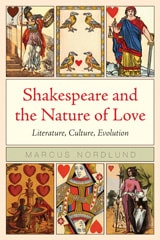
Shakespeare and the Nature of Love
Literature, Culture, EvolutionMarcus Nordlund
Northwestern University Press, 2007
After addressing critical issues about love, biology, and culture raised by his method, Nordlund considers four specific forms of love in seven of Shakespeare’s plays. Examining the vicissitudes of parental love in Titus Andronicus and Coriolanus, he argues that Shakespeare makes a sustained inquiry into the impact of culture and society upon the natural human affections. King Lear offers insight into the conflicted relationship between love and duty. In two problem plays about romantic love, Troilus and Cressida and All’s Well that Ends Well, the tension between individual idiosyncrasies and social consensus becomes especially salient. And finally, in Othello and The Winter’s Tale, Nordlund asks what Shakespeare can tell us about the dark avatar of jealousy.
Shakespeare and the Problem of Meaning
Norman Rabkin
University of Chicago Press, 1981
"Norman Rabkin's new book is a very different kind of good book. Elegantly spare, sharp, undogmatic. . . . The relationship between the perception of unity and the perception of artistic achievement is a basic conundrum, and it is one that Mr. Rabkin has courageously placed at the center of his discussion." –G. K. Hunter, Sewanee Review
"Rabkin's book is brilliant, taut, concise, beautifully argued, and sensitively responsive to the individuality of particular Shakespeare plays." –Anne Barton, New York Review of Books
Shakespeare and the Senses
Holly E. Dugan
Arizona Center for Medieval and Renaissance Studies, 2024
Could something as seemingly natural as a smell, taste, sight, or sound be socially constructed and change over time? Shakespeare and the Senses argues that understanding the original conditions in which Shakespeare’s plays were performed allows us to explore the senses as both visceral, bodily experiences and constructed, social phenomena. As Ben Jonson famously wrote in the First Folio of 1623, Shakespeare can seem to be “not of an age, but for all time.” While this is clever marketing, Shakespeare did write his plays in a particular time and place far removed from our own. Many of his most powerful metaphors rely on sensory details—Aaron’s black hue; Cleopatra’s strange, invisible perfumes; Fluellen’s Welsh accent; Lady Macbeth’s overly scrubbed hands; Malvolio’s yellow stockings—which Elizabethan-era audiences may have understood very differently from us.
Shakespeare and the Senses draws on interdisciplinary research methods in the new field of sensory studies to expand our understanding of what Shakespeare meant to his first audiences.

Shakespeare at the Cineplex
The Kenneth Branagh EraSamuel Crowl
Ohio University Press, 2005
Samuel Crowl’s Shakespeare at the Cineplex: The Kenneth Branagh Era is the first thorough exploration of the fifteen major Shakespeare films released since the surprising success of Kenneth Branagh’s Henry V (1989). Crowl presents the rich variety of these films in the “long decade: between the fall of the Berlin Wall and the terrorist attacks on September 11, 2001.” The productions range from Hollywood-saturated films such as Franco Zeffirelli’s Hamlet and Michael Hoffman’s A Midsummer Night’s Dream to more modest, experimental offerings, such as Christine Edzard’s As You Like It. Now available in paperback, Shakespeare at the Cineplex will be welcome reading for fans, students, and scholars of Shakespeare in performance.
Shakespeare from the Margins
Language, Culture, ContextPatricia Parker
University of Chicago Press, 1996
Combining feminist and historical approaches with attention to the "matter" of language as well as of race and gender, Parker's brilliant "edification from the margins" illuminates much that has been overlooked, both in Shakespeare and in early modern culture. This book, a reexamination of popular and less familiar texts, will be indispensable to all students of Shakespeare and the early modern period.
Shakespeare in Kabul
Stephen Landrigan and Qais Akbar Omar
Haus Publishing, 2012
Shakespeare in Theory
The Postmodern Academy and the Early Modern TheaterStephen Bretzius
University of Michigan Press, 1997
Shakespeare on Love and Friendship
Allan Bloom
University of Chicago Press, 2000
This volume includes essays on five plays, Romeo and Juliet, Anthony and Cleopatra, Measure for Measure, Troilus and Cressida, and The Winter's Tale, and within these Bloom meditates on Shakespeare's work as a whole. He also draws on his formidable knowledge of Plato, Rousseau, and others to bring both ancients and moderns into the conversation. The result is a truly synoptic treatment of eros—not only a philosophical reflection on Shakespeare, but a survey of the human spirit and its tendency to seek what Bloom calls the "connectedness" of love and friendship.
These highly original interpretations of the plays convey a deep respect for their author and a deep conviction that we still have much to learn from him. In Bloom's view, we live in a love-impoverished age; he asks us to turn once more to Shakespeare because the playwright gives us a rich version of what is permanent in human nature without sharing our contemporary assumptions about erotic love.
"Provocative and illuminating." —Michiko Kakutani, New York Times
"A brilliant analysis of the erotic ugliness and the balancing erotic grace of The Winter's Tale . . . and Bloom makes more sense of [Measure for Measure] than anyone else I have read." —A. S. Byatt, Washington Post Book World
At his death in 1992, Allan Bloom was the John U. Nef Distinguished Service Professor in the Committee on Social Thought at the University of Chicago. He is the author of several books, including Shakespeare's Politics (with Harry V. Jaffa) and The Closing of the American Mind.
Shakespeare on the American Yiddish Stage
Joel Berkowitz
University of Iowa Press, 2002
The professional Yiddish theatre started in 1876 in Eastern Europe; with the assassination of Tsar Alexander II in 1881, masses of Eastern European Jews began moving westward, and New York—Manhattan’s Bowery and Second Avenue—soon became the world’s center of Yiddish theatre. At first the Yiddish repertoire revolved around comedies, operettas, and melodramas, but by the early 1890s America's Yiddish actors were wild about Shakespeare. In Shakespeare on the American Yiddish Stage, Joel Berkowitz knowledgeably and intelligently constructs the history of this unique theatrical culture.
The Jewish King Lear of 1892 was a sensation. The year 1893 saw the beginning of a bevy of Yiddish versions of Hamlet; that year also saw the first Yiddish production of Othello. Romeo and Juliet inspired a wide variety of treatments. The Merchant of Venice was the first Shakespeare play published in Yiddish, and Jacob Adler received rave reviews as Shylock on Broadway in both 1903 and 1905. Berkowitz focuses on these five plays in his five chapters. His introduction provides an orientation to the Yiddish theatre district in New York as well as the larger picture of Shakespearean production and the American theatre scene, and his conclusion summarizes the significance of Shakespeare’s plays in Yiddish culture.
Shakespeare the Actor and the Purposes of Playing
Meredith Anne Skura
University of Chicago Press, 1993
Despite the obvious differences between our theater and Shakespeare's, sixteenth-century testimony suggests that the experience of acting has not changed much over the centuries. Beginning with a psychoanalytically informed account of acting today, Skura shows how this intense and ambivalent experience appears not only in literal references to acting in Shakespearean drama but also in recurring narrative concerns, details of language, and dramatic strategies used to engage the audience. Looking at the plays in the context of both public and private worlds outside the theater, Skura rereads the canon to identify new configurations in the plays and new ways of understanding theatrical self-consciousness in Renaissance England. Rich in theatrical, psychoanalytic, biographical, and historical insight, this book will be invaluable to students of Shakespeare and instructive to all readers interested in the dynamics of performance.
Shakespeare the Illusionist
Magic, Dreams, and the Supernatural on FilmNeil Forsyth
Ohio University Press, 2019
In Shakespeare the Illusionist, Neil Forsyth reviews the history of Shakespeare’s plays on film, using the basic distinction in film tradition between what is owed to Méliès and what to the Lumière brothers. He then tightens his focus on those plays that include some explicit magical or supernatural elements—Puck and the fairies, ghosts and witches, or Prospero’s island, for example—and sets out methodically, but with an easy touch, to review all the films that have adapted those comedies and dramas, into the present day.
Forsyth’s aim is not to offer yet another answer as to whether Shakespeare would have written for the screen if he were alive today, but rather to assess what various filmmakers and TV directors have in fact made of the spells, haunts, and apparitions in his plays. From analyzing early camera tricks to assessing contemporary handling of the supernatural, Forsyth reads Shakespeare films for how they use the techniques of moviemaking to address questions of illusion and dramatic influence. In doing so, he presents a bold step forward in Shakespeare and film studies, and his fresh take is presented in lively, accessible language that makes the book ideal for classroom use.
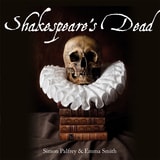
Shakespeare's Dead
Stages of Death in Shakespeare's PlayworldsSimon Palfrey and Emma Smith
Bodleian Library Publishing, 2016
Published to accompany a major exhibition at the Bodleian Library, University of Oxford, Shakespeare’s Dead documents the many ways Shakespeare’s characters meet their demise, from suicide to murder, from death by workaday dagger to the more creative method of being baked and fed to one’s family in a meat pie. Through these examples, Simon Palfrey and Emma Smith show Shakespeare’s mastery at choreographing death as a means of rediscovery. Some characters refuse to go quietly, dying in stages, as in Nick Bottom’s performance as Pyramus killing himself with much flourish in A Midsummer Night’s Dream. Others are remembered in elegies, and still others are resurrected or reappear as ghosts. Shakespeare’s death scenes also often speak to the boundaries between theater and everyday life, with funerals and scenes of mourning that are undercut by their staged inauthenticity.
Extensively illustrated with contemporary drawings and images from stage history, Shakespeare’s Dead takes readers through the playwright’s great death scenes and tragic figures, exploring in them the theme of life in death and delineating the cultural, religious, and social contexts.
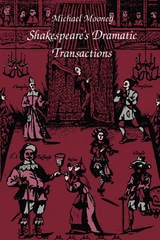
Shakespeare's Dramatic Transactions
Michael Mooney
Duke University Press, 1990
Michael Mooney draws on the work of East German critic Robert Weimann and his concept of figurenposition—the correlation between an actor’s stage location and the speech, action, and stylization associated with that position—to understand the actor/stage location relationship in Shakespeare’s plays. In his examination of the original staging of Shakespeare’s tragedies, Mooney looks at the traditional interplay between a downstage “place” and upstage “location” to describe the difference between non-illusionistic action (often staged near the audience) and the illusionistic, localized action that characterizes mimetic art.
The innovative and insightful approach of Shakespeare’s Dramatic Transactions brings together the techniques of performance criticism and the traditional literary study of Shakespearean tragedy. In showing how the distinctions of stage location illuminate the interaction among language, representation, Mooney’s compelling argument enhances our understanding of Shakespeare and the theater.
Shakespeare's Freedom
Stephen Greenblatt
University of Chicago Press, 2010
Shakespeare lived in a world of absolutes—of claims for the absolute authority of scripture, monarch, and God, and the authority of fathers over wives and children, the old over the young, and the gentle over the baseborn. With the elegance and verve for which he is well known, Stephen Greenblatt, author of the best-selling Will in the World, shows that Shakespeare was strikingly averse to such absolutes and constantly probed the possibility of freedom from them. Again and again, Shakespeare confounds the designs and pretensions of kings, generals, and churchmen. His aversion to absolutes even leads him to probe the exalted and seemingly limitless passions of his lovers.
Greenblatt explores this rich theme by addressing four of Shakespeare’s preoccupations across all the genres in which he worked. He first considers the idea of beauty in Shakespeare’s works, specifically his challenge to the cult of featureless perfection and his interest in distinguishing marks. He then turns to Shakespeare’s interest in murderous hatred, most famously embodied in Shylock but seen also in the character Bernardine in Measure for Measure. Next Greenblatt considers the idea of Shakespearean authority—that is, Shakespeare’s deep sense of the ethical ambiguity of power, including his own. Ultimately, Greenblatt takes up Shakespearean autonomy, in particular the freedom of artists, guided by distinctive forms of perception, to live by their own laws and to claim that their creations are singularly unconstrained.
A book that could only have been written by Stephen Greenblatt, Shakespeare’s Freedom is a wholly original and eloquent meditation by the most acclaimed and influential Shakespearean of our time.
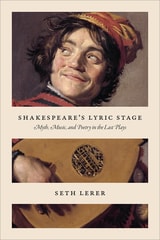
Shakespeare's Lyric Stage
Myth, Music, and Poetry in the Last PlaysSeth Lerer
University of Chicago Press, 2018
As Seth Lerer shows in this pioneering book, Shakespeare’s late plays invite us to contemplate that very question, offering up lyric as a displaced and sometimes desperate antidote to situations of duress or powerlessness. Lerer argues that the theme of lyric misalignment running throughout The Tempest, The Winter’s Tale, Henry VIII, and Cymbeline serves a political purpose, a last-ditch effort at transformation for characters and audiences who had lived through witch-hunting, plague, regime change, political conspiracies, and public executions.
A deep dive into the relationship between aesthetics and politics, this book also explores what Shakespearean lyric is able to recuperate for these “victims of history” by virtue of its disjointed utterances. To this end, Lerer establishes the concept of mythic lyricism: an estranging use of songs and poetry that functions to recreate the past as present, to empower the mythic dead, and to restore a bit of magic to the commonplaces and commodities of Jacobean England. Reading against the devotion to form and prosody common in Shakespeare scholarship, Lerer’s account of lyric utterance’s vexed role in his late works offers new ways to understand generational distance and cultural change throughout the playwright’s oeuvre.
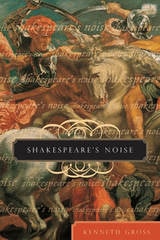
Shakespeare's Noise
Kenneth Gross
University of Chicago Press, 2001
Kenneth Gross explores Shakespeare's deep fascination with dangerous and disorderly forms of speaking—especially rumor, slander, insult, vituperation, and curse—and through them offers a vision of the work of words in his plays. Coriolanus's taunts or Lear's curses force us to think not just about how Shakespeare's characters speak, but also about how they hear, overhear, and mishear what is spoken, how rumor becomes tragic knowledge for Hamlet, or opens Othello to fantastic jealousies. Gross also shows how Shakespeare's preoccupation with "noisy" speech echoed and transformed a broader cultural obsession with the perils of rumor, slander, and libel in Renaissance England.
Elegantly written and passionately argued, Shakespeare's Noise will challenge and delight anyone who loves his plays, from scholars to general readers, actors, and directors.
Shakespeare's Once and Future Child
Speculations on SovereigntyJoseph Campana
University of Chicago Press, 2024
Politicians are fond of saying that “children are the future.” How did the child become a figure for our political hopes? Joseph Campana’s book locates the source of this idea in transformations of childhood and political sovereignty during the age of Shakespeare, changes spectacularly dramatized by the playwright himself. Shakespeare’s works feature far more child figures—and more politically entangled children—than other literary or theatrical works of the era. Campana delves into this rich corpus to show how children and childhood expose assumptions about the shape of an ideal polity, the nature of citizenship, the growing importance of population and demographics, and the question of what is or is not human. As our ability to imagine viable futures on our planet feels ever more limited, and as children take up legal proceedings to sue on behalf of the future, it behooves us to understand the way past child figures haunt our conversations about intergenerational justice. Shakespeare offers critical precedents for questions we still struggle to answer.
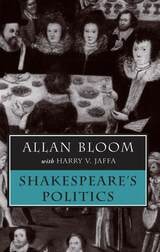
Shakespeare's Politics
Allan Bloom
University of Chicago Press, 1981
In essays looking at Julius Caesar, Othello, and The Merchant of Venice, Bloom shows how Shakespeare presents a picture of man that does not assume privileged access for only literary criticism. With this claim, he argues that political philosophy offers a comprehensive framework within which the problems of the Shakespearean heroes can be viewed. In short, he argues that Shakespeare was an eminently political author. Also included is an essay by Harry V. Jaffa on the limits of politics in King Lear.
"A very good book indeed . . . one which can be recommended to all who are interested in Shakespeare." —G. P. V. Akrigg
"This series of essays reminded me of the scope and depth of Shakespeare's original vision. One is left with the impression that Shakespeare really had figured out the answers to some important questions many of us no longer even know to ask."-Peter A. Thiel, CEO, PayPal, Wall Street Journal
Allan Bloom was the John U. Nef Distinguished Service Professor on the Committee on Social Thought and the co-director of the John M. Olin Center for Inquiry into the Theory and Practice of Democracy at the University of Chicago. Harry V. Jaffa is professor emeritus at Claremont McKenna College and Claremont Graduate School.
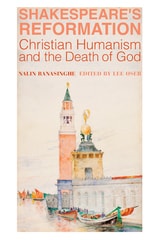
Shakespeare's Reformation
Christian Humanism and the Death of GodNalin Ranasinghe
St. Augustine's Press, 2022
"I will try to claim that Shakespeare offers an esoteric vindication of the human soul itself, not merely poetry, against the looming backdrop of the Counter-Reformation in Europe and the Puritan perversion of English Anglicanism. Neither the Scholasticism of the former nor the fundamentalism of the latter had any sympathy for the claims of men like Bottom or the Bastard to see beyond the confines of scripture and sacred social structures. While poetry could indulge in metaphysical fantasy, it could not take on the status quo without the assistance of more learned allies; this Shakespeare seems to do by his re-telling of Classical and English history. As disingenuous as Bottom (or Erasmus) in this artful use of ignorance and folly to conceal his serious goals, Shakespeare is thus tying poetry to history and giving us an alternate, if playful, account of Western Civilization."
Shakespeare's Reparative Comedies
A Psychoanalytic View of the Middle AgesJoseph Westlund
University of Chicago Press, 1984
Shakespeare's Roman Trilogy
The Twilight of the Ancient WorldPaul A. Cantor
University of Chicago Press, 2017
Cantor analyzes the way Shakespeare chronicles the rise and fall of the Roman Republic and the emergence of the Roman Empire. The transformation of the ancient city into a cosmopolitan empire marks the end of the era of civic virtue in antiquity, but it also opens up new spiritual possibilities that Shakespeare correlates with the rise of Christianity and thus the first stirrings of the medieval and the modern worlds.
More broadly, Cantor places Shakespeare’s plays in a long tradition of philosophical speculation about Rome, with special emphasis on Machiavelli and Nietzsche, two thinkers who provide important clues on how to read Shakespeare’s works. In a pathbreaking chapter, he undertakes the first systematic comparison of Shakespeare and Nietzsche on Rome, exploring their central point of contention: Did Christianity corrupt the Roman Empire or was the corruption of the Empire the precondition of the rise of Christianity? Bringing Shakespeare into dialogue with other major thinkers about Rome, Shakespeare’s Roman Trilogy reveals the true profundity of the Roman Plays.
Shakespeare's Rome
Republic and EmpirePaul A. Cantor
University of Chicago Press, 2017
In Shakespeare’s Rome, Cantor examines the political settings of Shakespeare’s Roman plays, Coriolanus and Antony and Cleopatra, with references as well to Julius Caesar. Cantor shows that Shakespeare presents a convincing portrait of Rome in different eras of its history, contrasting the austere republic of Coriolanus, with its narrow horizons and martial virtues, and the cosmopolitan empire of Antony and Cleopatra, with its “immortal longings” and sophistication bordering on decadence.
Shakespeare's Tribe
Church, Nation, and Theater in Renaissance EnglandJeffrey Knapp
University of Chicago Press, 2004
To be sure, Renaissance playwrights rarely sermonized in their plays, which seemed preoccupied with sex, violence, and crime. During a time when acting was regarded as a kind of vice, many theater professionals used their apparent godlessness to advantage, claiming that it enabled them to save wayward souls the church could not otherwise reach. The stage, they argued, made possible an ecumenical ministry, which would help transform Reformation England into a more inclusive Christian society.
Drawing on a variety of little-known as well as celebrated plays, along with a host of other documents from the English Renaissance, Shakespeare's Tribe changes the way we think about Shakespeare and the culture that produced him.
Winner of the Best Book in Literature and Language from the Association of American Publishers' Professional/Scholarly division, the Conference on Christianity and Literature Book Award, and the Roland H. Bainton Prize for Literature from the Sixteenth Century Society and Conference.
Shakespeare, Brecht, and the Intercultural Sign
Antony Tatlow
Duke University Press, 2001
Reflecting on how, why, and to what effect knowledges and styles of performance pollinate across cultures, Tatlow demonstrates that the employment of one culture’s material in the context of another defamiliarizes the conventions of representation in an act that facilitates access to what previously had been culturally repressed. By reading the intercultural, Tatlow shows, we are able not only to historicize the effects of those repressions that create a social unconscious but also gain access to what might otherwise have remained invisible.
This remarkable study will interest students of cultural interaction and aesthetics, as well as readers interested in theater, Shakespeare, Brecht, China, and Japan.
Shakespearean Cultures
Latin America and the Challenges of Mimesis in Non-Hegemonic CircumstancesJoão Cezar de Castro Rocha
Michigan State University Press, 2019
Shakespearean Pragmatism
Market of His TimeLars Engle
University of Chicago Press, 1993
To Engle, the problems of worth, price, and value that appear so frequently in Shakespeare's works reveal a playwright dramatizing the negotiable nature of perception and belief—in short, the nature of his audience's purchase on reality. This innovative argument is the first to view Shakespeare in the context of contemporary pragmatism and to show that Shakespeare in many ways anticipated pragmatism as it has been developed in the thought of Richard Rorty, Barbara Herrnstein Smith, and others. With detailed reference to the sonnets and plays, Engle explores Shakespeare's tendency to treat knowledge, truth, and certainty as relatively stable goods within a theatrical economy of social interaction. He shows the playwright recasting kingship, aristocracy, and poetic immortality in pragmatic terms.
As attentive to history as it is to contemporary theory, this book mediates between current and traditional accounts of Shakespeare. In doing so, it offers a sweeping new account of Shakespeare's enterprise that will interest philosophers, literary theorists, and Shakespeare scholars alike.
Shakespearean Territories
Stuart Elden
University of Chicago Press, 2018
Shakespeare’s Hand
Jonathan Goldberg
University of Minnesota Press, 2002
A provocative exploration of the relationship between gender, history, and Shakespeare’s plays.
Over the past fifteen years, Jonathan Goldberg’s wide-ranging essays have been among the most sophisticated, influential, and controversial writing about Shakespeare. He challenges the critical orthodoxy, provoking scholars to reassess both their own assumptions and those underpinning the field of Shakespeare studies. Collected in one volume for the first time, these essays offer a sustained, energetic, and rigorous examination of issues of gender and sexuality that pervade Shakespeare’s plays, as well as a road map of the shifts during the past two decades in our understanding of English literature’s most canonical figure.
Central to these essays are concerns about textuality as considered from a number of vantage points, including deconstructionist, psychoanalytic, and historicist. Goldberg studies most of Shakespeare’s plays, giving particular emphasis to Henry IV, Parts 1 and 2, and to Romeo and Juliet; he focuses throughout on the relationship between the text as material object and the reality created or reflected by that text. Among the issues he considers are the textual instability of Shakespeare’s plays and the historical instabilities of gender and sexuality depicted in those plays, the construction of gender and the dehumanization implicit in treating characters as a textual production, the function of letters and other documents within the Shakespearean texts, and the correlation of sexual politics and textual desire. Tracing a path from characters in the scriptive sense to their embodiment in characters marked by gender and sexuality, Shakespeare's Hand provides a brilliant set of inquiries into the production, critical reception, and conditions of Shakespearean texts.
Shakespeare’s Legal Ecologies
Law and Distributed SelfhoodKevin Curran
Northwestern University Press, 2017
At the center of the book is Shakespeare’s fascination with questions that are fundamental to both law and philosophy: What are the sources of agency? What counts as a person? For whom am I responsible, and how far does that responsibility extend? What is truly mine? Curran guides readers through Shakespeare’s responses to these questions, paying careful attention to both historical and intellectual contexts.
The result is a book that advances a new theory of Shakespeare’s imaginative relationship to law and an original account of law’s role in the ethical work of his plays and sonnets. Readers interested in Shakespeare, theater and philosophy, law, and the history of ideas will find Shakespeare’s Legal Ecologies to be an essential resource.
Shakespeare’s Politic Comedy
Will Morrisey
St. Augustine's Press, 2022
INTRODUCTORY NOTE: The Politic Character of Shakespeare’s Comedy
PART ONE: THREE REGIMES: OLIGARCHY, ARISTOCRACY, MONARCHY
Chapter One: Shakespearean Comedy: Two Points on the Compass
Chapter Two: Gentlemen and Gentlemanliness
Chapter Three: Royal Dreaming
PART TWO: THE RULE OF LAW
Chapter Four: Comic Errors, Legal Slapstick
Chapter Five: What Will You?
PART THREE: THE COMEDY OF MORALS
Chapter Six: Taming Our Shrewishness
Chapter Seven: What Does Shakespeare Mean When He Says, “As You Like It”?
PART FOUR: THE COMEDY OF POLITICS
Chapter Eight: Is All Well That Ends Well?
Chapter Nine: The Geopolitics of Love
Chapter Ten: The Wisest Beholder
SHAKESPEARE’S POLITIC MERRIMENT
Shakesqueer
A Queer Companion to the Complete Works of ShakespeareMadhavi Menon, ed.
Duke University Press, 2011
Contributors. Matt Bell, Amanda Berry, Daniel Boyarin, Judith Brown, Steven Bruhm, Peter Coviello, Julie Crawford, Drew Daniel, Mario DiGangi, Lee Edelman, Jason Edwards, Aranye Fradenburg, Carla Freccero, Daniel Juan Gil, Jonathan Goldberg, Jody Greene, Stephen Guy-Bray, Ellis Hanson, Sharon Holland, Cary Howie, Lynne Huffer, Barbara Johnson, Hector Kollias, James Kuzner , Arthur L. Little Jr., Philip Lorenz, Heather Love, Jeffrey Masten, Robert McRuer , Madhavi Menon, Michael Moon, Paul Morrison, Andrew Nicholls, Kevin Ohi, Patrick R. O’Malley, Ann Pellegrini, Richard Rambuss, Valerie Rohy, Bethany Schneider, Kathryn Schwarz, Laurie Shannon, Ashley T. Shelden, Alan Sinfield, Bruce Smith, Karl Steel, Kathryn Bond Stockton, Amy Villarejo, Julian Yates
Shylock Is Shakespeare
Kenneth Gross
University of Chicago Press, 2006
Marvelously speculative and articulate, Gross’s book argues that Shylock is a breakthrough for Shakespeare the playwright, an early realization of the Bard’s power to create dramatic voices that speak for hidden, unconscious, even inhuman impulses—characters larger than the plays that contain them and ready to escape the author’s control. Shylock is also a mask for Shakespeare’s own need, rage, vulnerability, and generosity, giving form to Shakespeare’s ambition as an author and his uncertain bond with the audience. Gross’s vision of Shylock as Shakespeare’s covert double leads to a probing analysis of the character’s peculiar isolation, ambivalence, opacity, and dark humor. Addressing the broader resonance of Shylock, both historical and artistic, Gross examines the character’s hold on later readers and writers, including Heinrich Heine and Philip Roth, suggesting that Shylock mirrors the ambiguous states of Jewishness in modernity.
A bravura critical performance, Shylock Is Shakespeare will fascinate readers with its range of reference, its union of rigor and play, and its conjectural—even fictive—means of coming to terms with the question of Shylock, ultimately taking readers to the very heart of Shakespeare’s humanizing genius.
Sovereign Amity
Figures of Friendship in Shakespearean ContextsLaurie Shannon
University of Chicago Press, 2001
Shannon demonstrates that the likeness of sex and station urged in friendship enabled a civic parity not present in other social forms. Early modern friendship was nothing less than a utopian political discourse. It preceded the advent of liberal thought, and it made its case in the terms of gender, eroticism, counsel, and kingship. To show the power of friendship in early modernity, Shannon ranges widely among translations of classical essays; the works of Elizabeth I, Montaigne, Donne, and Bacon; and popular literature, to focus finally on the plays of Shakespeare. Her study will interest scholars of literature, history, gender, sexuality, and political thought, and anyone interested in a general account of the English Renaissance.
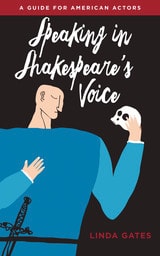
Speaking in Shakespeare's Voice
A Guide for American ActorsLinda Gates
Northwestern University Press, 2019
Speaking in Shakespeare's Voice: A Guide for American Actors is a book for undergraduate and graduate students of acting as well as for the professional who would like to perform Shakespeare with the skill of a classical actor. It is also valuable for European actors interested in performing Shakespeare in American English and British actors who would like to explore Shakespeare from an American perspective.
This guide focuses on the technical elements of voice and speech, including breathing, resonance, and diction, as well as providing an introduction to verse speaking and scansion and to Shakespeare’s rhetorical devices, such as antithesis, alliteration, onomatopoeia, irony, metaphor, and wordplay. These topics are annotated with examples from Shakespeare’s plays to demonstrate how an actor can apply the lessons to actual performance. The book also explores the history of Shakespearean performance in the United States and provides guidance on current editions of Shakespeare’s text from the Folio to online Open Source Shakespeare. A helpful appendix offers examples of two-person scenes and contextualized monologues.
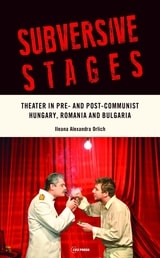
Subversive Stages
Theater in Pre- and Post-Communist Hungary, Romania and BulgariaIleana Alexandra Orlich
Central European University Press, 2017
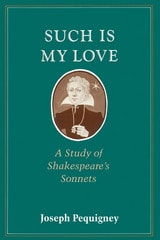
Such Is My Love
A Study of Shakespeare's SonnetsJoseph Pequigney
University of Chicago Press, 1985