Results by title
66 books match the query 'Signs' and 47 start with s
Signs
Maurice Merleau-Ponty
Northwestern University Press, 1964
Thus does Maurice Merleau-Ponty describe speech in this collection of his important writings on the philosophy of expression, composed during the last decade of his life. For him, expression is a category of human behavior and existence much broader than language alone. He maintains that man is essentially expressive, even prior to speaking: in his silence, gestures, and lived behavior.

Signs In Culture
Roland Barthes TodaySteven Ungar
University of Iowa Press, 1989
Roland Barthes's critical writings promoted postwar movements ranging from the New Novel to the Parisian version of structural analysis. As a theorist, he was inspired in large part by semiology, the general science of signs set forth in the work of Ferdinand de Saussure. This volume presents a challenging variety of essays that elaborate and comment on specific elements in the evolution of Barthes's study of signs, from the revolutionary semiology of his 1957 Mythologies to the semioclasm and semiotrophy of such post-1960s' books as S/Z, The Pleasure of the Text, and A Lover's Discourse.
The nine essays of Signs in Culture have been organized to express the striking interplay of language and writing as the ethics of form Barthes first described in his 1953 Writing Degree Zero. Each essay serves as a pivotal critical exercise beginning with or departing from Barthes's writing. Each essayist thus engages an expanded semiology which inscribes the life of signs within the institutions and practices that literary critics, philosophers, and historians alike have seen as constituting the elements of a cultural study and critique.

Signs Of Danger
Waste, Trauma, and Nuclear ThreatPeter C. Van Wyck
University of Minnesota Press, 2004
Questions the literal burying of the nuclear threat and how it relates to expectations for our future
A rising ocean. A falling building. A toxic river. Species extinguished. A nuclear landscape. In a world so configured, the state of contemporary ecological thought and practice is woefully—and perilously—inadequate. Focusing on the government’s nuclear waste burial program in Carlsbad, New Mexico, Signs of Danger begins the urgent work of finding a new way of thinking about ecological threat in our time.
The Waste Isolation Pilot Plant in Carlsbad began receiving shipments in 1999. With a proposed closing date of 2030, this repository for nuclear waste must be secured with a sign, the purpose of which will be to keep people away for three hundred generations. In the official documents uncovered by Peter van Wyck, we encounter a government bureaucracy approaching the issue of nuclear waste as a technical problem only to find itself confronting a host of intractable philosophical issues concerning language, culture, and history. Signs of Danger plumbs these depths as it shows us how the problem raised in the desert of New Mexico is actually the problem of a culture grappling with ecological threats and with questions of the limits of meaning and representation in the deep future. The reflections at the center of this book—on memory, trauma, disaster, representation, and the virtual—are aimed at defining the uniquely modern status of environmental and nuclear threats. They offer invaluable insights into the interface of where culture ends and nature begins, and how such a juncture is closely linked with questions of risk, concepts of history, and the cultural experience of time.Winner of the 2005 Gertrude J. Robinson Book Prize of the Canadian Communication Association
Signs and Cities
Black Literary PostmodernismMadhu Dubey
University of Chicago Press, 2003
Dubey shows how black novelists from the last three decades have reconsidered the modern urban legacy and thus articulated a distinctly African-American strain of postmodernism. She argues that novelists such as Octavia Butler, Samuel Delany, Toni Morrison, Gloria Naylor, Ishmael Reed, Sapphire, and John Edgar Wideman probe the disillusionment of urban modernity through repeated recourse to tropes of the book and scenes of reading and writing. Ultimately, she demonstrates that these writers view the book with profound ambivalence, construing it as an urban medium that cannot recapture the face-to-face communities assumed by oral and folk forms of expression.
Signs and Images
Writings on Art, Cinema and PhotographyRoland Barthes
Seagull Books, 2016
Roland Barthes was a restless, protean thinker. A constant innovator—often as a daring smuggler of ideas from one discipline to another—he first gained an audience with his pithy essays on mass culture and then went on to produce some of the most suggestive and stimulating cultural criticism of the late twentieth century, including Empire of Signs, The Pleasure of the Text, and Camera Lucida. In 1976, this one-time structuralist outsider was elected to a chair at France’s preeminent Collège de France, where he chose to style himself as a professor of literary semiology until his death in 1980.
The greater part of Barthes’s published writings has been available to a French audience since 2002, but now, translator Chris Turner presents a collection of essays, interviews, prefaces, book reviews, and other journalistic material for the first time in English and divided into five themed volumes. Volume four, Signs and Images, gathers pieces related to his central concerns—semiotics, visual culture, art, cinema, and photography—and features essays on Marthe Arnould, Lucien Clergue, Daniel Boudinet, Richard Avedon, Bernard Faucon, and many more.
Signs and Signals from Vietnam
Essays on Contemporary ArtEdited by Pamela N. Corey, Nora A. Taylor, and Do Tuong Linh
National University of Singapore Press, 2026
The first English-language volume on Vietnamese contemporary art.
Contemporary art in Vietnam is a dynamic field shaped by memory, history, and experimentation. Over the last thirty years, Vietnamese artists have come to command international recognition, even as a growing domestic market for contemporary art fosters alternative infrastructures of collection and exhibition. Signs and Signals from Vietnam brings together artists, curators, and academics to examine artistic practice and contemporary art histories in Vietnam today.
Moving beyond familiar North-South or diasporic-national divides, the essays represent the perspectives of Vietnamese, Vietnamese diasporic, and non-Vietnamese writers of different generations, affiliations, and positionalities. Contributors trace the inventive ways artists work with language, narrative, performance, and archival practice to communicate through their art. Key themes running through the volume represent the predominant concerns of Vietnamese artists over the past three decades, including the enduring impact of socialist paradigms in contemporary art, gender, diaspora, memory, and the environment. Together, these essays demonstrate how contemporary art can convey lesser-known histories, contested narratives, and personal perspectives.
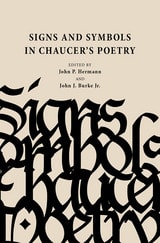
Signs and Symbols in Chaucer's Poetry
John P. Hermann
University of Alabama Press, 1981
Unlocking the rich symbolic world of Chaucer through the lens of medieval culture and meaning.
Innovative and thorough, Signs and Symbols in Chaucer’s Poetry presents nine essays that reexamine the literary iconography of Middle English. Chaucer’s work is the most well-known, and possibly the most significant, remnant of the Middle Ages; investigations into his writing and meanings are fruitful even today. The essays collected by John P. Hermann and John J. Burke Jr. invite scholars to consider new interpretations of old symbols while acknowledging the intricacies of historical context.
Each highly distinguished scholar responds to D. W. Robertson’s seminal, if controversial, approach to Chaucer’s work. Robertson’s scholarship, which also provides the opening essay of the collection, uses a historicist approach to contextualize Chaucer’s imagery within the literary and cultural conventions of the Middle Ages. Sources for such contextualization include etymology, topology, the classics, pictorial art, the Bible, and the developing sciences of the time. Robertson, as well as his contemporary Bernard F. Huppé, provided a fascinating new direction for modern Chaucer studies that focused on daily life.
Each essay uses this approach to draw attention to various examples of Chaucer’s iconography. The texts span several of Chaucer’s works and a plethora of subjects, including music, disappointed expectations, repeated or conflicting signs, and more. This volume provides insight into Chaucer’s work as well as the Middle Ages as a whole, examining conventions and expectations of society at that time. Scholars, instructors, and lovers of Chaucer will all find value in this finely edited collection.
Signs and Voices
Deaf Culture, Identity, Language, and ArtsKristin A. Lindgren
Gallaudet University Press, 2008
Cochlear implants, mainstreaming, genetic engineering, and other ethical dilemmas confronting deaf people mandated a new, wide-ranging examination of these issues, fulfilled by Signs and Voices: Deaf Culture, Identity, Language, and Arts. This collection, carefully chosen from the 2004 Signs and Voices Conference, the Presidential Forum on American Sign Language at the Modern Language Association Convention, and other sources, addresses all of the factors now changing the cultural landscape for deaf people. To ensure quality and breadth of knowledge, editors Kristin A. Lingren, Doreen DeLuca, and Donna Jo Napoli selected the work of renowned scholars and performers Shannon Allen, H-Dirksen L. Bauman, Adrian Blue, Brenda Jo Brueggemann, Teresa Blankmeyer Burke, Peter Cook, David P. Corina, Michael Davidson, Kristen Harmon, Tom Humphries, Sotaro Kita, Heather Knapp, Robert G. Lee, Irene W. Leigh, Kenny Lerner, Carole Neidle, Peter Novak, AslI Özyürek, David M. Perlmutter, Anne Senghas, and Ronnie Wilbur.
Signs and Voices is divided into three sections—Culture and Identity, Language and Literacy, and American Sign Language in the Arts—each of which focuses on a particular set of theoretical and practical concerns. Also, the included DVD presents many of the performances from the Arts section. Taken together, these essays and DVD point to new directions in a broad range of fields, including cognitive science, deaf studies, disability studies, education, linguistics, literary criticism, philosophy, and psychology. This extraordinary showcase of innovative and rigorous cross-disciplinary study will prove invaluable to everyone interested in the current state of the Deaf community.

Signs and Wonders
Religious Rhetoric and the Preservation of Sign LanguageTracy Ann Morse
Gallaudet University Press, 2014
In Chapter One, Morse analyzes Thomas Hopkins Gallaudet’s use of religious references in his 1817 maiden address at the first American school for deaf students. She examines his and other speeches as examples of the intersection of education for deaf Americans and Protestant missionary efforts to convert them. In the second chapter, she presents the different religious perspectives of the two deaf education camps: Manualists argued that sign language was a gift from God, while Oralists viewed hand gestures as animal-like, indicative of lower evolutionary development.
Chapter Three explores the religious rhetoric in churches, sanctuaries where sign language flourished and deaf members formed relationships. In the fourth chapter, Morse shows how Deaf activist George Veditz signed using religious themes in his political films. She also comments on the impact of the bilingual staging of Big River: The Adventures of Huckleberry Finn, which began to change the hearing world’s opinion about the Deaf community. Morse concludes with speculation on the shifting terrain for deaf people due to technological innovations that might supplant religious rhetoric as a tool to support the Deaf community.

Signs from Silence
Ur of the First SumeriansPetr Charvát
Karolinum Press, 2015
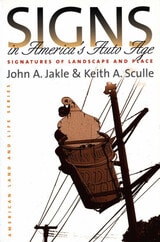
Signs in America's Auto Age
Signatures of Landscape and PlaceJohn A. & Keith A. Jakle & Sculle
University of Iowa Press, 2004

Signs of Borges
Sylvia Molloy
Duke University Press, 1994
Borges's sustained practice of the uncanny gives rise in his texts to endless tensions between illusion and meaning, and to the competing desires for fragmentation, dispersal, and stability. Molloy traces the movement of Borges's own writing by repeatedly spanning the boundaries of genre and cutting across the conventional separations of narrative, lyric and essay, fact and fiction. Rather than seeking to resolve the tensions and conflicts, she preserves and develops them, thereby maintaining the potential of these texts to disturb. At the site of these tensions, Molloy locates the play between meaning and meaninglessness that occurs in Borges's texts. From this vantage point his strategies of deception, recourse to simulacra, inquisitorial urge to unsettle binarism, and distrust of the permanent--all that makes Borges Borges--are examined with unmatched skill and acuity.
Elegantly written and translated, Signs of Borges presents a remarkable and dynamic view of one of the most international and compelling writers of this century. It will be of great interest to all students of twentieth-century literature, particularly to students of Latin American literature.

Signs of Change
New Directions in Theatre EducationJoan Lazarus
Intellect Books, 2012
Signs of Deference, Signs of Demeanour
Interlocutor Reference and Self-Other Relations across Southeast Asian Speech CommunitiesEdited by Dwi Noverini Djenar and Jack Sidnell
National University of Singapore Press, 2022
A study of interlocutor reference that significantly deepens our understanding of the ways in which self-other relations are linguistically mediated in social interaction, based on the analysis of Southeast Asian languages.
Terms used by speakers to refer to themselves and their interlocutors form one of the ways that language expresses, defines, and creates a field for working out social relations. Because this field of study in sociolinguistics historically has focused on Indo-European languages, it has tended to dwell on references to the addressee—for example, the choice between tu and vous when addressing someone in French. This book uses the study of Southeast Asian languages to theorize interlocutor reference more broadly, significantly deepening our understanding of the ways in which self-other relations are linguistically mediated in social interaction. As the authors explain, Southeast Asian systems exceed in complexity and nuance the well-described cases of Europe in two basic ways. First, in many languages of Southeast Asia, a speaker must select an appropriate reference form not only for other/addressee but also for self/speaker. Second, in these languages, in addition to pronouns, speakers draw upon a range of common and proper nouns including names, kin terms, and titles, in referring to themselves and the addressee. Acts of interlocutor reference, therefore, inevitably do more than simply identify the speaker and addressee; they also convey information about the proposed relation between interlocutors. Bringing together studies from both small-scale and large, urbanized communities across Mainland and Insular Southeast Asia, this is an important contribution to the regional linguistic and anthropological literature.
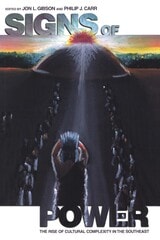
Signs of Power
The Rise of Cultural Complexity in the SoutheastEdited by Jon L. Gibson and Philip J. Carr
University of Alabama Press, 2004
Traces the sources of power and large-scale organization of prehistoric peoples among Archaic societies.
By focusing on the first instances of mound building, pottery making, fancy polished stone and bone, as well as specialized chipped stone, artifacts, and their widespread exchange, this book explores the sources of power and organization among Archaic societies. It investigates the origins of these technologies and their effects on long-term (evolutionary) and short-term (historical) change.
The characteristics of first origins in social complexity belong to 5,000- to 6,000-year-old Archaic groups who inhabited the southeastern United States. In Signs of Power, regional specialists identify the conditions, causes, and consequences that define organization and social complexity in societies. Often termed "big mound power," these considerations include the role of demography, kinship, and ecology in sociocultural change; the meaning of geometry and design in sacred groupings; the degree of advancement in stone tool technologies; and differentials in shell ring sizes that reflect social inequality.
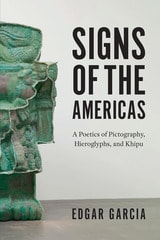
Signs of the Americas
A Poetics of Pictography, Hieroglyphs, and KhipuEdgar Garcia
University of Chicago Press, 2020
Garcia tells the story of the present life of these sign-systems, examining the contemporary impact they have had on poetry, prose, visual art, legal philosophy, political activism, and environmental thinking. In doing so, he brings together a wide range of indigenous and non-indigenous authors and artists of the Americas, from Aztec priests and Amazonian shamans to Simon Ortiz, Gerald Vizenor, Jaime de Angulo, Charles Olson, Cy Twombly, Gloria Anzaldúa, William Burroughs, Louise Erdrich, Cecilia Vicuña, and many others. From these sources, Garcia depicts the culture of a modern, interconnected hemisphere, revealing that while these “signs of the Americas” have suffered expropriation, misuse, and mistranslation, they have also created their own systems of knowing and being. These indigenous systems help us to rethink categories of race, gender, nationalism, and history. Producing a new way of thinking about our interconnected hemisphere, this ambitious, energizing book redefines what constitutes a “world” in world literature.
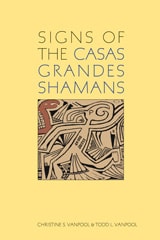
Signs of the Casas Grandes Shamans
VanPool Christine & Todd
University of Utah Press, 2007
Looking through this window, authors Christine and Todd VanPool find a world centered on shamans who took spiritual journeys to consort with supernatural creatures. The shamans called upon horned serpents to bring rain, the lifeblood for farmers living in the Chihuahuan desert; dealt with snakes that held powers more potent than their bites; and raised, sacrificed, and buried macaws as ritual offerings to ensure water and fertility.
These findings challenge long-held beliefs about Southwestern religion and force a reconsideration of the importance of shamanism in the development of social differentiation in societies around the world.
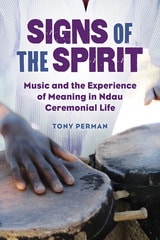
Signs of the Spirit
Music and the Experience of Meaning in Ndau Ceremonial LifeTony Perman
University of Illinois Press, 2020
Perman's encounters with the spirits, the mediums who bring them back, and the accompanying rituals form the heart of his ethnographic account of how the Ndau experience ceremonial musicking. As Perman witnessed other ceremonies, he discovered that music and dancing shape the emotional lives of Ndau individuals by inviting them to experience life's milestones or cope with its misfortunes as a group. Signs of the Spirit explores the historical, spiritual, and social roots of ceremonial action and details how that action influences the Ndau's collective approach to their future. The result is a vivid ethnomusicological journey that delves into the immediacy of musical experience and the forces that transform ceremonial performance into emotions and community.
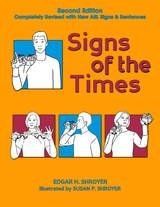
Signs of the Times
Edgar H. Shroyer
Gallaudet University Press, 2011
•Completely Revised with New Signs and Lessons
•Each Sign Illustration Features Sentences in English and ASL Order
•New Class Activities and New Student Activities for Homework or Quizzes
•New Facts about American Sign Language Grammar and Deaf Culture
Now, the bestselling American Sign Language textbook Signs of the Times has been completely revised and updated. The new, second edition is an excellent beginner’s American Sign Language textbook designed for use in the classroom or at home. Organized into 44 lessons, it presents more than 1,300 signs representing 3,500 English glosses. Each lesson contains clear illustrations of all signs, English equivalent words and synonyms, sample sentences to define vocabulary context, and practice sentences to display and reinforce ASL usage.
Signs of the Times is a complete text that includes new class activities for teachers, plus new student activities that can be done in class, as homework, or as quizzes. The new edition features the Contextual Sign/Word Appendix, which displays groups of sentences using the same English word to show different meanings along with the corresponding ASL signs. It also provides an expanded index, vocabulary lists, and a reading reference list. The new edition offers facts on ASL grammar and Deaf culture and includes mind ticklers that enliven the lessons with hints, tips, and mnemonic devices.
The new Signs of the Times expands the features that made it a standard, easy-to-use ASL textbook. Signs are repeated in sentences throughout the book to provide excellent practice for the students. The clear, easy-to-understand sign illustrations facilitates the learning process, enhancing students’ success while also making ASL fun.
Signs
Journal of Women in Culture and Society, volume 45 number 2 (Winter 2020)The University of Chicago Press
University of Chicago Press Journals, 2020

Signs
Journal of Women in Culture and Society, volume 45 number 3 (Spring 2020)The University of Chicago Press
University of Chicago Press Journals, 2020
Signs
Journal of Women in Culture and Society, volume 45 number 4 (Summer 2020)The University of Chicago Press
University of Chicago Press Journals, 2020

Signs
Journal of Women in Culture and Society, volume 46 number 1 (Autumn 2020)The University of Chicago Press
University of Chicago Press Journals, 2020
Signs
Journal of Women in Culture and Society, volume 46 number 2 (Winter 2021)The University of Chicago Press
University of Chicago Press Journals, 2021

Signs
Journal of Women in Culture and Society, volume 46 number 3 (Spring 2021)The University of Chicago Press
University of Chicago Press Journals, 2021
Signs
Journal of Women in Culture and Society, volume 46 number 4 (Summer 2021)The University of Chicago Press
University of Chicago Press Journals, 2021
Signs
Journal of Women in Culture and Society, volume 47 number 1 (Autumn 2021)The University of Chicago Press
University of Chicago Press Journals, 2021

Signs
Journal of Women in Culture and Society, volume 47 number 2 (Winter 2022)The University of Chicago Press
University of Chicago Press Journals, 2022
Signs
Journal of Women in Culture and Society, volume 47 number 3 (Spring 2022)The University of Chicago Press
University of Chicago Press Journals, 2022
Signs
Journal of Women in Culture and Society, volume 47 number 4 (Summer 2022)The University of Chicago Press
University of Chicago Press Journals, 2022
Signs
Journal of Women in Culture and Society, volume 48 number 1 (Autumn 2022)The University of Chicago Press
University of Chicago Press Journals, 2022

Signs
Journal of Women in Culture and Society, volume 48 number 2 (Winter 2023)The University of Chicago Press
University of Chicago Press Journals, 2023

Signs
Journal of Women in Culture and Society, volume 48 number 3 (Spring 2023)The University of Chicago Press
University of Chicago Press Journals, 2023
Signs
Journal of Women in Culture and Society, volume 48 number 4 (Summer 2023)The University of Chicago Press
University of Chicago Press Journals, 2023
Signs
Journal of Women in Culture and Society, volume 49 number 1 (Autumn 2023)The University of Chicago Press
University of Chicago Press Journals, 2023
Signs
Journal of Women in Culture and Society, volume 49 number 2 (Winter 2024)The University of Chicago Press
University of Chicago Press Journals, 2024
Signs
Journal of Women in Culture and Society, volume 49 number 3 (Spring 2024)The University of Chicago Press
University of Chicago Press Journals, 2024

Signs
Journal of Women in Culture and Society, volume 49 number 4 (Summer 2024)The University of Chicago Press
University of Chicago Press Journals, 2024
Signs
Journal of Women in Culture and Society, volume 50 number 1 (Autumn 2024)The University of Chicago Press
University of Chicago Press Journals, 2024
Signs
Journal of Women in Culture and Society, volume 50 number 2 (Winter 2025)The University of Chicago Press
University of Chicago Press Journals, 2025
Signs
Journal of Women in Culture and Society, volume 50 number 3 (Spring 2025)The University of Chicago Press
University of Chicago Press Journals, 2025
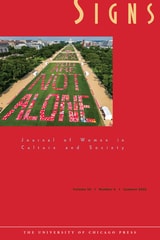
Signs
Journal of Women in Culture and Society, volume 50 number 4 (Summer 2025)The University of Chicago Press
University of Chicago Press Journals, 2025
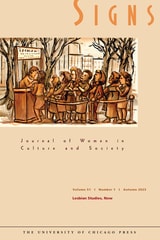
Signs
Journal of Women in Culture and Society, volume 51 number 1 (Autumn 2025)The University of Chicago Press
University of Chicago Press Journals, 2025
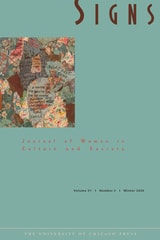
Signs
Journal of Women in Culture and Society, volume 51 number 2 (Winter 2026)The University of Chicago Press
University of Chicago Press Journals, 2026
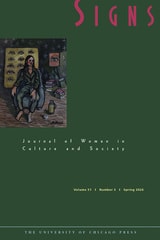
Signs
Journal of Women in Culture and Society, volume 51 number 3 (Spring 2026)The University of Chicago Press
University of Chicago Press Journals, 2026
Signs
Journal of Women in Culture and Society, volume 51 number 4 (Summer 2026)The University of Chicago Press
University of Chicago Press Journals, 2026

Speech and Phenomena
And Other Essays on Husserl's Theory of SignsJacques Derrida
Northwestern University Press, 1973