Results by title
231 books match the query 'Society' and 49 start with s
Saints and Society
The Two Worlds of Western Christendom, 1000-1700Donald Weinstein and Rudolph M. Bell
University of Chicago Press, 1986

Saxony in German History
Culture, Society, and Politics, 1830-1933James Retallack, Editor
University of Michigan Press, 2000
Focusing on the east German state of Saxony, the contributors to this volume refuse easy resolution of that tension, seeking instead to illustrate how local, regional, and national cultures commingled, diverged, and influenced each other over time. By considering both the erosion and the persistence of traditional identities and regional boundaries, these essays help to restore an appreciation of regional "ways of seeing," suggesting they really did matter--in their own right, and for the nation as a whole.
Topics considered include the expansion of a German reading public, Jewish emancipation, the formation of socio-moral milieus, working-class leisure, the expansion of the public sphere, the rise of consumer co-operatives, gendered attempts to fashion the "new" liberal man, and degradation rituals in the 1920s. Presenting to English-reading audiences the fruits of cutting-edge research conducted in Saxon archives since 1989, the contributors offer innovative ways to reassess the larger sweep of German history.
This book serves as a how-to guide for the study of any region in history. Beyond its primary appeal to European historians, it will also speak to students and scholars in comparative politics and sociology.
James Retallack is Professor of History, University of Toronto.

School, Society, and State
A New Education to Govern Modern America, 1890-1940Tracy L. Steffes
University of Chicago Press, 2012
“Democracy has to be born anew every generation, and education is its midwife,” wrote John Dewey in his classic work The School and Society. In School, Society, and State, Tracy Steffes places that idea at the center of her exploration of the connections between public school reform in the early twentieth century and American political development from 1890 to 1940.
American public schooling, Steffes shows, was not merely another reform project of the Progressive Era, but a central one. She addresses why Americans invested in public education and explains how an array of reformers subtly transformed schooling into a tool of social governance to address the consequences of industrialization and urbanization. By extending the reach of schools, broadening their mandate, and expanding their authority over the well-being of children, the state assumed a defining role in the education—and in the lives—of American families.
In School, Society, and State, Steffes returns the state to the study of the history of education and brings the schools back into our discussion of state power during a pivotal moment in American political development.
School, State, and Society
The Growth of Elementary Schooling in Nineteenth-Century France--A Quantitative AnalysisRaymond Grew and Patrick J. Harrigan
University of Michigan Press, 1992
Science, Faith and Society
Michael Polanyi
University of Chicago Press, 1964
Polanyi aims to show that science must be understood as a community of inquirers held together by a common faith; science, he argues, is not the use of "scientific method" but rather consists in a discipline imposed by scientists on themselves in the interests of discovering an objective, impersonal truth. That such truth exists and can be found is part of the scientists' faith. Polanyi maintains that both authoritarianism and scepticism, attacking this faith, are attacking science itself.

Science, Society, and the Search for Life in the Universe
Bruce Jakosky
University of Arizona Press, 2006
Astrobiology is the relatively new, but fast growing scientific discipline that involves trying to understand the origin, evolution, and distribution of life within the universe. It is also one of the few scientific disciplines that attracts the public’s intense curiosity and attention. This interest stems largely from the deep personal meaning that the possible existence of extraterrestrial life has for so many. Whether this meaning relates to addressing the “Big Questions” of our existence, the possibility of encountering life on other planets, or the potential impact on our understanding of religion, there is no doubt that the public is firmly vested in finding answers.
In this broadly accessible introduction to the field, Bruce Jakosky looks at the search for life in the universe not only from a scientific perspective, but also from a distinctly social one. In lucid and engaging prose, he addresses topics including the contradiction between the public’s fascination and the meager dialogue that exists between those within the scientific community and those outside of it, and what has become some of the most impassioned political wrangling ever seen in government science funding.

Self and Society
Are Communal Solidarity and Individual Freedom Allies or Antagonists?Michael Amherst, David Crane, Nick Inman, Beninio McDonough-Tranza, and Tara McEvoy
Haus Publishing, 2021
Bringing together the winning and shortlisted essays from the 2020 Hubert Butler Essay Prize, Self and Society presents five fresh perspectives on the tension between individual freedom and communal solidarity, asking what we owe our communities and why it matters. With a foreword by Ireland’s President Michael D. Higgins, the book examines themes that are more pressing than ever in the age of Coronavirus and Brexit, invoking the spirit of the Irish essayist Hubert Butler to investigate whether collective and personal aims can be synergistic or are destined to remain ever in conflict.
Winner Michael Amherst takes on identity politics, questioning whether the stratification of society in the name of social justice is helpful or harmful in the pursuit of equality. Runners-up Tara McEvoy and David Crane tackle, respectively, the necessity of collective action as a response to the current pandemic and other social crises, and the role of conflicts of individual freedom in facilitating or stifling the economic liberation of refugees. Special mentions have been awarded to Nick Inman and Beninio McDonough-Tranza for their respective essays on personal responsibility and the legacy of the Polish union Solidarnosc.

Settlement, Subsistence, and Society in Late Zuni Prehistory
Keith W. Kintigh
University of Arizona Press, 1985
Keith W. Kintigh demonstrates how changing agricultural strategies and developing mechanisms of social integration contributed to these population shifts. In particular, he argues that occupants of the earliest large pueblos relied on runoff agriculture, but that gradually spring-and river-fed irrigation systems were adopted. Resultant strengthening of the mechanisms of social integration allowed the increased occupational stability of the protohistorical Zuni towns.

Severe Storms and Society
Seeking Resilience and Understanding Human Behavior in Meteorology, the Weather Enterprise, and PublicsJack R. Friedman, Daphne S. LaDue, Laura Myers, and Melissa J. Lamkin
American Meteorological Society, 2021

Sex, Society, and the Making of Pornography
The Pornographic Object of KnowledgeJeffrey Escoffier
Rutgers University Press, 2021
Signs
Journal of Women in Culture and Society, volume 45 number 2 (Winter 2020)The University of Chicago Press
University of Chicago Press Journals, 2020

Signs
Journal of Women in Culture and Society, volume 45 number 3 (Spring 2020)The University of Chicago Press
University of Chicago Press Journals, 2020
Signs
Journal of Women in Culture and Society, volume 45 number 4 (Summer 2020)The University of Chicago Press
University of Chicago Press Journals, 2020

Signs
Journal of Women in Culture and Society, volume 46 number 1 (Autumn 2020)The University of Chicago Press
University of Chicago Press Journals, 2020
Signs
Journal of Women in Culture and Society, volume 46 number 2 (Winter 2021)The University of Chicago Press
University of Chicago Press Journals, 2021

Signs
Journal of Women in Culture and Society, volume 46 number 3 (Spring 2021)The University of Chicago Press
University of Chicago Press Journals, 2021
Signs
Journal of Women in Culture and Society, volume 46 number 4 (Summer 2021)The University of Chicago Press
University of Chicago Press Journals, 2021
Signs
Journal of Women in Culture and Society, volume 47 number 1 (Autumn 2021)The University of Chicago Press
University of Chicago Press Journals, 2021

Signs
Journal of Women in Culture and Society, volume 47 number 2 (Winter 2022)The University of Chicago Press
University of Chicago Press Journals, 2022
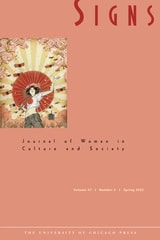
Signs
Journal of Women in Culture and Society, volume 47 number 3 (Spring 2022)The University of Chicago Press
University of Chicago Press Journals, 2022
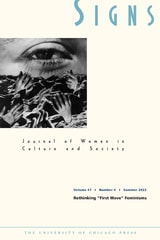
Signs
Journal of Women in Culture and Society, volume 47 number 4 (Summer 2022)The University of Chicago Press
University of Chicago Press Journals, 2022
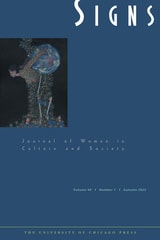
Signs
Journal of Women in Culture and Society, volume 48 number 1 (Autumn 2022)The University of Chicago Press
University of Chicago Press Journals, 2022

Signs
Journal of Women in Culture and Society, volume 48 number 2 (Winter 2023)The University of Chicago Press
University of Chicago Press Journals, 2023

Signs
Journal of Women in Culture and Society, volume 48 number 3 (Spring 2023)The University of Chicago Press
University of Chicago Press Journals, 2023
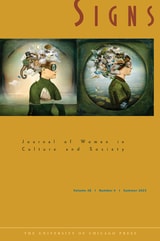
Signs
Journal of Women in Culture and Society, volume 48 number 4 (Summer 2023)The University of Chicago Press
University of Chicago Press Journals, 2023
Signs
Journal of Women in Culture and Society, volume 49 number 1 (Autumn 2023)The University of Chicago Press
University of Chicago Press Journals, 2023

Signs
Journal of Women in Culture and Society, volume 49 number 2 (Winter 2024)The University of Chicago Press
University of Chicago Press Journals, 2024

Signs
Journal of Women in Culture and Society, volume 49 number 3 (Spring 2024)The University of Chicago Press
University of Chicago Press Journals, 2024

Signs
Journal of Women in Culture and Society, volume 49 number 4 (Summer 2024)The University of Chicago Press
University of Chicago Press Journals, 2024
Signs
Journal of Women in Culture and Society, volume 50 number 1 (Autumn 2024)The University of Chicago Press
University of Chicago Press Journals, 2024
Signs
Journal of Women in Culture and Society, volume 50 number 2 (Winter 2025)The University of Chicago Press
University of Chicago Press Journals, 2025
Signs
Journal of Women in Culture and Society, volume 50 number 3 (Spring 2025)The University of Chicago Press
University of Chicago Press Journals, 2025
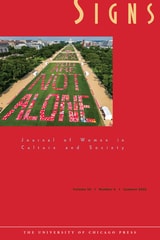
Signs
Journal of Women in Culture and Society, volume 50 number 4 (Summer 2025)The University of Chicago Press
University of Chicago Press Journals, 2025
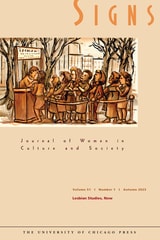
Signs
Journal of Women in Culture and Society, volume 51 number 1 (Autumn 2025)The University of Chicago Press
University of Chicago Press Journals, 2025

Signs
Journal of Women in Culture and Society, volume 51 number 2 (Winter 2026)The University of Chicago Press
University of Chicago Press Journals, 2026
Signs
Journal of Women in Culture and Society, volume 51 number 3 (Spring 2026)The University of Chicago Press
University of Chicago Press Journals, 2026
Signs
Journal of Women in Culture and Society, volume 51 number 4 (Summer 2026)The University of Chicago Press
University of Chicago Press Journals, 2026
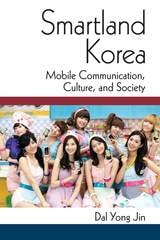
Smartland Korea
Mobile Communication, Culture, and SocietyDal Yong Jin
University of Michigan Press, 2017
Society And Legal Change 2Nd Ed
Alan Watson, foreword by Paul Finkelman
Temple University Press, 2001
In this first U.S. edition of a classic work of comparative legal scholarship, Alan Watson argues that law fails to keep step with social change, even when that change is massive. To illustrate the ways in which law is dysfunctional, he draws on the two most innovative western systems, of Rome and England, to show that harmful rules continue for centuries. To make his case, he uses examples where, in the main, "the law benefits no recognizable group or class within the society (except possibly lawyers who benefit from confusion) and is generally inconvenient or positively harmful to society as a whole or to large or powerful groups within the society."
Widely respected for his "fearless challenge of the accepted or dominant view and his own encyclopedic knowledge of Roman law" (The Encyclopedia of Historians and Historical Writing), Watson considers the development of law in global terms and across the centuries. His arguments centering on how societies borrow from other legal systems and the continuity of legal systems are particularly instructive for those interested in legal development and the development of a common law for the European Union.
postamble();
Society As Educator in an Age of Transition
Edited by Kenneth D. Benne and Steven Tozer
University of Chicago Press, 1987

Society and Natural Resources
A Summary of KnowledgeMichael J. Manfredo
University Press of Colorado, 2023
This book is a reprint of the original edited volume first published in 2004. In thirty-one chapters, the edited volume documents the exciting period of the emerging interdisciplinary field of society and natural resource scholarship from 1986 to 2004. It was published in part to commemorate the tenth International Symposium on Society and Resources Management (ISSRM) in Keystone, Colorado. ISSRM has brought together natural resource professionals, social science researchers, non-government agencies, private sector organizations, and students on a biennial basis since 1986. The book presents the most significant contributions to the symposia hosted by Pennsylvania State University, Colorado State University, University of Wisconsin-Madison, Texas A&M University, University of Illinois at Urbana-Champaign, Oregon State University, University of Missouri at Columbia, Western Washington University, and Indiana University. The first International ISSRM was held in Belize, Australia, and Italy and started a fruitful cross-continental exchange on society and natural resources showcased in this book.
Contributors: Jim Absher, Kathleen Andereck, Jill Belsky, John Bergstrom, Carter Betz, Alan Bright, Perry J. Brown, Tommy Brown, Mark Brunson, Rabel Burdge, Fred Buttel, KristinCheek, Chia-Kuen Cheng, Tony Cheng, David Cole, H Ken Cordell, Terry Daniel, Steven Daniels, Dan Decker, Robert Ditton, John Dwyer, Alan Ewert, Don Field, Myron Floyd, R Bruce Gill, Alan Graefe, Gary Green, Doug Jackson-Smith, Rebecca Johnson, Richard Knopf, Rick Krannich, Jessica Leahy, Xinran You Lehto, John Loomas, Al Luloff, Mike Manfredo, Robert Manning, Sarah McCaffrey, Stephen McCool, Yoon-Jung Oh, Joseph O'Leary, Carol Saunders, Steve Selin, Bruce Shindler, George Stankey, Bill Stewart, Vicky Sturtevant, Jonathan Taylor, Suzanne Taylor, Tara Teel, Brijesh Thapa, Gene Theodori, Carla Koons Trentelman, Jerry Vaske, Joanne Vining, Doug Whittaker, Dan Williams

Society and Nature
Towards a Green Social TheoryPeter Dickens
Temple University Press, 1992

Society and its Outsiders in the Novels of Jakob Wassermann
Katharina Volckmer
University of London Press, 2016
Society as Text
Essays on Rhetoric, Reason, and RealityRichard Harvey Brown
University of Chicago Press, 1987
Society in Action
The Theory of Social BecomingPiotr Sztompka
University of Chicago Press, 1991
Sztompka connects the interpretations of such collective activity to a wider grasp of the nature of social action. The result is a comprehensive and original theory of social change which focuses on the self-transforming influence on society of its members' striving for freedom, autonomy, and self-fulfillment. He develops his theory by means of a general concept of "social becoming," the roots of which he traces to the early romantic and humanist work of Karl Marx and his followers and to two influential sociological schools of today, the theory of agency and historical sociology.
Sztompka situates his theory midway between the rigid determinism of social totalities and the unbridled voluntarism of free individuals. Social change, he demonstrates, can be understood neither as the outcome of individual actions taken alone nor as structurally determined actions. Instead, he confers upon social organizations and movements a "self-transcending" quality: they express human agency yet, by virtue of their active character, are quite often able to achieve unpredictable outcomes.
Throughout his analysis of social movements and revolutions in history, Sztompka emphasizes the dynamics of spontaneous social change generated from below—a theoretical testimony to the rapid and fundamental social change in Eastern Europe in recent history. Against the fashions of postmodernist malaise, boredom, and disenchantment, his theory of social becoming expresses the possibility of emancipation, of change leading to positive gains. His work registers a belief in progress, not inevitably gained, but its attainment fully dependent upon the creativity and optimism of an active citizenry.

Society, Culture, and the State in Germany, 1870-1930
Geoff Eley, Editor
University of Michigan Press, 1997

Society, Power, and Land in Northeastern Zimbabwe, ca. 1560–1960
Admire Mseba
Ohio University Press, 2024
This book refocuses attention on how regimes of power rooted in kinship, gender, generation, and status have, individually and in combination, informed access to land in precolonial northeastern Zimbabwe. It then examines how these regimes of power interacted with colonial policies to inform the African experience in colonial Zimbabwe. Further, the book places land and the ability to ensure its fecundity at the center of the making and moderation of precolonial political power and how this power was impacted by the imposition of colonial rule.
Tracing the dynamics of land and power from precolonial times, together with their entanglement with colonial policies, is important, for this relationship is almost always neglected by both scholars and policymakers drawn to the high drama of colonial and postcolonial politics of land. This oversight has real consequences on our understandings of landed inequalities and how they are addressed. When Zimbabwe’s postcolonial state focused on colonially induced racialized land inequalities, its land reform efforts left older forms of landed inequalities based on gender, generation, and ideas of belonging intact. The book, which details these inequalities, reminds Zimbabweans and others that if the quest for equity espoused in postcolonial land reforms is to be meaningful, it must be attentive to both colonially induced inequalities and those enduring disparities that predated, were deepened by, and outlived colonial rule. At the same time, Zimbabweans who now live with a postcolonial state that is increasingly centralizing power over land may well learn from past societies’ creative efforts to limit the authority of their leaders.
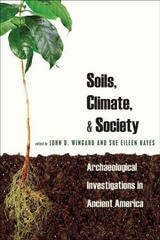
Soils, Climate and Society
Archaeological Investigations in Ancient AmericaJohn D. Wingard
University Press of Colorado, 2013
The volume traces the origins of agriculture, the transition to agrarian societies, the sociocultural implications of agriculture, agriculture's effects on population, and the theory of carrying capacity, considering the relation of agriculture to the profound social changes that it wrought in the New World. Soil science plays a significant, though varied, role in each case study, and is the common component of each analysis. Soil chemistry is also of particular importance to several of the studies, as it determines the amount of food that can be produced in a particular soil and the effects of occupation or cultivation on that soil, thus having consequences for future cultivators.
Soils, Climate and Society demonstrates that renewed investigation of agricultural production and demography can answer questions about the past, as well as stimulate further research. It will be of interest to scholars of archaeology, historical ecology and geography, and agricultural history.

Sports Illusion, Sports Reality
A Reporter's View of Sports, Journalism, and SocietyLeonard Koppett
University of Illinois Press, 1994
ever written, I'd like to see the book that beats it. . . . Should be
read by every sports fan or -- for that matter -- social critic."
--From a five-star review, West Coast Review of Books.
"Explores its subject so thoroughly and demolishes so many commonly
held assumptions that after reading it even the most knowledgeable fans
(and some journalists) should feel like drunks who have suddenly been
forced to sober up."
-- Chicago Tribune
"Required reading for anyone who calls himself a fan."
-- Chicago Sun-Times
"An invaluable contribution to sports literature."
-- Howard Cosell