Results by title
151 books match the query 'Tales' and 7 start with s
Shadows of Empire
Colonial Discourse and Javanese TalesLaurie J. Sears
Duke University Press, 1996
Though Javanese shadow theater (wayang) has existed for hundreds of years, our knowledge of its history, performance practice, and role in Javanese society only begins with Dutch documentation and interpretation in the nineteenth century. Analyzing the Mahabharata and Ramayana tales in relation to court poetry, Islamic faith, Dutch scholarship, and nationalist journals, Sears shows how the shadow theater as we know it today must be understood as a hybrid of Javanese and Dutch ideas and interests, inseparable from a particular colonial moment. In doing so, she contributes to a re–envisioning of European histories that acknowledges the influence of Asian, African, and New World cultures on European thought—and to a rewriting of colonial and postcolonial Javanese histories that questions the boundaries and content of history and story, myth and allegory, colonialism and culture.

Shih-shuo Hsin-yü
A New Account of Tales of the WorldBy Liu I-ch’ing; With commentary by Liu Chün; Translated with introduction and notes by Richard B. Mather
University of Michigan Press, 2002
So Ole Says to Lena
Folk Humor of the Upper MidwestCompiled and edited by James P. Leary
University of Wisconsin Press, 2002
In the land of beer, cheese, and muskies—where the polka is danced and winter is unending and where Lutherans and Catholics predominate—everybody is ethnic, the politics are clean, and the humor is plentiful. This collection includes jokes, humorous anecdotes, and tall tales from ethnic groups (Woodland Indians, French, Cornish, Germans, Irish, Scandinavians, Finns, and Poles) and working folk (loggers, miners, farmers, townsfolk, hunters, and fishers). Dig into the rich cultural context supplied by the notes and photographs, or just laugh at the hundreds of jokes gathered at small-town cafes, farm tables, job sites, and church suppers. This second edition includes an afterword and indexes of motifs and tale types.
Stop the Presses (So I Can Get Off)
Tales from Forty Years of Sports WritingClyde Bolton
University of Alabama Press, 2005
A delightful blend of memoir, opinion, and sports from an Alabama original.
For 31 years, Clyde Bolton wrote four sports columns per week for the Birmingham News. By his estimation, this makes him the most widely read Alabamian in history. He may be right.
In Stop the Presses (So I Can Get Off) he takes the reader along on a joyride through more than three decades of Alabama sports. Unsurprisingly, tales of Bear Bryant and Shug Jordan, Roll Tide and War Eagle, dominate, but at one point or another, Clyde covered just about every type of sporting event in the state. Personalities and events from the realms of high school sports, minor league baseball, college basketball, and Nextel Cup Racing are just some of the many facets of his personal and professional life that he shares in this, his 17th book.
In relating the outlines of his life, Bolton pays homage to his mentors, including famed sports editor Benny Marshall, and shares some insights he’s gained after a lifetime in the newspaper game. But throughout the book, he never forgets that any good journalist—any good writer—is in the business of telling stories. And oh, what stories!
Bolton writes of meeting Michael Jordan during the basketball star’s year with the Birmingham Barons; of having dinner with Muhammad Ali at the Lambda Chi Alpha fraternity house at Auburn University; of walking incognito down sunny Birmingham sidewalks with Hall-of-Famer Johnny Unitas. He explains why Bear Bryant, in his opinion, is the greatest football coach ever, tells of interviewing Joe Namath in the men’s bathroom, and reveals why his grandmother watched professional wrestling on her hands and knees on the floor in front of the television.
Stop the Presses (So I Can Get Off) is a joyous romp through the SEC, the Nextel Cup Circuit, and, in the end, life itself.
Stories as Equipment for Living
Last Talks and Tales of Barbara MyerhoffBarbara Myerhoff
University of Michigan Press, 2007
Barbara Myerhoff's groundbreaking work in reflexivity and narrative ethnography broke with tradition by focusing not on the raw ethnographic data, but on her interaction with those she studied. Myerhoff's unfinished projects, including her final talks on storytelling, ritual, and the "culture of aging and Yiddishkeit," offer a magisterial summary of her life's work.
"The beauty of Stories as Equipment for Living is the quality of being a compilation of rescued fragments, bits and pieces of a great master's writing and thinking that were coming towards synthesis but had never reached a finished form prior to her death. This collection is an examination of the place of narrative in human life, the synthetic nature of culture and the constant search for visibility particularly by those relegated for one reason or another to the margins. A thought-provoking book worthy of extended reflection."
---Jack Kugelmass, Professor of Anthropology and Director of Jewish Studies, University of Florida
"Stories as Equipment for Living achieves a nice balance between preserving Myerhoff's work in its original form and reconstructed contexts, but presenting it in a manner relevant to readers a generation after her death. The book documents Myerhoff's growing involvement with Jewish culture, the actual process of anthropological work through field notes, and the picture of how she always was bouncing the fine details of this combined professional and personal venture off the 'big questions' of anthropology in its broadest sense."
---Harvey E. Goldberg, Professor of Sociology and Anthropology, Hebrew University, Israel
"These essays capture the rhythm of Barbara Myerhoff's words and her vivid and distinctive train of thought, bringing the reader into the classroom of one of anthropology's finest lecturers. As an anthropologist with a poet's gift for language, she utilizes the tools of ethnography and extraordinary powers of observation---a remarkable 'ethnographic eye'---to explore the outward expressions and inner lives of the Fairfax neighborhood of L.A. These stories are not only glorious introductions to the study of culture, but provide in their revelations a reason for studying it. They are required reading for anyone passionate to know what an anthropologist can teach us about communities and ultimately about ourselves."
---Steve Zeitlin, Director, City Lore: The New York Center for Urban Folk Culture
"Master of the third voice, the voice of collaboration, Myerhoff is at once a consummate listener and inspired storyteller. This book offers a rare and luminous opening into the working process and wisdom of one of the great anthropologists of the twentieth century."
---Barbara Kirshenblatt-Gimblett, Professor of Performance Studies at New York University and coauthor of They Called Me Mayer July: Painted Memories of a Jewish Childhood in Poland Before the Holocaust
"Myerhoff and her collaborators have given her 'Hasidim,' her disciples old and new, a final and precious gift."
---Jonathan Boyarin, The Robert M. Beren Distinguished Professor of Modern Jewish Studies at the University of Kansas and author of Thinking in Jewish
Barbara Myerhoff was a renowned anthropologist who did pioneering work in gerontology, Jewish studies, folklore, and narrative anthropology. She is best known for her ethnography of and personal involvement with a community of elderly immigrant Jews in California. Her writings and lectures have had an enormous impact on all of these areas of study, and her books are widely celebrated, especially Number Our Days, whose companion documentary film won an Academy Award.
Marc Kaminsky is a psychotherapist, a poet, a writer, and the former codirector of the Institute on Humanities, Arts and Aging of the Brookdale Center on Aging.
Mark Weiss is a writer, an editor, a translator, and a poet; his books include the widely praised Across the Line/Al Otro Lado.
Deena Metzger is a novelist, a poet, and the founding codirector (with Marc Kaminsky) of the Myerhoff Center.
Thomas R. Cole is the Beth and Toby Grossman Professor and Director of the McGovern Center for Health, Humanities, and the Human Spirit at the University of Texas Health Science Center in Houston, and a Professor of Humanities in the Department of Religious Studies at Rice University; his expertise lies in the history of aging and humanistic gerontology.
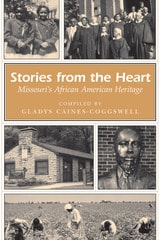
Stories from the Heart
Missouri's African American HeritageCompiled by Gladys Caines-Coggswell
University of Missouri Press, 2009
All along the river, from the front porches of Hannibal to the neighborhoods of St. Louis to the cotton fields of the Bootheel and west to Kansas City, stories are being told.
This collection of family stories and traditional tales brings to print down-home stories about all walks of African American life. Passed down from grandparents and great-grandparents, they have been lovingly gathered by Gladys Caines Coggswell as she visited Missouri communities and participated in storytelling events over the last two decades. These stories bring to life characters with uncommon courage, strength, will, and wit as they offer insight into African American experiences throughout the state’s history.
Often profound, always entertaining, some of these stories hark back to times barely remembered. Many tell of ordinary folks who achieved victories in the face of overwhelming odds. They range from recollections of KKK activities—recalling a Klan leader who owned property on which a black family lived as “the man who was always so nice to us”—to remembered differences between country and city schools and black schoolchildren introduced to Dick and Jane and Little Black Sambo. Stories from the Bootheel shed light on family life, sharecropping, and the mechanization of cotton culture, which in one instance led to a massive migration of rats as the first mechanical cotton pickers came in.
As memorable as the stories are the people who tell them, such as the author’s own “Uncle Pete” reporting on a duck epidemic or Evelyn Pulliam of Kennett telling of her resourceful neighbors in North Lilburn. Loretta Washington remembers sitting on her little wooden stool beside her great-grandmother’s rocking chair on the front porch in Wardell, mesmerized by stories—and the time when rocking chair and little wooden stool were moved inside and the stories stopped. Marlene Rhodes writes of her mother’s hero, Odie, St. Louis “Entrepreneur and English gentleman.”
Whether sharing previously unknown stories from St. Louis or betraying the secret of “Why Dogs Chase Cats,” this book is a rich repository of African American life. And if some of these tales seem unusual, the people remembering them will be the first to tell you: that’s the way it was. Coggswell preserves them for posterity and along with them an important slice of Missouri history.
Story
Harold Scheub
University of Wisconsin Press, 1998
What is the essence of story? How does the storyteller convey meaning? Leading scholar Harold Scheub tackles these questions and more, demonstrating that the power of story lies in emotion.
While others have focused on the importance of structure in the art of story, Scheub emphasizes emotion. He shows how an expert storyteller uses structural elements—image, rhythm, and narrative—to shape a story's fundamental emotional content. The storyteller uses traditional images, repetition, and linear narrative to move the audience past the story’s surface of morals and ideas, and make connections to their past, present, and future. To guide the audience on this emotional journey is the storyteller’s art.
The traditional stories from South African, Xhosa, and San cultures included in the book lend persuasive support to Scheub’s. These stories speak for themselves, demonstrating that a skilled performer can stir emotions despite the obstacles of space, time, and culture.