Results by title
88 books match the query 'Translation' and 10 start with s
Sappho to Valéry
Poems in TranslationJohn Frederick Nims
University of Arkansas Press, 1990
Revised and enlarged, the second edition of Sappho to Valéry includes both the originals and translations of ninety-eight poems from nine different languages. Nims offers new and lively interpretations of a number of poems that have been translated and others available in no other English translation.
A former editor of Poetry, John Frederick Nims has published several volumes of his own poetry, poetry in translation, and essays on the form.
Science in Translation
Movements of Knowledge through Cultures and TimeScott L. Montgomery
University of Chicago Press, 2000
"[A] book of great richness, as much for its examples as for its ideas, which keenly illustrate the development of knowledge across languages and epochs. It is a book to read and reread. Its subject is important; it is ours, it is our history." -André Clas, Meta: Journal des Traducteurs
"[T]his book . . . seems to stand alone on the shelf. A good thing, therefore, that it is so full of good things, both in the content and the prose." —William R. Everdell, MAA Online
"[A]n impressive work. . . . By reminding us of the role of diverse cultures in the elevation of science within a particular nation or civilization, the book makes a substantial contribution to the postmodern worldview that emphasizes multiculturalism." —Choice
Secondhand China
Spain, the East, and the Politics of TranslationCarles Prado-Fonts
Northwestern University Press, 2022
Uncovering an eclectic and surprising archive, Prado-Fonts draws on diverse cultural artifacts from popular literature, journalism, and early cinema to offer a rich account of how China was seen across the West between 1880 and 1930. Enrique Gaspar, Luis de Oteyza, Vicente Blasco Ibáñez, and lesser-known authors writing in Spanish and Catalan put themselves in dialogue with Leo Tolstoy, John Dewey, W. Somerset Maugham, Bertrand Russell, Pearl Buck, and André Malraux, as well as stereotypical figures from popular culture like Fu Manchu and Charlie Chan. Throughout, Prado-Fonts exposes translation as a technology of cultural hegemony and China as an appealing object for representation. A timely contribution to our understanding of how we create and consume knowledge about the world, Secondhand China is essential reading for scholars and students of Orientalism, postcolonial studies, translation studies, comparative literature, and cultural studies.

Sexology and Translation
Cultural and Scientific Encounters across the Modern WorldHeike Bauer
Temple University Press, 2015
Sexology and Translation is the first study of the contemporaneous emergence of sexology in Europe, Asia, and the Middle East. Heike Bauer and her contributors—historians, literary and cultural critics, and translation scholars—address the intersections between sexuality and modernity in a range of contexts during the period from the 1880s to the 1930s.
From feminist sexualities in modern Japan to Magnus Hirschfeld’s affective sexology, this book offers compelling new insights into how sexual ideas were formed in different contexts via a complex process of cultural negotiation. By focusing on issues of translation—the dynamic process by which ideas are produced and transmitted—the essays in Sexology and Translation provide an important corrective to the pervasive idea that sexuality is a “Western” construct that was transmitted around the world.
This volume deepens understanding of how the intersections between national and transnational contexts, between science and culture, and between discourse and experience, shaped modern sexuality.
Sites of Translation
What Multilinguals Can Teach Us about Digital Writing and RhetoricLaura Gonzales
University of Michigan Press, 2018
Winner of the 2016 Sweetland Digital Rhetoric Collaborative Book Prize
Sites of Translation illustrates the intricate rhetorical work that multilingual communicators engage in as they translate information for their communities. Blending ethnographic and empirical methods from multiple disciplines, Laura Gonzales provides methodological examples of how linguistic diversity can be studied in practice, both in and outside the classroom, and provides insights into the rhetorical labor that is often unacknowledged and made invisible in multilingual communication. Sites of Translation is relevant to researchers and teachers of writing as well as technology designers interested in creating systems, pedagogies, and platforms that will be more accessible and useful to multilingual audiences. Gonzales presents multilingual communication as intellectual labor that should be further valued in both academic and professional spaces, and supported by multilingual technologies and pedagogies that center the expertise of linguistically diverse communicators.
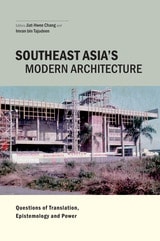
Southeast Asia's Modern Architecture
Questions of Translation, Epistemology and PowerEdited by Jiat-Hwee Chang and Imran bin Tajudeen
National University of Singapore Press, 2018
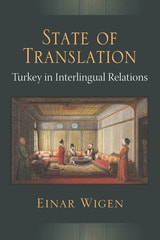
State of Translation
Turkey in Interlingual RelationsEinar Wigen
University of Michigan Press, 2018
International politics often requires two or more languages. The resulting interlingual relations mean translation, either by interpreters who are quite literally in the middle of conversations, or by bilingual statesmen who negotiate internationally in one language and then legitimize domestically in another. Since no two languages are the same, what can be argued in one language may be impossible in another. Political concepts can thus be significantly reformulated in the translation process. State of Translation examines this phenomenon using the case of how 19th-century Ottoman and later Turkish statesmen struggled to reconcile their arguments in external languages (French, then English) with those in their internal language (Ottoman, later Turkish), and in the process further entangled them. Einar Wigen shows how this process structured social relations between the Ottoman state and its interlocutors, both domestically and internationally, and shaped the dynamics of Turkish relations with Europe.
Strange Cocktail
Translation and the Making of Modern Hebrew PoetryAdriana X. Jacobs
University of Michigan Press, 2018
For centuries, poets have turned to translation for creative inspiration. Through and in translation, poets have introduced new poetic styles, languages, and forms into their own writing, sometimes changing the course of literary history in the process. Strange Cocktail is the first comprehensive study of this phenomenon in modern Hebrew literature of the late nineteenth century to the present day. Its chapters on Esther Raab, Leah Goldberg, Avot Yeshurun, and Harold Schimmel offer close readings that examine the distinct poetics of translation that emerge from reciprocal practices of writing and translating. Working in a minor literary vernacular, the translation strategies that these poets employed allowed them to create and participate in transnational and multilingual poetic networks. Strange Cocktail thereby advances a comparative and multilingual reframing of modern Hebrew literature that considers how canons change and are undone when translation occupies a central position—how lines of influence and affiliation are redrawn and literary historiographies are revised when the work of translation occupies the same status as an original text, when translating and writing go hand in hand.
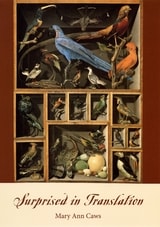
Surprised in Translation
Mary Ann Caws
University of Chicago Press, 2006
For Mary Ann Caws—noted translator of surrealist poetry—the most appealing translations are also the oddest; the unexpected, unpredictable, and unmimetic turns that translations take are an endless source of fascination and instruction. Surprised in Translation is a celebration of the occasional and fruitful peculiarity that results from some of the most flavorful translations of well-known authors. These translations, Caws avers, can energize and enliven the voice of the original.
In eight elegant chapters Caws reflects on translations that took her by surprise. Caws shows that the elimination of certain passages from the original—in the case of Stéphane Mallarmé translating Tennyson, Ezra Pound interpreting the troubadours, or Virginia Woolf rendered into French by Clara Malraux, Charles Mauron, and Marguerite Yourcenar—often produces a greater and more coherent art. Alternatively, some translations—such as Yves Bonnefoy’s translations of Shakespeare, Keats, and Yeats into French—require more lines in order to fully capture the many facets of the original. On other occasions, Caws argues, a swerve in meaning—as in Beckett translating himself into French or English—can produce a new text, just as true as the original.
Imbued with Caws’s personal observations on the relationship between translators and the authors they translate, Surprised in Translation will interest a wide range of readers, including students of translation, professional literary translators, and scholars of modern and comparative literature.
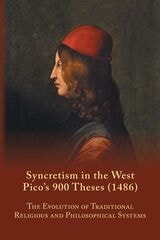
Syncretism in the West
Pico's 900 Theses (1486) With Text, Translation, and CommentaryEdited by S. A. Farmer
Arizona Center for Medieval and Renaissance Studies, 2016
This is the 2016 paperback printing of the 2008 edition of the popular text, translation, and commentary by S. A. Farmer. (The 2008 edition was a revised edition of the 1998 original publication).
Published by ACMRS (Arizona Center for Medieval and Renaissance Studies) in Tempe, Arizona as part of the MRTS (Medieval and Renaissance Texts and Studies) Series, this book -- previously available only in hardcover and otherwise out-of-print since 2014 -- is now available in its entirety in paperback format.