Results by title
65 books match the query 'Virginia' and 10 start with s

SUBURBAN ALCHEMY
1960S NEW TOWNS AND THE TRANSFORMATION ONICHOLAS DAGEN BLOOM
The Ohio State University Press, 2001
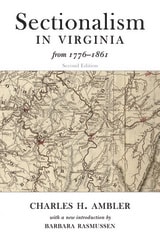
Sectionalism in Virginia from 1776 - 1861
Charles H. Ambler with a new introduction by Barbara Rasmussen
West Virginia University Press, 2008
This 1910 study of sectionalism in Virginia illustrates how the east and west of Virginia were destined to separate into two states. Barbara Rasmussen, professor of Public History and Director of Cultural Resource Management at West Virginia University writes a new introduction to Sectionalism in Virginia, setting Ambler’s classic grand achievement into the context of its production by creating an historical process for studying West Virginia history.
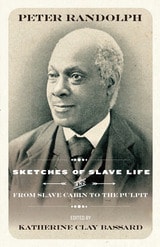
Sketches of Slave Life and From and From Slave Cabin to the Pulpit
Peter Randolph
West Virginia University Press, 2016
This book is the first anthology of the autobiographical writings of Peter Randolph, a prominent nineteenth-century former slave who became a black abolitionist, pastor, and community leader.
Randolph’s story is unique because he was freed and relocated from Virginia to Boston, along with his entire plantation cohort. A lawsuit launched by Randolph against his former master’s estate left legal documents that corroborate his autobiographies.
Randolph's writings give us a window into a different experience of slavery and freedom than other narratives currently available and will be of interest to students and scholars of African American literature, history, and religious studies, as well as those with an interest in Virginia history and mid-Atlantic slavery.
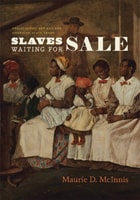
Slaves Waiting for Sale
Abolitionist Art and the American Slave TradeMaurie D. McInnis
University of Chicago Press, 2011
In 1853, Eyre Crowe, a young British artist, visited a slave auction in Richmond, Virginia. Harrowed by what he witnessed, he captured the scene in sketches that he would later develop into a series of illustrations and paintings, including the culminating painting, Slaves Waiting for Sale, Richmond, Virginia.
Southern Stalemate
Five Years without Public Education in Prince Edward County, VirginiaChristopher Bonastia
University of Chicago Press, 2011
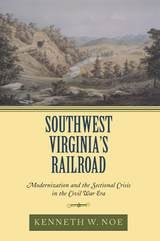
Southwest Virginia's Railroad
Modernization and the Sectional Crisis in the Civil War EraKenneth W. Noe
University of Alabama Press, 2003
A close study of one region of Appalachia that experienced economic vitality and strong sectionalism before the Civil War
This book examines the construction of the Virginia and Tennessee Railroad through southwest Virginia in the 1850s, before the Civil War began. The building and operation of the railroad reoriented the economy of the region toward staple crops and slave labor. Thus, during the secession crisis, southwest Virginia broke with northwestern Virginia and embraced the Confederacy. Ironically, however, it was the railroad that brought waves of Union raiders to the area during the war
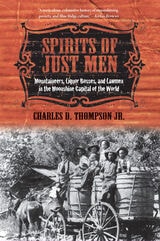
Spirits of Just Men
Mountaineers, Liquor Bosses, and Lawmen in the Moonshine Capital of the WorldCharles D. Thompson, Jr.
University of Illinois Press, 2011
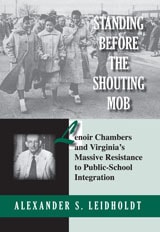
Standing Before the Shouting Mob
Lenoir Chambers and Virginia's Massive Resistance to Public School IntegrationAlex Leidholdt
University of Alabama Press, 2007
A southern journalist campaigns for racial understanding during the
struggle over school desegregation in Virginia.
In 1958 the nation's attention was focused on Norfolk,
Virginia, where nearly ten thousand students were locked out of their schools.
Rather than comply with the desegregation mandate of Brown v. Board
of Education, Governor J. Lindsay Almond, supported by the powerful
political machine of Senator Harry F. Byrd, Sr., had closed Norfolk's white
secondary schools.
Massive resistance to integration transformed Norfolk
into a civil rights arena. Although the process by which Norfolk's schools
were integrated was far from orderly, the transition was characterized
by debate, political maneuvering, and judicial action--not violence. Lenoir
Chambers, editor of the Norfolk Virginian-Pilot, conducted a five-year
editorial campaign supporting the peaceful implementation of the Court's
order. The Pilot was Virginia's only white newspaper to take this
position. Chambers was later awarded a Pulitzer Prize for his editorials.
Utilizing a wide range of primary and secondary sources,
Standing before the Shouting Mob examines Chambers's campaign, explores
the influences that shaped his racial views, and places him within the
context of southern journalism. The book also provides a detailed analysis
of Virginia's massive resistance and Norfolk's school closing.
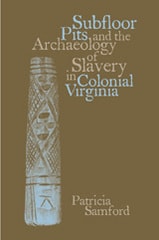
Subfloor Pits and the Archaeology of Slavery in Colonial Virginia
Patricia Samford
University of Alabama Press, 2007
Enslaved Africans and their descendants comprised a significant portion of colonial Virginia populations, with most living on rural slave quarters adjacent to the agricultural fields in which they labored. Archaeological excavations into these home sites have provided unique windows into the daily lifeways and culture of these early inhabitants.
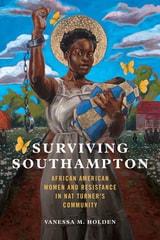
Surviving Southampton
African American Women and Resistance in Nat Turner's CommunityVanessa M. Holden
University of Illinois Press, 2021
The 1831 Southampton Rebellion led by Nat Turner involved an entire community. Vanessa M. Holden rediscovers the women and children, free and enslaved, who lived in Southampton County before, during, and after the revolt. Mapping the region's multilayered human geography, Holden draws a fuller picture of the inhabitants, revealing not only their interactions with physical locations but also their social relationships in space and time. Her analysis recasts the Southampton Rebellion as one event that reveals the continuum of practices that sustained resistance and survival among local Black people. Holden follows how African Americans continued those practices through the rebellion’s immediate aftermath and into the future, showing how Black women and communities raised children who remembered and heeded the lessons absorbed during the calamitous events of 1831.
A bold challenge to traditional accounts, Surviving Southampton sheds new light on the places and people surrounding Americas most famous rebellion against slavery.