1566 books match the query 'Christianity' and 111 start with s
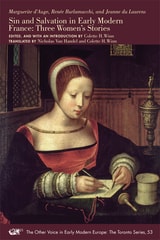
cover of Sin and Salvation in Early Modern France: Three Women’s Stories

Sin and Salvation in Early Modern France

Three Women’s Stories

Marguerite d'Auge, Renée Burlamacchi, and Jeanne du Laurens

Iter Press, 2017

The texts available here in English for the first time open a window into the lives of three early modern Frenchwomen as they explore the common themes of family, memory, sin, and salvation. The Regrets of Marguerite d’Auge (1600), the Memoirs of Renée Burlamacchi (1623), and the Genealogy of Jeanne du Laurens (1631), taken from different genres of historical writings, raise important questions: Why and how did female authorship find its way into the historical record? How did these voices escape the censorship and prejudice against female publication? In a time of extreme religious conflict, how did these women convey their views on controversial issues such as primacy of grace, indulgences, and salvation without disrupting the gender expectations of the era?
[more]
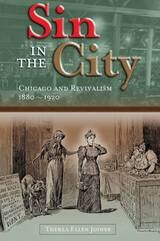
cover of Sin in the City: Chicago and Revivalism, 1880-1920

Sin in the City

Chicago and Revivalism, 1880-1920

Thekla Ellen Joiner

University of Missouri Press, 2013

  Long before today’s culture wars, the “Third Great Awakening” rocked America. During the late nineteenth and early twentieth centuries, evangelists such as Dwight L. Moody and Billy Sunday roused citizens to renounce sin as it manifested in popular culture, moral ambiguity, and the changing role of women.

            Sin in the City examines three urban revivals in turn-of-the-century Chicago to show how revivalists negotiated that era’s perceived racial, sexual, and class threats. While most studies of this movement have focused on its male leaders and their interactions with society, Thekla Ellen Joiner raises new questions about gender and race by exploring Third Awakening revivalism as the ritualized performance of an evangelical social system defined by middle-class Protestant moral aspirations for urban America. Rather than approaching these events merely as the achievements of persuasive men, she views them as choreographed collective rituals reinforcing a moral order defined by ideals of femininity, masculinity, and racial purity.

            Joiner reveals how revivalist rhetoric and ritual shifted from sentimentalist identification of sin with males to a more hard-nosed focus on females, castigating “loose women” whose economic and sexual independence defied revivalist ideals and its civic culture. She focuses on Dwight L. Moody’s 1893 World’s Fair revival, the 1910 Chapman-Alexander campaign, and the 1918 Billy Sunday revival, comparing the locations, organization, messages, and leaders of these three events to depict the shift from masculinized to feminized sin. She identifies the central role women played in the Third Awakening as the revivalists promoted feminine virtue as the corrective to America’s urban decline. She also shows that even as its definition of sin became more feminized, Billy Sunday’s revivalism began to conform to Chicago’s emerging color line.

            Enraged by rapid social change in cities like Chicago, these preachers spurred Protestant evangelicals to formulate a gendered and racialized moral regime for urban America. Yet, as Joiner shows, even as revivalists demonized new forms of entertainment, they used many of the modern cultural practices popularized in theaters and nickelodeons to boost the success of their mass conversions.

            Sin in the City shows that the legacy of the Third Awakening lives on today in the religious right’s sociopolitical activism; crusade for family values; disparagement of feminism; and promotion of spirituality in middle-class, racial, and cultural terms. Providing cultural and gender analysis too often lacking in the study of American religious history, it offers a new model for understanding the development of a gendered theology and set of religious practices that influenced Protestantism in a period of enormous social change.
[more]
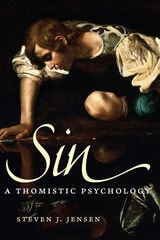
cover of Sin: A Thomistic Psychology

Sin

A Thomistic Psychology

Steven J. Jensen

Catholic University of America Press, 2018
If the human soul is made for good, then how do we choose evil? On the other hand, perhaps the human soul is not made for good. Perhaps the magnitude of human depravity reveals that the human soul may directly choose evil. Notably, Thomas Aquinas rejects this explanation for the prevalence of human sin. He insists that in all our desires we seek what is good. How, then, do we choose evil? Only by mistaking evil for good. This solution to the difficulty, however, leads Aquinas into another conundrum. How can we be held responsible for sins committed under a misunderstanding of the good? The sinner, it seems, has simply made an intellectual blunder. Sin has become an intellectual defect rather than a depravity of will and desire. Sin: A Thomistic Psychology grapples with these difficulties. A solution to the problem must address a host of issues. Does the ultimate good after which we all strive have unity, or is it simply a collection of basic goods? What is venial sin? What momentous choice must a child make in his first moral act? In what way do passion, a habitually evil will, and ignorance cause human beings to sin? What is the first cause of moral evil? Do human beings have free will to determine themselves to particular actions? The discussion of these topics focuses upon the interplay of reason, will, and the emotions, examining the inner workings of our moral deliberations. Ultimately, the book reveals how the failure to maintain balance in our deliberations subverts our fidelity to the one true good.
[more]
cover of Sing Them Over Again to Me: Hymns and Hymnbooks in America

Sing Them Over Again to Me

Hymns and Hymnbooks in America

Edited by Mark A. Noll and Edith L. Blumhofer

University of Alabama Press, 2006

Hymns and hymnbooks as American historical and cultural icons.

This work is a study of the importance of Protestant hymns in defining America and American religion. It explores the underappreciated influence of hymns in shaping many spheres of personal and corporate life as well as the value of hymns for studying religious life. Distinguishing features of this volume are studies of the most popular hymns (“Amazing Grace,” “O, For a Thousand Tongues to Sing,” “All Hail the Power of Jesus’ Name”), with attention to the ability of such hymns to reveal, as they are altered and adapted, shifts in American popular religion. The book also focuses attention on the role hymns play in changing attitudes about race, class, gender, economic life, politics, and society.
[more]
cover of Singing the Lord's Song in a Strange Land: Hymnody in the History of North American Protestantism

Singing the Lord's Song in a Strange Land

Hymnody in the History of North American Protestantism

Edith L. Blumhofer

University of Alabama Press, 2008

The latest scholarship on the role of hymns in American evangelicalism
 
Music and song are important parts of worship, and hymns have long played a central role in Protestant cultural history. This book explores the ways in which Protestants have used and continue to use hymns to clarify their identity and define their relationship with America and to Christianity. Representing seven groups—Baptists, Presbyterians, Lutherans, Mennonites, Holiness, Hispanics, and Evangelicals—the nine essays reveal how hymns have helped immigrants to establish new identities, contributed to the body of worship resources, and sustained ethnic identity.
 
Individual essays address the music of the Old-Fashioned Revival Hour, America’s longest running and most successful independent radio program; singing among Swedish evangelicals in America; the German hymn tradition as transformed by Mennonite immigrants; the ways hymnody reinforces themes of the Wesleyan holiness movement; the history of Mercer’s Cluster (1810), a southern hymnal that gave voice to slaves, women, and native Americans; and the Presbyterian hymnal tradition in Canada formed by Scottish immigrants.
 
[more]
cover of Sins of Christendom: Anti-Mormonism and the Making of Evangelicalism

Sins of Christendom

Anti-Mormonism and the Making of Evangelicalism

Nathaniel Wiewora

University of Illinois Press, 2024
Evangelical criticism of the Church of Jesus Christ of Latter-day Saints dates back to the earliest days of the Church. Nathaniel Wiewora uses the diverse animus expressed by evangelicals to illuminate how they used an imaginary Church as a proxy to disagree, attack, compromise, and settle differences among themselves. As Wiewora shows, the evangelical practice to contrast itself with the emerging faith not only encompassed but also went beyond religious matters. If Joseph Smith was accused of muddling religious truth, he and his followers also faced accusations of immoral economic practices and a sinful regard for wealth that reflected worries within the evangelical world. Attacks on Latter-day Saints’ emotional religious displays, the Book of Mormon’s authenticity, and the dangerous ideas represented by Nauvoo paralleled similar conflicts. Wiewora traces how the failure to blunt the Church’s success led evangelicals to change their own methods and pursue the religious education infrastructure that came to define parts of the movement.
[more]
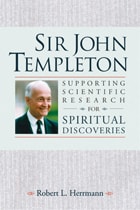
cover of Sir John Templeton: Supporting Scientific Research For Spiritual Discoveries

Sir John Templeton

Supporting Scientific Research For Spiritual Discoveries

Robert Herrmann

Templeton Press, 2004

The biography of the "Wizard of Wall Street" who has dedicated his life to advancing the scientific study of spiritual realities has been revised and updated. Sir John Templeton was an inspiring and motivational force both through his personal example and through the foundation that bears his name and is dedicated to his mission.
 
This volume reviews the life of this man of vision, from his childhood in rural Tennessee, to his education at Yale and Oxford, to his legendary years on Wall Street, the birth of his children, and the development and growth of "humility theology science." Interwoven with the stories and facts are the roots of his faith and the values that he credits for his financial success and are the catalyst for his lifelong mission.
 
Sir John's biography updates the growth of the many and varied programs of the John Templeton Foundation that support this mission. It also introduces some of the scientists, theologians, philosophers, writers, and fellow investors who now serve as staff and advisors to the John Templeton Foundation, striving toward Sir John's goal of one-hundred-fold more spiritual information gained through the application of scientific methodology and analysis.
[more]
cover of Sisters for Justice: Small Acts in the Transformation of Apartheid South Africa

Sisters for Justice

Small Acts in the Transformation of Apartheid South Africa

Catherine Higgs

University of Wisconsin Press, 2025

Sisters for Justice explores the activism of a select number of Catholic religious sisters in South Africa, beginning in the 1960s. Catherine Higgs analyzes how these individuals’ seemingly small actions in a variety of spheres helped shift policy and contribute to the dismantling of the apartheid state. As she reveals, they helped provide basic medical services to displaced Africans, opened private convent schools to children of all races despite segregationist laws, advocated for African pension rights, served on justice and peace commissions, and joined protests—all while working within the context of a hierarchical male-led church initially hesitant to criticize a state openly hostile to Catholics.

Based on extensive oral history interviews with white and Black sisters as well as deep archival research, this groundbreaking book reveals a largely untold story, nested within the broader literature of women’s activism in South Africa. The result is a new perspective that expands and intensifies our understanding of a dramatic period during which individual actions, in the aggregate, contributed to social change.
[more]
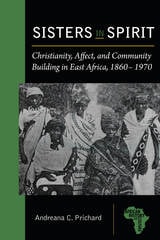
cover of Sisters in Spirit: Christianity, Affect, and Community Building in East Africa, 1860–1970

Sisters in Spirit

Christianity, Affect, and Community Building in East Africa, 1860–1970

Andreana C. Prichard

Michigan State University Press, 2017
In this pioneering study, historian Andreana Prichard presents an intimate history of a single mission organization, the Universities’ Mission to Central Africa (UMCA), told through the rich personal stories of a group of female African lay evangelists. Founded by British Anglican missionaries in the 1860s, the UMCA worked among refugees from the Indian Ocean slave trade on Zanzibar and among disparate communities on the adjacent Tanzanian mainland. Prichard illustrates how the mission’s unique theology and the demographics of its adherents produced cohorts of African Christian women who, in the face of linguistic and cultural dissimilarity, used the daily performance of a certain set of “civilized” Christian values and affective relationships to evangelize to new inquirers. The UMCA’s “sisters in spirit” ultimately forged a united spiritual community that spanned discontiguous mission stations across Tanzania and Zanzibar, incorporated diverse ethnolinguistic communities, and transcended generations. Focusing on the emotional and personal dimensions of their lives and on the relationships of affective spirituality that grew up among them, Prichard tells stories that are vital to our understanding of Tanzanian history, the history of religion and Christian missions in Africa, the development of cultural nationalisms, and the intellectual histories of African women.
 
[more]
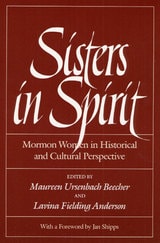
cover of Sisters in Spirit: Mormon Women in Historical and Cultural Perspective

Sisters in Spirit

Mormon Women in Historical and Cultural Perspective

Edited by Maureen Ursenbach Beecher and Lavina Fielding Anderson

University of Illinois Press, 1987

This book of essays about Mormon women, all written and edited by scholars who are themselves Mormon women, is a brave and important work. Readers will fully appreciate just how brave and important it really is, however, if they can see how this work of historical theology fits into the history of historical writing about Mormon women, as well as how it fits into Mormon history itself.
 
"The women who contributed to this book are among the best of the Mormon literati . . . [they] hold that there is hope within the church for change, for reform, for expansion of the place of women." -- Women's Review of Books
 
"Historians of women in America have a great deal to learn from the history of Mormon women. This fine set of essays provides an excellent introduction to a subject about which we should all know more." -- Anne Firor Scott, author of Making the Invisible Woman Visible.
 
[more]
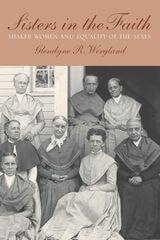
cover of Sisters in the Faith: Shaker Women and Equality of the Sexes

Sisters in the Faith

Shaker Women and Equality of the Sexes

Glendyne R. Wergland

University of Massachusetts Press, 2011

In 1788, following the death of charismatic founder Mother Ann Lee, the celibate religious group known as the Shakers set out to institutionalize equality of the sexes in their theology, government, and daily practice. In this book, Glendyne Wergland evaluates how well they succeeded in that mission by examining the experiences of women within Shaker communities over more than a century. 

Drawing on an extensive archive of primary documents, Wergland discusses topics ranging from girlhood, health, and dress to why women joined the Shakers and how they were viewed by those outside their community. She analyzes the division of labor between men and women, showing that there was considerable cooperation and reciprocity in carrying out most tasks—from food production to laundering to gathering firewood—even as gendered conflicts remained. 

In her conclusion, Wergland draws together all of these threads to show that Shaker communities achieved a remarkable degree of gender equality at a time when women elsewhere still suffered under the legal and social strictures of the traditional patriarchal order. In so doing, she argues, the experience of Shaker women served as a model for promoting women's rights in American political culture.
[more]
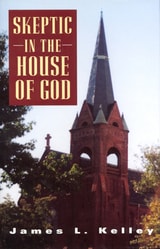
cover of Skeptic in the House of God

Skeptic in the House of God

Kelley, James L

Rutgers University Press, 1997

James L.Kelley, a skeptic about religion, writes with insight and humor of his journey through St. Mark's, an Episcopal church that welcomes doubters without pressuring them to compromise their intellectual integrity. When Kelley first visited the church well into his forties, he was searching for a respite from urban malaise and found himself filled with disquieting questions: How could he reconcile his convictions with the central purpose of the church-to worship a God he didn't believe in? Could he say the prayers and sing the hymns while remaining an honest skeptic?

After fifteen years of full participation in a church that is open not only to skeptics but also to gay men and lesbians, blacks and Jews, where members are invited to critique Sunday sermons, and where hymns are rewritten to reflect feminist concerns, Kelley found that his agnosticism remained but his skepticism about church participation had disappeared. Modern urban life can be a sterile, isolating experience. Yet in St. Mark's Kelley discovered a place of vibrant community, honest inquiry, and support over the hard places in life.
[more]
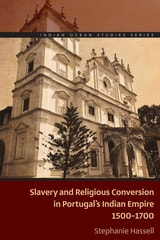
cover of Slavery and Religious Conversion in Portugal's Indian Empire, 1500-1700

Slavery and Religious Conversion in Portugal's Indian Empire, 1500-1700

Stephanie Hassell

Ohio University Press, 2025

In the sixteenth and seventeenth centuries, enslaved Africans and Asians were part of the larger Portuguese project of building and maintaining a Catholic empire in the Indian Ocean. Both the Church and the Crown influenced the owner-slave relationship across households, the most basic organizational unit of power over the populace. Responsible for their enslaved dependents’ conversion to Catholicism, slaveholders became religious stewards whose spiritual duties toward their slaves helped expand the Christian population. This converted population was part of the imperial security apparatus, which conceptualized enslaved Catholics as loyal allies against neighboring Muslim states. They became members of the broader colonial community in which Catholicism also conveyed rights, enabled agency, and provoked household struggles between owners and slaves. Thus, the making of a Catholic empire was a contested process tied to the complex relationships between enslaved individuals, their enslavers, and the Church. The Portuguese Inquisition was a hybrid ecclesiastical and state institution, and its records detail the Crown’s commitment to the creation of a worldwide Catholic empire. Accordingly, inquisitorial encounters brought conversion, slavery, and empire into one field of vision. The Portuguese Inquisition had only one overseas tribunal, located in Goa, India. While most trial records of the Goa Tribunal were destroyed, author Stephanie Hassell has utilized extant sixteenth- and seventeenth-century cases featuring enslaved defendants and witnesses. Her use of thousands of case summaries provides a broader inquisitorial context by showing how prosecutorial trends reflected the anxieties of the Portuguese imperial state. Parish records, ecclesiastical council records, and municipal council records likewise emphasize the significance of religious conversion.
[more]
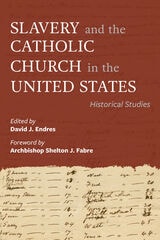
cover of Slavery and the Catholic Church in the United States: Historical Studies

Slavery and the Catholic Church in the United States

Historical Studies

David J. Endres

Catholic University of America Press, 2023
The intertwining of U.S. Catholicism and race-based slavery is a painful aspect of the Church’s history. Many scholars have shied away from this uncomfortable topic, but in recent years a cadre of historians have studied Catholics’ varied roles: as enslaved persons, slaveholders, defenders of slavery, and, in a few cases, advocates of abolition and emancipation. This collection of nine essays is divided into three sections: enslaved persons and slaveholders, debating abolition and emancipation, and historians and historiography. The studies, many of which are informed by recent archival discoveries, offer a model for historians seeking to understand the relationship between slavery and the Church, not only topically but in terms of methods, contexts, and resources. They contribute to a broader appreciation of religion’s role in race-based slavery and, in doing so, will assist scholars, teachers, and students in the contemporary discussion involving slavery, racism, and their legacies. Slavery and the Catholic Church in the United States witnesses to the fragility of humanity, which is capable of freedom or slavery, brotherhood or hatred. Yet each chapter offers a ray of hope, suggesting how we might acknowledge and respond to this difficult history.
[more]
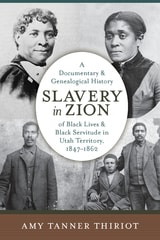
cover of Slavery in Zion: A Documentary and Genealogical History of Black Lives and Black Servitude in Utah Territory, 1847-1862

Slavery in Zion

A Documentary and Genealogical History of Black Lives and Black Servitude in Utah Territory, 1847-1862

Amy Tanner Thiriot

University of Utah Press, 2022

According to an Akan proverb, “It is not wrong to go back for that which you have forgotten.” This belief underlies historian Amy Tanner Thiriot’s work in Slavery in Zion, which combines genealogical and historical research to bring to light events and relationships unknown or misunderstood for well over a century. The total number of enslaved people in Utah’s early history has remained an open question for many years, due in part to the nature of nineteenth-century records, and an exact number is undetermined. But while writing this book Thiriot documented around one hundred enslaved or indentured Black men, women, and children in Utah Territory.
 
Slavery in Zion has two major parts. The first section provides an introductory history, chapters on southern and western experiences, and information on life after emancipation. The second section is a biographical encyclopedia of names, relationships, and events. Although Slavery in Zion contains material applicable to legal history and the history of race and Mormonism, its most important contribution is as an archive of the experiences of Utah’s enslaved Black people, at last making their stories an integral part of the record of Utah and the American West—no longer forgotten or written out of history.
[more]
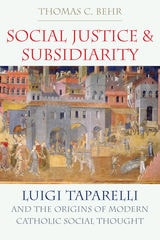
cover of Social Justice and Subsidiarity: Luigi Taparelli and the Origins of Modern Catholic Social Thought

Social Justice and Subsidiarity

Luigi Taparelli and the Origins of Modern Catholic Social Thought

Thomas C. Behr

Catholic University of America Press, 2020
Luigi Taparelli, SJ, 1793-1862, in his Theoretical Treatise of Natural Right Based on Fact, 1840-43, presents a neo-Thomistic approach to social, economic, and political sciences grounded in an integral conception of the human person as social animal but also as rational truth seeker. His conceptions of social justice and of subsidiarity are fundamental to modern Catholic social teaching (CST). His work moves away from traditionalist-conservative reaction in favor of an authentically human, moderately liberal, modernity built on the harmony of faith and reason. He zealously deconstructs laissez-faire liberal ideology and its socialist progeny in scores of articles in the Civiltà Cattolica, the journal that he co-founded in 1850. His arguments figure prominently in the Syllabus of Errors (1864) of Pius IX. Though a moderate liberal himself, his reputation as anti-liberal reactionary and defender of Papal temporal sovereignty is the chief reason why Pope Leo XIII later sought to quiet Taparelli’s contribution to the foundations and pillars of modern CST that began with the restoration of Thomistic philosophy in Aeterni Patris (1879), and the “magna carta” of modern Catholic social teaching, Rerum Novarum (1891). Pius XI relies heavily on Taparelli’s concept of subsidiarity in Quadragesimo Anno (1931), and sought to advance interest in Taparelli studies. However, Taparelli’s eclectic philosophical orientation and writing style have been a considerable stumbling block. In this present book, Taparelli’s ideas are evaluated both for their philosophical character but also in their historical context. Taparelli’s theories of the just society and ordered liberty, are as timely nowadays for reasoned political and ethical discourse as ever. The book includes an appendix of translated portions of the Theoretical Treatise of Natural Right Based on Fact that relate to subsidiarity.
[more]
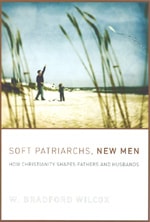
cover of Soft Patriarchs, New Men: How Christianity Shapes Fathers and Husbands

Soft Patriarchs, New Men

How Christianity Shapes Fathers and Husbands

W. Bradford Wilcox

University of Chicago Press, 2004

In the wake of dramatic, recent changes in American family life, evangelical and mainline Protestant churches took markedly different positions on family change. This work explains why these two traditions responded so differently to family change and then goes on to explore how the stances of evangelical and mainline Protestant churches toward marriage and parenting influenced the husbands and fathers that fill their pews.

According to W. Bradford Wilcox, the divergent family ideologies of evangelical and mainline churches do not translate into large differences in family behavior between evangelical and mainline Protestant men who are married with children. Mainline Protestant men, he contends, are "new men" who take a more egalitarian approach to the division of household labor than their conservative peers and a more involved approach to parenting than men with no religious affiliation. Evangelical Protestant men, meanwhile, are "soft patriarchs"—not as authoritarian as some would expect, and given to being more emotional and dedicated to their wives and children than both their mainline and secular counterparts. Thus, Wilcox argues that religion domesticates men in ways that make them more responsive to the aspirations and needs of their immediate families.
[more]
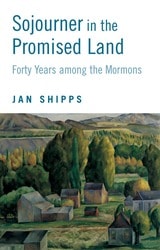
cover of Sojourner in the Promised Land: Forty Years among the Mormons

Sojourner in the Promised Land

Forty Years among the Mormons

Jan Shipps

University of Illinois Press, 2001
Infused with Jan Shipps’s lively curiosity, scholarly rigor, and contagious fascination with a significant subculture, Sojourner in the Promised Land presents a distinctive parallel history in which Shipps surrounds her professional writings about the Latter-day Saints with an ongoing personal description of her encounters with them. By combining a portrait of the dynamic evolution of contemporary Mormonism with absorbing intellectual autobiography, Shipps illuminates the Mormons and at the same time shares with the reader what it has been like to be on the outside of a culture that remains both familiar and strange.
[more]
cover of Solemn Covenant: THE MORMON POLYGAMOUS PASSAGE

Solemn Covenant

THE MORMON POLYGAMOUS PASSAGE

B. Carmon Hardy

University of Illinois Press, 1992

Winner of the Mormon History Association Best Book Award, 1993.
[more]
cover of Some Hard Stars

Some Hard Stars

Thacker, David

Signature Books, 2026

Some Hard Stars knits together past and present in pursuit of a deeper understanding of love, rebirth, and sustaining joy. Through poems full of care and tenderness for family, neighbors, and friends, Thacker demonstrates how “love requires / a willing mind,” especially when confronting the difficulties of mortality with honesty. These poems sing and think out loud, through traditional forms and meters as well as through music invented for the needs at hand. They are intense and exacting in their questions, careful and complex in their laments, and delicate with sacred moments of change.
[more]
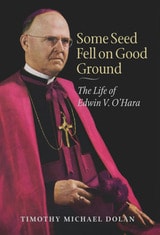
cover of Some Seed Fell on Good Ground: The Life of Edwin V. O'Hara

Some Seed Fell on Good Ground

The Life of Edwin V. O'Hara

Timothy Michael Dolan

Catholic University of America Press, 2012
A man far ahead of his time, Archbishop Edwin V. O'Hara of Kansas City (1881-1956) orchestrated numerous initiatives that profoundly affected American Catholic life.
[more]
cover of Songs for the Fast and Pascha

Songs for the Fast and Pascha

Blake St. Ephrem the Syrian

Catholic University of America Press, 2022
Among the writers of the Syriac Christian tradition, none is as renowned as St. Ephrem of Nisibis (ca. 307–373), known to much of the later Christian world simply as “the Syrian.” The great majority of Ephrem’s works are poetry, with the madrāšē (“teaching songs”) especially prominent. This volume presents English translations of four complete madrāšē cycles of Ephrem: On the Fast, On the Unleavened Bread, On the Crucifixion, and On the Resurrection. These collections include some of the most liturgically oriented songs in Ephrem’s corpus, and, as such, provide a window into the celebration of Lent and Easter in the Syriac-speaking churches of northern Mesopotamia in the fourth century. Even more significantly, they represent some of the oldest surviving poetry composed for these liturgical seasons in the entire Christian tradition. Not only are the liturgical occasions of the springtime months a source of colorful imagery in these texts, but Ephrem also employs traditional motifs of warm weather, spring rainstorms, and revived vegetation, which likely reflect Hellenistic literary influences. Like all of Ephrem’s poetry, these songs express early Christian theology in language that is symbolic, terse, and vibrant. They are rich with biblical allusions and references, especially to the Exodus and Passion narratives. They also reveal a contested religious environment in which Ephrem strove to promote the Christian Pascha and Christian interpretations of Scripture over and against those of Jewish communities in the region, thus maintaining firm boundaries around the identity and practices of the churches.
[more]
cover of Sonia Johnson: A Mormon Feminist

Sonia Johnson

A Mormon Feminist

Christine Talbot

University of Illinois Press, 2024

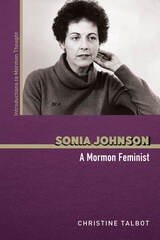
Few figures in the history of the Church of Jesus Christ of Latter-day Saints provoke such visceral responses as Sonia Johnson. Her unrelenting public support of the Equal Rights Amendment (ERA) made her the face of LDS feminism while her subsequent excommunication roiled the faith community.

Christine Talbot tells the story of Sonia’s historic confrontation with the Church within the context of the faith’s first large-scale engagement with the feminist movement. A typical if well-educated Latter-day Saints homemaker, Sonia was moved to action by the all-male LDS leadership’s opposition to the ERA and a belief the Church should stay out of politics. Talbot uses the activist’s experiences and criticisms to explore the ways Sonia’s ideas and situation sparked critical questions about LDS thought, culture, and belief. She also illuminates how Sonia’s excommunication shaped LDS feminism, the Church’s antagonism to feminist critiques, and the Church itself in the years to come.

A revealing and long-overdue account, Sonia Johnson explores the life, work, and impact of the LDS feminist.
[more]
cover of Southern Religion and Christian Diversity in the Twentieth Century

Southern Religion and Christian Diversity in the Twentieth Century

Wayne Flynt, Foreword by Charles A. Israel and John Giggie

University of Alabama Press, 2016

Essays by the distinguished historian of southern religion Wayne Flynt, that illuminate the often overlooked complexity among southern Protestants.

Throughout its dramatic history, the American South has wrestled with issues such as poverty, social change, labor reform, civil rights, and party politics, and Flynt’s writing reaffirms religion as the lens through which southerners understand and attempt to answer these contentious questions. In Southern Religion and Christian Diversity in the Twentieth Century, however, Flynt gently but persuasively dispels the myth—comforting to some and dismaying to others—of religion in the South as an inert cairn of reactionary conservatism.

Flynt introduces a wealth of stories about individuals and communities of faith whose beliefs and actions map the South’s web of theological fault lines. In the early twentieth century, North Carolinian pastor Alexander McKelway became a relentless crusader against the common practice of child labor. In 1972, Rev. Dr. Ruby Kile, in a time of segregated churches led by men, took the helm of the eight-member Powderly Faith Deliverance Center in Jefferson County, Alabama and built the fledgling group into a robust congregation with more than 700 black and white worshippers. Flynt also examines the role of religion in numerous pivotal court cases, such as the US Supreme Court school prayer case Engel v. Vitale, whose majority opinion was penned by Justice Hugo Black, an Alabamian. These fascinating case studies and many more illuminate a religious landscape of far more varied texture and complexity than is commonly believed.

Southern Religion and Christian Diversity in the Twentieth Century offers much to readers and scholars interested in the South, religion, and theology. Writing with his hallmark wit, warmth, and erudition, Flynt’s Southern Religion and Christian Diversity in the Twentieth Century is a vital record of gospel-inspired southerners whose stories revivify sclerotic assumptions about the narrow conformity of southern Christians. 
[more]
cover of Southwell's Sphere: The Influence of England's Secret Poet

Southwell's Sphere

The Influence of England's Secret Poet

Gary M. Bouchard

St. Augustine's Press, 2016
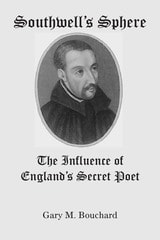
Once feared by Queen Elizabeth I and admired by William Shakespeare, Robert Southwell, s.j. (1561–1595), clings today to a thinning canonical presence in English literature among a sphere of other writers incongruously called the metaphysical poets. Southwell’s Sphere lifts this sixteenth century Jesuit priest and prolific writer from the obscurity in which he too often resides and places him instead at the center of a sphere of English poets upon whom his life and works exerted an observable influence. As he weaved his religious content into the familiar loom of Elizabethan form and style, this young missionary priest was seeking not just to catechize those whom he regarded as the faithful and the fallen, but to intentionally reform the verse of his native England. Remarkably, during his brief six-year mission, he actually managed in many respects to do so. Surviving for six years by successfully navigating and fostering a complicated underground Catholic network in and around London before being captured, tortured and imprisoned, Southwell was brought to trial and executed at Tyburn at age 33. He therefore never knew most of the “skillfuller wits” that he called upon to direct their poetic skills to the service of God. And like the marks upon his tortured body, the poetic marks of influence that his work left upon individual writers of this era were in many cases deliberately concealed. Southwell’s Sphere seeks to rediscover those marks and offer the reader a renewed appreciation for this subverted and subverting literary force in Early Modern England. In individual explicative chapters this book examines works by six poets whose verse may be appreciated differently in light of Robert Southwell’s life and work. The author makes the case that Southwell’s works, posthumously and prolifically published, instructed William Alabaster, provoked Edmund Spenser, prompted George Herbert, haunted John Donne, inspired Richard Crashaw and — two and a half centuries later — consoled Gerard Manley Hopkins, s.j. With the exception of Spenser, all of these poets were, like Southwell, ordained ministers. The particular personal, political and religious complexities of each of their lives notwithstanding, what they most shared in common with Southwell was their priestly vocation, their talent as English poets and the inevitable and inextricable joining of these two activities in their lives. While it would have made little sense for any of these poets to acknowledge Southwell as a poetic peer, each of them authored important verse that can best be appreciated within the sphere of this improbably successful and influential English poet.
[more]
cover of Spencer Kimball's Record Collection: Essays on Mormon Music

Spencer Kimball's Record Collection

Essays on Mormon Music

Michael Hicks

Signature Books, 2020

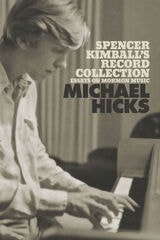
At times jubilant, at times elegiac, this set of ten essays by music historian Michael Hicks navigates topics that range from the inner musical life of Joseph Smith to the Mormon love of blackface musicals, from endless wrangling over hymnbooks to the compiling of Mormon folk and exotica albums in the 1960s.  It also offers a brief memoir of what happened to LDS Church President Spencer Kimball’s record collection and a lengthy, brooding piece on the elegant strife it takes to write about Mormon musical history in the first place.  There are surprises and provocations, of course, alongside judicious sifting of sources and weighing of evidence. The prose is fresh, the research smart, and the result a welcome mixture of the careful and the carefree from Mormonism’s best-known scholar of musical life.
[more]
cover of Spiraling Into God: Bonaventure on Grace, Hierarchy , and Holiness

Spiraling Into God

Bonaventure on Grace, Hierarchy , and Holiness

Katherine Wrisley Shelby

Catholic University of America Press, 2023
Spiraling into God: Bonaventure on Grace, Hierarchy, and Holiness offers a systematic account of the Seraphic Doctor’s doctrine of grace across his speculative-academic, mystical, hagiographical, and pastoral texts. It does so by arguing that an account of this kind can only be provided by also attending to his theology of hierarchy, a methodology derived from Bonaventure’s claim in the Major Legend of St. Francis that Francis of Assisi was a “vir hierarchicus,” or hierarchical man. As the book explores in great depth, this appellation relies upon Bonaventure’s reading of a Victorine Dionysian interpreter by the name of Thomas Gallus, whose “angelic anthropology”—or notion of the hierarchical soul—becomes a crucial component within the Seraphic Doctor’s teaching on grace as he interprets the sanctity of St. Francis. Throughout the course of his career, Bonvaenture will define sanctifying grace as a created “inflowing” (influentia) that “hierarchizes” human beings by purifying, illuminating, and perfecting them from within, thus causing them to become a similitude of the Trinity. This book explains what this means and why it matters. Most existing scholarship on this subject in Bonaventure’s thought interprets it as a subtopic with respect to other themes—for example, with respect to his Christology or his Trinitarian theology—rather than taking the time to understand his doctrine of grace in its own right. Alternatively, scholarly treatments of his doctrine of grace will treat it at length, but will only examine the topic as it appears in his more speculative-academic texts—most especially his Commentary on the Sentences or his famous Itinerarium Mentis in Deum—without bringing these into conversation with his pastoral works, sermon literature, or hagiographical texts. This book provides the first unified treatment of Bonaventure’s doctrine of grace across all these different genres of his known corpus, and in so doing, fills a massive lacuna in both Bonaventurean scholarship and in the field of medieval historical theology.
[more]
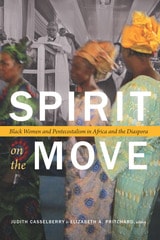
cover of Spirit on the Move: Black Women and Pentecostalism in Africa and the Diaspora

Spirit on the Move

Black Women and Pentecostalism in Africa and the Diaspora

Judith Casselberry and Elizabeth Pritchard, editors

Duke University Press, 2019

Pentecostalism is currently the fastest-growing Christian movement, with hundreds of millions of followers. This growth overwhelmingly takes place outside of the West, and women make up 75 percent of the membership. The contributors to Spirit on the Move examine Pentecostalism's appeal to black women worldwide and the ways it provides them with a source of community and access to power. Exploring a range of topics, from Neo-Pentecostal churches in Ghana that help women challenge gender norms to evangelical gospel musicians in Brazil, the contributors show how Pentecostalism helps black women draw attention to and seek remediation from the violence and injustices brought on by civil war, capitalist exploitation, racism, and the failures of the state. In fleshing out the experiences, theologies, and innovations of black women Pentecostals, the contributors show how Pentecostal belief and its various practices reflect the movement's complexity, reach, and adaptability to specific cultural and political formations.

Contributors. Paula Aymer, John Burdick, Judith Casselberry, Deidre Helen Crumbley, Elizabeth McAlister, Laura Premack, Elizabeth A. Pritchard, Jane Soothill, Linda van de Kamp
[more]
cover of Spirit's Gift: The Metaphysical Insight of Claude Bruaire

Spirit's Gift

The Metaphysical Insight of Claude Bruaire

Antonio López, F.S.C.B.

Catholic University of America Press, 2006
Spirit's Gift is the first book in English devoted to the philosophy of Claude Bruaire (1932-1986). Its focus is the notion of gift, a notion that has recently been the subject of lively debate involving Jacques Derrida, Jean-Luc Marion, Marcel Mauss, and others.
[more]
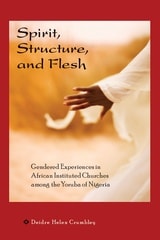
cover of Spirit, Structure, and Flesh: Gender and Power in Yoruba African Instituted Churches

Spirit, Structure, and Flesh

Gender and Power in Yoruba African Instituted Churches

Deidre Helen Crumbley

University of Wisconsin Press, 2008
Although popularized in Africa by Western missionaries, the Christian faith as practiced by Africans has acquired unique traits over time. Some of the most radical reinterpretations of Christianity are offered by those churches known as “AICs” (variously, African Initiated, African Instituted, or African Independent Churches)—new denominations founded by Africans skeptical of dogma offered by mainstream churches with roots in European empires. As these churches spread throughout the African diaspora, they have brought with them distinct practices relating to gender. Such practices range from the expectation that women avoid holy objects and sites during menstruation to the maintenance of church structures in which both men and women may be ordained and assigned the same duties and responsibilities.
            How does having a female body affect one’s experience of indigenized Christianity in Africa? Spirit, Structure, and Flesh addresses this question by exploring the ways ritual, symbol, and dogma circumscribe, constrain, and liberate women in AICs. Through detailed description of worship and doctrine, as well as careful analyses of church history and organizational processes, Deidre Helen Crumbley explores gendered experiences of faith and power in three Nigerian indigenous AICs, demonstrating the roles of women in the day-to-day life of these churches.
[more]
cover of Spiritual Connection in Daily Life: Sixteen Little Questions That Can Make a Big Difference

Spiritual Connection in Daily Life

Sixteen Little Questions That Can Make a Big Difference

Lynn Underwood

Templeton Press, 2013

How often do you find moments of deep peace and satisfaction in your day-to-day life? How often does connection with other people, the divine, or nature make you feel more alive? How often are you touched by a sense of awe-inspiring beauty, compassionate love, or pure joy? For many of us, these kinds of experiences tend to be fleeting and all too rare. Fortunately, new research is suggesting that a regular practice of paying attention to experiences like these can help any of us find them more often and cultivate richer, deeper, and more satisfying lives.
 
In Spiritual Connection in Daily Life, Lynn Underwood introduces her Daily Spiritual Experience Scale (DSES), which is comprised of sixteen simple, multiple-choice questions that invite us to become more attuned tothese extraordinary experiences in ordinary life. The DSES is the definitive set of questions for measuring the experience of spiritual connection and has been used in hundreds of studies, translated into over twenty languages, and used around the world by counselors, therapists, nurses, social workers, clergy from multiple faiths, and business leaders.
 
Spiritual Connection in Daily Life offers a step-by-step guide to using the DSES to improve our abilities to sense the “more than” in the midst of our days. Embraced by people from many different cultures, religious traditions, and professional backgrounds, the DSES doesn’t require any extraordinary experience like hearing divine voices or embarking upon a dramatic religious conversion. Nor does it belabor the exact definition of “spirituality.” Rather, it simply invites us to focus on aspects of our daily lives such as deep peace, sense of inner strength, longing, and compassionate love. The sixteen questions also provide a common, nonpolarizing language for communicating with others about the role of the “more than” in our lives.
 
Adherents of all faith traditions, as well as people with no religious leanings whatsoever, have experienced profound and lasting benefits from having these experiences, including improved health behaviors, better relationships, decreased stress and burnout, and improvements in daily mood. Now all of us can reap these same long-term benefits with just a little bit of self-reflection and Dr. Underwood’s expert guidance.

[more]
cover of Spiritual Writings of Sister Margaret of the Mother of God (1635-1643)

Spiritual Writings of Sister Margaret of the Mother of God (1635-1643)

Margaret Van Noort

Iter Press, 2015

In 1635, as directed by her confessor so that he might understand “the state of her soul,” Margaret Van Noort, a lay sister of the royal convent of Discalced Carmelite nuns in Brussels, composed her spiritual autobiography. This text was followed by two diaries in 1636 and 1637 recording the workings of her inner life and relation to God, and reflecting the cosmopolitan Catholic tradition of her homeland. Now gathered in this volume, these works illustrate Margaret’s development from a troubled young lay sister into a woman of spiritual experience and authority.
[more]
cover of Spirituality and the Writer: A Personal Inquiry

Spirituality and the Writer

A Personal Inquiry

Thomas Larson

Ohio University Press, 2019

Today, the surprisingly elastic form of the memoir embraces subjects that include dying, illness, loss, relationships, and self-awareness. Writing to reveal the inner self—the pilgrimage into one’s spiritual and/or religious nature—is a primary calling. Contemporary memoirists are exploring this field with innovative storytelling, rigorous craft, and new styles of confessional authorship. Now, Thomas Larson brings his expertise as a critic, reader, and teacher to the boldly evolving and improvisatory world of spiritual literature.

In his book-length essay Spirituality and the Writer, Larson surveys the literary insights of authors old and new who have shaped religious autobiography and spiritual memoir—from Augustine to Thomas Merton, from Peter Matthiessen to Cheryl Strayed. He holds them to an exacting standard: they must render transcendent experience in the writing itself. Only when the writer’s craft prevails can the fleeting and profound personal truths of the spirit be captured. Like its predecessor, Larson’s The Memoir and the Memoirist,Spirituality and the Writer will find a home in writing classrooms and book groups, and be a resource for students, teachers, and writers who seek guidance with exploring their spiritual lives.
[more]
cover of Spirituality, Gender, and the Self in Renaissance Italy: Angela Merici and the Company of St. Ursula (1474–1540)

Spirituality, Gender, and the Self in Renaissance Italy

Angela Merici and the Company of St. Ursula (1474–1540)

Querciolo Mazzonis

Catholic University of America Press, 2007
Spirituality, Gender, and the Self in Renaissance Italy places St. Angela Merici and her Company of St. Ursula in historical and religious context and examines them from a variety of perspectives: institutional, social, spiritual, and cultural.
[more]
cover of Spoils of the Kingdom: Clergy Misconduct and Religious Community

Spoils of the Kingdom

Clergy Misconduct and Religious Community

Anson Shupe

University of Illinois Press, 2006

In Spoils of the Kingdom, Anson Shupe investigates clergy misconduct as it has recently unfolded across five faith-based groups. Looking at episodes of abuse in the Roman Catholic, Mormon, African American Protestant, white Evangelical Protestant, and First Nations communities, Spoils of the Kingdom tackles hard questions not only about the sexual abuse of women and children, but also about economic frauds perpetrated by church leaders (including embezzlement, mis-represented missions, and outright theft) as well as cases of excessively authoritarian control of members’ health, lifestyles, employment, and politics.
 
Drawing on case evidence, Shupe employs classical and modern social exchange theories to explain the institutional dynamics of clergy misconduct. He argues that there is an implicit contract of reciprocity and compliance between congregants and religious leaders that, when amplified by the charismatic awe often associated with religious authorities, can lead to misconduct.
 
[more]
cover of Sport and Christianity: A Sign of the Times in the Light of Faith

Sport and Christianity

A Sign of the Times in the Light of Faith

Kevin Lixey

Catholic University of America Press, 2012

Sport and Christianity explores the connections between these two seemingly disparate phenomena. It reflects on what the fascination for sport reveals about the human person and to what degree sporting activities are compatible with, and can even advance, the church's mission.
[more]
cover of Sports in Zion: Mormon Recreation, 1890-1940

Sports in Zion

Mormon Recreation, 1890-1940

Richard Ian Kimball

University of Illinois Press, 2002

If a religion cannot attract and instruct young people, it will struggle to survive, which is why recreational programs were second only to theological questions in the development of twentieth-century Mormonism. In this book, Richard Ian Kimball explores how Mormon leaders used recreational programs to ameliorate the problems of urbanization and industrialization and to inculcate morals and values in LDS youth. As well as promoting sports as a means of physical and spiritual excellence, Progressive Era Mormons established a variety of institutions such as the Deseret Gymnasium and camps for girls and boys, all designed to compete with more "worldly" attractions and to socialize adolescents into the faith.

Kimball employs a wealth of source material including periodicals, diaries, journals, personal papers, and institutional records to illuminate this hitherto underexplored aspect of the LDS church. In addition to uncovering the historical roots of many Mormon institutions still visible today, Sports in Zion is a detailed look at the broader functions of recreation in society.
[more]
cover of St. Augustine on Marriage and Sexuality (Selections from the Fathers of the Church, Volume 1)

St. Augustine on Marriage and Sexuality (Selections from the Fathers of the Church, Volume 1)

Saint Augustine

Catholic University of America Press, 1996
[more]
cover of St. Augustine's Interpretaion of the Psalms of Ascent

St. Augustine's Interpretaion of the Psalms of Ascent

Gerard McLarney

Catholic University of America Press, 2014
Recent research has explored how past interpretation can help contextualize current interpretation as well as provide a more colorful and theologically meaningful understanding of scripture. In St. Augustine's Interpretation of the Psalms of Ascent, Gerald McLarney examines Augustine of Hippo's (d. 430) interpretation of the ascent motif in sermons on Psalms 119-133. He looks at the delivery, transmission, and broader context of the sermons, as well as examining the sermons as they stand.
[more]
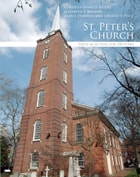
cover of St. Peter's Church: Faith in Action for 250 Years

St. Peter's Church

Faith in Action for 250 Years

Cornelia Frances Biddle

Temple University Press, 2011

Celebrating 250 years, St. Peter's Episcopal Church in the Society Hill neighborhood of Philadelphia, has witnessed a rich mixture of people and events that reflect critical periods of American political and cultural history. George Washington worshiped here as did abolitionists and slave holders, Whigs, Democrats, and Republicans. St. Peter's was a point of first contact for thousands of immigrants, and the church opened schools for immigrants to help them to acculturate to life in Philadelphia.

Opening a window onto colonial Philadelphia and the nation's histories, St. Peter's Church is a glorious testament to this National Historic Landmark. In addition to the stories and hundreds of black-and-white and color photographs, this handsome volume provides a history of the grounds, the churchyard, and the church itself-a classic example of eighteenth-century Philadelphia design that later incorporated the work of renown architects William Strickland, Thomas U. Walter, and Frank Furness.
[more]
cover of St. Thomas and the Rites of Man: A Historical Study of the Summa Theologiae, Tertia Pars, Question 83, Articles 4 & 5

St. Thomas and the Rites of Man

A Historical Study of the Summa Theologiae, Tertia Pars, Question 83, Articles 4 & 5

Niels Krogh Rasmussen

Catholic University of America Press, 2026
Long buried in the archives of the Dominican studium at Le Saulchoir, the lectorate dissertation of Fr. Niels Krogh Rasmussen, OP, is now made available to a wider English-speaking audience interested in Saint Thomas Aquinas’s contribution to liturgical theology. Originally written in 1966, just after the Second Vatican Council, Rasmussen’s work is a witness to the intense liturgical ferment of those years and expresses an early attempt to appropriate the then-new postconciliar mode of liturgical reflection, bolstered by attentive historical-critical work, in the spirit of Saint Thomas. Treating the saint’s reflection on the Mass rites in the Summa Theologiae, Rasmussen shows how Aquinas, while writing in the disputed question format, nevertheless presents his readers with an expositio Missae, placing him within the tradition of great medieval Mass expositors, from Amalarius of Metz and Florus of Lyon in the ninth century, Saint Albert the Great and Durandus of Mende in the thirteenth century. By isolating this distinctly liturgical content (without, however, completely eschewing its original quaestio format), Rasmussen is able to highlight the distinctiveness of Thomas’s liturgical thought against that of his predecessors and contemporaries. Even if certain insights or expressions of Rasmussen’s may sound dated to the contemporary reader—since this work was composed in that interim period between Inter Oecumenici (1964) and the promulgation of the Missal of Paul VI (1969)—such insights in fact add to the historical value of this dissertation, offering a snapshot of a time when the reform of the liturgy was very much a living process with a terminus yet to be determined. 60 years later, students of Thomism, liturgical theology, and medieval studies can continue to benefit from this work.
[more]
cover of St. Thomas, Nevada: A History Uncovered

St. Thomas, Nevada

A History Uncovered

Aaron McArthur

University of Nevada Press, 2013
The history of St. Thomas, Nevada, the remains of which today lay under the high water mark of Lake Mead, begins in 1865 with Mormon missionaries sent by Brigham Young to the Moapa Valley to grow cotton. In 1871 the boundary of Utah territory was shifted east by one degree longitude, and the town became part of Nevada. New settlers moved in, miners and farmers, interacting with the Mormons and native Paiutes. The building of Hoover Dam doomed the small settlement, yet a striking number of people still have connections to a town that ceased to exist three-quarters of a century ago. Today, the ruins of this ghost town, just sixty miles east of Las Vegas, are visible when the waters of Lake Mead are low. Located in a national recreation area, the National Park Service today preserves and interprets the remains of St. Thomas as a significant historical site. Touching as it does upon on early explorers, Mormons, criminals, railroad and auto transportation, mining, water, state and federal relations, and more, St. Thomas, Nevada offers much to Mormon and regional historians, as well as general readers of western history.
[more]
cover of Staging Contemplation: Participatory Theology in Middle English Prose, Verse, and Drama

Staging Contemplation

Participatory Theology in Middle English Prose, Verse, and Drama

Eleanor Johnson

University of Chicago Press, 2018

What does it mean to contemplate? In the Middle Ages, more than merely thinking with intensity, it was a religious practice entailing utter receptiveness to the divine presence. Contemplation is widely considered by scholars today to have been the highest form of devotional prayer, a rarified means of experiencing God practiced only by the most devout of monks, nuns, and mystics.
            Yet, in this groundbreaking new book, Eleanor Johnson argues instead for the pervasiveness and accessibility of contemplative works to medieval audiences. By drawing together ostensibly diverse literary genres—devotional prose, allegorical poetry, cycle dramas, and morality plays—Staging Contemplation paints late Middle English contemplative writing as a broad genre that operated collectively and experientially as much as through radical individual disengagement from the world. Johnson further argues that the contemplative genre played a crucial role in the exploration of the English vernacular as a literary and theological language in the fifteenth century, tracing how these works engaged modes of disfluency—from strained syntax and aberrant grammar, to puns, slang, code-switching, and laughter—to explore the limits, norms, and potential of English as a devotional language. Full of virtuoso close readings, this book demonstrates a sustained interest in how poetic language can foster a participatory experience of likeness to God among lay and devotional audiences alike.
[more]
cover of Stained Glass Ceilings: How Evangelicals Do Gender and Practice Power

Stained Glass Ceilings

How Evangelicals Do Gender and Practice Power

Lisa Weaver Swartz

Rutgers University Press, 2023
Stained Glass Ceilings speaks to the intersection of gender and power within American evangelicalism by examining the formation of evangelical leaders in two seminary communities.Southern Baptist Theological Seminary inspires a vision of human flourishing through gender differentiation and male headship. Men practice “Godly Manhood," and are taught to act as the "head" of a family, while their wives are socialized into codes of “Godly Womanhood" that prioritize prescribed gender roles. This power structure privileges men yet offers agency to their wives in women-centered spaces and through marital relationships. Meanwhile, Asbury Theological Seminary promises freedom from gendered hierarchies. Appealing to a story of gender-blind equality, Asbury welcomes women into classrooms, administrative offices, and pulpits. But the institution’s construction of egalitarianism obscures the fact that women are rewarded for adapting to an existing male-centered status quo rather than for developing their own voices as women. Featuring high-profile evangelicals such as Al Mohler and Owen Strachan, along with young seminarians poised to lead the movement in the coming decades, Stained Glass Ceilings illustrates the liabilities of white evangelical toolkits and argues that evangelical culture upholds male-centered structures of power even as it facilitates meaning and identity.
[more]
cover of Stations of the Cross: Adorno and Christian Right Radio

Stations of the Cross

Adorno and Christian Right Radio

Paul Apostolidis

Duke University Press, 2000

Since the 1970s, American society has provided especially fertile ground for the growth of the Christian right and its influence on both political and cultural discourse. In Stations of the Cross political theorist Paul Apostolidis shows how a critical component of this movement’s popular culture—evangelical conservative radio—interacts with the current U.S. political economy. By examining in particular James Dobson’s enormously influential program, Focus on the Family—its messages, politics, and effects—Apostolidis reveals the complex nature of contemporary conservative religious culture.
Public ideology and institutional tendencies clash, the author argues, in the restructuring of the welfare state, the financing of the electoral system, and the backlash against women and minorities. These frictions are nowhere more apparent than on Christian right radio. Reinvigorating the intellectual tradition of the Frankfurt School, Apostolidis shows how ideas derived from early critical theory—in particular that of Theodor W. Adorno—can illuminate the political and social dynamics of this aspect of contemporary American culture. He uses and reworks Adorno’s theories to interpret the nationally broadcast Focus on the Family, revealing how the cultural discourse of the Christian right resonates with recent structural transformations in the American political economy. Apostolidis shows that the antidote to the Christian right’s marriage of religious and market fundamentalism lies not in a reinvocation of liberal fundamentals, but rather depends on a patient cultivation of the affinities between religion’s utopian impulses and radical, democratic challenges to the present political-economic order.
Mixing critical theory with detailed analysis, Stations of the Cross provides a needed contribution to sociopolitical studies of mass movements and will attract readers in sociology, political science, philosophy, and history.
[more]
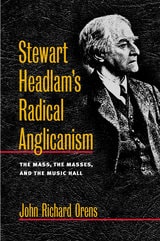
cover of Stewart Headlam's Radical Anglicanism: The Mass, the Masses, and the Music Hall

Stewart Headlam's Radical Anglicanism

The Mass, the Masses, and the Music Hall

John Richard Orens

University of Illinois Press, 2003

Standing in stark contrast to the conservative churchmen of Victorian Britain, the Anglican clergyman Stewart Headlam was a passionately progressive reformer, a champion of the working poor--especially women --a defender of the music hall performers his colleagues attacked as licentious, and, in short, a man of God who remained firmly and controversially engaged with the society in which he lived and worked.
 
This book, the first significant study of Headlam since 1928, paints a rich and complex picture of this larger-than-life man of the cloth, charting the trail he blazed across the social, political, and religious landscape of late nineteenth- and early twentieth-century Britain.
 
Dissatisfied from an early age with his family’s Evangelical faith, Headlam became an Anglican curate, but his political views were increasingly radicalized as he befriended working-class atheists and trade union leaders. John Richard Orens details Headlam’s repeated conflicts with the establishment figures of his faith over his defense of music hall ballet performers’ right to reveal their legs, his role in the early years of the Fabian Society, his anti-puritanism, and his passionate socialism. Headlam was even instrumental in having Oscar Wilde bailed out of prison following the writer’s arrest for “homosexual offenses.”
 
With this intellectual biography, Orens places Headlam’s life, beliefs, and actions in the context of the period, contributing to the ongoing debate about the proper relationship between Christianity, on the one hand, and society, sexuality, and the arts, on the other.
 
[more]
cover of Still, the Small Voice: Narrative, Personal Revelation, and the Mormon Folk Tradition

Still, the Small Voice

Narrative, Personal Revelation, and the Mormon Folk Tradition

Tom Mould

Utah State University Press, 2011

Memorates—personal experience narratives of encounters with the supernatural—that recount individuals’ personal revelations, primarily through the Holy Ghost, are a pervasive aspect of the communal religious experience of Mormons, members of the Church of Jesus Christ of Latter-day Saints. In accordance with current emphases in folklore studies on narrative and belief, Tom Mould uses ethnographic research and an emic approach that honors the belief systems under study to analyze how people within Mormon communities frame and interpret their experiences with the divine through the narratives they share.  In doing so, he provides a significant new ethnographic interpretation of Mormon culture and belief and also applies his findings directly to broader scholarly folklore discourse on performance, genre, personal experience narrative, belief, and oral versus written traditions.
[more]
cover of Stones, Bones, and the Sacred: Essays on Material Culture and Ancient Religion in Honor of Dennis E.

Stones, Bones, and the Sacred

Essays on Material Culture and Ancient Religion in Honor of Dennis E.

Alan H. Cadwallader

SBL Press, 2016

A crucial text for any university course on the interaction of archaeology and the Bible

The world of early Christians was not a world lived in texts; it was a world saturated with material reality and concerns: what, where and when to eat or drink; how to present oneself in the space of bodily life and that of death; how to move from one place to another; what impacted status or the adjudication of legal charges. All these and more controlled so much of life in the ancient world. The Christians were not immune from the impact of these realities. Sometimes they absorbed their surrounds; sometimes they quite explicitly rejected the material practices bearing in on them; frequently they modified the practice and the rationale to create a significant Christian alternative. The collection of essays in this volume come from a range of international scholars who, for all their different interests and critical commitments, are yet united in treasuring research into the Greek and Roman worlds in which Christians sought to make their way. They offer these essays in honor of one who has made a lifetime's work in mining ancient material culture to extract nuggets of insight into early Christian dining practices: Dennis E. Smith.

Features

  • Rich examples of method in the utilization of ancient material culture for biblical interpretation.
  • Thirteen essays with a response from Dennis E. Smith
  • Maps, diagrams, and plates
    [more]
    cover of Storm of Words: Science, Religion, and Evolution in the Civil War Era

    Storm of Words

    Science, Religion, and Evolution in the Civil War Era

    Monte Harrell Hampton

    University of Alabama Press, 2014

    A study of the ways that southern Presbyterians in the wake of the Civil War contended with a host of cultural and theological questions

    Southern Presbyterian theologians enjoyed a prominent position in antebellum southern culture. Respected for both their erudition and elite constituency, these theologians identified the southern society as representing a divine, Biblically ordained order. Beginning in the 1840s, however, this facile identification became more difficult to maintain, colliding first with antislavery polemics, then with Confederate defeat and reconstruction, and later with women’s rights, philosophical empiricism, literary criticisms of the Bible, and that most salient symbol of modernity, natural science.

    As Monte Harrell Hampton shows in Storm of Words, modern science seemed most explicitly to express the rationalistic spirit of the age and threaten the Protestant conviction that science was the faithful “handmaid” of theology. Southern Presbyterians disposed of some of these threats with ease. Contemporary geology, however, posed thornier problems. Ambivalence over how to respond to geology led to the establishment in 1859 of the Perkins Professorship of Natural Science in Connexion with Revealed Religion at the seminary in Columbia, South Carolina. Installing scientist-theologian James Woodrow in this position, southern Presbyterians expected him to defend their positions.

    Within twenty-five years, however, their anointed expert held that evolution did not contradict scripture. Indeed, he declared that it was in fact God’s method of creating. The resulting debate was the first extended evolution controversy in American history. It drove a wedge between those tolerant of new exegetical and scientific developments and the majority who opposed such openness. Hampton argues that Woodrow believed he was shoring up the alliance between science and scripture—that a circumscribed form of evolution did no violence to scriptural infallibility. The traditionalists’ view, however, remained interwoven with their identity as defenders of the Lost Cause and guardians of southern culture.

    The ensuing debate triggered Woodrow’s dismissal. It also capped a modernity crisis experienced by an influential group of southern intellectuals who were grappling with the nature of knowledge, both scientific and religious, and its relationship to culture—a culture attempting to define itself in the shadow of the Civil War and Reconstruction.
    [more]
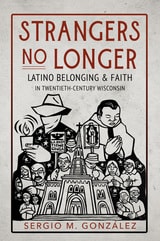
    cover of Strangers No Longer: Latino Belonging and Faith in Twentieth-Century Wisconsin

    Strangers No Longer

    Latino Belonging and Faith in Twentieth-Century Wisconsin

    Sergio M. González

    University of Illinois Press, 2024

    Hospitality practices grounded in religious belief have long exercised a profound influence on Wisconsin’s Latino communities. Sergio M. González examines the power relations at work behind the types of hospitality--welcoming and otherwise--practiced on newcomers in both Milwaukee and rural areas of the Badger State. González’s analysis addresses central issues like the foundational role played by religion and sacred spaces in shaping experiences and facilitating collaboration among disparate Latino groups and across ethnic lines; the connections between sacred spaces and the moral justification for social justice movements; and the ways sacred spaces evolved into places for mitigating prejudice and social alienation, providing sanctuary from nativism and repression, and fostering local and transnational community building.

    Perceptive and original, Strangers No Longer reframes the history of Latinos in Wisconsin by revealing religion’s central role in the settlement experience of immigrants, migrants, and refugees.

    [more]