Results by title
8113 books match the query 'Literary Criticism' and 542 start with s

Scepticism and Hope in Twentieth Century Fantasy Literature
Kath Filmer
University of Wisconsin Press, 1992

Schechner Plays
Edited by Richard Schechner
Intellect Books, 2025
This book offers a collection of Richard Schechner’s performance texts ranging from orthodox plays to group-devised texts. Covering the full breadth of his work from the 1950s to the present, it includes several never-before-published early texts as well as updated versions of well-known productions such as Dionysus in 69, YokastaS, Makbeth, and Imagining O. Márta Minier's introduction gives an overview of Schechner's work, while Schechner introduces each script in terms of their intellectual and production contexts.
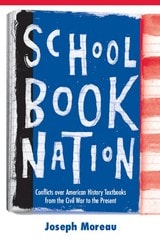
Schoolbook Nation
Conflicts over American History Textbooks from the Civil War to the PresentJoseph Moreau
University of Michigan Press, 2004
-Gary B. Nash, Director of the National Center for History in the Schools
Taking Frances FitzGerald's textbook study America Revised as a point of departure, Joseph Moreau in Schoolbook Nation challenges FitzGerald's premise that the 1960s were the beginning of the end of the glory days of American history education.
Moreau recounts how in the late twentieth century, cultural commentators such as historian Arthur Schlesinger Jr. and politician Newt Gingrich preached that a new identity crisis had shaken American history in the sixties, and that the grand unified view of our past had given way to various interest groups, who dismantled the old national narrative while demanding a more "inclusive" curriculum for their children.
Moreau discovered, however, that American history, while grand, has never been unified. Delving into more than 100 history books from the last 150 years, the author reveals that the efforts of pressure groups to influence the history curriculum are nearly as old as the mustiest textbook. "For those who would influence textbooks and teaching-Protestant elites in the 1870s, Irish-Americans in the 1920s, and conservative politicians today-the sky has always been falling," according to Moreau.
Schoolbook Nation offers a history lesson of its own: when the story of the past is written or rewritten, truth is often a victim. With its comprehensive treatment of the subjects of honesty and politics in the teaching of history, this is an essential book on the side of truth in a complex debate.

Schoolcraft's Ojibwa Lodge Stories
Life on the Lake Superior FrontierPhilip P. Mason
Michigan State University Press, 1997
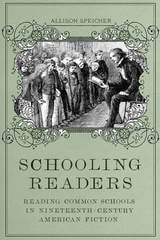
Schooling Readers
Reading Common Schools in Nineteenth-Century American FictionAllison Speicher
University of Alabama Press, 2016
Despite hailing from different regions with diverse histories and cultures, authors in all parts of the US produced remarkably similar school fictions. These stories, rather than offering idealized depictions of earnest schoolchildren in humble, rough-hewn schoolhouses, expose common schools as sites of both community bonding and social strife. These stories, Speicher shows, reflect surprisingly contemporary problems like school violence and apprehensions about assessments.
In four insightful sections, Speicher illuminates the plotlines that define the common school narrative: school exhibitions, in which common schools were opened to the public for a day of student performances; romances between teachers and students; violence against teachers; and teachers adopting their students. She offers rich examples from one hundred and thirty school stories by well-known authors such as Mark Twain, Bret Harte, Catharine Maria Sedgwick, and Edward Eggleston, as well as by educational reform pioneers such as C. W. Bardeen and long-forgotten contributors to nineteenth-century magazines.
By reading these fictions alongside the discourse of reformers like Horace Mann, Speicher illustrates the utility of fiction for uncovering the diverse reactions nineteenth-century Americans had to the expansion of public education as well as the role fiction played in shaping these responses. Throughout she maintains a dual focus, drawing on both literary and educational history, thereby offering much of value to those interested in either field.
Schools and Universities on the Continent
The Complete Prose Works of Matthew ArnoldMatthew Arnold; Edited by R. H. Super
University of Michigan Press, 1964
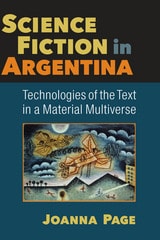
Science Fiction in Argentina
Technologies of the Text in a Material MultiverseJoanna Page
University of Michigan Press, 2016
Science Fusion in Contemporary Mexican Literature
Brian T. Chandler
Bucknell University Press, 2024
Science In The New Age
The Paranormal, Its Defenders & Debunkers,David J. Hess
University of Wisconsin Press, 1993
Hess begins by looking at each group’s unique version of knowledge, science, and religion and at its story about the other groups. Comparing the various discourses, texts, writers, and groups as cultures, he shows how skeptics, parapsychologists, and New Agers may disagree vehemently with each other, but end up sharing many rhetorical strategies, metaphors, models, values, and cultural categories. Furthermore, he argues, their shared “paraculture” has a great deal in common with the larger culture of the United States. The dialogue on the paranormal, Hess concludes, has as much to do with gender, power, and cultural values as it does with spirits, extrasensory perception, and crystal healing.
Scotland's Forgotten Treasure
The Visionary Romances of George MacDonaldColin Manlove
Aberdeen University Press, 2017
Scrap Theory
Reproductive Injustice in the Black Feminist ImaginationMali D. Collins
The Ohio State University Press, 2025
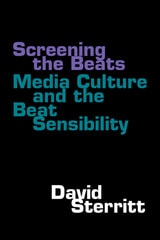
Screening the Beats
Media Culture and the Beat SensibilityDavid Sterritt
Southern Illinois University Press, 2004
Film critic David Sterritt’s Screening the Beats: Media Culture and the Beat Sensibility showcases the social and aesthetic viewpoints of lynchpin Beat writers Jack Kerouac, William S. Burroughs, and Allen Ginsberg, juxtaposing their artistry with 1950s culture and achieving what Kerouac might have called a “bookmovie” riff. In clear prose, Sterritt captures the raw energy of the Beats and joins in their celebration of aesthetic freakishness. Tapping into the diversified spirit of the Beat Generation and its nuanced relationship with postwar American culture, Sterritt considers how the Beats variously foreground, challenge, and illuminate major issues in Hollywood and avant-garde film, critical and cultural theory, and music in the mass-media age.
Sterritt engages the creative and spiritual facets of the Beats, emulating their desire to evoke ephemeral aspects of human existence. Dealing with both high and low cultures as well as various subcultures, he highlights the complementary contributions to cultural creativity made by these authors. Screening the Beats grapples with paradoxes in Beat writing, in particular the conflict between spiritual purity and secular connectedness, which often materialized in the beatific bebop spontaneity, Zen-like transcendentalism, and plain hipster smarts that characterized the writings of Kerouac, Burroughs, and Ginsberg.
This interdisciplinary study tackles such topics as Ginsberg’s and Kerouac’s uses of racial and ethnic stereotypes prevalent in the popular movies of the 1950s era; the uses and limitations of improvisation as a creative tool in literature, jazz, and film; Kerouac’s use of cinematic metaphor to evoke Buddhist concepts; and intersections of the grotesque and carnivalesque in works as seemingly diverse as autobiographical novels by Kerouac, a radio play by Antonin Artaud, cultural theories of Gilles Deleuze and Félix Guattari, and the boisterous lunacy of Three Stooges farce. Deftly threading literary, musical, and cinematic works with a colorful array of critical theories, Screening the Beats illuminates the relationship between American culture and the imaginative forces of the Beat Generation.
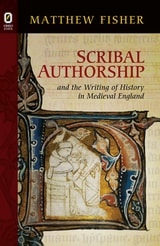
Scribal Authorship and the Writing of History in Medieval England
Matthew Fisher
The Ohio State University Press, 2012
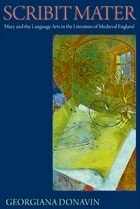
Scribit Mater
Marey and the Language Arts in the Literature of Medieval EnglandGeorgiana Donavin
Catholic University of America Press, 2012
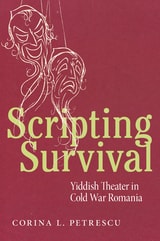
Scripting Survival
Yiddish Theater in Cold War RomaniaCorina L. Petrescu
Rutgers University Press, 2027
In Cold War Romania, the Jewish State Theater in Bucharest (TES) was a site for high-stakes cultural negotiations. While the state used the theater to consolidate Yiddish stagecraft into a tool for state propaganda, a more nuanced story unfolded behind the scenes: TES was also a vehicle for preserving and advancing Yiddish culture within the confines of a socialist state. This book focuses on five commemorative volumes published between 1956 and 1976 by editors who were Shoah survivors—individuals uniquely torn between their passion for Yiddish culture and the communist ideal. By analyzing these volumes, the study reveals the hidden ideological tensions and cultural ambitions embedded within the theater’s operations and provides a rare window into the struggle to maintain a distinctive Jewish identity while navigating the rigid political realities of the time. It is a compelling look at the editorial strategies used to safeguard a vanishing heritage.
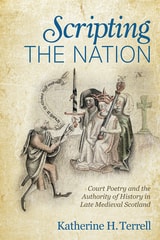
Scripting the Nation
Court Poetry and the Authority of History in Late Medieval ScotlandKatherine H. Terrell
The Ohio State University Press, 2021
Seamus Heaney and the Emblems of Hope
Karen Marguerite Moloney
University of Missouri Press, 2007
A rich body of mythology and literature has grown around the Celtic ritual known as the Feis of Tara or “marriage of sovereignty”—ancient ceremonies in which the future king pledges to care for the land and serve the goddess of sovereignty. Seamus Heaney, whose writing has attracted the overwhelming share of critical attention directed toward contemporary Irish poetry, has engaged this symbolic tradition in some of his most significant—and controversial—work.
Seamus Heaney and the Emblems of Hope explores Heaney’s use of the family of sovereignty motifs and redresses the imbalance of criticism that has overemphasized the theme of sacrifice to the detriment of more optimistic symbols. Moreover, Moloney reviews the development of the marriage motif in Irish poetry from the ninth to the twenty-first centuries with a focus on Heaney’s adaptations from The Frenzy of Sweeney and The Midnight Court and on the work of such poets as Kinsella, Montague, Boland, and Ní Dhomhnaill. Karen Marguerite Moloney examines the central role that Heaney assigns the Feis of Tara in his response to the crisis of Ulster and to the general spiritual bankruptcy of our times, showing in his verse how the relationship of the male lover to the goddess—particularly in her more repugnant guises—serves as prototype for the humility and deference needed to repair the effects of English colonization of Ireland and, by extension, centuries of worldwide patriarchal abuse.
Through close, sustained readings of poems previously overlooked or misinterpreted, such as “Ocean’s Love to Ireland,” “Come to the Bower,” and “Bone Dreams”—poems that Irish feminist critics have deemed flawed and distressingly sexist—Moloney refutes views that have long stood unchallenged. She also considers the direction of Heaney’s more recent poems, which continue to resonate to the twin demands of conscience and artistic integrity.
An impeccably researched and immensely readable work, Seamus Heaney and the Emblems of Hope reveals that Heaney’s poetry offers a reverence for archetypal femininity and Dionysian energy that can counter the sterility and violence of postcolonial Irish life. Moloney shows us that, in the tradition of poets who preceded him, Heaney turns to the marriage of sovereignty to encode a message for our times—and to offer up emblems of hope on behalf of us all.
Seamus Heaney and the End of Catholic Ireland
Kieran Quinlan
Catholic University of America Press, 2020

Searching for Emma
Gustave Flaubert and Madame BovaryDacia Maraini
University of Chicago Press, 1997
Maraini argues that in their desire to claim Emma Bovary as a standard-bearer of revolt, women have often overlooked the bitter, pitiless way in which Flaubert evokes Emma's insignificance and vulgarity. Searching for Emma guides the reader through Flaubert's novel and many of his letters, seeking out the sources of his obsessive cruelty toward Emma. Maraini relates Flaubert's contempt for Emma to his relationship with his mistress, Louise Colet, to his general terror of women, and to his own self-loathing. It was entirely in spite of himself, Maraini writes, that Flaubert created the female Don Quixote so admired for her restlessness and determination.
Searching for Emma offers a novelist's insight into the complex relationship between author and character, and into the deepest motivations of fiction.
Searching for Feminist Superheroes
Gender, Sexuality, and Race in Marvel ComicsSam Langsdale
University of Texas Press, 2024
How superhero narratives in the margins of the mainstream tell innovative, feminist stories.
It’s no secret that superhero comics and their related media perpetuate a model of a straight, white, male hero at the expense of representing women and other minorities, but other narratives exist. Searching for Feminist Superheroes recognizes that female-led superhero comics, with diverse casts of characters and inclusive storytelling, exist on the margins of the mainstream superhero genre. But rather than focusing on these stories as marginalized, Sam Langsdale’s work on heroes such as Spider-Woman, America Chavez, and Ironheart locates the margins as a site of innovation and productivity, which have enabled the creation of feminist superhero texts.
Employing feminist and intersectional philosophies in an analysis of these comics, Langsdale suggests that feminist superheroes have the potential to contribute to a social imagination that is crucial in working toward a more just world. At a time when US popular culture continues to manifest as a battleground between oppressive and progressive social norms, Searching for Feminist Superheroes demonstrates that a fight for a better world is worthwhile.
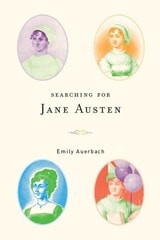
Searching for Jane Austen
Emily Auerbach
University of Wisconsin Press, 2004
In this beautifully illustrated and lively work, Auerbach surveys two centuries of editing, censoring, and distorting Austen’s life and writings. Auerbach samples Austen’s flamboyant, risqué adolescent works featuring heroines who get drunk, lie, steal, raise armies, and throw rivals out of windows. She demonstrates that Austen constantly tested and improved her skills by setting herself a new challenge in each of her six novels.
In addition, Auerbach considers Austen’s final irreverent writings, discusses her tragic death at the age of forty-one, and ferrets out ridiculous modern adaptations and illustrations, including ads, cartoons, book jackets, newspaper articles, plays, and films from our own time. An appendix reprints a ground-breaking article that introduced Mark Twain’s "Jane Austen," an unfinished and unforgettable essay in which Twain and Austen enter into mortal combat.
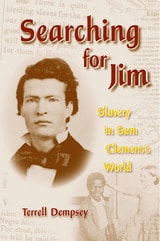
Searching for Jim
Slavery in Sam Clemens's WorldTerrell Dempsey
University of Missouri Press, 2005
During Sam’s earliest years, his father, John Marshall Clemens, had significant interaction with slaves. Newly discovered court records show the senior Clemens in his role as justice of the peace in Hannibal enforcing the slave ordinances. With the death of his father, young Sam was apprenticed to learn the printing and newspaper trade. It was in the newspaper that slaves were bought and sold, masters sought runaways, and life insurance was sold on slaves. Stories the young apprentice typeset helped Clemens learn to write in black dialect, a skill he would use throughout his writing, most notably in Huckleberry Finn.
Missourians at that time feared abolitionists across the border in Illinois and Iowa. Slave owners suspected every traveling salesman, itinerant preacher, or immigrant of being an abolition agent sent to steal slaves. This was the world in which Sam Clemens grew up. Dempsey also discusses the stories of Hannibal’s slaves: their treatment, condition, and escapes. He uncovers new information about the Underground Railroad, particularly about the role free blacks played in northeast Missouri.
Carefully reconstructed from letters, newspaper articles, sermons, speeches, books, and court records, Searching for Jim offers a new perspective on Clemens’s writings, especially regarding his use of race in the portrayal of individual characters, their attitudes, and worldviews. This fascinating volume will be valuable to anyone trying to measure the extent to which Clemens transcended the slave culture he lived in during his formative years and the struggles he later faced in dealing with race and guilt. It will forever alter the way we view Sam Clemens, Hannibal, and Mark Twain.
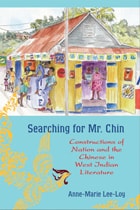
Searching for Mr. Chin
Constructions of Nation and the Chinese in West Indian LiteratureAuthored by Anne-Marie Lee-Loy
Temple University Press, 2010
What do twentieth-century fictional images of the Chinese reveal about the construction of nationhood in the former West Indian colonies? In her groundbreaking interdisciplinary work, Searching for Mr. Chin, Anne-Marie Lee-Loy seeks to map and understand a cultural process of identity formation: “Chineseness” in the West Indies.
Reading behind the stereotypical image of the Chinese in the West Indies, she compares fictional representations of Chinese characters in Jamaica, Trinidad, and Guyana to reveal the social and racial hierarchies present in literature by popular authors such as V.S. Naipaul and Samuel Selvon, as well as lesser known writers and hard to access literary texts.
Using historical, discursive, and theoretical frameworks for her literary analysis, Lee-Loy shows how the unstable and ambiguous “belonging” afforded to this “middleman minority” speaks to the ways in which narrative boundaries of the nation are established. In addition to looking at how Chinese have been viewed as “others,” Lee-Loy examines self-representations of “Chineseness” and how they complicate national narratives of belonging.
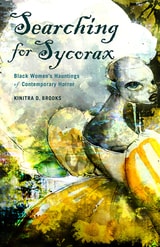
Searching for Sycorax
Black Women's Hauntings of Contemporary HorrorBrooks, Kinitra D
Rutgers University Press, 2018
Seasoned Authors for a New Season
The Search for Standards in Popular WritingEdited by Louis Filler
University of Wisconsin Press, 1980
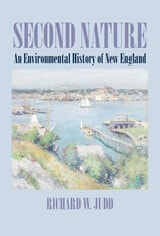
Second Nature
An Environmental History of New EnglandRichard W. Judd
University of Massachusetts Press, 2014
Winner of the 2014 New England Historical Association's James P. Hanlan Book Award
Bounded by the St. Lawrence Valley to the north, Lake Champlain to the west, and the Gulf of Maine to the east, New England may be the most cohesive region in the United States, with a long and richly recorded history. In this book, Richard W. Judd explores the mix of ecological process and human activity that shaped that history over the past 12,000 years. He traces a succession of cultures through New England's changing postglacial environment down to the 1600s, when the arrival of Europeans interrupted this coevolution of nature and culture.
A long period of tension and warfare, inflected by a variety of environmental problems, opened the way for frontier expansion. This in turn culminated in a unique landscape of forest, farm, and village that has become the embodiment of what Judd calls “second nature”—culturally modified landscapes that have superseded a more pristine “first nature.”
In the early 1800s changes in farm production and industrial process transformed central New England, while burgeoning markets at the geographical margins brought rapid expansion in fishing and logging activities. Although industrialization and urbanization severed connections to the natural world, the dominant cultural expression of the age, Romanticism, provided new ways of appreciating nature in the White Mountains and Maine woods. Spurred by these Romantic images and by a long tradition of local resource management, New England gained an early start in rural and urban conservation.
In the 1970s environmentalists, inspired by a widespread appreciation for regional second-nature landscapes, moved quickly from battling pollution and preserving wild lands to sheltering farms, villages, and woodlands from intrusive development. These campaigns, uniquely suited to the region's land-use history, ecology, and culture, were a fitting capstone to the environmental history of New England.
Secondhand China
Spain, the East, and the Politics of TranslationCarles Prado-Fonts
Northwestern University Press, 2022
Uncovering an eclectic and surprising archive, Prado-Fonts draws on diverse cultural artifacts from popular literature, journalism, and early cinema to offer a rich account of how China was seen across the West between 1880 and 1930. Enrique Gaspar, Luis de Oteyza, Vicente Blasco Ibáñez, and lesser-known authors writing in Spanish and Catalan put themselves in dialogue with Leo Tolstoy, John Dewey, W. Somerset Maugham, Bertrand Russell, Pearl Buck, and André Malraux, as well as stereotypical figures from popular culture like Fu Manchu and Charlie Chan. Throughout, Prado-Fonts exposes translation as a technology of cultural hegemony and China as an appealing object for representation. A timely contribution to our understanding of how we create and consume knowledge about the world, Secondhand China is essential reading for scholars and students of Orientalism, postcolonial studies, translation studies, comparative literature, and cultural studies.
Secrecy, Magic, and the One-Act Plays of Harlem Renaissance Women Writers
Taylor Hagood
The Ohio State University Press, 2010
Exploring secrecy from the standpoints of poststructuralist language theory and game theory as well as dramatic performance, Taylor Hagood argues that the secret—a thing visible for its very invisibility—is a fundamental cog in the machinery of society, employed as a tool for both oppression and subversion. The many facets of secrecy have been particularly salient in African American culture, informing everything from the Underground Railroad to the subtle coding of Signifying. Most devastatingly, people on both sides of the color line are caught within a web of secrecy that is the result of centuries of distrust, doubt, and fear, a fact that is powerfully manifest not only in these one-act plays but in the reader’s/spectator’s interactions with them.
Secret Leaves
The Novels of Walter ScottJudith Wilt
University of Chicago Press, 1985

Secret Sharers in Italian Comedy
From Machiavelli to GoldoniJackson I. Cope
Duke University Press, 1996
Though outwardly similar to New Comedy with its characteristically harmonious closure, this essentially anti-Plautine form employs a secret—known by the audience but unequally shared among the players—to introduce a radical discrepancy between simultaneous stories unfolding in a single action doubly understood. The result is a plot that is misleading at the surface, contingent and unfinished at its end. The audience, in a position of enforced collusion with regard to the secret, becomes a formal ingredient in the production. The play, more cynical than carnivalesque, opens onto vistas of disruption and deception rather than closing on a note of renewed social harmony.
Cope’s close and original readings of both classic and lesser-known plays by Machiavelli, Ruzante, Cecchi, Grazzini, Fagiuoli, Maggi, and others follow this peculiarly Italian, anti-Plautine paradigm through variations across three centuries to its masterful and complex culmination in Carlo Goldoni’s villeggiatura trilogy. Establishing a new comedic canon that demands a revision of Italian dramatic history and the history of European dramatic theory, Secret Sharers in Italian Comedy makes an important contribution to Italian studies and will also attract readers among theater scholars in English, comparative literature, and drama.
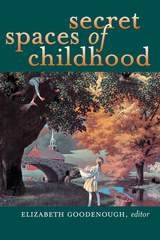
Secret Spaces of Childhood
Elizabeth Goodenough, Editor
University of Michigan Press, 2003
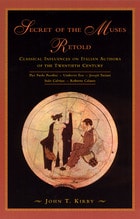
Secret of the Muses Retold
Classical Influences on Italian Authors of the Twentieth CenturyJohn T. Kirby
University of Chicago Press, 2000
These are some of the questions that gave rise to John Kirby's Secret of the Muses Retold. This new study of works by five twentieth-century Italian writers investigates the abiding influence of the Greek and Roman classics, and their rich legacy in our own day. The result is not only a splendid introduction to contemporary Italian literature, but also a lucid and stimulating meditation on the insights that writers such as Umberto Eco and Italo Calvino have tapped from the wellspring of ancient tradition.
Kirby's book offers an impassioned plea for the recuperation of the humanities in general, and of classical studies in particular. No expertise in Greek, Latin, Italian, or literary theory is presumed, and both traditional and postmodern perspectives are accommodated.
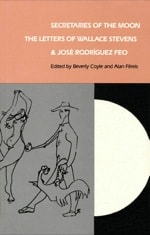
Secretaries of the Moon
The Letters of Wallace Stevens and José Rodriguez FeoBeverly Coyle and Alan Filreis, eds.
Duke University Press, 1986
Coyle and Filreis present the entire extant correspondence between the two men. The fifty-one Rodriguez Feo letters and ten of the numerous Stevens letters are printed here for the first time, and the exchange between the two is unusually complete. The work includes a critical introduction and complete annotation of the letters.

Secrets Need Words
Indonesian Poetry, 1966–1998Harry Aveling
Ohio University Press, 2001
Short listed for the 2007 New South Wales Premier's Translation Prize
The period from 1966 to 1999 represents a distinct era in Indonesian history. Throughout the “New Order” regime of President Suharto, the policies of economic development and political stability were dominant. However, the public opinion of personal expression was consistently under suspicion, and indeed dissent was severely punished.
Secrets Need Words traces the development of Indonesian poetry throughout this entire period. Texts are presented both in the original Indonesian and in careful, stylistically sensitive English translations.
In this anthology of contemporary work by Indonesian poets, the renowned translator and editor Harry Aveling presents a series of ongoing analyses detailing the political and social shifts that have influenced the work of particular poets.
Professor Aveling's analyses, along with the poems themselves, demonstrate how the poets responded to the power of the state in a variety of ways ranging from direct confrontation to withdrawal into personal and private realms characterized by fantasy and the use of heavily rhythmic language.
Secrets Need Words will be of interest to scholars of Indonesia and comparative literature, and will be for many years to come a basic text for scholarship and teaching. But it also offers all readers of poetry an opportunity to explore a new, complex, and exciting body of literature from one of the world's largest nations.
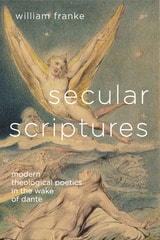
Secular Scriptures
Modern Theological Poetics in the Wake of DanteWilliam Franke
The Ohio State University Press, 2015
Secular Scriptures examines, through its own original speculative outlook, some of the most compelling exemplars of religious-poetic revelation in modern Western literature. The essays taken as an ensemble revolve around and are bookended by Dante, but they also explore the work of Chaucer, Shakespeare, Milton, Blake, Leopardi, Baudelaire, Dickinson, and Yeats. Looking both backward and forward from the vantage of Dante, Franke explores the roots of secularized religious vision in antiquity and the Middle Ages, even as he also looks forward toward its fruits in modern poetry and poetics. Ultimately, Franke’s analyses demonstrate the possibilities opened by understanding literature as secularized religious revelation.
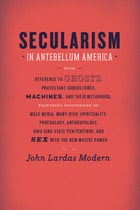
Secularism in Antebellum America
John Lardas Modern
University of Chicago Press, 2011
Ghosts. Railroads. Sing Sing. Sex machines. These are just a few of the phenomena that appear in John Lardas Modern’s pioneering account of religion and society in nineteenth-century America. This book uncovers surprising connections between secular ideology and the rise of technologies that opened up new ways of being religious. Exploring the eruptions of religion in New York’s penny presses, the budding fields of anthropology and phrenology, and Moby-Dick, Modern challenges the strict separation between the religious and the secular that remains integral to discussions about religion today.
Modern frames his study around the dread, wonder, paranoia, and manic confidence of being haunted, arguing that experiences and explanations of enchantment fueled secularism’s emergence. The awareness of spectral energies coincided with attempts to tame the unruly fruits of secularism—in the cultivation of a spiritual self among Unitarians, for instance, or in John Murray Spear’s erotic longings for a perpetual motion machine. Combining rigorous theoretical inquiry with beguiling historical arcana, Modern unsettles long-held views of religion and the methods of narrating its past.
Secularization and Cultural Criticism
Religion, Nation, and ModernityVincent P. Pecora
University of Chicago Press, 2006
Religion is an undiscovered country for much of the secular academy, which remains deeply ambivalent about it as an object of study. On the one hand, secular scholars agree that it is time to take religion seriously. On the other, these same scholars persist in assuming that religion rests not on belief but on power and ideology. According to Vincent Pecora, the idea of the secular itself is the source of much of the contradiction and confusion in contemporary thought about religion. Pecora aims here to work through the paradoxes of secularization, which emerges in this book as an intractable problem for cultural criticism in the nation-states of the post-Enlightenment West.
Secularization and Cultural Criticism examines the responses of a wide range of thinkers—Edward Said, Talal Asad, Jürgen Habermas, Walter Benjamin, Emile Durkheim, Carl Schmitt, Matthew Arnold, and Virginia Woolf, among others—to illustrate exactly why the problem of secularization in the study of society and culture should matter once again. Exploring the endemic difficulty posed by religion for the modern academy, Pecora makes sense of the value and potential impasses of secular cultural criticism in a global age.
See It Feelingly
Classic Novels, Autistic Readers, and the Schooling of a No-Good English ProfessorRalph James Savarese
Duke University Press, 2018
Since the 1940s researchers have been repeating claims about autistic people's limited ability to understand language, to partake in imaginative play, and to generate the complex theory of mind necessary to appreciate literature. In See It Feelingly Ralph James Savarese, an English professor whose son is one of the first nonspeaking autistics to graduate from college, challenges this view.
Discussing fictional works over a period of years with readers from across the autism spectrum, Savarese was stunned by the readers' ability to expand his understanding of texts he knew intimately. Their startling insights emerged not only from the way their different bodies and brains lined up with a story but also from their experiences of stigma and exclusion.
For Mukhopadhyay Moby-Dick is an allegory of revenge against autism, the frantic quest for a cure. The white whale represents the autist's baffling, because wordless, immersion in the sensory. Computer programmer and cyberpunk author Dora Raymaker skewers the empathetic failings of the bounty hunters in Philip K. Dick's Do Androids Dream of Electric Sheep? Autistics, some studies suggest, offer instruction in embracing the nonhuman. Encountering a short story about a lonely marine biologist in Antarctica, Temple Grandin remembers her past with an uncharacteristic emotional intensity, and she reminds the reader of the myriad ways in which people can relate to fiction. Why must there be a norm?
Mixing memoir with current research in autism and cognitive literary studies, Savarese celebrates how literature springs to life through the contrasting responses of unique individuals, while helping people both on and off the spectrum to engage more richly with the world.
Seeing Double
Baudelaire's ModernityFrançoise Meltzer
University of Chicago Press, 2011
The poet Charles Baudelaire (1821–1867) has been labeled the very icon of modernity, the scribe of the modern city, and an observer of an emerging capitalist culture. Seeing Double reconsiders this iconic literary figure and his fraught relationship with the nineteenth-century world by examining the way in which he viewed the increasing dominance of modern life. In doing so, it revises some of our most common assumptions about the unresolved tensions that emerged in Baudelaire’s writing during a time of political and social upheaval.
Françoise Meltzer argues that Baudelaire did not simply describe the contradictions of modernity; instead, his work embodied and recorded them, leaving them unresolved and often less than comprehensible. Baudelaire’s penchant for looking simultaneously backward to an idealized past and forward to an anxious future, while suspending the tension between them, is part of what Meltzer calls his “double vision”—a way of seeing that produces encounters that are doomed to fail, poems that can’t advance, and communications that always seem to falter. In looking again at the poet and his work, Seeing Double helps to us to understand the prodigious transformations at stake in the writing of modern life.
Seeing MAD
Essays on MAD Magazine's Humor and LegacyJudith Yaross Lee
University of Missouri Press, 2021
Mad magazine stands near the heart of post-WWII American humor, but at the periphery in scholarly recognition from American cultural historians, including humor specialists. This book fills that gap, with perceptive, informed, engaging, but also funny essays by a variety of scholars. The chapters, written by experts on humor, comics, and popular culture, cover the genesis of Mad; its editors and prominent contributors; its regular features and departments and standout examples of their contents; perspectives on its cultural and political significance; and its enduring legacy in American culture.
Seeing Red
Anger, Sentimentality, and American IndiansCari M. Carpenter
The Ohio State University Press, 2008
Seeing Through Madness
Essays in Crazy TimesW. J. T. Mitchell
University of Chicago Press, 2027
An insightful reconsideration of our historical moment seen through the lens of madness.
In Seeing Through Madness, W. J. T. Mitchell pursues the idea of “putting madness to work” by transforming it from an individual affliction—an illness to be treated—into a critical framework for understanding the human condition. The human species is now a danger to itself and others—the very definition of mental disorder in most societies. Therefore, it is time, Mitchell argues, for a fundamental reconsideration of madness, not only as a subject in media and the arts but more fundamentally as a “critical optic” on our historical moment. It is time to see through madness in all its variations, to see by means of it as a template for understanding, and to see it through to some form of wisdom.
While drawing a sense of urgency from Mitchell’s conviction that the whole world is experiencing a widespread political madness, the book specifically focuses on American psychoses and collective disorders, not least the country’s delusional exceptionalism.
Incisive, eclectic, and occasionally enraged, Mitchell’s essays are the guide we need to see us through crazy times.
Seeing the Light
The Social Logic of Personal DiscoveryThomas DeGloma
University of Chicago Press, 2014
In Seeing the Light, Thomas DeGloma explores such accounts of personal awakening, in stories that range from the discovery of a religious truth to remembering a childhood trauma to embracing a new sexual orientation. He reveals a common social pattern: When people discover a life-changing truth, they typically ally with a new community. Individuals then use these autobiographical stories to shape their stances on highly controversial issues such as childhood abuse, war and patriotism, political ideology, human sexuality, and religion. Thus, while such stories are seemingly very personal, they also have a distinctly social nature. Tracing a wide variety of narratives through nearly three thousand years of history, Seeing the Light uncovers the common threads of such stories and reveals the crucial, little-recognized social logic of personal discovery.
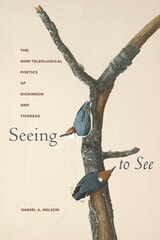
Seeing to See
The Non-Teleological Poetics of Dickinson and ThoreauDaniel A. Nelson
University of Massachusetts Press, 2025
Seeing to See focuses on two American authors who are notoriously hard to classify: Emily Dickinson and Henry David Thoreau. Dickinson proves challenging due to her short and obscure poems and Thoreau due to his insistence on capturing even the most seemingly mundane information. Daniel A. Nelson uncovers evidence that the works of these authors are often intentionally and painstakingly without aim or purpose. He argues that in their texts there is in fact an avoidance of teleological structures of writing and thinking, whereby a thing’s—or a word’s, or a text’s—value hinges on its relation to the world or other contexts.
In Nelson’s reading, Thoreau and Dickinson seem to be able to set aside all thought of distinct personal and professional goals, through which readers typically try to make an overarching sense out of, and to derive some form of profit from, disparate experiences, events, actions, and feelings. Further, both authors seem to be able to get outside of the worldview according to which the value and meaning of something, be it a natural object, a word, or an experience, is a function of its participation in a larger system. Examples of such systems include an ecosystem, taxonomic system, or syntactic system; a writer’s career, or life, or philosophy; even a single poem or journal entry. In the absence of such connections to broader categorical spheres, both writers force readers to contemplate the ineffable, constantly changing relation between words and the natural world. This contemporary reading of two iconic writers reframes their work and how readers think of nature, accepting, as these authors did, the potential freedom of the unknown.
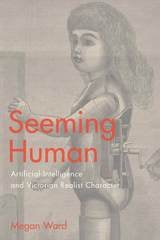
Seeming Human
Artificial Intelligence and Victorian Realist CharacterMegan Ward
The Ohio State University Press, 2018
In Seeming Human, Megan Ward contends that mid-twentieth-century versions of artificial intelligence (AI) offer a theory of verisimilitude omitted by traditional histories of character, which often focus on the development of interiority and the shift from “flat” to “round” characters in the Victorian era. Instead, by reading character through AI, Megan Ward’s Seeming Human argues that routinization, predictability, automation, and even flatness are all features of realist characters.
Early artificial intelligence movements such as cybernetics, information theory, and the Turing test define ways of seeming—rather than being—human. Using these theories of verisimilitude to read Victorian novelists such as Elizabeth Gaskell, Margaret Oliphant, Anthony Trollope, Thomas Hardy, and Henry James, Seeming Human argues that mechanicity has been perceived as anti-realist because it is the element that we least want to identify as human. Because AI produces human-like intelligence, it makes clear that we must actually turn to machines in order to understand what makes realist characters seem so human.
Selected Book Reviews (CW13)
Eric Voegelin, Edited & Translated by Jodi Cockerill and Barry Cooper, & Intro by Jodi Cockerill
University of Missouri Press, 2001
Over the course of his varied and distinguished academic life, Eric Voegelin was often called upon by review editors of scholarly journals as well as by editors in the popular press to examine, summarize, and critically assess the work of other scholars, of statesmen, and of men of affairs. The contents of the books Voegelin reviewed mirror his changing interests over the years, including questions of method, points of legal philosophy and jurisprudence, and issues of race, war, and the aftermath of war. Of course, he was frequently called upon as well to review standard texts and new editions and monographs across the full range of political science.
This collection of Voegelin's reviews amounts to a reflection in miniature of many of the problems Voegelin tackled in his essays, articles, and books from the 1920s until the 1950s, when, owing to the press of other business, he began to decline requests to review the work of others. Some of his reviews are little more than clinical summaries; others are analytic essays. A few are extended engagements with a text or a set of problems. Occasionally, particularly among the later reviews originally written in English, one finds flashes of Voegelin's legendary wit and a restrained impatience with the inadequate approaches or sheer incompetence of others. These book reviews will be of interest to all students and scholars of Eric Voegelin's work.
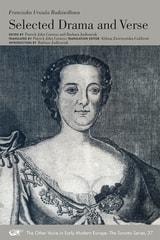
Selected Drama and Verse
Franciszka Urszula Radziwillowa
Iter Press, 2015
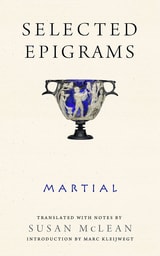
Selected Epigrams
Martial, Translated with notes by Susan McLean, Introduction by Marc Kleijwegt
University of Wisconsin Press, 2014
Selected Essays and Dialogues by Gianni Celati
Adventures into the Errant FamiliarEdited and Translated by Patrick Barron
University College London, 2024
Selected Essays and Dialogues is a collection of translations of Italian essayist Gianni Celati’s theoretical and musing work from the late 1960s to the present. Its topics range from environmental perception and archaeological conceptions of historical knowledge to street theater, writing, photography, cinema, and translation. The book provides a framework of key literary, theoretical, and artistic movements of the past fifty years, as well as a guide for English-language readers to place Celati’s work in historical, cultural, and biographical contexts.
Celati’s fondness for the unexpected ordinary tempts readers to wander and become lost in the webs of his daring thoughts. Indeed, a genial adventurousness can be found within all of his writings collected here, driven by an affectionate and light-hearted engagement with the surrounding world. This collection offers a taste of his adventures of the mind and body, led by a lithe sensitivity not restricted to the so-called high arts or letters, but also very much engaged with the everyday lives, places, and tales we all constantly share.
Selected Essays
Viacheslav IvanovViacheslav Ivanov
Northwestern University Press, 2003
A poet, critic, and theoretician during the Silver Age of Russian poetry, at the turn of the twentieth century, Viacheslav Ivanov was dubbed "Viacheslav the Magnificent" by his contemporaries for his erudition, sumptuous and allusive poetry, and brilliant essays. He provided Russian Symbolism with theoretical underpinnings based on classical and biblical mythology, the aesthetics of music, philosophy ranging from Plato and Kant to Schopenhauer and Nietzsche, and a profound knowledge of classical and modern European poetry.
In choosing material for this volume of essays, Robert Bird and Michael Wachtel have covered a broad range of Ivanov's interests: the aesthetics of Symbolism, theater, culturological concerns, and on such influential figures of the period as Nietzsche, Solovyov, Tolstoy, and Scriabin. Also included are extensive notes on the essays in which classical, biblical, and poetic citations and allusions are identified, the aesthetic and theoretical contexts are clarified, and certain translation problems are briefly discussed. This volume provides valuable insight into the theory of Symbolism as it developed in Russia.