Results by title
2018 books match the query 'Political aspects' and 129 start with s
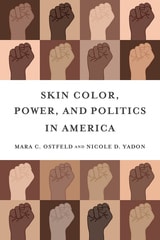
Skin Color, Power, and Politics in America
Mara Cecilia Ostfeld
Russell Sage Foundation, 2022
Ostfeld and Yadon surveyed over 1,300 people about their political views, including party affiliation, their opinions on welfare, and the importance of speaking English in the U.S. The authors created a matrix grounded in their “Roots of Race” framework, which predicts the relationship between skin color and political attitudes for each ethnoracial group based on the blurriness of the group’s boundaries and historical levels of privilege. They draw upon three distinct measures of skin color to conceptualize the relationship between skin color and political views: “Machine-Rated Skin Color,” measured with a light-reflectance meter; “Self-Assessed Skin Color,” using the Yadon-Ostfeld Skin Color Scale; and “Skin Color Discrepancy,” the difference between one’s Machine-Rated and Self-Assessed Skin Color.
Ostfeld and Yadon examine patterns that emerge among these measures, and their relationships with life experiences and political stances. Among Latinos, a group with relatively blurry group boundaries and low levels of historical privilege, the authors find a robust relationship between political views and Self-Assessed Skin Color. Latinos who overestimate the lightness of their skin color are more likely to hold conservative views on current racialized political issues, such as policing. Latinos who overestimate the darkness of their skin color, on the other hand, are more likely to hold liberal political views. As America’s major political parties remain divided on issues of race, this suggests that for Latinos, self-reported skin color is used as a means of aligning oneself with valued political coalitions.
African Americans, another group with low levels of historical privilege but with more clearly defined group boundaries, demonstrated no significant relationship between skin color and political attitudes. Thus, the lived experiences associated with being African American appeared to supersede the differences in life experiences due to skin color.
Whites, a group with more historical privilege and increasingly blurry group boundaries, showed a clear relationship between machine-assessed skin color and attitudes on political issues. Those with darker Machine-Rated Skin Color are more likely to hold conservative views, suggesting that they are responding to the threat of losing their privilege in a multicultural society.
At a time when the U.S. is both more diverse and politically divided, Skin Color, Power, and Politics in Americais a timely account of the ways in which skin color and politics are intertwined.
Smaddification
Dance and Decolonization in JamaicaAmanda Michelle Reid
Duke University Press, 2026
Small Media, Big Revolution
Communication, Culture, and the Iranian RevolutionAnnabelle Sreberny-Mohammadi
University of Minnesota Press, 1994
Reveals how small media (leaflets and audio cassettes) played an important role in the revolution that deposed the Shah of Iran.
To most Westerners, the Iranian revolution was a shocking spectacle, a distant mass upheaval suddenly breaking into the daily news. It was, in fact, a revolution of the television era, as these authors book clearly demonstrate. The first account of the role of culture and communication in the Iranian revolution, this is also the first book to consider revolution as communication in the modern world.
Coauthored by participants in the revolutionary upheaval, this study reflects an unusual breadth and depth of perspective. Drawing on ten years of research, the authors vividly show how the processes and products of modernization were used to undermine the very foundation of modernity in Iran. Their work reveals how deeply embedded cultural modes of communication coupled with crucial media technologies were able to mobilize a population within a repressive political context. Tracing the use of small media (audio cassettes and leaflets) to disseminate the revolution, the authors challenge much of the theory that has dominated international communication studies-and, in doing so, question the credibility of the established media. They also examine the dilemmas of cultural policy making based on Islamic principles in a media-saturated domestic and international environment.
Smoke and Tailings
An Environmental History of Butte and Anaconda, Montana, 1880–1930Fredric L. Quivik
University of Nevada Press, 2026
Butte’s history, a long-standing subject of historical inquiry, gains new depth as Quivik examines the technological developments pioneered by local mining companies. He challenges the simplistic narrative of a powerful corporation imposing its will on helpless agricultural communities. Local communities mounted strong opposition to the industry’s polluting methods; Quivik acknowledges this dynamic while also revealing efforts by the Anaconda Copper Mining Company to address environmental issues. The company developed and implemented technical solutions to minimize resource waste and mitigate damage, driven by both economic interests and litigation pressures. While these advancements lessened some of the environmental harm, they were insufficient to prevent long-term consequences. The operations in Butte and Anaconda ultimately created the largest Superfund complex in the United States, requiring billions of dollars in remediation.
Quivik’s nuanced approach opens the “black box” of technology, showing how innovations both alleviated and exacerbated the environmental challenges of mining, milling, and smelting. In addition to contributing to the rich literature on smelter smoke, this book breaks new ground by examining the underexplored environmental impacts of tailings, offering a fresh perspective on the intersection of industry, technology, and environmental change. The cultural landscapes of Butte and Anaconda retain many features of the region’s history of both environmental degradation and remediation. Smoke and Tailings is an essential addition to the study of Butte’s industrial and ecological history.
Snarl
In Defense of Stalled Traffic and Faulty NetworksRuth A. Miller
University of Michigan Press, 2014
Ruth A. Miller excavates a centuries-old history of nonhuman and nonbiological constitutional engagement and outlines a robust mechanical democracy that challenges existing theories of liberal and human political participation. Drawing on an eclectic set of legal, political, and automotive texts from France, Turkey, and the United States, she proposes a radical mechanical re-articulation of three of the most basic principles of democracy: vitality, mobility, and liberty.
Rather than defending a grand theory of materialist or posthumanist politics, or addressing abstract concepts or “things” writ large, Miller invites readers into a self-contained history of constitutionalism situated in a focused discussion of automobile traffic congestion in Paris, Istanbul, and Boston. Within the mechanical public sphere created by automotive space, Snarl finds a model of democratic politics that transforms our most fundamental assumptions about the nature, and constitutional potential, of life, movement, and freedom.

So Great Was the Slaughter
Market Hunters, Sportsmen, and Wildlife Conservation in ArkansasBuckley T. Foster
University of Alabama Press, 2025
Winner of the 2026 J.G. Ragsdale Book Award
So Great Was the Slaughter reveals the untold story of Arkansas conservation pioneers who saved the state’s game and fish populations. As Arkansas entered the twentieth century, the national demand for meat combined with the ability to ship millions of animals to hungry cities like New Orleans, Memphis, and Chicago had driven many species, including bison and passenger pigeons, to extinction in Arkansas. Many others, including deer, bear, turkey, quail, and fish, were in danger of disappearing.
In response, an unlikely coalition of Arkansas sportsmen, hunters, and conservationists created a vision for conservation legislation, game laws, and the establishment of fish hatcheries and wildlife refuges. With support from influential outsiders like E. A. McIlhenny and the United States Biological Survey, they waged a long battle against entrenched political and commercial interests.
Buckley Foster’s meticulous research reveals how these pioneers fought to save the state’s wildlife resources from destruction and laid the foundations for sustainable, modern wildlife management in Arkansas. So Great Was the Slaughter will fascinate hunters, conservationists, historians, and those interested in the history of wildlife conservation and conflicts between market hunters and sportsmen in the United States and the American South.
So Much Wasted
Hunger, Performance, and the Morbidity of ResistancePatrick Anderson
Duke University Press, 2010
Soccer's Neoliberal Pitch
The Sport's Power, Profit, and Discursive PoliticsJohn M. Sloop
University of Alabama Press, 2023
A powerful cultural critique of soccer’s public rhetoric
American sports agnostics might raise an eyebrow at the idea that soccer represents a staging ground for cultural, social, and political possibility. It is just another game, after all, in a society where mass-audience spectator sports largely avoid any political stance other than a generic, corporate-friendly patriotism. But John M. Sloop picks up on the work of Laurent Dubois and others to see in American soccer—a sport that has achieved immense participation and popularity despite its struggle to establish major league status—a game that permits surprisingly diverse modes of thinking about national identity because of its marginality.
As a rhetorician who draws on both critical theory and culture, Sloop seeks to read soccer as the game intersects with gender, race, sexuality, and class. The result of this engagement is a sense of both enormous possibility and real constraint. If American soccer offers more possibility because of its marginality, looking at how those possibilities are constrained can provide valuable insights into neoliberal logics of power, profit, politics, and selfhood.
In Soccer’s Neoliberal Pitch, Sloop analyzes a host of soccer-adjacent phenomena: the equal pay dispute between the US women’s national team and the US Soccer Federation, the significance of hooligan literature, the introduction of English soccer to American TV audiences, the strange invisibility of the Mexican soccer league despite its consistent high TV ratings, and the reading of US national teams as “underdogs” despite the nation’s quasi-imperial dominance of the Western hemisphere. An invaluable addition to a growing bookshelf on soccer titles, Soccer’s Neoliberal Pitch serves as a model for critical cultural work with sports, with appeal to not only sports studies, but cultural studies, communication, and even gender studies classrooms.
Social Controversy and Public Address in the 1960s and Early 1970s
A Rhetorical History of the United States, Volume IXRichard J. Jensen
Michigan State University Press, 2017
Social Logic Of Politics
Personal Networs As Contextsedited by Alan S. Zuckerman
Temple University Press, 2005
Social Media, Social Justice and the Political Economy of Online Networks
Jeffrey Layne Blevins and James Jaehoon Lee
University of Minnesota Press, 2021
Next Generation e-book nonfiction 2023 Indie Book Award Prize.
While social network analyses often demonstrate the usefulness of social media networks to affective publics and otherwise marginalized social justice groups, this book explores the domination and manipulation of social networks by more powerful political groups. Jeffrey Layne Blevins and James Lee look at the ways in which social media conversations about race turn politically charged, and in many cases, ugly. Studies show that social media is an important venue for news and political information, while focusing national attention on racially involved issues. Perhaps less understood, however, is the effective quality of this discourse, and its connection to popular politics, especially when Twitter trolls and social media mobs go on the attack.
Taking on prominent case studies from the past few years, including the Ferguson protests and the Black Lives Matter movement, the 2016 presidential election, and the rise of fake news, this volume presents data visualization sets alongside careful scholarly analysis. The resulting volume provides new insight into social media, legacy news, and social justice.
Social Voices
The Cultural Politics of Singers around the GlobeEdited by Levi S. Gibbs
University of Illinois Press, 2023
Around the world and across time, singers and their songs stand at the crossroads of differing politics and perspectives. Levi S. Gibbs edits a collection built around the idea of listening as a political act that produces meaning. Contributors explore a wide range of issues by examining artists like Romani icon Esma Redžepova, Indian legend Lata Mangeshkar, and pop superstar Teresa Teng. Topics include gendered performances and the negotiation of race and class identities; the class-related contradictions exposed by the divide between highbrow and pop culture; links between narratives of overcoming struggle and the distinction between privileged and marginalized identities; singers’ ability to adapt to shifting notions of history, borders, gender, and memory in order to connect with listeners; how the meanings we read into a singer’s life and art build on one another; and technology’s ability to challenge our ideas about what constitutes music.
Cutting-edge and original, Social Voices reveals how singers and their songs equip us to process social change and divergent opinions.
Contributors: Christina D. Abreu, Michael K. Bourdaghs, Kwame Dawes, Nancy Guy, Ruth Hellier, John Lie, Treva B. Lindsey, Eric Lott, Katherine Meizel, Carol A. Muller, Natalie Sarrazin, Anthony Seeger, Carol Silverman, Andrew Simon, Jeff Todd Titon, and Elijah Wald

Somatic States
On Cartography, Geobodies, Bodily IntegrityFranck Billé
Duke University Press, 2025

Someday All the Adults Will Die!
The Birth of Texas PunkPat Blashill
University of Texas Press, 2025
A deep dive into the early days of punk in Austin, Texas, this oral history immerses readers in a diverse and influential music scene.
Texas has always teemed with music and counterculture. When punk came to the state in 1978, it flourished in San Antonio, Dallas, Houston, and, especially, Austin. Punk and post-punk musicians, including nationally acclaimed bands like the Butthole Surfers, the Big Boys, the Dicks, and Daniel Johnston influenced local culture before slashing into the American musical psyche. (See Kurt Cobain sporting Johnston’s “Hi, How are you?” T-shirt.) Someday All the Adults Will Die! is an oral history of punk in Texas, from its rise in the late 1970s, through its strong anti-racist, feminist, and queer peak, to its dissolution in the late 1980s.
Now a seasoned music journalist, Blashill experienced the zenith of Texas punk as a teenager, and he captures its intensity in words and pictures. Someday All the Adults Will Die! is rife with electrifying images and firsthand tales of what made this scene such a storm of pleasures and terrors, uncompromising artists, and wild performances. This dynamic portrait of an untamed, all-out musical era is a must-read for fans of punk music, counterculture, and live music.
Somos Tejanas!
Chicana Identity and Culture in TexasEdited by Jody A. Marín and Norma E. Cantú
University of Texas Press, 2025
2026 Outstanding Book Award for Non-Fiction, National Association for Chicana and Chicano Studies (NACCS) Tejas Foco
2026 Silver Medal for the Dolores Huerta Best Cultural & Community Themed Book – English, Conference on Latin American History (CLAH)
An expansive volume on Tejana identity and Tejanidad told through personal narratives, poetry, and essays.
Being Tejanx is different than just being from Texas. Being Tejanx means you are a border subject. Being Tejanx means living in and from a certain history of oppression, possibility, activism, and cultural-linguistic hybridity arising within the US-Mexico borderland that is home. And being Tejanx means something in particular if you are a woman.
In ¡Somos Tejanas!, editors Norma E. Cantú and Jody A. Marín assemble contemporary Tejanx writers who provide firsthand accounts of their experience of identity, enriching the field of Tejanx studies through an encounter with gender and sexuality. The contributions, including personal and scholarly essays, poems, criticism, and artworks, explore the heterogeneity of Tejana identity and the sociopolitical movements, stories, dances, music, and athletic feats that mark Tejanidad. Authors contemplate the history and memory of segregation in Texas, the struggles of surviving the unnatural disaster and blackouts of 2021 amid the global pandemic of COVID-19, and the drug-war violence and ever-tightening immigration restrictions that strangle a transborder way of life shared by millions. An unrepentant act of expression from women under attack by state policymakers, this collection dispels the silence imposed by colonial erasure.

Song and Self
A Singer's Reflections on Music and PerformanceIan Bostridge
University of Chicago Press, 2023
Like so many performers, renowned tenor Ian Bostridge spent much of 2020 and 2021 unable to take part in live music. The enforced silence of the pandemic led him to question an identity that was previously defined by communicating directly with audiences in opera houses and concert halls. It also allowed him to delve deeper into many of the classical works he has encountered over the course of his career, such as Claudio Monteverdi’s seventeenth-century masterpiece Il Combattimento di Tancredi e Clorinda and Robert Schumann’s popular song cycle Frauenliebe und Leben. In lucid and compelling prose, Bostridge explores the ways Monteverdi, Schumann, and Britten employed and disrupted gender roles in their music; questions colonial power and hierarchy in Ravel’s Songs of Madagascar; and surveys Britten’s reckoning with death in works from the War Requiem to his final opera, Death in Venice.
As a performer reconciling his own identity and that of the musical text he delivers on stage, Bostridge unravels the complex history of each piece of music, showing how today’s performers can embody that complexity for their audiences. As readers become privy to Bostridge’s unique lines of inquiry, they are also primed for the searching intensity of his interpretations, in which the uncanny melding of song and self brings about moments of epiphany for both the singer and his audience.

Sonic Strategies
Performing Mexico's War on Drugs, Mourning, and FeminicideChristina Baker
Vanderbilt University Press, 2023
In Sonic Strategies, author Christina Baker highlights the tactics employed by contemporary performance artists in Mexico in response to the violence surrounding the nation’s War on Drugs. The introduction opens with a description of the 2007 reenactment of the Grito, or “cry,” of independence, a moment fraught with sonic sparring, setting the stage for how each subsequent chapter focuses on themes related to war and violence. Each chapter focuses on the works of one or more performance artist, and taken together, the case studies illuminate how critiques of the nation’s rising death tolls, governmental corruption, and gendered violence very literally sound, whether in Música de balas, a post-dramatic piece by Hugo Salcedo; the lamentations of the nation’s Antigones in works by Violeta Luna and Lukas Avendaño; satirical revisions of Mexican Golden Age film in the cabaret piece Nosotras las proles; or the story of transfeminicide in César Enríquez’s La Prietty Guoman by way of US pop music.
Written in an accessible style grounded in theater studies but interdisciplinary by design, Sonic Strategies will appeal to literary critics, students, musicologists, and theater and performance scholars alike. By paying close attention to planned and spontaneous sounds within live and textual experiences, Sonic Strategies contends that conscientious listening reveals dynamic practices that reside beyond the linguistic and embodied gesture.
Sonorous Passages
Black Maternal Soundings and the Liberation ImaginaryMeina Yates-Richard
Duke University Press, 2026
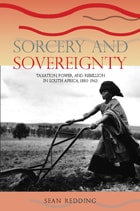
Sorcery and Sovereignty
Taxation, Power, and Rebellion in South Africa, 1880–1963Sean Redding
Ohio University Press, 2006
Rebellions broke out in many areas of South Africa shortly after the institution of white rule in the late nineteenth century and continued into the next century. However, distrust of the colonial regime reached a new peak in the mid-twentieth century, when revolts erupted across a wide area of rural South Africa. All these uprisings were rooted in grievances over taxes. Rebels frequently invoked supernatural powers for assistance and accused government officials of using witchcraft to enrich themselves and to harm ordinary people.
As Sean Redding observes in Sorcery and Sovereignty, beliefs in witchcraft and supernatural powers were part of the political rhetoric; the system of taxation—with all its prescribed interactions between ruler and ruled—was intimately connected to these supernatural beliefs.
In this fascinating study, Redding examines how black South Africans’ beliefs in supernatural powers, along with both economic and social change in the rural areas, resulted in specific rebellions and how gender relations in black South African rural families changed. Sorcery and Sovereignty explores the intersection of taxation, political attitudes, and supernatural beliefs among black South Africans, shedding light on some of the most significant issues in the history of colonized Africa.
Soul Power
Culture, Radicalism, and the Making of a U.S. Third World LeftCynthia A. Young
Duke University Press, 2006
Young analyzes a range of U.S. figures and organizations, examining how each deployed Third World discourse toward various cultural and political ends. She considers a trip that LeRoi Jones, Harold Cruse, and Robert F. Williams made to Cuba in 1960; traces key intellectual influences on Angela Y. Davis’s writing; and reveals the early history of the hospital workers’ 1199 union as a model of U.S. Third World activism. She investigates Newsreel, a late 1960s activist documentary film movement, and its successor, Third World Newsreel, which produced a seminal 1972 film on the Attica prison rebellion. She also considers the L.A. Rebellion, a group of African and African American artists who made films about conditions in the Watts neighborhood of Los Angeles. By demonstrating the breadth, vitality, and legacy of the work of U.S. Third World Leftists, Soul Power firmly establishes their crucial place in the history of twentieth-century American struggles for social change.
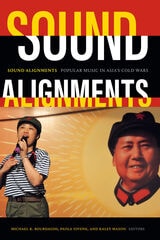
Sound Alignments
Popular Music in Asia's Cold WarsMichael K. Bourdaghs, Paola Iovene, and Kaley Mason, editors
Duke University Press, 2021
Contributors. Marié Abe, Michael K. Bourdaghs, Paola Iovene, Nisha Kommattam, Jennifer Lindsay, Kaley Mason, Anna Schultz, Hyunjoon Shin, C. J. W.-L. Wee, Hon-Lun (Helan) Yang, Christine R. Yano, Qian Zhang

Sound Pedagogy
Radical Care in MusicEdited by Colleen Renihan, John Spilker, and Trudi Wright. Foreword by William Cheng
University of Illinois Press, 2024
Contributors: Molly M. Breckling, William A. Everett, Kate Galloway, Sara Haefeli, Eric Hung, Stephanie Jensen-Moulton, Mark Katz, Nathan A. Langfitt, Matteo Magarotto, Mary Natvig, Frederick A. Peterbark, Laura Moore Pruett, Colleen Renihan, Amanda Christina Soto, John Spilker, Reba A. Wissner, and Trudi Wright

Sound System
The Political Power of MusicDave Randall
Pluto Press, 2017
Sound System is the story of one musician's journey to discover what makes music so powerful. Dave Randall uses his insider's knowledge of the industry to shed light on the secrets of celebrity, commodification and culture.
This is a book of raves, riots and revolution. From the Glastonbury Festival to the Arab Spring, Pop Idol to Trinidadian Carnival, Randall finds political inspiration across the musical spectrum and poses the question: how can we make music serve the interests of the many, rather than the few?
Published in partnership with the Left Book Club.

Sound and Affect
Voice, Music, WorldEdited by Judith Lochhead, Eduardo Mendieta, and Stephen Decatur Smith
University of Chicago Press, 2021
Sound and Affect maps a new territory for inquiry at the intersection of music, philosophy, affect theory, and sound studies. The essays in this volume consider objects and experiences marked by the correlation of sound and affect, in music and beyond: the voice, as it speaks, stutters, cries, or sings; music, whether vocal, instrumental, or machine-made; and our sonic environments, whether natural or artificial, and how they provoke responses in us. Far from being stable, correlations of sound and affect are influenced and even determined by factors as diverse as race, class, gender, and social and political experience. Examining these factors is key to the project, which gathers contributions from a cross-disciplinary roster of scholars, including both established and new voices. This agenda-setting collection will prove indispensable to anyone interested in innovative approaches to the study of sound and its many intersections with affect and the emotions.
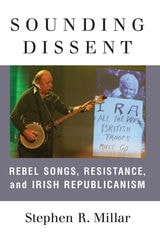
Sounding Dissent
Rebel Songs, Resistance, and Irish RepublicanismStephen R. Millar
University of Michigan Press, 2020
Sounding Dissent draws on three years of sustained fieldwork within Belfast's rebel music scene, in-depth interviews with republican musicians, contemporary audiences, and former paramilitaries, as well as diverse historical and archival material, including songbooks, prison records, and newspaper articles, to understand the history of political violence in Ireland.The book examines the potential of rebel songs to memorialize a pantheon of republican martyrs, and demonstrates how musical performance and political song not only articulate experiences and memories of oppression and violence, but also play a central role in the reproduction of conflict and exclusion in times of peace.
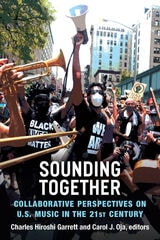
Sounding Together
Collaborative Perspectives on U.S. Music in the 21st CenturyCharles Hiroshi Garrett and Carol J. Oja, Editors
University of Michigan Press, 2021
Sounding Together: Collaborative Perspectives on U.S. Music in the Twenty-21st Century is a multi-authored, collaboratively conceived book of essays that tackles key challenges facing scholars studying music of the United States in the early twenty-first century. This book encourages scholars in music circles and beyond to explore the intersections between social responsibility, community engagement, and academic practices through the simple act of working together. The book’s essays—written by a diverse and cross-generational group of scholars, performers, and practitioners—demonstrate how collaboration can harness complementary skills and nourish comparative boundary-crossing through interdisciplinary research. The chapters of the volume address issues of race, nationalism, mobility, cultural domination, and identity; as well as the crisis of the Trump era and the political power of music. Each contribution to the volume is written collaboratively by two scholars, bringing together contributors who represent a mix of career stages and positions. Through the practice of and reflection on collaboration, Sounding Together breaks out of long-established paradigms of solitude in humanities scholarship and works toward social justice in the study of music.

Sounds of Black Switzerland
Blackness, Music, and Unthought VoicesJessie Cox
Duke University Press, 2025

Sounds of Vacation
Political Economies of Caribbean TourismJocelyne Guilbault and Timothy Rommen, editors
Duke University Press, 2019
Contributors. Jerome Camal, Steven Feld, Francio Guadeloupe, Jocelyne Guilbault, Jordi Halfman, Susan Harewood, Percy C. Hintzen, Timothy Rommen
Sounds of the Underground
A Cultural, Political and Aesthetic Mapping of Underground and Fringe MusicStephen Graham
University of Michigan Press, 2016
South Africa’s Resistance Press
Alternative Voices in the Last Generation under ApartheidLes Switzer
Ohio University Press, 2000
Sovereign, Settler, Leaker, Lie
Forms of the Secret in US Political RhetoricAtilla Hallsby
The Ohio State University Press, 2026
In Sovereign, Settler, Leaker, Lie, Atilla Hallsby argues that secrets play a pivotal role in organizing political discourse in the United States. Hallsby takes up contemporary case studies—ranging from the Valerie Plame scandal during the George W. Bush presidency, to the use of Saul Alinsky’s name as a partisan codeword for politicizing Obama’s Blackness, to Chelsea Manning’s public naming and outing—to show how dramatic revelations increasingly fail to produce meaningful change and instead reproduce entrenched racial, gendered, and colonial hierarchies.
The core feature of these interlinked moments of crisis is the secret: a rhetorical patterning of political life organized by specific forms, each one lending a familiar shape to the shadows of American empire. These forms, theorized here as tropes, connect decades of secrets, linking the George W. Bush administration’s War on Terror to the Trump-era reemergence of “deep state” conspiracy theories. As an extension of secrecy and surveillance studies, and with the aim of attaining a more accountable and just form of US governmentality, Sovereign, Settler, Leaker, Lie explains how still-unfolding political realities in the United States emerged, transformed, and regenerate.
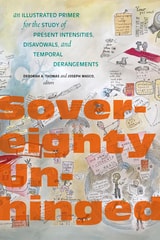
Sovereignty Unhinged
An Illustrated Primer for the Study of Present Intensities, Disavowals, and Temporal DerangementsDeborah A. Thomas and Joseph Masco, editors
Duke University Press, 2023
Contributors. Alex Blanchette, Yarimar Bonilla, Jessica Cattelino, María Elena García, Akhil Gupta, Lochlann Jain, Purnima Mankekar, Joseph Masco, Michael Ralph, Danilyn Rutherford, Arjun Shankar, Kristen L. Simmons, Deborah A. Thomas, Leniqueca A. Welcome, Kaya Naomi Williams, Jessica Winegar
Sovereignty, Inc.
Three Inquiries in Politics and EnjoymentWilliam Mazzarella, Eric L. Santner, and Aaron Schuster
University of Chicago Press, 2020
Drawing on anthropology, political theory, philosophy, psychoanalysis, and theater, William Mazzarella, Eric L. Santner, and Aaron Schuster show how politics in the age of Trump functions by mobilizing a contradictory and convoluted enjoyment, an explosive mixture of drives and fantasies that eludes existing portraits of our era. The current political moment turns out to be not so much exceptional as exceptionally revealing of the constitutive tension between enjoyment and economy that has always been a key component of the social order. Santner analyzes the collective dream-work that sustains a new sort of authoritarian charisma or mana, a mana-facturing process that keeps us riveted to an excessively carnal incorporation of sovereignty. Mazzarella examines the contemporary merger of consumer brand and political brand and the cross-contamination of politics and economics, warning against all too easy laments about the corruption of politics by marketing. Schuster, focusing on the extreme theatricality and self-satirical comedy of the present, shows how authority reasserts itself at the very moment of distrust and disillusionment in the system, profiting off its supposed decline. A dazzling diagnostic of our present, Sovereignty, Inc., forces us to come to terms with our complicity in Trump’s political presence and will immediately take its place in discussions of contemporary politics.
Spacing Debt
Obligations, Violence, and Endurance in Ramallah, PalestineChristopher Harker
Duke University Press, 2020
Spanish Film Under Franco
By Virginia Higginbotham
University of Texas Press, 1988
How does a totalitarian government influence the arts, and how do the arts respond? Spanish Film Under Franco raises these important questions, giving English speakers a starting point in their study of Spanish cinema.
After a brief overview of Spanish film before Franco, the author proceeds to a discussion of censorship as practiced by the Franco regime. The response of directors to censorship—the “franquista aesthetic,” or “aesthetic of repression,” with its highly metaphorical, oblique style—is explored in the works of Luis Buñuel, Carlos Saura, Juan Antonio Bardem, Luis García Berlanga, and other important directors.
Virginia Higginbotham combines historical perspective with detailed critical analysis and interpretation of many famous Franco-era films. She shows how directors managed to evade the censors and raise public awareness of issues relating to the Spanish Civil War and the repressions of the Franco regime.
Film has always performed an educational function in Spain, reaching masses of poor and uneducated citizens. And sometimes, as this study also reveals, Spanish film has been ignored when the questions it raised became too painful or demanding.
The author concludes with a look at post-Franco cinema and the directions it has taken. For anyone interested in modern Spanish film, this book will be essential reading.
Spanish and Empire
Nelsy Echavez-Solano
Vanderbilt University Press, 2007
Speaking to the People
The Rhetorical Presidency in Historical PerspectiveRichard Ellis
University of Massachusetts Press, 1998
Spectral Aesthetics
Visualizing the Crisis of Migrant DisappearanceChina Medel
University of Texas Press, 2026
Analyzing how artists reimagine migrant disappearance and visibility at the US–Mexico border.
In the mid-1990s, the US government implemented Prevention through Deterrence, a major buildup of troops, walls, and surveillance around El Paso and San Diego. Cut off from these crucial urban crossings, migrants flowed into the dangerous surrounding deserts, where some ten thousand have since died. This is all according to plan: Pentagon documents describe the strategy of funneling migrants toward “mortal danger.”
In this bracing critique, China Medel explores the aesthetics enabling and resisting the crisis of migrant death. The nation-state’s performance of sovereignty along the border, predicated on mass casualties, is tolerated and even celebrated, thanks to the images in our heads of racialized and therefore criminal bodies, made invisible as they disintegrate in the baking sand. Spectral Aesthetics shows how state officials and mainstream media, relying on postracial ideologies and white-supremacist agendas, collectively foster this picture of a brown body so abject that it is disposable. In close readings of artworks contesting this murderous visual regime, Medel discovers an alternative kind of sight, one emphasizing the ghostly traces of the dead. These are images not of the individual “alien” but of life itself, indisposable.
Spectres of 1919
Class and Nation in the Making of the New NegroBarbara Foley
University of Illinois Press, 2002
A look at the violent “Red Summer of 1919” and its intersection with the highly politicized New Negro movement and the Harlem Renaissance
With the New Negro movement and the Harlem Renaissance, the 1920s was a landmark decade in African American political and cultural history, characterized by an upsurge in racial awareness and artistic creativity. In Spectres of 1919 Barbara Foley traces the origins of this revolutionary era to the turbulent year 1919, identifying the events and trends in American society that spurred the black community to action and examining the forms that action took as it evolved.
Unlike prior studies of the Harlem Renaissance, which see 1919 as significant mostly because of the geographic migrations of blacks to the North, Spectres of 1919 looks at that year as the political crucible from which the radicalism of the 1920s emerged. Foley draws from a wealth of primary sources, taking a bold new approach to the origins of African American radicalism and adding nuance and complexity to the understanding of a fascinating and vibrant era.
Speech Rights in America
The First Amendment, Democracy, and the MediaLaura Stein
University of Illinois Press, 2005
The First Amendment is the principle guarantor of speech rights in the United States. But the Supreme Court's interpretations of it often privilege the interests of media owners over those of the broader citizenry.
Laura Stein argues that such rulings alienate citizens from their rights, corrupt the essential workings of democracy, and prevent the First Amendment from performing its critical role as a protector of free speech. Drawing on the best of the liberal democratic tradition, Stein demonstrates that there is a significant gap between First Amendment law and the speech rights necessary to democratic communication, and proposes an alternative set of principles to guide future judicial, legislative, and cultural policy on old and new media.

Speechwright
An Insider's Take on Political RhetoricWilliam F. Gavin
Michigan State University Press, 2011
For almost thirty years, William F. Gavin wrote speeches at the highest levels of government. Speechwright is his insider’s view of politics, a shrewd critique of presidential and congressional rhetoric, and a personal look at the political leaders for whom he wrote speeches. While serving President Richard Nixon and candidate Ronald Reagan, Gavin advocated for “working rhetoric”—well-crafted, clear, hard-hitting arguments that did not off er visions of the unattainable, but instead limited political discourse to achievable ends reached through practical means. Filled with hard-earned wisdom about politics and its discontents, Speechwright describes Gavin’s successes, his failures, and his call for political rhetoric built on strong argument rather than the mere search for eloquence.

Spider Web
The Birth of American AnticommunismNick Fischer
University of Illinois Press, 2016
Spin Cycle
How Research Gets Used in Policy Debates--The Case of Charter SchoolsJeffrey R. Henig
Russell Sage Foundation, 2008
Sport and Neoliberalism
Politics, Consumption, and CultureDavid L. Andrews
Temple University Press, 2012
Offering new approaches to thinking about sports and political ideologies, Sport and Neoliberalism explores the structures, formations, and mechanics of neoliberalism. The editors and contributors to this original and timely volume examine the intersection of sport as a national pastime and also an engine for urban policy—e.g., stadium building—as well as a powerful force for influencing our understanding of the relationship between culture, politics, and identity.
Sport and Neoliberalism examines the ways the neoliberal project creates priorities for civic society and how, in effect, it turns many aspects of sport into a vehicle of public governance. From the relationship between sport and the neo-liberal state, through the environmental dimensions of neo-liberal sport, to the political biopolitics of obesity, the essays in this volume explore the ways in which the “logics” of neoliberalism are manifest as powerful public pedagogies through the realm of popular culture.
Contributors include: Michael Atkinson, Ted Butryn, C. L. Cole, Norman Denzin, Grant Farred, Jessica Francombe, Caroline Fusco, Michael D. Giardina, Mick Green, Leslie Heywood, Samantha King, Lisa McDermott, Mary G. McDonald, Toby Miller, Mark Montgomery, Joshua I. Newman, Jay Scherer, Kimberly S. Schimmel, and Brian Wilson
In the series Sporting, edited by Amy Bass
Sports, Power, and Resistance
An Introduction to Critical Sports StudiesEdited by Thomas P. Oates and Travis Vogan
University of Illinois Press, 2026
Topics range from Black coaches in the National Football League to disordered eating within distance running to transgender athletes’ fight to participate in sports. The editors have organized the contributions into three sections. Part one probes how sports build communities that foster belonging as well as exclusion. The essays in part two explore multiple forms of resistance in sports through various performances and representations. In the final section, essayists analyze more explicit efforts to use sports as a platform for activism from various political viewpoints. Throughout, the works nurture and demonstrate a sensibility that encourages humanistic, critical, and interdisciplinary inquiry.
Wide-reaching and accessible, Sports, Power, and Resistance explores timely issues while demonstrating the value of blending perspectives to better understand the games we play and watch.
Contributors: Ali Bouterse, Adrian Burgos, Jr., Michael L. Butterworth, Noah Cohan, Douglas Hartmann, Victoria E. Johnson, Abraham I. Khan, Jason Kido Lopez, Theresa Runstedtler, Jaime Schultz, Samantha N. Sheppard, and Travers
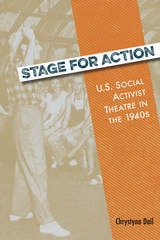
Stage for Action
U.S. Social Activist Theatre in the 1940sChrystyna Dail
Southern Illinois University Press, 2016
Exploring the intersection between performance and politics and the direct impact of the arts on social activism, Dail argues Stage for Action is a theatrical reflection of progressivism and the pro-working-class theatrical aesthetic of the 1940s. The theatre group, which used performance to encourage direct action and personal responsibility for change, eventually would function as the theatrical voice of the United States Progressive Party in the failed presidential campaign of former vice president Henry A. Wallace.
Calling into question the widely held belief that U.S. theatre in the early years of the Cold War was indifferent to activism, Stage for Action offers historians a new interpretation of social activist performance at midcentury.
Staging Resistance
Essays on Political TheaterJeanne Colleran and Jenny S. Spencer, Editors
University of Michigan Press, 1998
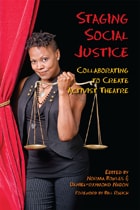
Staging Social Justice
Collaborating to Create Activist TheatreEdited by Norma Bowles and Daniel-Raymond Nadon
Southern Illinois University Press, 2013
Normal.dotm0011901163SIU Press195141012.00false18 pt18 pt00falsefalsefalseFringe Benefits, an award-winning theatre company, collaborates with schools and communities to create plays that promote constructive dialogue about diversity and discrimination issues. Staging Social Justice is a groundbreaking collection of essays about Fringe Benefits’ script-devising methodology and their collaborations in the United States, Australia, Canada and the United Kingdom. The anthology also vividly describes the transformative impact of these creative initiatives on participants and audiences. By reflecting on their experiences working on these projects, the contributing writers—artists, activists and scholars—provide the readerwith tools and inspiration to create their own theatre for social change.
“Contributors to this big-hearted collection share Fringe Benefits’ play devising process, and a compelling array of methods for measuring impact, approaches to aesthetics (with humor high on the list), coalition and community building, reflections on safe space, and acknowledgement of the diverse roles needed to apply theatre to social justice goals. The book beautifully bears witness to both how generative Fringe Benefits’ collaborations have been for participants and to the potential of engaged art in multidisciplinary ecosystems more broadly.”—Jan Cohen-Cruz, editor of Public: A Journal of Imagining America
Stare in the Darkness
The Limits of Hip-hop and Black PoliticsLester K. Spence
University of Minnesota Press, 2010
A growing number of black activists and artists claim that rap and hip-hop are the basis of an influential new urban social movement. Simultaneously, black citizens evince concern with the effect that rap and hip-hop culture exerts on African American communities. According to a recent Pew survey conducted on the opinions of Black Americans, 71 percent of blacks think that rap is a bad influence. To what extent are African American hopes and fears about hip-hop’s potential political power justified? In Stare in the Darkness, Lester K. Spence answers this question using a blend of neoliberal analysis, survey data, experiments, and case studies.
Spence finds that rap does in fact influence black political attitudes. However, rap also reproduces rather than critiques neoliberal ideology. Furthermore, black activists seeking to create an innovative model of hip-hop politics are hamstrung by their reliance on outmoded forms of organizing. By considering the possibilities inherent in the most prolific and prominent activities of hip-hop politics, Stare in the Darkness reveals, in a clear and practical manner, the political consequences of rap culture for black publics.

State Anti-Intellectualism and the Politics of Gender and Race
Illiberal France and BeyondÉric Fassin
Central European University Press, 2024
Eric Fassin examines the trend of State anti-intellectualism in France using the nation as a case study to demonstrate that this tendency is not limited to ostensibly illiberal regimes. He argues that today’s world requires an examination of this phenomenon beyond Cold War geopolitical divisions and highlights a global shift towards authoritarian neoliberalism. His book is a plea for the political urgency of intellectual work in a global moment of political anti-intellectualism.
The book covers the period from President Sarkozy to Prime Minister Valls and includes both firsthand and public cases of attacks against academics, not only in France, but also in Brazil, Hungary, Russia, Turkey, and the United States, with examples of State racism and the argument of the State against antiracism. The book also considers issues of censorship and cancel culture, concluding with Fassin’s firsthand account of attacks on him from the far-right.