Results by title
191 books match the query 'Studies' and 70 start with s
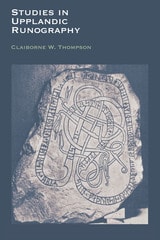
Studies in Upplandic Runography
By Claiborne W. Thompson
University of Texas Press, 1975
Studies in Upplandic Runography is a detailed treatment of the runic inscriptions from the province of Uppland, Sweden, where runic art reached a high point in A.D. 1200 and where runic inscriptions are most numerous. Most of the runic monuments discussed are from the eleventh century, an important period when Sweden was making the transition from paganism to Christianity.
The names of nearly fifty rune-carvers (runographers), professional and amateur, are known. However, many of the inscriptions were left unsigned. Claiborne Thompson examines the major problem of how an unsigned inscription is attributed to a known carver. Since each carver had a distinctive style which must be delineated, the book contains an exhaustive survey of the norms of Upplandic runography. In order to match the inscriptions with their carvers, Thompson analyzes the entire corpus of inscriptions from Uppland, their formation, the artistic designs they bear, the shapes of the runes on them, the orthography and language on them, and the manner in which they were carved.
Thompson then establishes a set of criteria for determining the authorship of a runic monument, stressing rune forms. All of the criteria are used in an extensive discussion of the carvings of Asmund Karasun, an interesting and influential carver from the first half of the eleventh century.
In addition, Thompson’s review of research describes scholarly interest in the problems of runography beginning in the early seventeenth century. The book includes an introductory sketch of the cultural background of Uppland and relates the runic tradition to historical and cultural traditions in eleventh-century Sweden.
Studies in Weak Arithmetics, Volume 1
Edited by Patrick Cégielski
CSLI, 2009
The field of weak arithmetics is an application of logical methods to number theory that was developed by mathematicians, philosophers, and theoretical computer scientists. In this volume, after a general presentation of weak arithmetics, the following topics are studied: the properties of integers of a real closed field equipped with exponentiation; conservation results for the induction schema restricted to first-order formulas with a finite number of alternations of quantifiers; a survey on a class of tools called pebble games; the fact that the reals e and pi have approximations expressed by first-order formulas using bounded quantifiers; properties of infinite pictures depending on the universe of sets used; a language that simulates in a sufficiently nice manner all algorithms of a certain restricted class; the logical complexity of the axiom of infinity in some variants of set theory without the axiom of foundation; and the complexity to determine whether a trace is included in another one.
Studies in Weak Arithmetics, Volume 2
Edited by Patrick Cégielski, Charalampos Cornaros, and Costas Dimitracopoulos
CSLI, 2013
Studies in Weak Arithmetics, Volume 3
Edited by Patrick Cegielski, Ali Enayat, and Roman Kossak
CSLI, 2013
Studies in the Archeological History of the Deh Luran Plain
The Excavation of Chagha SefidFrank Hole
University of Michigan Press, 1977
Studies in the Economics of Aging
Edited by David A. Wise
University of Chicago Press, 1994

Studies in the Eighteenth Century Background of Hume’s Empiricism
Mary Shaw Kuypers
University of Minnesota Press, 1930
Studies in the Eighteenth Century Background of Hume's Empiricism was first published in 1930. Minnesota Archive Editions uses digital technology to make long-unavailable books once again accessible, and are published unaltered from the original University of Minnesota Press editions.
A scholarly review of the influence of contemporary science and thought on the various phases of Hume's philosophy. The chapter headings are as follows: I. Introduction. II. Interpretations of Newtonian Science in the Eighteenth Century. III. Reverberations of the New Science in Philosophy. IV. Hume's Empiricism in Relation to Contemporary Science and Philosophy. V. Empiricism in Morals. VI. Empiricism in Politics. VII. Hume's Historical Writing. Bibliography.

Studies in the Formation of the Nation-state in Latin America
Edited by James Dunkerley
University of London Press, 2002
Contributors include Miguel Angel Centeno (Princeton University), Malcolm Deas (St Antony's College, Oxford), James Dunkerley (Institute of Latin American Studies, University of London), Paul Gootenberg (State University of New York at Stony Brook), Alan Knight (St Antony's College, Oxford), Colin Lewis (London School of Economics), Fernando Lopez Alves (University of California, Santa Barbara), David McCreery (Georgia State University), Florencia Mallon (University of Wisconsin), Seemin Qayum (Goldsmiths College, University of London), Guy Thomson (University of Warwick), and Steven Topik (University of California, Irvine). James Dunkerley is director of the Institute of Latin American Studies, University of London, and also professor of politics at Queen Mary, University of London. He is coeditor of the Journal of Latin American Studies. His most recent books are Americana:The Americas in the World, around 1850 (or 'Seeing the Elephant' as the Theme for an Imaginary Western) (2000) and Warriors and Scribes: Essays in the History and Politics of Latin America (2000).
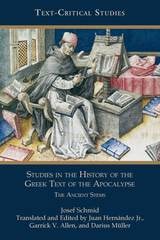
Studies in the History of the Greek Text of the Apocalypse
The Ancient StemsJosef Schmid
SBL Press, 2018
Now available in English
Josef Schmid's landmark publication, Studien zur Geschichte des Griechischen Apokalypse-Textes, has been the standard work for understanding Revelation's Greek manuscript tradition and textual history for more than sixty years. Despite the fact that most major studies on the book are based on Schmid's work, the work itself has long been out of print, making it difficult for the broader scholarly community to reassess Schmid's conclusions in light of recent manuscript discoveries and technological advances. This new translation of the work makes Schmid's detailed review of the history of textual scholarship; his comprehensive examination of the origin, history, and development of the Greek manuscripts of the book of Revelation; and his assessment of John's peculiar linguistic writing style accessible to a new generation of scholars.
Features
- A critical introduction that places Schmid's work in its historical and theoretical context
- Definitions and explanations of Schmid's text-critical terms and categories used in his construction of Revelation's Greek manuscript tradition
- The latest available information used to correct, update, and supplement Schmid's Greek manuscript data and historical and text-critical conclusions

Studies in the Metabolism of Vitamin B12
Alfred Doscherholmen
University of Minnesota Press, 1965
Studies in the Natural Radioactivity of Prehistoric Materials
Edited by Arthur J. Jelinek and James E. Fitting
University of Michigan Press, 1965
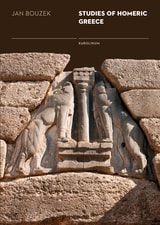
Studies of Homeric Greece
Jan Bouzek
Karolinum Press, 2018
Studies of Labor Market Intermediation
Edited by David H. Autor
University of Chicago Press, 2009
From the traditional craft hiring hall to the Web site Monster.com, a multitude of institutions exist to facilitate the matching of workers with firms. The diversity of such Labor Market Intermediaries (LMIs) encompasses criminal records providers, public employment offices, labor unions, temporary help agencies, and centralized medical residency matches. Studies of Labor Market Intermediation analyzes how these third-party actors intercede where workers and firms meet, thereby aiding, impeding, and, in some cases, exploiting the matching process.
By building a conceptual foundation for analyzing the roles that these understudied economic actors serve in the labor market, this volume develops both a qualitative and quantitative sense of their significance to market operation and worker welfare. Cross-national in scope, Studies of Labor Market Intermediation is distinctive in coalescing research on a set of market institutions that are typically treated as isolated entities, thus setting a research agenda for analyzing the changing shape of employment in an era of rapid globalization and technological change.
Studies of Supply and Demand in Higher Education
Edited by Charles T. Clotfelter and Michael Rothschild
University of Chicago Press, 1993
In higher education, supply refers to such issues as government support for public colleges and universities, the means by which graduate programs allocate financial support to students, and the criteria that universities use for investing endowments. Demand pertains to patterns of student enrollment and to the government, business, and individual market for the service and research activities of higher education.
Why are tuitions nearly the same among schools despite differences in prestige? How are institutions with small endowments able to compete successfully with institutions that have huge endowments? How are race and ethnicity reflected in enrollment trends? Where do the best students go? What choices among colleges do young people from low-income backgrounds face? This volume addresses these questions and suggests subjects for further study of the economics of higher education.
Studies of the Book of Mormon
Foreword by Sterling M. McMurrinB. H. Roberts
Signature Books, 1992
In this and other research, it was Roberts’s proclivity to go wherever the evidence took him, in this case anticipating and defending against potential future problems. Yet the manuscript was so poorly received by fellow church leaders that it was left to Roberts alone to decide whether he had overlooked some important piece of the puzzle or whether the Mormon scripture’s claims were, in fact, illegitimate. Clearly for most of his colleagues, institutional priorities overshadowed epistemological integrity.
But Roberts’s pathbreaking work has been judged by the editor to be methodologically sound–still relevant today. It shows the work of a keen mind, and illustrates why Roberts was one of the most influential Mormon thinkers of his day. The manuscript is accompanied by a preface and introduction, a history of the documents’ provenances, a biographical essay, correspondence to and from Roberts relating to the manuscript, a bibliography, and an afterword–all of which put the information into perspective.
Studies on Divergent Series and Summability
Walter Burton Ford, Ph.D.
University of Michigan Press, 1916
Studies on Wealth in the Ancient World (BICS Supplement 133)
Edited by Errietta M. A. Bissa and Federico Santangelo
University of London Press, 2016
Studies on the Abuse and Decline of Reason
Text and DocumentsF. A. Hayek
University of Chicago Press, 2010
Hayek argues that the vast number of elements whose interactions create social structures and institutions make it unlikely that social science can predict precise outcomes. Instead, he contends, we should strive to simply understand the principles by which phenomena are produced. For Hayek this modesty of aspirations went hand in hand with his concern over widespread enthusiasm for economic planning. As a result, these essays are relevant to ongoing debates within the social sciences and to discussion about the role government can and should play in the economy.
Studies on the Illuminated Chronicle
János M. Bak
Central European University Press, 2018
The present volume of studies—a joint publication with the National Széchényi Library, Budapest—is the first Subsidium of the Central European Medieval Text series, accompanying CEMT vol. IX on the Illuminated Chronicle, composed in the fourteenth century at the royal court of Louis I of Hungary. The large size of the volume, with the text and its annotations, did not permit the inclusion of a detailed scholarly introduction, unlike other CEMT items, so it is here printed separately.
The first essays analyze the text and the illuminations of the Illuminated Chronicle (formerly called the Vienna Chronicle) from literary-historical, art historical and heraldic perspectives. They also summarize the literature on the chronicle for the past two hundred years. Additional studies address the narrative. Since the chronicle starts with the history of the Huns, the imaginary ancestors of the Hungarians, one essay addresses the Attila tradition in Hungarian historiography. Others devote attention to the dynastic struggles of the eleventh century, placing them in the context of amicitia and deditio, and to the image of St. Ladislas I as the “ideal king”. The final essays examine the fate of the fourteenth-century chronicle texts over the subsequent centuries, their appearance in legal texts, and their reception abroad.
Studies on the effectiveness of endoscopic surgery in reproductive medicine
Jan Bosteels
Amsterdam University Press, 2014