Results by title
28167 books match the query 'History' and 1838 start with s
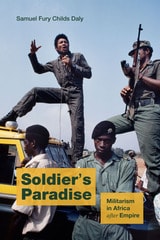
Soldier's Paradise
Militarism in Africa after EmpireSamuel Fury Childs Daly
Duke University Press, 2024
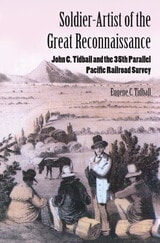
Soldier-Artist of the Great Reconnaissance
John C. Tidball and the 35th Parallel Pacific Railroad SurveyEugene C. Tidball
University of Arizona Press, 2004
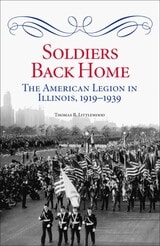
Soldiers Back Home
The American Legion in Illinois, 1919-1939Thomas B. Littlewood
Southern Illinois University Press, 2004
This first political and social history of the American Legion in Illinois from its formation in 1919 to the onset of World War II focuses on the organization’s influence on the two political parties and on public opinion at the state and local levels. Gauging the singular influence of the organization in a particularly turbulent time in Illinois and American history, Thomas B. Littlewood argues that the local orientation of individual posts was probably more important to most Legionnaires than the activities of the organization’s national leaders. At the same time, he shows how the conflicts within the Legion mirrored those in the larger society.
Soldiers Back Home: The American Legion in Illinois, 1919–1939 traces the origins of the organization nationally and in Illinois, showing it to be the biggest and most politically committed of the several organizations of World War I veterans. First and foremost a fraternal association of men whose military service set them apart, it was also a social mechanism through which veterans contained and redirected their anger and alienation. Littlewood details how the organization developed quickly into a vigorous pressure group working to influence public policy on behalf of veterans and their families. Concentrating at first on the welfare of children who had lost their fathers in the war, the Legion later became involved in a variety of community service activities and served as a political training ground.
World War I was the first conflict to be fought by a largely conscripted army. When the soldiers returned from the war, labor unions were pressing hard to organize American workers in rapidly growing concentrations of industry. Business enjoyed generally high esteem, but the ensuing social and economic turbulence led to a shattering of civil order in some parts of Illinois. Prohibition, bootleggers, and organized crime gave way to the crumbling of the economy and the lean, hard years of the Depression. While these events were unfolding in Illinois, rural citizens resisted the rebalancing of power caused by massive migrations of citizens from farm to city by refusing to reapportion legislative districts.
Organized thematically, Soldiers Back Home traces the Legion’s impact on politics, community life, labor relations, race relations, and the struggle for veterans’ benefits in Illinois. Littlewood maintains that the Legion experienced significant divisions along regional lines, especially over the issues of the Ku Klux Klan and labor. Likewise, brutal sectional tensions grew between rural and urban populations. Littlewood looks at the role of the veteran in American politics and society, discussing the careers of famed Illinois leaders such as Scott Lucas, William Dawson, and Everett Dirksen and their involvement with the Legion. He also addresses issues of diversity and division within the organization.
Resisting the polemics of some contemporary interpretations of the American Legion and avoiding the tone of the sanitized official histories of the organization, Soldiers Back Home is a major contribution to the history of the interwar years—in Illinois and nationally—that will interest general readers and historians alike. The volume is augmented by thirteen illustrations.
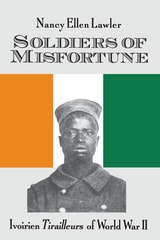
Soldiers Of Misfortune
lvoirien Tirailleurs of World War IINancy Ellen Lawler
Ohio University Press, 1992
This is a study of the African veterans of a European war. It is a story of men from the Cote d‘Ivoire, many of whom had seldom traveled more than a few miles from their villages, who served France as tirailleurs (riflemen) during World War II.
Thousands of them took part in the doomed attempt to hold back the armies of the Third Relch in 1940; many were to spend the rest of the war as prisoners in Germany or Occupied France.
Others more fortunate came under the authority of Vichy France, and were deployed in the Defense of the “Motherland” and its overseas possessions against the threat posed by the Allies. By 1943, the tirailleur regiments had passed into the service of de Gaulle’s free French and under Allied command, played a significant role in the liberation of Europe.
In describing these complex events, Dr. Lawler draws upon archives in both France and the Cote d’Ivoire. She also carried out an extensive series of interviews with Ivoirien veterans principally, but not exclusively, from the Korhogo region. The vividness of their testimony gives this study a special character. They talk freely not only of their wartime exploits, but also of their experiences after repatriation.
Lawler allows them to speak for themselves. They express their hatred of forced labor and military conscription, which were features of the colonial system, yet at the same time reveal a pride in having come to the defense of France. They describe their role in the nationalist struggle, as foot soldiers of Felix Houphouet-Boigny, but also convey their sense of having become a lost generation. They recognize that their experiences as French soldiers had become sadly irrelevant in a new nation in quest of its history.
Soldiers Once and Still
Ernest Hemingway, James Salter, and Tim O'BrienAlex Vernon
University of Iowa Press, 2007
Hemingway, Salter, and O’Brien form the core of Soldiers Once and Still because each represents a different warring generation of twentieth-century America: World War I with Hemingway, World War II and Korea with Salter, and Vietnam with O’Brien. Each author also represents a different literary voice of the twentieth century, from modern to mid-century to postmodern, and each presents a different battlefield experience: Hemingway as noncombatant, Salter as air force fighter pilot, and O’Brien as army grunt.
War’s pervasive influence on the individual means that, for veterans-turned-writers like Hemingway, Salter, and O’Brien, the war experience infiltrates their entire body of writing—their works can be seen not only as war literature but also as veterans’ literature. As such, their entire postwar oeuvre, regardless of whether an individual work explicitly addresses the war or the military, is open to Vernon’s exploration of war, society, gender, and literary history.
Vernon’s own experiences as a soldier, a veteran, a writer, and a critic inform this enlightening critique of American literature, offering students and scholars of American literature and war studies an invaluable tool for understanding war’s effects on the veteran writer and his society.
Soldiers and Silver
Mobilizing Resources in the Age of Roman ConquestBy Michael J. Taylor
University of Texas Press, 2020
Soldiers and Statesmen
Reflections on LeadershipJohn S. D. Eisenhower
University of Missouri Press, 2012
Soldiers of Misfortune
The Somervell and Mier ExpeditionsBy Sam W. Haynes
University of Texas Press, 1990
The Somervell and Mier Expeditions of 1842, culminating in the famous "black bean episode" in which Texas prisoners drew white or black beans to determine who would be executed by their Mexican captors, still capture the public imagination in Texas. But were the Texans really martyrs in a glorious cause, or undisciplined soldiers defying their own government? How did the Mier Expedition affect the border disputes between the Texas Republic and Mexico? What role did Texas President Sam Houston play? These are the questions that Sam Haynes addresses in this very readable book, which includes many dramatic excerpts from the diaries and letters of expedition participants.

Soldiers of the French Revolution
Alan Forrest
Duke University Press, 1989
Revolutionary idealists thought of the French soldier as a willing volunteer sacrificing himself for the principles of the Revolution; Forrest examines the convergence of these ideals with the ordinary, and often dreadful, experience of protracted warfare that the soldier endured.
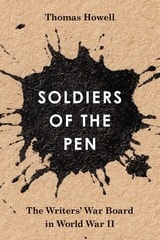
Soldiers of the Pen
The Writers' War Board in World War IIThomas Howell
University of Massachusetts Press, 2019
The WWB received federal money while retaining its status as a private organization that could mount campaigns without government oversight. Historian Thomas Howell argues that this unique position has caused its history to fall between the cracks, since it was not recognized as an official part of the government's war effort. Yet the WWB's work had a huge impact on the nation's wartime culture, and this fascinating history will inform contemporary thinking on propaganda, the media, and American society.
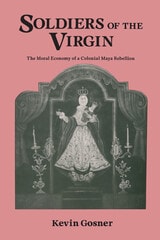
Soldiers of the Virgin
The Moral Economy of a Colonial Maya RebellionKevin Gosner
University of Arizona Press, 1992
Soldiers, Airmen, Spies, and Whisperers
The Gold Coast in World War IINancy Ellen Lawler
Ohio University Press, 2002
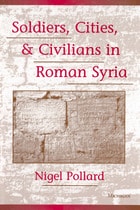
Soldiers, Cities, and Civilians in Roman Syria
Nigel Pollard
University of Michigan Press, 2000
Nigel Pollard is currently a Research Assistant at the Institute of Archaeology, University of Oxford.
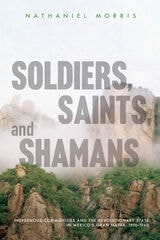
Soldiers, Saints, and Shamans
Indigenous Communities and the Revolutionary State in Mexico's Gran Nayar, 1910–1940Nathaniel Morris
University of Arizona Press, 2020
To make sense of this complex history, Nathaniel Morris offers the first systematic understanding of the participation of the Náayari, Wixárika, O’dam, and Mexicanero peoples in the Mexican Revolution. They are known for being among the least “assimilated” of all Mexico’s Indigenous peoples. It’s often been assumed that they were stuck up in their mountain homeland—“the Gran Nayar”—with no knowledge of the uprisings, civil wars, military coups, and political upheaval that convulsed the rest of Mexico between 1910 and 1940.
Based on extensive archival research and years of fieldwork in the rugged and remote Gran Nayar, Morris shows that the Náayari, Wixárika, O’dam, and Mexicanero peoples were actively involved in the armed phase of the revolution. This participation led to serious clashes between an expansionist, “rationalist” revolutionary state and the highly autonomous communities and heterodox cultural and religious practices of the Gran Nayar’s inhabitants. Morris documents confrontations between practitioners of subsistence agriculture and promoters of capitalist development, between rival Indian generations and political factions, and between opposing visions of the world, of religion, and of daily life. These clashes produced some of the most severe defeats that the government’s state-building programs suffered during the entire revolutionary era, with significant and often counterintuitive consequences both for local people and for the Mexican nation as a whole.
Solidarity and Fragmentation
Working People and Class Consciousness in Detroit, 1875-1900Richard Jules Oestreicher
University of Illinois Press, 1985
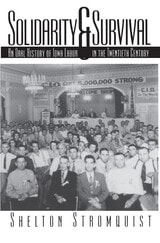
Solidarity and Survival
An Oral History of Iowa Labor in the Twentieth CenturyShelton Stromquist
University of Iowa Press, 1993
In Solidarity and Survival, three generations of Iowa workers tell of their unrelenting efforts to create a labor movement in the coal mines and on the rails, in packinghouses and farm equipment plants, on construction sites and in hospital wards. Drawing on nearly one thousand interviews collected over more than a decade by oral historians working for the Iowa Federation of Labor, AFL-CIO, Shelton Stromquist presents the resonant voices of the men and women who defined a new, prominent place for themselves in the lives of their communities and in the politics of their state.

Solidarity's Secret
The Women Who Defeated Communism in PolandShana Penn
University of Michigan Press, 2006
---Lech Walesa, former President of Poland and winner of the 1983 Nobel Peace Prize
Solidarity's Secret is the first book to record the crucial yet little-known role women played in the rise of an independent press in Poland and in the fall of that country's communist government.
Shana Penn pieces together a decade of interviews with the women behind the Polish pro-democracy movement-women whose massive contributions were obscured by the more public successes of their male counterparts.
Penn reveals the story of how these brave women ran Solidarity and the main opposition newspaper, Tygodnik Mazowsze, while prominent men like Lech Walesa were underground or in jail during the 1980s martial law years. The same women then went on to play influential roles in post-communist Poland.
Solidarity's Secret gives us a richly detailed story-within-a-story-unheard of not only in the West, but until recently even within Poland itself-from one of the most important eras in modern history.
Solidarity
Latin America and the US Left in the Era of Human RightsSteve Striffler
Pluto Press, 2018
In Solidarity, Steve Striffler addresses these key questions, offering the first history of US-Latin American solidarity from the Haitian Revolution to the present day. Striffler traces the history of internationalism through the Cold War, exploring the rise of human rights as the dominant current of international solidarity. He also considers the limitations of a solidarity movement today that inherited its organisational infrastructure from the human rights movements.
Moving beyond conventionally ahistorical analyses of solidarity, here Striffler provides a distinctive intervention in the history of progressive politics in both the US and Latin America, the past and present of US imperialism and anti-imperialism, and the history of human rights and labour internationalism.
Solitary Confinement
Social Death and Its AfterlivesLisa Guenther
University of Minnesota Press, 2013
Prolonged solitary confinement has become a widespread and standard practice in U.S. prisons—even though it consistently drives healthy prisoners insane, makes the mentally ill sicker, and, according to the testimony of prisoners, threatens to reduce life to a living death. In this profoundly important and original book, Lisa Guenther examines the death-in-life experience of solitary confinement in America from the early nineteenth century to today’s supermax prisons. Documenting how solitary confinement undermines prisoners’ sense of identity and their ability to understand the world, Guenther demonstrates the real effects of forcibly isolating a person for weeks, months, or years.
Drawing on the testimony of prisoners and the work of philosophers and social activists from Edmund Husserl and Maurice Merleau-Ponty to Frantz Fanon and Angela Davis, the author defines solitary confinement as a kind of social death. It argues that isolation exposes the relational structure of being by showing what happens when that structure is abused—when prisoners are deprived of the concrete relations with others on which our existence as sense-making creatures depends. Solitary confinement is beyond a form of racial or political violence; it is an assault on being.
A searing and unforgettable indictment, Solitary Confinement reveals what the devastation wrought by the torture of solitary confinement tells us about what it means to be human—and why humanity is so often destroyed when we separate prisoners from all other people.
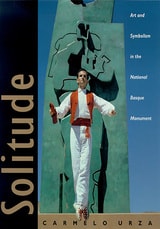
Solitude
Art And Symbolism In The National Basque MonumentCarmelo Urza
University of Nevada Press, 1993
Urza discusses the genesis of the National Basque Monument to the Basque Sheepherder that is located in Reno, Nevada. He also describes the competition held to determine the monument's design and the debates arising from the modern sculpture created by renowned Basque artist Nestor Basterrextea. Urza examines the arguments of those who favored the selection of a figurative, traditional symbol and those who preferred a modern, forward-looking symbol. He utilizes this discussion to explore the evolution of Basque ethnicity and its relationship to society.
Soloveitchik's Children
Irving Greenberg, David Hartman, Jonathan Sacks, and the Future of Jewish Theology in AmericaDaniel Ross Goodman
University of Alabama Press, 2023
A revealing account of the three main disciples of Rabbi Joseph B. Soloveitchik, an essential figure in Orthodox Judaism in America
Orthodox Judaism is one of the fastest-growing religious communities in contemporary American life. Anyone who wishes to understand more about Judaism in America will need to consider the tenets and practices of Orthodox Judaism: who its adherents are, what they believe in, what motivates them, and to whom they turn for moral, intellectual, and spiritual guidance.
Among those spiritual leaders none looms larger than Rabbi Joseph B. Soloveitchik, heir to the legendary Talmudic dynasty of Brisk and a teacher and ordainer of thousands of rabbis during his time as a Talmud teacher at Yeshiva University from the Second World War until the 1980s. Soloveitchik was not only a Talmudic authority but a scholar of Western philosophy. While many books and articles have been written about Soloveitchik’s legacy and his influence on American Orthodoxy, few have looked carefully at his disciples in Torah and Talmud study, and even fewer at his disciples in Jewish thought and philosophy.
Soloveitchik’s Children: Irving Greenberg, David Hartman, Jonathan Sacks, and the Future of Jewish Theology in America is the first book to study closely three of Soloveitchik’s major disciples in Jewish thought and philosophy: Rabbis Irving (“Yitz”) Greenberg, David Hartman, and Jonathan Sacks. Daniel Ross Goodman narrates how each of these three major modern Jewish thinkers learned from and adapted Soloveitchik’s teachings in their own ways, even while advancing his philosophical and theological legacy.
The story of religious life and Judaism in contemporary America is incomplete without an understanding of how three of the most consequential Jewish thinkers of this generation adapted the teachings of one of the most consequential Jewish thinkers of the previous generation. Soloveitchik’s Children tells this gripping intellectual and religious story in a learned and engaging manner, shining a light on where Jewish religious thought in the United States currently stands—and where it may be heading in future generations.

Solvable
How We Healed the Earth, and How We Can Do It AgainSusan Solomon
University of Chicago Press, 2024
We solved planet-threatening problems before, Susan Solomon argues, and we can do it again. Solomon knows firsthand what those solutions entail. She first gained international fame as the leader of an expedition to Antarctica in 1986, making discoveries that were key to healing the damaged ozone layer. She saw a path—from scientific and public awareness to political engagement, international agreement, industry involvement, and effective action. Solomon, an atmospheric scientist and award-winning author, connects this career-defining triumph to the inside stories of other past environmental victories—against ozone depletion, smog, pesticides, and lead—to extract the essential elements of what makes change possible.
The path to success begins when an environmental problem becomes both personal and perceptible to the general public. Lawmakers, diplomats, industries, and international agencies respond to popular momentum, and effective change takes place in tandem with consumer pressure when legislation and regulation yield practical solutions. Healing the planet is a long game won not by fear and panic but by the union of public, political, and regulatory pressure.
Solvable is a book for anyone who has ever despaired about the climate crisis. As Solomon reminds us, doom and gloom get us nowhere, and idealism will only take us so far. The heroes in these stories range from angry mothers to gang members turned social activists, to upset Long Island birdwatchers to iconoclastic scientists (often women) to brilliant legislative craftsmen. Solomon’s authoritative point of view is an inspiration, a reality check, a road map, and a much-needed dose of realism. The problems facing our planet are Solvable. Solomon shows us how.

Somalia - the Untold Story
The War Through the Eyes of Somali WomenEdited by Judith Gardner and Judy El Bushra
Pluto Press, 2004
In this book, Somali women write and talk about the war, their experiences and the unacceptable choices they often faced. They explain clearly, in their own words, the changes, challenges – and sometimes the opportunities – that war brought, and how they coped with them.
Key themes include the slaughter and loss of men, who were the prime target for killings; rape and sexual violence as a weapon of war; changing roles in the family and within the pastoralist economy; women mobilising for peace; and leading social recovery in a war-torn society.
This book is not only an important record of women's experience of war, but also provides researchers and students of gender and conflict with rare first hand accounts highlighting the impact of war on gender relations, and women's struggle for equal political rights in a situation of state collapse.
Somalis Abroad
Clan and Everyday Life in FinlandStephanie R. Bjork
University of Illinois Press, 2017

Somatic States
On Cartography, Geobodies, Bodily IntegrityFranck Billé
Duke University Press, 2025
Some Degree of Power
From Hired Hand to Union Craftsman in the Preindustrial American Printing Trades 1778-1815Mark Lause
University of Arkansas Press, 1991
Some Intellectual Consequences of the English Revolution
Christopher Hill
University of Wisconsin Press, 1980
In Some Intellectual Consequences of the English Revolution, Christopher Hill takes up themes that have emerged from a lifetime’s investigation into the causes of the English Revolution. However, Hill does more than analyze the origins of the Revolution. He examines the ways the seeds of change sown during the revolution, grew into transformative politics in the period following the restoration of the monarchy in 1660.
Hill argues that the intellectual heritage of the English Revolution was mixed. While he acknowledges its achievements, he also depicts some of its failings. Consequently, he challenges the view that radical notions faded with the Restoration, suggesting instead, that they continued in pervasive and subtle ways throughout the course of English and American history. The apparent similarity between the England of 1640 and that of 1660 is shown to be illusory. Each period’s institutions survived but the social context had changed. In this way, Hill demonstrates how intellectual consequences cannot be separated from the social and economic factors of the nation that produced them. He concludes that historians should turn their attention to the “unofficial” radical heritage that is less easy to comprehend, though no less important.
This is a highly readable and provocative account by one of the world’s foremost historians.
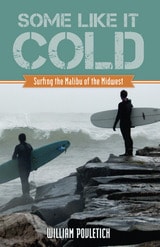
Some Like It Cold
Surfing the Malibu of the MidwestWilliam Povletich
Wisconsin Historical Society Press, 2016
Some Like It Cold
chronicles the true story of twin brothers Lee and Larry Williams, whose love of surfing evolved in the most unlikely of geographies: off the shores of Lake Michigan. From their boyhood home in Sheboygan, Wisconsin, the brothers trekked to the local beach with their longboards and their dreams to master the waves at spots like the Elbow and the Cove. The next six decades proved that their zeal for catching grinders and barrels was much more than a hobby.
Surfing in the cold had its challenges, and Lee and Larry recall stories of freak storms, ice-encrusted beaches, and near drownings, along with the usual hypothermia, helped but not cured by their customized cold-water wetsuits. Despite living nearly 2,000 miles from either coast, Lee and Larry have made a lifestyle out of freshwater surfing, recreating their hometown as "The Malibu of the Midwest" and gaining international fame as hosts of the Dairyland Surf Classic.
With humor and wit, author William Povletich brings their tale of revolutionizing surf culture to the page.
Some Measure of Justice
The Holocaust Era Restitution Campaign of the 1990sMichael R. Marrus; Foreword by William A. Schabas
University of Wisconsin Press, 2009
Writings on the subject of Holocaust reparations have largely come from participants, lawyers, philosophers, journalists, and social scientists specializing in restitution. In Some Measure of Justice Michael Marrus takes up the issue as a historian deeply involved with legal issues. He engages with larger questions about historical understanding and historical interpretation as they enter the legal arena. Ultimately this book asks, What constitutes justice for a great historic wrong? And, Is such justice possible?
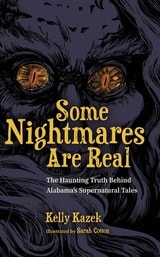
Some Nightmares Are Real
The Haunting Truth Behind Alabama’s Supernatural Talesby Kelly Kazek, illustrated by Sarah Cotton
University of Alabama Press, 2024
Southern writer and folklorist Kelly Kazek’s collection of eerie and enigmatic Alabama ghost stories
Dark secrets lurk beneath the sleepy surface of Alabama. Ghosts and grisly creatures haunt the towns and forests. In the great Southern ghost-story tradition, famed Alabama storyteller Kelly Kazek weaves a gothic tapestry of ten stories drawn from real people and legendary creatures, cursed places, and harrowing events.
Each story or legend takes readers to a different place in Alabama. Read about the bestial Wolf Woman who terrified Mobilians in the haunted old port city. In the northern city of Huntsville, visit the Dead Children’s Playground in gloomy Maple Hill Cemetery. In Jacksonville, feel the cold grip of the Old Mill Witch, rumored to protect the workers at the rickety cotton yarn mill. Hear about the mysterious green light that drifts along the Alabama River in the Black Belt hamlet of Gee’s Bend and learn about the role the Gee’s Bend Ferry played in the Civil Rights Movement.
Unlike most ghost-story collections, Some Nightmares Are Real includes an appendix of facts, historical resources, and information about how to visit the locations. These contemporary stories embrace a beloved Southern folkloric tradition for a new generation of young readers. The tales will terrify and ensnare ghost-story lovers of all ages. So settle in, pull the covers up tight, and maybe turn on the light, because the truth is: Some Nightmares Are Real.

Some Nightmares Are True
Ghosts of America's Deadliest Disastersby Kelly Kazek, illustrated by Sarah Cotton
University of Alabama Press, 2025
Digging up the eerie aftermath of America’s deadliest disasters—where ghost stories take root, history lingers in the shadows, and the past refuses to stay buried.
In this haunting follow-up to Some Nightmares Are Real: The Haunting Truth Behind Alabama’s Supernatural Tales, journalist and storyteller Kelly Kazek investigates supernatural folklore grounded in historical catastrophe. This time, she ventures far beyond Alabama, unearthing the eerie legends born from their aftermath of nine of America’s most infamous disasters. From the strangling suffocation of the Boston Molasses Flood and the terror of Galveston’s notorious Great Storm, to flames blasting from the Triangle Shirtwaist Factory disaster, Some Nightmares Are True examines ghost stories that have haunted communities long after the news headlines stopped.
Each spooky story blends vivid storytelling with meticulous research, connecting real events to the ghostly lore they inspired. Kazek explores not just the moment of disaster, but how grief, resilience, and remembrance shape the way stories live on—through newspaper archives, folklore, and generations of retelling.
With both wry Southern sensibility and journalistic rigor, Kazek explores how moments of tragedy like the Dixie Tornado Outbreak in Alabama, the capsizing of the SS Eastland in Chicago, and the haunting aftermath of the Schoolchildren’s Blizzard in Nebraska leave lasting imprints on generational memory. These sites of devastation become more than historical footnotes; they transform into hallowed grounds where grief lingers, legends remain, and the line between fact and folklore dissolves.
For ghost hunters, or simply those brave enough to follow their curiosity into learning more about the stories’ historical facts, Kazek has compiled a robust appendix that provides context, source materials, and location details, making this a perfect pick to toss in the car for that late-night road trip adventure. But remember, Some Nightmares Are True.
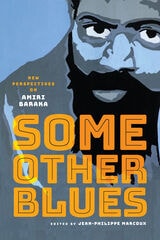
Some Other Blues
New Perspectives on Amiri BarakaEdited by Jean-Philippe Marcoux
The Ohio State University Press, 2021
(Include contributors if space allows) Contributors: Tony Bolden, Jeremy Glick, William J. Harris, Benjamin Lee, Aidan Levy, John Lowney, Jean-Philippe Marcoux, Kim McMillon, Fred Moten, Michael New, Aldon Lynn Nielsen, Amy Abugo Ongiri, Gregory Pierrot, Howard Rambsy II, Emily Ruth Rutter, Anthony Reed, Lauri Scheyer, Kathy Lou Schultz, Michael Simanga, James Smethurst, Laura Vrana, Tyrone Williams, Kalamu ya Salaam.
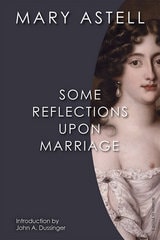
Some Reflections Upon Marriage
Mary Astell. Introduction by John A. Dussinger
University of Illinois Press, 2015
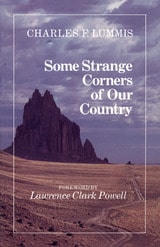
Some Strange Corners of Our Country
Charles F. Lummis; Foreword by Lawrence Clark Powell
University of Arizona Press, 1989
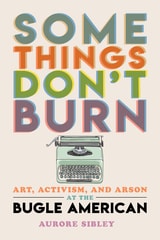
Some Things Don’t Burn
Art, Activism, and Arson at the Bugle AmericanAurore Sibley
Wisconsin Historical Society Press, 2026
A fierce, vibrant portrait of a newspaper that refused to go up in smoke.
From 1970 to 1978, the Bugle American wasn’t just an alternative newspaper―it was the sparkplug that propelled Milwaukee’s emergence as an influential cultural hub. With its incisive political coverage, razor-sharp cartoons, and in-depth reporting on the city’s explosive music scene, the Bugle American was a lifeline for artists, activists, and readers from Milwaukee to Madison hungry for independent journalism.
Then, on a cold night in February 1975, everything nearly ended. A firebomb ripped through the Bugle American offices, endangering the lives of staff and burning the building to the ground. The crime was never solved. But the paper didn’t die. Supported by a stunned but determined community―and high-profile allies including Leonard Cohen and George Reedy―the Bugle American rose from the ashes to publish the very next week.
In Some Things Don’t Burn: Art, Activism, and Arson at the Bugle American, author Aurore Sibley tells the full story of this influential underground paper: its founding ideals, its creative energy, its brushes with fame, and its lasting impact. With access to rare materials and family insights―her parents met at the Bugle American, and her father served as one of its editors―Sibley layers investigative research with personal narrative, exploring how revisiting the past helped her reconcile with her father’s complicated life and death.
Featuring dozens of photographs and illustrations, including cartoons and sketches by renowned underground artist and Bugle American co-founder Denis Kitchen, this book brings readers inside the quirky, passionate, and often chaotic world of a newsroom fighting to stay alive and independent.
A gripping story of art, activism, community, and resilience, Some Things Don’t Burn reminds us that while buildings can be destroyed, the ideals that ignite a movement are much harder to extinguish.

Some Words of Jane Austen
Stuart M. Tave
University of Chicago Press, 2019
Some of the Dead Are Still Breathing
Living in the FutureBy Charles Bowden
University of Texas Press, 2018
The third book in Charles Bowden’s “accidental trilogy” that began with Blood Orchid and Blues for Cannibals, Some of the Dead Are Still Breathing attempts to resolve the overarching question: “How can a person live a moral life in a culture of death?” As humanity moves further into the twenty-first century, Bowden continues to interrogate our roles in creating the ravaged landscapes and accumulated death that still surround us, as well as his own childhood isolation, his lust for alcohol and women, and his waning hope for a future. We witness post-Katrina New Orleans and terrorist-bombed Bali; we encounter our shared actions with the animal world and the desirous need for consumption; we see the clash and erosion of our physical and figurative borders, the savagery of our own civilization. A man of his time and out of time, Bowden seeks acceptance and a will to endure what may lie ahead.
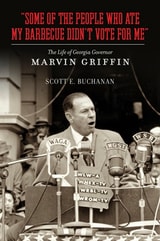
Some of the People Who Ate My Barbecue Didn't Vote for Me
The Life of Georgia Governor Marvin GriffinScott E. Buchanan
Vanderbilt University Press, 2011
.
In "Some of the People Who Ate My Barbecue Didn't Vote for Me," Scott Buchanan portrays Marvin Griffin as a Yellow Dog Democrat struggling against inevitable change. Griffin was viewed by many as a charismatic voice of resistance in the Georgia and the South in the wake of Brown v. Board of Education. He combined a staunch segregationist approach with economically progressive policies, assisting in Georgia's transformation from an agrarian economy to a more industrialized one.
Ironically, it was these efforts and the larger shift in politics that doomed Griffin's career, ensuring his administration would last only one term. In many ways, Griffin stands as a clear dividing line between the Old South and the New.

Someday All the Adults Will Die!
The Birth of Texas PunkPat Blashill
University of Texas Press, 2025
A deep dive into the early days of punk in Austin, Texas, this oral history immerses readers in a diverse and influential music scene.
Texas has always teemed with music and counterculture. When punk came to the state in 1978, it flourished in San Antonio, Dallas, Houston, and, especially, Austin. Punk and post-punk musicians, including nationally acclaimed bands like the Butthole Surfers, the Big Boys, the Dicks, and Daniel Johnston influenced local culture before slashing into the American musical psyche. (See Kurt Cobain sporting Johnston’s “Hi, How are you?” T-shirt.) Someday All the Adults Will Die! is an oral history of punk in Texas, from its rise in the late 1970s, through its strong anti-racist, feminist, and queer peak, to its dissolution in the late 1980s.
Now a seasoned music journalist, Blashill experienced the zenith of Texas punk as a teenager, and he captures its intensity in words and pictures. Someday All the Adults Will Die! is rife with electrifying images and firsthand tales of what made this scene such a storm of pleasures and terrors, uncompromising artists, and wild performances. This dynamic portrait of an untamed, all-out musical era is a must-read for fans of punk music, counterculture, and live music.
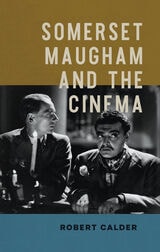
Somerset Maugham and the Cinema
Robert Calder
University of Wisconsin Press, 2024
This study of the famous author explores the relationship between literature and film, what is involved in adaptation, and how best to judge films based on celebrated books. Robert Calder, the world’s leading scholar of Maugham’s work, offers fascinating production histories, insight into both fortunate and misguided casting decisions, shrewd analyses of performances and film techniques, and summaries of public and critical responses. Maugham’s characters were often conflicted, iconoclastic, and morally out of step with their times, which may have accounted for the popularity of his fiction. Most of Maugham’s works could be adapted to satisfy the tastes of moviegoers and the demands of the Hays Office censors, if not the expectations of their author.
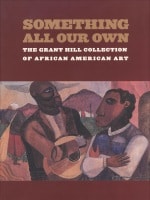
Something All Our Own
The Grant Hill Collection of African American ArtGrant Hill
Duke University Press, 2003
The forty-six pieces documented here include thirteen works that span the career of the great Romare Bearden, from his 1941 gouache painting Serenade to the important collages of the 1980s. Hill’s fascination with artists’ depiction of women is represented in Elizabeth Catlett’s lithographs, many of them from the 1992 series “For My People,” and her sculptures in stone, bronze, and onyx. In addition to these two giants of twentieth-century art, the Hill Collection features pieces by Phoebe Beasley, Arthello Beck Jr., John Biggers, Malcolm Brown, John Coleman, Edward Jackson, and Hughie Lee Smith.
Hill began collecting art in the early 1990s after learning from his parents to appreciate artworks not only as objects of beauty but as expressions of heritage and culture. According to the internationally known curator Alvia J. Wardlaw, he is part of an emerging group of young African American collectors who have “raised the bar for others.” Hill writes, “Getting to know yourself means understanding your background and appreciating those who have come before you. My father has a saying he uses in speeches: ‘To be ignorant of your past is to remain a boy. ‘The interest in my heritage as an African American is reflected in this collection.”
Something All Our Own features Wardlaw’s essay on the history of African American collecting. It also features articles about Bearden and Catlett by the scholars Elizabeth Alexander and Beverly Guy-Sheftall and reflections about Hill by the historian John Hope Franklin, Duke’s basketball coach Mike Krzyzewski, and the sportswriter William C. Rhoden. Hill and his father, the NFL great Calvin Hill, contribute a dialogue that explores their motivations for collecting art.
At the heart of the book are the exquisite color photographs of the forty-six artworks included in the exhibition, with commentary by Wardlaw and by Hill himself.
As a star athlete, Grant Hill is well aware that African Americans who excel in sports and entertainment are more broadly recognized than their counterparts in artistic fields. He strives to inspire young people to explore their heritage and broaden their concept of excellence by learning more about African American art. By sharing his artworks with collectors and fans, Hill reminds us that while the jump shot is ephemeral, art is enduring.
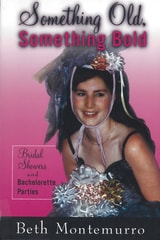
Something Old, Something Bold
Bridal Showers and Bachelorette PartiesMontemurro, Beth
Rutgers University Press, 2006
Weddings in the United States are often extravagant, highly ritualized, and costly affairs. In this book, Beth Montemurro takes a fresh look at the wedding process, offering a perspective not likely to be found in the many planning books and magazines readily available to the modern bride. Montemurro draws upon years of ethnographic research to explore what prenuptial events mean to women participants and what they tell us about the complexity and ambiguity of gender roles. Through the bachelorette party and the bridal shower, the bride-to-be is initiated into the role of wife by her friends and family, who present elaborate scenarios that demonstrate both what she is sacrificing and what she is gaining.
Montemurro argues that American society at the turn of the twenty-first century is still married to traditional conceptions of masculinity and femininity and that prenuptial rituals contribute to the stabilization of gender inequalities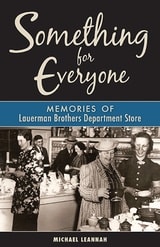
Something for Everyone
Memories of Lauerman Brothers Department StoreMichael Leanah
Wisconsin Historical Society Press, 2013
This book traces the history of the Lauerman enterprise and its importance to the community of Marinette and dozens of counties in northern Wisconsin and the UP. The author takes readers on a tour of the store’s most memorable and delightful features, from the plethora of merchandise offered to the record-listening booths to the famous frosted malt cones. Along the way we hear the recollections of dozens of former customers and employees whose memories form a unique tapestry of family, business, and community story. As it brings to life the people who worked and shopped at Lauermans, Something for Everyone will have readers fondly recalling their own favorite shopping destinations during the golden age of department stores.
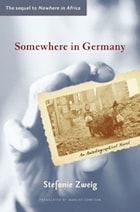
Somewhere in Germany
A NovelStefanie Zweig, Translated by Marlies Comjean
University of Wisconsin Press, 2006
In Frankfurt, Regina matures into a woman and, though her parents want her to marry an upstanding Jewish man, her love life progresses in its own idiosyncratic fashion. She develops a passion for art and journalism and begins her professional career at a Frankfurt newspaper. Walter at last finds professional success as a lawyer, but never quite adjusts to life in Frankfurt, recalling with nostalgia his childhood in Upper Silesia and his years in Africa. Only his son Max truly finds what Walter had hoped for: a new homeland in Germany.
Although the Redlichs receive kindness from strangers, they also learn anti-Semitism still prevails in post-Nazi Germany. They partake in the West German “economic miracle” with their own home, a second-hand car, and the discovery of television, but young Max’s discovery of the Holocaust revives long-buried memories. Rich in memorable moments and characters, this novel portrays the reality of postwar German society in vivid and candid detail.
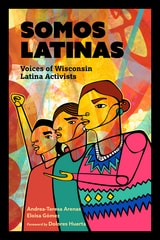
Somos Latinas
Voices of Wisconsin Latina ActivistsAndrea-Teresa Arenas
Wisconsin Historical Society Press, 2018
Celebrated Latina civil rights activist Dolores Huerta once said, “Every moment is an organizing opportunity, every person a potential activist, every minute a chance to change the world.” These are the stories of some of the Latina activists from Wisconsin who have lived Huerta’s words. Somos Latinas shares the powerful narratives of 25 activists—from outspoken demonstrators to collaborative community-builders to determined individuals working for change behind the scenes—providing proof of the long-standing legacy of Latina activism throughout Wisconsin.
Somos Latinas draws on activist interviews conducted as part of the Somos Latinas Digital History Project, housed at the Wisconsin Historical Society, and looks deep into the life and passion of each woman. Though Latinas have a rich history of community activism in the state and throughout the country, their stories often go uncelebrated. Somos Latinas is essential reading for scholars, historians, activists, and anyone curious about how everyday citizens can effect change in their communities.
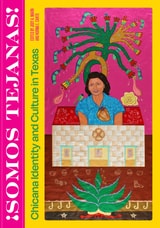
Somos Tejanas!
Chicana Identity and Culture in TexasEdited by Jody A. Marín and Norma E. Cantú
University of Texas Press, 2025
2026 Outstanding Book Award for Non-Fiction, National Association for Chicana and Chicano Studies (NACCS) Tejas Foco
2026 Silver Medal for the Dolores Huerta Best Cultural & Community Themed Book – English, Conference on Latin American History (CLAH)
An expansive volume on Tejana identity and Tejanidad told through personal narratives, poetry, and essays.
Being Tejanx is different than just being from Texas. Being Tejanx means you are a border subject. Being Tejanx means living in and from a certain history of oppression, possibility, activism, and cultural-linguistic hybridity arising within the US-Mexico borderland that is home. And being Tejanx means something in particular if you are a woman.
In ¡Somos Tejanas!, editors Norma E. Cantú and Jody A. Marín assemble contemporary Tejanx writers who provide firsthand accounts of their experience of identity, enriching the field of Tejanx studies through an encounter with gender and sexuality. The contributions, including personal and scholarly essays, poems, criticism, and artworks, explore the heterogeneity of Tejana identity and the sociopolitical movements, stories, dances, music, and athletic feats that mark Tejanidad. Authors contemplate the history and memory of segregation in Texas, the struggles of surviving the unnatural disaster and blackouts of 2021 amid the global pandemic of COVID-19, and the drug-war violence and ever-tightening immigration restrictions that strangle a transborder way of life shared by millions. An unrepentant act of expression from women under attack by state policymakers, this collection dispels the silence imposed by colonial erasure.
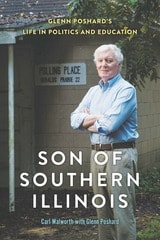
Son of Southern Illinois
Glenn Poshard’s Life in Politics and EducationCarl Walworth with Glenn Poshard
Southern Illinois University Press, 2023
A life of principles, service, and faith
This first biography of Glenn Poshard traces the life of a young man who rose from rural poverty in Southern Illinois to become a United States congressman and president of the Southern Illinois University system. This profound portrait unveils a life and career dedicated to making higher education affordable and improving the quality of life for the community of Southern Illinois.
Beginning with his childhood in a two-room home near Herald, Illinois and the early, tragic loss of his sister, this biography navigates Poshard’s service in the military, his time as a state senator and United States congressman, his run for governor, his years at Southern Illinois University, and the establishment of the Poshard Foundation for Abused Children. Intimacies of his personal life are disclosed, such as his struggles with and treatment for depression, his passion for education, and the lasting bonds he formed with his teachers. His unpopular decision to refuse PAC donations is also highlighted, along with the work that went into sponsoring the Illinois Wilderness Act, and his relationship with civil rights activist John Lewis. Glenn Poshard’s efforts for the Wilderness Act designated Southern Illinois’s famous Garden of the Gods as a National Wilderness Preservation System, which continues to attract visitors from around the world.
Poshard’s path from poverty was riddled with hardship, but his perseverance and family values ultimately allowed for longstanding personal and civic growth. From an admirable work ethic to a steadfast commitment to problem-solving, this biography illuminates the life and accomplishments of an impressive and generous leader.
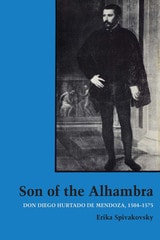
Son of the Alhambra
Don Diego Hurtado de Mendoza, 1504-1575By Erika Spivakovsky
University of Texas Press, 1970
Last of the Spanish Renaissance men, Diego Hurtado de Mendoza (1504–1575) was a master of the humanist disciplines as well as an active diplomat whose correspondence provides insight into the workings of power politics in the first post-Machiavellian decades.
This account of Mendoza's diplomatic career is a living commentary on the mid-sixteenth century, the time of the Spanish Inquisition and the Reformation, with its upheavals in the European balance of power. Mendoza served as ambassador of Charles V to Venice and Rome and as governor of Siena. His political life complements the reign of the Emperor whose ambition was to become a universal monarch.
An interesting contradiction in Mendoza's thought—his humanist theories versus personal ambition—prevented him from successful implemention of tyrannical imperial policies. His role in the government of the Holy Roman Empire shows how the exertion of imperialist power, humanist ethics notwithstanding, inevitably entails corruption, hypocrisy, greed, and imbalance in the one who tries to wield this power.
Gifted to the point of universal genius, Mendoza was perhaps the foremost representative of the splendid but little-known epoch of Spanish humanism, the era between the death of Queen Isabel (1504) and the abdication of her grandson Charles V (1556). Spain's short-lived Renaissance came to an abrupt end with the accession of Philip II and the almost simultaneous onset of the Counter Reformation. To this changed Spain, under monolithic thought control now exacted and enforced by monarch and Inquisition, Mendoza returned to live the last third of his life, mostly in obscurity, and in the last few years in royal disgrace.
Based on primary sources, this first biography of Mendoza in English also examines the relevance of some of Don Diego's disputed literary works to the legend that grew up around him as a spokesman for latent unorthodox opinion.
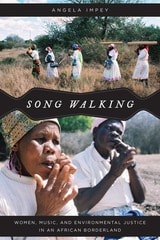
Song Walking
Women, Music, and Environmental Justice in an African BorderlandAngela Impey
University of Chicago Press, 2018
This book links ethnomusicological research to larger themes of international development, environmental conservation, gender, and local economic access to resources. By demonstrating that development processes are essentially cultural processes and revealing how music fits within this frame, Song Walking testifies to the affective, spatial, and economic dimensions of place, while contributing to a more inclusive and culturally apposite alignment between land and environmental policies and local needs and practices.
Song and Self
A Singer's Reflections on Music and PerformanceIan Bostridge
University of Chicago Press, 2023
Like so many performers, renowned tenor Ian Bostridge spent much of 2020 and 2021 unable to take part in live music. The enforced silence of the pandemic led him to question an identity that was previously defined by communicating directly with audiences in opera houses and concert halls. It also allowed him to delve deeper into many of the classical works he has encountered over the course of his career, such as Claudio Monteverdi’s seventeenth-century masterpiece Il Combattimento di Tancredi e Clorinda and Robert Schumann’s popular song cycle Frauenliebe und Leben. In lucid and compelling prose, Bostridge explores the ways Monteverdi, Schumann, and Britten employed and disrupted gender roles in their music; questions colonial power and hierarchy in Ravel’s Songs of Madagascar; and surveys Britten’s reckoning with death in works from the War Requiem to his final opera, Death in Venice.
As a performer reconciling his own identity and that of the musical text he delivers on stage, Bostridge unravels the complex history of each piece of music, showing how today’s performers can embody that complexity for their audiences. As readers become privy to Bostridge’s unique lines of inquiry, they are also primed for the searching intensity of his interpretations, in which the uncanny melding of song and self brings about moments of epiphany for both the singer and his audience.