Results by title
18284 books match the query 'United States' and 1181 start with s

Struggle for the Gulf Borderlands
The Creek War and the Battle of New Orleans, 1812-1815Frank L. Owsley
University of Alabama Press, 2000
Using American, British, and Spanish documents, many previously unknown, Frank Owsley’s study establishes the Creek War and the struggle to control the Gulf borderlands as integral parts of the War of 1812. The war between the United States and a large part of the Creek nation is usually studied as local or regional history. These documentary sources, however, show the larger picture. They show Spain to have been a major influence in the Creek War and indicate the extent to which the British were aiding the Indians and using them to redirect American troops. On the other hand, Andrew Jackson, in charge of the American forces on the Gulf Coast, emerged from the conflict as a first-rate military commander. His victories on the Gulf gave the West a leader and aided in shifting political power from the eastern seaboard to the South and West.
Owsley concludes that the victories in the Gulf region were of sufficient magnitude to justify the claim that the War of 1812 was not a draw but a decisive American victory and that had there been a general of Jackson's caliber on the northern frontier, the United States might have had a clear-cut victory there.
As a result of the war, the United States held its claim on Louisiana, annexed the Mobile district, forced Spain out of Florida, and broke the power of the southern Indians, thus opening vast lands for settlement from the new nation on the eastern seaboard.
Struggle for the Soul of the Postwar South
White Evangelical Protestants and Operation DixieElizabeth Fones-Wolf and Ken Fones-Wolf
University of Illinois Press, 2015
The authors' nuanced look at working class religion reveals how laborers across the surprisingly wide evangelical spectrum interpreted their lives through their faith. Factors like conscience, community need, and lived experience led individual preachers to become union activists and mill villagers to defy the foreman and minister alike to listen to organizers. As the authors show, however, all sides enlisted belief in the battle. In the end, the inability of northern organizers to overcome the suspicion with which many evangelicals viewed modernity played a key role in Operation Dixie's failure, with repercussions for labor and liberalism that are still being felt today.
Identifying the role of the sacred in the struggle for southern economic justice, and placing class as a central aspect in southern religion, Struggle for the Soul of the Postwar South provides new understandings of how whites in the region wrestled with the options available to them during a crucial period of change and possibility.

Struggle on the North Santiam
Power and Community on the Margins of the American WestBob H Reinhardt
Oregon State University Press, 2020
In this deeply researched account, historian Bob H. Reinhardt connects the North Santiam Canyon’s history to that of the Pacific Northwest and the United States more broadly. Readers will learn about specific events that illuminate themes in the region’s history: railroad development as seen through the failed dreams of the Oregon Pacific Railroad, federal land scams in the Oregon land fraud trials of the early twentieth century, the causes and consequences of mid-century river development projects like Detroit Dam, the post-war booms and busts of the timber industry, the spotted owl/ancient forest debate in the 1980s and 1990s, and the promises and perils of Oregon’s recreational tourism economy.
From nineteenth-century interactions between Native and non-Native peoples to the changing fortunes of the timber industry and questions about economic and environmental sustainability in the twenty-first century, the book offers important insights into power dynamics in small communities and marginal places. Struggle on the North Santiam will be of interest to scholars of the American West and thoughtful readers interested in Oregon and Pacific Northwest history.
Struggling With Iowas Pride
Labor Relations, Unionism, and Politics in the Rural Midwest since 1877Warren, Wilson J.
University of Iowa Press, 2000
Recognized between 1880 and 1910 by its trademark label "Iowa's Pride," John Morrell and Company is best known for contributing one of the most important local unions to the progressive United Packinghouse Workers of America. During the 1930s and 1940s, its members pursued a militant brand of unionism. By the early 1950s, the local's militancy became a source of contention among the membership. By explaining the effect of Morrell-Ottumwa's union leaders on local and state Democratic politics, especially in the development of the Congress of Industrial Organizations' Iowa State Industrial Union Council and the AFL-CIO's Iowa Federation of Labor, Wilson Warren makes an important contribution to the literature on labor's involvement in the Democratic party's ascendancy across much of the industrial North following World War II.
This history of Ottumwa's meatpacking workers provides insights into the development of several forms of labor relations, including the evangelical Christian paternalism, welfare capitalism, and unionism that were distinctive to one blue-collar community but that also reflected workers' experiences in many other rural midwestern industrial communities. By carefully analyzing all relevant labor and industrial sources and by revealing the deeply held aspirations and concerns expressed by both workers and managers, Warren constructs a window through which Iowa's industrial and labor history over the past 120 years can be viewed.
Stuart Symington
A LifeJames C. Olson
University of Missouri Press, 2003
Stubborn Twig
Three Generations in the Life of a Japanese American FamilyLauren Kessler
Oregon State University Press, 2005
To celebrate Oregon's 150th birthday, the Oregon Library Association has chosen one book for all Oregonians to read: Stubborn Twig. Lauren Kessler's award-winning book, the selection for the statewide Oregon Reads program, is a classic story of immigrants making their way in a new land. It is a living work of social history that rings with the power of truth and the drama of fiction, a moving saga about the challenges of becoming an American.
Masuo Yasui traveled from Japan across the other Oregon Trail — the one that spanned the Pacific Ocean — in 1903. Like most immigrants, he came with big dreams and empty pockets. Working on the railroads, in a cannery, and as a houseboy before settling in Hood River, Oregon, he opened a store, raised a large family, and became one of the area's most successful orchardists.
As Masuo broke the race barrier in the local business community, his American-born children broke it in school, scouts and sports, excelling in most everything they tried. For the Yasuis' first-born son, the constraints and contradictions of being both Japanese and American led to tragedy. But his seven brothers and sisters prevailed, becoming doctors, lawyers, teachers, and farmers. It was a classic tale of the American dream come true — until December 7, 1941, changed their lives forever.
The Yasuis were among the 120,000 people of Japanese ancestry along the West Coast who were forced from their homes and interned in vast inland "relocation camps." Masuo was arrested as a spy and imprisoned for the rest of the war; his family was shamed and broken. Yet the Yasuis endured, as succeeding generations took up the challenge of finding their identity as Americans. Stubborn Twig is their story — a story at once tragic and triumphant, one that bears eloquent witness to both the promise and the peril of America.

Stuck in Place
Urban Neighborhoods and the End of Progress toward Racial EqualityPatrick Sharkey
University of Chicago Press, 2013
In the 1960s, many believed that the civil rights movement’s successes would foster a new era of racial equality in America. Four decades later, the degree of racial inequality has barely changed. To understand what went wrong, Patrick Sharkey argues that we have to understand what has happened to African American communities over the last several decades. In Stuck in Place, Sharkey describes how political decisions and social policies have led to severe disinvestment from black neighborhoods, persistent segregation, declining economic opportunities, and a growing link between African American communities and the criminal justice system.
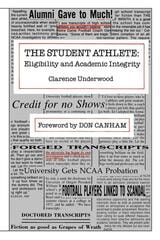
Student Athlete
Eligibility and Academic IntegrityClarence Underwood
Michigan State University Press, 1984
Student Athlete Eligibility and Academic Integrity covers areas: Characteristics of Student Athletes, Prospective Student Athletes and the NCAA, Black Student Athletes and Their Revolt, Financial Aid to Student Athletes, Support Services Staff, Recruitment and Admission, Monitoring Academic Affairs and Eligibility, Study Hall and Tutorial Programs, and Legal Implications for the Athletic Advisor.
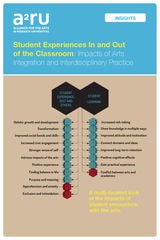
Student Experiences In and Out of the Classroom
Impacts of Arts Integration and Interdisciplinary PracticeGabriel Harp
A2RU Intervals, 2020

Students Lead The Library
The Importance Of StudentCarissa Tomlinson
Assoc of College & Research Libraries, 2016

Studies in American Culture
Dominant Ideas and ImagesJoseph J. Kwiat and Mary C. Turpie, Editors
University of Minnesota Press, 1960
Studies in American Culture was first published in 1960. Minnesota Archive Editions uses digital technology to make long-unavailable books once again accessible, and are published unaltered from the original University of Minnesota Press editions.
The last decade has seen a revolutionary interest at colleges and universities both in this country and abroad in the field known variously as American Studies, American Civilization, or American Culture. Now the time is ripe for a critical look at the field, to assess its intellectual and cultural problems, and to anticipate its future. This is what the contributors to this volume do, through thoughtful discussions and interesting examples of studies in American ideas and images.
There are sixteen contributors, members of the faculties of a number of colleges and universities, and representatives of various specialties such as literary history and criticism; social, intellectual, and aesthetic history; political, economic, and social theory.
In the introductory chapter, Henry Nash Smith discusses the problems of method which confront scholars in American Studies. The chapters which follow contain outstanding examples of scholarship in American Studies. The authors are Reuel Denney, John W. Ward, Mulford Q. Sibley, David R. Weimer, William Van O'Connor, Bernard Bowron, Leo Marx, Arnold Rose, Allen Tate, David W. Noble, J. C. Levenson, Joseph J. Kwiat, Theodore C. Blegen, and Charles H. Foster. In the final chapter, Robert E. Spiller looks at the past, present, and future of American Studies.
All the contributors as well as the editors are now or have been associated with the American Studies program at the University of Minnesota and with the late Tremaine McDowell, chairman of the program for thirteen years and a pioneer in the development of the discipline.
The book will be useful to anyone interested in American thought, culture, and society, to those conducting American Studies programs, and to their students.
Studies in Labor Markets
Sherwin Rosen
University of Chicago Press, 1981
Originally presented at a Universities-National Bureau Committee for Economic Research conference on labor markets in 1978, and not published elsewhere, the thirteen papers treat four interrelated themes: labor mobility, job turnover, and life-cycle dynamics; the analysis of unemployment compensation and employment policy; labor market discrimination; and labor market information and investment. The Introduction by Sherwin Rosen provides a thoughtful guide to the contents of the papers and offers suggestions for continuing research.

Studies in Philosophy for Children
Harry Stottlemeier's Discoveryedited by Ann Margaret Sharp and Ronald F. Reed
Temple University Press, 1991
Harry Stottlemeier's Discovery, created by Matthew Lipman in 1969, is now a widely used and highly successful tool for teaching philosophy to children. As the original novel of the Philosophy for Children program, its goal is to present major ideas in the history of philosophy, nurturing children's ability to think for themselves. At present, it is taught in 5,000 schools in the United States and has been translated into eighteen languages worldwide. This collection of essays reflects upon the development, refinement, and maturation of Philosophy for Children and on its relationship to the tradition of philosophy itself.
The contributors are philosophers themselves who have taught from Lipman's novels or conducted workshops instructing elementary school teachers on how most effectively to utilize the program in their classrooms. Teaching Harry raises philosophical issues concerning such concepts as authority, morality, religion, justice, truth, knowledge, beauty, and goodness. Gracing each article with personal experience, the authors recount their own struggles against the claims of philosophers and psychologists who have previously underestimated children's moral capability because of their lack of political and social experience.

Studies in State and Local Public Finance
Edited by Harvey S. Rosen
University of Chicago Press, 1986
Developed from a National Bureau of Economic Research conference on state and local financing, the volume includes papers summarizing and extending recent research as well as commentaries. Covering a wide range of topics, the papers share an empirical orientation and a concern with policy issues. The first two papers look at the role of tax-exempt bonds in local public finance. Their findings suggest that tax policies significantly affect municipal borrowing practices and that financial advantage can be achieved under certain of these practices. Other papers address specific issues related to state and local tax policy: the impact of local taxes on location decisions; efficient road-use charges for trucks; and the relation of income and general sales tax systems over time. Examining issues related to United States federalism, the last paper focuses on the impact of federal grant aid to states.
The research and findings these papers report make an important contribution to the study of local public finance and should be of particular interest to policymakers and those involved in private and public financing at the local, state, or federal level.

Studies into Darkness
The Perils and Promise of Freedom of SpeechEdited by Carin Kuoni and Laura Raicovich
Amherst College Press, 2022
Contributions by Zach Blas, Mark Bray, Natalie Diaz, Aruna D’Souza, Silvia Federici and Gabriela López Dena, Jeanne van Heeswijk, shawné michaelain holloway, Prathibha Kanakamedala and Obden Mondésir, Amar Kanwar, Carin Kuoni, Lyndon, Debora, and Abou, Svetlana Mintcheva, Mendi + Keith Obadike, Vanessa Place, Laura Raicovich, Michael Rakowitz, Kameelah Janan Rasheed, and Nabiha Syed.

Studies of Supply and Demand in Higher Education
Edited by Charles T. Clotfelter and Michael Rothschild
University of Chicago Press, 1993
In higher education, supply refers to such issues as government support for public colleges and universities, the means by which graduate programs allocate financial support to students, and the criteria that universities use for investing endowments. Demand pertains to patterns of student enrollment and to the government, business, and individual market for the service and research activities of higher education.
Why are tuitions nearly the same among schools despite differences in prestige? How are institutions with small endowments able to compete successfully with institutions that have huge endowments? How are race and ethnicity reflected in enrollment trends? Where do the best students go? What choices among colleges do young people from low-income backgrounds face? This volume addresses these questions and suggests subjects for further study of the economics of higher education.
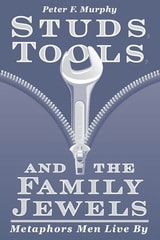
Studs, Tools, and the Family Jewels
Metaphors Men Live ByPeter F. Murphy
University of Wisconsin Press, 2001
Peter F. Murphy's purpose in this book is not to shock but rather to educate, provoke discussion, and engender change. Looking at the sexual metaphors that are so pervasive in American culture—jock, tool, shooting blanks, gang bang, and others even more explicit—he argues that men are trapped and damaged by language that constantly intertwines sexuality and friendship with images of war, machinery, sports, and work.
These metaphors men live by, Murphy contends, reinforce the view that relationships are tactical encounters that must be won, because the alternative is the loss of manhood. The macho language with which men cover their fear of weakness is a way of bonding with other men. The implicit or explicit attacks on women and gay men that underlie this language translate, in their most extreme forms, into actual violence. Murphy also believes, however, that awareness of these metaphorical power plays is the basis for behavioral change: "How we talk about ourselves as men can alter the way we live as men."
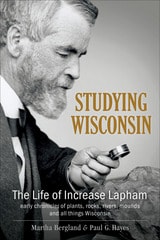
Studying Wisconsin
The Life of Increase Lapham, early chronicler of plants, rocks, rivers, mounds and all things WisconsinMartha Bergland
Wisconsin Historical Society Press, 2014
With masterful storytelling, Bergland and Hayes demonstrate how Lapham blended his ravenous curiosity with an equable temperament and a passion for detail to create a legacy that is still relevant today.
—John Gurda
In this long overdue tribute to Wisconsin’s first scientist, authors Martha Bergland and Paul G. Hayes explore the remarkable life and achievements of Increase Lapham (1811–1875). Lapham’s ability to observe, understand, and meticulously catalog the natural world marked all of his work, from his days as a teenage surveyor on the Erie Canal to his last great contribution as state geologist.
Self-taught, Lapham mastered botany, geology, archaeology, limnology, mineralogy, engineering, meteorology, and cartography. A prolific writer, his 1844 guide to the territory was the first book published in Wisconsin. Asked late in life which field of science was his specialty, he replied simply, “I am studying Wisconsin.”
Lapham identified and preserved thousands of botanical specimens. He surveyed and mapped Wisconsin’s effigy mounds. He was a force behind the creation of the National Weather Service, lobbying for a storm warning system to protect Great Lakes sailors. Told in compelling detail through Lapham’s letters, journals, books, and articles, Studying Wisconsin chronicles the life and times of Wisconsin’s pioneer citizen-scientist.

Style as Argument
Contemporary American NonfictionChirs Anderson
Southern Illinois University Press, 1987
Taking the position that style has a value in its own right, that language forms a major component of the story a nonfiction writer has to tell, Anderson analyzes the work of America’s foremost practitioners of New Journalism—Tom Wolfe, Truman Capote, Norman Mailer, and Joan Didion.
Anderson does for nonfiction what insightful critics have long been doing for fiction and poetry. His approach is rhetorical, and his message is that the rhetoric of Wolfe, Capote, Mailer, and Didion is a direct response to the problem of trying to convey to a general audience the sublime, inexplicable, or private and intuitive experiences that conventional rhetoric cannot evoke.
The emphasis in this book is on style, not genre, and the analysis characterizes the distinctive styles of four American writers, showing how the richness and complexity of their prose discloses an important argument about the value of language itself. Their prose is complex, nuanced, layered, affecting, always aware of itself as style. This self-consciousness, Anderson contends, prepares the reader to regard style as argument, a “tacit but powerful statement about the value of form as form, style as style.”
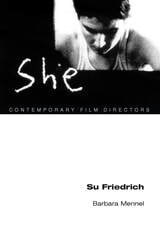
Su Friedrich
Barbara Mennel
University of Illinois Press, 2023
With acclaimed films like Sink or Swim and The Odds of Recovery, Su Friedrich’s body of work stands at the forefront of avant-garde and Queer cinema. Barbara Mennel examines the career of an experimental auteur whose merger of technical innovation and political critique connects with both cinephiles and activists. Friedrich’s integration of cinematic experimentation with lesbian advocacy serves as a beginning rather than an end point of analysis. With that in mind, Mennel provides an essential overview of the filmmaker’s oeuvre while highlighting the defining characteristics of her artistic and political signature. She also situates Friedrich within the cultural, political, and historical contexts that both shape the films and are shaped by them. Finally, Mennel expands our notion of auteurism to include directors who engage in collaborative and creative processes rooted in communities.
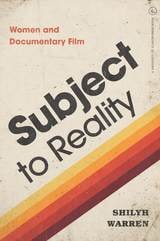
Subject to Reality
Women and Documentary FilmShilyh Warren
University of Illinois Press, 2019
Shilyh Warren reopens this understudied period and links it to a neglected era of women's filmmaking that took place from 1920 to 1940, another key period of thinking around documentary, race, and gender. Drawing women’s cultural expression during these two explosive times into conversation, Warren reconsiders key debates about subjectivity, feminism, realism, and documentary and their lasting epistemological and material consequences for film and feminist studies. She also excavates the lost ethnographic history of women's documentary filmmaking in the earlier era and explores the political and aesthetic legacy of these films in more explicitly feminist periods like the Seventies.
Filled with challenging insights and new close readings, Subject to Reality sheds light on a profound and unexamined history of feminist documentaries while revealing their influence on the filmmakers of today.
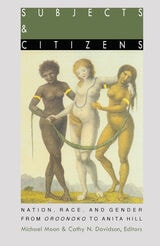
Subjects and Citizens
Nation, Race, and Gender from Oroonoko to Anita HillMichael Moon and Cathy N. Davidson, eds.
Duke University Press, 1995
Defining the landscape of the New American literary history, these essays are united by three interrelated concerns: ideas of origin (where does "American literature" begin?), ideas of nation (what does "American literature" mean?), and ideas of race and gender (what does "American literature" include and exclude and how?). Work by writers as diverse as Aphra Behn, James Fenimore Cooper, Edgar Allan Poe, Frances Harper, Harriet Beecher Stowe, Herman Melville, William Faulkner, Harriet Jacobs, Frederick Douglass, Abraham Lincoln, Bharati Mukherjee, Booker T. Washington, Mark Twain, Kate Chopin, Américo Paredes, and Toni Morrison are discussed from several theoretical perspectives, using a variety of methodologies. Issues of the "frontier" and the "border" as well as those of coloniality and postcoloniality are explored. In each case, these essays emphasize the ideological nature of national identity and, more specifically, the centrality of race and gender to our concept of nationhood.
Collected from recent issues of American Literature, with three new essays added, Subjects and Citizens charts the new directions being taken in American literary studies.
Contributors. Daniel Cooper Alarcón, Lori Askeland, Stephanie Athey, Nancy Bentley, Lauren Berlant, Michele A. Birnbaum, Kristin Carter-Sanborn, Russ Castronovo, Joan Dayan, Julie Ellison, Sander L. Gilman, Karla F. C. Holloway, Annette Kolodny, Barbara Ladd, Lora Romero, Ramón Saldívar, Maggie Sale, Siobhan Senier, Timothy Sweet, Maurice Wallace, Elizabeth Young

Subjects of the Sun
Solar Energy in the Shadows of Racial CapitalismMyles Lennon
Duke University Press, 2025
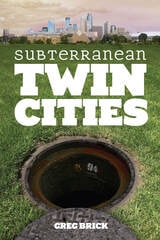
Subterranean Twin Cities
Greg Brick
University of Minnesota Press, 2009
We tend to send things underground that we are not interested in ever seeing again. Sewage. Garbage. In the past, we have used the underground to age such provisions as cheese and beer. In Subterranean Twin Cities, geologist, historian, and urban speleologist Greg Brick takes us on an adventurous, educational, and—thankfully—sanitary tour beneath the streets and into the myriad tunnels, caves, and industrial spaces that make up the Twin Cities’ fascinating and surprisingly vast underground landscape.
In this groundbreaking tour, the first of its kind of the Twin Cities, Brick mines the stories that lie below the city surface. Beginning with an accessible history on the geology of the area—including the giant cone-shaped mollusk Endoceras, whose thirteen-foot-long fossils are found in the Mississippi gorge—Brick guides us into a series of astounding firsthand expeditions. We follow him into St. Paul’s historic Carver’s Cave, with its stories of sunken treasure; through the many caves constructed for brewing, cheese ripening, and mushroom farming; and into the world of nineteenth-century show caves for tourists. We even find ourselves in the “Shangri-la” of urban caves: the extensive Schiek’s Cave seventy-five feet beneath the busy streets of downtown Minneapolis.
From spending the onset of Y2K in Carver’s Cave (just in case) to long hours wading in underground rivers, Brick proves himself a knowledgeable, wry, and daring guide. Subterranean Twin Cities shines a headlamp (with extra batteries, of course) into the captivating labyrinths beneath the Twin Cities and reminds us that what we see aboveground is really only half of the story.

Suburban Dreams
Imagining and Building the Good LifeGreg Dickinson
University of Alabama Press, 2014
2016 CHOICE OUTSTANDING ACADEMIC TITLE AND JANE JACOBS URBAN COMMUNICATION BOOK AWARD FINALIST
Explores how the suburban imaginary, composed of the built environment and imaginative texts, functions as a resource for living out the “good life”
Starting with the premise that suburban films, residential neighborhoods, chain restaurants, malls, and megachurches are compelling forms (topos) that shape and materialize the everyday lives of residents and visitors, Greg Dickinson’s Suburban Dreams offers a rhetorically attuned critical analysis of contemporary American suburbs and the “good life” their residents pursue.
Dickinson’s analysis suggests that the good life is rooted in memory and locality, both of which are foundations for creating a sense of safety central to the success of suburbs. His argument is situated first in a discussion of the intersections among buildings, cities, and the good life and the challenges to these relationships wrought by the twentieth and twenty-first centuries. The argument then turns to rich, fully-embodied analyses of suburban films and a series of archetypal suburban landscapes to explore how memory, locality, and safety interact in constructing the suburban imaginary. Moving from the pastoralism of residential neighborhoods and chain restaurants like Olive Garden and Macaroni Grill, through the megachurch’s veneration of suburban malls to the mixed-use lifestyle center’s nostalgic invocation of urban downtowns, Dickinson complicates traditional understandings of the ways suburbs situate residents and visitors in time and place.
The analysis suggests that the suburban good life is devoted to family. Framed by the discourses of consumer culture, the suburbs often privilege walls and roots to an expansive vision of worldliness. At the same time, developments such as farmers markets suggest a continued striving by suburbanites to form relationships in a richer, more organic fashion.
Dickinson’s work eschews casually dismissive attitudes toward the suburbs and the pursuit of the good life. Rather, he succeeds in showing how by identifying the positive rhetorical resources the suburbs supply, it is in fact possible to engage with the suburbs intentionally, thoughtfully, and rigorously. Beyond an analysis of the suburban imaginary, Suburban Dreams demonstrates how a critical engagement with everyday places can enrich daily life. The book provides much of interest to students and scholars of rhetoric, communication studies, public memory, American studies, architecture, and urban planning.
Suburban Lives
Marsh, Margaret
Rutgers University Press, 1990

Suburban Plots
Men at Home in Nineteenth-Century American Print CultureMaura D'Amore
University of Massachusetts Press, 2014
In Suburban Plots, Maura D'Amore explores how Henry David Thoreau, Henry Ward Beecher, Donald Grant Mitchell, Nathaniel Hawthorne, Nathaniel Parker Willis, and others utilized the pen to plot opportunities for a new sort of male agency grounded, literarily and spatially, in a suburbanized domestic landscape. D'Amore uncovers surprising narratives that do not fit easily into standard critical accounts of midcentury home life. Taking men out of work spaces and locating them in the domestic sphere, these writers were involved in a complex process of portraying men struggling to fulfill fantasies outside of their professional lives, in newly emerging communities. These representations established the groundwork for popular conceptions of suburban domestic life that remain today.
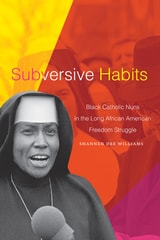
Subversive Habits
Black Catholic Nuns in the Long African American Freedom StruggleShannen Dee Williams
Duke University Press, 2022
Subversive Sounds
Race and the Birth of Jazz in New OrleansCharles B. Hersch
University of Chicago Press, 2008
Subversive Sounds probes New Orleans’s history, uncovering a web of racial interconnections and animosities that was instrumental to the creation of a vital American art form—jazz. Drawing on oral histories, police reports, newspaper accounts, and vintage recordings, Charles Hersch brings to vivid life the neighborhoods and nightspots where jazz was born.
This volume shows how musicians such as Jelly Roll Morton, Nick La Rocca, and Louis Armstrong negotiated New Orleans’s complex racial rules to pursue their craft and how, in order to widen their audiences, they became fluent in a variety of musical traditions from diverse ethnic sources. These encounters with other music and races subverted their own racial identities and changed the way they played—a musical miscegenation that, in the shadow of Jim Crow, undermined the pursuit of racial purity and indelibly transformed American culture.
“More than timely . . . Hersch orchestrates voices of musicians on both sides of the racial divide in underscoring how porous the music made the boundaries of race and class.”—New Orleans Times-Picayune

Succeeding Generations
On the Effects of Investments in ChildrenRobert Haveman
Russell Sage Foundation, 1994
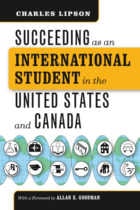
Succeeding as an International Student in the United States and Canada
Charles Lipson
University of Chicago Press, 2008
Succeeding is designed to help students navigate the myriad issues they will encounter—from picking a program to landing a campus job. Based on Lipson’s work with international students as well as extensive interviews with faculty and advisers, Succeeding includes practical suggestions for learning English, participating in class, and meeting with instructors. In addition it explains the rules of academic honesty as they are understood in U.S. and Canadian universities.
Life beyond the classroom is also covered, with handy sections on living on or off campus, obtaining a driver’s license, setting up a bank account, and more. The comprehensive glossary addresses both academic terms and phrases heard while shopping or visiting a doctor. There is even a chapter on the academic calendar and holidays in the United States and Canada.

Success Depends on the Animals
Emigrants, Livestock, and Wild Animals on the Overland Trails, 1840–1869Diana L. Ahmad
University of Nevada Press, 2016
Between 1840 and 1869, thousands of people crossed the American continent looking for a new life in the West. Success Depends on the Animals explores the relationships and encounters that these emigrants had with animals, both wild and domestic, as they traveled the Overland Trail. In the longest migration of people in history, the overlanders were accompanied by thousands of work animals such as horses, oxen, mules, and cattle. These travelers also brought dogs and other companion animals, and along the way confronted unknown wild animals.
Ahmad’s study is the first to explore how these emigrants became dependent upon the animals that traveled with them, and how, for some, this dependence influenced a new way of thinking about the human-animal bond. The pioneers learned how to work with the animals and take care of them while on the move. Many had never ridden a horse before, let alone hitched oxen to a wagon. Due to the close working relationship that the emigrants were forced to have with these animals, many befriended the domestic beasts of burden, even attributing human characteristics to them.
Drawing on primary sources such as journals, diaries, and newspaper accounts, Ahmad explores how these new experiences influenced fresh ideas about the role of animals in pioneer life. Scholars and students of western history and animal studies will find this a fascinating and distinctive analysis of an understudied topic.
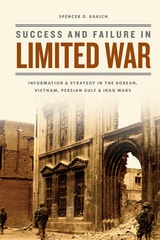
Success and Failure in Limited War
Information and Strategy in the Korean, Vietnam, Persian Gulf, and Iraq WarsSpencer D. Bakich
University of Chicago Press, 2014
Traditional assessments of wartime strategy focus on the relationship between the military and civilians, but Bakich argues that we must take into account the information flow patterns among top policy makers and all national security organizations. By examining the fate of American military and diplomatic strategy in four limited wars, Bakich demonstrates how not only the availability and quality of information, but also the ways in which information is gathered, managed, analyzed, and used, shape a state’s ability to wield power effectively in dynamic and complex international systems.
Utilizing a range of primary and secondary source materials, Success and Failure in Limited War makes a timely case for the power of information in war, with crucial implications for international relations theory and statecraft.

Successful Community Outreach
A How-To-Do-It Manual for LibrariansBarbara Blake
American Library Association, 2011
Successfully Serving the College Bound
Africa S. Hands
American Library Association, 2014
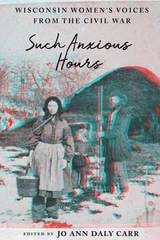
Such Anxious Hours
Wisconsin Women's Voices from the Civil WarJo Ann Daly Carr
University of Wisconsin Press, 2020
In Such Anxious Hours, Jo Ann Daly Carr places this material in historical context, detailing what was happening simultaneously in the nation, state, and local communities. Civil War history enthusiasts will appreciate these enlightening perspectives that demonstrate the variety of experiences in the Midwest during the bloody conflict.
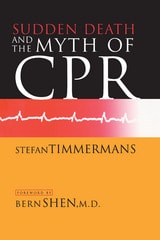
Sudden Death and the Myth of CPR
Stefan Timmermans, foreword by Bern Shen
Temple University Press, 1999
Anyone who has ever taken a CPR course has wondered, "What would happen if I actually had to use CPR?" In Western societies, the lifesaving power of resuscitation has the status of a revered cultural myth. It promises life in the face of sudden death, but the reality is that lives are rarely saved. Medical researchers estimate the survival rate for out-of-hospital CPR to be between 1 and 3 percent. Sudden Death and the Myth of CPR explores the history of this medical innovation and the promotion of its effectiveness.
The overuse of resuscitation, Timmermans explains, defines people's experience with sudden death, something he learned firsthand by following the practice of lifesaving from street corner to emergency room. He argues that very few people are successfully resuscitated without brain damage despite the promotion of CPR's effectiveness through powerful media images. In vivid accounts of the day-to-day practices of cardiopulmonary resuscitation in one of the only studies o f sudden death, Timmermans records the astonishingly frank comments of emergency personnel. Doctors, nurses, social workers, and paramedics express emotions from cynicism about going through the futile motions to genuine concern for victims' family members.
If a person who was supposed to keep on living dies at the end of a resuscitative attempt, how socially meaningful is the dying? Timmermans asks tough questions and addresses the controversial ethical issues about the appropriateness of interfering with life and death. He suggests policy reform and the restoration of dignity to sudden death.

Sudden Deaths in St. Louis
Coroner Bias in the Gilded AgeSarah E. Lirley
Southern Illinois University Press, 2024
Honorable Mention, 2025 Society of Midland Authors Award in History!
A social history of death investigations in the urban Midwest
The scene of myriad grisly deaths, late nineteenth-century St. Louis was a hotbed for homicide, suicide, alcoholism, abortion, and workplace accidents. The role of the city’s Gilded Age coroners has not been fully examined, contextualized, or interrogated until now. Sarah E. Lirley investigates the process in which these outcomes were determined, finding coroners’ rulings were not uniform, but rather varied by who was conducting the inquest. These fascinating case studies explore the lives of the deceased, as well as their families, communities, press coverage of the events, and the coroners themselves.
Sudden Deaths in St. Louis is a study of 120 coroners’ inquests conducted between 1875 and 1885. Each chapter analyzes the typical versus the atypical in verdicts of death. At the time, inaccurate findings and cursory investigations fueled criticisms of coroner’s offices for employing poorly trained laymen. The coroners featured in this book had the power to shape public perception of the deceased, and they often relied on preexisting reputations to determine cause of death. For instance, women who worked as prostitutes were likely to be ruled as suicides, whether or not that was actually the case, and women who were respected members of their communities, particularly mothers, frequently received rulings of suicide caused by insanity. Verdicts also depended in part on availability of witnesses, including family members, to determine whether another person could be held liable for the death. Lirley’s book highlights the stories of ordinary men and women whose lives were tragically cut short, and the injustice they received even after death.
Sudden Selector's Guide to Government Publications
Alexandra Simons
American Library Association, 2017
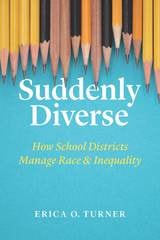
Suddenly Diverse
How School Districts Manage Race and InequalityErica O. Turner
University of Chicago Press, 2020
Suddenly Diverse is an ethnographic account of two school districts in the Midwest responding to rapidly changing demographics at their schools. It is based on observations and in-depth interviews with school board members and superintendents, as well as staff, community members, and other stakeholders in each district: one serving “Lakeside,” a predominately working class, conservative community and the other serving “Fairview,” a more affluent, liberal community. Erica O. Turner looks at district leaders’ adoption of business-inspired policy tools and the ultimate successes and failures of such responses. Turner’s findings demonstrate that, despite their intentions to promote “diversity” or eliminate “achievement gaps,” district leaders adopted policies and practices that ultimately perpetuated existing inequalities and advanced new forms of racism.
While suggesting some ways forward, Suddenly Diverse shows that, without changes to these managerial policies and practices and larger transformations to the whole system, even district leaders’ best efforts will continue to undermine the promise of educational equity and the realization of more robust public schools.
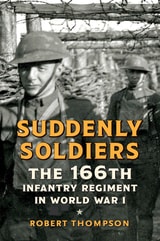
Suddenly Soldiers
The 166th Infantry Regiment in World War IRobert Thompson
Westholme Publishing, 2020
Finalist for the 2021 Army Historical Foundation Distinguished Writing Awards in Unit Histories
Americans Face the Horror of a Modern European War for the First Time
When America entered World War I in April 1917, state National Guard units had never planned to mobilize for this kind of war, and the men who made up the hometown companies of each regiment never imagined that they would be asked to fight in what was then the most savage war in human history—they were “innocents” being thrown into a horrendous European conflagration. Made up of companies from ten Ohio towns, the 166th Infantry Regiment became part of the famous 42nd Division, known as the “Rainbow Division.” They were the third American division to arrive in France, where they fought courageously in the trenches at Lunéville and Baccarat before being a key part of the American effort in the Second Battle of the Marne and the Saint Mihiel and Meuse-Argonne offensives. Despite their initial lack of training in modern warfare and weapons, the 166th Infantry compiled an impressive combat record. However, that record came at a terrible cost, with the regiment suffering over two thousand casualties in just nine months of fighting. While they battled the Germans, these hometown Guardsmen lived in trenches and foxholes for weeks at a time, while subsisting on canned beef and coffee amid near constant rain, deep mud, rats, and body lice that made their lives miserable. Because of poor planning and leadership from higher headquarters, they were often asked to achieve impossible objectives amid withering enemy machine-gun fire without proper logistics or artillery support. Yet, despite these challenges, they would persevere, overcome, and emerge victorious.
Using regimental histories and the letters and diaries of the soldiers who fought in France, Suddenly Soldiers: The 166th Infantry Regiment in World War I by author and historian Robert Thompson tells the compelling story of the young men—“citizen soldiers”—who have always borne the cost of America’s freedom with quiet courage.
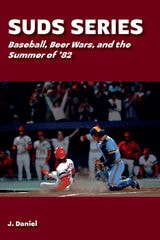
Suds Series
Baseball, Beer Wars, and the Summer of '82J. Daniel
University of Missouri Press, 2023
Even nominal baseball fans will enjoy reading about legendary players, teams, and personalities that emerged in the 1982 season: the year Ricky Henderson stole 130 bases; Reggie Jackson led the league in home runs; and Cal Ripken Jr. began his remarkable playing streak. Readers will also enjoy the cultural references, including the Pac-Man craze, a chart-topping album by Rush, and the “Light Beer Wars” waged by Anheuser-Busch and the Miller Brewing Company through a series of humorous TV commercials featuring well-loved professional sports figures.
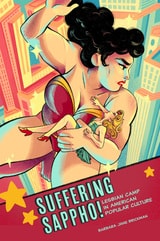
Suffering Sappho!
Lesbian Camp in American Popular CultureBarbara Jane Brickman
Rutgers University Press, 2024
Offering the first major consideration of lesbian camp in American popular culture, Suffering Sappho! traces a larger-than-life lesbian menace across midcentury media forms to propose five prototypical queer icons—the sicko, the monster, the spinster, the Amazon, and the rebel. On the pages of comics and sensational pulp fiction and the dramas of television and drive-in movies, Barbara Jane Brickman discovers evidence not just of campy sexual deviants but of troubling female performers, whose failures could be epic but whose subversive potential could inspire.
Supplemental images of interest related to this title: George and Lomas; Connie Minerva; Cat On Hot Tin; and Beulah and Oriole.


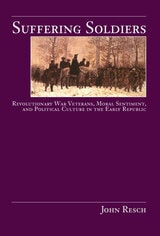
Suffering Soldiers
Revolutionary War Veterans, Moral Sentiment, and Political Culture in the Early RepublicJohn Resch
University of Massachusetts Press, 1999
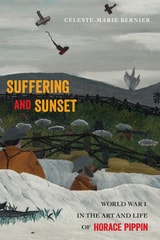
Suffering and Sunset
World War I in the Art and Life of Horace PippinCeleste-Marie Bernier
Temple University Press, 2017
For self-made artist and soldier Horace Pippin—who served in the 369th all-black infantry in World War I until he was wounded—war provided a formative experience that defined much of his life and work. His ability to transform combat service into canvases of emotive power, psychological depth, and realism showed not only how he viewed the world but also his mastery as a painter. In Suffering and Sunset, Celeste-Marie Bernier painstakingly traces Pippin’s life story of art as a life story of war.
Illustrated with more than sixty photographs, including works in various mediums—many in full color—this is the first intellectual history and cultural biography of Pippin. Working from newly discovered archives and unpublished materials, Bernier provides an in-depth investigation into the artist’s development of an alternative visual and textual lexicon and sheds light on his work in its aesthetic, social, and political contexts.
Suffering and Sunset illustrates Pippin’s status as a groundbreaking artist as it shows how this African American painter suffered from but also staged many artful resistances to racism in a white-dominated art world.

Sugar's Life in the Hood
The Story of a Former Welfare MotherBy Sugar Turner and Tracy Bachrach Ehlers
University of Texas Press, 2002
All her life, Sugar Turner has had to hustle to survive. An African American woman living in the inner city, she has been a single mother juggling welfare checks, food stamps, boyfriends and husbands, illegal jobs, and home businesses to make ends meet for herself and her five children. Her life's path has also wandered through the wilderness of crack addiction and prostitution, but her strong faith in God and her willingness to work hard for a better life pulled her through. Today, Turner is off welfare and is completing her education. She is computer literate, holds a job in the local school system, has sent three of her children to college, and is happily married.
In this engrossing book, Sugar Turner collaborates with anthropologist Tracy Bachrach Ehlers in telling her story. Through conversations with Ehlers, diary entries, and letters, Turner vividly and openly describes all aspects of her life, including motherhood, relationships with men, welfare and work, and her attachment to her friends, family, and life in the "hood." Ehlers also gives her reactions to Turner's story, discussing not only how it belies the "welfare queen" stereotype, but also how it forced her to confront her own lingering confusions about race, her own bigotry.
What emerges from this book is a fascinating story of two women from radically different backgrounds becoming equal witnesses to each other's lives. By allowing us into the real world of an inner-city African American mother, they replace with compassion and insight the stereotypes, half-truths, and scorn that too often dominate public discourse.

Suicide or Murder?
The Strange Death of Governor Meriwether LewisVardis Fisher
Ohio University Press, 1962
The death of Meriwether Lewis is one of the great mysteries of American history. Was he murdered at Grinder’s Stand or did he commit suicide? Vardis Fisher meticulously reconstructs the events and presents his own version of the case with the precision and persuasiveness of a fine trial lawyer. But Fisher was also a great novelist and it is his sense of character that serves him best here. We know Lewis’ complex sensibility as well as we know that of any man of his time—his journals are so self-revealing, so exacting in the record they make of his musings, doubts, and elations. Fisher offers us this complex Lewis and, with equal perceptiveness, sets the rough, frontier scene at Grinder’s Stand. The result is a fine mystery, well solved, that leans toward tragedy.

Suing for Medical Malpractice
Frank A. Sloan, Penny B. Githens, Ellen Wright Clayton, Gerald B. Hickson, Dougl
University of Chicago Press, 1993
The authors survey claims filed in Florida between 1986 and 1989 by people who suffered permanent injury or death during birth or during treatment in an emergency room. How often did illegitimate claims result in financial awards? What was the relation between the injury and the amount the patient lost economically? How much did the plaintiffs actually recover? How did the claimants choose their lawyers and what kind of relationship did they have?
Contrary to common perceptions, in the majority of cases the claims were merited, and the authors found that claimants were on average substantially undercompensated—only about one-fifth of plaintiffs recovered more than their economic loss caused by injury or death. The evidence in this book suggests that placing dollar limits on malpractice cases is unjustified and that our tort system is not so faulty after all.

Suing the Gun Industry
A Battle at the Crossroads of Gun Control and Mass TortsTimothy D. Lytton
University of Michigan Press, 2005
-New York Law Journal
"Second Amendment advocate or gun-control fanatic, all Americans who care about freedom need to read Suing the Gun Industry."
-Bob Barr, Member of Congress, 1995-2003, and Twenty-First Century Liberties Chair for Freedom and Privacy, American Conservative Union
"The source for anyone interested in a balanced analysis of the lawsuits against the gun industry."
-David Hemenway, Professor of Health Policy & Director, Harvard Injury Control Research Center Harvard School of Public Health Health Policy and Management Department, author of Private Guns, Public Health
"Highly readable, comprehensive, well-balanced. It contains everything you need to know, and on all sides, about the wave of lawsuits against U.S. gun manufacturers."
-James B. Jacobs, Warren E. Burger Professor of Law and author of Can Gun Control Work?
"In Suing the Gun Industry, Timothy Lytton has assembled some of the leading scholars and advocates, both pro and con, to analyze this fascinating effort to circumvent the well-known political obstacles to more effective gun control. This fine book offers a briefing on both the substance and the legal process of this wave of lawsuits, together with a better understanding of the future prospects for this type of litigation vis-à-vis other industries."
-Philip J. Cook, Duke University
"An interesting collection, generally representing the center of the gun-control debate, with considerable variation in focus, objectivity, and political realism."
-Paul Blackman, retired pro-gun criminologist and advocate
Gun litigation deserves a closer look amid the lessons learned from decades of legal action against the makers of asbestos, Agent Orange, silicone breast implants, and tobacco products, among others.
Suing the Gun Industry collects the diverse and often conflicting opinions of an outstanding cast of specialists in law, public health, public policy, and criminology and distills them into a complete picture of the intricacies of gun litigation and its repercussions for gun control.
Using multiple perspectives, Suing the Gun Industry scrutinizes legal action against the gun industry. Such a broad approach highlights the role of this litigation within two larger controversies: one over government efforts to reduce gun violence, and the other over the use of mass torts to regulate unpopular industries.
Readers will find Suing the Gun Industry a timely and accessible picture of these complex and controversial issues.
Contributors:
Tom Baker
Donald Braman
Brannon P. Denning
Tom Diaz
Howard M. Erichson
Thomas O. Farrish
Shannon Frattaroli
John Gastil
Dan M. Kahan
Don B. Kates
Timothy D. Lytton
Julie Samia Mair
Richard A. Nagareda
Peter H. Schuck
Stephen D. Sugarman
Stephen Teret
Wendy Wagner

Suing the Tobacco and Lead Pigment Industries
Government Litigation as Public Health PrescriptionDonald G. Gifford
University of Michigan Press, 2010
---David Owen, Carolina Distinguished Professor of Law, and Director of Tort Law Studies, University of South Carolina