Results by title
8113 books match the query 'Literary Criticism' and 542 start with s
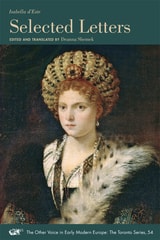
Selected Letters
Isabella d’Este
Iter Press, 2017
Isabella d’Este (1474–1539), daughter of the Este dukes of Ferrara and wife of Marchese Francesco II Gonzaga of Mantua, co-regent of the Gonzaga state, art collector, musician, diplomat, dynastic mother, traveler, reader, gardener, fashion innovator, and consummate politician, was also, as this volume attests, a prolific letter writer with a highly developed epistolary network. Presented here for the first time in any language is a representative selection from over 16,000 letters sent by Isabella to addressees across a wide social spectrum. Together, they paint a nuanced and colorful portrait of a brilliant and influential female protagonist of early modern European society.

Selected Letters of Walt Whitman
Edwin Haviland Miller
University of Iowa Press, 1990
There has never been an edition of the selected letters of Walt Whitman, a remarkable fact considering how accustomed we are to becoming acquainted with major writers through their letters. Now Edwin Haviland Miller, editor of the six-volume collected writings of Whitman, has used his intimate knowledge of the "good gray poet's" correspondence to produce this revealing selection of 250 letters, introduced and annotated concisely and evocatively. Whitman in these letters is simple, direct, colloquial, adding a counterpoint to his artistic voice and persona as a poet.
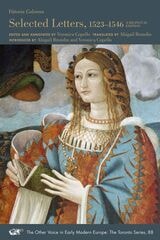
Selected Letters, 1523-1546
A Bilingual EditionVittoria Colonna
Iter Press, 2022
The most celebrated woman writer of the Italian Renaissance, Vittoria Colonna was known for her elegant poetry and use of the sonnet form to explore pressing religious questions. The selection of Colonna’s letters presented here for the first time in a collected edition was written to and from writers, artists, popes, cardinals, employees, and family members. Together they place Colonna at the center of intersecting epistolary networks as a political actor, theological thinker, literary practitioner, and caring friend. Revealing a historical woman speaking and acting with force in the world, these letters constitute a vital tool for anyone seeking to understand Colonna’s literary works. Newly translated, this work reveals new aspects and faces of the most celebrated woman writer of the Italian Renaissance.
Selected Passages from Correspondence with Friends
Nikolai Vasilevich Gogol
Vanderbilt University Press, 1969
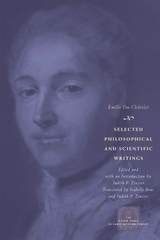
Selected Philosophical and Scientific Writings
Emilie Du Châtelet
University of Chicago Press, 2009
Though most historians remember her as the mistress of Voltaire, Emilie Du Châtelet (1706–49) was an accomplished writer in her own right, who published multiple editions of her scientific writings during her lifetime, as well as a translation of Newton’s Principia Mathematica that is still the standard edition of that work in French. Had she been a man, her reputation as a member of the eighteenth-century French intellectual elite would have been assured.
In the 1970s, feminist historians of science began the slow work of recovering Du Châtelet’s writings and her contributions to history and philosophy. For this edition, Judith P. Zinsser has selected key sections from Du Châtelet’s published and unpublished works, as well as related correspondence, part of her little-known critique of the Old and New Testaments, and a treatise on happiness that is a refreshingly uncensored piece of autobiography—making all of them available for the first time in English. The resulting volume will recover Châtelet’s place in the pantheon of French letters and culture.
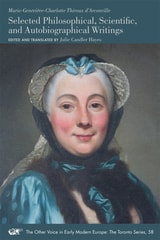
Selected Philosophical, Scientific, and Autobiographical Writings
Marie-Geneviève-Charlotte Thiroux d’Arconville
Iter Press, 2018
Edited and translated by Julie Candler Hayes
The Other Voice in Early Modern Europe: The Toronto Series, volume 58
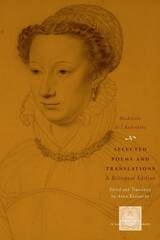
Selected Poems and Translations
A Bilingual EditionMadeleine de l'Aubespine
University of Chicago Press, 2007
Rather than adopt the conventional self-effacement that defined female poets of the time, l’Aubespine’s speakers are sexual, dominant, and defiant; and her subjects are women who are able to manipulate, rebuke, and even humiliate men.
Unavailable in English until now and only recently identified from scattered and sometimes misattributed sources, l’Aubespine’s poems and literary works are presented here in Anna Klosowska’s vibrant translation. This collection, which features one of the first French lesbian sonnets as well as reproductions of l’Aubespine’s poetic translations of Ovid and Ariosto, will be heralded by students and scholars in literature, history, and women’s studies as an important addition to the Renaissance canon.
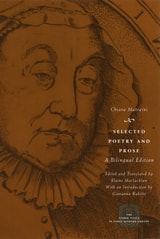
Selected Poetry and Prose
A Bilingual EditionChiara Matraini
University of Chicago Press, 2007
Mostly available in only a handful of rare book collections, her writings are now adeptly translated here for an English-speaking audience and situated historically in an introduction by noted Matraini expert Giovanna Rabitti. Selected Poetry and Prose allows the poet to finally take her place as one of the seminal authors of the Renaissance, next to her contemporaries Vittoria Colonna and Laura Battiferra, also published in the Other Voice series.
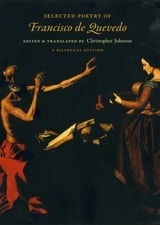
Selected Poetry of Francisco de Quevedo
A Bilingual EditionFrancisco de Quevedo
University of Chicago Press, 2009
Francisco de Quevedo (1580–1645), one of the greatest poets of the Spanish Golden Age, was the master of the baroque style known as “conceptismo,” a complex form of expression fueled by elaborate conceits and constant wordplay as well as ethical and philosophical concerns. Although scattered translations of his works have appeared in English, there is currently no comprehensive collection available that samples each of the genres in which Quevedo excelled—metaphysical and moral poetry, grave elegies and moving epitaphs, amorous sonnets and melancholic psalms, playful romances and profane burlesques.
In this book, Christopher Johnson gathers together a generous selection of forty-six poems—in bilingual Spanish-English format on facing pages—that highlights the range of Quevedo’s technical expertise and themes. Johnson’s ingenious solutions to rendering the difficult seventeenth-century Spanish into poetic English will be invaluable to students and scholars of European history, literature, and translation, as well as poetry lovers wishing to reacquaint themselves with an old master.
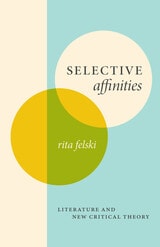
Selective Affinities
Literature and New Critical TheoryRita Felski
University of Chicago Press, 2026
Rita Felski’s new work brings literary studies into conversation with more affirmative and democratic forms of critical theory.
Literary critics associate the phrase “Frankfurt School” with early twentieth-century thinkers like Adorno or Benjamin, but contemporary German critical theory remains largely unknown. In this new book, Rita Felski draws on the work of a group of important philosophers and social theorists to offer fresh readings of literary texts by Robert Walser, Didier Eribon, Zadie Smith, Magda Szabo, John Williams, and Dionne Brand.
Through five key concepts derived from her reading of German theory—disclosure, recognition, self-realization, lifeworld, and resonance—Felski asks how these literary texts articulate the relationship between intellectuals and others. Contrary to critical theories that discount everyday experience, new German thought reveals the ethical, existential, and political richness of such experience. Through this framework, Felski shows that literature, theory, and experience are not opposed but mutually constitutive.
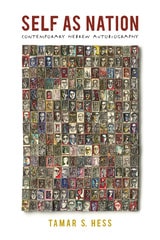
Self as Nation
Contemporary Hebrew AutobiographyTamar S. Hess
Brandeis University Press, 2016
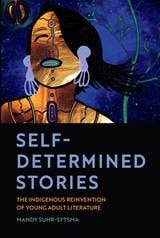
Self-Determined Stories
The Indigenous Reinvention of Young Adult LiteratureMandy Suhr-Sytsma
Michigan State University Press, 2018

Semiotics of Peasants in Transition
Slovene Villagers and Their Ethnic Relatives in AmericaIrene Portis-Winner
Duke University Press, 2002
Describing a process of continuous and enduring interaction between these geographically separate communities, Portis-Winner explains how, for instance, financial assistance from the emigrants enabled their Slovenian hometown to survive the economic depressions of the 1890s and 1930s. She also analyzes the extent to which memories, rituals, myths, and traditional activities from Slovenia have sustained their Cleveland relatives. The result is a unique anthropological investigation into the signifying practices of a strongly cohesive—yet geographically split—ethnic group, as well as an illuminating application of semiotic analyses to communities and the complex problems they face.
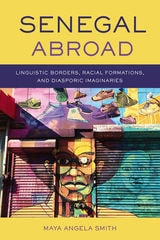
Senegal Abroad
Linguistic Borders, Racial Formations, and Diasporic ImaginariesMaya Angela Smith
University of Wisconsin Press, 2020
The Senegalese are notable, Smith suggests, both in their capacity for movement and in their multifaceted approach to language. She finds that, although the emigrants she interviews express complicated relationships to the multiple languages they speak and the places they inhabit, they also convey pleasure in both travel and language. Offering a mix of poignant, funny, reflexive, introspective, and witty stories, they blur the lines between the utility and pleasure of language, allowing a more nuanced understanding of why and how Senegalese move.

Sensational Futures
On Asian Racialization and Speculative AestheticsFrances Tran
Duke University Press, 2027
Senses of Style
Poetry before InterpretationJeff Dolven
University of Chicago Press, 2017
Sensible Ecstasy
Mysticism, Sexual Difference, and the Demands of HistoryAmy Hollywood
University of Chicago Press, 2001
What is particular to these thinkers, Hollywood reveals, is their attention to forms of mysticism associated with women. They regard mystics such as Angela of Foligno, Hadewijch, and Teresa of Avila not as emotionally excessive or escapist, but as unique in their ability to think outside of the restrictive oppositions that continue to afflict our understanding of subjectivity, the body, and sexual difference. Mystics such as these, like their twentieth-century descendants, bridge the gaps between action and contemplation, emotion and reason, and body and soul, offering new ways of thinking about language and the limits of representation.
Sensory Experiments
Psychophysics, Race, and the Aesthetics of FeelingErica Fretwell
Duke University Press, 2020
Sensus Spiritualis
Studies in Medieval Significs and the Philology of CultureFriedrich Ohly
University of Chicago Press, 2005
Drawn from the entire career of this great medievalist, who, more clearly and in greater detail than anyone before him, articulated the singularly allegorical mentality of the Middle Ages, the essays in this collection show the tendency of medieval thinkers and writers to see nature as a diaphanous screen held against God's sacred mysteries, simultaneously illuminating and obscuring. Ohly's work on the hermeneutics of word and image, meanwhile, traces the way his thinking opened philology to new possibilities through the dual interpretation of textual and visual media.
Including penetrating essays on poetic inspiration, the nature of beauty, sacred and profane exegesis, history as typology, and art as both object and text, this volume will be of enormous value to scholars of comparative literature, the history of art, and religion during the Middle Ages and Renaissance.
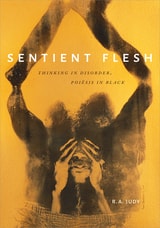
Sentient Flesh
Thinking in Disorder, Poiesis in BlackR. A. Judy
Duke University Press, 2020
Sentimental Collaborations
Mourning and Middle-Class Identity in Nineteenth-Century AmericaMary Louise Kete
Duke University Press, 2000
Many scholars have written about the sentimental novel as a primarily female genre and have stressed its negative ideological aspects. Kete finds that in fact many men—from writers to politicians—participated in nineteenth-century sentimental culture. Importantly, she also recovers the utopian dimension of the phenomenon, arguing that literary sentimentality, specifically in the form of poetry, is the written trace of a broad cultural discourse that Kete calls “sentimental collaboration”—an exchange of sympathy in the form of gifts that establishes common cultural or intellectual ground. Kete reads the work of Ralph Waldo Emerson, Henry Wadsworth Longfellow, Mark Twain, Harriet Beecher Stowe, and Lydia Huntley Sigourney with an eye toward the deployment of sentimentality for the creation of Americanism, as well as for political and abolitionist ends. Finally, she locates the origins of sentimental collaboration in the activities of ordinary people who participated in mourning rituals—writing poetry, condolence letters, or epitaphs—to ease their personal grief.
Sentimental Collaborations significantly advances prevailing scholarship on Romanticism, antebellum culture, and the formation of the American middle class. It will be of interest to scholars of American studies, American literature, cultural studies, and women’s studies.
Sentimental Materialism
Gender, Commodity Culture, and Nineteenth-Century American LiteratureLori Merish
Duke University Press, 2000
The phenomenon of female consumption was capitalism’s complement to male production: It created what Merish calls the “Other Protestant Ethic,”a feminine and sentimental counterpart to Max Weber’s ethic of hard work, economic rationality, and self-control. In addition, driven by the culture’s effort to civilize the “cannibalistic” practices of ethnic, class, and national otherness, appropriate female consumerism, marked by taste and refinement, identified certain women and their families as proper citizens of the United States. The public nature of consumption, however, had curiously conflicting effects: While the achievement of cultured material circumstances facilitated women’s civic agency, it also reinforced stereotypes of domestic womanhood.
Sentimental Materialism’s inquiry into middle-class consumption and accompanying ideals of womanhood will appeal to readers in a variety of disciplines, including American studies, cultural studies, feminist theory, and cultural history.
Sentimental Readers
The Rise, Fall, and Revival of a Disparaged RhetoricFaye Halpern
University of Iowa Press, 2013
Halpern examines these novels with a fresh eye by positioning sentimentality as a rhetorical strategy on the part of these novels’ (mostly) female authors, who used it to answer a question that plagued the male-dominated world of nineteenth-century American rhetoric and oratory: how could listeners be sure an eloquent speaker wasn’t unscrupulously persuading them of an untruth? The authors of sentimental novels managed to solve this problem even as the professional male rhetoricians and orators could not, because sentimental rhetoric, filled with tears and other physical cues of earnestness, ensured that an audience could trust the heroes and heroines of these novels. However, as a wider range of authors began wielding sentimental rhetoric later in the nineteenth century, readers found themselves less and less convinced by this strategy.
In her final discussion, Halpern steps beyond a purely historical analysis to interrogate contemporary rhetoric and reading practices among literature professors and their students, particularly first-year students new to the “close reading” method advocated and taught in most college English classrooms. Doing so allows her to investigate how sentimental novels are understood today by both groups and how these contemporary reading strategies compare to those of Americans more than a century ago. Clearly, sentimental novels still have something to teach us about how and why we read.
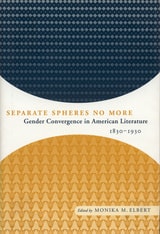
Separate Spheres No More
Gender Convergence in American Literature, 1830-1930Monika Elbert
University of Alabama Press, 2000
Examines the intersection of male and female spheres in American literature
Although they wrote in the same historical milieu as their male counterparts, women writers of the 19th- and early 20th-centuries have generally been "ghettoized" by critics into a separate canonical sphere. These original essays argue in favor of reconciling male and female writers, both historically and in the context of classroom teaching.
While some of the essays pair up female and male authors who write in a similar style or with similar concerns, others address social issues shared by both men and women, including class tensions, economic problems, and the Civil War experience. Rather than privileging particular genres or certain well-known writers, the contributors examine writings ranging from novels and poetry to autobiography, utopian fiction, and essays. And they consider familiar figures like Harriet Beecher Stowe, Emily Dickinson, and Ralph Waldo Emerson alongside such lesser-known writers as Melusina Fay Peirce, Susie King Taylor, and Mary Gove Nichols.
Each essay revises the binary notions that have been ascribed to males and females, such as public and private, rational and intuitive, political and domestic, violent and passive. Although they do not deny the existence of separate spheres, the contributors show the boundary between them to be much more blurred than has been assumed until now.

Serapion Sister
The Poetry of Exizaveta PolonskajaLeslie Dorfman Davis
Northwestern University Press, 2001
Sergei Dovlatov and His Narrative Masks
Jekaterina Young
Northwestern University Press, 2012
This book provides an introduction to Sergei Dovlatov (1941–1990) that is closely attentive to the details of his life and work, their place in the history of Soviet society and literature, and of émigré culture during this turbulent period. A journalist, newspaper editor, and prose writer, Dovlatov is most highly regarded for his short stories, which draw heavily on his experiences in Russia before 1979, when he was forced out of the country. During compulsory military service, before becoming a journalist, he worked briefly as a prison camp guard—an experience that gave him a unique perspective on the operations of the Soviet state. After moving to New York, Dovlatov published works (in the New Yorker and elsewhere) that earned him considerable renown in America and back in Russia. Young’s book presents a valuable critical overview of the prose of a late twentieth-century master within the context of the prevailing Russian and larger literary culture.

Serial Fu Manchu
The Chinese Supervillain and the Spread of Yellow Peril IdeologyRuth Mayer
Temple University Press, 2013
In the series Asian American History and Culture, edited by Sucheng Chan, David Palumbo-Liu, Michael Omi, K. Scott Wong, and Linda Trinh Võ
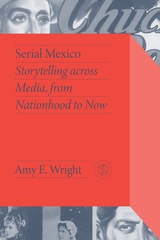
Serial Mexico
Storytelling across Media, from Nationhood to NowAmy E. Wright
Vanderbilt University Press, 2023
Honorable Mention, Premio al Mejor Libro en Humanidades, Latin American Studies Association–Mexico Section, 2025
No book until now has tied in two centuries of Mexican serial narratives—tales of glory, of fame, and of epic characters, grounded in oral folklore—with their subsequent retelling in comics, radio, and television soap operas. Wright’s multidisciplinary Serial Mexico delves into this storytelling tradition: examining the nostalgic tales reimagined in novelas, radionovelas, telenovelas and onwards, and examining the foundational figures who have been woven into society.
This panorama shows the Mexican experience of storytelling from the country’s early days until now, showcasing protagonists that mock authority, make light of hierarchy, and embrace the hybridity and mestizaje of Mexico. These tales reflect on and respond to crucial cultural concerns such as family, patriarchy, gender roles, racial mixing, urbanization, modernization, and political idealism. Serial Mexico thus examines how serialized storytelling’s melodrama and sensationalism reveals key political and cultural messaging.
In a detailed yet accessible style, Wright describes how these stories have continued to morph with current times’ concerns and social media. Will tropes and traditions carry on in new and reimagined serial storytelling forms? Only time will tell. Stay tuned for the next episode.
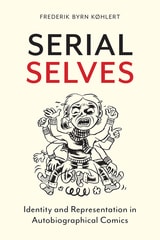
Serial Selves
Identity and Representation in Autobiographical ComicsFrederik Byrn Køhlert
Rutgers University Press, 2019
As the first comparative study of how comics artists from a wide range of backgrounds use the form to write and draw themselves into cultural visibility, Serial Selves will be of interest to anyone interested in the current boom in autobiographical comics, as well as issues of representation in comics and visual culture more broadly.
Seriality and Social Change
Peter Hitchcock
Seagull Books, 2025
From Karl Marx’s decision to publish Capital in serial form to contemporary adaptations in manga and graphic novels, Seriality and Social Change examines how serialization both democratizes knowledge and shapes the very process of social transformation. Peter Hitchcock delves into the paradox of the serial: while it can expand access to radical thought, it can also impose structural limits, slowing or containing the revolutionary potential it seeks to unleash.
Through a sweeping analysis that links literature and political economy, Hitchcock explores how serialized narratives frame, sustain, or even hinder movements for change. Does seriality mirror the mechanics of capitalism, or can it be a tool for subverting them? Engaging with this question across genres and forms, Seriality and Social Change invites readers to rethink how revolution is told and imagined over time.
Serious Daring
The Fiction and Photography of Eudora Welty and Rosamond PurcellSusan Letzler Cole
University of Arkansas Press, 2016
Serious Daring is the story of the complementary journeys of two American women artists, celebrated fiction writer Eudora Welty and internationally acclaimed photographer Rosamond Purcell, each of whom initially practiced, but then turned from, the art form ultimately pursued by the other.
For both Welty and Purcell, the art realized is full of the art seemingly abandoned. Welty’s short stories and novels use images of photographs, photographers, and photography. Purcell photographed books, texts, and writing.
Both women make compelling art out of the seeming tension between literary and visual cultures. Purcell wrote a memoir in which photographs became endnotes. Welty re-emerged as a photographer through the publication of four volumes of what she called her “snapshots,” magnificent black-and-white photographs of small-town Mississippi and New York City life.
Serious Daring is a fascinating look at how the road not taken can stubbornly accompany the chosen path, how what is seemingly left behind can become a haunting and vital presence in life and art.
Serious Reflections During the Life and Surprising Adventures of Robinson Crusoe with his Vision of the Angelick World
The Stoke Newington EditionDaniel Defoe
Bucknell University Press, 2022
Service Economies
Militarism, Sex Work, and Migrant Labor in South KoreaJin-kyung Lee
University of Minnesota Press, 2010
Making surprising and revelatory connections, Jin-kyung Lee analyzes South Korean military labor in the Vietnam War, domestic female sex workers, South Korean prostitution for U.S. troops, and immigrant/migrant labor from Asia in contemporary South Korea. Foregrounding gender, sexuality, and race, Lee reimagines the South Korean economic "miracle" as a global and regional articulation of industrial, military, and sexual proletarianization.
Lee not only addresses these under-studied labors individually but also integrates and unites them to reveal an alternative narrative of a changing South Korean working class whose heterogeneity is manifested in its objectification. Delving into literary and popular cultural sources as well as sociological work, Lee locates South Korean development in its military and economic interactions with the United States and other Asian nation-states, offering a unique perspective on how these practices have shaped and impacted U.S.-South Korea relations.
Set in Motion
Essays, Interviews, and DialoguesA. R. Ammons
University of Michigan Press, 1996
Setting Plato Straight
Translating Ancient Sexuality in the RenaissanceTodd W. Reeser
University of Chicago Press, 2015
In Setting Plato Straight, Todd W. Reeser undertakes the first sustained and comprehensive study of Renaissance textual responses to Platonic same-sex sexuality. Reeser mines an expansive collection of translations, commentaries, and literary sources to study how Renaissance translators transformed ancient eros into non-erotic, non-homosexual relations. He analyzes the interpretive lenses translators employed and the ways in which they read and reread Plato’s texts. In spite of this cleansing, Reeser finds surviving traces of Platonic same-sex sexuality that imply a complicated, recurring process of course-correction—of setting Plato straight.
Seven Contemporary Authors
Essays on Cozzens, Miller, West, Golding, Heller, Albee, and PowersEdited with an Introduction by Thomas B. Whitbread
University of Texas Press, 1966
These seven critical essays, each on a twentieth-century novelist, are disparate in content, but all are concerned with the problem of evil and inhumanity and with the paradoxes of human existence.
Each essay discusses a different author, but this independence of subject is resolved into a central theme through the interpretive approach followed by the seven critics. Each of the contributors presents his subject against the background of the current disillusionment and frustration of our age. Underlying each essay are undertones of the "absurdity" of life today for those who consider it thoughtfully, and the contrast between what men would like reality to be and what they actually find.
This unity of theme—the problem of evil, of inhumanity, of meaninglessness, the concern for the human being and his future—is developed in an interesting manner. It was exploited in different ways by the seven modern novelists discussed in the essays, and it is presented with different analytical techniques by the seven critics. Yet the reader senses the unity of feeling and purpose amid the diversity of fictional content and critical evaluation.
Besdies the interpretive Introduction by Thomas B. Whitbread, the book contains the following essays:
- R. W. Lewis, "The Conflicts of Reality: Cozzens' The Last Adam"
- Alan Friedman, "The Pitching of Love's Mansion in the Tropics of Henry Miller"
- Roger D. Abrahams, "Androgynes Bound: Nathanael West's Miss Lonelyhearts"
- George Clark, "An Illiberal Education: William Golding's Pedagogy"
- Vance Ramsey, "From Here to Absurdity: Heller's Catch-22"
- Anthony Channell Hilfer, "George and Martha: Sad, Sad, Sad"
- Robert G. Twombly, "Hubris, Health, and Holiness: The Despair of J. F. Powers"
Seven Faces
Brazilian Poetry Since ModernismCharles A. Perrone
Duke University Press, 1996
Perrone introduces the most important poetic themes of the second half of this century with a look back at Brazilian modernismo and the avant-garde legacy of poets of the 1920s and 30s. Brazilian poets, the author reveals, have long drawn inspiration from the other arts, experimenting with the inclusion of music, graphic arts, and other nontraditional elements within lyric forms. Relating aesthetic concerns to cultural issues, Perrone elucidates the major poetic movements in Brazil since modernismo: concretism and vanguard poetry, politically committed verse of the 60s, youth poetry of the 70s, the lyricism of Brazil’s renowned popular music, and the rethinking of poetry through postmodernism in the final decades of this century.
Providing a window on the ways in which poetry reflects a national spirit and offers a measure of the status of culture in a consumer society, Seven Faces is the only book-length study in English of contemporary Brazilian poetry. It will be welcomed by students and scholars of Latin American literature as well as by general readers interested in poetry and its influence on culture and society.
Seven Gothic Dramas, 1789–1825
1789-1825Jeffrey N. Cox
Ohio University Press, 1994
The Gothic drama came at a critical moment in the history of the theater, of British culture, and of European politics in the shadow of France’s revolution and the fall of Napoleon. It offered playwrights a medium to express the prevailing ideological tensions of romanticism and revolution, and also responded to a growing and changing theater audience.
In a wide-ranging introduction, Cox explores Gothic drama’s links with romanticism and its relation to other social and ideological shifts of the day. The texts are presented so as to reflect the dual life of dramatic works—on the stage and on the page. The plays are annotated and accompanied by biographic and bibliographic sketches.
Includes The Kentish Barons, by Francis North; Julia of Louvain; or, Monkish Cruelty, by J.C. Cross; The Castle Spectre, by Matthew G. Lewis; The Captive, by Matthew G. Lewis; De Monfort, by Joanna Baillie; Bertram; or, The Castle of St. Aldobrand, by C.R. Maturin; and Presumption; or, The Fate of Frankenstein, by R.B. Peake.

Seven Modern American Novelists
An IntroductionWilliam Van O’Connor, Editor
University of Minnesota Press, 1964
Seven Modern American Novelists was first published in 1964. Minnesota Archive Editions uses digital technology to make long-unavailable books once again accessible, and are published unaltered from the original University of Minnesota Press editions.
This volume provides critical introductions to seven of the most significant American novelists of this century, bringing together in convenient book form the material from some of the University of Minnesota Pamphlets on American Writers. The writers discussed and the contributing authors are Edith Wharton by Louis Auchincloss, Sinclair Lewis by Mark Schorer, F. Scott Fitzgerald by Charles E. Shain, William Faulkner by William Van O'Connor, Ernest Hemingway by Philip Young, Thomas Wolfe by C. Hugh Holman, and Nathanael West by Stanley Edgar Hyman.
In an introduction Mr. O'Connor, who is one of the editors of the pamphlet series, discusses some critical principles as they apply to fiction writers in general and to twentieth-century American novelists in particular. He is the author of many volumes of literary criticism as well as a collection of short stories and was a professor of English at the University of California, Davis.
Teachers, librarians, and others who use the material of the University of Minnesota Pamphlets on American Writers for frequent reference or as classroom texts will find this book particularly useful. Biographical information about the writers as well as critical evaluations of their writing is given. A bibliography for each writer lists his works and critical and biographical works about him.
Seven Modern American Poets
An IntroductionLeonard Unger
University of Minnesota Press, 1967
Seven Modern American Poets was first published in 1967. Minnesota Archive Editions uses digital technology to make long-unavailable books once again accessible, and are published unaltered from the original University of Minnesota Press editions.
This volume provides concise critical introductions to seven of the most important twentieth-century American poets, bringing together in convenient book form the material from some of the University of Minnesota Pamphlets on American Writers. The poets discussed and the contributing authors are Robert Frost by Lawrance Thompson, Wallace Stevens by William York Tindall, William Carlos Williams by John Malcolm Brinnin, Ezra Pound by William Van O'Connor, John Crowe Ransom by John L. Stewart, T.S. Eliot by Leonard Unger, and Allen Tate by George Hemphill.
Biographical information about the poets as well as critical discussions of their work is provided. A selected bibliography for each poet lists his works and critical and biographical writing about him.
In an introduction Mr. Unger, who is one of the editors of the pamphlet series, discusses the poets and their place in the development of modern American poetry. Mr. Unger is a professor of English at the University of Minnesota and the author of a number of critical works, including T. S. Eliot: Moments and Patterns.
Teachers, librarians, and others who use the material of the University of Minnesota Pamphlets on American Writers for frequent reference or as classroom texts will find this book particularly useful. It serves also as an excellent guide for the general reader.
Seventeen Syllables and Other Stories
Yamamoto, Hisaye
Rutgers University Press, 2001
In addition to the contents of the original volume, this edition brings back into print the following works:
- Death Rides the Rails to Poston
- Eucalyptus
- A Fire in Fontana
- Florentine Gardens
Seventeen Syllables and Other Stories
Yamamoto, Hisaye
Rutgers University Press, 2001
Sex Changes with Kleist
Katrin Pahl
Northwestern University Press, 2019
Focusing on the theatricality of Kleist’s interventions in the performance of gender, sexuality, and emotion and examining how his dramatic texts unhinge major tenets of classical European theater, Sex Changes with Kleist is vital reading for anyone interested in queer studies, feminist studies, performance studies, literary studies, or emotion studies. This book changes our understanding of Kleist and breathes new life into queer thought.
Sex Scandal
The Private Parts of Victorian FictionWilliam A. Cohen
Duke University Press, 1996
Scandal, then as now, makes public the secret indiscretions of prominent people, engrossing its audience in salacious details that violate the very code of propriety it aims to enforce. In narratives ranging from Great Expectations to the Boulton and Park sodomy scandal of 1870–71, from Eliot’s and Trollope’s novels about scandalous women to Oscar Wilde’s writing and his trials for homosexuality, Cohen shows how, in each instance, sexuality appears couched in coded terms. He identifies an assortment of cunning narrative techniques used to insinuate sex into Victorian writing, demonstrating that even as such narratives air the scandalous subject, they emphasize its unspeakable nature.
Written with an eye toward the sex scandals that still whet the appetites of consumers of news and novels, this work is suggestive about our own modes of imagining sexuality today and how we arrived at them. Sex Scandal will appeal to scholars and general readers interested in Victorian literature, the history of sexuality, gender studies, nineteenth-century Britain, and gay, lesbian, and queer studies.
Sex Work, Text Work
Mapping Prostitution in the Nineteenth-Century French NovelJessica Tanner
Northwestern University Press, 2027
While prostitutes in nineteenth-century Paris were subject to municipal laws that policed their bodies and movements, writers of the era enlisted them to stake their own claims on both the city and the novel as literary territory. Sex Work, Text Work: Mapping Prostitution in the Nineteenth-Century French Novel explores how prostitutes depicted by Émile Zola, Joris-Karl Huysmans, Edmond de Goncourt, Adolphe Tabarant, and Charles-Louis Philippe “write back,” confounding civil and literary efforts to contain them in space and in narrative.
In city-regulated brothels, brasseries à femmes, Haussmannian boulevards, and the novel itself, working-class prostitutes served to reinforce the boundaries of social inclusion and exclusion. And yet, Jessica Tanner contends, even the novels that most explicitly aligned with the disciplinary logic of regulated prostitution make space for a distinctly literary form of resistance: these women elude or disrupt the mapping that would claim them as literary territory, revealing their authors’ failure to secure their narratives as property. Tanner pushes back against the critical tendency to attribute agency only to courtesans who became published authors and forwards a new framework for understanding the political work novels engage in as they circulate. Observing that debates about the regulation of prostitution surfaced in tandem with racialized anxieties about the boundaries of the French nation, Tanner ultimately expands that framework to the history of French colonialism and the politics of immigration in the current day. This book shows that while sex workers have been recruited to mark the borders of civic and moral life, prostitution can also make space for more inclusive forms of community, both in the novel and in the world beyond its bounds.
Sex, Celibacy, and Deviance
The Victorians and the Song of SongsDuc Dau
The Ohio State University Press, 2024
Sex, Celibacy, and Deviance is the first major study to explore the Song of Songs (or Song of Solomon) in Victorian literature and art. As the Bible’s only erotic poem, the Song of Songs is the canonical Judeo-Christian book about love, furnishing the Victorians with an authoritative and literary language for love, marriage, sex, mourning, and religious celibacy.
Duc Dau adopts a queer and feminist lens to consider how Victorians employed and interpreted the Song of Songs in their work. How did writers and artists fashion and, most importantly, challenge the norms of gender, romantic love, and marriage? Spanning the early Victorian era through the first two decades of the twentieth century, Sex, Celibacy, and Deviance considers the works of Charlotte Brontë, Thomas Hardy, Christina Rossetti, John Gray, Michael Field, Edward Burne-Jones, and Simeon Solomon alongside two lesser-known figures: Irish-born Scottish artist Phoebe Anna Traquair and the Catholic religious leader Augusta Theodosia Drane. By addressing the relevance of the Song of Songs in light of shifting and conflicting religious and social contexts, Dau provides a fresh perspective on Victorian literature, religion, and culture.
Sex, Skulls, and Citizens
Gender and Racial Science in Argentina (1860-1910)Ashley Elizabeth Kerr
Vanderbilt University Press, 2020
PROSE Awards Subject Category Finalist—Biological Anthropology, Ancient History, and Archaeology, 2021
Best Nineteenth-Century Book Award, Latin American Studies Association Nineteenth-Century Section, 2021
Analyzing a wide variety of late-nineteenth-century sources, Sex, Skulls, and Citizens argues that Argentine scientific projects of the era were not just racial encounters, but were also conditioned by sexual relationships in all their messy, physical reality.
The writers studied here (an eclectic group of scientists, anthropologists, and novelists, including Estanislao Zeballos, Lucio and Eduarda Mansilla, Ramón Lista, and Florence Dixie) reflect on Indigenous sexual practices, analyze the advisability and effects of interracial sex, and use the language of desire to narrate encounters with Indigenous peoples as they try to scientifically pinpoint Argentina's racial identity and future potential.
Kerr's reach extends into history of science, literary studies, and history of anthropology, illuminating a scholarly time and place in which the lines betwixt were much blurrier, if they existed at all.

Sex, or the Unbearable
Lauren Berlant and Lee Edelman
Duke University Press, 2014
Through virtuoso interpretations of works of cinema, photography, critical theory, and literature, including Lydia Davis's story "Break It Down" (reprinted in full here), Berlant and Edelman explore what it means to live with negativity, with those divisions that may be irreparable. Together, they consider how such negativity affects politics, theory, and intimately felt encounters. But where their critical approaches differ, neither hesitates to voice disagreement. Their very discussion—punctuated with moments of frustration, misconstruction, anxiety, aggression, recognition, exhilaration, and inspiration—enacts both the difficulty and the potential of encounter, the subject of this unusual exchange between two eminent critics and close friends.
Sexology and Translation
Cultural and Scientific Encounters across the Modern WorldHeike Bauer
Temple University Press, 2015
Sexology and Translation is the first study of the contemporaneous emergence of sexology in Europe, Asia, and the Middle East. Heike Bauer and her contributors—historians, literary and cultural critics, and translation scholars—address the intersections between sexuality and modernity in a range of contexts during the period from the 1880s to the 1930s.
From feminist sexualities in modern Japan to Magnus Hirschfeld’s affective sexology, this book offers compelling new insights into how sexual ideas were formed in different contexts via a complex process of cultural negotiation. By focusing on issues of translation—the dynamic process by which ideas are produced and transmitted—the essays in Sexology and Translation provide an important corrective to the pervasive idea that sexuality is a “Western” construct that was transmitted around the world.
This volume deepens understanding of how the intersections between national and transnational contexts, between science and culture, and between discourse and experience, shaped modern sexuality.

Sexual Aim and Its Misses
On the Birth of the Sexual SubjectBenjamin Kahan
University of Chicago Press, 0
By shifting the study of sexuality to focus on “sexual aim,” we can understand the birth of the sexual subject—the historical emergence of an understanding of sexuality as an aspect of personhood.
Is it possible that half of the organization of modern sexuality has been forgotten? Historians of sexuality have thought about sexual desire almost exclusively in terms of the sexual object—the person to whom one is attracted. This book offers a history and theory of “sexual aim”—the what and how of desire—arguing that aim furnishes a constitutive and almost wholly ignored governing logic of sexuality.
The term “sexual aim” was coined by Sigmund Freud to describe “modes of gratification”—the sexual acts in which one finds pleasure, from kissing and copulation to voyeurism and fetishism. Benjamin Kahan repurposes this account to tell the complex story of how sexual aim catalyzed the formation of modern sexual identity and continues to operate as a powerful optic for understanding Euro-American sexualities.
Kahan focuses on nonnormative sexual aims, examining the histories of sadism, masochism, voyeurism, exhibitionism, and fetishism in order to articulate the relationship between sexual acts and sexuality. Drawing on diaries, court records, erotica, literary texts, marriage manuals, and medical treatises, Kahan vividly maps the emergence of the sexual subject from the early modern period through the twentieth century to furnish a new account of sexual modernity.