Results by title
5448 books match the query 'History and criticism' and 403 start with s
Singing the Self
Guitar Poetry, Community, and Identity in the Post-Stalin PeriodRachel S. Platonov
Northwestern University Press, 2012
This book is a study of a Soviet cultural phenomenon of the 1950s through the 1980s known as guitar poetry—songs accompanied by guitar and considered poetry in much the same way as those of, for example, Bob Dylan. Platonov’s is the most comprehensive book in English to date to analyze guitar poetry, which has rarely received scholarly attention outside of Russia. Going well beyond the conventional, text-centered view of guitar poetry as a form of political or artistic dissent, largely a function of the Cold War climate in which it began, Platonov argues for a more complex understanding of guitar poetry as a means of self-invention and community formation. Although grounded in literary studies, the book effectively brings historical, anthropological, and musicological perspectives to bear on an understudied phenomenon of the post-Stalin period.
Siren City
Sound and Source Music in Classic American NoirMiklitsch, Robert
Rutgers University Press, 2011
Focusing on a wide range of celebrated and less well known films and offering an introductory discussion of film sound, Robert Miklitsch mobilizes the notion of audiovisuality to investigate period sound technologies such as the radio and jukebox, phonograph and Dictaphone, popular American music such as "hot" black jazz, and "big numbers" featuring iconic performers such as Lauren Bacall, Veronica Lake, and Rita Hayworth. Siren City resonates with the sounds and source music of classic American noir-gunshots and sirens, swing riffs and canaries. Along with the proverbial private eye and femme fatale, these audiovisuals are central to the noir aesthetic and one important reason the genre reverberates with audiences around the world.
Siren Songs
Gender, Audiences, and Narrators in the OdysseyLillian Eileen Doherty
University of Michigan Press, 1995
Siren Songs synthesizes audience-oriented and narratological approaches, and examines the relationships among three kinds of audiences: internal, implied, and actual. The author prefaces her own reading of the Odyssey with an analysis of the issues posed by the earlier feminist readings on which she builds. Should the Odyssey be read as a "closed" text, that is, as one whose meaning is highly determined, or as an "open" text whose contradictions and ambiguities undercut its overt meanings?
Siren Songs presents a feminist critique of the Odyssey in an accessible manner aimed at a more general audience. All Greek is translated, and critical terminology is clearly defined.
Lillian Eileen Doherty is Associate Professor of Classics, University of Maryland, College Park.
Sissy!
The Effeminate Paradox in Postwar US Literature and CultureHarry Thomas Jr.
University of Alabama Press, 2017
Sissy!: The Effeminate Paradox in Postwar US Literature and Culture is a fascinating work of cultural criticism that focuses on the ways men and boys deemed to be feminine have been—and continue to be—condemned for their personalities and behavior. Critic Harry Thomas Jr. does not dismiss this approach, but rather identifies it as merely one side of a coin. On the other side, he asserts, the opposite exists: an American artistic tradition that celebrates and affirms effeminate masculinity.
The author argues that effeminate men and boys are generally portrayed using the grotesque, an artistic mode concerned with the depictions of hybrid bodies. Thomas argues that the often grotesque imagery used to depict effeminate men evokes a complicated array of emotions, a mix of revulsion and fascination that cannot be completely separated from one another.
Thomas looks to the sissies in the 1940s novels of Truman Capote and Carson McCullers; the truth-telling flaming princesses of James Baldwin’s Giovanni’s Room; the superstardom of pop culture icon Liberace; the prophetic queens of Tony Kushner’s Angels in America; and many others to demonstrate how effeminate men have often been adored because they are seen as the promise of a different world, one free from the bounds of heteronormativity.
Sissy! offers an unprecedented and counterintuitive overview of cultural and artistic attitudes toward male effeminacy in post–World War II America and provides a unique and contemporary reinterpretation of the “sissy” figure in modern art and literature.
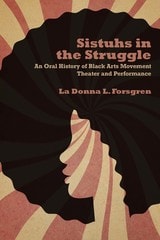
Sistuhs in the Struggle
An Oral History of Black Arts Movement Theater and PerformanceLa Donna L. Forsgren
Northwestern University Press, 2021
Outstanding Academic Title, CHOICE
The first oral history to fully explore the contributions of black women intellectuals to the Black Arts Movement, Sistuhs in the Struggle reclaims a vital yet under-researched chapter in African American, women’s, and theater history. This groundbreaking study documents how black women theater artists and activists—many of whom worked behind the scenes as directors, designers, producers, stage managers, and artistic directors—disseminated the black aesthetic and emboldened their communities.
Drawing on nearly thirty original interviews with well-known artists such as Ntozake Shange and Sonia Sanchez as well as less-studied figures including distinguished lighting designer Shirley Prendergast, dancer and choreographer Halifu Osumare, and three-time Tony-nominated writer and composer Micki Grant, La Donna L. Forsgren centers black women’s cultural work as a crucial component of civil rights and black power activism. Sistuhs in the Struggle is an essential collection for theater scholars, historians, and students interested in learning how black women’s art and activism both advanced and critiqued the ethos of the Black Arts and Black Power movements.
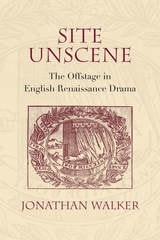
Site Unscene
The Offstage in English Renaissance DramaJonathan Walker
Northwestern University Press, 2017
Jonathan Walker demonstrates that by removing scenes from visible performance, playwrights take up the nondramatic mode of storytelling in order to transcend the limits of the stage. Through this technique, they present dramatic action from the subjective, self-interested, and idiosyncratic perspectives of individual characters. By recovering these offstage elements, Walker reveals the pervasive and formative dynamic between the onstage and offstage and between the seen and unseen in Renaissance drama.
Examining premodern dramatic theory, Renaissance plays, period amphitheaters, and material texts, this interdisciplinary work considers woodcuts, engravings, archaeology, architecture, rhetoric, the history of the book, as well as plays by Shakespeare, Marlowe, Kyd, Ford, Middleton, and Webster, among others. It addresses readers engaged in literary criticism, dramatic theory, theater history, and textual studies.
Sitting In
Selected Writings on Jazz, Blues, and Related TopicsHayden Carruth
University of Iowa Press, 1993
This collection of essays and poems about the influence of jazz on writing and culture in this country, an expanded edition of the 1986 publication, is a rewarding volume for all those entranced by jazz. Carruth brings his considerable poetic and literary sensibilities to bear on a topic very near to his heart: "Those who are devoted primarily to jazz, to poetry, to all the arts, are also those who contribute more intelligently than others to our practical and moral, political and social, advancement."
Situation Critical
Critique, Theory, and Early American StudiesMax Cavitch and Brian Connolly, editors
Duke University Press, 2024
Contributors. Max Cavitch, Brian Connolly, Matthew Crow, John J. Garcia, Christopher Looby, Michael Meranze, Mark J. Miller, Justine S. Murison, Britt Rusert, Ana Schwartz, Joan W. Scott, Jordan Alexander Stein

Six Modernist Moments in Poetry
David Young
University of Iowa Press, 2006

Sixteen Modern American Authors
A Survey of Research and CriticismJackson R. Bryer, ed.
Duke University Press, 1973
Sixteen Modern American Authors
A Survey of Research and Criticism since 1972Jackson R. Bryer, ed.
Duke University Press, 1989
“Students of modern American literature have for some years turned to Fifteen Modern American Authors (1969) as an indispensable guide to significant scholarship and criticism about twentieth-century American writers. In its new form—Sixteenth Modern American Authors—it will continue to be indispensable. If it is not a desk-book for all Americanists, it is a book to be kept in the forefront of the bibliographical compartment of their brains.”—American Studies
Skeptical Music
Essays on Modern PoetryDavid Bromwich
University of Chicago Press, 2001
The two general essays that frame Skeptical Music make Bromwich's aesthetic commitments clear. In "An Art without Importance," published here for the first time, Bromwich underscores the trust between author and reader that gives language its subtlety and depth, and makes the written word adequate to the reality that poetry captures. For Bromwich, understanding the work of a poet is like getting to know a person; it is a kind of reading that involves a mutual attraction of temperaments. The controversial final essay, "How Moral Is Taste?," explores the points at which aesthetic and moral considerations uneasily converge. In this timely essay, Bromwich argues that the wish for excitement that poetry draws upon is at once primitive and irreducible.
Skeptical Music most notably offers incomparable readings of individual poets. An essay on the complex relationship between Hart Crane and T. S. Eliot shows how the delicate shifts of tone and shading in their work register both affinity and resistance. A revealing look at W. H. Auden traces the process by which the voice of a generation changed from prophet to domestic ironist. Whether discussing heroism in the poetry of Wallace Stevens, considering self-reflection in the poems of Elizabeth Bishop, or exploring the battle between the self and its images in the work of John Ashbery, Skeptical Music will make readers think again about what poetry is, and even more important, why it still matters.
Skin Shows
Gothic Horror and the Technology of MonstersJack Halberstam
Duke University Press, 1995
Deploying feminist and queer approaches to the monstrous body, Halberstam views the Gothic as a broad-based cultural phenomenon that supports and sustains the economic, social, and sexual hierarchies of the time. She resists familiar psychoanalytic critiques and cautions against any interpretive attempt to reduce the affective power of the monstrous to a single factor. The nineteenth-century monster is shown, for example, as configuring otherness as an amalgam of race, class, gender, and sexuality. Invoking Foucault, Halberstam describes the history of monsters in terms of its shifting relation to the body and its representations. As a result, her readings of familiar texts are radically new. She locates psychoanalysis itself within the gothic tradition and sees sexuality as a beast created in nineteenth century literature. Excessive interpretability, Halberstam argues, whether in film, literature, or in the culture at large, is the actual hallmark of monstrosity.
Slapstick Modernism
Chaplin to Kerouac to Iggy PopWilliam Solomon
University of Illinois Press, 2018
William Solomon charts the origins and evolution of what he calls slapstick modernism--a merging of artistic experimentation with the socially disruptive lunacy made by the likes of Charlie Chaplin. Romping through texts, films, and theory, Solomon embarks on an intellectual odyssey from the high modernism of Dos Passos and Williams to the late modernism of the Beats and Burroughs before a head-on crash into the raw power of punk rock. Throughout, he shows the links between the experimental writers and silent screen performers of the early century, and explores the potent cultural undertaking that drew inspiration from anarchical comedy after World War II.
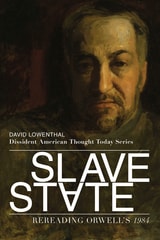
Slave State
Rereading Orwell's 1984David Lowenthal
St. Augustine's Press, 2021
There is no positive political message in 1984, argues Lowenthal, but there is positive moral message that is nearly always overlooked by commentators. “Through the movement of the novel, Orwell tries to impress on the passions, hearts and minds of his readers the most valuable lessons concerning the right and wrong way to live. With the decline of Christianity’s influence in forming the moral sense of the West and the concomitant increase in power hunger, wielding instruments born of modern enlightenment, what mankind most needed was moral guidance, conveyed not abstractly, through philosophy, but in such a way as to grip the whole soul.”
But can Orwell be trusted as a guide to the goodness in human nature? Lowenthal says he can be, and more. He gives us a sketch of the intellectual process that compels Orwell to ultimately outgrow Marxism, his detection and rejection of totalitarian regimes (above all in Communism), and in what way the principles of liberalism of his day were given warning labels by a writer who was not a formally educated political philosopher. Laced with relativism, any current of thought that does not acknowledge the proper ends of man will be effaced by the next master of the masses. Lowenthal echoes Orwell when he says, “we have abandoned inculcating good citizenship, higher ideals and a sense of personal worth in the schools, encouraging instead an aimless low-level conformist ‘individuality’ just waiting to be harnessed together and directed. Given these conditions, can we be sure we have left the conditions to the horrors of 1984 far behind as mere fiction?”
Orwell and Lowenthal are unlikely co-collaborators, unless one perceives how much alike in their exhortations to fellow man they are. The steady tenor of their hard warning is made possible by a hope-soaked confidence that, in utter sobriety, is repulsed by anything that threatens human freedom and dignity. This book is required reading for anyone who believes in the return of socialism. Indeed, any recent university graduate should be debriefed by Lowenthal before entering the real world.
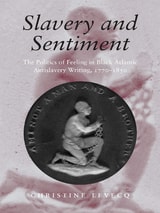
Slavery and Sentiment
The Politics of Feeling in Black Atlantic Antislavery Writing, 1770-1850Christine Levecq
University of New Hampshire Press, 2008
Levecq examines liberalism and republicanism, the main Anglo-American political ideologies of the period, in the antislavery texts of a range of African-American and Afro-British authors. Disclosing the political content hitherto unexamined in this kind of writing, she shows that while the overall story is one of increased liberalization of ideology on both sides of the Atlantic, the republican ideal persisted, particularly among black authors with transatlantic connections.
Demonstrating that such writers as Phillis Wheatley, Ignatius Sancho, Olaudah Equiano, Frederick Douglass, and Mary Prince were men and women of their times, Levecq provides valuable new insight into the ideological world of black Atlantic writers and puts them, for the first time, on modernity’s political map.
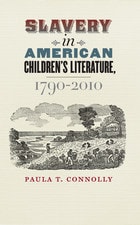
Slavery in American Children's Literature, 1790-2010
Paula T. Connolly
University of Iowa Press, 2013

Slavic Excursions
Essays on Russian and Polish LiteratureDonald Davie
University of Chicago Press, 1991
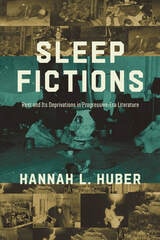
Sleep Fictions
Rest and Its Deprivations in Progressive-Era LiteratureHannah L. Huber
University of Illinois Press, 2023
A turn-of-the-century influx of new technologies and the enormous impact of the electric light transformed not only individual sleeping habits but the ways American culture conceived and valued sleep. Hannah L. Huber analyzes the works of Henry James, Edith Wharton, Charles Chesnutt, and Charlotte Perkins Gilman to examine the literary response to the period’s obsession with wakefulness. As these writers blurred the separation of public and private space, their characters faced exhaustion in a modern world that permeated every moment of their lives with artificial light, traffic noise, and the social pressure to remain active at all hours. The implacable cultural clock and constant stress over physical limitations had an even greater impact on marginalized figures. Huber pays particular attention to how these writers rebutted Americans’ confidence in the body’s ability to conquer sleep with vivid portraits of the devastating consequences of sleep disruption and deprivation.
The author also provides a website and text visualization tool that offers readers an interdisciplinary, deconstructed analysis of the book’s primary texts. The website can be found at: https://sleepfictions.org/sleep/scalar/index
Slips of the Mind
Poetry as ForgettingJennifer Soong
University of Chicago Press, 2025
In Slips of the Mind, poet and critic Jennifer Soong turns away from forgetting’s long-standing associations with suppression, privation, and error to argue that the absence or failure of memory has often functioned as a generative creative principle. Exploring forgetting not as the mere rejection of a literary past or a form of negative poetics, Soong puts to the test its very aesthetic meaning. What new structures, forms of desires, styles, and long and short feelings do lapses in time allow? What is oblivion’s relationship to composition? And how does the twentieth-century poet come to figure as the quintessential embodiment of such questions?
Soong uncovers forgetting’s influence on Gertrude Stein, Lyn Hejinian, Tan Lin, Harryette Mullen, Lissa Wolsak, and New York School poets John Ashbery, James Schuyler, Bernadette Mayer, and Ted Berrigan, among others. She reveals that forgetting’s shapeshifting produces differences in poetic genre, interest, and degrees of intentionality—and that such malleability is part of forgetting’s nature. Most provocatively, Soong shows how losing track of things, leaving them behind, or finding them already gone resists overdetermination and causality in the name of surprise, as poets leverage forgetting in order to replace identity with style. Slips of the Mind is the kind of literary criticism that will reward all readers of modern and contemporary poetry.
Slumming in New York
From the Waterfront to Mythic HarlemRobert M. Dowling
University of Illinois Press, 2006
Using the methods of ethnicity theory, black studies, regional studies, literary studies, and popular culture, Robert M. Dowling reveals the way in which "outsider" authors helped alleviate New York's mounting social anxieties by popularizing "insider" voices from neighborhoods as distinctive as the East Side waterfront, the Bowery, the Tenderloin's "black Bohemia," the Jewish Lower East Side, and mythic Harlem.
Small Change
Women, Learning, Patriotism, 1750-1810Harriet Guest
University of Chicago Press, 2000
During the second half of the eighteenth century, the social role of educated women and the nature of domesticity were the focus of widespread debate in Britain. The emergence of an identifiably feminist voice in that debate is the subject of Harriet Guest's new study, which explores how small changes in the meaning of patriotism and the relations between public and private categories permitted educated British women to imagine themselves as political subjects.
Small Change considers the celebration of learned women as tokens of national progress in the context of a commercial culture that complicates notions of gender difference. Guest offers a fascinating account of the women of the bluestocking circle, focusing in particular on Elizabeth Carter, hailed as the paradigmatic learned and domestic woman. She discusses the importance of the American war to the changing relation between patriotism and gender in the 1770s and 1780s, and she casts new light on Mary Wollstonecraft's writing of the 1790s, considering it in relation to the anti-feminine discourse of Hannah More, and the utopian feminism of Mary Hays.
Smile of Discontent
Humor, Gender, and Nineteenth-Century British FictionEileen Gillooly
University of Chicago Press, 1999
Gillooly shows how such humor became, for mostly female writers at the time, an unobtrusive and prudent means of expressing discontent with a culture that was ideologically committed to restricting female agency and identity. If the aggression and emotional distance of irony and satire mark them as "masculine," then for Gillooly, the passivity, indirection, and sympathy of the humor she discusses render it "feminine." She goes on to disclose how the humorous tactics employed by writers from Burney to Wharton persist in the work of Barbara Pym, Anita Brookner, and Penelope Fitzgerald.
The book won the Barbara Perkins and George Perkins Award given by the Society for the Study of Narrative Literature.
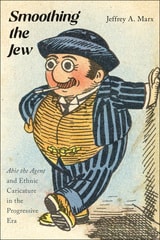
Smoothing the Jew
"Abie the Agent" and Ethnic Caricature in the Progressive EraJeffrey A. Marx
Rutgers University Press, 2024
Smoothing the Jew investigates how Jewish artists of the time attempted to “smooth over” these demeaning portrayals by focusing on the first Jewish comic strip published in English, Harry Hershfield’s Abie the Agent. Jeffrey Marx demonstrates how Hershfield created a Jewish protagonist who in part reassured nativists of the Jews’ ability to assimilate into American society while also encouraging immigrants and their children that, over time, they would be able to adopt American customs without losing their distinctly Jewish identity.

Snow on the Cane Fields
Women’s Writing and Creole SubjectivityJudith Raiskin
University of Minnesota Press, 1995
Snow on the Cane Fields was first published in 1995. Minnesota Archive Editions uses digital technology to make long-unavailable books once again accessible, and are published unaltered from the original University of Minnesota Press editions.
In a probing analysis of creole women's writing over the past century, Judith Raiskin explores the workings and influence of cultural and linguistic colonialism. Tracing the transnational and racial meanings of creole identity, Raiskin looks at four English-speaking writers from South Africa and the Caribbean: Olive Schreiner, Jean Rhys, Michelle Cliff, and Zoë Wicomb. She examines their work in light of the discourses of their times: nineteenth-century "race science" and imperialistic rhetoric, turn-of-the-century anti-Semitic sentiment and feminist pacifism, postcolonial theory, and apartheid legislation.
In their writing and in their multiple identities, these women highlight the gendered nature of race, citizenship, culture, and the language of literature. Raiskin shows how each writer expresses her particular ambivalences and divided loyalties, both enforcing and challenging the proprietary British perspective on colonial history, culture, and language. A new perspective on four writers and their uneasy places in colonial culture, Snow on the Cane Fields reveals the value of pursuing a feminist approach to questions of national, political, and racial identity.
Judith Raiskin is assistant professor of women's studies at the University of California, Santa Barbara.
Soap Fans
Pursuing Pleasure and Making Meaning in Everyday LifeC. Lee Harrington and Denise D. Bielby
Temple University Press, 1995
Do soap opera fans deserve their reputation as lonely people, hopeless losers, or bored housewives? No, according to C. Lee Harrington and Denise D. Bielby. These authors—soap fans themselves—argue that soap fans are normal individuals who translate their soap watching into a broad range of public and private experience. People who cut across all categories of age, gender, race, ethnicity, income, education, and ideology incorporate a love of the soaps into their day-to-day leisure activities.
Interviews with soap opera viewers, actors, writers, producers, directors, the daytime press, and fan club staff members reveal fascinating details about the inside world of fandom and the multitude of outlets for fan expression—clubs, newsletters, electronic bulletin boards, and public events. Numerous examples illustrate the pleasure fans derive from critiquing characters, speculating on plot twists, and swapping memorabilia.
Examining the experiences that shape fan culture, Harrington and Bielby analyze the narrative structure and various aspects of the production of the soaps. Their examination reveals that the "meaning" of soaps is complex, individualized, and not simply a reflection of the narrative content of the stories. The authors show fans who actively contemplate what it means to be a fan, and who adjust their level of involvement accordingly.
Social Minds in the Novel
Alan Palmer
The Ohio State University Press, 2010
Social Minds in the Novel is the highly readable sequel to Alan Palmer’s award-winning and much-acclaimed Fictional Minds. Here he argues that because of its undue emphasis on the inner, introspective, private, solitary, and individual mind, literary theory tells only part of the story of how characters in novels think. In addition to this internalist view, Palmer persuasively advocates an externalist perspective on the outer, active, public, social, and embodied mind. His analysis reveals, for example, that a good deal of fictional thought is intermental— joint, group, shared, or collective.
Social Minds in the NovelSocial minds are not of marginal interest; they are central to our understanding of fictional storyworlds. The purpose of this groundbreaking and important book is to put the complex and fascinating relationship between social and individual minds at the heart of narrative theory. The book will be of interest to scholars in narrative theory, cognitive poetics or stylistics, cognitive approaches to literature, philosophy of mind, social psychology, and the nineteenth-century novel.
focuses primarily on the epistemological and ethical debate in the nineteenth-century novel about the extent of our knowledge of the workings of other minds and the purposes to which this knowledge should be put. Palmer’s illuminating approach is pursued through skillful and provocative readings of Bleak House, Middlemarch, and Persuasion, and, in addition, Evelyn Waugh’s Men at Arms and Ian McEwan’s Enduring Love.
Social Voices
The Cultural Politics of Singers around the GlobeEdited by Levi S. Gibbs
University of Illinois Press, 2023
Around the world and across time, singers and their songs stand at the crossroads of differing politics and perspectives. Levi S. Gibbs edits a collection built around the idea of listening as a political act that produces meaning. Contributors explore a wide range of issues by examining artists like Romani icon Esma Redžepova, Indian legend Lata Mangeshkar, and pop superstar Teresa Teng. Topics include gendered performances and the negotiation of race and class identities; the class-related contradictions exposed by the divide between highbrow and pop culture; links between narratives of overcoming struggle and the distinction between privileged and marginalized identities; singers’ ability to adapt to shifting notions of history, borders, gender, and memory in order to connect with listeners; how the meanings we read into a singer’s life and art build on one another; and technology’s ability to challenge our ideas about what constitutes music.
Cutting-edge and original, Social Voices reveals how singers and their songs equip us to process social change and divergent opinions.
Contributors: Christina D. Abreu, Michael K. Bourdaghs, Kwame Dawes, Nancy Guy, Ruth Hellier, John Lie, Treva B. Lindsey, Eric Lott, Katherine Meizel, Carol A. Muller, Natalie Sarrazin, Anthony Seeger, Carol Silverman, Andrew Simon, Jeff Todd Titon, and Elijah Wald

Society and its Outsiders in the Novels of Jakob Wassermann
Katharina Volckmer
University of London Press, 2016
Sociology Confronts the Holocaust
Memories and Identities in Jewish DiasporasJudith M. Gerson and Diane L. Wolf, eds.
Duke University Press, 2007
Contributors explore diasporic Jewish identities in the post-Holocaust years; the use of sociohistorical analysis in studying the genocide; immigration and transnationalism; and collective action, collective guilt, and collective memory. In so doing, they illuminate various facets of the Holocaust, and especially post-Holocaust, experience. They investigate topics including heritage tours that take young American Jews to Israel and Eastern Europe, the politics of memory in Steven Spielberg’s collection of Shoah testimonies, and the ways that Jews who immigrated to the United States after the collapse of the Soviet Union understood nationality, religion, and identity. Contributors examine the Warsaw Ghetto Uprising of 1943 in light of collective action research and investigate the various ways that the Holocaust has been imagined and recalled in Germany, Israel, and the United States. Included in the commentaries about sociology and Holocaust studies is an essay reflecting on how to study the Holocaust (and other atrocities) ethically, without exploiting violence and suffering.
Contributors. Richard Alba, Caryn Aviv, Ethel Brooks, Rachel L. Einwohner, Yen Le Espiritu, Leela Fernandes, Kathie Friedman, Judith M. Gerson, Steven J. Gold , Debra R. Kaufman, Rhonda F. Levine , Daniel Levy, Jeffrey K. Olick, Martin Oppenheimer, David Shneer, Irina Carlota Silber, Arlene Stein, Natan Sznaider, Suzanne Vromen, Chaim Waxman, Richard Williams, Diane L. Wolf

Socrates and Aristophanes
Leo Strauss
University of Chicago Press, 1996
"Strauss gives us an impressive addition to his life's work—the recovery of the Great Tradition in political philosophy. The problem the book proposes centers formally upon Socrates. As is typical of Strauss, he raises profound issues with great courage. . . . [He addresses] a problem that has been inherent in Western life ever since [Socrates'] execution: the tension between reason and religion. . . . Thus, we come to Aristophanes, the great comic poet, and his attack on Socrates in the play The Clouds. . . [Strauss] translates it into the basic problem of the relation between poetry and philosophy, and resolves this by an analysis of the function of comedy in the life of the city." —Stanley Parry, National Review
Soda Goes Pop
Pepsi-Cola Advertising and Popular MusicJoanna K. Love
University of Michigan Press, 2019
Soda Goes Pop investigates these and other vital questions around the evolving relationships between popular music and corporate advertising. Joanna K. Love joins musical analysis, historical research, and cultural theory to trace parallel shifts in these industries over eight decades. In addition to scholarly and industry resources, she draws on first-hand accounts, pop culture magazines, trade press journals, and other archival materials. Pepsi’s longevity as an influential American brand, its legendary commercials, and its pioneering, relentless pursuit of alliances with American musical stars makes the brand a particularly instructive point of focus. Several of the company’s most famous ad campaigns are prime examples of the practice of redaction, whereby marketers select, censor, and restructure musical texts to fit commercial contexts in ways that revise their aesthetic meanings and serve corporate aims. Ultimately, Love demonstrates how Pepsi’s marketing has historically appropriated and altered images of pop icons and the meanings of hit songs, and how these commercials shaped relationships between the American music business, the advertising industry, and corporate brands.
Soda Goes Pop is a rich resource for scholars and students of American studies, popular culture, advertising, broadcast media, and musicology. It is also an accessible and informative book for the general reader, as Love’s musical and theoretical analyses are clearly presented for non-specialist audiences and readers with varying degrees of musical knowledge.
Soft Canons
American Women WritersKaren L. Kilcup
University of Iowa Press, 1999
Soft Matter
The Poetics of Weakness in Late Soviet SocialismJulia Vaingurt
Northwestern University Press, 2025
Identifies and examines a poetics of weakness in Soviet underground literature
Artists of the late Soviet era sought new, nonconformist ways of approaching literary fiction, arriving at weakness as a crucial principle of narrative and character formation. Julia Vaingurt argues that this counter-discourse of strategic weakness constituted both an aesthetic strategy and an ethical code, affording like-minded authors a feeling of recognition and commonality and uniting an international community of artists in resistance to the divisiveness of their worlds. Soft Matter: The Poetics of Weakness in Late Soviet Socialism explores the cultivation of weak subjectivity through modes such as gender subversion, queer holy foolishness, intoxication, madness, and writing disorders like graphomania and writer’s block. Identifying the poetics of weakness as formative for Soviet underground literature of the 1960s and ’70s, Vaingurt also traces the inheritance of a far older tradition within Russian culture of salutary weakness. As democratic deliberation continues to be under threat around the world, alternatives to the ubiquitous politics of force are an aesthetic, ethical, and ideological imperative.
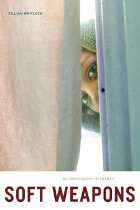
Soft Weapons
Autobiography in TransitGillian Whitlock
University of Chicago Press, 2007
Azar Nafisi’s Reading Lolita in Tehran,Marjane Satrapi’s comics, and “Baghdad Blogger” Salam Pax’s Internet diary are just a few examples of the new face of autobiography in an age of migration, globalization, and terror. But while autobiography and other genres of life writing can help us attend to people whose experiences are frequently unseen and unheard, life narratives can also be easily co-opted into propaganda. In Soft Weapons, Gillian Whitlock explores the dynamism and ubiquity of contemporary life writing about the Middle East and shows how these works have been packaged, promoted, and enlisted in Western controversies.
Considering recent autoethnographies of Afghan women, refugee testimony from Middle Eastern war zones, Jean Sasson’s bestsellers about the lives of Arab women, Norma Khouri’s fraudulent memoir Honor Lost, personal accounts by journalists reporting the war in Iraq, Satrapi’s Persepolis, Nafisi’s book, and Pax’s blog, Whitlock explores the contradictions and ambiguities in the rapid commodification of life memoirs. Drawing from the fields of literary and cultural studies, Soft Weapons will be essential reading for scholars of life writing and those interested in the exchange of literary culture between Islam and the West.
Soldiers Once and Still
Ernest Hemingway, James Salter, and Tim O'BrienAlex Vernon
University of Iowa Press, 2007
Hemingway, Salter, and O’Brien form the core of Soldiers Once and Still because each represents a different warring generation of twentieth-century America: World War I with Hemingway, World War II and Korea with Salter, and Vietnam with O’Brien. Each author also represents a different literary voice of the twentieth century, from modern to mid-century to postmodern, and each presents a different battlefield experience: Hemingway as noncombatant, Salter as air force fighter pilot, and O’Brien as army grunt.
War’s pervasive influence on the individual means that, for veterans-turned-writers like Hemingway, Salter, and O’Brien, the war experience infiltrates their entire body of writing—their works can be seen not only as war literature but also as veterans’ literature. As such, their entire postwar oeuvre, regardless of whether an individual work explicitly addresses the war or the military, is open to Vernon’s exploration of war, society, gender, and literary history.
Vernon’s own experiences as a soldier, a veteran, a writer, and a critic inform this enlightening critique of American literature, offering students and scholars of American literature and war studies an invaluable tool for understanding war’s effects on the veteran writer and his society.

Soldiers' Stories
Military Women in Cinema and Television since World War IIYvonne Tasker
Duke University Press, 2011
Soliciting Interpretation
Literary Theory and Seventeenth-Century English PoetryEdited by Elizabeth D. Harvey and Katharine Eisaman Maus
University of Chicago Press, 1990
In the first group of essays, David Norbrook, Annabel Patterson, John Guillory, Rosemary Kegl, and Stephen Orgel explore the various ways in which a text can be "political." Next, Arthur Marotti, Jane Tylus, and Jonathan Goldberg consider the circumstances of textual production and reception in the seventeenth century. Finally, Stanley Fish, Gordon Braden, Michael C. Schoenfeldt, and Maureen Quilligan discuss the particular forms of anxiety that result when seventeenth-century poets modify the traditional rhetoric of sexual desire to serve what seem to be erotic or religious purposes.
These essays, accompanied by an extensive editors' introduction, intersect less in their shared enthusiasm for particular authors or interpretative methods than in a common interest in particular critical issues. They present the most exciting work by critics redefining Renaissance studies.

Some Catholic Writers
Ralph McInerny
St. Augustine's Press, 2007
Some Write to the Future
Essays on Contemporary Latin American FictionAriel Dorfman
Duke University Press, 1991
Praise for Ariel Dorfman
“One of the most important voices coming out of Latin America.”—Salman Rushdie
“A remarkable writer . . . writing out of a very different cultural perspective from comfortable American readers.”—Digby Diehl, Los Angeles Herald Examiner
“One of the six greatest Latin American novelists.”—Jacobo Timmerman, Newsweek
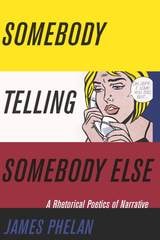
Somebody Telling Somebody Else
A Rhetorical Poetics of NarrativeJames Phelan
The Ohio State University Press, 2017
In doing so, he offers new readings of a wide range of narratives from Jane Austen’s Pride and Prejudice to Joan Didion’s The Year of Magical Thinking, from Joseph Conrad’s Lord Jim to George V. Higgins’s The Friends of Eddie Coyle, from Franz Kafka’s “Das Urteil” to Toni Morrison’s “Recitatif,” from David Small’s Stitches to Jhumpa Lahiri’s “Third and Final Continent,” from John O’Hara’s “Appearances” to Ian McEwan’s Enduring Love. Phelan contends that the standard view of narrative as a synthesis of story and discourse is inadequate to handle the complexities of narrative communication, and he demonstrates the greater explanatory power of his rhetorical view. Furthermore, Phelan gives new prominence to the presence and activity of the “somebody else,” as he shows that an audience’s unfolding responses to a narrative often influence its very construction.

Someday All the Adults Will Die!
The Birth of Texas PunkPat Blashill
University of Texas Press, 2025
A deep dive into the early days of punk in Austin, Texas, this oral history immerses readers in a diverse and influential music scene.
Texas has always teemed with music and counterculture. When punk came to the state in 1978, it flourished in San Antonio, Dallas, Houston, and, especially, Austin. Punk and post-punk musicians, including nationally acclaimed bands like the Butthole Surfers, the Big Boys, the Dicks, and Daniel Johnston influenced local culture before slashing into the American musical psyche. (See Kurt Cobain sporting Johnston’s “Hi, How are you?” T-shirt.) Someday All the Adults Will Die! is an oral history of punk in Texas, from its rise in the late 1970s, through its strong anti-racist, feminist, and queer peak, to its dissolution in the late 1980s.
Now a seasoned music journalist, Blashill experienced the zenith of Texas punk as a teenager, and he captures its intensity in words and pictures. Someday All the Adults Will Die! is rife with electrifying images and firsthand tales of what made this scene such a storm of pleasures and terrors, uncompromising artists, and wild performances. This dynamic portrait of an untamed, all-out musical era is a must-read for fans of punk music, counterculture, and live music.
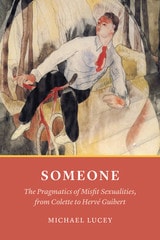
Someone
The Pragmatics of Misfit Sexualities, from Colette to Hervé GuibertMichael Lucey
University of Chicago Press, 2019
In Someone, Michael Lucey considers characters from twentieth-century French literary texts whose sexual forms prove difficult to conceptualize or represent. The characters expressing these “misfit” sexualities gravitate towards same-sex encounters. Yet they differ in subtle but crucial ways from mainstream gay or lesbian identities—whether because of a discordance between gender identity and sexuality, practices specific to a certain place and time, or the fleetingness or non-exclusivity of desire. Investigating works by Simone de Beauvoir, Colette, Jean Genet, and others, Lucey probes both the range of same-sex sexual forms in twentieth-century France and the innovative literary language authors have used to explore these evanescent forms.
As a portrait of fragile sexualities that involve awkward and delicate maneuvers and modes of articulation, Someone reveals just how messy the ways in which we experience and perceive sexuality remain, even to ourselves.
Something More than Night
The Case of Raymond ChandlerPeter Wolfe
University of Wisconsin Press, 1985
Something We Have That They Don't
British and American Poetic Relations since 1925Steve & Mark Clark & Ford
University of Iowa Press, 2004
(I like the way the English spell it
They’re so clever about some things
Probably smarter generally than we are
Although there is supposed to be something
We have that they don’'t—'don’t ask me
What it is. . . .)
—John Ashbery, “Tenth Symphony”
Something We Have That They Don’t presents a variety of essays on the relationship between British and American poetry since 1925. The essays collected here all explore some aspect of the rich and complex history of Anglo-American poetic relations of the last seventy years. Since the dawn of Modernism poets either side of the Atlantic have frequently inspired each other’s developments, from Frost’s galvanizing advice to Edward Thomas to rearrange his prose as verse, to Eliot’s and Auden’s enormous influence on the poetry of their adopted nations (“whichever Auden is,” Eliot once replied when asked if he were a British or an American poet, “I suppose, I must be the other”); from the impact of Charles Olson and other Black Mountain poets on J. H. Prynne and the Cambridge School, to the widespread influence of Frank O'Hara and Robert Lowell on a diverse range of contemporary British poets. Clark and Ford’s study aims to chart some of the currents of these ever-shifting relations. Poets discussed in these essays include John Ashbery, W. H. Auden, Elizabeth Bishop, T. S. Eliot, Mark Ford, Robert Graves, Thom Gunn, Lee Harwood, Geoffrey Hill, Michael Hofmann, Susan Howe, Robert Lowell, and W. B. Yeats.
“Poetry and sovereignty,” Philip Larkin remarked in an interview of 1982, “are very primitive things”: these essays consider the ways in which even seemingly very “unprimitive” poetries can be seen as reflecting and engaging with issues of national sovereignty and self-interest, and in the process they pose a series of fascinating questions about the national narratives that currently dominate definitions of the British and American poetic traditions.
This innovative and exciting new collection will be of great interest to students and scholars of British and American poetry and comparative literature.
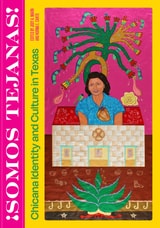
Somos Tejanas!
Chicana Identity and Culture in TexasEdited by Jody A. Marín and Norma E. Cantú
University of Texas Press, 2025
2026 Outstanding Book Award for Non-Fiction, National Association for Chicana and Chicano Studies (NACCS) Tejas Foco
2026 Silver Medal for the Dolores Huerta Best Cultural & Community Themed Book – English, Conference on Latin American History (CLAH)
An expansive volume on Tejana identity and Tejanidad told through personal narratives, poetry, and essays.
Being Tejanx is different than just being from Texas. Being Tejanx means you are a border subject. Being Tejanx means living in and from a certain history of oppression, possibility, activism, and cultural-linguistic hybridity arising within the US-Mexico borderland that is home. And being Tejanx means something in particular if you are a woman.
In ¡Somos Tejanas!, editors Norma E. Cantú and Jody A. Marín assemble contemporary Tejanx writers who provide firsthand accounts of their experience of identity, enriching the field of Tejanx studies through an encounter with gender and sexuality. The contributions, including personal and scholarly essays, poems, criticism, and artworks, explore the heterogeneity of Tejana identity and the sociopolitical movements, stories, dances, music, and athletic feats that mark Tejanidad. Authors contemplate the history and memory of segregation in Texas, the struggles of surviving the unnatural disaster and blackouts of 2021 amid the global pandemic of COVID-19, and the drug-war violence and ever-tightening immigration restrictions that strangle a transborder way of life shared by millions. An unrepentant act of expression from women under attack by state policymakers, this collection dispels the silence imposed by colonial erasure.
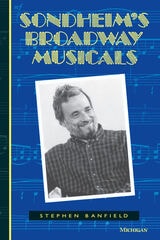
Sondheim's Broadway Musicals
Stephen Banfield
University of Michigan Press, 1995
Sondheim's Broadway Musicals is the first book to take an in-depth look at Sondheim's work. Stephen Banfield examines each of Sondheim's musicals for Broadway, from West Side Story and Gypsy to the 1987 musical Into the Woods, and includes A Funny Thing Happened on the Way to the Forum, Company, Follies, Anyone Can Whistle, A Little Night Music, Pacific Overtures, Merrily We Roll Along, Sweeney Todd, and Sunday in the Park with George. Banfield also discusses Sondheim's other work, such as the 1991 show Assassins and his music for the 1990 film Dick Tracy--for which "Sooner or Later" won him an Academy Award for Best Song.
"Banfield seems almost to hear Sondheim's music with Sondheim's ears. This extremely valuable work discusses Sondheim's early training and subsequent career, his general compositional concerns, and his style. The meat of the book is a musical-dramatic analysis of his musicals . . . . For each musical, Banfield places the work and its components in a historical and typological text. He also treats in welcome detail the musical profile or universe of each show: Sondheim's use of generative intervals or interval complexes as source material, motifs that reappear in various guises in various songs, the sound world that defines the musical's emotional mind. The book will be as useful to those who are cool to Sondheim's work as to his fans." --Choice
Song and Self
A Singer's Reflections on Music and PerformanceIan Bostridge
University of Chicago Press, 2023
Like so many performers, renowned tenor Ian Bostridge spent much of 2020 and 2021 unable to take part in live music. The enforced silence of the pandemic led him to question an identity that was previously defined by communicating directly with audiences in opera houses and concert halls. It also allowed him to delve deeper into many of the classical works he has encountered over the course of his career, such as Claudio Monteverdi’s seventeenth-century masterpiece Il Combattimento di Tancredi e Clorinda and Robert Schumann’s popular song cycle Frauenliebe und Leben. In lucid and compelling prose, Bostridge explores the ways Monteverdi, Schumann, and Britten employed and disrupted gender roles in their music; questions colonial power and hierarchy in Ravel’s Songs of Madagascar; and surveys Britten’s reckoning with death in works from the War Requiem to his final opera, Death in Venice.
As a performer reconciling his own identity and that of the musical text he delivers on stage, Bostridge unravels the complex history of each piece of music, showing how today’s performers can embody that complexity for their audiences. As readers become privy to Bostridge’s unique lines of inquiry, they are also primed for the searching intensity of his interpretations, in which the uncanny melding of song and self brings about moments of epiphany for both the singer and his audience.

Song-Poems from Xanadu
J. I. Crump
University of Michigan Press, 1993
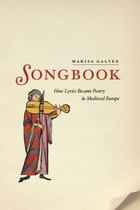
Songbook
How Lyrics Became Poetry in Medieval EuropeMarisa Galvez
University of Chicago Press, 2012
Today we usually think of a book of poems as composed by a poet, rather than assembled or adapted by a network of poets and readers. But the earliest European vernacular poetries challenge these assumptions. Medieval songbooks remind us how lyric poetry was once communally produced and received—a collaboration of artists, performers, live audiences, and readers stretching across languages and societies.
The only comparative study of its kind, Songbook treats what poetry was before the emergence of the modern category “poetry”: that is, how vernacular songbooks of the thirteenth to fifteenth centuries shaped our modern understanding of poetry by establishing expectations of what is a poem, what is a poet, and what is lyric poetry itself. Marisa Galvez analyzes the seminal songbooks representing the vernacular traditions of Occitan, Middle High German, and Castilian, and tracks the process by which the songbook emerged from the original performance contexts of oral publication, into a medium for preservation, and, finally, into an established literary object. Galvez reveals that songbooks—in ways that resonate with our modern practice of curated archives and playlists—contain lyric, music, images, and other nonlyric texts selected and ordered to reflect the local values and preferences of their readers. At a time when medievalists are reassessing the historical foundations of their field and especially the national literary canons established in the nineteenth century, a new examination of the songbook’s role in several vernacular traditions is more relevant than ever.