Results by title
28167 books match the query 'History' and 1838 start with s
Scientific Babel
How Science Was Done Before and After Global EnglishMichael D. Gordin
University of Chicago Press, 2015
So how did we get from there to here? How did French, German, Latin, Russian, and even Esperanto give way to English? And what can we reconstruct of the experience of doing science in the polyglot past? With Scientific Babel, Michael D. Gordin resurrects that lost world, in part through an ingenious mechanism: the pages of his highly readable narrative account teem with footnotes—not offering background information, but presenting quoted material in its original language. The result is stunning: as we read about the rise and fall of languages, driven by politics, war, economics, and institutions, we actually see it happen in the ever-changing web of multilingual examples. The history of science, and of English as its dominant language, comes to life, and brings with it a new understanding not only of the frictions generated by a scientific community that spoke in many often mutually unintelligible voices, but also of the possibilities of the polyglot, and the losses that the dominance of English entails.
Few historians of science write as well as Gordin, and Scientific Babel reveals his incredible command of the literature, language, and intellectual essence of science past and present. No reader who takes this linguistic journey with him will be disappointed.

Scientific Freedom under Attack
Political Oppression, Structural Challenges, and Intellectual Resistance in Modern and Contemporary HistoryEdited by Ralf Roth and Asli Vatansever
Campus Verlag, 2020

Scientific History
Experiments in History and Politics from the Bolshevik Revolution to the End of the Cold WarElena Aronova
University of Chicago Press, 2021
The book explores the intertwined trajectories of six intellectuals and the larger programs they set in motion: Henri Berr (1863–1954), Nikolai Bukharin (1888–1938), Lucien Febvre (1878–1956), Nikolai Vavilov (1887–1943), Julian Huxley (1887–1975), and John Desmond Bernal (1901–1971). Though they held different political views, spoke different languages, and pursued different goals, these thinkers are representative of a larger motley crew who joined the techniques, approaches, and values of science with the writing of history, and who created powerful institutions and networks to support their projects.
In tracing these submerged stories, Aronova reveals encounters that profoundly shaped our knowledge of the past, reminding us that it is often the forgotten parts of history that are the most revealing.
Scientific Perspectivism
Ronald N. Giere
University of Chicago Press, 2006
Many people assume that the claims of scientists are objective truths. But historians, sociologists, and philosophers of science have long argued that scientific claims reflect the particular historical, cultural, and social context in which those claims were made. The nature of scientific knowledge is not absolute because it is influenced by the practice and perspective of human agents. Scientific Perspectivism argues that the acts of observing and theorizing are both perspectival, and this nature makes scientific knowledge contingent, as Thomas Kuhn theorized forty years ago.
Using the example of color vision in humans to illustrate how his theory of “perspectivism” works, Ronald N. Giere argues that colors do not actually exist in objects; rather, color is the result of an interaction between aspects of the world and the human visual system. Giere extends this argument into a general interpretation of human perception and, more controversially, to scientific observation, conjecturing that the output of scientific instruments is perspectival. Furthermore, complex scientific principles—such as Maxwell’s equations describing the behavior of both the electric and magnetic fields—make no claims about the world, but models based on those principles can be used to make claims about specific aspects of the world.
Offering a solution to the most contentious debate in the philosophy of science over the past thirty years, Scientific Perspectivism will be of interest to anyone involved in the study of science.

Scientific Practice
Theories and Stories of Doing PhysicsEdited by Jed Z. Buchwald
University of Chicago Press, 1995
This book examines small-scale experiment in physics, in particular the relation between theory and practice. The contributors focus on interactions among the people, materials, and ideas involved in experiments—factors that have been relatively neglected in science studies.
The first half of the book is primarily philosophical, with contributions from Andrew Pickering, Peter Galison, Hans Radder, Brian Baigrie, and Yves Gingras. Among the issues they address are the resources deployed by theoreticians and experimenters, the boundaries that constrain theory and practice, the limits of objectivity, the reproducibility of results, and the intentions of researchers. The second half is devoted to historical case studies in the practice of physics from the early nineteenth to the early twentieth century. These chapters address failed as well as successful experimental work ranging from Victorian astronomy through Hertz's investigation of cathode rays to Trouton's attempt to harness the ether. Contributors to this section are Jed Z. Buchwald, Giora Hon, Margaret Morrison, Simon Schaffer, and Andrew Warwick.
With a lucid introduction by Ian Hacking, and original articles by noted scholars in the history and philosophy of science, this book is poised to become a significant source on the nature of small-scale experiment in physics.

Scotland and America in the Age of Paine
Ronald Lyndsey Crawford
Aberdeen University Press, 2022

Scots in Michigan
Alan T. Forrester
Michigan State University Press, 2003
Scots began settling in North America in the earliest colonial days. They were heavily involved in the Great Lakes region’s major industries, as these evolved from fur trade to farming and lumbering to industry. From early settlement to the industrial revolution, Scots brought to the state a pioneer spirit and an extraordinary level of education. Though rendered almost invisible both by clustering under the umbrella of the British Commonwealth and by the fact that few Scottish traditions are considered whatsoever foreign, ethnic, or exotic, Scottish influences run deep in Michigan history and culture. From ice hockey to industry, much of what represents Michigan has roots that were embedded in Scotland. Although Alan T. Forrester notes that symbolic Scottish ethnicity—Highland Games, Scottish Festivals, and Burns Night Suppers—is practically the only obvious relic of Scottish heritage in Michigan, he illuminates how much more of this legacy is a part of this state.
Scourge of the Caribbean
Charles E. Hawkins, Sailor of Three RepublicsJames M. Denham
University of Alabama Press, 2026
Illuminates the early American period in the upper Caribbean
Scourge of the Caribbean explores the mysterious and dramatic life and career of Charles E. Hawkins, a relatively unknown naval figure in early national America. Hawkins’s action-packed life at sea in his brief but accomplished career reveals much about an era when the rules of the maritime world, especially in the Caribbean, were in flux. For the US Navy and its commanders, the Caribbean presented an untold number of ambiguities: revolutionary juntas, privateering, piracy, and deadly disease, all within some of the most beautiful landscapes and waterscapes on earth.
Hawkins, from a well-connected family, took to the sea as a midshipman in the US Navy. Stalled promotion, economic setbacks, and blunted opportunities stymied the young officer, but ambition, combined with varied experiences and maritime pursuits, presented other prospects. At a time when individual agency mattered most, Hawkins stepped outside traditional boundaries of conduct on numerous occasions. Hawkins followed a mentor into the Mexican navy and became the most successful and feared raider of Spanish ships, earning the sobriquet “scourge” because of his raids along Cuba’s northern coast. In 1835, Hawkins joined the Texas independence movement against Mexico. Within the historical narrative are lurid accounts of adultery, affairs of honor, a bloody assassination, and complicated maritime legal battles. Based on prodigious research, this lively tale will appeal to those interested in maritime and early American history and the upper Caribbean in the Age of Sail.
Scouting for the Bluecoats
Navajos, Apaches, and the U.S. Military, 1873–1911Robert S. McPherson
University Press of Colorado, 2022
—Kent Powell, Senior historian at Utah Division of State History and editor of Utah State Historical Quarterly (retired)
"Scouting for the Bluecoats examines the important role that Navajos played in military operations during the last quarter of the nineteenth and beginning of the twentieth centuries. Unlike the famous Navajo code talkers of World War II, little has been written about these men who served in some of the most challenging and noteworthy struggles against the Apaches. Until now, their story has been forgotten. Navajo skills in understanding and tracking a wily foe across an inhospitable landscape proved to be essential elements in ending the Apache wars. For those interested in the recruitment and deployment of the scouts, measures taken to counter enemy tactics, and the challenge of obtaining recognition for their service, this book is an invaluable source and a must-read for any serious scholar of Navajo history."
—Ronald P. Maldonado, Tribal historic preservation officer (retired), Navajo Nation

Scouting with the Buffalo Soldiers
John P. Langellier
University of North Texas Press, 2020
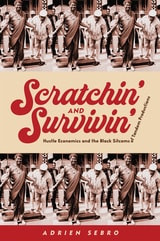
Scratchin' and Survivin'
Hustle Economics and the Black Sitcoms of Tandem ProductionsAdrien Sebro
Rutgers University Press, 2024
The 1970s was a golden age for representations of African American life on TV sitcoms: Sanford & Son, Good Times, The Jeffersons. Surprisingly, nearly all the decade’s notable Black sitcoms were made by a single company, Tandem Productions. Founded by two white men, the successful team behind All in the Family, writer Norman Lear and director Bud Yorkin, Tandem gave unprecedented opportunities to Black actors, writers, and producers to break into the television industry. However, these Black auteurs also struggled to get the economic privileges and creative autonomy regularly granted to their white counterparts.
Scratchin’ and Survivin’ discovers surprising parallels between the behind-the-scenes drama at Tandem and the plotlines that aired on their sitcoms, as both real and fictional African Americans devised various strategies for getting their fair share out of systems prone to exploiting their labor. The media scholar Adrien Sebro describes these tactics as a form of “hustle economics,” and he pays special attention to the ways that Black women—including actresses like LaWanda Page, Isabel Sanford, and Esther Rolle—had to hustle for recognition. Exploring Tandem’s complex legacy, including its hit racially mixed sitcom Diff’rent Strokes, he showcases the Black talent whose creative agency and labor resilience helped to transform the television industry.
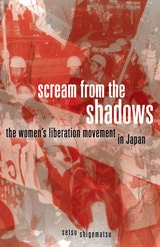
Scream from the Shadows
The Women’s Liberation Movement in JapanSetsu Shigematsu
University of Minnesota Press, 2012
More than forty years ago a women’s liberation movement called ūman ribu was born in Japan amid conditions of radicalism, violence, and imperialist aggression. Setsu Shigematsu’s book is the first to present a sustained history of ūman ribu’s formation, its political philosophy, and its contributions to feminist politics across and beyond Japan. Through an in-depth analysis of ūman ribu, Shigematsu furthers our understanding of Japan’s gender-based modernity and imperialism and expands our perspective on transnational liberation and feminist movements worldwide.
In Scream from the Shadows, Shigematsu engages with political philosophy while also contextualizing the movement in relation to the Japanese left and New Left as well as the anti–Vietnam War and radical student movements. She examines the controversial figure Tanaka Mitsu, ūman ribu’s most influential activist, and the movement’s internal dynamics. Shigematsu highlights ūman ribu’s distinctive approach to the relationship of women—and women’s liberation—to violence: specifically, the movement’s embrace of violent women who were often at the margins of society and its recognition of women’s complicity in violence against other women.
Scream from the Shadows provides a powerful case study of a complex and contradictory movement with a radical vision of women’s liberation. It offers a unique opportunity to reflect on the blind spots within our contemporary and dominant views of feminism across their liberal, marxist, radical, Euro-American, postcolonial, and racial boundaries.

Scream! Bleed! Take Off Your Clothes!
Stuart Gordon and Chicago’s Organic Theater CompanyMary Griswold, Cordis Heard, Jim Rinnert and Mike Saad
University of Chicago Press, 2026
A captivating firsthand account of Chicago’s groundbreaking, tumultuous Organic Theater Company.
When the founder of the Organic Theater Company died in 2020, the Chicago Tribune asked, “Did one person invent Chicago theater? If so, it was Stuart Gordon.” And yet, this iconic theater group is arguably the most influential Chicago company whose story has never been fully told.
In its heyday, from 1969 through 1985, the Organic’s high-spirited, gutsy, and close-knit company created more than thirty idiosyncratic works. A springboard for playwright David Mamet and for the television series ER, it also was formative in the careers of many well-known actors, including Joe Mantegna, André De Shields, Meshach Taylor, and Dennis Franz. Scream! Bleed! Take Off Your Clothes! is the story of a young theater company that always pushed boundaries with an anarchic exuberance. Drawing on extensive interviews and archival research, this insiders’ account, assembled by three Organic members and an artistic associate, details those exciting productions and the company’s complicated internal dynamics, while also positioning the group within Chicago’s vibrant theater scene and the larger culture of the time.

Screen Nazis
Cinema, History, and DemocracySabine Hake
University of Wisconsin Press, 2012
From the late 1930s to the early twenty-first century, European and American filmmakers have displayed an enduring fascination with Nazi leaders, rituals, and symbols, making scores of films from Confessions of a Nazi Spy (1939) and Watch on the Rhine (1943) through Des Teufels General (The Devil’s General, 1955) and Pasqualino settebellezze (Seven Beauties, 1975), up to Der Untergang (Downfall, 2004), Inglourious Basterds (2009), and beyond.
Probing the emotional sources and effects of this fascination, Sabine Hake looks at the historical relationship between film and fascism and its far-reaching implications for mass culture, media society, and political life. In confronting the specter and spectacle of fascist power, these films not only depict historical figures and events but also demand emotional responses from their audiences, infusing the abstract ideals of democracy, liberalism, and pluralism with new meaning and relevance.
Hake underscores her argument with a comprehensive discussion of films, including perspectives on production history, film authorship, reception history, and questions of performance, spectatorship, and intertextuality. Chapters focus on the Hollywood anti-Nazi films of the 1940s, the West German anti-Nazi films of the 1950s, the East German anti-fascist films of the 1960s, the Italian “Naziploitation” films of the 1970s, and issues related to fascist aesthetics, the ethics of resistance, and questions of historicization in films of the 1980s–2000s from the United States and numerous European countries.
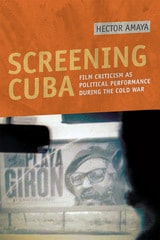
Screening Cuba
Film Criticism as Political Performance during the Cold WarHector Amaya
University of Illinois Press, 2010

Screening Modernism
European Art Cinema, 1950-1980András Bálint Kovács
University of Chicago Press, 2007
Spanning from the 1950s to the 1970s, András Bálint Kovács’s encyclopedic work argues that cinematic modernism was not a unified movement with a handful of styles and themes but rather a stunning range of variations on the core principles of modern art. Illustrating how the concepts of modernism and the avant-garde variously manifest themselves in film, Kovács begins by tracing the emergence of art cinema as a historical category. He then explains the main formal characteristics of modern styles and forms as well as their intellectual foundation. Finally, drawing on modernist theory and philosophy along the way, he provides an innovative history of the evolution of modern European art cinema.
Exploring not only modernism’s origins but also its stylistic, thematic, and cultural avatars, Screening Modernism ultimately lays out creative new ways to think about the historical periods that comprise this golden age of film.
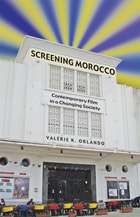
Screening Morocco
Contemporary Film in a Changing SocietyValérie K. Orlando
Ohio University Press, 2011
Screening Neoliberalism
Transforming Mexican Cinema, 1988-2012Ignacio M. Sánchez Prado
Vanderbilt University Press, 2014
Screening Out the Past
The Birth of Mass Culture and the Motion Picture IndustryLary May
University of Chicago Press, 1983
"It is impossible to follow a narrow trail through the movies. The vistas keep opening, and May, linking movies to mass society, finds and makes new perceptions on emerging women, the rise of the studios, the special growth and appeal of Los Angeles, the nature of studio leadership and the early and persistent imputed corrupting power of film."—Charles Champlin, Los Angeles Times
"Lary May . . . has provided a set of new and rich insights into the changing patterns of American culture, 1890-1929. . . . His concentration on social and cultural history indirectly provides answers to questions which have baffled political historians for several decades."—David W. Noble, Minneapolis Tribune
"[Screening Out the Past is] a scrupulously argued, clearly written account of Hollywood's role in bringing America skipping and giggling from the Victorian world into the twentieth century. May is splendid on the psychology of the immigrant movie moguls, on Douglas Fairbanks and Mary Pickford as post Great War role models, and many other things."—Philip French, London Sunday Observor
"Altogether, the book represents the most successful blending of movie and cultural history to date."—Benjamin McArthur, Journal of Social History
Screening The Body
Tracing Medicine’s Visual CultureLisa Cartwright
University of Minnesota Press, 1995
Moving images are used as diagnostic tools and locational devices every day in hospitals, clinics, and laboratories. But how and when did they come to be established and accepted sources of knowledge about the body in medical culture? How are the specialized techniques and codes of these imaging techniques determined, and whose bodies are studied, diagnosed, and treated with the help of optical recording devices?
Screening the Body traces the fascinating history of scientific film during the late nineteenth and early twentieth centuries to show that early experiments with cinema are important precedents of contemporary medical techniques such as ultrasound and PET scanning. Lisa Cartwright brings to light eccentric projects in the history of science and medicine, such as Thomas Edison's sensational attempt to image the brain with X rays before a public audience, and the efforts of doctors to use the motion picture camera to capture movements of the body, from the virtually imperceptible flow of blood to epileptic seizures.Drawing on feminist film theory, cultural studies, the history of film, and the writings of Foucault, Cartwright illustrates how this scientific cinema was part of a broader tendency in society toward the technological surveillance, management, and physical transformation of the individual body and the social body. She unveils an area of film culture that has rarely been discussed but that will leave readers with a new way of seeing the everyday practice of diagnostic imaging that we all inevitably encounter in clinics and hospitals.
Screening the Beats
Media Culture and the Beat SensibilityDavid Sterritt
Southern Illinois University Press, 2004
Film critic David Sterritt’s Screening the Beats: Media Culture and the Beat Sensibility showcases the social and aesthetic viewpoints of lynchpin Beat writers Jack Kerouac, William S. Burroughs, and Allen Ginsberg, juxtaposing their artistry with 1950s culture and achieving what Kerouac might have called a “bookmovie” riff. In clear prose, Sterritt captures the raw energy of the Beats and joins in their celebration of aesthetic freakishness. Tapping into the diversified spirit of the Beat Generation and its nuanced relationship with postwar American culture, Sterritt considers how the Beats variously foreground, challenge, and illuminate major issues in Hollywood and avant-garde film, critical and cultural theory, and music in the mass-media age.
Sterritt engages the creative and spiritual facets of the Beats, emulating their desire to evoke ephemeral aspects of human existence. Dealing with both high and low cultures as well as various subcultures, he highlights the complementary contributions to cultural creativity made by these authors. Screening the Beats grapples with paradoxes in Beat writing, in particular the conflict between spiritual purity and secular connectedness, which often materialized in the beatific bebop spontaneity, Zen-like transcendentalism, and plain hipster smarts that characterized the writings of Kerouac, Burroughs, and Ginsberg.
This interdisciplinary study tackles such topics as Ginsberg’s and Kerouac’s uses of racial and ethnic stereotypes prevalent in the popular movies of the 1950s era; the uses and limitations of improvisation as a creative tool in literature, jazz, and film; Kerouac’s use of cinematic metaphor to evoke Buddhist concepts; and intersections of the grotesque and carnivalesque in works as seemingly diverse as autobiographical novels by Kerouac, a radio play by Antonin Artaud, cultural theories of Gilles Deleuze and Félix Guattari, and the boisterous lunacy of Three Stooges farce. Deftly threading literary, musical, and cinematic works with a colorful array of critical theories, Screening the Beats illuminates the relationship between American culture and the imaginative forces of the Beat Generation.

Screening the Transition
Spanish Cinema and the Challenges of DemocracyFederico Bonaddio
Intellect Books, 2026
A timely study of Spanish cinema during the country’s transition to democracy, including how popular and auteur films grappled with the authoritarian past.
Screening the Transition examines how Spanish cinema produced in the years immediately following Francisco Franco’s death articulated—through its narratives and characterizations—the social and cultural challenges encountered during the country’s transition to democracy. These films reflect emergent post-dictatorship realities, including increased openness toward sexuality and nudity; the erosion of traditional family structures; persistent attachments to, and reckonings with, the Francoist past; the development of political plurality and expanded freedom of expression; and various forms of marginalization, whether economic or based on gender and sexuality. In doing so, the analysis conceptualizes Spain’s transition not solely in political terms, as is commonly the case, but as a profoundly personal and affective process.
Federico Bonaddio demonstrates the limitations of cinema in this period, which at times revealed an inability to transcend deep-seated prejudices and forms of reticence cultivated over nearly four decades of authoritarian rule. These limitations surface in the prurient treatment of female nudity and sexual violence; in the deployment of comedy to belittle or trivialize democratic change; in a preference for metaphor and allegory over direct political engagement; and in the restricted investigative ambitions of historical dramas.
Considering both popular and auteur cinema, the book is primarily concerned with how filmmaking registered the difficulties of consigning the dictatorship fully to the past, despite the so-called pact of forgetting promoted by political elites to facilitate national reconciliation.
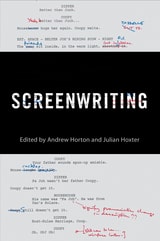
Screenwriting
Horton, Andrew
Rutgers University Press, 2014
Reaching back to the early days of Hollywood, when moonlighting novelists, playwrights, and journalists were first hired to write scenarios and photoplays, Screenwriting illuminates the profound ways that screenwriters have contributed to the films we love. This book explores the social, political, and economic implications of the changing craft of American screenwriting from the silent screen through the classical Hollywood years, the rise of independent cinema, and on to the contemporary global multi-media marketplace. From The Birth of a Nation (1915), Gone With the Wind (1939), and Gentleman’s Agreement (1947) to Chinatown (1974), American Beauty (1999), and Lost in Translation (2003), each project began as writers with pen and ink, typewriters, or computers captured the hopes and dreams, the nightmares and concerns of the periods in which they were writing.
As the contributors take us behind the silver screen to chronicle the history of screenwriting, they spotlight a range of key screenplays that changed the game in Hollywood and beyond. With original essays from both distinguished film scholars and accomplished screenwriters, Screenwriting is sure to fascinate anyone with an interest in Hollywood, from movie buffs to industry professionals.

Scribal Authorship and the Writing of History in Medieval England
Matthew Fisher
The Ohio State University Press, 2012
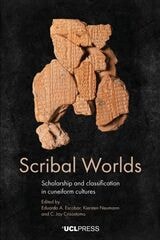
Scribal Worlds
Scholarship and Classification in Cuneiform CulturesEdited by Eduardo A. Escobar, Kiersten Neumann, and C. Jay Crisostomo
University College London, 2026
Revealing the scholarly worlds behind the world’s first writing system, this volume explores how cuneiform cultures classified, transmitted, and interpreted knowledge.
Cuneiform is the world’s first preserved writing system, yet cuneiform texts and the associated cultures and practices remain undervalued across several disciplines. Scribal Worlds: Scholarship and Classification in Cuneiform Cultures explores the history of the earliest writing cultures of the ancient Middle East. Case studies reconstruct the intellectual frameworks and the transmission of knowledge of scribal cultures to show how specific texts and objects can be interpreted within their cultural contexts.

Scribit Mater
Marey and the Language Arts in the Literature of Medieval EnglandGeorgiana Donavin
Catholic University of America Press, 2012
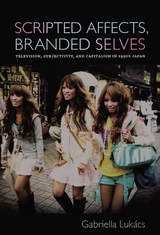
Scripted Affects, Branded Selves
Television, Subjectivity, and Capitalism in 1990s JapanGabriella Lukács
Duke University Press, 2010
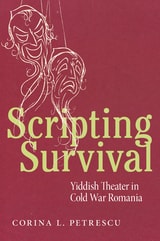
Scripting Survival
Yiddish Theater in Cold War RomaniaCorina L. Petrescu
Rutgers University Press, 2027
In Cold War Romania, the Jewish State Theater in Bucharest (TES) was a site for high-stakes cultural negotiations. While the state used the theater to consolidate Yiddish stagecraft into a tool for state propaganda, a more nuanced story unfolded behind the scenes: TES was also a vehicle for preserving and advancing Yiddish culture within the confines of a socialist state. This book focuses on five commemorative volumes published between 1956 and 1976 by editors who were Shoah survivors—individuals uniquely torn between their passion for Yiddish culture and the communist ideal. By analyzing these volumes, the study reveals the hidden ideological tensions and cultural ambitions embedded within the theater’s operations and provides a rare window into the struggle to maintain a distinctive Jewish identity while navigating the rigid political realities of the time. It is a compelling look at the editorial strategies used to safeguard a vanishing heritage.
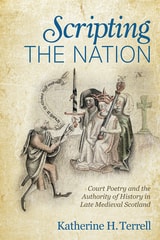
Scripting the Nation
Court Poetry and the Authority of History in Late Medieval ScotlandKatherine H. Terrell
The Ohio State University Press, 2021
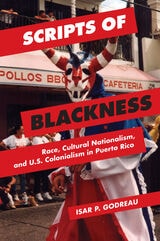
Scripts of Blackness
Race, Cultural Nationalism, and U.S. Colonialism in Puerto RicoIsar P. Godreau
University of Illinois Press, 2015
Based on an ethnographic study of the barrio of San Antón in the city of Ponce, Scripts of Blackness examines institutional and local representations of blackness as developing from a power-laden process that is inherently selective and political, not neutral or natural. Godreau traces the presumed benevolence or triviality of slavery in Puerto Rico, the favoring of a Spanish colonial whiteness (under a hispanophile discourse), and the insistence on a harmonious race mixture as discourses that thrive on a presumed contrast with the United States that also characterize Puerto Rico as morally superior. In so doing, she outlines the debates, social hierarchies, and colonial discourses that inform the racialization of San Antón and its residents as black.
Mining ethnographic materials and anthropological and historical research, Scripts of Blackness provides powerful insights into the critical political, economic, and historical context behind the strategic deployment of blackness, whiteness, and racial mixture.

Scrutinizing Feminist Epistemology
An Examination of Gender in SciencePinnick, Cassandra
Rutgers University Press, 2003
This volume presents the first systematic evaluation of a feminist epistemology of sciences’ power to transform both the practice of science and our society. Unlike existing critiques, this book questions the fundamental feminist suggestion that purging science of alleged male biases will advance the cause of both science and by extension, social justice.
The book is divided into four sections: the strange status of feminist epistemology, testing feminist claims about scientific practice, philosophical and political critiques of feminist epistemology, and future prospects of feminist epistemology. Each of the essays¾most of which are original to this text¾ directly confronts the very idea that there could be a feminist epistemology or philosophy of science. Rather than attempting to deal in detail with all of the philosophical views that fall under the general rubric of feminist epistemology, the contributors focus on positions that provide the most influential perspectives on science. Not all of the authors agree amongst themselves, of course, but each submits feminist theories to careful scrutiny. Scrutinizing Feminist Epistemology provides a timely, well-rounded, and much needed examination of the role of gender in scientific research.
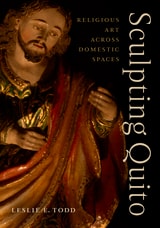
Sculpting Quito
Religious Art across Domestic SpacesLeslie E. Todd
University of Texas Press, 2026
A study of domestic religious sculptures in Quito.
During the eighteenth century, the colonial capital of Quito established itself as a prolific producer of wooden polychrome sculpture. With large glass eyes, smooth shiny surfaces, and minute attention to detail, the sculptures possessed an artistic refinement that enchanted contemporaries. While these objects depicted Christian sacred personages, they were not always sequestered in churches and shrines. They filled domestic spaces, becoming signifiers not only of holiness but also of a distinctive Quitenian culture.
Devotional sculpture was, on its face, an aesthetic reifiction of the colonial project, commissioned by creole elites. However, drawing on published accounts and archival evidence, including wills and dowries, Leslie Todd shows that sculpture was diffused across society, contributing to a complex localized identity. As makers, viewers, and owners of sculpture, Quiteños of Indigenous and mixed heritage and varying socioeconomic backgrounds took active roles in creating the city’s visual culture. In doing so, Todd argues, they simultaneously underscored and challenged colonial class and power systems, investing a European form with styles that revealed and reinforced specifically Spanish American subjectivity.
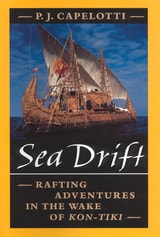
Sea Drift
Rafting Adventures in the Wake of Kon-TikiCapelotti, P. J
Rutgers University Press, 2001
It was the original Survivor series, only without the omnipresent cameras, paramedics, and faux tribal rituals. Between the spring of 1947 and the summer of the year 2000, more than forty expeditions sought to drift across the oceans of the world on rafts made from straw, from bamboo, and from the same kinds of wood that children use to make model airplanes. These audacious raft voyages began with the legendary Kon-Tiki expedition, under the leadership of the renowned Norwegian explorer Thor Heyerdahl. The Kon-Tiki balsa wood raft drifted more than four thousand miles from Peru to Polynesia, and remained afloat months after experts predicted it would sink to the bottom of the Pacific. Heyerdahl’s radical thesis of a prehistoric world where ancient mariners drifted between continents on ocean currents electrified the postwar world. His Kon-Tiki: Across the Pacific by Raft sold twenty million copies in sixty-five languages.
Sea Drift is the first and only book to document all of the transoceanic raft expeditions that were organized and carried out in the half century after Kon-Tiki. But it is much more than a simple history of exploration. Readers learn of the Mormon who drifted to Hawaii to prove that wise men from Israel had colonized America, and the Frenchman who squeezed fresh water from the entrails of fish as he drifted alone across the Atlantic in a rubber boat. Then there was the anthropologist who put five men and six women on a raft to see who would make love to whom first.
Spanning more than fifty years and recounting more than forty expeditions, Sea Drift is a riveting chronicle of human daring, endurance, and folly.
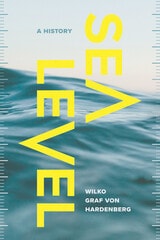
Sea Level
A HistoryWilko Graf von Hardenberg
University of Chicago Press, 2024
News reports warn of rising sea levels spurred by climate change. Waters inch ever higher, disrupting delicate ecosystems and threatening island and coastal communities. The baseline for these measurements—sea level—may seem unremarkable, a long-familiar zero point for altitude. But as Wilko Graf von Hardenberg reveals, the history of defining and measuring sea level is intertwined with national ambitions, commercial concerns, and shifting relationships between people and the ocean.
Sea Level provides a detailed and innovative account of how mean sea level was first defined, how it became the prime reference point for surveying and cartography, and how it emerged as a powerful mark of humanity’s impact on the earth. With Hardenberg as our guide, we traverse the muddy spaces of Venice and Amsterdam, the coasts of the Baltic Sea, the Panama and Suez canals, and the Himalayan foothills. Born out of Enlightenment studies of physics and quantification, sea level became key to state-sponsored public works, colonial expansion, Cold War development of satellite technologies, and recognizing the climate crisis. Mean sea level, Hardenberg reveals, is not a natural occurrence—it has always been contingent, the product of people, places, politics, and evolving technologies. As global warming transforms the globe, Hardenberg reminds us that a holistic understanding of the ocean and its changes requires a multiplicity of reference points.
A fascinating story that revises our assumptions about land and ocean alike, Sea Level calls for a more nuanced understanding of this baseline, one that allows for new methods and interpretations as we navigate an era of unstable seas.
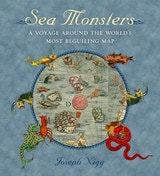
Sea Monsters
A Voyage around the World's Most Beguiling MapJoseph Nigg
University of Chicago Press, 2013
Nearly two meters wide in total, the map’s nine wood-block panels comprise the largest and first realistic portrayal of Northern Europe. But in addition to these important geographic elements, Magnus’s map goes beyond cartography to scenes both domestic and mystic. Close to shore, Magnus shows humans interacting with common sea life—boats struggling to stay afloat, merchants trading, children swimming, and fisherman pulling lines. But from the offshore deeps rise some of the most magical and terrifying sea creatures imaginable at the time or thereafter—like sea swine, whales as large as islands, and the Kraken. In this book, Nigg provides a thorough tour of the map’s cartographic details, as well as a colorful look at its unusual pictorial and imaginative elements. He draws on Magnus’s own text to further describe and illuminate the inventive scenes and to flesh out the stories of the monsters.
Sea Monsters is a stunning tour of a world that still holds many secrets for us land dwellers, who will forever be fascinated by reports of giant squid and the real-life creatures of the deep that have proven to be as bizarre and otherworldly as we have imagined for centuries. It is a gorgeous guide for enthusiasts of maps, monsters, and the mythic.

Sea Nomads of Southeast Asia
From the Past to the PresentEdited by Bérénice Bellina, Roger Blench, and Jean-Christophe Galipaud
National University of Singapore Press, 2020
For many years, the sea nomads were assumed to be without history, and even without archaeology. This has proven far from the case, and recent archaeological findings allow us to more closely describe sea nomadism from the Pleistocene through the early Holocene up to the present. Integrating these findings with the latest in historical research, linguistics, ethnography and historical genetics allows us to better understand sea-nomad ways of life over a scale of millennia and to appreciate the diversity and flexibility of this sea-nomad world. This in turn enriches our understanding of nomadism and mobility as ways of life more generally, and of the sea not only as a landscape of resources, but as a home and spiritual landscape.
Sea Voyages and Beyond
Emerging Strategies in Socio-Rhetorical InterpretationVernon K. Robbins
SBL Press, 2018
Explore insights, methodologies, and advances in socio-rhetorical interpretation
Essays in this volume from Vernon K. Robbins merge social and rhetorical strategies of interpretation and set the stage for how socio-rhetorical interpretation has developed in the context of research into the rhetoric of religious antiquity. This book contains “By Land and By Sea: The We Passages and Ancient Sea Voyages” (1978), which initially received widespread praise and then became an object of significant criticism. The volume includes Robbins’s varied, detailed responses to both encouragement and critique of his approach.
Features:
- Introduction to the collection by David B. Gowler
- Twelve essays that programmatically study early Christian texts using resources from the social sciences
- Reflections on the future of socio-rhetorical criticism
Sea la Luz
The Making of Mexican Protestantism in the American Southwest, 1829-1900Juan Francisco Martínez
University of North Texas Press, 2006

Sea of Lentils
Hilda Otano Benitez
University of Massachusetts Press, 1990
Sealed in Parchment
Rereadings of Knighthood in the Illuminated Manuscripts of Chretien de TroyesSandra Hindman
University of Chicago Press, 1994
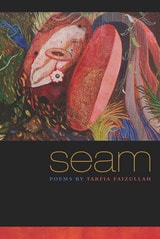
Seam
Tarfia Faizullah
Southern Illinois University Press, 2014
Winner, Great Lakes Colleges Association New Writers Award, 2014
Winner, Binghamton University Milt Kessler Poetry Book Award, 2015
Winner, Drake University Emerging Writers Award, 2015
The poems in this captivating collection weave beauty with violence, the personal with the historic as they recount the harrowing experiences of the two hundred thousand female victims of rape and torture at the hands of the Pakistani army during the 1971 Liberation War. As the child of Bangladeshi immigrants, the poet in turn explores her own losses, as well as the complexities of bearing witness to the atrocities these war heroines endured.
Throughout the volume, the narrator endeavors to bridge generational and cultural gaps even as the victims recount the horror of grief and personal loss. As we read, we discover the profound yet fragile seam that unites the fields, rivers, and prisons of the 1971 war with the poet’s modern-day hotel, or the tragic death of a loved one with the holocaust of a nation.
Moving from West Texas to Dubai, from Virginia to remote villages in Bangladesh and back again, the narrator calls on the legacies of Willa Cather, César Vallejo, Tomas Tranströmer, and Paul Celan to give voice to the voiceless. Fierce yet loving, devastating and magical at once, Seam is a testament to the lingering potency of memory and the bravery of a nation’s victims.

Seamus Heaney and the End of Catholic Ireland
Kieran Quinlan
Catholic University of America Press, 2020
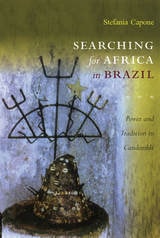
Searching for Africa in Brazil
Power and Tradition in CandombléStefania Capone
Duke University Press, 2010
Challenging the usual interpretations of Afro-Brazilian religions as fixed entities, completely independent of one another, Capone reveals these practices as parts of a unique religious continuum. She does so through an analysis of ritual variations as well as discursive practices. To illuminate the continuum of Afro-Brazilian religious practice and the tensions between exegetic discourses and ritual practices, Capone focuses on the figure of Exu, the sacred African trickster who allows communication between gods and men. Following Exu and his avatars, she discloses the centrality of notions of prestige and power—mystical and religious—in Afro-Brazilian religions. To explain how religious identity is constantly negotiated among social actors, Capone emphasizes the agency of practitioners and their political agendas in the “return to roots,” or re-Africanization, movement, an attempt to recover the original purity of a mythical and legitimizing Africa.
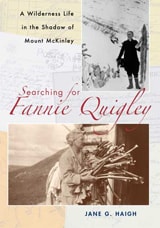
Searching for Fannie Quigley
A Wilderness Life in the Shadow of Mount McKinleyJane G. Haigh
Ohio University Press, 2007
At the age of 27, Fannie Sedlacek left her Bohemian homestead in Nebraska to join the gold rush to the Klondike. From the Klondike to the Tanana, Fannie continued north, finally settling in Katishna near Mount McKinley. This woman, later known as Fannie Quigley, became a prospector who staked her own claims and a cook who ran a roadhouse. She hunted and trapped and thrived for nearly forty years in an environment that others found unbearable.
Her wilderness lifestyle inspired many of those who met her to record their impressions of this self-sufficient woman, who died in 1944. To many of the 700,000 annual visitors to Denali National Park she is a symbol of the enduring spirit of the original pioneers.
Searching for Fannie Quigley: A Wilderness Life in the Shadow of Mount McKinley goes beyond the mere biographical facts of this unique woman’s journey. It also tells historian Jane G. Haigh’s own story of tracking and tracing the many paths that Fannie Quigley’s intriguing life took. Uncovering remote clues, digging through archives, and listening to oral accounts from a wide array of sources, Haigh has fashioned this rich lode into a compelling narrative.
In Searching for Fannie Quigley, Haigh separates fact from fiction to reveal the true story of this highly mythologized pioneer woman.
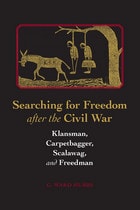
Searching for Freedom after the Civil War
Klansman, Carpetbagger, Scalawag, and FreedmanG. Ward Hubbs
University of Alabama Press, 2015
Examines the life stories and perspectives about freedom in relation to the figures depicted in an infamous Reconstruction-era political cartoon
The cartoon first appeared in the Tuskaloosa Independent Monitor, published by local Ku Klux Klan boss Ryland Randolph, as a swaggering threat aimed at three individuals. Hanged from an oak branch clutching a carpetbag marked “OHIO” is the Reverend Arad S. Lakin, the Northern-born incoming president of the University of Alabama. Swinging from another noose is Dr. Noah B. Cloud—agricultural reformer, superintendent of education, and deemed by Randolph a “scalawag” for joining Alabama’s reformed state government. The accompanying caption, penned in purple prose, similarly threatens Shandy Jones, a politically active local man of color.
Using a dynamic and unprecedented approach that interprets the same events through four points of view, Hubbs artfully unpacks numerous layers of meaning behind this brutal two-dimensional image.
The four men associated with the cartoon—Randolph, Lakin, Cloud, and Jones—were archetypes of those who were seeking to rebuild a South shattered by war. Hubbs explores these broad archetypes but also delves deeply into the four men’s life stories, writings, speeches, and decisions in order to recreate each one’s complex worldview and quest to live freely. Their lives, but especially their four very different understandings of freedom, help to explain many of the conflicts of the 1860s. The result is an intellectual tour de force.
General readers of this highly accessible volume will discover fascinating new insights about life during and after America’s greatest crisis, as will scholars of the Civil War, Reconstruction, and southern history.
Searching for Golden Empires
Epic Cultural Collisions in Sixteenth-Century AmericaWilliam K. Hartmann
University of Arizona Press, 2014
Recounting eyewitness experiences that the Spaniards recorded in letters and memoirs, Hartmann describes ancient lifeways from Mexico to the western United States; Aztec accounts of the conquest; discussions between Aztec priests and Spanish priests about the nature of the universe; Cortés’s lifelong relationship with his famous Native mistress, Malinche (not to mention the mysterious fate of his wife); lost explorers who wandered from Florida to Arizona; and Marcos de Niza’s controversial reports of the “Seven Cities of Cíbola.”
Searching for Golden Empires describes how, even after the conquest of Mexico, Cortés remained a “wildcat” competitor with Coronado in a race to see who could find the “next golden empire,” believed to lie in the north. It is an exciting history of the shared story of the United States and Mexico, unveiling episodes both tragic and uplifting.

Searching for Jane Austen
Emily Auerbach
University of Wisconsin Press, 2004
In this beautifully illustrated and lively work, Auerbach surveys two centuries of editing, censoring, and distorting Austen’s life and writings. Auerbach samples Austen’s flamboyant, risqué adolescent works featuring heroines who get drunk, lie, steal, raise armies, and throw rivals out of windows. She demonstrates that Austen constantly tested and improved her skills by setting herself a new challenge in each of her six novels.
In addition, Auerbach considers Austen’s final irreverent writings, discusses her tragic death at the age of forty-one, and ferrets out ridiculous modern adaptations and illustrations, including ads, cartoons, book jackets, newspaper articles, plays, and films from our own time. An appendix reprints a ground-breaking article that introduced Mark Twain’s "Jane Austen," an unfinished and unforgettable essay in which Twain and Austen enter into mortal combat.
Searching for Jim
Slavery in Sam Clemens's WorldTerrell Dempsey
University of Missouri Press, 2005
During Sam’s earliest years, his father, John Marshall Clemens, had significant interaction with slaves. Newly discovered court records show the senior Clemens in his role as justice of the peace in Hannibal enforcing the slave ordinances. With the death of his father, young Sam was apprenticed to learn the printing and newspaper trade. It was in the newspaper that slaves were bought and sold, masters sought runaways, and life insurance was sold on slaves. Stories the young apprentice typeset helped Clemens learn to write in black dialect, a skill he would use throughout his writing, most notably in Huckleberry Finn.
Missourians at that time feared abolitionists across the border in Illinois and Iowa. Slave owners suspected every traveling salesman, itinerant preacher, or immigrant of being an abolition agent sent to steal slaves. This was the world in which Sam Clemens grew up. Dempsey also discusses the stories of Hannibal’s slaves: their treatment, condition, and escapes. He uncovers new information about the Underground Railroad, particularly about the role free blacks played in northeast Missouri.
Carefully reconstructed from letters, newspaper articles, sermons, speeches, books, and court records, Searching for Jim offers a new perspective on Clemens’s writings, especially regarding his use of race in the portrayal of individual characters, their attitudes, and worldviews. This fascinating volume will be valuable to anyone trying to measure the extent to which Clemens transcended the slave culture he lived in during his formative years and the struggles he later faced in dealing with race and guilt. It will forever alter the way we view Sam Clemens, Hannibal, and Mark Twain.

Searching for Life's Meaning
Changes and Tensions in the Worldviews of Chinese Youth in the 1980sLuo Xu
University of Michigan Press, 2002
Drawing on his own experience as a teacher at Capital Normal University in Beijing, China during the 1980s, as well as exhaustive research, Luo Xu investigates the social and political climate of 1980s China in order to help better define the culture that ultimately drove the events at Tiananmen. Supporting his arguments with solid primary source documents, Xu contends that the contemplation of the meaning of life, along with other philosophical questions, were integral components of the general social crisis leading up to the movement of 1989.
Elegantly written and accessible to a general readership, this study will also be useful to specialists. Searching for Life's Meaning is a concise but detailed introduction to the mentalities of the Chinese generation presently assuming leadership in China. It should be valuable reading in courses on Chinese history and politics, and will be of interest to scholars in the related fields of Asian studies, anthropology, cultural studies, and youth studies. The book will also appeal to business- people and other professionals concerned with managing relations with the world's fastest growing polity.
Luo Xu is Assistant Professor of History, State University of New York College at Cortland.
Searching for Solidarity
Revolutionary Dreams and Radical Social MovementsNoor Ghazal Aswad
The Ohio State University Press, 2025