Results by title
4917 books match the query 'Philosophy' and 320 start with s
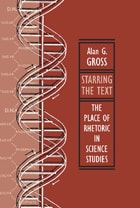
Starring the Text
The Place of Rhetoric in Science StudiesAlan G. Gross
Southern Illinois University Press, 2006
Starring the Text: The Place of Rhetoric in Science Studies firmly establishes the rhetorical analysis of science as a respected field of study. Alan G. Gross, one of rhetoric’s foremost authorities, summarizes the state of the field and demonstrates the role of rhetorical analysis in the sciences. He documents the limits of such analyses with examples from biology and physics, explores their range of application, and sheds light on the tangled relationships between science and society. In this deep revision of his important Rhetoric of Science, Gross examines how rhetorical analyses have a wide range of application, effectively exploring the generation, spread, certification, and closure that characterize scientific knowledge. Gross anchors his position in philosophical rather than in rhetorical arguments and maintains there is rhetorical criticism from which the sciences cannot be excluded.
Gross employs a variety of case studies and examples to assess the limits of the rhetorical analysis of science. For example, in examining avian taxonomy, he demonstrates that both taxonomical and evolutionary species are the product of rhetorical interactions. A review of Newton’s two formulations of optical research illustrates that their only significant difference is rhetorical, a difference in patterns of style, arrangement, and argument. Gross also explores the range of rhetorical analysis in his consideration of the “evolution of evolution” of Darwin’s notebooks. In his analysis of science and society, he explains the limits of citizen action in executive, judicial, and legislative democratic realms in the struggle to prevent, ameliorate, and provide adequate compensation for occupational disease. By using philosophical, historical, and psychological perspectives, Gross concludes, rhetorical analysis can also supplement other viewpoints in resolving intellectual problems.
Starring the Text, which includes fourteen illustrations, is an updated, readable study geared to rhetoricians, historians, philosophers, and sociologists interested in science. The volume effectively demonstrates that the rhetoric of science is a natural extension of rhetorical theory and criticism.
State Repression and the Labors of Memory
Elizabeth Jelin
University of Minnesota Press, 2003
A timely exploration of the nature of memory and its political uses
Hearing the news from South America at the turn of the millennium can be like traveling in time: here are the trials of Pinochet, the searches for “the disappeared” in Argentina, the investigation of the death of former president Goulart in Brazil, the Peace Commission in Uruguay, the Archive of Terror in Paraguay, a Truth Commission in Peru. As societies struggle to come to terms with the past and with the vexing questions posed by ineradicable memories, this wise book offers guidance.
Combining a concrete sense of present urgency and a theoretical understanding of social, political, and historical realities, State Repression and the Labors of Memory fashions tools for thinking about and analyzing the presences, silences, and meanings of the past. With unflappable good judgment and fairness, Elizabeth Jelin clarifies the often muddled debates about the nature of memory, the politics of struggles over memories of historical injustice, the relation of historiography to memory, the issue of truth in testimony and traumatic remembrance, the role of women in Latin American attempts to cope with the legacies of military dictatorships, and problems of second-generation memory and its transmission and appropriation. Jelin’s work engages European and North American theory in its exploration of the various ways in which conflicts over memory shape individual and collective identities, as well as social and political cleavages. In doing so, her book exposes the enduring consequences of repression for social processes in Latin America, and at the same time enriches our general understanding of the fundamentally conflicted and contingent nature of memory.
State of Exception
Giorgio Agamben
University of Chicago Press, 2004
The sequel to Agamben's Homo Sacer: Sovereign Power and Bare Life, State of Exception is the first book to theorize the state of exception in historical and philosophical context. In Agamben's view, the majority of legal scholars and policymakers in Europe as well as the United States have wrongly rejected the necessity of such a theory, claiming instead that the state of exception is a pragmatic question. Agamben argues here that the state of exception, which was meant to be a provisional measure, became in the course of the twentieth century a normal paradigm of government. Writing nothing less than the history of the state of exception in its various national contexts throughout Western Europe and the United States, Agamben uses the work of Carl Schmitt as a foil for his reflections as well as that of Derrida, Benjamin, and Arendt.
In this highly topical book, Agamben ultimately arrives at original ideas about the future of democracy and casts a new light on the hidden relationship that ties law to violence.
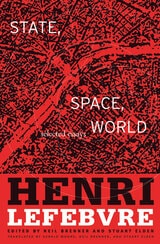
State, Space, World
Selected EssaysHenri Lefebvre
University of Minnesota Press, 2009
State, Space, World collects a series of Lefebvre’s key writings on the state from this period. Making available in English for the first time the as-yet-unexplored political aspect of Lefebvre’s work, it contains essays on philosophy, political theory, state formation, spatial planning, and globalization, as well as provocative reflections on the possibilities and limits of grassroots democracy under advanced capitalism.
State, Space, World is an essential complement to The Production of Space, The Urban Revolution, and The Critique of Everyday Life. Lefebvre’s original and prescient analyses that emerge in this volume are urgently relevant to contemporary debates on globalization and neoliberal capitalism.
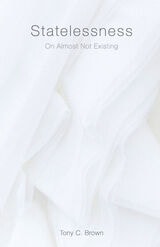
Statelessness
On Almost Not ExistingTony C. Brown
University of Minnesota Press, 2022
A pathbreaking new genealogy of statelessness
Just as the modern state and the citizenship associated with it are commonly thought of as a European invention, so too is citizenship’s negation in the form of twentieth-century diaspora and statelessness. Statelessness sets forth a new genealogy, suggesting that Europe first encountered mass statelessness neither inside its own borders nor during the twentieth century, as Hannah Arendt so influentially claimed, but outside of itself—in the New World, several hundred years earlier.
Through close readings of political philosophers from Hobbes to Rousseau to Kant, Tony C. Brown argues that statelessness became a central problem for political thought early on, with far-reaching implications for thinking both on the state and on being human. What Europeans thought they saw among the “savages” of the Americas was life without political order, life less than human. Lacking almost everything those deemed clearly human had achieved, the stateless existed in a radically precarious, almost inhuman privation.
And yet this existence also raised the unsettling possibility that state-based existence may not be inevitable, necessary, or even ideal. This possibility, as Brown shows, prompts the response—as defensive as it was aggressive—that we call Enlightenment political philosophy, which arguably still orders much thinking on being stateless today, including our discourses concerning migrants and Indigenous peoples.
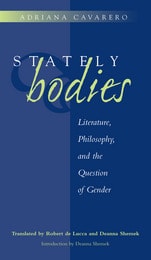
Stately Bodies
Literature, Philosophy, and the Question of GenderAdriana Cavarero
University of Michigan Press, 2002
She examines bodily metaphor in political discourse and in fictional depictions of politics, including Sophocles' Antigone, Plato's Timaeus, Livy, John of Salisbury, Shakespeare's Hamlet, and Hobbes' Leviathan. An appendix explores two texts by women that disrupt these notions: Maria Zambrano's Tomb of Antigone and Ingeborg Bachmann's Undine Goes.
Cavarero exposes the problematic nature of the mind/body dualism that has been essential in Western thought. Her insight that the expelled, depoliticized body is a female one becomes an instrument for decoding many paradoxical tropes of the political body. For instance, Cavarero revisits Antigone as the tragedy in which a body that is displaced, bleeding, and matrilinear allows the construction of a political order where misogynous rationality rules. Throughout the book, Cavarero argues that women have been cast by male thinkers into the realm of the corporeal as nonpolitical, and also suggests that this nonpolitical position is also a source of knowledge and power, that politics is a masculine pursuit that should not be admired or envied.
Adriana Cavarero is Professor of Philosophy, University of Verona, and frequently is Visiting Professor. New York University. Her books Relating Narratives: Storytelling and Selfhood and In Spite of Plato: A Feminist Rewriting of Ancient Philosophy were published by Routledge.
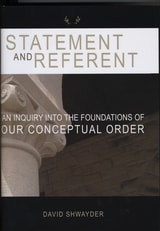
Statement and Referent
An Inquiry into the Foundations of our Conceptual OrderDavid Shwayder
CSLI, 2008
Plato’s Parmenides and Aristotle’s Metaphysics initiated the discussion of the “First Philosophy” in the Western canon. Here, David Shwayder continues this debate by considering statements as the fundamental bearers of truth-values. Systematically moving from action to utterance, Shwayder argues that the category of “bodies” is fundamental to the human scheme of conceptualization and that if we had no capacity to refer to bodies then we would be unable to address referents from other categories.
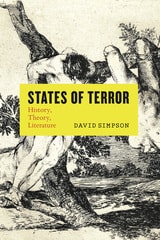
States of Terror
History, Theory, LiteratureDavid Simpson
University of Chicago Press, 2019
Introducing the concept of the “fear-terror cluster,” Simpson is able to capture the wide range of terms that we have used to express extreme emotional states over the centuries—from anxiety, awe, and concern to dread, fear, and horror. He shows that the choices we make among such words to describe shades of feeling have seriously shaped the attribution of motives, causes, and effects of the word “terror” today, particularly when violence is deployed by or against the state. At a time when terror-talk is widely and damagingly exploited by politicians and the media, this book unpacks the slippery rhetoric of terror and will prove a vital resource across humanistic and social sciences disciplines.
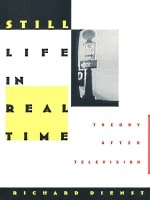
Still Life in Real Time
Theory After TelevisionRichard Dienst
Duke University Press, 1994
Five theoretical projects provide Still Life in Real Time with its framework: the cultural studies tradition of Raymond Williams; Marxist political economy; Heideggerian existentialism; Derridean deconstruction; and a Deleuzian anatomy of images. Drawing lessons from television programs like Twin Peaks and Crime Story, television events like the Gulf War, and television personalities like Madonna, Dienst produces a remarkable range of insights on the character of the medium and on the theories that have been affected by it.
From the earliest theorists who viewed television as a new metaphor for a global whole, a liberal technology empty of ideological or any other content, through those who saw it as a tool for consumption, making time a commodity, to those who sense television’s threat to being and its intimate relation to power, Dienst exposes the rich pattern of television’s influence on philosophy, and hence on the deepest levels of contemporary experience.
A book of theory, Still Life in Real Time will compel the attention of all those with an interest in the nature of the ever present, ever shifting medium and its role in the thinking that marks our time.
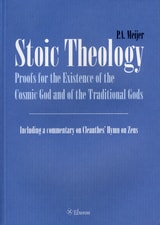
Stoic Theology
Proof for the Existence of the Cosmic God and of the Traditional GodsP. A. Meijer
Eburon Academic Publishers, 2008
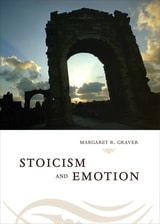
Stoicism and Emotion
Margaret Graver
University of Chicago Press, 2007
In this elegant and clearly written work, Margaret Graver gives a compelling new interpretation of the Stoic position. Drawing on a vast range of ancient sources, she argues that the chief demand of Stoic ethics is not that we should suppress or deny our feelings, but that we should perfect the rational mind at the core of every human being. Like all our judgments, the Stoics believed, our affective responses can be either true or false and right or wrong, and we must assume responsibility for them. Without glossing over the difficulties, Graver also shows how the Stoics dealt with those questions that seem to present problems for their theory: the physiological basis of affective responses, the phenomenon of being carried away by one’s emotions, the occurrence of involuntary feelings and the disordered behaviors of mental illness. Ultimately revealing the deeper motivations of Stoic philosophy, Stoicism and Emotion uncovers the sources of its broad appeal in the ancient world and illuminates its surprising relevance to our own.

Stolen Future, Broken Present
The Human Significance of Climate ChangeDavid A. Collings
Michigan Publishing Services, 2014

Stolen Life
Fred Moten
Duke University Press, 2018
In Stolen Life—the second volume in his landmark trilogy consent not to be a single being—Fred Moten undertakes an expansive exploration of blackness as it relates to black life and the collective refusal of social death. The essays resist categorization, moving from Moten's opening meditation on Kant, Olaudah Equiano, and the conditions of black thought through discussions of academic freedom, writing and pedagogy, non-neurotypicality, and uncritical notions of freedom. Moten also models black study as a form of social life through an engagement with Fanon, Hartman, and Spillers and plumbs the distinction between blackness and black people in readings of Du Bois and Nahum Chandler. The force and creativity of Moten's criticism resonate throughout, reminding us not only of his importance as a thinker, but of the continued necessity of interrogating blackness as a form of sociality.
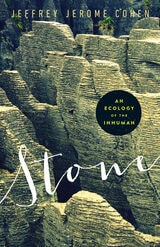
Stone
An Ecology of the InhumanJeffrey Jerome Cohen
University of Minnesota Press, 2015
Stone maps the force, vivacity, and stories within our most mundane matter, stone. For too long stone has served as an unexamined metaphor for the “really real”: blunt factuality, nature’s curt rebuke. Yet, medieval writers knew that stones drop with fire from the sky, emerge through the subterranean lovemaking of the elements, tumble along riverbeds from Eden, partner with the masons who build worlds with them. Such motion suggests an ecological enmeshment and an almost creaturely mineral life.
Although geological time can leave us reeling, Jeffrey Jerome Cohen argues that stone’s endurance is also an invitation to apprehend the world in other than human terms. Never truly inert, stone poses a profound challenge to modernity’s disenchantments. Its agency undermines the human desire to be separate from the environment, a bifurcation that renders nature “out there,” a mere resource for recreation, consumption, and exploitation.
Written with great verve and elegance, this pioneering work is notable not only for interweaving the medieval and the modern but also as a major contribution to ecotheory. Comprising chapters organized by concept —“Geophilia,” “Time,” “Force,” and “Soul”—Cohen seamlessly brings together a wide range of topics including stone’s potential to transport humans into nonanthropocentric scales of place and time, the “petrification” of certain cultures, the messages fossils bear, the architecture of Bordeaux and Montparnasse, Yucca Mountain and nuclear waste disposal, the ability of stone to communicate across millennia in structures like Stonehenge, and debates over whether stones reproduce and have souls.
Showing that what is often assumed to be the most lifeless of substances is, in its own time, restless and forever in motion, Stone fittingly concludes by taking us to Iceland⎯a land that, writes the author, “reminds us that stone like water is alive, that stone like water is transient.”
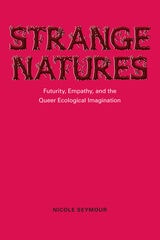
Strange Natures
Futurity, Empathy, and the Queer Ecological ImaginationNicole Seymour
University of Illinois Press, 2013

Strange Tastes
Aesthetics and the Public in Latin American and Latinx FeminismsMonique Roelofs
Duke University Press, 2026

Strategies of Deconstruction
Derrida and the Myth of the VoiceJ. Claude Evans
University of Minnesota Press, 1991
Strategies of Deconstruction was first published in 1991. Minnesota Archive Editions uses digital technology to make long-unavailable books once again accessible, and are published unaltered from the original University of Minnesota Press editions.
In the past two decades, the "movement" of deconstruction has bad tremendous impact on a number of academic, disciplines in the United States. However, its force has been rather limited in the field of philosophy, despite the fact that in Europe the practice of deconstruction emerged in the work of philosophers. Although the reasons for this can be debated, two of the more obvious explanations are the mainstream Anglo-American philosophers rarely studied the German and French philosophical traditions in great detail, and deconstruction's focus on discourse and interpretation has made it more attractive to the literary and humanistic disciplines.
With this context, Strategies of Deconstruction focuses on the early work of Jacques Derrida, the French philosopher who introduced deconstruction in Speech and Phenomena,his study of Edmund Husserl, and Of Grammatology, and whose philosophical reputation stems in no small part from his work on Husserl. In examining the philosophical import of Derrida's theories of reading, text, and language, specifically as they related to Speech and Phenomena,J. Claude Evans makes careful reference to Husserl's own texts. His analysis indicates that there are many systematic irregularities in Derrida's study and that without those irregularities Derrida's conclusions cannot be substantiated.
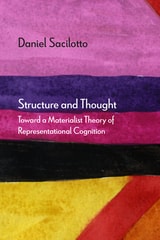
Structure and Thought
Toward a Materialist Theory of Representational CognitionDaniel Sacilotto; Foreword by Ray Brassier
Northwestern University Press, 2024
This study develops a novel account of representational cognition, explaining how cognitive systems progressively come to map the structure of their worlds. Daniel Sacilotto offers a constructive response to the critique of representation formulated throughout the post‑Kantian philosophical tradition. Rather than a skepticism or idealism whereby thinking can grasp appearances but never the real, representation, Sacilotto shows, is a constitutive dimension of cognitive systems’ creative capacity to know and intervene in the world of which they are part.
Structure and Thought: Toward a Materialist Theory of Representational Cognition integrates various lines in contemporary philosophy, including those often seen as incommensurable or in irresolvable tension with one another. Sacilotto thus advances a productive synthesis of a materialist ambition to provide a creative and historical understanding of cognition with a structural realist account of representation. He shows how the different forms of sensory, discursive, and theoretical mediation that characterize human cognition are conducive to a realist epistemological framework that explains how the possibility of knowledge about a mind‑independent reality is conceivable.
Struggle and Utopia at the End Times of Philosophy
François Laruelle
University of Minnesota Press, 2012
Very few thinkers have traveled the heretical path that François Laruelle walks between philosophy and non-philosophy. For Laruelle, the future of philosophy is problematic, but a mutation of its functions is possible. Up until now, philosophy has merely been a utopia concerned with the past and only provided the services of its conservation. We must introduce a rigorous and nonimaginary practice of a utopia in action, a philo-fiction—a close relative to science fiction. From here we can see the double meaning of the watchword, a tabula rasa of the future. This new destination is imposed by a specifically human messianism, an eschatology within the limits of the Man-in-person as antihumanist ultimatum addressed to the History of Philosophy. This book elucidates some of the fundamental problems of non-philosophy and takes on its detractors.
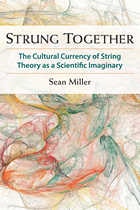
Strung Together
The Cultural Currency of String Theory as a Scientific ImaginarySean Miller
University of Michigan Press, 2013
In Strung Together: The Cultural Currency of String Theory as a Scientific Imaginary, Sean Miller examines the cultural currency of string theory, both as part of scientific discourse and beyond it. He demonstrates that the imaginative component of string theory is both integral and indispensable to it as a scientific discourse. While mathematical arguments provide precise prompts for physical intervention in the world, the imaginary that supplements mathematical argument within string theory technical discourse allows theorists to imagine themselves interacting with the cosmos as an abstract space in such a way that strings and branes as phenomena become substantiated and legitimized. And it is precisely this sort of imaginary—which Miller calls a scientific imaginary—duly substantiated and acculturated, that survives the move from string theory technical discourse to popularizations and ultimately to popular and literary discourses. In effect, a string theory imaginary legitimizes the science itself and helps to facilitate a virtual domestication of a cosmos that was heretofore remote, alien, and incomprehensible.
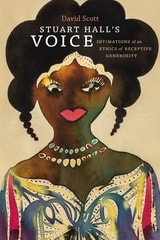
Stuart Hall's Voice
Intimations of an Ethics of Receptive GenerosityDavid Scott
Duke University Press, 2017
Studies in Aristotle
Dominic J. O'Meara
Catholic University of America Press, 2018
Studies in Epistemology
Peter A. French, Theodore E. Uehling Jr., and Howard K. Wettstein, Editors
University of Minnesota Press, 1980
Studies in Epistemology was first published in 1980. Minnesota Archive Editions uses digital technology to make long-unavailable books once again accessible, and are published unaltered from the original University of Minnesota Press editions.
This is Volume V in the series Midwest Studies in Philosophy
In 1979 the University of Minnesota Press assumed publication of the annual Midwest Studies in Philosophy, previously published by the University of Minnesota, Morris. At that time, the young series had already received acclaim from philosophers. Alan Donagan called the Studies "a significant and up-to-date forum of discussion on topics that matter to all serious philosophers," and, according to W. V. Quine, the Studies have maintained "an unusually high standard."
Studies in Language and Information
John Perry
CSLI, 2019
Studies in Medieval Philosophy
John F. Wippel
Catholic University of America Press, 2018
Studies in Metaphysics
Peter A. French, Theodore E. Uehling Jr., and Howard K. Wettstein, Editors
University of Minnesota Press, 1979
Studies in Metaphysics was first published in 1979. Minnesota Archive Editions uses digital technology to make long-unavailable books once again accessible, and are published unaltered from the original University of Minnesota Press editions.
Studies in Phenomenology and Psychology
Aron Gurwitsch
Northwestern University Press, 1966
Studies in Philosophy and the History of Philosophy
John K. Ryan
Catholic University of America Press, 2018
Studies in Philosophy and the History of Philosophy Vol. 2
John K. Ryan
Catholic University of America Press, 2018
Studies in Philosophy and the History of Philosophy Vol. 4
John K. Ryan
Catholic University of America Press, 2018
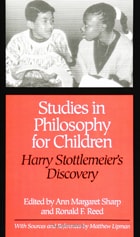
Studies in Philosophy for Children
Harry Stottlemeier's Discoveryedited by Ann Margaret Sharp and Ronald F. Reed
Temple University Press, 1991
Harry Stottlemeier's Discovery, created by Matthew Lipman in 1969, is now a widely used and highly successful tool for teaching philosophy to children. As the original novel of the Philosophy for Children program, its goal is to present major ideas in the history of philosophy, nurturing children's ability to think for themselves. At present, it is taught in 5,000 schools in the United States and has been translated into eighteen languages worldwide. This collection of essays reflects upon the development, refinement, and maturation of Philosophy for Children and on its relationship to the tradition of philosophy itself.
The contributors are philosophers themselves who have taught from Lipman's novels or conducted workshops instructing elementary school teachers on how most effectively to utilize the program in their classrooms. Teaching Harry raises philosophical issues concerning such concepts as authority, morality, religion, justice, truth, knowledge, beauty, and goodness. Gracing each article with personal experience, the authors recount their own struggles against the claims of philosophers and psychologists who have previously underestimated children's moral capability because of their lack of political and social experience.

Studies in Philosophy, Politics, and Economics
F. A. Hayek
University of Chicago Press, 1967
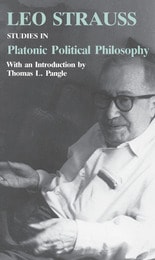
Studies in Platonic Political Philosophy
Leo Strauss
University of Chicago Press, 1983
As his choice of title indicates, the heart of Strauss's work is Platonism—a Platonism that is altogether unorthodox and highly controversial. These essays consider, among others, Heidegger, Husserl, Nietzsche, Marx, Moses Maimonides, Machiavelli, and of course Plato himself to test the Platonic understanding of the conflict between philosophy and political society. Strauss argues that an awesome spritual impoverishment has engulfed modernity because of our dimming awareness of that conflict.
Thomas Pangle's Introduction places the work within the context of the entire Straussian corpus and focuses especially on Strauss's late Socratic writings as a key to his mature thought. For those already familiar with Strauss, Pangle's essay will provoke thought and debate; for beginning readers of Strauss, it provides a fine introduction. A complete bibliography of Strauss's writings if included.
Studies in Weak Arithmetics, Volume 1
Edited by Patrick Cégielski
CSLI, 2009
The field of weak arithmetics is an application of logical methods to number theory that was developed by mathematicians, philosophers, and theoretical computer scientists. In this volume, after a general presentation of weak arithmetics, the following topics are studied: the properties of integers of a real closed field equipped with exponentiation; conservation results for the induction schema restricted to first-order formulas with a finite number of alternations of quantifiers; a survey on a class of tools called pebble games; the fact that the reals e and pi have approximations expressed by first-order formulas using bounded quantifiers; properties of infinite pictures depending on the universe of sets used; a language that simulates in a sufficiently nice manner all algorithms of a certain restricted class; the logical complexity of the axiom of infinity in some variants of set theory without the axiom of foundation; and the complexity to determine whether a trace is included in another one.
Studies in Weak Arithmetics, Volume 2
Edited by Patrick Cégielski, Charalampos Cornaros, and Costas Dimitracopoulos
CSLI, 2013
Studies in Weak Arithmetics, Volume 3
Edited by Patrick Cegielski, Ali Enayat, and Roman Kossak
CSLI, 2013
Studiolo
Giorgio Agamben
Seagull Books, 2022
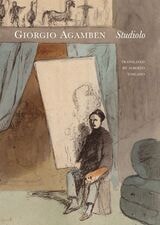
In Renaissance palaces, the studiolo was a small room to which the prince withdrew to meditate or read, surrounded by paintings he particularly loved. This book is a kind of studiolo for its author, Giorgio Agamben, as he turns his philosophical lens on the world of Western art.
Studiolo is a fascinating take on a selection of artworks created over millennia; some are easily identifiable, others rarer. Though they were produced over an arc of time stretching from 5000 BCE to the present, only now have they achieved their true legibility. Agamben contends that we must understand that the images bequeathed by the past are really addressed to us, here and now; otherwise, our historical awareness is broken. Notwithstanding the attention to detail and the critical precautions that characterize the author’s method—they provoke us with a force, even a violence, that we cannot escape. When we understand why Dostoevsky feared losing his faith before Holbein’s Body of the Dead Christ, when Chardin’s Still Life with Hare is suddenly revealed to our gaze as a crucifixion or Twombly’s sculpture shows that beauty must ultimately fall, the artwork is torn from its museological context and restored to its almost prehistoric emergence. These artworks are beautifully reproduced in color throughout Agamben’s short but significant addition to his scholarly oeuvre in English translation.
Studying Human Behavior
How Scientists Investigate Aggression and SexualityHelen E. Longino
University of Chicago Press, 2013
Stupidity
Avital Ronell
University of Illinois Press, 2001
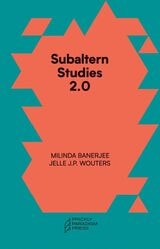
Subaltern Studies 2.0
Being against the CapitaloceneMilinda Banerjee and Jelle J.P. Wouters
Prickly Paradigm Press, 2022
State and Capital reign over the Age of Sorrow. We face inequality, pandemics, ethnocide, climate crisis, and mass extinction. Our desire for security and power governs us as State. Our desire for possessions governs us as Capital. Our desires imprison and rule us beings as Unbeing. Yet, from Nagaland to New Zealand, Bhutan to Bolivia, a second wave of anti-colonial revolutions has begun. Arising from assemblies of humans and other-than-humans, these revolutions replace possessive individualism with non-exploitative interdependence. Naga elders, Bhutanese herders and other indigenous communities, feminists, poets, seers, yaks, cranes, vultures, and fungi haunt this pamphlet. The original Subaltern Studies narrated how Indian peasant communities destroyed the British empire. Subaltern Studies 2.0 prophesies the multi-being demos and liberates Being from Unbeing. Re-kin, Re-nomad, Re-animate, Re-wild! The Animist Revolution has come.
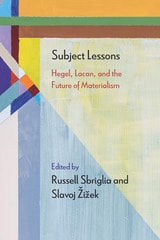
Subject Lessons
Hegel, Lacan, and the Future of MaterialismEdited by Russell Sbriglia and Slavoj Zizek
Northwestern University Press, 2020
Responding to the ongoing “objectal turn” in contemporary humanities and social sciences, the essays in Subject Lessons present a sustained case for the continued importance— indeed, the indispensability—of the category of the subject for the future of materialist thought.
Approaching matters through the frame of Hegel and Lacan, the contributors to this volume, including the editors, as well as Andrew Cole, Mladen Dolar, Nathan Gorelick, Adrian Johnston, Todd McGowan, Borna Radnik, Molly Anne Rothenberg, Kathryn Van Wert, and Alenka Zupančič—many of whom stand at the forefront of contemporary Hegel and Lacan scholarship—agree with neovitalist thinkers that material reality is ontologically incomplete, in a state of perpetual becoming, yet they maintain that this is the case not in spite of but, rather, because of the subject.
Incorporating elements of philosophy, psychoanalysis, and literary and cultural studies, Subject Lessons contests the movement to dismiss the subject, arguing that there can be no truly robust materialism without accounting for the little piece of the Real that is the subject.
Subject Of Philosophy
Phillipe Lacoue-Labarthe
University of Minnesota Press, 1993
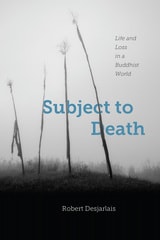
Subject to Death
Life and Loss in a Buddhist WorldRobert Desjarlais
University of Chicago Press, 2016
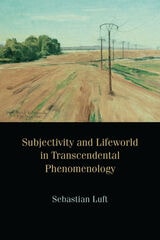
Subjectivity and Lifeworld in Transcendental Phenomenology
Sebastian Luft
Northwestern University Press, 2011
The key point Luft brings into focus is that Husserl's hermeneutic phenomenology is distinct from other hermeneutic philosophers', namely Ernst Cassirer, Martin Heidegger, and Hans-Georg Gadamer. Unlike them, Husserl's focus centers on the work subjects must do in order to uncover the prejudices that guide their unreflective relationship to the world. Luft also demonstrates that there is a deep consistency within Husserl's own writings—from early to late—around the guiding themes of the natural attitude, the need and function of the epoché, and the split between egos, where the transcendental self (distinct from the natural self) is seen as the fundamental ability we all have to inquire into the genesis of our tradition-laden attitudes toward the world.
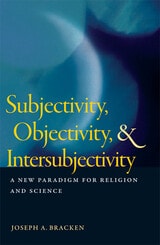
Subjectivity, Objectivity, and Intersubjectivity
A New Paradigm for Religion and ScienceJoseph A. Bracken
Templeton Press, 2009
During the Middle Ages, philosophers and theologians argued over the extramental reality of universal forms or essences. In the early modern period, the relation between subjectivity and objectivity, the individual self and knowledge of the outside world, was a rich subject of debate. Today, there is considerable argument about the relation between spontaneity and determinism within the evolutionary process, whether a principle of spontaneous self-organization as well as natural selection is at work in the aggregation of molecules into cells and the development of primitive forms of life into complex organisms. In Subjectivity, Objectivity and Intersubjectivity, Joseph A. Bracken proposes that what is ultimately at stake here is the age-old problem of the relationship between the One and the Many, universality and particularity on different levels of existence and activity within nature.
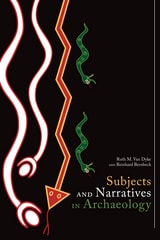
Subjects and Narratives in Archaeology
Ruth M. Van Dyke
University Press of Colorado, 2015
Seeking to move beyond the customary limits of archaeological prose and representation, Subjects and Narratives in Archaeology presents archaeology in a variety of nontraditional formats. The volume demonstrates that visual art, creative nonfiction, archaeological fiction, video, drama, and other artistic pursuits have much to offer archaeological interpretation and analysis.
Chapters in the volume are augmented by narrative, poetry, paintings, dialogues, online databases, videos, audio files, and slideshows. The work will be available in print and as an enhanced ebook that incorporates and showcases the multimedia elements in archaeological narrative. While exploring these new and not-so-new forms, the contributors discuss the boundaries and connections between empirical data and archaeological imagination.
Both a critique and an experiment, Subjects and Narratives in Archaeology addresses the goals, advantages, and difficulties of alternative forms of archaeological representation. Exploring the idea that academically sound archaeology can be fun to create and read, the book takes a step beyond the boundaries of both traditional archaeology and traditional publishing.
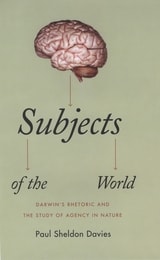
Subjects of the World
Darwin's Rhetoric and the Study of Agency in NaturePaul Sheldon Davies
University of Chicago Press, 2009
Being human while trying to scientifically study human nature confronts us with our most vexing problem. Efforts to explicate the human mind are thwarted by our cultural biases and entrenched infirmities; our first-person experiences as practical agents convince us that we have capacities beyond the reach of scientific explanation. What we need to move forward in our understanding of human agency, Paul Sheldon Davies argues, is a reform in the way we study ourselves and a long overdue break with traditional humanist thinking.
Davies locates a model for change in the rhetorical strategies employed by Charles Darwin in On the Origin of Species. Darwin worked hard to anticipate and diminish the anxieties and biases that his radically historical view of life was bound to provoke. Likewise, Davies draws from the history of science and contemporary psychology and neuroscience to build a framework for the study of human agency that identifies and diminishes outdated and limiting biases. The result is a heady, philosophically wide-ranging argument in favor of recognizing that humans are, like everything else, subjects of the natural world—an acknowledgement that may free us to see the world the way it actually is.

Sum Total Of Human Happiness
James V. Schall
St. Augustine's Press, 2006
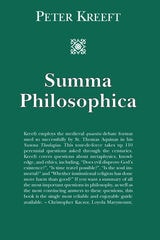
Summa Philosophica
Peter Kreeft
St. Augustine's Press, 2012
Next to the Socratic Method, the best method for organizing a logical debate over a controversial philosophical or theological issue is the method St. Thomas Aquinas uses in the Summa Theologiae. As the charm of the Socratic dialogue is its dramatic length, its uncertainty, and the psychological dimension of a clash between live characters, so the charm of the Summa method is the opposite: its condensation and its impersonality, objectivity, simplicity, directness, and logical clarity. Beginning philosophy students pick up both methods very quickly, and write adept imitations of them. It’s both profitable and fun to do it. Yet professionally philosophers have not followed these tried-and-true roads. Why not? Probably it is pride, the refusal to stoop to conquer, the confusion of “stooped” with “stupid.”
Peter Kreeft has written over a dozen books of Socratic dialogues, and readers like them – they like the form, or format, irrespective of the content. There is no reason that the Summa format cannot produce the same results. It is a very simple five-step procedure: (1) the formulation of the question; (2) the opponent’s leading objections to your answer or thesis, formulated as clearly and fairly and strongly as possible; (3) a short argument from some recognized past authority for your thesis; (4) your own longer, original argument; and (5) a refutation of each objection, “deconstructing” it and showing how and where it went wrong . . . all in one or two pages, severely condensed, clear and simple (and therefore usually in syllogisms, the clearest and simplest and most direct form of logical argument).
Kreeft has taken 110 of the most important and most often argued-about questions in each major division of philosophy and applied this method to it. The answers usually match common sense (and therefore Aristotle’s philosophy and Aquinas’s theology). At the very least, this is a useful philosophical reference book for arguments; not necessarily the elaborate and artificial arguments that might occur to contemporary “analytic” philosophers, but the arguments ordinary people would give, and still give on both sides of these great questions. Why no one has written such a book before is mind-boggling. We fully expect that many readers of this book will imitate it, as Kreeft has imitated Aquinas. This book is pregnant with many children.
Summa metaphysicae ad mentem Sancti Thomae
Essays in Honor of John F. WippelTherese Scarpelli Cory
Catholic University of America Press, 2023