Results by title
3785 books match the query 'Poetry' and 342 start with s
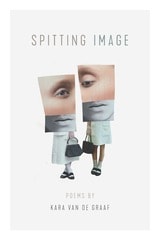
Spitting Image
Kara van de Graaf
Southern Illinois University Press, 2018
Taking as its primary theme the exploration of the female body in current culture, Spitting Image considers the myriad intersections of the body and gender, desire, relationships, and otherness. Van de Graaf interrogates underrepresented elements of the female experience, especially the physical, rhetorical, and aesthetic limitations of fatness in poetry and other arts. She then complicates those limitations through her use of innovative forms and imaginative verse, implicitly calling for poetry to engage with the female form in fresh ways. Throughout, Van de Graaf’s poems ask: In a time where we have more agency to define ourselves than ever before, what barriers still remain? What do our bodies mean to who we are?
At turns oblique and direct, Van de Graaf’s poems strive to create space for themselves not only in the field of contemporary poetry but also in a larger world that has been prone to ignoring or shaming women for their bodies. That these poems succeed on both counts is a testament to this remarkable new poet, who claims “That millimeter of space that means / all of us are apart, that means / we can never really touch / anything. . . . Yes, I want that, too.”
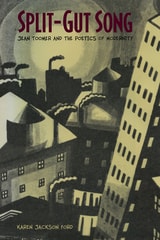
Split-Gut Song
Jean Toomer and the Poetics of ModernityKaren Jackson Ford
University of Alabama Press, 2005
Reclaiming Jean Toomer as a radical innovator of African American modernist poetics.
In Split-Gut Song, Karen Jackson Ford looks at what it means to be African American, free, and creative by analyzing Jean Toomer's main body of work, specifically, his groundbreaking creation Cane. When first published in 1923, this pivotal work of modernism was widely hailed as inaugurating a truly artistic African American literary tradition. Yet Toomer's experiments in literary form are consistently read in terms of political radicalism—protest and uplift—rather than literary radicalism.
Ford contextualizes Toomer's poetry, letters, and essays in the literary culture of his period and, through close readings of the poems, shows how they negotiate formal experimentation (imagism, fragmentation, dialect) and traditional African American forms (slave songs, field hollers, call-and-response sermons, lyric poetry). At the heart of Toomer's work is the paradox that poetry is both the saving grace of African American culture and that poetry cannot survive modernity. This contradiction, Ford argues, structures Cane, wherein traditional lyric poetry first flourishes, then falters, then falls silent.
The Toomer that Ford discovers in Split-Gut Song is a complicated, contradictory poet who brings his vexed experience and ideas of racial identity to both conventional lyric and experimental forms. Although Toomer has been labelled a political radical, Ford argues that politics is peripheral in his experimental, stream-of-consciousness work. Rather Toomer exhibits a literary radicalism as he struggles to articulate his perplexed understanding of race and art in 20th-century America.

Spoon River Anthology
An Annotated EditionEdgar Lee Masters. Edited and with an Introduction and Annotations by John E. Hallwas
University of Illinois Press, 1992
What lies beneath the surface of Masters' timeless classic
One of the most striking and original achievements in American poetry is now available in a remarkable edition that comprehends the poet and his book in an entirely new way.
This edition of Spoon River Anthology probes the social background of the small-town world that Edgar Lee Masters loved and hated--and finally transmuted into powerful literary art. Extensive annotations identify the people whose lives inspired the 243 poetic accounts of frustration, violence, struggle, and triumph that shocked American readers.
The most extraordinary feature of this edition is the extensive introduction that provides the key to this misunderstood American classic. The book's relationship to Whitman is clearly established, and the important influences of Browning, Goethe, Spinoza, and others are revealed for the first time. John Hallwas' approach combines cultural, biographical, philosophical, psychoanalytic, mythic, and symbolic insights--and concludes with a stunning reassessment of "Our New Poet."
The annotated Spoon River Anthology supersedes seventy-five years of largely misdirected critical commentary. It will send a new generation of readers back to this surprisingly complex book that probes so deeply into the American consciousness.
Spotted Ponies
The Collected ZinesMag Gabbert, Chen Chen, Tarfia Faizullah, Leila Chatti, and Carly Joy Miller with artwork by Taylor Dolan
Bridwell Press, 2025
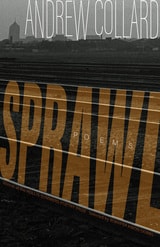
Sprawl
PoemsAndrew Collard
Ohio University Press, 2023
Within the larger geographical space of the metropolis are the in-between places of personal significance: the gas stations, burger joints, malls, and parking lots where many of the defining moments of ordinary lives occur. These poems take deep inspiration from such places, insisting on the value of the people found there, along with their experiences. What might be considered high and low culture are as inextricably linked in the formal cues of the poems as they are in the Michigan landscape, influenced by pop music, midcentury modern aesthetics, comic books, and cars.
While the sprawl of the title refers to the seemingly endless succession of businesses and neighborhoods extending north from Detroit (“a sprawl this extensive breeds / empty pockets”), it also invokes the sprawl of history through poems that move between the past and present. One sequence of poems built on old newspaper clippings draws attention to a Chrysler plant that once constructed Redstone missiles. Elsewhere, two poems refer to the Detroit newspaper strike of the 1990s, a local controversy with lasting implications for the community. Sprawl ultimately illuminates the relationship of one place to other places, contextualizing its characters and locales within a wider societal frame.
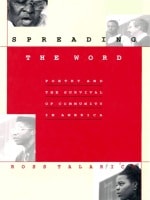
Spreading the Word
Poetry and the Survival of Community in AmericaRoss Talarico
Duke University Press, 1995
Drawing on his workshops in Rochester, Talarico describes a unique approach for eliciting poetry from people of many ages and backgrounds—particularly underpriviledged urban kids and the elderly. The process—from dialogue to self-expression to publication to public event—illuminates the urgency and meaning of releasing the spirit captured in each man and woman and child’s experience. "Some people say that Ross Talarico has done the impossible," the Today Show remarked of his success in Rochester; and with this book Talarico offers the same opportunity to others. Teachers, community leaders, parents, and children will be able to follow his practical, hands-on approach to encouraging self-expression in diverse, even unlikely, settings. They will see here how poetry is indeed relevant, ever more crucial to our identity as the culture evolves—how it is, finally, the place where the inarticulate can come to speak for themselves.
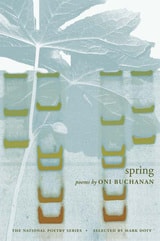
Spring
Oni Buchanan
University of Illinois Press, 2008
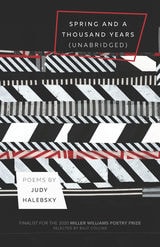
Spring and a Thousand Years (Unabridged)
PoemsJudy Halebsky
University of Arkansas Press, 2020
A translator’s notebook, an almanac, an ecological history, Judy Halebsky’s Spring and a Thousand Years (Unabridged) moves between multiple intersections and sign systems connected in a long glossary poem that serves as the book’s guide to what is lost, erased, or disrupted in transition both from experience to written word and from one language, location, and time period to another.
Writers Li Bai, Matsuo Bashō, Sei Shōnagon, and Du Fu make frequent appearances in centuries ranging from the eighth to the twenty-first, and appear in conversation with Grace Paley, Donald Hall, and Halebsky herself, as the poet explores subjects ranging from work and marriage to environmental destruction. Asking what would happen if these poets—not just their work—appeared in California, the poems slip between different geographies, syntaxes, times, and cultural frameworks.
The role of the literary translator is to bring text from one language into another, working to at once shift and retain the context of the original—from one alphabet to another, one point in time to another. These are poems in homage to translation; they rely on concepts that can bridge time and space, and as a result are as likely to find meaning in donuts or Zumba as they are to find it in the ocean. Spring and a Thousand Years (Unabridged) finds reasons for hope not in how the world should be, but in how it has always been.
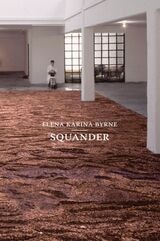
Squander
Elena Karina Byrne
Omnidawn, 2016
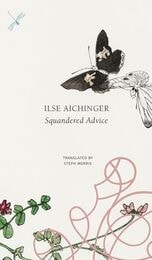
Squandered Advice
Ilse Aichinger
Seagull Books, 2022
Austrian writer Ilse Aichinger (1921–2016) was a member of the Gruppe 47 writers’ group, which sought to renew German-language literature after World War II. From a wide-ranging literary career that encompassed all genres, Squandered Advice was Aichinger’s sole poetry collection. The book gathers poems written over several decades, yet Aichinger’s poetic voice remains remarkably consistent, frequently addressing us or a third party, often in the imperative, with many poems written in the form of a question. Even though they use free verse throughout, the poems are still tightly structured, often around sounds or repetition, using spare language. Phrases are often fragmentary, torn off, and juxtaposed as if in a collage. Isolated and haunting, the images are at times everyday, at other times surreal, suggesting dreams or memories. The tone ranges from reassuring and gentle to disjointed and disturbing, but the volume was carefully composed by the author into an integral whole, not chronological but following its own poetic logic. This new translation makes Aichinger’s critically acclaimed book, which has inspired poets in the German-speaking world for decades, available to English-language readers for the first time.

St. Austin Review, Poetry and Praise, May/June 2012, Vol. 12, No. 3
Joseph Pearce
St. Augustine's Press, 2012
St. Austin Review, Verse in Adversity
Poetry & Modernity, May/June 2016, Vol. 16, No. 3Joseph Pearce
St. Augustine's Press, 2016
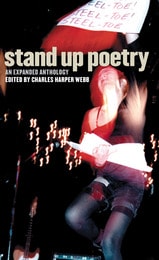
Stand Up Poetry
An Expanded AnthologyCharles Harper Webb
University of Iowa Press, 2002
Contributors:
Kim Addonizio
Dorothy Barresi
Charles Bukowski
Maxine Chernoff
Lucille Clifton
Billy Collins
Philip Dacey
Stephen Dunn
Deborah Harding
Edward Hirsch
Tony Hoagland
Allison Joseph
Jesse Lee Kercheval
Lisa Lewis
Bill Mohr
Ed Ochester
Lawrence Raab
Maureen Seaton
James Tate
Rafael Zepeda
plus many more
Witty, sexy, gritty, outrageous, emotional, hilarious, honest, courageous. What do these words describe? A growing movement in American literary circles: Stand Up Poetry.
Over twenty years ago, Charles Harper Webb discovered a vibrant and invigorating poetry scene in southern California. Featuring some of America's best contemporary poets, this scene, according to Webb, “showed insight, imagination, craft, philosophical depth, but most of all, it was funny, and it was fun.” Stand Up Poetry: The Poetry of Los Angeles and Beyond (1990) was the result of Webb's enthusiasm for this poetic genre.
A decade later, the popularity of performance poetry, poetry slams, and poetry readings is on the rise, and Webb has expanded his anthology to include a greater sampling of poets from across the country. From Charles Bukowski to Billy Collins and Allison Joseph, the poets included in this collection are popular and emerging, classical and experimental, young and old; yet all exhibit the characteristics so important to Stand Up Poetry—humor, performability, accessibility, individuality. Most important, these poems are enjoyable when read silently or aloud, on the page or on the stage.
Stand Up Poetry: An Expanded Anthology is at its core a celebration of poetry offering readers a wonderful lesson in the power of words to entertain and inspire.
Standing around the Heart
PoemsGary Fincke
University of Arkansas Press, 2005
Star Apocrypha
Christopher Buckley
Northwestern University Press, 2001
Star Ledger
Lynda Hull
University of Iowa Press, 1991
Stardust Media
Christina Pugh
University of Massachusetts Press, 2020
Christina Pugh's fifth book of poems explores the technologies both ancient and new that inhabit our contemporary cultural moment. Mapping an uncanny journey through the clusters of media we encounter daily but seldom stop to contemplate, Pugh's focused descriptions, contrasting linguistic textures, and acute poetic music become multifarious sources of beauty, disruption, humor, and hurt. Here, Netflix and YouTube share space with eighteenth-century paintings, Italian graffiti, ballet, Kurt Cobain's recordings, and even a collection of rocks. Whether technology is a vessel for joy or grief in these poems, it is always an expression of our continuing desire to invent and to mediate. At once personal archive and cultural barometer, Stardust Media traces the moving constellations of life in the distant twenty-first century, “a kaleidoscope / . . . half-filled with sky-blue glass-cut blossoming, / then labored to crystallize.”

Stars at Noon
Poems from the Life of Jacqueline CochranEnid Shomer
University of Arkansas Press, 2001
These poems give voice to the life of the first woman to fly faster than the speed of sound. While Jacqueline Cochran was alive, no man or woman in the world could match her records for speed, distance, and altitude flying. Founder and director of the Women’s Airforce Service Pilots (WASP) during World War II, Cochran continued to fly competitively until she was sixty, owned and operated her own line of designer cosmetics for three decades, ran for Congress, and generally placed herself on the path of history. Having begun life as a foundling in the crushing poverty of a lumber company town of the Florida panhandle, she described her life as “a passage from sawdust to stardust.” Yet after her death she has barely been remembered.
Poet Enid Shomer brings back this mercurial, dazzling, powerful woman. These poems speak in her voice and in the voices of her mother, teachers, husband, confidants, and political opponents, shaped by Shomer’s consummate formal control and stunning lyricism.
Starshine & Clay
Kamilah Aisha Moon
Four Way Books, 2017
Starship Tahiti
PoemsBrandon Dean Lamson
University of Massachusetts Press, 2013
The poems in Brandon Dean Lamson's first volume, Starship Tahiti, explore imprisoned bodies and the tension between captivity and imagination. Beginning on Rikers Island, the book traces a creation myth in reverse, moving from prison to the spacious arches of Grand Central Station to the shores of the Chesapeake Bay.
Lamson examines themes of violence, gender, and identity in various real and imagined settings where inmates read Antigone, Howlin' Wolf sings in a black barbershop, and Metallica records burn on a Viking altar. Throughout these shifts, the poems construct fractured narratives that subvert linear storytelling. The layering of voice and imagery in this collection transgresses boundaries between the secular and the sacred, and between the communal and the personal. As the speaker of “Portland Bardo” says, “The fragile, in between state of larvae hatching / is no less desirable than full bloom in a city of roses, if such a city can ever be found.”
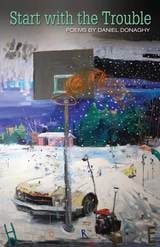
Start with the Trouble
PoemsDaniel Donaghy
University of Arkansas Press, 2009
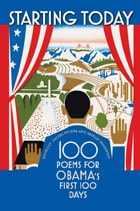
Starting Today
100 Poems for Obama’s First 100 DaysRachel Zucker
University of Iowa Press, 2010
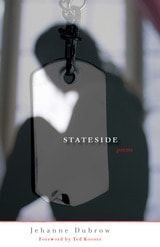
Stateside
PoemsJehanne Dubrow
Northwestern University Press, 2010
Winner, 2012 Alice Fay Di Castagnola Award from the Poetry Society of America
Winner, Individual Artist's Award from the Maryland State Arts Council
First Prize, Anna Davidson Rosenberg Poetry Award for Poems on the Jewish Experience (for three poems from her manuscript-in-progress, "The Arranged Marriage")
Although the poems in Stateside are concerned with a husband's deployment to the war in Iraq, Jehanne Dubrow's riveting collection is driven more by intellectual curiosity and emotional exploration than by any overt political agenda. The speaker in these poems attempts to understand her situation within the long history of military wives left to wait and wonder – Penelope is a model, but also a source of mystery. These poems are dazzling in their use of form, their sensual imagery, and their learnedness, and possess a level of subtlety and control rarely found in the work of a young poet. Dubrow is fearless in her contemplation of the far-reaching effects of war, but even more so in her excavation of a marriage under duress.
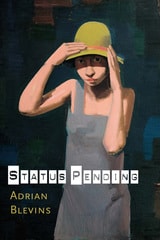
Status Pending
Adrian Blevins
Four Way Books, 0
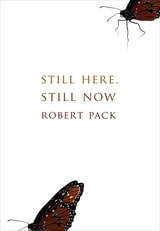
Still Here, Still Now
Robert Pack
University of Chicago Press, 2008
The first section of the book contains traditional lyrics that celebrate family ties and seek consolations for the passing of personal and evolutionary time. The poems in this group address a named or unnamed auditor in a voice of intimate engagement. Featuring the most narrative selections in the book, the second section consists of fable-like stories, rich with innuendo and implication. The characters in these poems make choices that press against the events and circumstances that challenge and define them. Embodying what Harold Bloom has called Pack’s “courage to surmount suffering,” the poems of the third section are largely devoted to biblical themes and philosophical speculations on the meaning of happiness and the uses of suffering. Here, Pack’s empathy for the human condition as well as his forebodings about the prospect of human survival are on poignant display. The final section of the book turns to Pack's abiding interest in landscape and the ways in which the place one inhabits contains and animates our individual lives.
Ripe with many years, Pack remains a vital presence in American letters. Still Here, Still Now is an affecting and graceful addition to the oeuvre of a poet whose compelling and distinct voice will continue to resonate among his loyal readers.
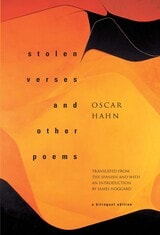
Stolen Verses and Other Poems
Oscar Hahn
Northwestern University Press, 2000

Stone Lyre
René Char
Tupelo Press, 2010
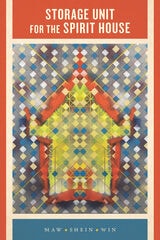
Storage Unit for the Spirit House
Maw Shein Win
Omnidawn, 2020
Assemblages of both earthly and noncorporeal possessions throughout the collection become resonant and alive, and Win must summon “a circle of drums and copper bells” to appease the nats who have moved into a long-ago family house. This careful curation of unlikely objects and images becomes an act of ritual collection that uses language to interrogate how pain in life can transform someone into a nat or a siren that lives on. Restrained lines request our imagination as we move with the poet through haunted spaces and the objects that inhabit them.
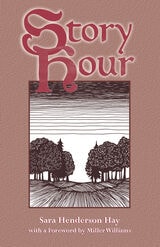
Story Hour
Sara Henderson Hay
University of Arkansas Press, 1998
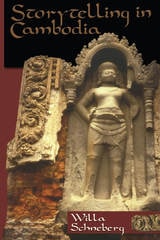
Storytelling in Cambodia
Willa Schneberg
Calyx, 2006
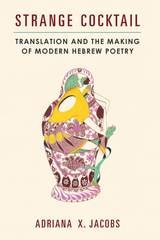
Strange Cocktail
Translation and the Making of Modern Hebrew PoetryAdriana X. Jacobs
University of Michigan Press, 2018
For centuries, poets have turned to translation for creative inspiration. Through and in translation, poets have introduced new poetic styles, languages, and forms into their own writing, sometimes changing the course of literary history in the process. Strange Cocktail is the first comprehensive study of this phenomenon in modern Hebrew literature of the late nineteenth century to the present day. Its chapters on Esther Raab, Leah Goldberg, Avot Yeshurun, and Harold Schimmel offer close readings that examine the distinct poetics of translation that emerge from reciprocal practices of writing and translating. Working in a minor literary vernacular, the translation strategies that these poets employed allowed them to create and participate in transnational and multilingual poetic networks. Strange Cocktail thereby advances a comparative and multilingual reframing of modern Hebrew literature that considers how canons change and are undone when translation occupies a central position—how lines of influence and affiliation are redrawn and literary historiographies are revised when the work of translation occupies the same status as an original text, when translating and writing go hand in hand.
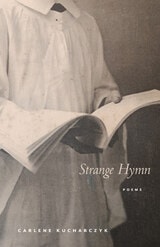
Strange Hymn
PoemsCarlene Kucharczyk
University of Massachusetts Press, 2025
Winner of the 2025 Vermont Book Award for Poetry!
“I’ll tell you everything I know. Though there might not be much to tell,” confesses the speaker in Strange Hymn by Carlene Kucharczyk, in a meticulously crafted lyrical journey exploring morality and humanity. The poems here grapple with understanding physical loss: “I wanted / to know at once and definitively our animal bodies / were not all we were. It is shameful to be this fragile.” They also engage with the more abstract slipping away of memory and time: “Since I was born, I have been forgetting. Forgetting what I have wanted to remember.” Kucharczyk’s insightful poems blur the lines between history and myth, love and grief, song and silence.
Caught between lamenting the passage of time and rejoicing in small beauties, she writes, “I tell you, I wish we could stay here longer / in this hotel of lost grandeur, this palace of interesting disarray, / and stay here with these pieces of the impersonal past / that have somehow not yet outlasted their small lights.” Each moment reflects on our ephemeral lives from musings on art and nature to reflections on the self, asking “Is a mirror a sort of glass house? / And, is there a way to see ourselves besides through the glass?”
As readers traverse this collection, they learn how the body sings, the many iterations of Mary, what sirens truly think of Odysseus, how a Morning Glory unfurls, and lessons in orthodontics, but most importantly, how to live with absence. Kucharczyk is a master of manipulating time and space through her dynamic use of form, creating a narrative that begs, “After I’m gone, don’t bury my body— / Burn it, and turn it into song.”
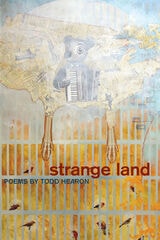
Strange Land
Todd Hearon
Southern Illinois University Press, 2010
Todd Hearon’s haunting debut collection chronicles the twin paths of isolation and desire in the search for meaning and union with others. On his pilgrimage through the lost worlds of earth and the soul, the speaker encounters drought in both the literal and spiritual sense as he confronts desolate landscapes, from the brown remnants of ruined cities, to the depths of the human heart and man’s capacity for utter destruction. Yet even though he frequently encounters darkness, he never ceases to seek beauty. He is a man who wears many faces, from Adam, staring down a bleak future bereft of Paradise, to the doomed poet Shelley, drowned off the coast of Italy. He speaks as a man adrift in his own life, seeking an answer to his emptiness, an estranged traveler through memory and longing. Lyrical and intense, Strange Land is a quest for understanding and human connection.
Strange Land
It goes without saying
a word: the world under cover
of midnight snow, what we have known
of pageantry and lilac, leaf and song
subsumed in starless silence.
Waking at dawn into the tremulous blue
of the room, as in earth’s afterglow,
we lie, lidless, listening, as crows
call out the ear’s horizons.
What year is it? Into what country were we born
and now must make our way? Outside the pane
the stillness feels ancestral but the ghosts
not yours, not mine. My émigré,
we are cut off. An ocean to the east
churns in chiaroscuro while unseen
ranges to the south deflect our passage,
what passage might have been.
This country seems the passing of a dream
to a moonscape’s still immitigable white,
a land’s amnesia where against the sky
three needling black birds fly
and slip like an ellipsis out of sight.
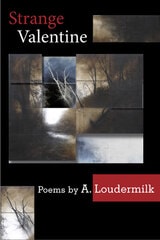
Strange Valentine
A. Loudermilk
Southern Illinois University Press, 2005
A. Loudermilk utilizes confessional, persona, and third-person poems throughout this intimate yet socially conscious first collection. Strange Valentine is an indictment of love, fixating on the paranoid relationship between body and state, on the dangerous relationship between family history and sexual history, and on the elusive relationship between gender and sexuality—specifically as experienced in the working-class towns of the southernmost Midwest. Riding highly crafted rhythms in sound, line, and invented form, Loudermilk’s multivoiced storytelling resounds with the characters and heartbreaks of the heartland.
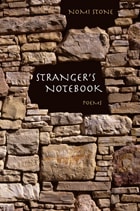
Stranger's Notebook
PoemsNomi Stone
Northwestern University Press, 2008
Stone's moving debut collection of verse is inspired by her encounter with perhaps the last cohesive, traditional Jewish community in the Middle East and North Africa. According to their story of origin, a handful of exiles arrived on the island of Djerba, Tunisia, in 586 B.C., carrying a single stone from the destroyed Temple in Jerusalem. Drawing from this cosmology, the poems follow a stranger who arrives into an ancient community that is both at home and deeply estranged on the island. Its people occupy the uneasy space of all insular communities, deciding when to let the world in and when to shut it out. The poems are about the daily lives and deeper cosmos of the Jews of Djerba as well as the Muslims next door. In her exploration, Stone sees vivid recurring images of keys, stones, homes, the laughter of girls, the eyes of men, the color blue, and the force of blood or bombs. With this journey of faith, doubt, longing, and home, Stone has brought readers a rare look into a story that resonates powerfully with questions of cultural preservation and coexistence.
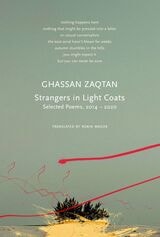
Strangers in Light Coats
Selected Poems, 2014–2020Ghassan Zaqtan
Seagull Books, 2023
Ghassan Zaqtan is not only one of the most significant Palestinian poets at work today, but one of the most important poets writing in Arabic. Since the publication of his first collection in 1980, Zaqtan’s presence as a poet has evolved with the same branching and cumulative complexity as his poems—an invisible system of roots insistently pushing through the impacted soil of political and national narratives.
Strangers in Light Coats is the third collection of Zaqtan’s poetry to appear in English. It brings together poems written between 2014 and 2020 drawn from six volumes of poetry. Catching and holding the smallest particles of observation and experience in their gravity, the poems sprout and grow as though compelled, a trance of process in which fable, myth, and elegy take form only to fall apart and reconfigure, each line picked apart by the next and brought into the new body.
Strangers
A Book of PoemsDavid Ferry
University of Chicago Press, 1983
"Strangers is a remarkably good book for a reader sufficiently attentive to hear its quiet power, to let it work in its distinctive way."—Boston Globe
"The poems of David Ferry's Strangers are in fact one book, and it is a splendid one. There is the same austere and poignant voice throughout, asking the unanswerable things, speaking of all that is withheld from us, confronting the unknownness that dwells even in the familiar and dear. Painful and touching, the book offers a distinctive vision which is at the same time inescapably true."—Richard Wilbur
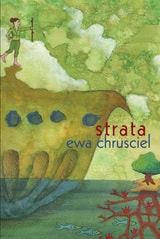
Strata
Ewa Chrusciel
Omnidawn, 2018

Stray Home
Amy M. Clark
University of North Texas Press, 2010
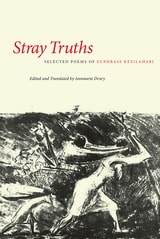
Stray Truths
Selected Poems of Euphrase KezilahabiAnnmarie Drury
Michigan State University Press, 2015
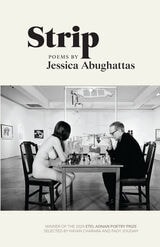
Strip
PoemsJessica Abughattas
University of Arkansas Press, 2020
“The mystery that Abughattas composes is always moving toward an impossible freeing of the self from its numerous frames. Yet frame by frame . . . she suspends our disbelief, catalogs those potentialities in an America always ready to shoot, direct, and produce the film of itself. Strip is ‘in love with possibility,’ ‘in praise of here I am, here I’ve been,’ USA style. Strip celebrates the body—its rise and fall, ebb and flow, in a carnival of parties—restlessly, shamelessly, searching for a way out…. Even as Abughattas claims that ‘I can’t believe sometimes I have a body,’ her poems teem with an awareness of the body’s unavoidable centrality in our lives—in how we view our lives, and how others view them; in how they progress, and how they end; in how they become meaningful, and how they are stripped of meaning. And no stripping escapes memory. Whether in terms of dispossession or sexuality, admiration or pity, Abughattas renders her treatment of the body with candor and poignancy. . . . The most startling moments in Abughattas’s poems, however, depend not on shocking or intimate details—but on the ‘I’ pulling away from the self, abandoning the ego, and gazing outward. She tries to see something else, to escape the body’s restraints.”
—Fady Joudah and Hayan Charara, from the Preface
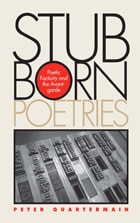
Stubborn Poetries
Poetic Facticity and the Avant-GardePeter Quartermain
University of Alabama Press, 2013
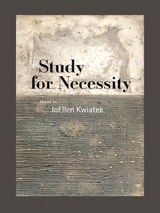
Study for Necessity
JoEllen Kwiatek
University of Iowa Press, 2015
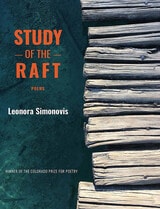
Study of the Raft
Leonora Simonovis
University Press of Colorado, 2021
In Study of the Raft, Leonora Simonovis’s poems weave the outer world of a failed political revolution in her native country, Venezuela, with an inner journey into the memories of migration and exile, of a home long gone, and of family relations, especially among womxn. The collection explores the consequences of colonization, starting with “Maps,” a poem that speaks of loss and uprootedness, recalling a time when indigenous lands were stolen and occupied, where stories were lost as new languages and beliefs were imposed on people. The politics of the present are also the politics of the past, not just in the Venezuelan context, but in many other Latin American and Caribbean countries. It is the reality of all indigenous people. Simonovis’s poems question the capacity of language to represent the complexity of lived experience, especially when it involves living from more than one language and culture. These poems wrestle with questions of life and death, of what remains after what and whom we know are no longer with us, and how we, as humans, constantly change and adjust in the face of uncertainty.
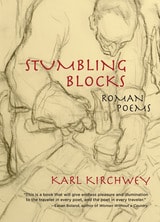
Stumbling Blocks
Roman PoemsKarl Kirchwey
Northwestern University Press, 2017
As in his 1998 New York Times Notable Book The Engrafted Word, the city of Rome becomes a lens through which to understand the contemporary human experience and the upheavals of human loss. Stumbling Blocks takes as its starting point the shattered ancient Roman ruins described in Renaissance poet Joachim du Bellay's celebrated sonnet—a landscape of death feeding upon itself and restored to life in the imagination of each successive generation to salvage its own narratives.
Kirchwey builds new arches and mythological intersections in exquisite poems that take long walks in the Eternal City, through landscapes far away and deep within. This gorgeous collection takes us back in time and brings us forward through our Old and New Worlds, revealing through the religion of art both beauty and atrocity.

Subject/Object and Beyond
Women in Early Modern FranceEdited by Nancy M. Frelick and Edith Benkov
Iter Press, 2023
Subject/Object and Beyond brings together essays by established and emerging scholars to honor the exceptionally rich contributions and career of scholar Colette H. Winn. It also celebrates fifty years of sustained scholarship on early modern women, along with the foundation of Women’s Studies as a recognized academic discipline in North America. The collection comprises seventeen articles that explore multiple perspectives on early modern women, including their writings, translations, reception, and contributions to various fields, including literature, music, politics, religion, and science.
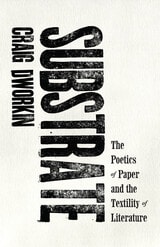
Substrate
The Poetics of Paper and the Textility of LiteratureCraig Dworkin
University of Chicago Press, 0
A study of the signifying potential of paper, the foundational material for literary texts in the modern era.
For ease of reading, the paper of a printed page must recede far enough into the background to make ink legible. Yet paper—the primary substrate for literary texts—has its own signifying potential, its own poetics. Craig Dworkin shows that looking at the page, rather than through its illusory withdrawal, can unlock interpretive insights that readers would otherwise miss. What often seems incidental can prove to be as semantically important as the words of the text themselves.
Substrate argues that the material affordances of paper in general—its pliability, fibrous weave, and capacity to fold, tear, crumple, and shuffle—variously inform the poetics of William Blake, Stéphane Mallarmé, Jen Bervin, and Susan Howe. For all four of these poets, the qualities of paper serve as models for structuring the language of their poems in innovative ways. Dworkin further shows how each poet in turn engages paper at another level by incorporating it within the thematic ambit of key poems. The full meaning of these poems is thus inextricable from their printing. Substrate is a brilliant inquiry in poetics and the logic of media more generally.
Subterranean
Richard Greenfield
Omnidawn, 2018

Such Is My Love
A Study of Shakespeare's SonnetsJoseph Pequigney
University of Chicago Press, 1985
Such Rich Hour
Cole Swensen
University of Iowa Press, 2001
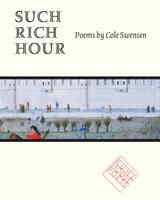
Covering a variety of subjects—from the plague and the first danse macabre to the development of perspective and recipes for pigments—the poems in Cole Swensen's new collection are set in fifteenth-century France and explore the end of the medieval world and its gradual transition into the Renaissance. The collection is loosely based on the calendar illuminations from the Très Riches Heures, the well-known book of hours, and uses them to explore the ways that the arts—visual and verbal—interact with history, at times prefiguring it, at times shaping it, and at times offering wry commentary or commiseration.