Results by title
3785 books match the query 'Poetry' and 342 start with s
Sugar
Andrea Cohen
Four Way Books, 2026
About Sugar, David Orr has said: “Andrea Cohen’s ninth collection is elegantly precise—but this isn’t the precision of a meticulously arranged garden or tidy bookshelf. Rather, Cohen’s nimble, exacting lines are like guide ropes strung up the sides of an icy mountain: Her precision manages risk, and the risk leads to startling vistas. An entire relationship dynamic unfolds in the five monosyllables of ‘Proximity’: ‘She died / Of my wounds.’ In ‘Ghosting,’ the ambiguity of departure—the way in which lives and loves sometimes cease without concluding—is captured in all its shades of gray: ‘Any ghost will / tell you— // the last thing / we mean // to do / is leave you.’ We sometimes think of poems as recreating experience, but Cohen’s work reminds us that poetry, at its most patient and compassionate, is also a way of discerning. Sugar brings us a step closer to the sun; it helps us to orient ourselves, but more than that, it helps us to see.”
Suicides and Jazzers
Hayden Carruth
University of Michigan Press, 1993
In Suicides and Jazzers, Hayden Carruth reveals as never before the hard experiences that have shaped his life and art. In the lead essay, entitled "Suicide," he speaks of the psychiatric illness he has lived with for most of his life and his attempted suicide in 1988. In "Fragments of Autobiography," he shares memories of a Connecticut childhood, early ruminations about death, and his coming-of-age in small-town America.
A major essay on the poetry of Paul Goodman is followed by shorter essays on Wallace Stevens, Emily Dickinson, Donald Hall, and Carolyn Kizer. In sections entitled "Elegies," "Reviews," and "Musical" Carruth celebrates fine writers and musicians who he feels have been intentionally neglected by the establishment, including authors Grace Paley and David Ignatow, tenor saxophonist Ben Webster, and, in "The Spun-Off Independent Dead-End Ten-Star Blast," white jazz musicians.

Sunday Houses the Sunday House
Elizabeth Hughey
University of Iowa Press, 2007
In Sunday Houses the Sunday House, Elizabeth Hughey embraces the possibility that we can learn as much from objects as we can from other people, from the inanimate as much as the animate. Each poem descends upon a place and a time, takes a few notes, and then leaves quietly without slamming any doors. Sunday Houses the Sunday House reveals what the world is like when your attention is focused elsewhere, when your head is turned the other way.
In ineffably beautiful verse, Hughey captures moments in time and place with confidence but without being judgmental. Although it may seem that the scope of these poems is rather small—a good party, a couple of eggs, a housekeeper's daydream—they reveal both a deep intelligence and a spirit of whimsy. Gertrude Stein wrote that she wanted to be "drunk with nouns," and in a sense that is what Hughey has accomplished here.
Sunday Rising
Patricia Clark
Michigan State University Press, 2013

Sundays
Thomas Gardner
Tupelo Press, 2020

Sunflower Facing The Sun
Greg Pape
University of Iowa Press, 1992
Supplement to “Walt Whitman
A Descriptive Bibliography”Joel Myerson
University of Iowa Press, 2011
Supplice
T. Zachary Colter
University Press of Colorado, 2014
Winner of the 2014 Colorado Prize for Poetry, Supplice is the second installment in T. Zachary Cotler’s sonnet sequence that began with Sonnets to the Humans.These are amatory sonnets, but with love and rhyme tortured into broken and boneset textures. Supplice herself, the dark lady of these poems, is difficult to pin down with an epithet. Is she the angel of reality, banality, popular culture, pornography, uncertainty, or economic and environmental crisis? She has something to do with the history of cruelty and pain, with the devaluation of traditional ideas of beauty, and with the silence and science that have replaced divinity.
Supply Chain
Pimone Triplett
University of Iowa Press, 2017
Surprised in Translation
Mary Ann Caws
University of Chicago Press, 2006
For Mary Ann Caws—noted translator of surrealist poetry—the most appealing translations are also the oddest; the unexpected, unpredictable, and unmimetic turns that translations take are an endless source of fascination and instruction. Surprised in Translation is a celebration of the occasional and fruitful peculiarity that results from some of the most flavorful translations of well-known authors. These translations, Caws avers, can energize and enliven the voice of the original.
In eight elegant chapters Caws reflects on translations that took her by surprise. Caws shows that the elimination of certain passages from the original—in the case of Stéphane Mallarmé translating Tennyson, Ezra Pound interpreting the troubadours, or Virginia Woolf rendered into French by Clara Malraux, Charles Mauron, and Marguerite Yourcenar—often produces a greater and more coherent art. Alternatively, some translations—such as Yves Bonnefoy’s translations of Shakespeare, Keats, and Yeats into French—require more lines in order to fully capture the many facets of the original. On other occasions, Caws argues, a swerve in meaning—as in Beckett translating himself into French or English—can produce a new text, just as true as the original.
Imbued with Caws’s personal observations on the relationship between translators and the authors they translate, Surprised in Translation will interest a wide range of readers, including students of translation, professional literary translators, and scholars of modern and comparative literature.
Surrealism
The Road to the AbsoluteAnna Balakian
University of Chicago Press, 1987
This volume includes photographs of the poets and reproductions of paintings by Ernst, Dali, Tanguy, and others.
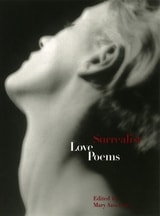
Surrealist Love Poems
Edited by Mary Ann Caws
University of Chicago Press, 2005
Surrealist Love Poems brings together sixty poems by Surrealists who charged their work with all forms of eroticism. Expertly and energetically edited by Mary Ann Caws, this collection seeks to demonstrate the truth of Breton's words, that "the embrace of poetry like that of bodies / As long as it lasts / Shuts out all the woes of the world."
"Erotic, impassioned and necrophilic, the sixty works gathered in Surrealist Love Poems celebrate the idea of obsessive and transformative love. 'I want to sleep with you side by side. . . . Stretched out on your shadow / Hammered by your tongue / To die in a rabbit's rotting teeth / Happy' writes Joyce Mansour. . . . Caws places poems by major surrealist writers like André Breton and Paul Eluard, along with the poetry of Picasso, Dalí, and Frida Kahlo, side by side with fourteen lushly printed and alluring black-and-white photos by the likes of Man Ray, Lee Miller, and Claude Cahun."—Publishers Weekly
Surveille
Caitlin Roach
University of Wisconsin Press, 2024

Survival This Way
Interviews with American Indian PoetsJoseph Bruchac
University of Arizona Press, 1987
Survivor's Notebook
PoemsDan O'Brien
Acre Books, 2023
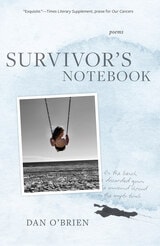
Dan O’Brien’s powerful companion to Our Cancers catalogs the recovery of a cancer survivor, whose wife has recently survived her own cancer, as he returns to his daily life while raising a young daughter. This prose-poem sequence is a true survivor’s notebook, using photos and the tools of memoir to evoke how disaster can constellate our past, present, and future.
In his poems, plays, and nonfiction, Dan O’Brien has explored, as he says in a 2023 interview, “how trauma shatters identity, and in its aftermath we reconfigure and rewrite, as it were, the story of who we were and are and maybe will be.” In highly personal poems reminiscent of dramatic monologues, as well as shorter lyric fragments, the protagonist reconsiders the people and places he knew before his illness, including his estranged family and others with cancer. While looking back he moves forward again, resuming his career as a writer and teacher, revisiting Ireland, and making a kind of pilgrimage to the Holy Land. There is a confiding and at times comical tone in these poems as O’Brien awakens to the delights, absurdities, and wonders of existence, and as he and his wife work through the aftershocks of their trauma toward a deeper love.
With text and image, Survivor’s Notebook shows how we go on, with resilience, gratitude, and joy, when “the emergency’s elsewhere” now.
Survivor's Notebook
PoemsDan O’Brien
Acre Books, 2023
In his poems, plays, and nonfiction, Dan O’Brien has explored, as he says in a 2023 interview, “how trauma shatters identity, and in its aftermath we reconfigure and rewrite, as it were, the story of who we were and are and maybe will be.” In highly personal poems reminiscent of dramatic monologues, as well as shorter lyric fragments, the protagonist reconsiders the people and places he knew before his illness, including his estranged family and others with cancer. While looking back he moves forward again, revisiting Ireland, resuming his career as a writer and teacher, and making a kind of pilgrimage to the Holy Land. There is a confiding and at times comical tone in these poems, as he awakens to the delights, absurdities, and wonders of existence, and as he and his wife work through the aftershocks of their trauma toward a deeper love.
Survivor’s Notebook shows how we go on, with resilience, gratitude, and joy, when “the emergency’s elsewhere” now.
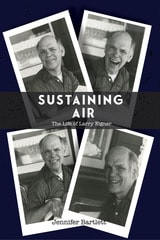
Sustaining Air
The Life of Larry EignerJennifer Bartlett
University of Alabama Press, 2023
The biography of a poet seminal to postwar American poetry
The poet Larry Eigner (1927–1996) was a key figure in New American poetry, which grew out of the Black Mountain School and San Francisco Renaissance, and a major influence on the Language poets. Eigner also had cerebral palsy as the result of an accident at birth. It is fortuitous that the poet lived his life in two locations vibrant in both poetics and disability activism. Except for brief periods attending camp and school, he lived with his parents in Swampscott, Massachusetts, until the age of 51. Later, he moved to Berkeley, California, at the height of the disability rights movement. In the 1950s, Eigner attended Camp Jened, which later became famous in the film Crip Camp.
Bartlett’s biography covers every significant phase of Eigner’s life: his childhood and young adulthood when he began typing poems with one finger on the manual typewriter that was a bar mitzvah gift; his first publications and the maturation of his poetic interests through correspondence with poets of the era; and after his move to Berkeley, the ever-expanding circle of friends, poets, caretakers, and collaborators he established there. The result is a deeply insightful account of an utterly distinctive voice whose influence widens and deepens with each new generation that encounters him.
Susto
Tommy Archuleta
University Press of Colorado, 2023
Swale
Allison Hutchcraft
New Issues Poetry and Prose, 2020
Swale interrogates the violence of colonialism and its reverberations over time, as well as the extinction and the rapid decline of animal species. By turns tidal and cloistered, Swale speaks of science, reliquaries, and lapis lazuli, traversing forests, seascapes, and meadows. Here, the ocean becomes a field, a medieval tapestry transforms into a space that can be entered, and the body is fleshless, struck through with light. The speaker of these poems is ultimately unfixed—and with that comes both imaginative possibility and a personal unmooring. In poems that cast and recast the interior self in different guises—from the perpetually off-kilter Alice to the divergent voices of the shorn lamb and predatory foxhound—an unsettling anxiety grows starker, along with the wish for repair.
Swallowing the Sea
On Writing & Ambition, Boredom, Purity & SecrecyLee Upton
Tupelo Press, 2012
Swamp Candles
Ralph Burns
University of Iowa Press, 1996
In his convincing and highly accomplished fifth book, Ralph Burns draws on his deep practice and experience. His tones, forms, and subjects are various and striking, and the work of a poet mature and courageous enough to range through the full spectrum of his emotions.
Sometimes Burns is haunted by the strength and fallibility of the Christian tradition, and in many of his poems he explores the conflicts between individuals and the larger world—the mystery and responsibility of choice, consequence and inconsequence, “the terror of being taken.”
Swan Hammer
An Instructor’s Guide to MirrorsMaggie Graber
Michigan State University Press, 2022
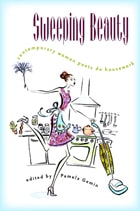
Sweeping Beauty
Contemporary Women Poets Do HouseworkPamela Gemin
University of Iowa Press, 2005
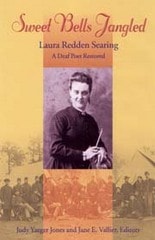
Sweet Bells Jangled
Laura Redden Searing, A Deaf Poet RestoredJudy Yaeger Jones
Gallaudet University Press, 2003
Laura Redden Searing (1839-1923) defied critics of the time by establishing herself as a successful poet, a poet who was deaf. She began writing verse at the Missouri School for the Deaf in 1858, and, under the pseudonym Howard Glyndon, soon found herself catapulted into national prominence by her patriotic Civil War poems. Abraham Lincoln himself bought her books, the most critically acclaimed being Idylls of Battle and Poems of the Rebellion, published in 1864. Her poem “Belle Missouri” became the song of the Missouri Volunteers, and she was sent by the St. Louis Republican newspaper to Washington as a war correspondent.
Despite her success, detractors decried her poetry simply because she was deaf, asking how she could know anything of rhyme, rhythm, or musical composition. She quieted them with the simple elegance of her words and the sophistication of her allegorical themes. Readers can enjoy her work again in this volume, which features more than 70 of her finest poems. They also will learn her feelings about the constraints imposed on 19th-century women in her epic narrative of misunderstanding and lost love “Sweet Bells Jangled:”
Out of sight of the heated land
Over the breezy sea;
Into the reach of the solemn mist
Quietly drifted we.
Her restoration will be an event welcomed by poetry aficionados everywhere.
Sweet Home, Saturday Night
PoemsDavid Baker
University of Arkansas Press, 1991
Sweet Repetition
Cynthia Cruz
University of Chicago Press, 2025
Integrating Lacanian and Freudian psychoanalysis, continental philosophy, and the works of other poets, this collection explores narrative through abstraction and considers how repetition holds both the power to constrain and to generate. Freud explains how what we repress—what we know but don’t want to acknowledge—reappears in our actions through repetition. Through slips of the tongue or selective memory, we engage with what our unconscious knows, finding knowledge through unknowing. The psychoanalytic session is centered on bringing forth repressed knowledge through acts of unknowing—speaking without thinking—which brings one closer to recognizing an obscured desire.
The poetry of Sweet Repetition works in ways akin to the psychoanalytic act. These pulsing poems follow the definitions of the word revolution—to revolve, change direction, unroll, unwind, happen again, repeat, orbit around. Images and words reappear in the motion of Cynthia Cruz’s poems, inviting us into their revolutionary, political, and cumulative effects.
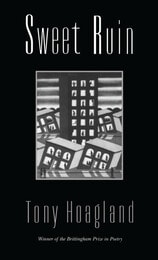
Sweet Ruin
Tony Hoagland
University of Wisconsin Press, 1992
Tony Hoagland captures the recognizably American landscape of a man of his generation: sex, friendship, rock and roll, cars, high optimism, and disillusion. With what Robert Pinsky has called “the saving vulgarity of American poetry,” Hoagland’s small biographies of destruction reveal that defeat is a natural prelude to grace and loss a kind of threshold to freedom.
“A remarkable book. Without any rhetorical straining, with a disarming witty directness, these poems manage to transform every subject they touch, from love to politics, reaching out from the local and the personal to place the largest issues in the context of feeling. It’s hard to think of a recent book that succeeds with equal grace in fusing the truth-telling and the lyric impulse, clarity and song, in a way that produces such consistent pleasure and surprise.”—Carl Dennis
“This is wonderful poetry: exuberant, self-assured, instinct with wisdom and passion.”—Carolyn Kizer
“There is a fine strong sense in these poems of real lives being lived in a real world. This is something I greatly prize. And it is all colored, sometimes brightly, by the poet’s own highly romantic vision of things, so that what we may think we already know ends up seeming rich and strange.”—Donald Justice
“In Sweet Ruin, we’re banging along the Baja of our little American lives, spritzing truth from our lapels, elbowing our compadres, the Seven Deadly Sins. Maybe we’re unhappy in a less than tragic way, but our ruin requires of us a love and understanding and loyalty just as deep and sweet as any tragic hero’s. And it’s all the more poignant in a sad and funny way because the purpose of this forced spiritual march, Hoagland seems to be saying, is to leave ourselves behind. Undoubtedly, you will recognize among the body count many of your selves.”—Jack Myers
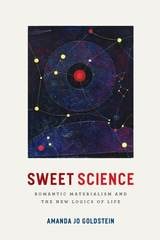
Sweet Science
Romantic Materialism and the New Logics of LifeAmanda Jo Goldstein
University of Chicago Press, 2017
Goldstein puts apparently literary projects, such as William Blake’s poetry of embryogenesis, Goethe’s journals On Morphology, and Percy Shelley’s “poetry of life,” back into conversation with the openly poetic life sciences of Erasmus Darwin, J. G. Herder, Jean-Baptiste Lamarck, and Étienne Geoffroy Saint-Hilaire. Such poetic sciences, Goldstein argues, share in reviving Lucretius’s De rerum natura to advance a view of biological life as neither self-organized nor autonomous, but rather dependent on the collaborative and symbolic processes that give it viable and recognizable form. They summon De rerum natura for a logic of life resistant to the vitalist stress on self-authorizing power and to make a monumental case for poetry’s role in the perception and communication of empirical realities. The first dedicated study of this mortal and materialist dimension of Romantic biopoetics, Sweet Science opens a through-line between Enlightenment materialisms of nature and Marx’s coming historical materialism.
Sweet Spot
PoemsJ.T. Barbarese
Northwestern University Press, 2012
Classical deities and down-and-out junkies, high school sweethearts and the inner life of JFK—these are the coordinates of J.T. Barbarese’s terrain. The poems in Sweet Spot set up shop where average lived experience meets American history. Masterfully evokes both the specific land- and cityscapes of his poems as well the psychological types of the varied characters that populate them, Sweet Spot confirms Barbarese’s preeminence as a chronicler of the heroic everyday, the telling detail, the subtle reminders of the human predicament hidden in habit and memory.
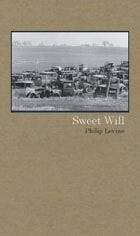
Sweet Will
Philip Levine
University of Iowa Press, 2013
The poems, including the long meditation of more than five hundred lines, “A Poem with No Ending,” are beautiful and essential. Restored to print, they will resonate with readers who love both the earlier and the later work of one of our most important poets.
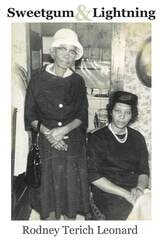
Sweetgum & Lightning
Rodney Terich Leonard
Four Way Books, 2021
Sweetgum & Lightning lets us into an extraordinary poetic universe, shaped by a vernacular rooted in the language of self, one’s origins, and music. In poems that are deeply sensual in nature, Rodney Terich Leonard considers gender and sexuality, art, poverty, and community. Imagery expands through unexpected lexical associations and rumination on the function of language; words take on new meaning and specificity, and the music of language becomes tantamount to the denotations of words themselves. Through extensive webs of connotation, Leonard’s narratives achieve a sense of accuracy and intimacy. The nuanced lens of these poems is indicative of the honesty of expression at work in the collection—one that affirms the essentiality of perception to living and memory.
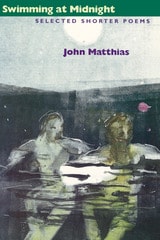
Swimming At Midnight
Selected Shorter PoemsJohn Matthias
Ohio University Press, 1995
Swimming at Midnight collects the short and middle-length poems from John Matthias’s earlier books together with twenty poems that have previously appeared only in magazines. It is published simultaneously with Beltane at Aphelion, which includes all of Matthias’s longer poems. The two books together represent some thirty years of his work.
The poems in Swimming at Midnight range from early lyrics written in American during the late 1960s to meditative poems dealing with historical, geographical and cultural themes deriving from Matthias’s years in England in the seventies and eighties; they include the epistolary poems from Turns, “Poem for Cynouai” from Crossing, “A Wind in Roussillon” from Northern Summer, and the formal experiments engaging issues of poetics and metaphysics for which Matthias is well known. The book concludes with a section of new poems and translations dealing both with the public world of modern history and the private experience of life in the century’s final decade. The last poem of all connects the work in Swimming at Midnight with the last of the long poems in Beltane at Aphelion.
Critics have been warm in their praise of Matthias’s work. Robert Duncan called his early poetry “the work of a Goliard—one of those wandering souls out of a Dark Age in our own time,” and Guy Davenport has said that his recent work makes him “one of the leading poets in the USA.” D. M. Thomas in the TLS admired the “virtuosity” of Turns and the way “life presses into the poems,” while John Fuller in the same journal found the poems in Crossing “bursting with a masterful intelligence.” In a long essay on Northern Summer, Jeremy Hooker wrote: “In his combination of lyrical and discursive voices, as in subject and concern, Matthias has an exciting range…He writes in some poems from a tension between a scribe’s respect for the integrity of his materials and a magician’s freedom to transform them, and in many poems he brings together the contrasting gifts and is fully present as himself, both scribe and magician.”
Swoon
Victoria Redel
University of Chicago Press, 2003
Symmetry
Marc Straus
Northwestern University Press, 2000
Symmetry and Sense
The Poetry of Sir Philip SidneyBy Robert L. Montgomery
University of Texas Press, 1961
Few Elizabethans left the image of their personalities cut so deeply into the Renaissance imagination as did Sir Philip Sidney. Widely admired in his own time, Sidney must seem to the modern reader almost universally accomplished. His talents as courtier, diplomat, soldier, scholar, novelist, and poet are history.
Almost immediately after Sidney's death in battle against the Spaniards in the Low Countries, the process of legend began, and the legend has survived, sometimes obscuring the facts. The versatile "Renaissance man" has become, in the eyes of some critics, the romantic lover whose frustrations and despair found release in the "confessional" form of the sonnet sequence, Astrophel and Stella, and in other poems. To show these poems to be consciously constructed works of art, not simply passionate outbursts of romantic emotion, is one aim of this study.
The author examines Sidney as poet and critic, concentrating his study on rhetorical technique and poetic rhythm and form. He shows Sidney experimenting with the symmetrical possibilities of rhythm and phrase; practicing the ornateness current and acceptable in his day. He examines Sidney's comment on such a style in The Defense of Poesy and the ways in which the poet's own work agreed with or departed from his expressed opinions. He also balances Sidney's poetry against the powerful tradition of Petrarchan love literature and the equally powerful Renaissance impulse to subject passion to the rule of reason. Finally, in an extended analysis of Astrophel and Stella, he shows Sidney as the master of a plainer, wittier, more subtly fashioned style and a complex, more dramatically immediate form. What emerges from the study is not the personality of the poet, but the principles of his art and the value of his achievement in the mainstream of English Renaissance verse.
Sympathetic Magic
Amy Fleury
Southern Illinois University Press, 2013
Amy Fleury’s bewitching new collection of poems, Sympathetic Magic, unveils the everyday manifestations of sympathy as well as the connections wrought by “sympathetic magic”—that indelible tether that binds people, places, and objects across time and distance. Fleury’s lyrics journey across the landscapes of childhood and old age, body and spirit, past and future, exploring the boundless permutations of sympathy as it appears in the most surprising locations. Connections reveal themselves in the aggressive silence of the small town or the round penmanship of a loved one, and echo throughout the solitude and regeneration of the forest as well as the antiseptic air of the hospital. At the center of these travels lies the narrator, stretching her limbs from the heart of the heartland, her body a compass summoning us from all directions, emphasizing with tender simplicity that “we all live under the self-same moon, no matter the phase.”
Syncopations
The Stress of Innovation in Contemporary American PoetryJed Rasula
University of Alabama Press, 2004
Syncopations is an analysis of the sustaining vitality behind contemporary American poetry from 1975 to the present day by one of the most astute observers and critics in the field. The 12 essays reflect Jed Rasula’s nearly 30 years of advocacy on behalf of “opening the field” of American poetry.
From the Beats and the Black Mountain poets in the 1950s and 1960s to the impact of language poetry, the specter of an avant-garde has haunted the administrative centers of poetic conservatism. But the very concept of avant-garde is misleading, implying organized assault. Incentives for change can be traced to other factors, including the increased participation of women, critical theory’s self-reflection, and a growing interest in the book as a unit of composition. Syncopations addresses these and other issues evident in the work of such poets and critics as Clayton Eshleman, Marjorie Perloff, Ronald Johnson, Clark Coolidge, Nathaniel Mackey, and Robin Blaser. Its chapters range in modes and include close readings, sociological analysis, philosophical-aesthetic meditations, and career appraisals.
By examining both exemplary innovators and the social context in which innovation is either resisted, acclaimed, or taken for granted, Rasula delivers an important conceptual chronicle of the promise of American poetry.
Synonyms for Silence
A. Molotkov
Acre Books, 2019
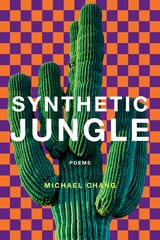
Synthetic Jungle
PoemsMichael Chang
Northwestern University Press, 2023
A vital breath of life arrives in American poetry with Synthetic Jungle, the latest collection from acclaimed poet Michael Chang. With poems in a register both hilarious and scathing, Synthetic Jungle effortlessly bashes convention while simultaneously rebuilding the language we use to communicate our fears and joys.
Synthetic Jungle is a collection written by a brilliant jester who winks at you as you catch their every reference before sharing a laugh at your own self-satisfaction. Themes of identity, sexuality, and literacy play out in a dizzying rhythm of microtheaters. Readers will find themselves giggling, snorting, and guffawing their way through this work: whether at a repudiation of the literary landscape or a critique of a failing justice system, to laugh along with Chang is to recognize your mistakes and, ultimately, grow from them.
Fractal and kinetic in the quick-witted spirit of John Ashbery and Emily Dickinson, Chang’s tender poems dance around, between, and through the personal and philosophical. Synthetic Jungle is as sweet as it is grand, and beneath its sarcastic grin reverberates an immense, open heart.
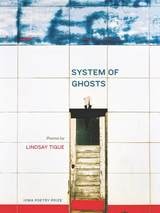
System of Ghosts
Lindsey Tigue
University of Iowa Press, 2016
Rooted in the personal, the speaker of this collection moves through society and history, with the aim of firmly placing herself within her own life and loss. Facts become an essential bridge between spatial and historical boundaries. She connects us to the disappearance of species, abandoned structures, and heartbreak—abandoned spaces that tap into the searing grief woven into society’s public places. There is solace in research, one system this collection uses to examine the isolation of contemporary life alongside personal, historical, and ecological loss. While her poems are intimate and personal, Tigue never turns away from the larger contexts within which we all live.
System of Ghosts is, at its core, an act of reaching out—across time, space, history, and across the room.
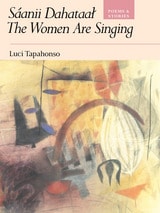
Sáanii Dahataal/The Women Are Singing
Poems and StoriesLuci Tapahonso
University of Arizona Press, 1993
Luci Tapahonso shows how the details of everyday life—whether the tragedy of losing a loved one or the joy of raising children, or simply drinking coffee with her uncle—bear evidence of cultural endurance and continuity. Through her work, readers may come to better appreciate the different perceptions that come from women's lives.
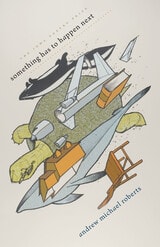
something has to happen next
andrew michael roberts
University of Iowa Press, 2009
Working with brevity and compression, Andrew Michael Roberts first imagines how small he can go with a poem and still maintain some sort of emotional or imagistic center. Then, released from this limitation, the rest of his playful, unexpected poems expand to fill a world with imagery, emotion, and sound.
What Roberts calls “simply a book of small poems” grew out of his obsessions with time and catastrophe and love and abandonment—what is always possible, almost attained, but lost at the last minute. When something ends or when everything ends, something else must always happen next—what will it be, and who will be there to name and love and destroy it?