Results by title
196 books match the query 'Activism & Social Justice' and 28 start with t

The Art of Memes in Feminist Digital Culture
Shana MacDonald
The Ohio State University Press, 2025
In The Art of Memes in Feminist Digital Culture, Shana MacDonald argues that memes are a unique medium of communication that both respond to and reflect the current cultural moment. The book—the first to treat memes as a unique medium of communication distinct from other internet and digital media—examines feminist and queer activist uses of memes as a form of digital resistance, demonstrating through collage, reenactment, and montage that countercultural meme makers intervene in the status quo and offer cultural critiques with potentially broad circulation. In this way, MacDonald situates memes as part of a lineage of aesthetic resistance, exploring the operational logic of bricolage, intertextuality, and intermediality within contemporary internet meme cultures on the left.
MacDonald examines memes from feminist, queer, antiracist, and anticapitalist accounts on Instagram, as well as how meme genres and themes shift when they travel across different platforms and subcultures. By considering memes as a medium, she sheds light on how they operate within contemporary digital culture as a beacon for online public discourse that pushes against dominant norms.

The Choral Turn
Performing the Chorus in the Ruins of DemocracyAmy Holzapfel
University of Michigan Press, 2027
The Choral Turn: Performing the Chorus in the Ruins of Democracy examines the recent resurgence of the chorus—a hallmark of ancient Greek tragedy—across contemporary Western theatre, performance, and activism, arguing that this “choral turn” is inseparable from anxieties about the decline of liberal democracy. Drawing on classical studies, theatre and performance studies, and political philosophy, Holzapfel coins the term “choraperformativity” to describe performances that mobilize the formal and collective conventions of the chorus to contest or reshape dominant political narratives. The Choral Turn uses case studies—plays about war and catastrophe featuring Greek-like choruses, refugee performers theatrically reenacting their own displacement, environmental protesters staging collective mourning for a dying planet—to show how groups use choral performance to demand recognition and assert the need for change. Rather than treating the chorus as inherently progressive, the study asks hard questions about who gets included in these choral communities and who gets left out, offering a nuanced, timely look at collective action on stage and in the streets.

The Fiercest Kind
Five Black Women in Art, Performance, and Resistance, 1937–1965H. Zahra Caldwell
University of Massachusetts Press, 2026
Artists fighting racism and sexism from the end of the Great Depression through the Civil Rights era
In 1943, the production of the Columbia Pictures film The Heat’s On halted for three days due to an on-set protest by featured performer Hazel Scott. Appalled by the racially demeaning and stereotypical depictions of Black women extras and dancers, Scott—one of the top African American performers of the era—forced the studio to relent. But her protest of Hollywood racism angered powerful white men in the industry, and despite her rising career, she was soon banished from American film.
Scott was far from the only Black woman in a creative field to use her professional success as leverage against prejudice. In The Fiercest Kind, cultural historian H. Zahra Caldwell explores the biographical narratives of five Black women at the top of their artistic crafts in the mid-20th century to understand how they pushed back against racism and sexism. From 1937–1965, pianist Hazel Scott, dancer Katherine Dunham, cartoonist Jackie Ormes, multihyphenate fine artist (graphic artist, painter, and sculptor) Elizabeth Catlett, and singer Lena Horne were among the most popular and nationally known Black women in their respective fields, spanning film, television, print media, and fine art. Generating creative works at the end of the Great Depression through the Civil Rights era, they used their professional and personal lives to confront seemingly insurmountable repression through what Caldwell defines as “layered resistance.”
A Black feminist practice, layered resistance consists of four tactics: claiming and adapting cultural spaces for Black women; strategically crafting positive images of Black womanhood that directly challenge white supremacy; combining performance and/or visual representation with social and political activism; and choosing unconventional lifestyles that defy rigid gender and racial norms. These artists also lived in, worked in, and supported important Black spaces such as Harlem and Black Chicago. Using a methodology that combines textual analysis, archival research, and oral history, Caldwell understands this strategy within larger movements for Black freedom and equality that spanned the twentieth century and continue to the present day.

The Green New Deal from Below
How Ordinary People Are Building a Just and Climate-Safe EconomyJeremy Brecher
University of Illinois Press, 2024
A visionary program for national renewal, the Green New Deal aims to protect the earth’s climate while creating good jobs, reducing injustice, and eliminating poverty. Its core principle is to use the necessity for climate protection as a basis for realizing full employment and social justice.
Jeremy Brecher goes beyond the national headlines and introduces readers to the community, municipal, county, state, tribal, and industry efforts advancing the Green New Deal across the United States. Brecher illustrates how such programs from below do the valuable work of building constituencies and providing proofs of concept for new ideas and initiatives. Block by block, these activities have come together to form a Green New Deal built on a strong foundation of small-scale movements and grassroots energy.
A call for hope and a better tomorrow, The Green New Deal from Below offers a blueprint for reconstructing society on new principles to avoid catastrophic climate change.
The Healing Stage
Black Women, Incarceration, and the Art of TransformationLisa Biggs
The Ohio State University Press, 2022

The House on Rondo
Debra J Stone
University of Minnesota Press, 2025
A young girl reckons with the demolition of a Black Saint Paul neighborhood to make way for the Interstate in the early 1960s
When thirteen-year-old Zenobia has to leave her friends and spend the summer at Grandma’s while Mama recovers from a stroke, life seems so unfair. But then the eviction letters start arriving throughout her grandparents’ neighborhood, and white men chalk arrows to mark the gas and water lines, and a new world of unfairness unfolds before her. It’s 1963, and Zenobia’s grandparents’ house on Rondo Avenue in Saint Paul—like all the homes in this thriving Black community—is targeted for demolition to make way for the new Interstate Highway 94.
As Zenobia gradually learns about what’s planned for the Rondo neighborhood and what this means for everyone who lives there, she discovers how her story is intertwined with the history of her family, all the way back to Great Grandma Zenobia and the secrets Grandma Essie held close about the reason for her light skin. With the destruction of the neighborhood looming, Zenobia takes a stand on behalf of her community, joining her no-nonsense neighbor, onetime cowgirl Mrs. Ruby Pearl, in a protest and ultimately getting arrested. Though Zenobia is grounded for a month, her punishment seems of little consequence in comparison to what is happening all around her. Even though the demolition continues, she is proud to discover the power and connection in protesting injustice.
The House on Rondo captures the heartbreak, resistance, and resilience that marks a community sacrificed in the name of progress—a “progress” that never seems to favor Black families and neighborhoods and that haunts cities like Saint Paul to this day. As Zenobia learns what can be destroyed and what cannot, her story teaches us that joy, community, and love persist, even amid violence and loss.
The Justice We Demand
Voices from the Indigenous Anti-Rape RevolutionSarah Deer
University of Minnesota Press, 2027
Sharing stories by Indigenous survivors of sexual violence to reconceptualize justice beyond punishment and remediation
The Justice We Demand asks a profound and urgent question: What does justice truly mean for rape survivors? To address sexual violence, two dominant frameworks of justice persist: carceral justice, which centers punishing perpetrators through the criminal legal system, and restorative justice, which emphasizes repairing interpersonal relationships to resolve tensions between perpetrator and victim. Indigenous survivors and their communities, however, do not view justice as a neat binary between carceralism or restoration. Instead, they navigate complex legal and social systems across federal, state, local, and tribal jurisdictions, and they imagine justice in the form of ceremony, apology, banishment, and more, remedies that often fall outside the formal, colonialist legal system.
Centering the importance of storytelling in addressing trauma, Sarah Deer and Melinda Chen listen to the stories of fifty-one Indigenous women and Two-Spirit survivors of sexual violence to understand their versions of justice. Through their felt experiences, Indigenous survivors challenge conventional criminal justice paradigms that persist in Tribal Nations and settler colonial states, cultivating sovereign approaches to punishment and healing.
With actionable insight and resounding truth, The Justice We Demand urges us to reconsider what justice means and envisions a constellation of remedies led by each survivor’s needs, rooted in their own terms, bodies, and land.
Retail e-book files for this title are screen-reader friendly with images accompanied by short alt text and/or extended descriptions.
The National Alliance of Black Feminists
A HistoryIleana Nachescu
University of Illinois Press, 2025
Ileana Nachescu places the NABF’s history as the bridge between Black women’s social activism in the 1970s and the intellectual activism of the 1980s. Her account details the NABF’s work and how it reflected the group’s strong humanist belief in the transformation of all human beings. Nachescu also shows that the NABF’s post-Eighties erasure from movement histories is consistent with how many white feminists marginalized women of color and rejected their leadership. From there, Nachescu examines Black lesbians’ vibrant support of the NABF and shows how respectability politics pressured the group to support its lesbian membership in private but maintain a public silence on the issue.
A rare in-depth look at an overlooked organization, The National Alliance of Black Feminists tells an untold story of Black women’s liberation in the Midwest.
The New Civil Rights Movement Reader
Resistance, Resilience, and JusticeEdited by Traci Parker and Marcia Walker-McWilliams
University of Massachusetts Press, 2023
In the United States, the fight to secure full civil rights for African American people has endured for centuries. The movement has included many voices, among them, working people, charismatic activists, musicians and artists, the LGBTQIA community, veterans, suburbanites, and elected officials. Moving from the labor struggles of the 1930s to the sit-ins and boycotts of midcentury, and the Black Lives Matter protests of today, this expansive volume brings together first-person accounts, political documents and speeches, and historical photographs from each region of the country.
Designed for use in courses and engaging for general readers, this new compilation is the most diverse, most inclusive, and most comprehensive resource available for teaching and learning about the civil rights movement. With chronological and geographical depth, The New Civil Rights Movement Reader addresses a range of key topics, including youth activism, regional and local freedom struggles, voting rights, economic inequality, gender, sexuality, and culture, and the movement’s global reach.
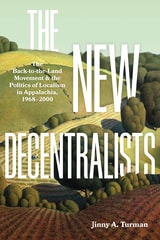
The New Decentralists
The Back-to-the-Land Movement and the Politics of Localism in Appalachia, 1968-2000Jinny A Turman
West Virginia University Press, 2026
How some “back-to-the-landers” fled alienating urban, bureaucratic places for rural Appalachia in pursuit of self-reliance, liberation, and community, only to later find themselves vulnerable to a rising tide of national conservatism that minted new political elites on the state and local level at odds with their progressive social ideas and environmental values.
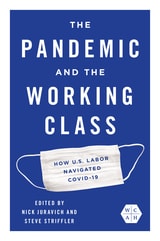
The Pandemic and the Working Class
How US Labor Navigated COVID-19Edited by Nick Juravich and Steve Striffler
University of Illinois Press, 2025
Nick Juravich and Steve Striffler edit a collection that examines the effects of the pandemic on workers. Sections of the book focus on specific impacts and government efforts to restructure the economy; the dramatic effect of the pandemic on the hospitality industry; educators’ response on behalf of themselves and their students; frontline healthcare workers; and the innovative forms of labor organizing that emerged during and after COVID.
Contributors: Carlos Aramayo, Kathleen Brown, Sandrine Etienne, Ismael García-Colón, Puya Gerami, Maura Hagan, Connor Harney, Devan Hawkins, Leigh Howard, Marian Moser Jones, Doris Joy, Nick Juravich, Eric Larson, Kathryn M. Meyer, Samir Sonti, Steve Striffler, Lia Warner, Andrew B. Wolf, and Jennifer Zelnick

The Philosophy of Vegetarianism
Daniel A. Dombrowski
University of Massachusetts Press, 1984
Daniel A. Dombrowski uses the tools and insights of these contemporary debates in order to better understand the strengths and weaknesses of ancient philosophical vegetarianism. He also uses the wisdom of the Greek vegetarians as an Archimedean point from which to critique both the opponents and the defenders of contemporary philosophical vegetarianism. The book includes an annotated bibliography of the current debates in this burgeoning field of scholarship.
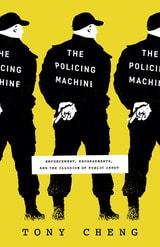
The Policing Machine
Enforcement, Endorsements, and the Illusion of Public InputTony Cheng
University of Chicago Press, 2024
The past few years have seen Americans express passionate demands for police transformation. But even as discussion of no-knock warrants, chokeholds, and body cameras has exploded, any changes to police procedures have only led to the same outcomes. Despite calls for increased accountability, police departments have successfully stonewalled change.
In The Policing Machine, Tony Cheng reveals the stages of that resistance, offering a close look at the deep engagement strategies that NYPD precincts have developed with only subsets of the community in order to counter any truly meaningful, democratic oversight. Cheng spent nearly two years in an unprecedented effort to understand the who and how of police-community relationship building in New York City, documenting the many ways the police strategically distributed power and privilege within the community to increase their own public legitimacy without sacrificing their organizational independence. By setting up community councils that are conveniently run by police allies, handing out favors to local churches that will promote the police to their parishioners, and offering additional support to institutions friendly to the police, the NYPD, like police departments all over the country, cultivates political capital through a strategic politics that involves distributing public resources, offering regulatory leniency, and deploying coercive force. The fundamental challenge with police-community relationships, Cheng shows, is not to build them. It is that they already exist and are motivated by a machinery designed to stymie reform.
The Policing Machine
Enforcement, Endorsements, and the Illusion of Public InputTony Cheng
University of Chicago Press, 2024
A revelatory look at how the NYPD has resisted change through strategic and selective community engagement.
The past few years have seen Americans express passionate demands for police transformation. But even as discussion of no-knock warrants, chokeholds, and body cameras has exploded, any changes to police procedures have only led to the same outcomes. Despite calls for increased accountability, police departments have successfully stonewalled change.
In The Policing Machine, Tony Cheng reveals the stages of that resistance, offering a close look at the deep engagement strategies that NYPD precincts have developed with only subsets of the community in order to counter any truly meaningful, democratic oversight. Cheng spent nearly two years in an unprecedented effort to understand the who and how of police-community relationship building in New York City, documenting the many ways the police strategically distributed power and privilege within the community to increase their own public legitimacy without sacrificing their organizational independence. By setting up community councils that are conveniently run by police allies, handing out favors to local churches that will promote the police to their parishioners, and offering additional support to institutions friendly to the police, the NYPD, like police departments all over the country, cultivates political capital through a strategic politics that involves distributing public resources, offering regulatory leniency, and deploying coercive force. The fundamental challenge with police-community relationships, Cheng shows, is not to build them. It is that they already exist and are motivated by a machinery designed to stymie reform.
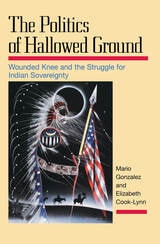
The Politics of Hallowed Ground
Wounded Knee and the Struggle for Indian SovereigntyMario Gonzalez and Elizabeth Cook-Lynn
University of Illinois Press, 1999
Inside the Sioux Nation's pursuit of recognition and justice
This book is the powerful story of the ongoing struggle of indigenous Americans in the twentieth century United States and of its shift in focus from traditional battlefield and massacre sites to federal courtrooms and the halls of Congress.
The Politics of Hallowed Ground includes excerpts from the diary kept by Mario Gonzalez, the attorney for the Sioux Nation in its struggle for recognition of the Wounded Knee Massacre site as a national monument. Gonzalez's personal record of the struggle is coupled with commentary by Elizabeth Cook-Lynn, a Native American writer who places the work in its historical context. Together, the two voices will draw the reader into far more than the continuing struggle of the Sioux people to achieve justice.
The book covers Sioux history from before the Wounded Knee tragedy to modern times, through the Sioux Nation's long and often rancorous dialogue with the U.S. government over control of South Dakota's Black Hills, traditional Sioux lands recognized by treaty in 1877 and never forfeited or sold. After reading a 13-year-old survivor's narrative of what happened at Wounded Knee and the list of the dead and wounded, readers will find it difficult not to share the Sioux perspective.
The Politics of Hate
How the Christian Right Darkened America's Political SoulAngelia R. Wilson
Temple University Press, 2025
Based on original research, participant observation at events, and data collection, Wilson follows the money to provide a meticulous analysis of how Christian Right political elites operate. She traces the evolutionary development of the Christian Right’s political professionalism and their allegiance to a grand vision that articulates a grammar of war to fulfill their Biblical worldview.
The Politics of Hate demonstrates how Christian Right organizations educate and train networks of soldiers to tactically engage the enemy in local, state, and national legal and political battles. Wilson carefully documents their history of co-belligerency, their strategies of political warfare, and, importantly, the impact of this war that has, over the past fifty years, forever changed American politics.

The Popular Wobbly
Selected Writings of T-Bone SlimT-Bone Slim
University of Minnesota Press, 2025
The first critical edition of the writings of the prolific radical workers’ newspaper columnist and musician who rode the rails during the Great Depression
The Popular Wobbly brings together a wide selection of writings by T-Bone Slim, the most popular and talented writer belonging to the Industrial Workers of the World (IWW). Slim wrote humorous, polemical pieces, engaging with topics like labor and class injustice, which were mostly published in IWW publications from 1920 until his death in 1942. Although relatively little is known about Slim, editors Owen Clayton and Iain McIntyre coalesce the latest research on this enigmatic character to create a vivid portrait that adds valuable context for the array of writings assembled here.
Known as “the laureate of the logging camps,” Slim also composed numerous songs that have been performed and recorded by Pete Seeger, Utah Phillips, and Candie Carawan, who in 1960 updated Slim’s song “The Popular Wobbly” with Civil Rights–era lyrics. Slim’s witticisms, sayings, and exhortations (“Wherever you find injustice, the proper form of politeness is attack”; “Only the poor break laws—the rich evade them”) were widely discussed among fellow hobos across the “jungle” campfires that dotted the railways, and some even transcribed his commentary on boxcars that traveled the country. Yet despite Slim’s importance and fame during his lifetime, his work disappeared from public view almost immediately after his death.
The Popular Wobbly is the first critical edition of Slim’s work and also a significant contribution to literature about working-class writers, the radical labor movement, and the history and culture of nomadism and precarity. With this publication, Slim’s rediscovered writings can once again inspire artists and activists to march and agitate for a more just and equitable world.
The Power We Need Right Now
Black Sororities and Black Radical Movements of the 1970sAisha A. Upton Azzam
Temple University Press, 2026
There is a long history of sororities such as Alpha Kappa Alpha (AKA) and Delta Sigma Theta (Delta) participating in activism and social justice efforts—from the Civil Rights Movement in the 1960s to Kamala Harris’s recent political campaigns. But radical movements like Black Lives Matter have posed more challenging questions for these organizations.
In The Power We Need Right Now, Aisha Upton Azzam investigates the legacies of AKA and Delta to understand the considerations that weigh on their engagement with present day Black movements. These organizations wield a significant amount of political power to mobilize in support of their causes. The response each sorority has had to movements fifty years apart is strikingly similar—even if their approaches are quite different.
Using a Black feminist theoretical framework, Upton Azzam brings context and meaning to the interactions of these sororities with Black radical movements. She highlights the costs communities bear from sororities’ adherence to respectability and racial uplift ideologies by tracing each sorority’s history and response to emerging Black feminist and Black Power movements during the tumultuous 1970s.
The Power We Need Right Now emphasizes that Black communities still have the ability to wield their political power and influence to further the struggle for Black liberation.
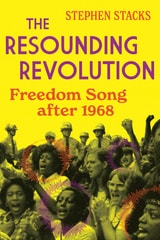
The Resounding Revolution
Freedom Song after 1968Stephen Stacks
University of Illinois Press, 2025
Stacks’s analysis shifts the focus of attention from genre--freedom song--to process and practice--freedom singing. As he shows, freedom singing after 1968 generates multilayered meanings. It can reinforce, or resist, consensus memories or dominant narratives. Stacks illuminates freedom singing’s diversity by examining it in three contexts: performance, protest, and within documentary sound recording/film.
Insightful and vividly detailed, The Resounding Revolution examines sixty years of Black music to challenge and reshape the entrenched story of the Civil Rights Movement.
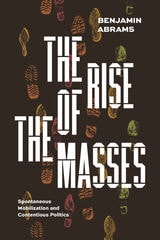
The Rise of the Masses
Spontaneous Mobilization and Contentious PoliticsBenjamin Abrams
University of Chicago Press, 2023
Between 15 and 26 million Americans participated in protests surrounding the murders of George Floyd, Ahmaud Arbery, Breonna Taylor, and others as part of the Black Lives Matter protests in 2020, which is only one of the most recent examples of an immense mobilization of citizens around a cause. In The Rise of the Masses, sociologist Benjamin Abrams addresses why and how people spontaneously protest, riot, and revolt en masse. While most uprisings of such a scale require tremendous resources and organizing, this book focuses on cases where people with no connection to organized movements take to the streets, largely of their own accord. Looking to the Arab Spring, Occupy Wall Street, and the Black Lives Uprising, as well as the historical case of the French Revolution, Abrams lays out a theory of how and why massive mobilizations arise without the large-scale planning that usually goes into staging protests.
Analyzing a breadth of historical and regional cases that provide insight into mass collective behavior, Abrams draws on first-person interviews and archival sources to argue that people organically mobilize when a movement speaks to their pre-existing dispositions and when structural and social conditions make it easier to get involved—what Abrams terms affinity-convergence theory. Shedding a light on the drivers behind large spontaneous protests, The Rise of the Masses offers a significant theory that could help predict movements to come.
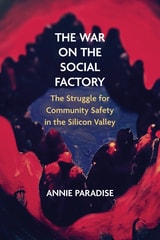
The War on the Social Factory
The Struggle for Community Safety in the Silicon ValleyAnnie Paradise
Northwestern University Press, 2024
A collective ethnography of grassroots mobilizations for community safety across the Silicon Valley
This is a narrative of struggle and solidarity and a collective toolkit for grassroots opposition to militarization, policing, and ongoing conditions of war in the current conjuncture of racial patriarchal capitalism. Grassroots researcher Annie Paradise presents here a collective ethnography of the mothers and community matriarchs whose children have been murdered by police across the San Francisco Bay Area as they develop and practice autonomous, creative forms of resistance.
The War on the Social Factory: The Struggle for Community Safety in the Silicon Valley maps local families’ struggles to reclaim their households and their communities—to create a social infrastructure of care, justice, and safety outside state- and market-determined modes of “security.” Practices such as sustained vigil, testimony, and the production and circulation of insurgent knowledges are shown here to be part of interconnected justice efforts to demilitarize and decarcerate communities in the face of the multiple forms of violence enacted under late racial patriarchal capitalism. Paradise examines the expanding carceral processes of enclosure, criminalization, dispossession, expropriation, and disposability that mark the neoliberal "security” regime across the Silicon Valley and offers counter-counterinsurgent strategies and practices of co-generative, dynamic resistance.

The West Bank Wall
Unmaking PalestineRay Dolphin
Pluto Press, 2006
Israel claims it is a security measure to protect Israeli citizens from terrorist attacks. Opponents point to the serious impact on the rights of Palestinians, depriving them of their land, mobility and access to health and educational services.
This book explores the Palestinian experience of the Wall in their international context. What are the real intentions behind the Israeli security argument? Is it a means of securing territory permanently through an illegal annexation of East Jerusalem? The West Bank Wall is a cutting account of the impact of the wall and how it affects prospects of a future peace in the Middle East.

The World of W.E.B. Du Bois
A Quotation SourcebookMeyer Weinberg
University of Massachusetts Press, 2012
Meyer Weinberg created The World of W.E.B. Du Bois to provide a short journey through Du Bois's views on virtually all aspects of twentieth-century life. More than one thousand quotations from his published writings and correspondence are included, arranged into twenty topical chapters. Each quotation begins with a heading designed to summarize its main theme. A subject index provides additional access to the ideas of this complex figure.
This Book is Free and Yours to Keep
Notes from the Appalachian Prison Book ProjectConnie Banta
West Virginia University Press, 2024
This Book Is Free and Yours to Keep presents a captivating collection of letters and artwork by people in prison that highlights the crucial work done by the Appalachian Prison Book Project (APBP), a nonprofit that provides books to incarcerated people in West Virginia, Virginia, Tennessee, Kentucky, Ohio, and Maryland. Through the words of people directly impacted by the criminal punishment system, the collection provides uncommon insight into reading practices and everyday life in prisons and jails while being an inspiration for prison book projects, prison reform, and abolition.
Simultaneously communicating the vital importance of access to books and education, and conveying the power of community, the letters sent to APBP by incarcerated people spark conversations about race, poverty, and incarceration and shed light on the movement for accountability for state violence. This Book Is Free and Yours to Keep elucidates the violence and neglect perpetuated by carceral systems and offers a way forward based on solidarity and collaboration.
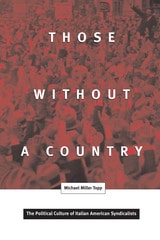
Those Without A Country
The Political Culture of Italian American SyndicalistsMichael Miller Topp
University of Minnesota Press, 2001
In the first book-length history of the Italian American syndicalist movement—the Italian Socialist Federation—Michael Miller Topp presents a new way of understanding the Progressive Era labor movement in relation to migration, transnationalism, gender, and class identity. Those without a Country demonstrates that characterizations of "old" (pre-1960s) social movements as predominantly class-based are vastly oversimplified—and contribute to current debates about the implications of identity politics for the American Left and American culture generally.
Topp traces the rise and fall of the Italian American syndicalist movement from the turn of the twentieth century to the executions of Sacco and Vanzetti in 1927. His use of Italian-language sources, combined with his attention to transnationalism and masculinity, provides new vantage points on a range of related topics, including the 1912 Lawrence, Massachusetts, textile workers’ strike, the impact of World War I on this immigrant community, and the genesis of both fascism and antifascism. Those without a Country brings forward fascinating new material to revise and refine our views of not only Progressive Era radicalism but immigration, gender, and working-class history as well.
To Turn the World Around
Democracy and the Politics of RepairAli Aslam
University of Minnesota Press, 2027
A stirring exploration of abolitionist thought and Black feminism to articulate a transformative theory of repair
Amid the relentless news of ICE raids, Supreme Court rulings that dismantle our civil rights, and egregious violations of democratic norms, people in the United States are struggling to visualize an actionable path forward. In To Turn the World Around, Ali Aslam proposes a transformative approach that pairs inner healing work with collective external engagement challenging oppressive forces. To actualize W. E. B. DuBois’s concept of abolition democracy, drawing from Black sociality grounded in the refusal of white institutions, Aslam advocates for not working within a broken system nor fleeing it, or merely enduring injustice, and instead offers combined personal healing and embodied action.
Aslam’s vision of transformative selfhood centers healing justice, self and mutual aid, and a somatic approach informed by Black women’s history of navigating bodily dispossession and violations of autonomy and personhood. Simultaneously a tool of personal survival, political refusal, and collective care, inner work incubates new forms of resistance and prepares participants to engage with the outer work of abolition. The movements that rise from the foundation of this inner work are collaborative and experimental, a collective “figuring out” that creates holistic approaches to abolition that transcend conventional politics.
Reimagining inner work as resistance that is ongoing, expansive, and relational, To Turn the World Around offers a stirring framework for the creation of transformational movements. Aslam’s unique theory of repair carefully bridges constituencies, acknowledging the politics of refusal while embracing the hopefulness of sociality.
Retail e-book files for this title are screen-reader friendly.
Truth Be Told
White Nostalgia and Antiracist Queer Resistance in “Post-Truth” AmericaLaura Elliot Tetreault
The Ohio State University Press, 2025
Taking a critical disinformation studies approach, Tetreault analyzes post-truth political messaging in the US after 2016. Using racial rhetorical criticism combined with a queer lens, they focus on how contemporary antiracist, queer, and feminist activists used various forms of cultural production to work against disinformation and its circulation, enacting refusal and insisting on the validity of their own knowledges as a form of community care. Tetreault ultimately argues that it’s not just the truth that academics must advocate for; they must question whose truth and how that truth is mediated and circulated.
Two-Year College Writing Studies
Rationale and Praxis for Just TeachingDarin Jensen
Utah State University Press, 2023
Contributors draw on theories of identity, rhetorical third space, and linguistics to articulate a praxis of just teaching. They describe existing institutional challenges and opportunities that foster equity and offer cautionary tales of educational systems dismantled for short-term economic and political gains. Two-year college writing studies—when properly resourced—holds the potential to foster (or undermine) democratic ideals of civic literacy and uplift. Chapters in this volume offer case study examples of changes in departmental practices for reflection, interaction, and assessment that empower faculty to break free and engage directly with institutional, regional, state, and national constraints.
By making these resilient practices visible, Two-Year College Writing Studies amplifies the voices and validates the experiences of instructors engaging in this work. It will serve generalists, specialists, and academics interested in the subdiscipline of student success pedagogies and the political histories of two-year colleges and be useful for instructors new to the field, as professional development for veteran instructors, and as an introduction for graduate students entering two-year college writing studies programs.