Results by title
71 books match the query 'Adventures' and 19 start with t
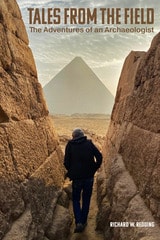
Tales From the Field
The Adventures of an ArchaeologistDr. Richard W. Redding, edited by Alexis Redding
Michigan Publishing Services, 2026
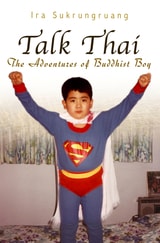
Talk Thai
The Adventures of Buddhist BoyIra Sukrungruang
University of Missouri Press, 2011
When Ira Sukrungruang was born to Thai parents newly arrived in the U.S., they picked his Jewish moniker out of a book of “American” names. In this lively, entertaining, and often hilarious memoir, he relates the early life of a first-generation Thai-American and his constant, often bumbling attempts to reconcile cultural and familial expectations with the trials of growing up in 1980s America.
Young Ira may have lived in Oak Lawn, Illinois, but inside the family’s bi-level home was “Thailand with American conveniences.” They ate Thai food, spoke the Thai language, and observed Thai customs. His bedtime stories were tales of Buddha and monkey-faced demons. On the first day of school his mother reminded him that he had a Siamese warrior’s eyes—despite his thick glasses—as Aunty Sue packed his Muppets lunch box with fried rice. But when his schoolmates played tag he was always It, and as he grew, he faced the constant challenge of reconciling American life with a cardinal family rule: “Remember, you are Thai.”
Inside the Thai Buddhist temple of Chicago, another “simulated Thailand,” are more rules, rules different from those of the Southside streets, and we see mainstream Western religion—“god people”—through the Sukrungruang family’s eyes. Within the family circle, we meet a mother who started packing for her return to Thailand the moment she arrived; her best friend, Aunty Sue, Ira’s second mother, who lives with and cooks for the family; and a wayward father whose dreams never quite pan out.
Talk Thai is a richly told account that takes us into an immigrant’s world. Here is a story imbued with Thai spices and the sensibilities of an American upbringing, a story in which Ira practices English by reciting lines from TV sitcoms and struggles with the feeling of not belonging in either of his two worlds. For readers who delight in the writings of Amy Tan, Gish Jen, and other Asian-Americans, Talk Thai provides generous portions of a still-mysterious culture while telling the story of an American boyhood with humor, playfulness, and uncompromising honesty.
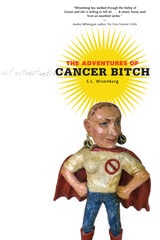
The Adventures of Cancer Bitch
S. L. Wisenberg
University of Iowa Press, 2009
Wisenberg’s writing has been compared to a mix of Leon Wieseltier and Fran Lebowitz, and in this book, she has Wieseltier’s erudition and Lebowitz’s self-deprecating cleverness: “If anybody ever offers you the choice between suffering and depression, take the suffering. And I don't mean physical suffering. I mean emotional suffering. I am hereby endorsing psychic suffering over depression.”
From The Adventures of Cancer Bitch:
I found that when you invite people to a pre-mastectomy party, they show up. Even those with small children. The kids were so young that they didn't notice that most of the food had nipples. . . . I talked to everyone—about what I'm not sure. Probably about my surgery. Everyone told me how well I looked. I felt giddy. I was going to go under, but not yet; I was going to be cut, but not yet; I was going to be bald, but not yet. As my friend who had bladder cancer says: The thing about cancer is you feel great until they start treating you for it.
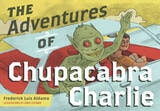
The Adventures of Chupacabra Charlie
Written by Frederick Luis AldamaIllustrated by Chris Escobar
The Ohio State University Press, 2020
With magical realism, allegory, and gentle humor, Aldama and Escobar have created a story that will resonate with young and old readers alike as it incorporates folklore into its subtle take on the current humanitarian crisis at the border.

The Adventures of Lindamira
A Lady of QualityBenjamin Boyce, Editor
University of Minnesota Press, 1949
The Adventures of Lindamira was first published in 1949. Minnesota Archive Editions uses digital technology to make long-unavailable books once again accessible, and are published unaltered from the original University of Minnesota Press editions.
The Adventures of Lindamira, A Lady of Quality. Written by her own hand, to her Friend in the Country. In IV Parts. Revised and Corrected by Mr. Tho. Brown (London, 1702) is a very rare but important and interesting early English novel. This work was reissued in 1713 as The Lover's Secretary: or the Adventures of Lindamira, and again, with the same title, in 1734, 1745, and 1751.
Lindamira is remarkable historically as one of the earliest epistolary novels in English and also as one of the first pieces of extended prose fiction to enter the gap between the risque, realistic romance on one hand and the artificial French romance of court life on the other. The book is entertaining and compares favorably in naturalness, humor, and plausibility with the work of the contemporary Mrs. Behn, Congreve, and even Defoe.
Most historians have been unfamiliar with the work for the good reason that few copies have survived. The British Museum, Yale, University of Pennsylvania, Newberry, and Brown University have copies of the second or later edition. The only known copy of the first edition is in the Library of the University of Minnesota, and it is from this copy of the first edition that the University of Minnesota Press has reprinted this edition.
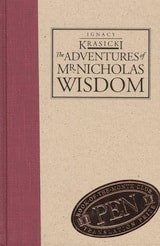
The Adventures of Mr. Nicholas Wisdom
Ignacy Krasicki
Northwestern University Press, 1992
Winner, 1993 PEN Book-of-the-Month Club Translation Prize
Published in 1776 and considered the first Polish novel ever written, The Adventures of Mr. Nicholas Wisdom is a picaresque tale following the naïve title character's coming of age. Having conquered (and fled) sophisticated Warsaw, Nicholas enjoys many adventures across Europe, South America, and the high seas. He finally lands among the natives of an unknown isle who reject his allegedly superior European ways and instead tutor him for an "enlightened" existence. Resonant with Enlightenment ideas, The Adventures of Mr. Nicholas Wisdom provides a sly portrait of the era's Polish society and a fascinating perspective on the broader problems of eighteenth-century European culture.
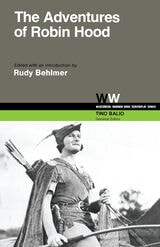
The Adventures of Robin Hood
Edited, with an introduction by Rudy Behlmer; Tino T. Balio, Series Editor
University of Wisconsin Press, 1979
For sheer screen entertainment, few motion pictures have ever matched the 1938 Warner Brothers production of The Adventures of Robin Hood. Even today, after more than four decades. Errol Flynn's dashing performance places this picture high in any list of all-time favorites.
It is one of the most studied of motion pictures, not only because of its popularity but also because of the extremely high level of talent brought to bear in its creation and the sharply honed production and editing techniques that allow an incredible amount of action and movement in the 102 minutes of the film.
Includes the complete screenplay.
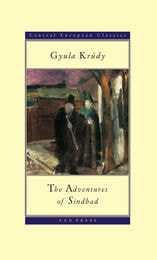
The Adventures of Sindbad
Gyula Krúdy
Central European University Press, 1998
In these marvellously written tales, Sindbad, a voyager in the realms of memory and imagination, travels through the centuries in pursuit of an ideal of love that is directed as much at the feminine essence as at his individual lovers. He is by nature a melancholy sensualist, but whether the women he seduces and loves are projections of his desire, or he of theirs, is a moot question.
These short stories flow without a strict narrative framework Sindbad journeys between the past and the present and is merely a ghost in many of his adventures. Although Sindbad can move through time, it is time that proves his chief enemy, and youth that remains his real love. This deeply autumnal book, full of resonances and associations, is an erotic elegy to the dying Habsburg Empire.
The stories are taken from the omnibus triple-volume Hungarian edition published as The Three Books of Sindbad in Hungary in 1944, which includes The Travels of Sindbad (1912), The Resurrection of Sindbad (1916), and The Youth and Grief of Sindbad (1917).
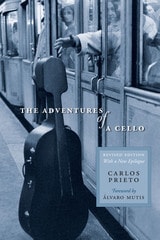
The Adventures of a Cello
Revised Edition, with a New EpilogueBy Carlos Prieto
University of Texas Press, 2011
In 1720, Antonio Stradivari crafted an exquisite work of art—a cello known as the Piatti. Over the next three centuries of its life, the Piatti cello left its birthplace of Cremona, Italy, and resided in Spain, Ireland, England, Italy, Germany, and the United States. In 1978, the Piatti became the musical soul mate of world-renowned cellist Carlos Prieto, with whom it has given concerts around the world.
In this delightful book, Mr. Prieto recounts the adventurous life of his beloved "Cello Prieto," tracing its history through each of its previous owners from Stradivari in 1720 to himself. He then describes his noteworthy experiences of playing the Piatti cello, with which he has premiered some eighty compositions. In this part of their mutual story, Prieto gives a concise summary of his own remarkable career and his relationships with many illustrious personalities, including Igor Stravinsky, Dmitry Shostakovich, Pablo Casals, Mstislav Rostropovich, Yo-Yo Ma, and Gabriel García Márquez. A new epilogue, in which he describes recent concert tours in Moscow, Siberia, and China and briefer visits to South Korea, Taiwan, and Venezuela, as well as recent recitals with Yo-Yo Ma, brings the story up to 2009.
To make the story of his cello complete, Mr. Prieto also provides a brief history of violin making and a succinct review of cello music from Stradivari to the present. He highlights the work of composers from Latin America, Spain, and Portugal, for whose music he has long been an advocate and principal performer.
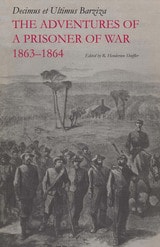
The Adventures of a Prisoner of War, 1863–1864
By Decimus et Ultimus Barziza. Edited by R. Henderson Shuffler
University of Texas Press, 1964
This journal is the exciting personal narrative of a Texan who was a prisoner of the Union Army during the Civil War, escaped to Canada, and finally made his way back into the Confederacy through the blockade. It was written while the war was still in progress.
The journal was issued anonymously in Houston early in 1865. Its author, Decimus et Ultimus Barziza, was a colorful, competent, truly remarkable Texan—well educated, well traveled, and sophisticated as an observer. Barziza came to Texas from Virginia in 1857. He left a growing law practice at Owensville to enter Confederate service as first lieutenant of the “Robertson Five-Shooters,” an infantry company which was one of the original units of the Fourth Texas Infantry, Hood’s Brigade. After fighting in many battles, he was wounded at Gettysburg and left lying on the field. The Yankees picked him up and imprisoned him at Johnson’s Island.
A year later, as Barziza was being shipped to another prison, he escaped by diving through a window of the moving train at midnight. Making his way across Pennsylvania to New York, he took a train for Canada. There he became one of the first beneficiaries of an underground system which eventually returned him to North Carolina. Too ill from his wounds and the hardships of his escape to return to active duty, he spent the next few months writing his memoirs. They cover the period from the drive for Gettysburg to Barziza’s return to the Confederacy.
Before the original publication of this book, only two copies of The Adventures of a Prisoner of War were known to exist. R. Henderson Shuffler, then director of the Texana program of the University of Texas, felt that it was intriguing and important enough to merit editing for republication. The journal has the further attraction of describing the then little-known machinery which was set up in Canada to help Rebel soldiers who had escaped Northern prisons make their way back to the Confederacy by way of Nova Scotia and Bermuda.
Shuffler supplements the narrative with limited yet helpful documentation, providing introductory sections explaining Barziza’s background and his career as a Texas legislator and lawyer, as well as carrying the war story up to the sequence where Barziza’s account begins.
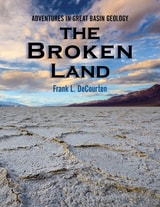
The Broken Land
Adventures in Great Basin GeologyFrank DeCourten
University of Utah Press, 2003
"The desert may seem timeless from within the Yellow Circle tonight, but the permanence of the surrounding landscape is only an illusion. Even the land is alive here, constantly changing and evolving as do all living things. Nothing here is 'finished.' Everything around us—the plants, the animals, the rocks, and the terrain itself—is in the process of becoming something else. And, of course, so are we. None of us around the campfire tonight are the same people we were yesterday, or will be tomorrow."—from the book
The Broken Land surveys the geological phenomena of the magnificent Great Basin landscape of western Utah, Nevada, eastern California, and adjacent regions. Each chapter focuses on a locality or area that provides insight into the deep history of one of North America's most remote regions—one of its continental margins. It is the only book available covering the geology of the entire Great Basin. Written for anyone with a casual to serious interest in natural history, The Broken Land conveys Frank DeCourten's awe at the story written in the rock of the basin.
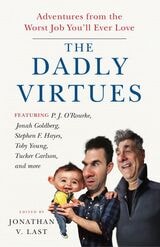
The Dadly Virtues
Adventures from the Worst Job You'll Ever LoveJonathan V. Last
Templeton Press, 2015
The Dadly Virtues is a tongue-in-cheek collection of encouragement and guidance for any stage of fatherhood, from pacifying babies to prepping for senior prom, from cutting the cord to getting the first, “Best Grandpa” t-shirt. P.J. O’Rourke sets the stage with the chapter, “What Do Men Get from Fatherhood? Besides What They Put In …” and then is followed by:
•Matthew Continetti’s, “Newborn Terror: The Moment You Realize that ‘Bundle of Joy’ Is a Euphemism for Something Very Different.”
•Stephen F. Hayes’ “Siblings: The Best Gift You’ll Ever Give Your Kids.”
•Jonah Goldberg’s “Get Your Kid a Dog: The Moral Case for Pets.”
•Tucker Carlson’s “In Praise of Adventure: How to Fill a Child’s Life with Excitement and Danger (without Getting Them Killed).”
•Michael Graham’s, “Dating: Enjoy the Movie and Please Keep the Impregnation to a Minimum.”
•Christopher Caldwell’s “College: It’s Not as Bad as You Think; It’s Worse.”
•Andrew Ferguson’s “Emerging Adults and Empty Nesters: Just When You Had Fatherhood All Figured Out.”
•Toby Young’s “The Dark Side: Bad Parenting and the Things We Think, but Do Not Say.”
•Joseph Epstein’s “Thanks, Grandpa: Grandfatherhood and the Spirit of the Age.”
•And more.
Father-to-be, two-time-dad, or granddad, each essay will make you laugh and, at the same time, reinforce your commitment to the virtuous—the dadly—life.
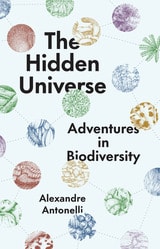
The Hidden Universe
Adventures in BiodiversityAlexandre Antonelli
University of Chicago Press, 2022
We are now living in an environmental emergency. As climate change, habitat loss, and other threats have placed almost one-fifth of all species on Earth at risk of extinction in the coming decades, a deeper understanding of biodiversity has never been more important. Biodiversity encompasses the rich variety of all life on Earth—the building blocks of life that provide invaluable sources of food, medicine, clothing, building materials, and more.
Marking the arrival of a bold new voice in popular science, The Hidden Universe shows readers what’s at stake in the fight to protect and restore biodiversity, but also what can and should be done now to protect our planet and ourselves for the future. As director of science at one of the world’s largest research organizations in plant and fungal sciences, Brazilian-born scientist Alexandre Antonelli is ideally suited to reveal the wonders of biodiversity at a genetic, species, and ecosystem level—what biodiversity is, how it works, and why it is the most important tool in our battle against climate change. Antonelli offers recommendations for large-scale political changes, as well as smaller, practical steps that readers can implement in their own lives and homes. With Antonelli as our guide, The Hidden Universe helps us imagine a future where biodiversity is not just preserved but cherished.
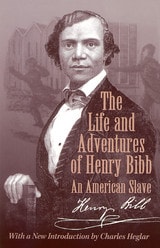
The Life and Adventures of Henry Bibb
An American SlaveHenry Bibb
University of Wisconsin Press, 2001
First published in 1849 and largely unavailable for many years, The Life and Adventures of Henry Bibb is among the most remarkable slave narratives. Born on a Kentucky plantation in 1815, Bibb first attempted to escape from bondage at the age of ten. He was recaptured and escaped several more times before he eventually settled in Detroit, Michigan, and joined the antislavery movement as a lecturer.
Bibb’s story is different in many ways from the widely read Narrative of the Life of Frederick Douglass, An American Slave and Harriet Jacobs’ Incidents in the Life of a Slave Girl. He was owned by a Native American; he is one of the few ex-slave autobiographers who had labored in the Deep South (Louisiana); and he writes about folkways of the slaves, especially how he used conjure to avoid punishment and to win the hearts of women. Most significant, he is unique in exploring the importance of marriage and family to him, recounting his several trips to free his wife and child. This new edition includes an introduction by literary scholar Charles Heglar and a selection of letters and editorials by Bibb.
The Life and Adventures of an Arkansaw Doctor
David Rattlehead
University of Arkansas Press, 1989
The Modern Myths
Adventures in the Machinery of the Popular ImaginationPhilip Ball
University of Chicago Press, 2021
Myths are usually seen as stories from the depths of time—fun and fantastical, but no longer believed by anyone. Yet, as Philip Ball shows, we are still writing them—and still living them—today. From Robinson Crusoe and Frankenstein to Batman, many stories written in the past few centuries are commonly, perhaps glibly, called “modern myths.” But Ball argues that we should take that idea seriously. Our stories of Dracula, Dr. Jekyll and Mr. Hyde, and Sherlock Holmes are doing the kind of cultural work that the ancient myths once did. Through the medium of narratives that all of us know in their basic outline and which have no clear moral or resolution, these modern myths explore some of our deepest fears, dreams, and anxieties. We keep returning to these tales, reinventing them endlessly for new uses. But what are they really about, and why do we need them? What myths are still taking shape today? And what makes a story become a modern myth?
In The Modern Myths, Ball takes us on a wide-ranging tour of our collective imagination, asking what some of its most popular stories reveal about the nature of being human in the modern age.
Their Blood Runs Cold
Adventures with Reptiles and AmphibiansWhit Gibbons
University of Alabama Press, 1983
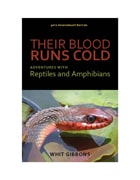
Their Blood Runs Cold
Adventures with Reptiles and AmphibiansWhit Gibbons
University of Alabama Press, 2013
Enter the fascinating world of reptiles and amphibians through the eyes of a pioneering field scientist.
Their Blood Runs Cold is entertaining, informative reading that not only enhances our understanding of a unique group of animals, but also provides genuine insight into the mind and character of a research scientist.
Whit Gibbons possesses the rare talent of conveying the challenge and excitement of scientific inquiry. A research ecologist who specializes in the study of reptiles and amphibians, he gives accounts of work in the field that are as readable as good short stories.
From the dangers of being chased by an angry rattlesnake to the exhilaration of discovering a previously undescribed species, Gibbons brings to life the everyday experiences of the herpetologist as he chases down lizards, turtles, snakes, alligators, salamanders, and frogs in their natural habitats. With essays like “Turtles May Be Slow but They’re 200 Million Years Ahead of Us” and “How to Catch an Alligator in One Uneasy Lesson,” Their Blood Runs Cold both entertains and informs.
The thirtieth anniversary edition of Their Blood Runs Cold features a new prologue and epilogue, additions that address changes in the taxonomy and study of reptiles and amphibians that have occurred since the publication of the original edition and offer suggestions for further reading that highlight the explosion of interest in the topic.
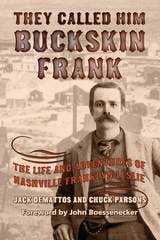
They Called Him Buckskin Frank
The Life and Adventures of Nashville Franklyn LeslieJack DeMattos
University of North Texas Press, 2018