Results by title
3576 books match the query 'American' and 770 start with t
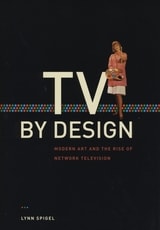
TV by Design
Modern Art and the Rise of Network TelevisionLynn Spigel
University of Chicago Press, 2008
Whereas most histories of television focus on the way older forms of entertainment were recycled for the new medium, Lynn Spigel shows how TV was instrumental in introducing the public to the latest trends in art and design. Abstract expressionism, pop art, art cinema, modern architecture, and cutting-edge graphic design were all mined for staging techniques, scenic designs, and an ever-growing number of commercials. As a result, TV helped fuel the public craze for trendy modern products, such as tailfin cars and boomerang coffee tables, that was vital to the burgeoning postwar economy. And along with influencing the look of television, many artists—including Eero Saarinen, Ben Shahn, Saul Bass, William Golden, and Richard Avedon—also participated in its creation as the networks put them to work designing everything from their corporate headquarters to their company cufflinks.
Taboo Subjects
Race, Sex, and PsychoanalysisGwen Bergner
University of Minnesota Press, 2005
Tactics of the Human
Experimental Technics in American FictionLaura Shackelford
University of Michigan Press, 2015

Tactile Sensibilities
Seeing Through Print in American ArtJuliet Sperling
University of Chicago Press, 0
A print-driven history of American art in the long nineteenth century.
Juliet Sperling’s Tactile Sensibilities uses interactive printed objects to uncover culturally instilled ideas about touch’s role in perception and shows how these frameworks were integral to ways of making and appreciating even seemingly untouchable works of painting and sculpture. Crucial to Sperling’s argument is a genre of paper constructions designed to engage the hand and eye in tandem: multilayered and lift-the-flap book plates, pull-tab engravings, foldable playbills, and spinning paper wheels that built expectations of touch as a trained, focused process into their structure and material. Intimately scaled and portable, tactile prints cut across multiple spheres of experience, including spaces in which people learned to view, understand, and create art.
Sperling reverses standard procedures for integrating prints into art history. Rather than working her way outward from canonical artworks toward ephemeral sources within the artist’s orbit, she uses previously unstudied printed materials to open period discourses of tactile sensibility that ultimately lead to art objects, unlocking new meanings behind works of painting and sculpture by artists including Raphaelle Peale, Hiram Powers, William Sidney Mount, and Winslow Homer. In treating sidelined materials as dedicated objects of study in their own right, Tactile Sensibilities reveals that in the long nineteenth century, print was an intellectually dense and powerfully connective medium, vital in mediating the tactile sensibilities that shaped ways of making and appreciating art.
Take Me with You, Wherever You're Going
Jessica Jacobs
Four Way Books, 2019
Take Nothing With You
Sarah V. Schweig
University of Iowa Press, 2016
These poems operate on the notion that the lyric can be discovered in scattered headlines, office-wide emails, road signs—the detritus of the everyday. But a poem doesn’t stop at found fragments; it creates something from them. These poems question and re-question what can be truthfully said, rediscovering the lyric in the very process of thinking, revising, and re-envisioning.
Taken In Faith
PoemsHelen Pinkerton
Ohio University Press, 2002
In 1967, Yvor Winters wrote of Helen Pinkerton, “she is a master of poetic style and of her material. No poet in English writes with more authority.” Unfortunately, in 1967 mastery of poetic style was not, by and large, considered a virtue, and Pinkerton’s finely crafted poems were neglected in favor of more improvisational and flashier talents. Though her work won the attention and praise of serious readers, who tracked her poems as they appeared in such journals as The Paris Review, The Sewanee Review, and The Southern Review, her verse has never been available in a trade book. Taken in Faith remedies that situation, bringing Pinkerton’s remarkable poems to a general audience for the first time.
Even her very earliest works embody a rare depth and seriousness. Primarily lyrical and devotional, they always touch on larger issues of human struggle and conduct. More recent poems, concerned in part with history, exhibit a stylistic as well as a thematic shift, moving away from the rhymed forms of her devotional works into a blank verse marked by a quiet flexibility and contemplative grace.
Like Virginia Adair, another poet who waited long for proper recognition, Pinkerton speaks as a woman who has lived fully and observed acutely and who has set the life and observations down in memorable verse. Taken in Faith represents a half-century of her poetic efforts.
Taken Somehow By Surprise
David Clewell
University of Wisconsin Press, 2011
David Clewell’s spirited poems cut through the noise we too often accommodate in our daily lives. Breath by surprising breath, this poet takes us into chambers of the heart that have never been mapped quite this way before. By turns raucous and strangely soothing, narrative and lyrical, Clewell traffics in unlikely and compelling details of our mostly discernible world: a school custodian’s role in the burgeoning Space Race, the vastness of abandoned missile silos, the first lawn flamingos, and the living fossil still using a typewriter.
Taking Books to the World
American Publishers and the Cultural Cold WarAmanda Laugesen
University of Massachusetts Press, 2017
In Taking Books to the World, Amanda Laugesen tells the story of this purposeful enterprise, demonstrating the mix of goodwill and political drive behind its efforts to create modern book industries in developing countries. Examining the project through a clarifying lens, she reveals the ways Franklin's work aligned with cultural currents, exposing the imperial beliefs, charitable hopes, and intellectual reasoning behind this global experiment.
Taking Care of Time
Cortney Davis
Michigan State University Press, 2018
Tales Out of School
Selected InterviewsRobert Creeley
University of Michigan Press, 1994

Tales and Sketches, vol. 1
1831-1842Edgar Allan Poe
University of Illinois Press, 1978
Poe's stories reflect his professed method of "writing as if the author were firmly impressed with the truth, yet astonished at the immensity of the wonders he related." Marrying grotesque inventiveness with superb plot construction, Poe's strikingly original tales often use only one main character and one main incident. In many of them, horror and suspense, revenge and torture, are laced with hilarious satire. Each volume is enriched with Mabbott's detailed and authoritative notes on sources, the history and collation of all known texts authorized by Poe, and variants of Poe's "final" version.
Volume 1 includes Poe's earliest parodies, beginning in 1831, and gathers his gothic tales written through 1842. The stories collected in this volume include "Ms. Found in a Bottle," the horrific "Berenice," "Ligeia" (which Poe considered his finest tale), "The Murders in the Rue Morgue," and one of his most famous stories, "The Fall of the House of Usher."
Promising spine-tingling delights and sleepless nights, this annotated edition of Tales and Sketches is a treasure trove for scholars and general readers alike, confirming Poe's status as one of literary art's "most brilliant but erratic stars."
Tales and Sketches, vol. 2
1843-1849Edgar Allan Poe
University of Illinois Press, 1978
Poe's stories reflect his professed method of "writing as if the author were firmly impressed with the truth, yet astonished at the immensity of the wonders he related." Marrying grotesque inventiveness with superb plot construction, Poe's strikingly original tales often use only one main character and one main incident. In many of them, horror and suspense, revenge and torture, are laced with hilarious satire. Each volume is enriched with Mabbott's detailed and authoritative notes on sources, the history and collation of all known texts authorized by Poe, and variants of Poe's "final" version.
Volume 2 contains stories written between 1843 and Poe's death, including "The Tell-Tale Heart," "The Purloined Letter," and "The Cask of Amontillado."
Promising spine-tingling delights and sleepless nights, this annotated edition of Tales and Sketches is a treasure trove for scholars and general readers alike, confirming Poe's status as one of literary art's "most brilliant but erratic stars."
Tales and Songs of Southern Illinois
Collected by Charles Neely
Southern Illinois University Press, 1998
First published in 1938, this lively collection of over 150 tales and songs runs the gamut from joy to woe, from horror to humor. In forming the collection, Charles Neely required only that the tales and songs—whether home grown or transplanted from the great body of world lore— had taken root somehow in the area of southern Illinois known as Egypt.
Notable tales include "Bones in the Well," "A Visit from Jesse James," "The Flight of the Naked Teamsters," "The Dug Hill Boger," and "How Death Came to Ireland"; among the songs and ballads are "Barbara Allen," "Hog and Hominy," "The Drunkard’s Lone Child," "The Belleville Convent Fire," "Shawneetown Flood," and "The Death of Charlie Burger."
Talking All Morning
Robert Bly
University of Michigan Press, 1980
Talking Back to Emily Dickinson, and Other Essays
William H. Pritchard
University of Massachusetts Press, 2009
The essays, all of them about English and American writers, are arranged chronologically, beginning with Shakespeare, an Edmund Burke, and proceeding through the nineteenth and twentieth centuries to end with contemporaries like Kinglsey Amis, V. S. Naipaul, and Doris Lessing. Pritchard writes with equal authority about poetry and fiction; the collection also includes assessments of critics such as Matthew Arnold and Thomas Carlyle, Ford Madox Ford and R. P. Blackmur.
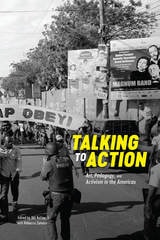
Talking to Action
Art, Pedagogy, and Activism in the AmericasBill Kelley, Jr. with Rebecca Zamora
School of the Art Institute of Chicago, 2017

Talking to Action
Spanish Language EditionBill Kelley, Jr. with Rebecca Zamora
School of the Art Institute of Chicago, 2017
This is the Spanish language edition.
Talking to Strangers
Patricia Dobler
University of Wisconsin Press, 1986
In her first book of poems, Patricia Dobler records her memories of the Ohio mill town where she grew up in the 1950s. but the poems range over time and the memories of others, as well: her immigrant Hungarian grandparents, her parent's tensions during hard times (”Years spilled on the kitchen table, / picked over like beans or old bills”), the dangers, losses, and occasional triumphs of hard-working men and women.
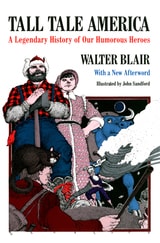
Tall Tale America
A Legendary History of our Humorous HeroesWalter Blair
University of Chicago Press, 1987
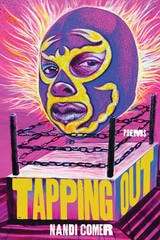
Tapping Out
PoemsNandi Comer
Northwestern University Press, 2020
The harsh realities of being migrant and immigrant, being birthright and oppressed, are as hard-pressed as the plancha move to the body. Each poem in Tapping Out is a “freestyle movement” of language and complexity put on full display, under the bright lights and roars of survival. Comer’s splendid and barbed, Detroit style of language melts the masks with searing words.
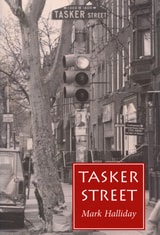
Tasker Street
Mark Halliday
University of Massachusetts Press, 1992
Tasker Street, winner of the Juniper Prize for poetry, is the second collection of poems by the acclaimed American poet Mark Halliday. Following his debut, Little Star (1987), which was selected for the National Poetry Series, Tasker Street confirmed Halliday as one of the most distinctive and engaging voices in contemporary American poetry.
Halliday's poems are marked by a restless, probing intelligence and a distinctly conversational energy. The poems in Tasker Street are personal in tone, narrative in impulse, and unafraid to range widely across the textures of everyday life: relationships, memory, desire, self-doubt, ambition, and the comic absurdities of being alive. These are poems that think out loud, circling back on themselves with a self-awareness that is at once disarming and deeply serious, even as they entertain with wit, verbal dexterity, and a refusal to settle for easy resolutions.
Drawing on the traditions of Frank O'Hara's personism and the narrative directness of the New York School, yet infused with a philosophical attentiveness honed by Halliday's scholarly engagement with the poetry of Wallace Stevens, the poems in Tasker Street balance accessibility with intellectual ambition. They invite readers into a voice that is simultaneously intimate and performative, one that embraces digression, self-interrogation, and the pleasures of language even while confronting questions of mortality, meaning, and the stubborn persistence of the self.
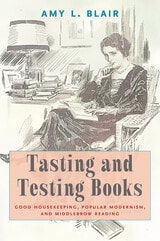
Tasting and Testing Books
Good Housekeeping, Popular Modernism, and Middlebrow ReadingAmy L. Blair
University of Massachusetts Press, 2024
A CHOICE 2025 Outstanding Academic Title
Honorable Mention, 2023-2024 Research Society of American Periodicals Book Prize
In its February 1926 issue, Good Housekeeping magazine introduced a column for its approximately one million subscribers called “Tasting and Testing Books.” The column’s author, Emily Newell Blair, would go on to produce ninety-one reading advice columns for the magazine between 1926 and 1934. During this period, Good Housekeeping became the most widely circulated periodical in the United States, doubling its circulation to over two million copies. Much of its popularity stemmed from its intensive promotion of its Seal of Approval for a variety of products, which brought consumers to it for utilitarian purposes. With her focus on regular books, Blair distinguished herself from highbrow literary critics, many of whom have been objects of study as High Modernists. She offered advice to help middle-class women readers make their own choices about the best books in which to invest time and money, rather than dictating what they should or should not read. She aligns herself with the average subscriber, outside the book publishing and reviewer industries, focusing on books that would now be termed middlebrow reading.
Blair’s time at Good Housekeeping covers the era from the heights of the “Roaring Twenties” to the depths of the Great Depression, and her recommendations offer a window into the uses of middlebrow reading during this period of dramatic economic and social shifts. Tasting and Testing Books argues that the consumer-first message of Good Housekeeping infused Blair’s advice column and validated a new attitude of proudly middlebrow pleasure reading in the mid-twentieth century. These columns shed new light on the reading lives of too-often overlooked women, often living outside of urban centers and away from elite literary circles, and present Emily Newell Blair, who strongly identified with her readers as a truly democratic tastemaker.
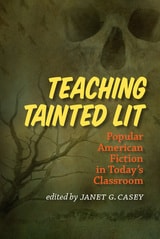
Teaching Tainted Lit
Popular American Fiction in Today's ClassroomJanet G. Casey
University of Iowa Press, 2015
The essays in this collection presume that the popular is here to stay and that its instructive implications are not merely noteworthy, but richly nuanced and deeply compelling. They address a broad variety of issues concerning canonicity, literature, genre, and the classroom, as its contributors teach everything from Stephen King and Lady Gaga to nineteenth-century dime novels and the 1852 best-seller Uncle Tom’s Cabin.
It is no secret that teaching popular texts fuels controversies about the value of cultural studies, the alleged relaxation of aesthetic standards, and the possible “dumbing down” of Americans. By implicitly and explicitly addressing such contentious issues, these essays invite a broader conversation about the place of the popular not only in higher education but in the reading lives of all Americans.
TechnoRage
PoemsWilliam Olsen
Northwestern University Press, 2017
Teeth
Aracelis Girmay
Northwestern University Press, 2007
LOVE,
you be the reason why
we swagger & jive,
lift the guitar, & pick up the axe.
when it is i tilt my hat to the side,
wearing colors & perfumes, it's cause, love,
you did it to me. oh,
you do sure turn my tongue to fiddle,
& make the salt taste sweet. man,
i don't need a rooster, or peacock even,
to help me spend my time, nope,
just you, love, right & solid as
a line.
Telling Incest
Narratives of Dangerous Remembering from Stein to SapphireJanice Doane and Devon Hodges
University of Michigan Press, 2001
Examining the work of writers from Gertrude Stein to Toni Morrison and Dorothy Allison, Telling Incest argues that an incest story's plausibility depends upon a shifting set of narrative conventions and cultural expectations. As contexts for telling incest stories have changed, so too have the tasks of those who tell and those who listen. The authors analyze both fictional and nonfiction narratives about father-daughter incest, beginning by scrutinizing the shadowy accounts found in nineteenth-century case records, letters, and narratives.
Telling Incest next explores African American stories that shift the blame for incest from the black family to the predations of a paternalistic white culture. Janice Doane and Devon Hodges demonstrate that writers drew upon this reworked incest narrative in the 1970s and early 1980s in order to relate a feminist story about incest, a story that criticizes patriarchal power. This feminist form of the story, increasingly emphasizing trauma and recovery, can be found in such popular books as Alice Walker's The Color Purple and Jane Smiley's A Thousand Acres. Doane and Hodges then examine recent memoirs and novels such as Dorothy Allison's Bastard Out of Carolina and Sapphire's Push, narratives that again rework the incest story in an effort to "tell" about women's complex experiences of subjugation and hope.
Telling Incest will be of particular interest to readers who have enjoyed the popular and culturally significant work of writers such as Alice Walker, Toni Morrison, Jane Smiley, and Dorothy Allison and to students of women's studies, feminist theory, and cultural studies.
Janice Doane is Professor of English, St. Mary's College of California. Devon Hodges is Professor of English, George Mason University. They have also coauthored From Klein to Kristeva: Psychoanalytic Feminism and the Search for the "Good Enough" Mother and Nostalgia and Sexual Difference: The Resistance to Contemporary Feminism.
Telling It Slant
Avant Garde Poetics of the 1990SMark Wallace
University of Alabama Press, 2001
The finest essays from the newest generation of critics and poet-critics are gathered together in this volume documenting the growth in readership and awareness of avant-garde poetries.
This collection demonstrates the breadth and openness of the field of avant-garde poetry by introducing a wide range of work in poetics, theory, and criticism from emerging writers. Examining the directions innovative poetry has taken since the emergence and success of the Language movement, the essays discuss new forms and the reorientation of older forms of poetry in order to embody present and ongoing involvements. The essays center around four themes: the relation between poetics and contemporary cultural issues; new directions for avant-garde practices; in-depth explorations of current poets and their predecessors; and innovative approaches to the essay form or individual poetics.
Diverging from the traditional, linear argumentative style of academic criticism, many of the essays in this collection instead find critical forms more subtly related to poetry. Viewed as a whole, the essays return to a number of shared issues, namely poetic form and the production of present-day poetry. While focusing on North American poetry, the collection does reference the larger world of contemporary poetics, including potential biases and omissions based on race and ethnicity.
This is cutting-edge criticism at its finest, essential reading for students and scholars of avant-garde poetry, of interest to anyone interested in contemporary American literature and poetry.
Telling Rhythm
Body and Meaning in PoetryAmittai Aviram
University of Michigan Press, 1994
Templates for Authorship
American Women's Literary Autobiography of the 1930sWindy Counsell Petrie
University of Massachusetts Press, 2021
Windy Counsell Petrie considers twelve autobiographies from a diverse group of writers, ranging from highbrow modernists such as Gertrude Stein and Harriet Monroe to popular fiction writers like Edith Wharton and Edna Ferber, and lesser known figures such as Grace King and Carolyn Wells. Since there were few existing examples of women's literary autobiography, these writers found themselves marketed and interpreted within four cultural templates: the artist, the activist, the professional, and the celebrity. As they wrote their life stories, the women adapted these templates to counter unwanted interpretations and resist the sentimental feminine traditions of previous generations with innovative strategies of deferral, elision, comedy, and collaboration. This accessible study contends that writing autobiography offered each of these writers an opportunity to define and defend her own literary legacy.
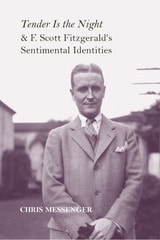
Tender Is the Night and F. Scott Fitzgerald's Sentimental Identities
Chris Messenger
University of Alabama Press, 2015
In “Tender Is the Night” and F. Scott Fitzgerald’s Sentimental Identities, Messenger traces the roots of Fitzgerald’s writing career to the deaths of his two infant sisters a few months before his own birth. It was their loss, Fitzgerald wrote, that made him a writer. Messenger highlights how the loss of Fitzgerald’s siblings powerfully molded his relation to maternal nurturing and sympathy in Tender Is the Night as well as how it shaped the homosocial intimations of its care-giving protagonist, psychiatrist Dick Diver. A concomitant grief and mourning was fueled by Fitzgerald’s intimate and intense creative rivalry with his often-institutionalized wife, Zelda Sayre Fitzgerald.
While sentiment is a discredited strain in high modernism, Fitzgerald nevertheless embraced it in Tender Is the Night to fashion this most poignant and beautiful successor to The Great Gatsby. Fitzgerald’s aesthetic and emotional preoccupations came most vividly to life in this major novel. Messenger describes how Fitzgerald, creating his character Nicole Warren Diver as a victim of paternal incest, finally found the sentimental key to finishing his novel and uniting his vision of the two narratives of “saving” the two sisters and reimagining the agony of his wife and their marriage.
Fitzgerald’s productive quarrel with and through sentiment defines his career, and Messenger convincingly argues that Tender Is the Night should be placed alongside TheGreat Gatsby as a classic exemplar of the modern novel.
Terminal Diagrams
PoemsGarrick Davis
Ohio University Press, 2010
Garrick Davis’s Terminal Diagrams may have been inspired by the illustrated maps in airport lounges, or perhaps they are the blueprints of the Apocalypse, with their subjects and objects representing the bitter fruits of either some future nightmare or the present world. Regardless, their vision is so bleak and unsparing, only a few will be able to savor them. Here, the art of poetry has been mechanized just as the world has been mechanized. Whether his subject is a car accident on the freeways of Los Angeles or the Book of Revelation transmitted by television, Davis’s stanzas conjure a kind of futuristic noir. In poem after poem, he examines the artistic possibilities of the machine, and its alterations of human experience, with a modern spirit that—as Baudelaire defined it—has embraced “the sublimity and monstrousness of something new.”
Terrae Nullius
Selected Geographies 2001-2021William L. Fox
University of Nevada Press, 2027
The Alaska Pipeline becomes a line of poetry, a line in the land—the beginning of an epic and the end of an era. A map in the Antarctic becomes the ground beneath the reader’s feet, erasing itself with every step. A monk in a monastery beneath Mount Everest writes a prayer as the mountain traces a contrail across the upper atmosphere, inscribing a path to be followed.
In each place, William L. Fox reveals how the world leaves its mark on us—and how, through language, we move toward a sense of belonging. His spare, minimalist poems inhabit the planet’s wide empty spaces: Nevada’s Great Basin, the Antarctic and Arctic, the red deserts of interior Australia, the immense playas of Chile’s Atacama, and beyond. Between and within these lines, the poems explore how land becomes landscape, how terrain becomes territory, and how meaning is made.
Terrible Swift Sword
The Legacy of John BrownPeggy A. Russo
Ohio University Press, 2005
More than two centuries after his birth and almost a century and a half after his death, the legendary life and legacy of John Brown go marching on. Variously deemed martyr, madman, monster, terrorist, and saint, he remains one of the most controversial figures in America’s history. Brown’s actions in Kansas and in Harpers Ferry, West Virginia, were major catalysts for the American Civil War, and continue today to evoke praise or condemnation.
Through the prisms of history, literature, psychology, criminal justice, oral history, African American studies, political science, film studies, and anthropology, Terrible Swift Sword offers insights not only into John Brown’s controversial character and motives but also into the nature of a troubled society before, during, and after the Civil War. The contributors discuss reasons why Brown’s contemporaries supported him, analyze Brown’s behavior and his depiction in literature, and examine the iconography and mythology surrounding him.
The interdisciplinary focus brought by editors Peggy A. Russo and Paul Finkelman makes this collection unique. Terrible Swift Sword: The Legacy of John Brown will appeal to a broad audience of readers interested in this turbulent moment in American history.
Testaments
Two Novellas of Emigration and ExileDanuta Mostwin
Ohio University Press, 2005
Translated from Polish by Marta Erdman and Nina Dyke.
Polish émigrés have written poignantly about the pain of exile in letters, diaries, and essays; others, more recently, have recreated Polish-American communities in works of fiction. But it is Danuta Mostwin’s fiction, until now unavailable in English translation, that bridges the divide between Poland and America, exile and emigration.
Mostwin and her husband survived the ravages of World War II, traveled to Britain, and then emigrated to the United States. Mostwin devoted her scholarly career to the study of immigrants trapped between cultural worlds. Winner of international awards for her fiction, Danuta Mostwin here offers two novellas, translated by the late Marta Erdman, which are the first of her works published in English in the United States.
Deeply melancholic and moving in its unsentimental depiction of ordinary people trying to make sense of their uprooted lives, Testaments presents two powerful vignettes of life in immigrant America, The Last Will of Blaise Twardowski and Jocasta. This timely publication provides an introduction to Mostwin’s work that will ensure that she is recognized as the creator of one of the most nuanced and deeply moving pictures of emigration and exile in Polish-American literature.

Texas on the Table
People, Places, and Recipes Celebrating the Flavors of the Lone Star StateBy Terry Thompson-Anderson, Photos by Sandy Wilson
University of Texas Press, 2014
With a bounty of locally grown meats and produce, artisanal cheeses, and a flourishing wine culture, it’s a luscious time to be cooking in Texas. From restaurant chefs to home cooks, Texans are going to local dairies, orchards, farmers’ markets, ranches, vineyards, and seafood sellers to buy the very freshest ingredients, whether we’re cooking traditional favorites or the latest haute cuisine. We’ve discovered that Texas terroir—our rich variety of climates and soils, as well as our diverse ethnic cultures—creates a unique “taste of place” that gives Texas food a flavor all its own.
Written by one of Texas’s leading cookbook authors, Terry Thompson-Anderson, Texas on the Table presents 150 new and classic recipes, along with stories of the people—farmers, ranchers, shrimpers, cheesemakers, winemakers, and chefs—who inspired so many of them and who are changing the taste of Texas food. The recipes span the full range from finger foods and first courses to soups and breads, salads, seafood, chicken, meat (including wild game), sides and vegetarian dishes, and sweets. Some of the recipes come from the state’s most renowned chefs, and all are user-friendly for home cooks. Finally, the authors and winemakers tell which recipes they turn to when opening their favorite wines.
This delicious compilation of recipes and stories of the people behind them, illustrated with Sandy Wilson’s beautiful photographs, makes Texas on the Table the must-have cookbook for everyone who relishes the flavors of the Lone Star State.
Textual Contraception
Birth Control and Modern American FictionBeth Widmaier Capo
The Ohio State University Press, 2007
Merging cultural analysis and literary scholarship, this compelling work moves from a consideration of how cultural forces shaped literary production and political activism to a close examination of how fictional representations of contraception influenced the terms of public discourse on marriage, motherhood, economics, and eugenics.
By analyzing popular fiction such as Mother by Kathleen Norris, radical periodicals such as The Masses and Birth Control Review, and literature by authors from Theodore Dreiser to William Faulkner, and Nella Larsen to Mary McCarthy, Beth Widmaier Capo reveals the rich cross-influence of contraceptive and literary history.
That Kind of Happy
Maggie Dietz
University of Chicago Press, 2016
If I slept too long, forgive me.
A north wind quickened the window frames
so the room pitched like a moving train
and the pillow’s whiff of hickory
and shaving soap conjured your body
beside me. So I slept in the berth
as the train chuffed on, unburdened
by waking’s cold water, ignorant
of pain, estrangement, hunger and
the crucial fuel the boiler burned
to keep the minutes’ pistons churning
while I slept. Forgive me.
That Kind of Happy, the long-awaited second collection by award-winning poet Maggie Dietz, explores the sharp, profound tension between a disquieted inner life and quotidian experience. Central to the book are poems that take up two major life events: becoming a mother and losing a father within a short stretch of time. Here, at the intersection of joy and grief, of persistence and attrition, Dietz wrestles with the questions posed by such conflicting experiences, revealing a mind suspicious of quick fixes and dissatisfied with easy answers. The result is a book as anguished as it is distinguished.
That Self-Forgetful Perfectly Useless Concentration
Alan Shapiro
University of Chicago Press, 2016
In this book, Shapiro brings his characteristic warmth, humor, and many years as both poet and teacher to bear on questions surrounding two preoccupations: the role of conventions—of literary and social norms—in how we fashion our identities on and off the page, and how suffering both requires and resists self-expression. He sketches affectionate portraits of his early teachers, revisits the deaths of his brother and sister, and examines poems that have helped him navigate troubled times. Integrating storytelling and literary analysis so seamlessly that art and life become extensions of each other, Shapiro embodies in his lively prose the very qualities he celebrates in the poems he loves.
Brimming with wit and insight, this is a book for poets, students and scholars of poetry, teachers of literature, and everyone who cares about the literary arts and how they illuminate our personal and public lives.

The "Counterfeit" Man
The True Story of the Boorn-Colvin Murder CaseGerald W. McFarland
University of Massachusetts Press, 1993
The (Other) American Traditions
Nineteenth-Century Women WritersWarren, Joyce W
Rutgers University Press, 1993
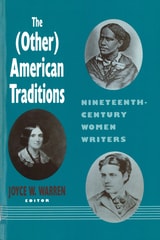
The American literary canon has been the subject of debate and change for at least a decade. As women writers and writers of color are being rediscovered and acclaimed, the question of whether they are worthy of inclusion remains open.
The (Other) American Traditions brings together for the first time in one place, essays on individual writers and traditions that begin to ask the harder questions. How do we talk about these writers once we get beyond the historical issues? How is their work related to their male counterparts? How is it similar: how is it different? Are differences related to gender or race or class? How has the selection of books in the literary canon (Melville, Hawthorne, Emerson, and James) led to a definition of the American tradition that was calculated to exclude women? Do we need a new critical vocabulary to discuss these works? Should we stop talking about a tradition and begin to talk about many traditions? How did black American women writers develop strategies for speaking out when they were doubly in jeopardy of being ignored as blacks and as women? The volume offers irrefutable proof that the writers, the critics who work on their texts, all these questions, and the expansion of the canon matter very much indeed.
Contributors: Nina Baym, Deborah Carlin, Joanne Dobson, Josephine Donovan, Judith Fetterley, Frances Smith Foster, Susan K. Harris, Karla F.C. Holloway, Paul Lauter, Diane Lichtenstein, Carla L. Peterson, Carol J. Singley, Jane Tompkins, Joyce W. Warren and Sandra A. Zagarell.
The 44th of July
Jaswinder Bolina
Omnidawn, 2019
In The 44th of July, Jaswinder Bolina offers bracing and often humorous reflections on American culture through the lens of an alienated outsider at a deliberately uncomfortable distance that puts the oddities of the culture on full display. Exploring the nuances of life in an America that doesn’t treat you as one of its own, yet whose benefits still touch your life, these exquisitely crafted poems sing in a kaleidoscopic collaging of language the mundane, yet surreal experience of being in between a cultural heritage of migration and poverty and daily life in a discriminatory yet prosperous nation. Both complicit in global capitalism and victims of the inequality that makes it possible, these are the Americans who are caught in a system with no clear place for them. Bolina opens the space to include the excluded, bringing voice and embodied consciousness to experiences that are essential to Americanness, but get removed from view in the chasms between self and other, immigrant and citizen.

The Absent Man
The Narrative Craft of Charles W. ChesnuttCharles Duncan
Ohio University Press, 1998
As the first African-American fiction writer to achieve a national reputation, Ohio native Charles W. Chesnutt (1858–1932) in many ways established the terms of the black literary tradition now exemplified by such writers as Toni Morrison, Alice Walker, and Charles Johnson.
Following the highly autobiographical nonfiction produced by Frederick Douglass, Harriet Jacobs, and other slave narrative writers, Chesnutt’s complex, multi-layered short fiction transformed the relationship between African-American writers and their readers. But despite generous praise from W. D. Howells and other important critics of his day, and from such prominent readers as William L. Andrews, Henry Louis Gates, Jr., and Eric Sundquist in ours, Chesnutt occupies a curiously ambiguous place in American literary history.
In The Absent Man, Charles Duncan demonstrates that Chesnutt’s uneasy position in the American literary tradition can be traced to his remarkable narrative subtlety. Profoundly aware of the delicacy of his situation as a black intellectual at the turn of the century, Chesnutt infused his work with an intricate, enigmatic artistic vision that defies monolithic or unambiguously political interpretation, especially with regard to issues of race and identity that preoccupied him throughout his career.
In this first book-length study of the innovative short fiction, Duncan devotes particular attention to elucidating these sophisticated narrative strategies as the grounding for Chesnutt’s inauguration of a tradition of African-American fiction.
The Absurd Hero in American Fiction
Updike, Styron, Bellow, SalingerBy David D. Galloway
University of Texas Press, 1981
When The Absurd Hero in American Fiction was first released in 1966, Granville Hicks praised it in a lead article for the Saturday Review as a sensitive and definitive study of a new trend in postwar American literature. In the years that followed, David Galloway’s analysis of the writings of John Updike, William Styron, Saul Bellow, and J. D. Salinger became a standard critical work, an indispensable tool for readers concerned with contemporary American literature. The New York Times described the book as “a seminal study of the modern literary imagination."
David Galloway, himself an established novelist, later extensively revised The Absurd Hero to include authoritative discussions of more than a dozen novels which had appeared since the first revised edition was released in 1970. Among them are John Updike’s Couples, Rabbit Redux, and The Coup; William Styron’s The Confessions of Nat Turner and Sophie’s Choice; and Saul Bellow’s Mr. Sammler’s Planet and Humboldt’s Gift. Through detailed analyses of these works, Galloway demonstrates the continuing relevance of his own provocative concept of the absurd hero and provides important insights into the literary achievements of four of America’s most influential postwar novelists.
The Accounts
Katie Peterson
University of Chicago Press, 2013

The Advocates of Poetry
A Reader of American Poet-Critics of the Modernist EraR S Gwynn
University of Arkansas Press, 1996

The Afterlife of Objects
Dan Chiasson
University of Chicago Press, 2002
The Afterlife of Sympathy
Reading American Literary Realism in the Wake of "Uncle Tom’s Cabin"Faye Halpern
University of Massachusetts Press, 2024
Literary realism rose to prominence in postbellum America with what the realists heralded as artful and accurate depictions of the world. Realism is thought to have replaced sentimentality—an earlier mode of writing the realists disparaged, which has often been seen as antithetical to realism. Literary scholar Faye Halpern challenges this apparent binary by uncovering how and why William Dean Howells, Mark Twain, Henry James, Constance Fenimore Woolson, and Charles Chesnutt incorporated sentimental elements into their most famous works.
With its distinctively narratological approach, The Afterlife of Sympathy offers a more rhetorical way to understand sentimentality and assess the ethical complexity of sympathy. Halpern demonstrates how sentimentality enables authors to form intimate relationships between their characters and readers to supplement the critical distance that realist writers otherwise celebrate and that has remained a key value in literary studies today. In reassessing American literary realism, Halpern seeks not only to understand why these writers adopted sentimental techniques but to provide insight into contemporary arguments in literary studies about critical distance and sympathetic identification.

The Afterlife of Taste Hierarchies in Contemporary U.S. Art and Literature
Rooney, Monique
University of Iowa Press, 2026
Connecting literary studies, media theory, and cultural criticism, The Afterlife of Taste Hierarchies in Contemporary U.S. Art and Literature offers a fresh vocabulary for understanding how we evaluate art and each other in an age of digital mediation. Drawing on works and artifacts ranging from Beyoncé’s Lemonade and Andrea Long Chu’s “China Brain” to Ottessa Moshfegh’s My Year of Rest and Relaxation and the viral Bernie Sanders mittens meme, Monique Rooney traces how aspirations to refinement and gestures of condescension—once associated with high-, middle-, and lowbrow culture—continue to define aesthetic experience. This book moves between literary and popular forms, attending as closely to the meme’s dispersed creativity as to the novel’s intentional aesthetics.
The Afterlives of Specimens
Science, Mourning, and Whitman's Civil WarLindsay Tuggle
University of Iowa Press, 2017
Grounded in archival discoveries, Afterlives traces the origins of nineteenth-century America’s preservation compulsion, illuminating the influences of botanical, medical, spiritualist, and sentimental discourses on Whitman’s work. Tuggle unveils previously unrecognized connections between Whitman and the leading “medical men” of his era, such as the surgeon John H. Brinton, founding curator of the Army Medical Museum, and Silas Weir Mitchell, the neurologist who discovered phantom limb syndrome. Remains from several amputee soldiers whom Whitman nursed in the Washington hospitals became specimens in the Army Medical Museum.
Tuggle is the first scholar to analyze Whitman’s role in medically memorializing the human cadaver and its abandoned parts.