Results by title
975 books match the query 'Case studies' and 152 start with t
Tactical Urbanism for Librarians
Quick, Low-Cost Ways to Make Big ChangesKaren Munro
American Library Association, 2017
Taking Society's Measure
A Personal History of Survey ResearchHerbert Hyman
Russell Sage Foundation, 1991

Teaching Information Literacy Online
Trudi E. Jacobson
American Library Association, 2011
Teaching in the Terrordome
Two Years in West Baltimore with Teach for AmericaHeather Kirn Lanier
University of Missouri Press, 2012

Technological Shortcuts to Social Change
Amitai Etzioni
Russell Sage Foundation, 1973

Technological Turf Wars
A Case Study of the Computer Antivirus IndustryJessica Johnston
Temple University Press, 2008
In Technological Turf Wars, Jessica Johnston analyzes the tensions and political dilemmas that coexist in the interrelationship among science, technology and society. Illustrating how computer security is as concerned with social relationships as it is with technology, Johnston provides an illuminating ethnography that considers corporate culture and the workplace environment of the antivirus industry.
Using a qualitative, interdisciplinary approach, which combines organizational and security studies with critical and social analysis of science and technology, Johnston questions the motivations, contradictions and negotiations of antivirus professionals. She examines the tensions between the service ethics and profit motives—does the industry release viruses to generate demand for antivirus software?—and considers the dynamics within companies by looking at facets such as gender bias and power politics. Technological Turf Wars is an informed, enlightened and entertaining view of how the production of computer security technology is fraught with social issues.
Technologies of Suspicion and the Ethics of Obligation in Political Asylum
Bridget M. Haas
Ohio University Press, 2019
Across the globe, migration has been met with intensifying modes of criminalization and securitization, and claims for political asylum are increasingly met with suspicion. Asylum seekers have become the focus of global debates surrounding humanitarian obligations, on the one hand, and concerns surrounding national security and border control, on the other. In Technologies of Suspicion and the Ethics of Obligation in Political Asylum, contributors provide fine-tuned analyses of political asylum systems and the adjudication of asylum claims across a range of sociocultural and geopolitical contexts.
The contributors to this timely volume, drawing on a variety of theoretical perspectives, offer critical insights into the processes by which tensions between humanitarianism and security are negotiated at the local level, often with negative consequences for asylum seekers. By investigating how a politics of suspicion within asylum systems is enacted in everyday practices and interactions, the authors illustrate how asylum seekers are often produced as suspicious subjects by the very systems to which they appeal for protection.
Contributors: Ilil Benjamin, Carol Bohmer, Nadia El-Shaarawi, Bridget M. Haas, John Beard Haviland, Marco Jacquemet, Benjamin N. Lawrance, Rachel Lewis, Sara McKinnon, Amy Shuman, Charles Watters
Technology Disaster Response and Recovery Planning
A LITA GuideMary Mallery
American Library Association, 2015

Teenage Wasteland
Suburbia's Dead End KidsDonna Gaines
University of Chicago Press, 1998
"A powerful book."—Samuel G. Freedman, New York Times Book Review
"[Gaines] sheds light on a poorly understood world and raises compelling questions about what society might do to help this alienated group of young people."—Ann Grimes, Washington Post Book World
"There is no comparable study of teenage suburban culture . . . and very few ethnographic inquiries written with anything like Gaines's native gusto or her luminous eye for detail."—Andrew Ross, Transition
"An outstanding case study. . . . Gaines shows how teens engage in cultural production and how such social agency is affected by economic transformations and institutional interventions."—Richard Lachman, Contemporary Sociology
"The best book on contemporary youth culture."—Rolling Stone
Telling Stories
Perspectives on Longitudinal Writing ResearchJenn Fishman
Utah State University Press, 2023
In Telling Stories, more than a dozen longitudinal writing researchers look beyond conventional project findings to story their work and, in doing so, offer otherwise unavailable glimpses into the logics and logistics of long-range studies of writing. The result is a volume that centers interrelations among people, places, and politics across two decades of praxis and an array of educational sites: two-year colleges, a senior military college, an adult literacy center, a small liberal arts college, and both public and private four-year universities.
Contributors share direct knowledge of longitudinal writing research, citing project data (e.g., interview transcripts, research notes, and journals), descriptions drawn from memory, and extended personal reflections. The resulting stories, tempered by the research and scholarship of others, convey a sense of longitudinal research as a lived activity as well as a prominent and consequential approach to inquiry. Yet Telling Stories is not a how-to guide, nor is it written for longitudinal researchers alone. Instead, this volume addresses issues about writing research that are germane to all who conduct or count on it. Such topics include building and sustaining good interpersonal research relations, ethically negotiating the institutional power dynamics that undergird writing research, effectively using knowledge from longitudinal studies to advocate for writers and writing educators, and improving both conceptual and concrete resources for long-range research in writing studies.
Telling the Technical Services Story
Communicating ValueKimberley A. Edwards
American Library Association, 2021
Technical Services isn’t the hidden discipline it once was. Even so, despite all the cross-departmental interaction, misconceptions about the work are all too common. It’s incumbent on technical services staff to take a proactive approach by communicating to others their value to the library and institutional mission. Spotlighting several successful initiatives, this collection will give you the guidance to bolster communication within departments, across the library, and campus-wide. You’ll learn about
- applying the 7 principles of communities of practice to break down silos;
- software such as Trello, Basecamp, and Confluence that can improve communications workflows;
- ticketing systems and training to help frontline staff solve e-resource access problems;
- engaging faculty in collection decisions using a mix of communication channels;
- how informational classes on metadata can improve the work of staff across the library;
- supporting research data management through metadata outreach;
- using focus groups to develop shared expectations with subject librarians;
- 4 narrative strategies to market library resources;
- using infographics as a dynamic way to illustrate progress in a collection management program;
- developing an external communication plan for a library de-selection project;
- using portfolio management to collaboratively implement new services; and
- planning a cross-departmental retreat.

Territories of Difference
Place, Movements, Life, RedesArturo Escobar
Duke University Press, 2008
Escobar illuminates many interrelated dynamics, including the Colombian government’s policies of development and pluralism that created conditions for the emergence of black and indigenous social movements and those movements’ efforts to steer the region in particular directions. He examines attempts by capitalists to appropriate the rainforest and extract resources, by developers to set the region on the path of modernist progress, and by biologists and others to defend this incredibly rich biodiversity “hot-spot” from the most predatory activities of capitalists and developers. He also looks at the attempts of academics, activists, and intellectuals to understand all of these complicated processes. Territories of Difference is Escobar’s effort to think with Afro-Colombian intellectual-activists who aim to move beyond the limits of Eurocentric paradigms as they confront the ravages of neoliberal globalization and seek to defend their place-based cultures and territories.

Texas Monthly On . . .
Texas True CrimeFrom the editors of Texas Monthly
University of Texas Press, 2007
Since 1973, one magazine has covered crime in Texas like no one else, delving deep into stories that may turn your stomach—but won't let you turn away. Texas Monthly On... Texas True Crime is a high-speed read around Texas, chasing criminals from the Panhandle to the Piney Woods, through gated mansions and trailer parks, from 1938 to the twenty-first century. The stories, which originally appeared as articles in the magazine, come from some of its most notable writers: Cecilia Ballí investigates the drug-fueled violence of the border; Pamela Colloff reports on Amarillo's lethal feud between jocks and punks; Michael Hall re-visits the legend of Joe Ball, a saloon owner who allegedly fed his waitresses to pet alligators; Skip Hollandsworth uncovers the computer nerd who became Dallas' most notorious jewel thief; and Katy Vine tracks a pair of teenage lesbians inspired by Thelma and Louise.
Texas Monthly On... Texas True Crime is the second in a series of books in which the editors of Texas Monthly offer the magazine's inimitable perspective on various aspects of Texas culture, including food, politics, travel, and music, among other topics. Texas Monthly On... Texas Women was released in 2006.
Texas Monthly On . . .
Texas WomenFrom the editors of Texas Monthly
University of Texas Press, 2006
Since 1973, Texas Monthly has spotlighted hundreds of Texans who, for better or worse, make this state like no place else. TEXAS MONTHLY On . . . Texas Women profiles thirteen women who are not only fascinating in their own right, but also representative of the legions of women who have contributed to the character and uniqueness of Texas. They range from First Ladies Laura Bush and Lady Bird Johnson to pop culture icons such as Candy Barr and Janis Joplin—and all of them exemplify the qualities that make Texas women distinctive. The women's profiles originally appeared as articles in the magazine, authored by some of Texas Monthly's notable writers—Cecilia Ballí, Gary Cartwright, Paul Burka, Mimi Swartz, Jan Jarboe Russell, Skip Hollandsworth, Robert Draper, William Broyles Jr., Jan Reid, Joe Nick Patoski, Pamela Colloff, and Helen Thorpe. The writers also introduce their pieces with headnotes that update the stories or, in some cases, tell the story behind the story.
TEXAS MONTHLY On . . . Texas Women is the first in a series of books in which the editors of Texas Monthly will offer the magazine's inimitable perspective on various aspects of Texas culture, including food, politics, travel, and music, among other topics.
Textbooks in Academic Libraries
Selection, Circulation, and AssessmentChris Diaz
American Library Association, 2017

That Futebol Feeling
Sport and Play in Brazil's HeartlandDavid Faflik
Temple University Press, 2025
That Futebol Feeling captures the region’s enthrallment with “the beautiful game,” and shows us how and why play is central to the human condition. David Faflik profiles members of the most celebrated local team, Clube Atlético Mineiro (CAM), as well as its passionate, never-say-die fans, to show how futebol and fandom shape their everyday lives and perspectives. He discovers bonds of work and play, as well as pride, identity, and community. Additionally, Faflik’s analysis of Brazil’s futebol culture reflects sports fandom worldwide.
CAM stands as a symbol for a way of life in Minas Gerais, the birthplace of Pelé. Faflik interrogates what playing the game means to those who dedicate their lives to the sport. He writes, “The feelings that football inspires are the best of me.” That Futebol Feeling shares that special feeling with the rest of us.
The Archaeology of Meaningful Places
Brenda J Bowser
University of Utah Press, 2009
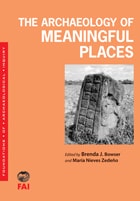
Diverse spatial and temporal contexts in two culture areas--Mesoamerica and the Greater Southwest--serve as backdrops for nine chapters in which fourteen contributors show how place is an ideal starting point to begin unraveling the human past. Several authors further address the enduring significance of places of the past for contemporary peoples. Among the many strengths of this volume is the careful way in which powerful concepts, diverse lines of thought, and empirical models are integrated to reveal the multiple facets of meaningful places, and to illustrate ways in which places may be approached archaeologically, theoretically, and culturally. Ultimately, the book’s contributors champion the notion that place is a valid and useful analytical unit for describing, reconstructing, interpreting, and explaining the form, structure, and temporality of the meanings humans ascribe to their environment.
The Art of Getting More Back in Diplomacy
Negotiation Lessons from North Korea, China, Libya, and the United NationsEric N. Richardson
University of Michigan Press, 2021
In the field of negotiation theory, the Harvard Project’s Getting to Yes and Donald Trump’s The Art of the Deal occupy polar opposition locations on a spectrum considering distributive and integrative negotiation theories. The Art of Getting More Back in Diplomacy offers case studies from international negotiations in which the author participated that can help illustrate the tactics and theories of each type of negotiation and to make students in law, business, and other fields into better negotiators. Among the case studies are lessons drawn from negotiating denuclearization with North Korea, political reconciliation in Libya, human rights improvements in China, Israel-Palestinian peace processes, and UN negotiations over surveillance, privacy, atrocities prevention, LGBTI rights, and other fundamental freedoms. By illustrating these lessons, The Art of Getting More Back in Diplomacy strengthens the tools that students and teachers of negotiations should have in their negotiating toolbox. Perhaps most importantly, Richardson provides concrete examples of how a negotiator is likely to Get More Back for their clients if they deploy these tactics, rather than having them used against the negotiator.
The Assassination of Theo van Gogh
From Social Drama to Cultural TraumaRon Eyerman
Duke University Press, 2008
Eyerman utilizes theories of social drama and cultural trauma to evaluate the reactions to and effects of the murder. A social drama is triggered by a public transgression of taken-for-granted norms; one that threatens the collective identity of a society may develop into a cultural trauma. Eyerman contends that the assassination of Theo van Gogh quickly became a cultural trauma because it resonated powerfully with the postwar psyche of the Netherlands. As part of his analysis of the murder and reactions to it, he discusses significant aspects of twentieth-century Dutch history, including the country’s treatment of Jews during the German occupation, the loss of its colonies in the wake of World War II, its recruitment of immigrant workers, and the failure of Dutch troops to protect Muslims in Srebrenica in 1995.
The Assembly Line
Robert Linhart
University of Massachusetts Press, 1981

The Bahá'í
The Religious Construction of a Global IdentityMcMullen, Michael
Rutgers University Press, 2000
The Bahá’í Faith is one of the fastest growing, but least studied, of the world’s religions. Adherents view themselves as united by a universal belief that transcends national boundaries. Michael McMullen examines how the Bahá’í develop and maintain this global identity. Taking the Bahá’í community in Atlanta, Georgia, as a case in point, his book is the first to comprehensively examine the tenets of this little-understood faith.
McMullen notes that, to the Bahá’í, Buddha, Moses, Jesus, and Mohammed are all divinely sent teachers of ‘the Truth’, whose messages conform to the needs of their individual cultures and historical periods. But religion—which draws from the teaching of Bahá’u’lláh, a nineteenth-century Persian—encourages its members to think of themselves as global citizens. It also seeks to establish unity among its members through adherence to a Bahá’í worldview.
By examining the Atlanta Bahá’í community, McMullen shows how this global identity is interpreted locally. He discusses such topics as: the organizational structure and authority relations in the Bahá’í “Administrative Order”; Bahá’í evangelicalism; and the social boundaries between Bahá’ís and the wider culture.
The Battles of Germantown
Effective Public History in AmericaDavid W. Young
Temple University Press, 2019
2020 Philip S. Klein Book Prize Winner, Pennsylvania Historical Association
Known as America’s most historic neighborhood, the Germantown section of Philadelphia (established in 1683) has distinguished itself by using public history initiatives to forge community. Progressive programs about ethnic history, postwar urban planning, and civil rights have helped make historic preservation and public history meaningful. The Battles of Germantown considers what these efforts can tell us about public history’s practice and purpose in the United States.
Author David Young, a neighborhood resident who worked at Germantown historic sites for decades, uses his practitioner’s perspective to give examples of what he calls “effective public history.” The Battles of Germantown shows how the region celebrated “Negro Achievement Week” in 1928 and, for example, how social history research proved that the neighborhood’s Johnson House was a station on the Underground Railroad. These encounters have useful implications for addressing questions of race, history, and memory, as well as issues of urban planning and economic revitalization.
Germantown’s historic sites use public history and provide leadership to motivate residents in an area challenged by job loss, population change, and institutional inertia. The Battles of Germantown illustrates how understanding and engaging with the past can benefit communities today.
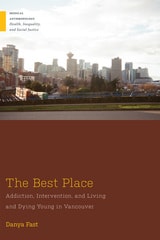
The Best Place
Addiction, Intervention, and Living and Dying Young in VancouverDanya Fast
Rutgers University Press, 2024
Winner of the CASCA Labrecque-Lee Book Prize
In both local and international imaginations, Vancouver, Canada, is often celebrated as one of the world’s most beautiful, cosmopolitan, and livable cities. Simultaneously, the city continues to be ground zero for successive waves of public health emergency and intervention, including a recent and unprecedented drug overdose crisis driven by the proliferation of illicitly manufactured fentanyl and related analogs in the local drug supply. In The Best Place: Addiction, Intervention, and Living and Dying Young in Vancouver, Danya Fast explores these politics of place from the perspectives of young people who use drugs. Those who are the subject of this book were in many ways relegated to the social, spatial, and economic margins of the city. Yet, they were also often at the very center of city life and state projects, including the project of protecting life in the context of the current overdose crisis.
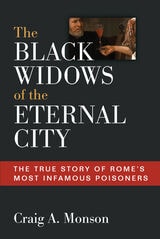
The Black Widows of the Eternal City
The True Story of Rome's Most Infamous PoisonersCraig A. Monson
University of Michigan Press, 2020
In the present study, Craig A. Monson takes advantage of a recent discovery—the 1,450-page notary’s transcript of the 1659 investigation. It is supplemented here by many ancillary archival sources, unknown to all previous writers. Since the story of Gironima Spana and the would-be widows is partially about what people believed to be true, however, this investigation also juxtaposes some of the “alternative facts” from earlier, sensational accounts with what the notary’s transcript and other, more reliable archival documents reveal.
Written in a style that avoids arcane idioms and specialist jargon, the book can potentially speak to students and general readers interested in seventeenth-century social history and gender issues. It rewrites the life story of Gironima Spana (largely unknown until now), who has dominated all earlier accounts, usually in caricatures that reiterate the tropes of witchcraft. It also concentrates on the dozen other widows whose stories could be the most recovered from archival sources and whom Spana had totally eclipsed in earlier accounts. Most were women “of a very ordinary sort” (prostitutes; beggars; wives of butchers, barbers, dyers, lineners, innkeepers), the kinds of women commonly lost to history. The book seeks to explain why some women were hanged (only six, in fact, most of whom may not have directly poisoned anyone), while dozens of others who did poison their husbands escaped the gallows and, in some cases, were not even interrogated. It also reveals what happened to these other alleged perpetrators, whose fates have remained unknown until now. Other purported culprits, about whom less complete pictures emerge, are briefly discussed in an appendix.
The study incorporates illustrations of archival manuscripts to demonstrate the challenges of deciphering them and illustrates “scenes of the crime” and other important locations, identified on seventeenth-century, bird’s eye-perspective views of Rome and in modern photographs. It also includes GPS coordinates for any who might wish to revisit the sites.
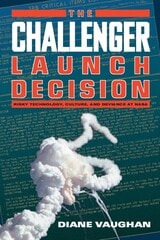
The Challenger Launch Decision
Risky Technology, Culture, and Deviance at NASADiane Vaughan
University of Chicago Press, 1995
Journalists and investigators have historically cited production problems and managerial wrong-doing as the reasons behind the disaster. The Presidential Commission uncovered a flawed decision-making process at the space agency as well, citing a well-documented history of problems with the O-ring and a dramatic last-minute protest by engineers over the Solid Rocket Boosters as evidence of managerial neglect.
Why did NASA managers, who not only had all the information prior to the launch but also were warned against it, decide to proceed? In retelling how the decision unfolded through the eyes of the managers and the engineers, Vaughan uncovers an incremental descent into poor judgment, supported by a culture of high-risk technology. She reveals how and why NASA insiders, when repeatedly faced with evidence that something was wrong, normalized the deviance so that it became acceptable to them.
No safety rules were broken. No single individual was at fault. Instead, the cause of the disaster is a story not of evil but of the banality of organizational life. This powerful work explains why the Challenger tragedy must be reexamined and offers an unexpected warning about the hidden hazards of living in this technological age.
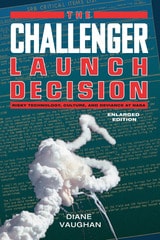
The Challenger Launch Decision
Risky Technology, Culture, and Deviance at NASA, Enlarged EditionDiane Vaughan
University of Chicago Press, 2015
When the Space Shuttle Challenger exploded on January 28, 1986, millions of Americans became bound together in a single, historic moment. Many still vividly remember exactly where they were and what they were doing when they heard about the tragedy. Diane Vaughan recreates the steps leading up to that fateful decision, contradicting conventional interpretations to prove that what occurred at NASA was not skullduggery or misconduct but a disastrous mistake.
Why did NASA managers, who not only had all the information prior to the launch but also were warned against it, decide to proceed? In retelling how the decision unfolded through the eyes of the managers and the engineers, Vaughan uncovers an incremental descent into poor judgment, supported by a culture of high-risk technology. She reveals how and why NASA insiders, when repeatedly faced with evidence that something was wrong, normalized the deviance so that it became acceptable to them. In a new preface, Vaughan reveals the ramifications for this book and for her when a similar decision-making process brought down NASA's Space Shuttle Columbia in 2003.
The Child Who Walks Alone
Case Studies of Rejection in the SchoolsBy Anne and Hart Stilwell
University of Texas Press, 1996
There is an old song that goes, "Look down, look down, that lonesome road, before you travel on." Facing that lonesome road, the adult might travel on. Often, the child can't.
During her twenty-year career as a school social worker, Anne Stilwell worked with two thousand "problem" children. She and her husband, professional writer Hart Stilwell, present here twenty-one factual accounts of children who suffered rejection in the public schools.
Some of the children in these accounts are unusually bright and some are mentally retarded. They are belligerent and destructive or withdrawn. They are from broken homes or happy homes, from the slums or Middle America. They are blacks, Chicanos, and Anglos. There is only one common denominator among these children—tragedy.
Every classroom teacher will gain from this sympathetic evaluation of the problems faced by children in the public schools. No one who reads this book can remain unaware of major areas that call for deep concern on the part of educators and parents. The Stilwells have described school children and their problems and at the same time offered telling portraits of the families of which the youngsters are a part. In the struggle to see that the problem child has a chance to develop and advance within the limits of his or her ability, parents, teachers, administrators, and social workers must work together or all fail. When they fail, the child must walk alone.
The authors' objective in presenting these cases is to show what has happened and does happen, and to encourage others to work for change. A prominent educator describes their account as "an exceptionally worthwhile teaching document—stimulating, touching, well written, and honest."
While this book was originally written in 1972, the issue of rejection in the public schools is, sadly, still timely.

The City, Revisited
Urban Theory from Chicago, Los Angeles, and New YorkDennis R. Judd
University of Minnesota Press, 2011
Contributors: Janet Abu-Lughod, Northwestern U and New School for Social Research; Robert Beauregard, Columbia U; Larry Bennett, DePaul U; Andrew A. Beveridge, Queens College and CUNY; Amy Bridges, U of California, San Diego; Terry Nichols Clark, U of Chicago; Nicholas Dahmann, U of Southern California; Michael Dear, U of California, Berkeley; Steven P. Erie, U of California, San Diego; Frank Gaffikin, Queen's U of Belfast; David Halle, U of California, Los Angeles; Tom Kelly, U of Illinois at Chicago; Ratoola Kunda, U of Illinois at Chicago; Scott A. MacKenzie, U of California, Davis; John Mollenkopf, CUNY; David C. Perry, U of Illinois at Chicago; Francisco Sabatini, Ponticia Universidad Catolica de Chile; Rodrigo Salcedo, Pontificia Universidad Catolica de Santiago; Dick Simpson, U of Illinois at Chicago; Daphne Spain, U of Virginia; Costas Spirou, National-Louis U in Chicago.
The Collection All Around
Sharing Our Cities, Towns, and Natural PlacesJeffrey T. Davis
American Library Association, 2017

The Color of Strangers, the Color of Friends
Alan Peshkin
University of Chicago Press, 1991
"Peshkin strikes a hopeful chord, revealing what social encounters among ethnic groups—at their best—can be like in America."—Education Digest
The Common Place of Law
Stories from Everyday LifePatricia Ewick and Susan S. Silbey
University of Chicago Press, 1998
One narrative is based on an idea of the law as magisterial and remote. Another views the law as a game with rules that can be manipulated to one's advantage. A third narrative describes the law as an arbitrary power that is actively resisted. Drawing on these extensive case studies, Ewick and Silbey present individual experiences interwoven with an analysis that charts a coherent and compelling theory of legality. A groundbreaking study of law and narrative, The Common Place of Law depicts the institution as it is lived: strange and familiar, imperfect and ordinary, and at the center of daily life.
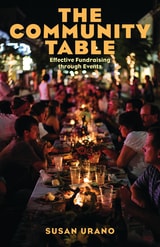
The Community Table
Effective Fundraising through EventsSusan Cole Urano
Ohio University Press, 2016
In resource-challenged Athens County, Ohio, staff and volunteers at the nonprofit Athens County Foundation came up with a daring idea: to host a locally sourced, gourmet dinner for four hundred people. The meal would be held on the brick-paved main street of the city of Athens, to raise funds for the food bank, and increase awareness of the persistent local struggle with food insecurity, as well as raise the visibility of the foundation. The logistical challenges were daunting, but the plan would unite the community around the common theme of providing for its own.
Since then, Bounty on the Bricks has become a touchstone event that raises close to one hundred thousand dollars for the food bank. In The Community Table, Athens County Foundation executive director Susan Urano translates her years of nonprofit experience with large-scale annual fundraisers into a step-by-step guide for development professionals, community leaders, and volunteers.
Urano guides readers to consider when to mount a fundraiser, who the stakeholders are, what social and financial value the event will bring to the community, and how partnerships might augment the payoff. Using real-life examples, she explains how organizers can learn from mistakes and illustrates methods of team building, conflict resolution, and problem solving. Sample ideas, timelines, budgets, publicity plans, and committee structures round out The Community Table.
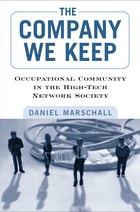
The Company We Keep
Occupational Community in the High-Tech Network SocietyDaniel Marschall
Temple University Press, 2014
At the birth of the Internet Age, computer technologists in small, aggressive software development companies became part of a unique networked occupational community. They were creative, team-oriented, and enthusiastic workers who built "boundaryless careers," hopping from one employer to another.
In his absorbing ethnography The Company We Keep, sociologist Daniel Marschall immerses himself in IntenSivity, one such technological workplace. Chronicling the employees' experiences, Marschall examines how these workers characterize their occupational culture, share values and work practices, and help one another within their community. He sheds light on the nature of this industry marked by highly skilled jobs and rapid technological change.
The experiences at IntenSivity are now mirrored by employees at Facebook and thousands of other cutting-edge, high-tech start-up firms. The Company We Keep helps us understand the emergence of virtual work communities and the character of the contemporary labor market at the level of a small enterprise.
The Comparative Guide to WordPress in Libraries
A LITA GuideAmanda L. American Library Association
American Library Association, 2014
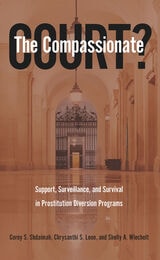
The Compassionate Court?
Support, Surveillance, and Survival in Prostitution Diversion ProgramsCorey S. Shdaimah, Chrysanthi S. Leon, and Shelly A. Wiechelt
Temple University Press, 2023
The authors of The Compassionate Court? provide case studies of such programs and draw upon interviews and observations conducted over a decade to reveal how participants and professionals perceive court-affiliated PDPs, clients, and staff. Considering the motivations, vision, and goals of these programs as well as their limitations—the inequity and disempowerment of their participants—the authors also present their own changing perspectives on prostitution courts, diversion programs, and criminalization of sex work.
The Complete Guide to Institutional Repositories
Stephen Craig Finlay
American Library Association, 2021
The Institutional Repository (IR) has become standard to the academic library in the past decade. In fact, some 5,000 are listed in open access directories. However, IR operations are anything but standard. You are not alone in your challenges, whether it’s discovery of born-digital content or policies for deposit and withdrawal. This resource gathers expertise to offer a comprehensive guide on contemporary institutional repository management. Readers will sharpen their understanding of such key IR topics as
- managing complexity task-by-task using a detailed breakdown of IR projects;
- six crucial elements every deposit policy should address;
- using the SHERPA RoMEO database to quickly locate publisher policies;
- policy development, community outreach, and open source software testing, illuminated through case studies;
- metadata basics for the non-cataloger;
- authority control for electronic theses, dissertations, and grey literature;
- workflow suggestions for small and mid-sized institutions;
- showcasing undergraduates’ work with student peer-reviewed journals, photography, or theater performances;
- promoting faculty engagement with awards and recognition; and
- copyright fundamentals all staff who interact with the IR should know.

The Complete Guide to Personal Digital Archiving
Brianna H. Marshall
American Library Association, 2017
The Convolutions of Historical Politics
Alexei Miller
Central European University Press, 2012
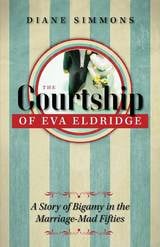
The Courtship of Eva Eldridge
A Story of Bigamy in the Marriage Mad FiftiesDiane Simmons
University of Iowa Press, 2016
Everyone got married in the 1950s, then moved to the suburbs to have the children of the soon-to-be-famous baby boom. For Americans who had survived the Great Depression and World War II, prosperous married life was a triumph. The unwed were objects of pity, scorn, even suspicion. And so in the 1950s, Eva Eldridge, no longer so young and marginally employed, was the perfect target for handsome Vick, who promised everything: storybook romance, marital respectability, and the lively social life she loved. When he disappeared not long after their honeymoon, she was devastated.
Eva hadn’t always been so vulnerable. Growing up pretty and popular in rural Oregon, she expected to marry young and live a life much like that of her parents, farming and rearing children. But then the United States threw its weight into World War II and as men headed to battle, the government started recruiting women to work in their places. Eva, like many other young women, found that life in the city with plenty of money, personal freedom, and lots of soldiers and sailors eager to pay court was more exhilarating than life down on the farm. After the war, she was ambivalent about getting married and settling down—at least until Vick arrived.
Refusing to believe her brand-new husband had abandoned her, Eva set about tracking down a man who, she now believed, was more damaged by wartime trauma than she had known. But instead of a wounded hero, she found a long string of women much like herself—hard-working, intelligent women who had loved and married Vick and now had no idea where—or even who—he was.
Drawing on a trove of some eight hundred letters and papers, Diane Simmons tells the story of Eva’s poignant struggle to get her dream husband back, as well as the stories of the women who had stood at the altar with Vick before and after her. Eva’s remarkable life illuminates women’s struggle for happiness at a time when marriage—and the perfect husband—meant everything.

The Culture of Korean Industry
An Ethnography of Poongsan CorporationChoong Soon Kim
University of Arizona Press, 1992
The Culture of Public Problems
Drinking-Driving and the Symbolic OrderJoseph R. Gusfield
University of Chicago Press, 1980
"A sophisticated and thoughtful critic. . . . Gusfield argues that the 'myth of the killer drunk' is a creation of the 'public culture of law.' . . . Through its dramatic development and condemnation of the anti-social character of the drinking-driver, the public law strengthens the illusion of moral consensus in American society and celebrates the virtues of a sober and orderly world."—James D. Orcutt, Sociology and Social Research
"Joseph Gusfield denies neither the role of alcohol in highway accidents nor the need to do something about it. His point is that the research we conduct on drinking-driving and the laws we make to inhibit it tells us more about our moral order than about the effects of drinking-driving itself. Many will object to this conclusion, but none can ignore it. Indeed, the book will put many scientific and legal experts on the defensive as they face Gusfield's massive erudition, pointed analysis and criticism, and powerful argumentation. In The Culture of Public Problems, Gusfield presents the experts, and us, with a masterpiece of sociological reasoning."—Barry Schwartz, American Journal of Sociology
This book is truly an outstanding achievement. . . . It is sociology of science, sociology of law, sociology of deviance, and sociology of knowledge. Sociologists generally should find the book of great theoretical interest, and it should stimulate personal reflection on their assumptions about science and the kind of consciousness it creates. They will also find that the book is a delight to read."—William B. Bankston, Social Forces

The Dark Days of Abraham Lincoln's Widow, as Revealed by Her Own Letters
Myra Helmer Pritchard, edited and annotated by Jason Emerson
Southern Illinois University Press, 2011
Written in 1927 but barred from timely publication by the Lincoln family, The Dark Days of Abraham Lincoln's Widow, as Revealed by Her Own Letters is based on nearly two dozen intimate letters written between Mary Lincoln and her close friend Myra Bradwell mainly during the former's 1875 incarceration in an insane asylum. By the 1920s most accounts of Mrs. Lincoln focused on her negative qualities and dismissed her as "crazy." Bradwell's granddaughter Myra Helmer Pritchard wrote this distinctly sympathetic manuscript at the behest of her mother, who wished to vindicate Mary Lincoln in the public eye by printing the private correspondence. Pritchard fervently defends Mrs. Lincoln's conduct and sanity, arguing that she was not insane but rather the victim of an overzealous son who had his mother committed.
The manuscript and letters were thought to have been destroyed, but fortunately the Lincolns' family lawyer stored copies in a trunk, where historian Jason Emerson discovered them in 2005. While leaving the manuscript intact, Emerson has enhanced it with an introduction and detailed annotations. He fills in factual gaps; provides background on names, places, and dates; and analyzes Pritchard's interpretations, making clear where she was right and where her passion to protect Mrs. Lincoln led to less than meticulous research and incorrect conclusions. This volume features an easy-to-follow format that showcases Pritchard's text on the left-hand pages and Emerson's insightful annotations on the right-hand pages.
Following one of the most revered and reviled, famous and infamous of the First Ladies, this book provides a unique perspective of Mrs. Lincoln's post-White House years, with an emphasis on her commitment to a sanitarium. Emerson's contributions make this volume a valuable addition to the study of the Lincoln family. This fascinating work gives today's Lincoln enthusiasts the chance to read this intriguing interpretation of the former First Lady that predates nearly every other book written about her.
The DeMarco Factor
Transforming Public Will into Political PowerMichael Pertschuk
Vanderbilt University Press, 2010
DeMarco's unique strategic template, developed over two decades of serial campaigning, includes momentum-building stages over a multiyear campaign; unrelenting, skillful access to the media for engaging public support; coalitions of hundreds, even thousands, of faith, community, labor, public health, and business groups; and a hard press on candidates to support legislation before elections, rather than after they are comfortably in office. As an organizer/leader, Demarco also succeeds in his campaigns through force of personality: his unquenchable exuberance and idiosyncrasies delight and madden his opponents--sometimes his allies, too.
Michael Pertschuk, himself a veteran advocate, here chronicles three of DeMarco's campaigns, each facing a different obstacle course. His deep analysis draws out strategic and leadership lessons that engaged citizens and advocates for popular causes stonewalled by powerful lobbies can put to immediate and practical use.
The Decline of Comity in Congress
Eric M. Uslaner
University of Michigan Press, 1996

The Design of Agreement
Evidence from ChamorroSandra Chung
University of Chicago Press, 1998
The Disaster Planning Handbook for Libraries
Mary Grace Flaherty
American Library Association, 2021
Your library is a vital information hub and resource provider every single day, and that’s doubly true when calamity strikes. In fact, your library’s role as an “essential community function” during disasters is now encoded in U.S. law. Engaging as a partner in planning and preparedness will build much-needed community support should disaster strike, and even a basic plan will also save you time and stress later on. No matter where your library is in the disaster planning cycle, this handbook will make the process clearer and less daunting. You’ll get tools, activities, easy-to-adapt templates, and hands-on guidance on such topics as
- the six phases of disaster response;
- 15 first-hand accounts of library disaster planning or responses, helping you identify the library services most needed during a disaster;
- three essential factors that will shape the form of your disaster plan;
- preparing for hurricanes, tornadoes, fires, floods, and earthquakes;
- ideas for connecting with your community’s emergency response teams;
- federal government planning resources;
- pointers on working with state and local governments;
- a sample Memorandum of Understanding to outline mutual support for a speedier recovery;
- recommended courses and training, many of which are free;
- targeted advice for archives and special collections;
- sample building inspection checklists; and
- recommended games to help children and families prepare.
The Duplex Nature of Indigeneity
Navigating Identity in the Ahuehuepan DiasporaFrans J. Schryer
University Press of Colorado, 2025
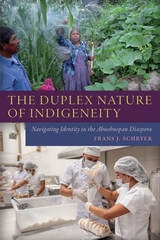
Using a variety of sources, perspectives, and methods, Schryer takes a duplexity approach, which allows understanding the complexity of social reality and its complementary nature—it identifies fields, clusters, and layers as interconnected components of social life. The innovative methods consist of the combination of ethnographic description and an ethnohistorical census that provides information on every person going back to approximately 1850. That census is further examined with the use of inferential and non-inferential statistical techniques, archival research in locations not normally accessible to scholars, Facebook, phone interviews conducted over several years, and help from Nahuatl-speaking people whose perspectives on the findings generate additional information and insights.
Unique in this presentation, which dips into the lives of generations of people to draw insight on those who lay claim to transnational Indigeneity, Schryer’s work contributes to research and theoretical discussion in the field of migration and globalization studies through a close examination of one Indigenous community over the course of many years, utilizing a mix of qualitative and quantitative research methods in anthropology.

The Executive Way
Conflict Management in CorporationsCalvin Morrill
University of Chicago Press, 1995
Personal and corporate scandals, compensation battles, budget worries, interdepartmental rivalries, personal enmities, and general rancor are among everyday challenges faced by executives. Morrill shows what most influences the way managers handle routine conflicts are the cultures created by their company's organizational structure: whether there is a strong hierarchy, a weak hierarchy, or an absence of any strong central authority. The issues most likely to cause conflict within corporations Morrill identifies as managerial style, competition between departments, and performance evaluations, promotions, and compensation.
Among the people whose day-to-day lives we get to know are Jacobs, a divisional executive whose intuitive understanding of the corporate hierarchy enables him to topple his incompetent superior without direct confrontation; Fuller, who through a mix of brains, guile, and connections rises from staff executive secretary to corporate vice president in a large bank; Green, an old-fashioned accounting partner in a firm being taken over by management consultants; and the "Princess of Power," "Iron Man," and the "Terminator"—executives fighting their way to the top of a successful entertainment company.
Unprecedented in its direct access to top managers, this portrayal of daily life and conflict management among corporate elites will be of interest to professionals, scholars, and practitioners in organizational culture and behavior, managerial decision making, dispute, social control, law and society, and organizational ethnography.
The Expectation of Justice
France, 1944–1946Megan Koreman
Duke University Press, 2000
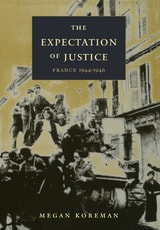
As the first social history of the “après -Libération” period from the perspective of ordinary people, Koreman’s study reveals how citizens of these towns expected legal, social, and honorary justice—such as punishment for collaborators, fair food distribution, and formal commemoration of patriots, both living and dead. Although the French expected the Resistance’s Provisional Government to act according to local understandings of justice, its policies often violated local sensibilities by instead pursuing national considerations. Koreman assesses both the citizens’ eventual disillusionment and the social costs of the “Resistencialist myth” propagated by the de Gaulle government in an effort to hold together the fragmented postwar nation. She also suggests that the local demands for justice created by World War II were stifled by the Cold War, since many people in France feared that open opposition to the government would lead to a Communist takeover. This pattern of nationally instituted denial and suppression made it difficult for citizens to deal effectively with memories of wartime suffering and collaborationist betrayal. Now, with the end of the Cold War, says Koreman, memories of postwar injustices are resurfacing, and there is renewed interest in witnessing just and deserved closure.
This social history of memory and reconstruction will engage those interested in history, war and peace issues, contemporary Europe, and the twentieth century.

The Expert Library
Staffing, Sustaining, And Advancing TheScott Walter
Assoc of College & Research Libraries, 2011