Results by title
80 books match the query 'Christianity and politics' and 18 start with t
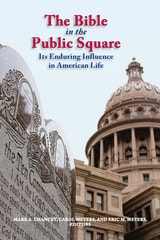
The Bible in the Public Square
Its Enduring Influence in American LifeMark A. Chancey
SBL Press, 2014
Explore perceptions and interpretations of scripture in American politics, identity, popular culture, and public education
Essays from the perspectives of American history, the history of ideas, film studies, visual studies, cultural studies, education, and church-state studies provide essential research for those interested in the intersection of the Bible and American culture. The contributors are Yaakov Ariel, Jacques Berlinerblau, Mark A. Chancey, Rubén Dupertuis, John Fea, Shalom Goldman, Charles C. Haynes, Carol Meyers, Eric M. Meyers, David Morgan, Adele Reinhartz, and David W. Stowe.
Features:
- Ten essays and an introduction present research from professors of biblical studies, Judaism, English, and history
- Articles relevant to scholars, students, and the general public
- Analysis of the tensions in American society regarding the Bible and its role in public life.
The Christian Structure of Politics
The De Regno of Thomas AquinasWilliam McCormick, SJ
Catholic University of America Press, 2022
The Common Good of Constitutional Democracy
Essays in Political Philosophy and on Catholic Social TeachingMartin Rhonheimer
Catholic University of America Press, 2013
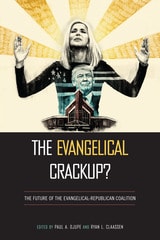
The Evangelical Crackup?
The Future of the Evangelical-Republican CoalitionEdited by Paul Djupe and Ryan L. Claassen
Temple University Press, 2019
Why did Donald Trump attract a record number of white evangelical voters without unified support—and despite nontrivial antipathy from evangelical leaders? The editors and leading scholars that contribute to the timely volume The Evangelical Crackup? answer this question and provide a comprehensive assessment of the status of evangelicals and the Christian Right in the Republican coalition.
The expected “crackup” with the Republican Party never happened. Each chapter in this cogent volume includes analyses of the 2016 election to explain why—and why that is critical. Chapters examine policy priorities, legal advocacy, and evangelical loyalty to the Republican Party; rhetoric, social networks, and evangelical elite influence; and the political implications of movements within evangelicalism, such as young evangelicals, Hispanics, and the Emergent Church movement.
Contributors include: Daniel Bennett, Mark Brockway, Ryan P. Burge, Brian R. Calfano, Jeremy Castle, Kimberly Conger, Daniel A. Cox, Kevin den Dulk, Sarah Allen Gershon, Tobin Grant, Robert P. Jones, Geoffrey Layman, Andrew R. Lewis, Ronald J. McGauvran, Joshua Mitchell, Juhem Navarro-Rivera, Jacob R. Neiheisel, Elizabeth Oldmixon, Adrian D. Pantoja, David Searcy, Anand Edward Sokhey, J. Benjamin Taylor, Robert Wuthnow, and the editors.
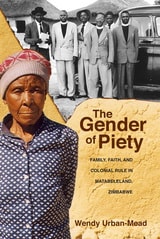
The Gender of Piety
Family, Faith, and Colonial Rule in Matabeleland, ZimbabweWendy Urban-Mead
Ohio University Press, 2015
The Gender of Piety is an intimate history of the Brethren in Christ Church in Zimbabwe, or BICC, as related through six individual life histories that extend from the early colonial years through the first decade after independence. Taken together, these six lives show how men and women of the BICC experienced and sequenced their piety in different ways. Women usually remained tied to the church throughout their lives, while men often had a more strained relationship with it. Church doctrine was not always flexible enough to accommodate expected masculine gender roles, particularly male membership in political and economic institutions or participation in important male communal practices.
The study is based on more than fifteen years of extensive oral history research supported by archival work in Zimbabwe, the United Kingdom, and the United States. The oral accounts make it clear, official versions to the contrary, that the church was led by spiritually powerful women and that maleness and mission-church notions of piety were often incompatible.
The life-history approach illustrates how the tension of gender roles both within and without the church manifested itself in sometimes unexpected ways: for example, how a single family could produce both a legendary woman pastor credited with mediating multiple miracles and a man—her son—who joined the armed wing of the Zimbabwe African People’s Union nationalist political party and fought in Zimbabwe’s liberation war in the 1970s. Investigating the lives of men and women in equal measure, The Gender of Piety uses a gendered interpretive lens to analyze the complex relationship between the church and broader social change in this region of southern Africa.
The Judgment of the Nations
Christopher Dawson
Catholic University of America Press, 2011
The Kingdom Suffereth Violence
The Machiavelli / Erasmus / More Correspondence and Other Unpublished DocumentsPhilippe Bénéton
St. Augustine's Press, 2012
The Lesson of Carl Schmitt
Four Chapters on the Distinction between Political Theology and Political PhilosophyHeinrich Meier
University of Chicago Press, 1998
Relating this religious dimension to Schmitt's support for National Socialism and his continuing anti-Semitism, Meier compels the reader to come to terms with the irreconcilable differences between political theology and political philosophy. His book will give pause to those who have tended to gloss over the troubling aspects of some of Schmitt's ideas.
With editions in German, French, Italian, and now English, Meier's two books on Schmitt have dramatically reoriented the international debate about Carl Schmitt and his significance for twentieth-century political thought.
"Standing far above the rest . . . is Heinrich Meier's new study, Die Lehre Carl Schmitts, which covers all of Schmitt's writings. . . . Meier's work has forced everyone to take a second look at the assumptions underlying Schmitt's better-known writings and reconsider some that have been ignored."—Mark Lilla, reviewing the German edition in The New York Review of Books
The Lesson of Carl Schmitt
Four Chapters on the Distinction between Political Theology and Political Philosophy, Expanded EditionHeinrich Meier
University of Chicago Press, 2011
The Mind That Is Catholic
Philosophical and Political EssaysJames V. Schall
Catholic University of America Press, 2008
The Origins of Christian Democracy
Politics and Confession in Modern GermanyMaria D. Mitchell
University of Michigan Press, 2012
This book is a pioneering contribution to the history of the founding of the West German political system after the Second World War. The political cooperation between Catholics and Protestants that resulted in the formation of the Christian Democratic Union (CDU) in occupied and early West Germany represented a significant change from a long history of hostility in confessional relations. Given that the CDU went on to dominate politics in West Germany well into the 1960s, Maria D. Mitchell argues that an understanding of what made this interconfessional party possible is crucial to an exploration of German history in the postwar period. She examines the political history of party formation as well as the religious beliefs and motivations that shaped the party's philosophy and positions. She provides an authoritative guide to the complex processes of maneuvering and negotiation that produced the CDU during 1945-46. The full range of political possibilities is discussed, including the suppressed alternatives to the Adenauer/Erhard axis that eventually defined the party's trajectory during the 1950s and the abortive Christian Socialism associated with Jacob Kaiser.
The Political Economy of Distributism
Property, Liberty, and the Common GoodAlexander William Salter
Catholic University of America Press, 2023
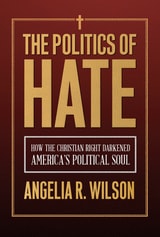
The Politics of Hate
How the Christian Right Darkened America's Political SoulAngelia R. Wilson
Temple University Press, 2025
Based on original research, participant observation at events, and data collection, Wilson follows the money to provide a meticulous analysis of how Christian Right political elites operate. She traces the evolutionary development of the Christian Right’s political professionalism and their allegiance to a grand vision that articulates a grammar of war to fulfill their Biblical worldview.
The Politics of Hate demonstrates how Christian Right organizations educate and train networks of soldiers to tactically engage the enemy in local, state, and national legal and political battles. Wilson carefully documents their history of co-belligerency, their strategies of political warfare, and, importantly, the impact of this war that has, over the past fifty years, forever changed American politics.
The Transformation of the Christian Right in the 1980s
Matthew C. Moen
University of Alabama Press, 2008
The Transformation of the Christian Right chronicles and analyzes the remarkable changes that have occurred in the Christian Right from its emergence in the late 1970s to the present. It documents the rapid turnover of Christian-Right organizations and explains the forces driving that kaleidoscopic change. Moen also traces the strategic shift of the movement’s leaders, away from lobbying the Congress and toward mobilizing conservative activists in the grass roots; he demonstrates the substitution of liberal language (with its emphasis on “equality, rights, and freedom”) for moralistic language (with its focus on “right and wrong”). Much has been written about the Christian Right’s impact on politics but little about how years of political activism have shaped and influenced the Christian Right. Moen addresses that neglected side of the issue.
The Unity of the Nations
Joseph Ratzinger
Catholic University of America Press, 2015
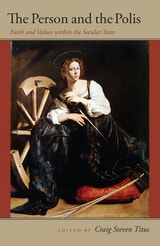
The person and the polis
faith and values within the secular stateCraig Steven Titus
Catholic University of America Press, 2006
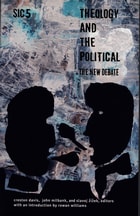
Theology and the Political
The New Debate, sic vCreston Davis, John Milbank and Slavoj Žižek, eds.
Duke University Press, 2005
Contributors. Anthony Baker, Daniel M. Bell Jr., Phillip Blond, Simon Critchley, Conor Cunningham, Creston Davis, William Desmond, Hent de Vries, Terry Eagleton, Rocco Gangle, Philip Goodchild, Karl Hefty, Eleanor Kaufman, Tom McCarthy, John Milbank, Antonio Negri, Catherine Pickstock, Patrick Aaron Riches, Mary-Jane Rubenstein, Regina Mara Schwartz, Kenneth Surin, Graham Ward, Rowan Williams, Slavoj Žižek
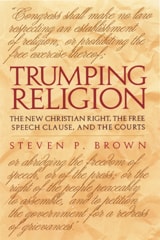
Trumping Religion
The New Christian Right, the Free Speech Clause, and the CourtsSteven P. Brown
University of Alabama Press, 2004
The first scholarly treatment of the strategies employed by the New Christian Right in redefining religious freedom in the courtroom.
Trumping Religion provides a detailed analysis of the five major public-interest law firms that have litigated religion cases in the federal courts between 1980 and 2000. Allied with several highly vocal, evangelical ministries, such as those of Jerry Falwell and Pat Robinson, these legal organizations argue that religious expression is a form of protected speech and thereby gain a greater latitude of interpretation in the courts. The long-term agenda of the New Christian Right as illuminated by this study is to shape church-state jurisprudence in a way that permits free course for the Christian gospel.
Steven P. Brown presents his research and conclusions from a balanced viewpoint. In filling a distinct void in the literature, this book will be of considerable interest to political scientists, legal scholars, law schools and seminaries, and anyone concerned with the intersection of religion and judicial politics.