Results by title
91 books match the query 'Citizen participation' and 16 start with t

Tactical Urbanism for Librarians
Quick, Low-Cost Ways to Make Big ChangesKaren Munro
American Library Association, 2017

Technological Democracy
Bureaucracy and Citizenry in the German Energy DebateCarol J. Hager
University of Michigan Press, 1995

The City Creative
The Rise of Urban Placemaking in Contemporary AmericaMichael H. Carriere and David Schalliol
University of Chicago Press, 2021
Spanning the 1950s to the post-recession 2010s, The City Creative highlights the roles of such prominent individuals and organizations as Jane Jacobs, Christopher Alexander, Richard Sennett, Project for Public Spaces, and the National Endowment for the Arts in the development of urban placemaking, both in the abstract and on the ground. But that’s only half the story. Bringing the narrative to the present, Michael H. Carriere and David Schalliol also detail placemaking interventions at more than 200 sites in more than 40 cities, combining archival research, interviews, participant observation, and Schalliol’s powerful documentary photography. Carriere and Schalliol find that while these formal and informal placemaking interventions can bridge local community development and regional economic plans, more often than not, they push the boundaries of mainstream placemaking. Rather than simply stressing sociability or market-driven economic development, these initiatives offer an alternative model of community-led progress with the potential to redistribute valuable resources while producing tangible and intangible benefits for their communities. The City Creative provides a kaleidoscopic overview of how these initiatives grow, and sometimes collapse, illustrating the centrality of placemaking in the evolution of the American city and how it can be reoriented to meet demands for a more equitable future.
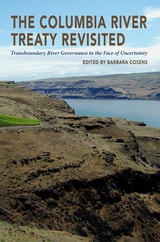
The Columbia River Treaty Revisited
Transboundary River Governance in the Face of UncertaintyEdited by Barbara Cosens
Oregon State University Press, 2012
The Columbia River Treaty Revisited, with contributions from historians, geographers, environmental scientists, and other experts, is intended to facilitate conversation about the impending expiration. It allows the reader, through the close inspection of the Columbia River Basin, to better grasp the uncertainty of water governance. It aids efforts, already underway, to understand changes in the basin since the treaty was passed, to predict future changes, and to determine whether alteration of the treaty is ultimately advisable.
The Columbia River Treaty Revisited will appeal to those interested in water basin management–scholars, stakeholders, and residents of the Columbia River basin alike.
A Project of the Universities Consoritum on Columbia River Governance
The Universities Consortium on Columbia River Governance, with representatives from universities in the U.S. and Canada, formed to offer a nonpartisan platform to facilitate an informed, inclusive, international dialogue among key decision-makers and other interested people and organizations; to connect university research to problems faced within the basin; and to expose students to a complex water resources problem. The Consortium organized the symposium on which this volume is based.
The Earth
Natural Resources and Human InterventionFriedrich Schmidt-Bleek
Haus Publishing, 2009
The Hidden Face of Local Power
Appointed Boards and the Limits of DemocracyMirya R. Holman
Temple University Press, 2025
The Hidden Face of Local Power explicates the purpose, role, and consequences of appointed boards in U.S. cities. Mirya Holman finds cities create strong boards that generate policy, consolidate power, and defend the interests of businesses and wealthy and white residents. In contrast, weak boards pacify agitation from marginalized groups to give the appearance of inclusivity, democratic deliberation, and redistributional policymaking. Cities preserve this strong board/weak board dichotomy through policymaking power, institutional design, and by controlling who serves on the boards.
The Hidden Face of Local Power examines the role of boards in the development of urban political institutions, the allocation of power in local politics, and the persistence of inequality. Holman enhances our understanding of how political institutions have contributed to racism and their impact on how people use and live in urban spaces. In her shrewd analysis of the creation and use of boards as political institutions, Holman proves that neither weak or strong boards achieves the goal they are advertised to achieve. In doing so, she provides a new view of the failures of local democracy along with ideas for improvement.
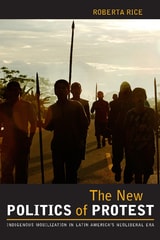
The New Politics of Protest
Indigenous Mobilization in Latin America's Neoliberal EraRoberta Rice
University of Arizona Press, 2012
In June 1990, Ecuador saw the first major indigenous rebellion within its borders since the colonial era. For weeks, indigenous protesters participated in marches, staged demonstrations, seized government offices, and blockaded roads. Since this insurrection, indigenous movements have become increasingly important in the fight against Latin American Neoliberalism.
Roberta Rice's New Politics of Protest seeks to analyze when, where, and why indigenous protests against free-market reforms have occurred in Latin America. Comparing cases in Ecuador, Peru, Bolivia, and Chile, this book details the emergence of indigenous movements under and against Neoliberal governments. Rice uses original field research and interviews with indigenous leaders to examine long-term patterns of indigenous political activism and overturn accepted theories on the role of the Indian in democracy.
A useful and engaging study, The New Politics of Protest seeks to determine when indigenous movements become viable political parties. It covers the most recent rounds of protest to demonstrate how a weak and unresponsive government is more likely to experience revolts against unpopular reforms. This influential work will be of interest to scholars of Latin American politics and indigenous studies as well as anyone studying oppressed peoples who have organized nationwide strikes and protests, blocked economic reforms, toppled corrupt leaders, and even captured presidencies.
The Next Form of Democracy
How Expert Rule Is Giving Way to Shared Governance—and Why Politics Will Never Be the SameMatt Leighninger
Vanderbilt University Press, 2006
The stories of civic experiments in this book can show us the realpolitik of deliberative democracy, and illustrate how the evolution of democracy is already reshaping politics.

The Return of the Mexican Gray Wolf
Back to the BlueBobbie Holaday
University of Arizona Press, 2003
Inspired by the plight of the Mexican gray wolf, retiree Bobbie Holaday formed the citizens advocacy group Preserve Arizona's Wolves (P.A.WS.) in 1987 and embarked on a crusade to raise public awareness. She soon found herself in the center of a firestorm of controversy, with environmentalists taking sides against ranchers and neighbors against neighbors. This book tells her story for the first time, documenting her eleven-year effort to bring the gray wolf back to the Blue.
As Holaday quickly learned, ranchers exerted considerable control over the state legislature, and politicians in turn controlled decisions made by wildlife agencies. Even though the wolf had been listed as endangered since 1976, opposition to it was so strong that the Arizona Game and Fish Department had been unable to launch a recovery program. In The Return of the Mexican Gray Wolf, Holaday describes first-hand the tactics she and other ordinary citizens on the Mexican Wolf Recovery Team adopted to confront these obstacles. Enhanced with more than 40 photographs—32 in color—her account chronicles both the triumphs of reintroduction and the heartbreaking tragedies the wolves encountered during early phases.
Thanks to Holaday's perseverance, eleven wolves were released into the wild in 1998, and the Blue Range once again echoed with their howls. Her tenacity was an inspiration to all those she enlisted in the cause, and her story is a virtual primer for conservation activists on mobilizing at the grassroots level. The Return of the Mexican Gray Wolf shows that one person can make a difference in a seemingly hopeless cause and will engage all readers concerned with the preservation of wildlife.
All royalties go to the Mexican Wolf Trust Fund administered by the Arizona Game and Fish Department.
The Solutions are Already Here
Strategies of Ecological Revolution from BelowPeter Gelderloos
Pluto Press, 2022
Across the world, grassroots networks of local communities are working to realize their visions of an alternative revolutionary response to planetary destruction, often pitted against the new megaprojects promoted by greenwashed alternative energy infrastructures and the neocolonialist, technocratic policies that are the forerunners of the Green New Deal.
Gelderloos interviews food sovereignty activists in Venezuela, Indigenous communities reforesting their lands in Brazil and anarchists fighting biofuel plantations in Indonesia, looking at the battles that have cancelled airports, stopped pipelines, and helped the most marginalized to fight borders and environmental racism, to transform their cities, to win a dignified survival.

The Unreal Estate Guide to Detroit
Andrew Herscher
University of Michigan Press, 2012
Intense attention has been paid to Detroit as a site of urban crisis. This crisis, however, has not only yielded the massive devaluation of real estate that has so often been noted; it has also yielded an explosive production of seemingly valueless urban property that has facilitated the imagination and practice of alternative urbanisms. The first sustained study of Detroit’s alternative urban cultures, The Unreal Estate Guide to Detroit initiates a new focus on Detroit as a site not only of urban crisis but also of urban possibility.
The Guide documents art and curatorial practices, community and guerilla gardens, urban farming and forestry, cultural platforms, living archives, evangelical missions, temporary public spaces, intentional communities, furtive monuments, outsider architecture, and other work made possible by the ready availability of urban space in Detroit. The Guide poses these spaces as “unreal estate”: urban territory that has slipped through the free- market economy and entered other regimes of value, other contexts of meaning, and other systems of use. The appropriation of this territory in Detroit, the Guide suggests, offers new perspectives on what a city is and can be, especially in a time of urban crisis.
The War on the Social Factory
The Struggle for Community Safety in the Silicon ValleyAnnie Paradise
Northwestern University Press, 2024
A collective ethnography of grassroots mobilizations for community safety across the Silicon Valley
This is a narrative of struggle and solidarity and a collective toolkit for grassroots opposition to militarization, policing, and ongoing conditions of war in the current conjuncture of racial patriarchal capitalism. Grassroots researcher Annie Paradise presents here a collective ethnography of the mothers and community matriarchs whose children have been murdered by police across the San Francisco Bay Area as they develop and practice autonomous, creative forms of resistance.
The War on the Social Factory: The Struggle for Community Safety in the Silicon Valley maps local families’ struggles to reclaim their households and their communities—to create a social infrastructure of care, justice, and safety outside state- and market-determined modes of “security.” Practices such as sustained vigil, testimony, and the production and circulation of insurgent knowledges are shown here to be part of interconnected justice efforts to demilitarize and decarcerate communities in the face of the multiple forms of violence enacted under late racial patriarchal capitalism. Paradise examines the expanding carceral processes of enclosure, criminalization, dispossession, expropriation, and disposability that mark the neoliberal "security” regime across the Silicon Valley and offers counter-counterinsurgent strategies and practices of co-generative, dynamic resistance.
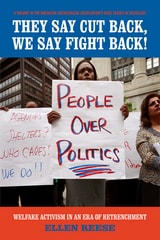
They Say Cutback, We Say Fight Back!
Welfare Activism in an Era of RetrenchmentEllen Reese
Russell Sage Foundation, 2012
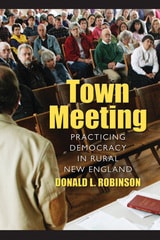
Town Meeting
Practicing Democracy in Rural New EnglandDonald L. Robinson
University of Massachusetts Press, 2011
At Gettysburg, Abraham Lincoln described government by the people as “the great task remaining before us.” Many citizens of modern America, frustrated and disheartened, are tempted to despair of realizing that ideal. Yet, it is a project still alive in parts of New England.
This book traces the origins of town-meeting democracy in Ashfield, a community of just under 2,000 people in the foothills of the Berkshires in western Massachusetts. Donald Robinson begins by recounting several crises at the town's founding in the eighteenth century that helped to shape its character. He shows how the town has changed since then and examines how democratic self-government functions in the modern context.
The picture is not pretty. Self-government carries no guarantees, and Ashfield is no utopia. Human failings are abundantly on display. Leaders mislead. Citizens don't pay attention and they forget hard-earned lessons.
But in this candid account of the operation of democracy in one New England town, Robinson demonstrates that for better and for worse, Ashfield governs itself democratically. Citizens control the actions of their government. Not everyone participates, but all may, and everyone who lives in the town must accept and obey what town meeting decides.
Transforming Rural Water Governance
The Road from Resource Management to Political Activism in NicaraguaSarah T. Romano
University of Arizona Press, 2019
In Transforming Rural Water Governance Sarah T. Romano explains the bottom-up development and political impact of community-based water and sanitation committees (CAPS) in Nicaragua. Romano traces the evolution of CAPS from rural resource management associations into a national political force through grassroots organizing and strategic alliances.
Resource management and service provision is inherently political: charging residents fees for service, determining rules for household water shutoffs and reconnections, and negotiating access to water sources with local property owners constitute just a few of the highly political endeavors resource management associations like CAPS undertake as part of their day-to-day work in their communities. Yet, for decades in Nicaragua, this local work did not reflect political activism. In the mid-2000s CAPS’ collective push for social change propelled them onto a national stage and into new roles as they demanded recognition from the government.
Romano argues that the transformation of Nicaragua’s CAPS into political actors is a promising example of the pursuit of sustainable and equitable water governance, particularly in Latin America. Transforming Rural Water Governance demonstrates that when activism informs public policy processes, the outcome is more inclusive governance and the potential for greater social and environmental justice.

Trouble in the Forest
California’s Redwood Timber WarsRichard Widick
University of Minnesota Press, 2009
Wars over natural resources have been fiercely fought in the Humboldt Bay redwood region of Northern California, a situation made devastatingly urgent in recent decades of timber war that raised questions of economic sustainability and ecological preservation. In Trouble in the Forest, Richard Widick narrates the long and bloody history of this hostility and demonstrates how it exemplifies the key contemporary challenge facing the modern societies-the collision of capitalism, ecology, and social justice.
An innovative blend of social history, cultural theory, and ethnography, Trouble in the Forest traces the origins of the redwood conflict to the same engines of modernity that drove the region's colonial violence against American Indians and its labor struggles during the industrial revolution. Widick describes in vivid detail the infamous fight that ensued when Maxxam Inc. started clearing ancient forests in Humboldt after acquiring the Pacific Lumber Company in 1985, but he also reaches further back and investigates the local Indian clashes and labor troubles that set the conditions of the timber wars. Seizing on public flash points of each confrontation-including the massacre of Wiyot on Indian Island in 1860, the machine-gunning of redwood strikers by police and company thugs during the great lumber strike of 1935, and the car bombing of forest defenders in 1990-Widick maps how the landscape has registered the impact of this epochal struggle, and how the timber wars embody the forces of market capitalism, free speech, and liberal government.
Showing how events such as an Indian massacre and the death of a protester at the hands of a logger create the social memory and culture of timber production and environmental resistance now emblematic of Northern California's redwood region, Trouble in the Forest ultimately argues that the modern social imaginary produced a perpetual conflict over property that fueled the timber wars as it pushed toward the western frontier: first property in land, then in labor, and now in environment.