Results by title
172 books match the query 'Citizenship' and 32 start with t
Talkative Polity
Radio, Domination, and Citizenship in UgandaFlorence Brisset-Foucault
Ohio University Press, 2019
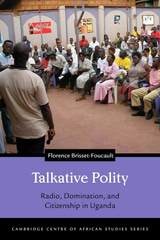
For the first decade of the twenty-first century, every weekend, people throughout Uganda converged to participate in ebimeeza, open debates that invited common citizens to share their political and social views. These debates, also called “People’s Parliaments,” were broadcast live on private radio stations until the government banned them in 2009. In Talkative Polity, Florence Brisset-Foucault offers the first major study of ebimeeza, which complicate our understandings of political speech in restrictive contexts and force us to move away from the simplistic binary of an authoritarian state and a liberal civil society.
Brisset-Foucault conducted fieldwork from 2005 to 2013, primarily in Kampala, interviewing some 150 orators, spectators, politicians, state officials, journalists, and NGO staff. The resulting ethnography invigorates the study of political domination and documents a short-lived but highly original sphere of political expression. Brisset-Foucault thus does justice to the richness and depth of Uganda’s complex political and radio culture as well as to the story of ambitious young people who didn’t want to behave the way the state expected them to. Positioned at the intersection of media studies and political science, Talkative Polity will help us all rethink the way in which public life works.
The Autobiography of Citizenship
Assimilation and Resistance in U.S. EducationCooper, Tova
Rutgers University Press, 0
The Border Crossed Us
Rhetorics of Borders, Citizenship, and Latina/o IdentityJosue David Cisneros
University of Alabama Press, 2013
Explores efforts to restrict and expand notions of US citizenship as they relate specifically to the US-Mexico border and Latina/o identity.
Borders and citizenship go hand in hand. Borders define a nation as a territorial entity and create the parameters for national belonging. But the relationship between borders and citizenship breeds perpetual anxiety over the purported sanctity of the border, the security of a nation, and the integrity of civic identity.
In The Border Crossed Us, Josue David Cisneros addresses these themes as they relate to the US-Mexico border, arguing that issues ranging from the Mexican-American War of 1846–1848 to contemporary debates about Latina/o immigration and border security are negotiated rhetorically through public discourse. He explores these rhetorical battles through case studies of specific Latina/o struggles for civil rights and citizenship, including debates about Mexican American citizenship in the 1849 California Constitutional Convention, 1960s Chicana/o civil rights movements, and modern-day immigrant activism.
Cisneros posits that borders—both geographic and civic—have crossed and recrossed Latina/o communities throughout history (the book’s title derives from the popular activist chant, “We didn’t cross the border; the border crossed us!”) and that Latina/os in the United States have long contributed to, struggled with, and sought to cross or challenge the borders of belonging, including race, culture, language, and gender.
The Border Crossed Us illuminates the enduring significance and evolution of US borders and citizenship, and provides programmatic and theoretical suggestions for the continued study of these critical issues.
The Capacity Contract
Intellectual Disability and the Question of CitizenshipStacy Clifford Simplican
University of Minnesota Press, 2015
In the first sustained examination of disability through the lens of political theory, The Capacity Contract shows how the exclusion of disabled people has shaped democratic politics. Stacy Clifford Simplican demonstrates how disability buttresses systems of domination based on race, sex, and gender. She exposes how democratic theory and politics have long blocked from political citizenship anyone whose cognitive capacity falls below a threshold level⎯marginalization with real-world repercussions on the implementation of disability rights today.
Simplican’s compelling ethnographic analysis of the self-advocacy movement describes the obstacles it faces. From the outside, the movement must confront stiff budget cuts and dwindling memberships; internally, self-advocates must find ways to demand political standing without reinforcing entrenched stigma against people with profound cognitive disabilities. And yet Simplican’s investigation also offers democratic theorists and disability activists a more emancipatory vision of democracy as it relates to disability⎯one that focuses on enabling people to engage in public and spontaneous action to disrupt exclusion and stigma.
Taking seriously democratic promises of equality and inclusion, The Capacity Contract rejects conceptions of political citizenship that privilege cognitive capacity and, instead, centers such citizenship on action that is accessible to all people.
The Child before the Court
Judgment, Citizenship, and the ConstitutionTimothy Barouch
University of Alabama Press, 2021
A study that challenges our notions about citizenship and judgment by considering the place of children in historical and contemporary legal discourse.
Many of the most controversial political issues of our time focus on the actions and well-being of children such as Greta Thunberg’s climate movement; youth activists standing up for racial justice, safe schools, and an equitable economy; and the furor over separating migrant children from their families. When do we treat children as competent citizens, when do we treat them as dependents in need of protection, and why?
The Child before the Court: Judgment, Citizenship, and the Constitution provides answers to these foundational questions. It analyzes landmark US Supreme Court cases involving children’s free speech and due process rights and argues that our ideas about civic and legal judgment are deeply contested concepts instead of simple character traits. These cases serve as analytic touchstones for these problems, and the Court’s opinions seemingly articulate clear rules through a pragmatic balancing of interests.
Timothy Barouch shows how these cases continually reshape constitutional thought, breaking from a vocabulary of wardship and recasting the child as a liberal individual. He analyzes these legal opinions as judicial novelizations and focuses on their rhetorical markers: the range of tropes, idioms, figures, and arguments that emerge across nearly two centuries of jurisprudence in this important but oft-neglected area. The careful and subtle readings of these cases demonstrate how judicial representations of the child provide key resources for thinking about the child as citizen and, more broadly, citizenship itself. It serves as a bold call to think through the relationship between the liberal individual and the problem of civic judgment as it manifests in public culture in a wide array of contexts at a time when liberal democracy is under siege.

The Collected Works of William Howard Taft, Volume I
Four Aspects of Civic Duty and Present Day ProblemsDavid H. Burton
Ohio University Press, 2001
The inaugural volume of The Collected Works of William Howard Taft is composed of two of his earliest books, Four Aspects of Civic Duty and Present Day Problems. Based on a series of lectures delivered at Yale in 1906, Four Aspects of Civic Duty is an attempt by then Secretary of War Taft to bring to the attention of his audience the importance of civic duty from the perspective of the university graduate, the judge on the bench, the colonial administrator, and the national executive branch of government. His remarks were drawn from his own experience, while at the same time he laid down the principles of citizenship with which all people could identify. In Present Day Problems, William Howard Taft demonstrates the depth of his knowledge and the seriousness of his reflections on a wide range of topics including Sino-American relations and the ongoing contest between capital and labor in America’s increasingly industrial socioeconomy. The problems he takes up are met head-on and discussed in a fashion likely to persuade his audience that he is well prepared to tackle the burdens of the presidency.
The Collected Works of William Howard Taft, in eight volumes, will include Taft’s complete published works as well as his presidential and state addresses and selected court opinions from his days as chief justice of the Supreme Court.
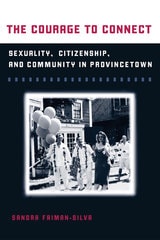
The Courage to Connect
Sexuality, Citizenship, and Community in ProvincetownSandra L. Faiman-Silva
University of Illinois Press, 2003
Based on over six years of fieldwork, Sandra L. Faiman-Silva's The Courage to Connect traces the transformation of the Cape Cod community of Provincetown from its nineteenth-century origins as a fishing town where Portuguese immigrants settled to its present status as a welcoming, sexually diverse tourist enclave. Faiman-Silva examines the community’s history and economy as well as how gay and straight cultures intersect in areas such as public education, local government, and law enforcement. Using queer and critical culture theory to deconstruct day-to-day local encounters, Faiman-Silva describes the causes of social conflicts and how these conflicts can be resolved. Capturing the pathos and joy of a community that has struggled to accommodate radical social changes, The Courage to Connect yields understanding of the ways in which communities can construct themselves to overcome differences.
The Dialectics of Citizenship
Exploring Privilege, Exclusion, and RacializationBernd Reiter
Michigan State University Press, 2013
The Documented Child
Migration, Personhood, and Citizenship in Twenty-First-Century U.S. Latinx Children's LiteratureMaya Socolovsky
University of Arizona Press, 2025
Immigration is at once a personal, immediate, and urgent issue that plays a central role in the United States’ perception of itself. In The Documented Child, scholar Maya Socolovsky demonstrates how the portrayal of Latinx children has shifted over the first two decades of the twenty-first century in literary texts aimed at children and young adults and looks at how these shifts map onto broader changes in immigration policy and discourse.
Through a critical inquiry into picture books and middle-grade and young adult literature, Socolovsky argues that the literary documentations of—and for—U.S. Latinx children have shifted over the decades, from an emphasis on hybrid transnationalism to that of a more American-oriented self. Socolovsky delves into texts written from 1997 to 2020, a period marked by tremendous changes in U.S. immigration policies, amplified discourses around nationhood, and an increasingly militarized border. The author shows how children’s and young adult books have shifted their depictions of the border, personal and national identity, and sovereignty.
For students, scholars, and educators of Latinx studies and children’s literature, this work shows how the creators of children’s literature reflect new strategies for representing the undocumented Latinx child protagonist. While earlier books document the child as a transnational (sometimes global) subject, later books document her as both a transnational and U.S. national subject. The Documented Child explores this change as a necessary survival strategy, reflecting current awareness that cultural hybridity and transnational identity are not sufficient stand-ins for the stability and security of legal personhood.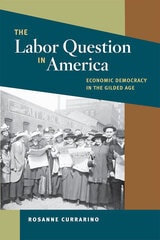
The Labor Question in America
Economic Democracy in the Gilded AgeRoseanne Currarino
University of Illinois Press, 2011
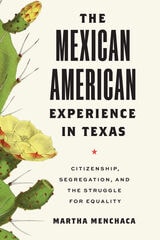
The Mexican American Experience in Texas
Citizenship, Segregation, and the Struggle for EqualityBy Martha Menchaca
University of Texas Press, 2022
A historical overview of Mexican Americans' social and economic experiences in Texas
For hundreds of years, Mexican Americans in Texas have fought against political oppression and exclusion—in courtrooms, in schools, at the ballot box, and beyond. Through a detailed exploration of this long battle for equality, this book illuminates critical moments of both struggle and triumph in the Mexican American experience.
Martha Menchaca begins with the Spanish settlement of Texas, exploring how Mexican Americans’ racial heritage limited their incorporation into society after the territory’s annexation. She then illustrates their political struggles in the nineteenth century as they tried to assert their legal rights of citizenship and retain possession of their land, and goes on to explore their fight, in the twentieth century, against educational segregation, jury exclusion, and housing covenants. It was only in 1967, she shows, that the collective pressure placed on the state government by Mexican American and African American activists led to the beginning of desegregation. Menchaca concludes with a look at the crucial roles that Mexican Americans have played in national politics, education, philanthropy, and culture, while acknowledging the important work remaining to be done in the struggle for equality.
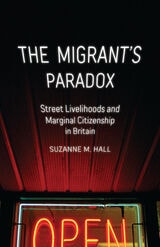
The Migrant's Paradox
Street Livelihoods and Marginal Citizenship in BritainSuzanne M. Hall
University of Minnesota Press, 2021
Connects global migration with urban marginalization, exploring how “race” maps onto place across the globe, state, and street
In this richly observed account of migrant shopkeepers in five cities in the United Kingdom, Suzanne Hall examines the brutal contradictions of sovereignty and capitalism in the formation of street livelihoods in the urban margins. Hall locates The Migrant’s Paradox on streets in the far-flung parts of de-industrialized peripheries, where jobs are hard to come by and the impacts of historic state underinvestment are deeply felt.
Drawing on hundreds of in-person interviews on streets in Birmingham, Bristol, Leicester, London, and Manchester, Hall brings together histories of colonization with current forms of coloniality. Her six-year project spans the combined impacts of the 2008 financial crisis, austerity governance, punitive immigration laws and the Brexit Referendum, and processes of state-sanctioned regeneration. She incorporates the spaces of shops, conference halls, and planning offices to capture how official border talk overlaps with everyday formations of work and belonging on the street.
Original and ambitious, Hall’s work complicates understandings of migrants, demonstrating how migrant journeys and claims to space illuminate the relations between global displacement and urban emplacement. In articulating “a citizenship of the edge” as an adaptive and audacious mode of belonging, she shows how sovereignty and inequality are maintained and refuted.
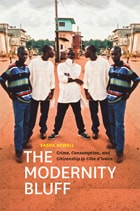
The Modernity Bluff
Crime, Consumption, and Citizenship in Côte d’IvoireSasha Newell
University of Chicago Press, 2012
In Côte d’Ivoire, appearing modern is so important for success that many young men deplete their already meager resources to project an illusion of wealth in a fantastic display of Western imitation, spending far more than they can afford on brand name clothing, accessories, technology, and a robust nightlife. Such imitation, however, is not primarily meant to deceive—rather, as Sasha Newell argues in The Modernity Bluff, it is an explicit performance so valued in Côte d’Ivoire it has become a matter of national pride.
Called bluffeurs, these young urban men operate in a system of cultural economy where reputation is essential for financial success. That reputation is measured by familiarity with and access to the fashionable and expensive, which leads to a paradoxical state of affairs in which the wasting of wealth is essential to its accumulation. Using the consumption of Western goods to express their cultural mastery over Western taste, Newell argues, bluffeurs engage a global hierarchy that is profoundly modern, one that values performance over authenticity—highlighting the counterfeit nature of modernity itself.
The Moral Neoliberal
Welfare and Citizenship in ItalyAndrea Muehlebach
University of Chicago Press, 2012

The Parent as Citizen
A Democratic DilemmaBrian Duff
University of Minnesota Press, 2010
Duff explains how influential theories of democratic citizenship rely on the metaphor of parenthood to help individuals rise to the challenges of politics, and demonstrates that this reliance has unintended consequences. When parenthood is imagined to instill confidence in political virtue, it uncovers insecurity. When parenthood is believed to inculcate openness to change, it produces fundamentalism. Duff develops this argument through original readings of four theorists of citizenship: Jean-Jacques Rousseau, Friedrich Nietzsche, Richard Rorty, and Cornel West-readings that engage the ways in which these theorists incorporated their personal history into their political thought. In showing how problems that plagued canonical theorists of citizenship still trouble contemporary thinkers and citizens alike, Duff's insights are deeply relevant to present-day politics.
The Perils of Belonging
Autochthony, Citizenship, and Exclusion in Africa and EuropePeter Geschiere
University of Chicago Press, 2009
Despite being told that we now live in a cosmopolitan world, more and more people have begun to assert their identities in ways that are deeply rooted in the local. These claims of autochthony—meaning “born from the soil”—seek to establish an irrefutable, primordial right to belong and are often employed in politically charged attempts to exclude outsiders. In The Perils of Belonging, Peter Geschiere traces the concept of autochthony back to the classical period and incisively explores the idea in two very different contexts: Cameroon and the Netherlands.
In both countries, the momentous economic and political changes following the end of the cold war fostered anxiety over migration. For Cameroonians, the question of who belongs where rises to the fore in political struggles between different tribes, while the Dutch invoke autochthony in fierce debates over the integration of immigrants. This fascinating comparative perspective allows Geschiere to examine the emotional appeal of autochthony—as well as its dubious historical basis—and to shed light on a range of important issues, such as multiculturalism, national citizenship, and migration.
The Phratries of Attica
S. D. Lambert
University of Michigan Press, 1998
The Politics of Informality
Housing and Planning in Mexico CityEmilio de Antuñano
University of Texas Press, 2026
An examination of the central role and political power of informal neighborhoods in Mexico City.
At the beginning of the twentieth century, Mexico City was tightly bounded, with a population of about half a million people. By the end of that century, it was an unfathomable megalopolis of some 20 million. It had also become exhibit A in an “urban crisis” decried by demographers, NGOs, and the Mexican government. Mexico City’s greatest sin was its shantytowns—informal neighborhoods built in defiance of regulations and viewed as incurably disordered.
The Politics of Informality is an illuminating political and intellectual history, examining how these neighborhoods have figured in Mexican life and in the ideologies underlying urban planning. Prior to the Mexican Revolution of 1910, urban experts saw Mexico City as a tidy modern capital in-waiting. But during the interwar period, informal neighborhoods boomed, as working-class families asserted claims to housing under the revolution’s framework of citizenship and social justice. Then, amid Cold War realignments, a new cohort of urban experts pathologized Mexico City, turning it into a transnational laboratory for the study of poverty, migration, and overpopulation. Tracing a fascinating evolution, ThePolitics of Informality underscores the stubborn opposition between technocratic modernism and revolutionary, extralegal politics.
The Promise of Youth Anti-Citizenship
Race and Revolt in EducationKevin L. Clay
University of Minnesota Press, 2024
When inclusion into the fold of citizenship is conditioned by a social group’s conceit to ritual violence, humiliation, and exploitation, what can anti-citizenship offer us?
The Promise of Youth Anti-citizenship argues that Black youth and youth of color have been cast as anti-citizens, disenfranchised from the social, political, and economic mainstream of American life. Instead of asking youth to conform to a larger societal structure undergirded by racial capitalism and antiblackness, the volume’s contributors propose that the collective practice of anti-citizenship opens up a liberatory space for youth to challenge the social order.
The chapters cover an array of topics, including Black youth in the charter school experiment in post-Katrina New Orleans; racial capitalism, the queering of ethnicity, and the 1980s Salvadoran migration to South Central Los Angeles; the notion of decolonizing classrooms through Palestinian liberation narratives; and more. Through a range of methodological approaches and conceptual interventions, this collection illuminates how youth negotiate and exercise anti-citizenship as forms of either resistance or refusal in response to coercive patriotism, cultural imperialism, and predatory capitalism.
Contributors: Karlyn Adams-Wiggins, Portland State U; Ariana Brazier; Julio Cammarota, U of Arizona; Michael Davis, U of Wisconsin–Madison; Damaris C. Dunn, U of Georgia; Diana Gamez, U of California, Irvine; Rachel F. Gómez, Virginia Commonwealth U; Luma Hasan; Gabriel Rodriguez, Iowa State U; Christopher R. Rogers, U of Pennsylvania; Damien M. Sojoyner, U of California, Irvine.
The Queen of America Goes to Washington City
Essays on Sex and CitizenshipLauren Berlant
Duke University Press, 1997
As Berlant traces the guiding images of U.S. citizenship through the process of privatization, she discusses the ideas of intimacy that have come to define national culture. From the fantasy of the American dream to the lessons of Forrest Gump, Lisa Simpson to Queer Nation, the reactionary culture of imperilled privilege to the testimony of Anita Hill, Berlant charts the landscape of American politics and culture. She examines the consequences of a shrinking and privatized concept of citizenship on increasing class, racial, sexual, and gender animosity and explores the contradictions of a conservative politics that maintains the sacredness of privacy, the virtue of the free market, and the immorality of state overregulation—except when it comes to issues of intimacy.
Drawing on literature, the law, and popular media, The Queen of America Goes to Washington City is a stunning and major statement about the nation and its citizens in an age of mass mediation. As it opens a critical space for new theory of agency, its narratives and gallery of images will challenge readers to rethink what it means to be American and to seek salvation in its promise.
The Republic Afloat
Law, Honor, and Citizenship in Maritime AmericaMatthew Taylor Raffety
University of Chicago Press, 2013
The Road to Citizenship
What Naturalization Means for Immigrants and the United StatesAptekar, Sofya
Rutgers University Press, 2015
The Scandal of the State
Women, Law, and Citizenship in Postcolonial IndiaRajeswari Sunder Rajan
Duke University Press, 2003
The Scandal of the State develops through a series of compelling case studies, each of which centers around an incident exposing the contradictory position of the Indian state vis-à-vis its female citizens and, ultimately, the inadequacy of its commitment to women’s rights. Sunder Rajan focuses on the custody battle over a Muslim child bride, the compulsory sterilization of mentally retarded women in state institutional care, female infanticide in Tamilnadu, prostitution as labor rather than crime, and the surrender of the female outlaw Phoolan Devi. She also looks at the ways the Uniform Civil Code presented many women with a stark choice between allegiance to their religion and community or the secular assertion of individual rights. Rich with theoretical acumen and activist passion, The Scandal of the State is a powerful critique of the mutual dependence of women and the state on one another in the specific context of a postcolonial modernity.
The Spirit of the Laws in Mozambique
Juan Obarrio
University of Chicago Press, 2014
Having made the transition from a people’s republic to democratic rule in the 1990s, Mozambique offers a fascinating case of postwar reconstruction, economic opening, and transitional justice, one in which the customary has played a central role. Obarrio shows how its sovereignty has met countless ambiguities within the entanglements of local community, nation-state, and international structures. The postcolonial nation-state emerges as a maze of entangled jurisdictions. Ultimately, he looks toward local rituals and relations as producing an emergent kind of citizenship in Africa, which he dubs “customary citizenship,” forming not a vestige of the past but a yet ill-defined political future.
The Three Ages of Government
From the Person, to the Group, to the WorldJos C.N. Raadschelders
University of Michigan Press, 2020
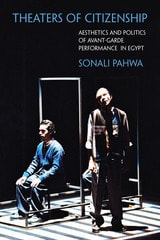
Theaters of Citizenship
Aesthetics and Politics of Avant-Garde Performance in EgyptSonali Pahwa
Northwestern University Press, 2020
In 2004, independent cultural institutions were sites for more democratic forms of youth organization and cultural participation than were Egyptian state theaters. Sonali Pahwa looks at identity formation within this infrastructure for new cultural production: festivals, independent troupes, workshops, and manifesto movements. Bringing institutional changes in dialogue with new performance styles on stages and streets, Pahwa conceptualizes performance culture as a school of citizenship. Independent theater incubated hope in times of despair and pointed to different futures for the nation’s youth than those seen in television and newspapers. Young dramatists countered their generation’s marginalization in the neoliberal economy, media, and political institutions as they performed alternative visions for the nation. An important contribution to the fields of anthropology and performance studies, Pahwa’s analysis will also interest students of sociology and Egyptian history.
Theatre Symposium, Vol. 28
Theatre and CitizenshipEdited by Andrew Gibb
University of Alabama Press, 2020
A collection of essays whose authors reach beyond simple definitions of citizenship as determined by documents and legal rights
The scholarly conference from which this publication emerged was circulated in the waning months of 2018, following a summer of urgent and emotional debate surrounding new US immigration policies regarding immigrant family separations, arguments fueled on one side by fears about the loss of social cohesion, and on the other by photographs of incarcerated children. Given the then-prevailing political atmosphere, editor Andrew Gibb anticipated that a good number of submissions might draw connections between the patterns, policies, and histories of immigration on the one hand, and theatrical or otherwise performance-centered expressions of citizenship, whether inclusive or exclusionary, on the other. In retrospect, what could have been foreseen is that theatre scholars, educators, and professionals would interpret recent events against a wider and more complex backdrop. The ultimate result of that initial call is this volume, a collection of essays whose authors reach beyond simple definitions of citizenship as determined by documents and legal rights, and who engage in larger conversations about what citizenship can mean, and how such meanings are expressed through theatre and performance.
Interestingly, while none of the authors published herein take up immigration as a central issue, they all make use of some combination of three particular analytical frameworks, all of which happen to be pertinent to the current immigrant experience and attempts to regulate it: bodies, institutions, and technologies.

Them and Us
Questions of Citizenship in a Globalizing WorldRob Kroes
University of Illinois Press, 2000
An accomplished set of meditations by one of Europe's leading Americanists, Them and Us is a rich comparative study of European and American cultural traditions and their influence on conceptions of community. In contrast with the ethnic and nationalist allegiances that historically have splintered Europe, Rob Kroes identifies a complex of cultural practices that have mitigated against ethnically rooted divisions in the United States. He argues that the American approach–-articulated by a national rhetoric emphasizing openness rather than closure, diversity rather than uniformity--has much to offer a Europe where the nationalist and ethnic conflicts that spawned two world wars continue to sow terror and destruction.
Kroes discusses European and American attitudes toward the welfare state, the human rights tradition in the United States, and the role of regionalism in shaping conceptions of national identity. He also considers new, transnational forms of cultural membership that are emerging to take the place of nation-based citizenship. He contends that the frame of reference Europeans now use to make sense of their collective situation draws on ingredients provided by the worldwide dissemination of American mass culture. He investigates the way this emerging world culture, under American auspices, affects the way people in their local and national settings structure their sense of the past and conceive of their citizenship.
Imagining a new set of cultural relationships that could serve as the basis for global citizenship, Them and Us is an insightful consideration of the types of solidarity that might weave humankind together into a meaningful community.
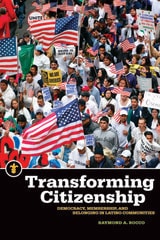
Transforming Citizenship
Democracy, Membership, and Belonging in Latino CommunitiesRaymond A. Rocco
Michigan State University Press, 2014

Transit States
Labour, Migration and Citizenship in the GulfOmar AlShehabi
Pluto Press, 2014
The cheap and transitory labour power these workers provide has created the prodigious and extraordinary development boom across the region, and neighbouring countries are almost fully dependent on the labour markets of the Gulf to employ their working populations. For these reasons, the Gulf takes a central place in contemporary debates around migration and labour in the global economy.
This book attempts to bring together and explore these issues. The relationship between ‘citizen’ and ‘non-citizen’ holds immense significance for understanding the construction of class, gender, city and state in the Gulf, however too often these questions are occluded in too scholarly or overly-popular accounts of the region. Bringing together experts on the Gulf, Transit States confronts the precarious working conditions of migrants in a accessible, yet in-depth manner.
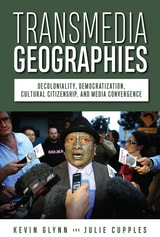
Transmedia Geographies
Decoloniality, Democratization, Cultural Citizenship, and Media ConvergenceKevin Glynn
Rutgers University Press, 2025
The authors explore the cultural politics that have developed within this new media environment by moving across the mediated landscapes of the first, third, and fourth (Indigenous people’s) worlds, which are deeply intertwined and interconnected under contemporary conditions of neoliberal globalization and emergent regimes of authoritarian postdemocracy. The book attends both to the platforms and digital networks of the new media environment and to the cultural forms and practices that have constituted television as the dominant medium of communication throughout the second half of the twentieth century. In the new media environment, transmediation works on behalf not only of those corporate megaconglomerates that have become all too familiar to media consumers around the world but also of many communities that have previously been excluded from access to the means of electronic textual production and circulation. For the latter, grassroots transmediation has become an important technique for the production of cultural citizenship.
Transnational Marriage and Partner Migration
Constellations of Security, Citizenship, and RightsAnne-Marie D'Aoust
Rutgers University Press, 2022